S. Werner (ed.),Proceedings of the 15th NODALIDA conference, Joensuu 2005, Ling@JoY 1, 2006, pp. 156–162
Anders Nøklestad
Dept. of Linguistics
Univ. of Oslo
P.O. Box 1102 Blindern
NO-0317 Oslo
Norway
Christer Johansson
Dept. of Linguistics
Univ. of Bergen
Sydnesplassen 7
NO-5007 Bergen
Norway
Abstract
This article describes a memory-based mechanism for anaphora resolution
and coreference. A program labels
the words in the text with
part-of-speech tags, functional roles, and
lemma forms. This information is
used for generating a representa-tion of each anaphor and antecedent
candidate. Each potential
anaphor-antecedent pair has a match vector calculated, which is used to select sim-ilar cases from a database of labeled cases. We are currently testing many feature combinations to find an
opti-mal set for the task. The most
re-cent results show an overall F-measure (combined precision and recall) of 62, with an F-measure of 40 for those cases where anaphor and antecedent are non-identical, and 81 for identical ones. The coreference chains are re-stricted so that an anaphor is only al-lowed to link to the last item in a chain.
1
Introduction
This article discusses a method for deciding whether an anaphor is coreferential with a po-tential antecedent. An early algorithm (Hobbs, 1978) performs searches for antecedents in
parsed syntactic trees. Preferences in the
model are present in the order of the tree
search. Another approach is to model the
salience of possible antecedents (Lappin and
Leass, 1994). Salience factors are weighted
somewhat ad hoc, but with a rank-order in-spired by observed ratings of salience in psycho-linguistic experiments. A third influen-tial theory is Centering Theory (Grosz et al.,
1995). Centering too, assumes a salience rat-ing, but has an added constraint that there is a single item which is in focus at any given time and therefore most likely to be pronomi-nalized. None of these models can be regarded as robust models, as they rely on fixed methods, which are not changed by experience. Hobbs’ method relies heavily on parsing, and depends on having the correct parse trees available. Lappin and Leass’ approach relies on a saliency rating, as well as parsing and finding functional roles. Their algorithm also has a heuristics that takes distance into account. Centering depends on maintaining forward and backward looking centers, and selecting the most likely candidate to be in focus.
Recently, anaphora resolution has been per-formed by machine learning techniques, using resources that are less demanding. For exam-ple, Lappin and Leass’ algorithm has been mod-ified so that it can operate on the result of a statistical part-of-speech tagger (Kennedy and Boguraev, 1996). Cardie and Wagstaff (1999) introduced an unsupervised clustering tech-nique that performs better than many hand-crafted systems on the related task of noun
phrase coreference. Because the algorithm
produced a measure of65, according to Cardie and Wagstaff (1999, p.82).
This article will discuss the use of memory-based learning (using the Tilburg Memory Based Learner application, known as TiMBL) in anaphora resolution. Exemplar based mod-els have been tried before, as noted above in the works on clustering (Cardie and Wagstaff, 1999), and decision tree learning (Soon et al., 2001). TiMBL internally uses decision tree techniques to make faster nearest neighbor de-cisions. The main advantage of, and theoreti-cal point of, memory-based learning is that all information is regarded as useful. All exam-ples may contribute to a correct classification, even rare examples, exceptions and sometimes even examples of misclassifications (Bosch and Daelemans, 1998). A further motivation is to let the exemplars decide the classification as far as possible, and not the prejudices of a biased lin-guist, who enters the task with (too) much back-ground knowledge about how the phenomenon should work, and (too) little coverage of all the cases that are exceptions, restricted to the sit-uation, or limited by performance demands for efficient communication. We still claim that a linguistic analysis is necessary, as we have no other means of judging which factors might contribute to the solution. The decision is how-ever let to the examples, when it comes to judg-ing how the factors we have pre-selected inter-act towards a classification decision. We should also acknowledge that there are certainly many relevant factors that have not been selected for representation, either because they did not contribute to the solution with the current set of features, or because we have not thought of them.
In what follows, we will first explain the memory-based machine learning approach, and then we will describe our database and the fea-tures we have used in order to train our classi-fier on the task of anaphora resolution. Finally, we report on the results of running 10-fold cross-validation experiments, which are done as a test of classification ability of this method. In 10-fold cross-validation, a tenth of the train-ing data is left out and classified by the rest of the instances. This is repeated until all items have been classified this way. This validation is different from using entirely new test data, since it is guaranteed to be within the types of texts we have selected for training. (In our
web demonstrator1, we have chosen a test text based on a children’s story, which is definitely in a different genre than the training exam-ples.)
2
Memory-based learning
We decided to work with memory-based learn-ing, as implemented in the TiMBL software package (Daelemans et al., 2004). This decision was inspired by anaphora resolution results from decision tree learning (Soon et al., 2001), which is a type of exemplar based machine learning mechanism. We have chosen a slightly different approach, using a nearest neighbor mechanism, within the field of memory-based learning. TiMBL is an efficient implementation of this algorithm, and recent results using this software package has shown good results, often better than decision tree learning, for exam-ple on chunking (Tjong Kim Sang and Buchholz, 2000). Decision tree learning does not use all the examples. It is what is sometimes classified as a greedy learner (i.e. trying to make general-izations as soon as possible), whereas TiMBL is a lazy learner (i.e. postponing the classification decision until it is needed).
Memory-based learning is a kind of k-nearest neighbor approach, which operates on exem-plars, or instances, in the form of feature vectors. It is a supervised machine learning method that requires an annotated training cor-pus. During the training phase, training in-stances are stored in a database, or instance base, along with their annotated categories.
Classifying a new instance amounts to com-paring it to the instances in the instance base, finding the ones that are most similar to the new instance (i.e., its nearest neighbors), and selecting the category that is shared by the ma-jority of those neighbors. The notion of simi-larity is taken in a geometrical sense, as exam-ples are represented as points, with an associ-ated category, in an n-dimensional space. The degree of similarity between instances is influ-enced by the choice of similarity metric and fea-ture weighting scheme. The size of the neigh-borhood is also influenced by the value of k used for the k -nearest neighbor classifier. If k=1, only the most similar instances are used, with k=2, the next best matches are also in-cluded, and so on.
1
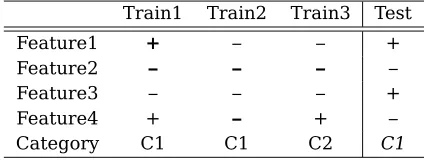
The classification process is illustrated in general terms in table 1, which shows three training instances and a test instance. The fea-tures can take the values plus or minus. The reader is encouraged to look for feature values that are the same for the test instance and the training instance.
The test instance matches Train1 on Fea-ture1 and Feature2, and it matches Train2 on Feature2 and Feature4, while Train3 only matches on Feature2. Thus, Train1 and Train2 constitute the set of nearest neighbors for Test. Since the majority (in this case all) of the near-est neighbors share the C1 category, this cate-gory is also selected for the Test instance.
Train1 Train2 Train3 Test
Feature1 + – – +
Feature2 – – – –
Feature3 – – – +
Feature4 + – + –
[image:3.595.75.288.278.359.2]Category C1 C1 C2 C1
Table 1: Classification based on nearest neigh-bors.
3
Anaphora resolution
We use a corpus which has been automatically annotated for part-of-speech tags and syntac-tic categories, and hand annotated for corefer-ence. The algorithm was trained on a subset of 41970 tokens, of which 35780 were words and the rest typographical annotations. From these 35780 words, we have 11831 markables (potential members of reference chains).
In order to experiment with a more limited material, we selected a set of pronouns which had all been marked either with or without an antecedent. Pronouns without antecedents re-fer to something not present in the (preceding) text. The chosen pronouns werehan “he”, hun, “she”, seg “himself/herself/itself/themselves”, den “it” masc./fem., and de “they”. The set of pronouns consisted of 2199 anaphor candi-dates, of which 2129 were marked with a coref-erential antecedent in the text. Cataphors were excluded from the training set.
3.1 Salience
The classification of an anaphor–antecedent pair is affected by a number of features, such as whether they agree in number, person, case
and gender. All these features create subdivi-sions of the representational space. Since the model is not probabilistic, it is not correct to associate probabilities to this selection. The method selects from the nearest neighbors, re-gardless of their likelihood of occurrence, or likelihood of predicting the correct class. Ad-ditional constraints may stem from syntactic restrictions (for example, whether a reflexive interpretation is possible), and selectional re-strictions (e.g., which are the typical objects of specific verbs). Real knowledge of what is pos-sible, may help. Recency, repeated mention and parallelism are other important factors in de-ciding coreference (Jurafsky and Martin, 2000, pp.678–684).
The factors we use are taken from a machine annotated corpus, so not all of these factors necessarily have correct values.
The factors are as follows (see also table 3):
• Do the lemmas of the anaphor candidate and the antecedent candidate match?
• Do the anaphor candidate and the an-tecedent candidate have the same
– syntactic function?
– grammatical gender? (We also want to add natural gender in the future.)
– number?
• Is the anaphor candidate a distinctly hu-man pronoun (han “he” or hun “she”) and the antecedent candidate a proper name?
– If so, do they have the same (natural) gender?
• Is the anaphor candidate a reflexive and the antecedent candidate its closest sub-ject?
• Is the antecedent candidate a subject?
• Is the number of sentence boundaries, as detected by the tagger (e.g. some conjunc-tions, and punctuation), between anaphor and antecedent candidates
– less than 2?
– less than 3?
Note that we have no information about nat-ural gender for lexical noun phrases, which is information we would want to have, in addition to grammatical gender. Various ways of finding the natural gender (Hale and Charniak, 1998, inter al., for English) will be tried out later in our project.
Since we are using memory-based learning for this task, the full impact of each feature is determined after the nearest neighbors have been found. A feature that is highly valuable in some contexts may simply not add anything in other contexts, for example if all the selected nearest neighbors contain the same feature. This is an advantage of memory-based learning, since it does not rely heavily on global statis-tics. TiMBL may also weigh features by their informativeness, by calculating the information gain of each feature (i.e. how much we gain in classification accuracy by knowing the value of the feature). Still, TiMBL is essentially a selec-tion mechanism and not a probabilistic mecha-nism.
3.2 Percolation
A strategy to percolate most of the matching features to the next referring expression in a chain was adapted. This means that the most recent antecedent candidate matches the union of its own matching features and those of the preceding antecedent candidates of the same chain. Sometimes information is not available immediately, but will be known after we have established coreference (see table 2) .
3 3.1 3.2
Calvin → who → he
— Calvin —
[image:4.595.331.497.240.406.2]— .... —
Table 2: Percolation ofCalvin to who
Take for example the following discourse, adapted and translated from a folk tale:"[Three brothers lived in a forest.] The oldest was called Adam1, the second Bert2, and the
youngest Calvin3, who3.1 used to tend to the
ashes4. The Sunday5 when the notice6 from
the King7 about the ship8 was posted, he3 .2
happened to be there. When he3.3 came home
and told about it6.1, Adam1.1 wanted to set out
immediately, and prepared some f ood9 for the
journey10. Forhe?wanted to find out ..."
The second time that he refers to Calvin at point 3.2, the information from the first men-tion of Calvin at point3has been percolated to thewho at3.1. After linking up, the information in3.2 contains the (lemma)/name "Calvin", the functional roles of position 3 (predicate filler), 3.1 (subject), and 3.2 (subject), as well as the number (singular), and the gender (masculine). If we presume that the name Calvin was not found in the lexical resources, then the gender of Calvin may be established by a co-occurrence relation.
feature 3 3.1 3∪3.1
match on
lemma – – –
syn.func. – + +
gender – – –
number + + +
human pro.
and prop. + – + and gen – – – refl+subject – – – subject-ant – + +
dist. <2 + + +
dist. <3 + + +
Table 3: Match between he at 3.2. and an-tecedentsCalvin(3), orwho (3.1), or3∪3.1) with percolation
[image:4.595.98.269.525.578.2]for the concatenated lemmas he/Calvin, and
he/who respectively. These items are not
per-colated, but contain the value of the candidate antecedent and the anaphor.
Table 4 shows the match vectors, after per-colation, forhe?matching with eitherAdam or
Calvin. As can be seen, Calvin matches on more features than Adam. Still, Adam might be se-lected as antecedent because it is closer to the anaphor. This is due to the fact that the search for an antecedent moves backwards in the text, starting at the anaphor and stopping as soon as there is a positive classification. Hence, if the match vector for Adam has more positive than negative nearest neighbors in the instance base,Adam will be selected as antecedent, and Calvin will never be considered.
feature 1.1 3.3
match on
lemma – +
syn.func. + +
gender – +
number + +
human pro.
and prop. + + and gen – – refl+subject – – subject-ant + +
dist. <2 – –
[image:5.595.109.254.318.484.2]dist. <3 + –
Table 4: Match vectors for he?, withAdam1.1,
andhe3.3/Calvin
Two important points are illustrated. First, that a closer antecedent will have an advan-tage, because it will be selected before its com-petitors if TiMBL decides for it, since the search for an antecedent is stopped when there is a positive classification. Second, that the final categorization does not depend on how many matches are recorded, but on how the full vec-tor and its neighbors have been classified pre-viously. A last point is that proper names are assumed to be in the singular; however, for some types of proper names (e.g. organiza-tions) the number featuremay have a differ-ent default than singular, or may come from a knowledge base. This is crucially an issue of what our lexical resources will deliver.
3.3 Future extensions
All the features we are using are language in-dependent, and can be found with commonly available tools for part-of-speech tagging and functional role assignment. We will therefore be able to extend our work fairly easily to han-dle other similar languages, where appropriate taggers are available, such as Dutch, English and Swedish. Databases of correctly annotated examples will have to be built up incremen-tally, but it might help to have a system that can suggest correct anaphor–antecedent rela-tions in a majority of the cases automatically. This procedure is enhanced if a tool is provided that makes it easy to correct mistakes made by the automatic procedure. We have work in progress that will provide such a tool on the internet. If people use it we will also benefit from their work, since we will have access to the annotated data after editing, and because we will get useful feedback on the mechanism. A very interesting research question is whether it is possible to use a common database for many different languages. Will the examples from different languages support or interfere with each other? Factors such as matching functional roles, parallelism, semantic similar-ity and function, may very well vary in a similar way across many (related) languages. We are further helped by the fact that only factors that are important in thetarget language (the lan-guage of the text to be processed) will be im-portant. For example, if a language does not have grammatical gender it can not discrimi-nate on that feature for any of the languages in the database, it will be as if the feature did not exist. When it comes to functional roles, they are designed to be annotated similarly across languages.
4
Training and testing
Selection Proportion Recall Precision F-measure
Identical anaphor-antecedent 67% 83.95 78.88 81.31 Non-identical anaphor-antecedent 33% 40.75 40.32 40.51
[image:6.595.98.490.73.134.2]All cases 100% 62.12 62.18 62.14
Table 5: Results from 10-fold cross-validation experiments.
Feature percolation allows previously found antecedents of a chain to influence the decision on anaphoric status. Features percolate and ac-cumulate towards the most recent member of a chain.
Training consists of providing postive and negative examples to the memory-based learner. Positive examples are pairs of anaphor and antecedent candidates, described by how they match on the features we have decided to include. Negative examples are pairs consisting of an anaphor and any markable that is closer to the anaphor than the actual antecedent. Typically, there are many more negative examples than positive examples.
In testing, we start searching from the pro-noun (or potential anaphor, in the more general case of coreference detection) backwards in the text until the algorithm finds a markable that is classified as an antecedent for the pronoun. The classification decision is binary, so we as-sign the first found candidate marked by the mechanism as an antecedent. We have exper-imented with using the strength of the classifi-cation decision (recalculated into z-scores, for general comparison), but this did not improve the results and was abandoned.
The classification decision is therefore sim-plistic: The memory-based learner is consulted for each markable that is encountered. If the positive nearest neighbor examples in the database outvote the negative examples, the classification is a yes, otherwise a no. When the mechanism says yes, there is no need to search further.
The results of our cross-validation experi-ments are shown in Table 5. The overall F-measure is 62.14. It should be noted, however, that the system performs much better in those cases where the anaphor and the antecedent are identical than in cases where they are not identical. Closely related to this observation is the fact that in 78% of the test cases, the classi-fier selects an antecedent that is identical to the anaphor. This strong tendency to select
identi-cal pairs is likely due to the fact that 67% of all manually annotated anaphor–antecedent pairs in the training data fit this characteristic. This is particularly noticeable forhan “he” and hun “she”, which also account for 78% of the rele-vant pronouns. The problem with this pattern is that we often miss many of the more inter-esting pairs, where there is a non-pronoun as antecedent. We simply do not have enough re-call to find these more interesting cases. The examples favor a negative classification, sim-ply because this is correct most of the time. A simple bias towards positive answers will hurt our precision, but this could be worth it if we could quantify how much more such a pair is worth. This is a highly task dependent decision. In many tasks, chains containing only pronouns would not make much difference, whereas a correct chain that links with keywords would be highly valuable (for example in estimating the topic of a paragraph).
We performed our 10-fold cross-validation ex-periments on a corpus of novels, which is a complex type of text with typically elaborate and long reference chains. Newspaper texts, in contrast, select for shorter, coherent para-graphs since space is a more limited resource in this domain.
5
Conclusion
We have presented a system for automatic res-olution of pronominal anaphora in Norwegian that is based on memory-based learning. The system reaches a performance level, which is comparable to that of earlier systems devel-oped for English in the context of the Message Understanding Conferences.
We plan to apply our system to related lan-guages, in order to see how language indepen-dent our selected features are. We would like to investigate whether patterns learned from the Norwegian data could actually be applied directly in order to perform anaphora resolu-tion in these other languages without having to re-train the system for each language.
Acknowledgements The BREDT project is
supported by a grant from the Norwegian Re-search Council under the KUNSTI programme. The first author is supported by a Ph.D. grant from the University of Oslo. We thank Dr Kaja Borthen for many valuable comments. A demonstrator of early results for anaphora res-olution is available from http://bredt.uib.no
References
A. van den Bosch and W. Daelemans. 1998. Do not forget: Full memory in memory-based learning of word pronunciation. In D.M.W. Powers, editor, proceedings of NeM-Lap3/CoNLL98, pages 195–204, Sydney, Aus-tralia.
C. Cardie and K. Wagstaff. 1999. Noun phrase coreference as clustering. In Proc. of the joint SIGDAT Conf. on Empirical Methods in NLP and Very Large Corpora, pages 82–89.
W. Daelemans, J. Zavrel, K. van der Sloot, and A. van der Bosch. 2004. TiMBL: Tilburg Memory-Based Learner, Version 5.1, Refer-ence Guide. Technical Report ILK 04–02, the ILK Group, Tilburg, the Netherlands.
B.J. Grosz, A. Joshi, and S. Weinstein. 1995. Centering: A framework for modeling the lo-cal coherence of discourse. Computational Linguistics, 21(2):203–225.
J. Hale and E. Charniak. 1998. Getting Useful Gender Statistics from English Text. Tech-nical Report CS-98-06, Comp. Sci. Dept. at Brown University, Providence, Rhode Island.
J.R. Hobbs. 1978. Resolving pronoun refer-ences. Lingua, 44:311–338.
D. Jurafsky and J.H. Martin. 2000. Speech and Language Processing. Prentice Hall, New Jersey.
C. Kennedy and B. Boguraev. 1996. Anaphora for everyone: Pronominal anaphora resolu-tion without a parser. InProceedings of the 16th International Conference on Computa-tional Linguistics., Copenhagen, Denmark.
S. Lappin and H. J. Leass. 1994. An algorithm for pronominal anaphora resolution. Compu-tational Linguistics, 20(4):535–561.
Wee Meng Soon, Hwee Tou Ng, and D. Chung Yong Lim. 2001. A machine learning approach to coreference resolution of noun phrases. Computational Linguistics, 27(4):521–544.