Discriminative word alignment by learning the alignment structure
and syntactic divergence between a language pair
Sriram Venkatapathy1
Language Technologies Research Centre, IIIT -Hyderabad Hyderabad - 500019, India.
Aravind K. Joshi
Department of Computer and Information Science and Institute for
Research in Cognitive Science, University of Pennsylvania, PA, USA.
Abstract
Discriminative approaches for word align-ment have gained popularity in recent years because of the flexibility that they offer for using a large variety of features and combining information from various sources. But, the models proposed in the past have not been able to make much use of features that capture the likelihood of an alignment structure (the set of alignment links) and the syntactic divergence be-tween sentences in the parallel text. This is primarily because of the limitation of their search techniques. In this paper, we pro-pose a generic discriminative re-ranking approach for word alignment which allows us to make use of structural features effec-tively. These features are particularly use-ful for language pairs with high structural divergence (like Hindi, English-Japanese). We have shown that by us-ing the structural features, we have ob-tained a decrease of 2.3% in the absolute value of alignment error rate (AER). When we add the cooccurence probabilities ob-tained from IBM model-4 to our features, we achieved the best AER (50.50) for the English-Hindi parallel corpus.
1 Introduction
In this paper, we propose a discriminative re-ranking approach for word alignment which al-lows us to make use of structural features effec-tively. The alignment algorithm first generates
11Part of the work was done at Institute for Research in Cognitive Science (IRCS), University of Pennsylvania, Philadelphia, PA 19104, USA, when he was visiting IRCS as a Visiting Scholar, February to December, 2006.
a list of k-best alignments using local features. Then it re-ranks this list of k-best alignments us-ing global features which consider the entire align-ment structure (set of alignalign-ment links) and the syn-tactic divergence that exists between the sentence pair. Use of structural information associated with the alignment can be particularly helpful for lan-guage pairs for which a large amount of unsuper-vised data is not available to measure accurately the word cooccurence values but which do have a small set of supervised data to learn the structure and divergence across the language pair. We have tested our model on the English-Hindi language pair. Here is an example of an alignment between English-Hindi which shows the complexity of the alignment task for this language pair.
Figure 1: An example of an alignment between an English and a Hindi sentence
To learn the weights associated with the param-eters used in our model, we have used a learning framework called MIRA (The Margin Infused Re-laxed Algorithm) (McDonald et al., 2005; Cram-mer and Singer, 2003). This is an online learning algorithm which looks at one sentence pair at a time and compares the k-best predictions of the alignment algorithm with the gold alignment to update the parameter weights appropriately.
In the past, popular approaches for doing word alignment have largely been generative (Och and Ney, 2003; Vogel et al., 1996). In the past cou-ple of years, the discriminative models for doing word alignment have gained popularity because of
the flexibility they offer in using a large variety of features and in combining information from vari-ous sources.
(Taskar et al., 2005) cast the problem of align-ment as a maximum weight bipartite matching problem, where nodes correspond to the words in the two sentences. The link between a pair of words, (ep,hq) is associated with a score (score(ep,hq)) reflecting the desirability of the ex-istence of the link. The matching problem is solved by formulating it as a linear programming problem. The parameter estimation is done within the framework of large margin estimation by re-ducing the problem to a quadratic program (QP). The main limitation of this work is that the fea-tures considered are local to the alignment links joining pairs of words. The score of an align-ment is the sum of scores of individual alignalign-ment links measured independently i.e., it is assumed that there is no dependence between the align-ment links. (Lacoste-Julien et al., 2006) extend the above approach to include features for fertil-ity and first-order correlation between alignment links of consecutive words in the source sentence. They solve this by formulating the problem as a quadratic assignment problem (QAP). But, even this algorithm cannot include more general fea-tures over the entire alignment. In contrast to the above two approaches, our approach does not im-pose any constraints on the feature space except for fertility (≤1) of words in the source language. In our approach, we model the one-to-one and many-to-one links between the source sentence and target sentence. The many-to-many alignment links are inferred in the post-processing stage us-ing simple generic rules. Another positive aspect of our approach is the application of MIRA. It, be-ing an online approach, converges fast and still re-tains the generalizing capability of the large mar-gin approach.
(Moore, 2005) has proposed an approach which does not impose any restrictions on the form of model features. But, the search technique has cer-tain heuristic procedures dependent on the types of features used. For example, there is little vari-ation in the alignment search between the LLR (Log-likelihood ratio) based model and the CLP (Conditional-Link Probability) based model. LLR and CLP are the word association statistics used in Moore’s work (Moore, 2005). In contrast to the above approach, our search technique is more
general. It achieves this by breaking the search into two steps, first by using local features to get the k-best alignments and then by using struc-tural features to re-rank the list. Also, by using all the k-best alignments for updating the parame-ters through MIRA, it is possible to model the en-tire inference algorithm but in Moore’s work, only the best alignment is used to update the weights of parameters. (Fraser and Marcu, 2006) have proposed an algorithm for doing word alignment which applies a discriminative step at every iter-ation of the traditional Expectiter-ation-Maximiziter-ation algorithm used in IBM models. This model still relies on the generative story and achieves only a limited freedom in choosing the features. (Blun-som and Cohn, 2006) do word alignment by com-bining features using conditional random fields. Even though their approach allows one to include overlapping features while training a discrimina-tive model, it still does not allow us to use fea-tures that capture information of the entire align-ment structure.
In Section 2, we describe the alignment search in detail. Section 3 describes the features that we have considered in our paper. Section 4 talks about the Parameter optimization. In Section 5, we present the results of our experiments. Section 6 contains the conclusion and our proposed future work.
2 Alignment Search
The goal of the word alignment algorithm is to link words in the source language with words in the tar-get language to tar-get the alignments structure. The best alignment structure between a source sen-tence and a target sensen-tence can be predicted by considering three kinds of information, (1) Prop-erties of alignment links taken independently, (2) Properties of the entire alignment structure taken as a unit, and (3) The syntactic divergence between the source sentence and the target sentence, given the alignment structure. Using the set of alignment links, the syntactic structure of the source sentence is first projected onto the target language to ob-serve the divergence.
2.1 Populate the Beam
The task in this step is to obtain the k-best candi-date alignment structures using the local features. The local features mainly contain the cooccurence information between a source and a target word and are independent of other alignment links in the sentence pair. Let the local feature vector be denoted as fL(ep, hq). The score of a particular alignment link is computed by taking a dot prod-uct of the weight vector W with the local feature vector of the alignment link. More formally, the local score of an alignment link is
scoreL(ep, hq) =W.fL(ep, hq)
The total score of an alignment structure is com-puted by adding the scores of individual alignment links present in the alignment. Hence, the score of an alignment structurea¯is,
scoreLa(¯a, S, T) = X
(ep,hq)∈¯a
scoreL(ep, hq)
We have proposed a dynamic programming al-gorithm of worst case complexityO(nm2+nk2)
to compute the k-best alignments. First, the local score of each source word with every target word is computed and stored in local beams associated with the source words. The local beams corre-sponding to all the source words are sorted and the top-k alignment links in each beam are retained. This operation has the worst-case complexity of
O(nm2).
Now, the goal is to get the k-best alignments in the global beam. The global beam initially con-tains no alignments. The k best alignment links of the first source word e0 are added to the global beam. To add the alignment links of the next source word to the global beam, thek2(ifk < m) combinations of the alignments in the global beam and alignments links in the local beam are taken and the best k are retained in the global beam. If k > m, then the total combinations taken are
mk. This is repeated till the entries in all the lo-cal beams are considered, the overall worst case complexity beingO(nk2)(orO(nmk)ifk > m).
2.2 Reorder the beam
We now have the k-best alignments using the local features from the last step. We then use global fea-tures to reorder the beam. The global feafea-tures look at the properties of the entire alignment structure instead of the alignment links locally.
Let the global feature vector be represented as
fG(¯a). The global score is defined as the dot prod-uct of the weight vector and the global feature vec-tor.
scoreG(¯a) =W.fG(¯a)
The overall score is calculated by adding the local score and the global score.
score(¯a) =scoreLa(¯a) +scoreG(¯a)
The beam is now sorted based on the overall scores of each alignment. The alignment at the top of the beam is the best possible alignment between source sentence and the target sentence.
2.3 Post-processing
The previous two steps produce alignment struc-tures which contain one-to-one and many-to-one links. In this step, the goal is to extend the best alignment structure obtained in the previous step to include the other alignments links of one-to-many and one-to-many-to-one-to-many types.
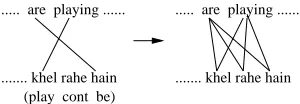
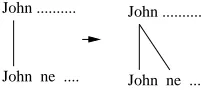
The majority of the links between the source sentence and the target sentence are one-to-one. Some of the cases where this is not true are the in-stances of idioms, alignment of verb groups where auxiliaries do not correspond to each other, the alignment of case-markers etc. Except for the cases of idioms in target language, most of the many-to-many links between a source and target sentences can be inferred from the instances of one-to-one and many-to-one links using three lan-guage lanlan-guage specific rules (Hindi in our case) to handle the above cases. Figure 1, Figure 2 and Figure 3 depict the three such cases where many-to-many alignments can be inferred. The align-ments present at the left are those which can be predicted by our alignment model. The alignments on the right side are those which can be inferred in the post-processing stage.
... are playing ...
... khel rahe hain
... are playing ...
... khel rahe hain (play cont be)
Figure 2: Inferring the many-to-many alignments of verb and auxiliaries
John ne .... John ...
John ne .... John ...
Figure 3: Inferring the one-to-many alignment to case-markers in Hindi
... kicked the bucket
... mara gaya
... kicked the bucket
... mara gaya (die go−light verb)
Figure 4: Inferring many-to-many alignment for source idioms
structure. If there is a dependency link between two source wordseoandep, whereeois the head andepis the modifier and if eoandep are linked to one or more common target word(s), it is log-ical to imagine that the alignment should be ex-tended such that both eoandep are linked to the same set of target words. For example, in Figure 4, new alignment link is first formed between ‘kick’ and ‘gayA’ using the language specific rule, and as ‘kick’ and ‘bucket’ are both linked to ‘mara’, ‘bucket’ is also now linked to ‘gayA’. Similarity, ‘the’ is linked to both ‘mara’ and ‘gayA’. Hence, the rules are applied by traversing through the de-pendency tree associated with the source sentence words in depth-first order. The dependency parser used by us was developed by (Shen, 2006). The following summarizes this step,
• Letwbe the next word considered in the dependency tree, letpwbe the parent ofw.
– Ifwandpware linked to one or more common word(s) in target language, alignwto all target words which are aligned topw.
– Else, Use the target-specific rules (if they match)
to extend the alignments ofw.
• Recursively consider all the children ofw
3 Parameters
As the number of training examples is small, we chose to use features (both local and structural) which are generic. Some of the features which we used in this experiment are as follows:
3.1 Local features (FL)
The local features which we consider are mainly co-occurrence features. These features estimate the likelihood of a source word aligning to a
tar-get word based on the co-occurrence information obtained from a large sentence aligned corpora1.
3.1.1 DiceWords
Dice Coefficient of the source word and the tar-get word (Taskar et al., 2005).
DCoeff(ep, hq) =
2∗Count(ep, hq)
Count(ep) +Count(hq)
where Count(ep, hq) is the number of times the wordhqwas present in the translation of sentences containing the wordepin the parallel corpus.
3.1.2 DiceRoots
Dice Coefficient of the lemmatized forms of the source and target words. It is important to consider this feature for language pairs which do not have a large unsupervised sentence aligned corpora. Co-occurrence information can be learnt better after we lemmatize the words.
3.1.3 Dict
This feature tests whether there exists a dictio-nary entry from the source wordep to the target wordhq. For English-Hindi, we used a medium-coverage dictionary (25000 words) available from IIIT - Hyderabad, India2.
3.1.4 Null POS
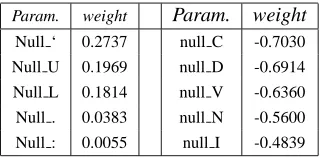
These parameters measures the likelihood of a source word with a particular part of speech tag3to be aligned to no word (Null) on the target language side. This feature was extremely useful because it models the cooccurence information of words with nulls which is not captured by the features
DiceWords and DiceRoots. Here are some of the
features of this type with extreme estimated pa-rameter weights.
3.2 Lemmatized word pairs
The word pairs themselves are a good indicator of whether an alignment link exists between the word pair or not. Also, taking word-pairs as fea-ture helps in the alignment of some of the most common words in both the languages. A variation of this feature was used by (Moore, 2005) in his paper.
150K sentence pairs originally collected as part of TIDES MT project and later refined at IIIT-Hyderabad, India.
Param. weight Param. weight
Null ‘ 0.2737 null C -0.7030 Null U 0.1969 null D -0.6914 Null L 0.1814 null V -0.6360 Null . 0.0383 null N -0.5600 Null : 0.0055 null I -0.4839
Table 1: Top Five Features each with Maximum and Minimum weights
Other parameters like the relative distance be-tween the source wordepand the target wordhq,
RelDist(ep, hq) = abs(j/|e| −k/|h|), which are mentioned as important features in the previous literature, did not perform well for the English-Hindi language pair. This is because of the pre-dominant word-order variation between the sen-tences of English and Hindi (Refer Figure 1).
3.3 Structural Features (FG)
The global features are used to model the prop-erties of the entire alignment structure taken as a unit, between the source and the target sentence. In doing so, we have attempted to exploit the syn-tactic information available on both the source and the target sides of the corpus. The syntactic infor-mation on the target side is obtained by projecting the syntactic information of the source using the alignment links. Some of the features which we have used in our work are in the following subsec-tion.
3.3.1 Overlap
This feature considers the instances in a sen-tence pair where a source word links to a target word which is a participant in more than one align-ment links (has a fertility greater than one). This feature is used to encourage the source words to be linked to different words in the target language. For example, we would prefer the alignment in Figure 6 when compared to the alignment in Fig-ure 5 even before looking at the actual words. This parameter captures such prior information about the alignment structure.
Figure 5: Alignment where many source words are linked to one target word
Figure 6: Alignment where the source words are aligned to many different target words
Formally, it is defined as
Overlap(¯a) = P
hq∈T,Fert(hq)>1Fert 2(h
q) P
h∈TFert(h)
whereT is the Hindi sentence. PFert2(hq)is measured in the numerator so that a more uniform distribution of target word fertilities be favored in comparison to others. The weight of overlap as estimated by our model is -6.1306 which indicates the alignments having a low overlap value are pre-ferred.
3.3.2 NullPercent
This feature measures the percentage of words in target language sentence which are not aligned to any word in the source language sentence. It is defined as
NullPercent= |hq|hq∈T,Fertility(hq)==0
|h|h∈T
3.3.3 Direction DepPair
The following feature attempts to capture the first order interdependence between the alignment links of pairs of source sentence words which are connected by dependency relations. One way in which such an interdependence can be measured is by noting the order of the target sentence words linked to the child and parent of a source sentence dependency relation. Figures 7, 8 and 9 depict the various possibilities. The words in the source sentence are represented using their part-of-speech tags. These part-of-speech tags are also projected onto the target words. In the figurespis the parent andcis the part-of-speech of the child.
p c
c p
p c
p c
Figure 8: Target word linked to a parent precedes the target word linked to a child
p c
p c
Figure 9: Parent and the child are both linked to same target word
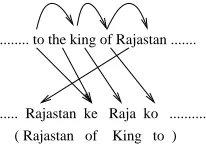
The situation in Figure 9 is an indicator that the parent and child dependency pair might be part or whole of a multi-word expression on the source side. This feature thus captures the divergence be-tween the source sentence dependency structure and the target language dependency structure (in-duced by taking the alignment as a constraint). Hence, in the test data, the alignments which do not express this divergence between the depen-dency trees are penalized. For example, the align-ment in Figure 10 will be heavily penalized by the model during re-ranking step primarily for two reasons, 1) The word aligned to the preposition ‘of’ does not precede the word aligned to the noun ‘king’ and 2) The word aligned to the preposition ‘to’ does not succeed the word aligned to the noun ‘king’.
... to the king of Rajastan ...
... Rajastan ke Raja ko ... ( Rajastan of King to )
Figure 10: A simple example of an alignment that would be penalized by the feature Direc-tion DepPair
3.3.4 Direction Bigram
This feature is a variation of the previous fea-ture. In the previous feature, the dependency pair on the source side was projected to the target side to observe the divergence of the dependency pair. In this feature, we take a bigram instead of a
de-pendency pair and observe its order in the target side. This feature is equivalent to the first-order features used in the related work.
There are three possibilities here, (1) The words of the bigram maintain their order when projected onto the target words, (2) The words of the bigram are reversed when projected, (3) Both the words are linked to the same word of the target sentence.
4 Online large margin training
For parameter optimization, we have used an on-line large margin algorithm called MIRA (Mc-Donald et al., 2005) (Crammer and Singer, 2003). We will briefly describe the training algorithm that we have used. Our training set is a set of English-Hindi word aligned parallel corpus. Let the num-ber of sentence pairs in the training data bet. We have{Sr, Tr,ˆar}for training wherer ≤ t is the index number of the sentence pair{Sr, Tr}in the training set and ˆar is the gold alignment for the pair{Sr, Tr}. Let W be the weight vector which has to be learnt,Wibe the weight vector after the end ofithupdate. To avoid over-fitting,W is ob-tained by averaging over all the weight vectorsWi. A generic large margin algorithm is defined follows for the training instances{Sr, Tr,aˆr},
InitializeW0,W,i forp= 1to Iterations do
forr= 1to t do
Get K-Best predictionsαr ={a1, a2...ak} for the training example(Sr, Tr,aˆr) using the current modelWiand applying step 1 and 2 of section 4. ComputeWi+1
by updatingWibased on (Sr, Tr,aˆr, αr).
i = i + 1
W =W +Wi+1
W = W
Iterations∗m
end for end for
The goal of MIRA is to minimize the change in
Wisuch that the score of the gold alignmentaˆ ex-ceeds the score of each of the predictions inαby a margin which is equal to the number of mistakes in the predictions when compared to the gold align-ment. One could choose a different loss function which assigns greater penalty for certain kinds of mistakes when compared to others.
algo-rithm mentioned above can be substituted by the following optimization problem,
minimizek(Wi+1−Wi)k
s.t.∀k,score(ˆar, Sr, Tr)−score(aq,k, Sr, Tr)
>=M istakes(ak,ˆar, Sr, Tr)
For optimization of the parameters, ideally, we need to consider all the possible predictions and assign margin constraints based on every predic-tion. But, here the number of such classes is ex-ponential and therefore we restrict ourselves to the
k−bestpredictions.
We estimate the parameters in two steps. In the first step, we estimate only the weights of the lo-cal parameters. After that, we keep the weights of local parameters constant and then estimate the weights of global parameters. It is important to decouple the parameter estimation to two steps. We also experimented estimating the parameters in one stage but as expected, it had an adverse impact on the parameter weights of local features which resulted in generation of poor k-best list af-ter the first step while testing.
5 Experiments and Results
5.1 Data
We have used English-Hindi unsupervised data of 50000 sentence pairs4. This data was used to ob-tain the cooccurence statistics such as DiceWords and DiceRoots which we used in our model. This data was also used to obtain the predictions of GIZA++ (Implements the IBM models and the HMM model). We take the alignments of GIZA++ as baseline and evaluate our model for the English-Hindi language pair.
The supervised training data which is used to estimate the parameters consists of 4252 sentence pairs. The development data consists of 100 tence pairs and the test data consists of 100 sen-tence pairs. This supervised data was obtained from IRCS, University of Pennsylvania. For train-ing our model, we need to convert the many-to-many alignments in the corpus to one-to-one or may-to-one alignments. This is done by applying inverse operations of those performed during the post-processing step (section 2.3).
4Originally collected as part of TIDES MT project and later refined at IIIT-Hyderabad, India.
5.2 Experiments
We first obtain the predictions of GIZA++ to ob-tain the baseline accuracies. GIZA++ was run in four different modes 1) English to Hindi, 2) Hindi to English, 3) English to Hindi where the words in both the languages are lemmatized and 4) Hindi to English where the words are lemmatized. We then take the intersections of the predictions run from both the directions (English to Hindi and Hindi to English). Table 2 contains the results of experi-ments with GIZA++. As the recall of the align-ment links of the intersection is very low for this dataset, further refinements of the alignments as suggested by (Och and Ney, 2003) were not per-formed.
Mode Prec. Rec. F-meas. AER
Normal: Eng-Hin 47.57 40.87 43.96 56.04
Normal: Hin-Eng 47.97 38.50 42.72 57.28
Normal: Inter. 88.71 27.52 42.01 57.99
Lemma.: Eng-Hin 53.60 44.58 48.67 51.33
Lemma.: Hin-Eng 53.83 42.68 47.61 52.39
Lemma.: Inter. 86.14 32.80 47.51 52.49
Table 2: GIZA++ Results
In Table 3, we observe that the best result (51.33) is obtained when GIZA++ is run after lem-matizing the words on the both sides of the unsu-pervised corpus. The best results obtained without lemmatizing is 56.04 when GIZA++ is run from English to Hindi.
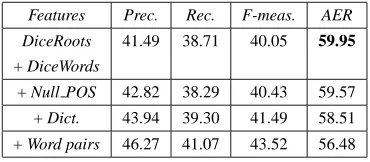
The table 4 summarizes the results when we used only the local features in our model.
Features Prec. Rec. F-meas. AER
DiceRoots 41.49 38.71 40.05 59.95
+ DiceWords
+ Null POS 42.82 38.29 40.43 59.57 + Dict. 43.94 39.30 41.49 58.51 + Word pairs 46.27 41.07 43.52 56.48
Table 3: Results using local features
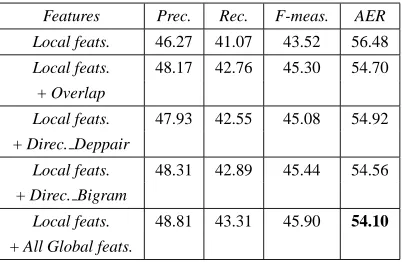
Features Prec. Rec. F-meas. AER
Local feats. 46.27 41.07 43.52 56.48
Local feats. 48.17 42.76 45.30 54.70 + Overlap
Local feats. 47.93 42.55 45.08 54.92 + Direc. Deppair
Local feats. 48.31 42.89 45.44 54.56 + Direc. Bigram
Local feats. 48.81 43.31 45.90 54.10
+ All Global feats.
Table 4: Results after adding global features
We see that by adding global features, we ob-tained an absolute increase of about 2.3 AER sug-gesting the usefulness of structural features which we considered. Also, the new AER is much better than that obtained by GIZA++ run without lem-matizing the words.
We now add the IBM Model-4 parameters (co-occurrence probabilities between source and tar-get words) obtained using GIZA++ and our fea-tures, and observe the results (Table 6). We can see that structural features resulted in a significant decrease in AER. Also, the AER that we obtained is slightly better than the best AER obtained by the GIZA++ models.
Features Prec. Rec. F-meas. AER
IBM Model-4 Pars. 48.85 43.98 46.29 52.71 +LocalF eats
IBM Model-4 Pars. 48.95 50.06 49.50 50.50
+ All feats.
Table 5: Results after combining IBM model-4 pa-rameters with our features
6 Conclusion and Future Work
In this paper, we have proposed a discriminative re-ranking approach for word alignment which al-lows us to make use of structural features effec-tively. We have shown that by using the structural features, we have obtained a decrease of 2.3% in the absolute value of alignment error rate (AER). When we combine the prediction of IBM model-4 with our features, we have achieved an AER which is slightly better than the best AER of GIZA++ for the English-Hindi parallel corpus (a language pair with significant structural divergences). We expect to get large improvements when we add more number of relevant local and structural
fea-tures. We also plan to design an appropriate de-pendency based decoder for machine translation to make good use of the parameters estimated by our model.
References
Phil Blunsom and Trevor Cohn. 2006. Discriminative word alignment with conditional random fields. In Proceedings of the 21st COLING and 44th Annual Meeting of the ACL, Sydney, Australia, July. ACL.
Koby Crammer and Yoram Singer. 2003. Ultraconser-vative online algorithms for multiclass problems. In Journal of Machine Learning Research.
Alexander Fraser and Daniel Marcu. 2006. Semi-supervised training for statistical word alignment. In Proceedings of the 21st COLING and 44th Annual Meeting of the ACL, Sydney, Australia, July. Asso-ciation for Computational Linguistics.
Simon Lacoste-Julien, Ben Taskar, Dan Klein, and Michael I. Jordan. 2006. Word alignment via quadratic assignment. In Proceedings of the Human Language Technology Conference of the NAACL, Main Conference, pages 112–119, New York City, USA, June. Association for Computational Linguis-tics.
Ryan McDonald, Fernando Pereira, Kiril Ribarov, and Jan Hajic. 2005. Non-project dependency pars-ing uspars-ing spannpars-ing tree algorithms. In Proceed-ings of Human Language Technology Conference and Conference on Empirical Methods in Natural Language Processing, pages 523–530, Vancouver, British Columbia, Canada, October. Association of Computational Linguistics.
Robert C. Moore. 2005. A discriminative frame-work for bilingual word alignment. In Proceedings of Human Language Technology Conference and Conference on Empirical Methods in Natural Lan-guage Processing, pages 81–88, Vancouver, British Columbia, Canada, October. Association of Compu-tational Linguistics.
F. Och and H. Ney. 2003. A systematic comparisoin of various statistical alignment models. In Compu-tational Linguistics.
Libin Shen. 2006. Statistical LTAG Parsing. Ph.D. thesis.
Ben Taskar, Simon Lacoste-Julien, and Dan Klein. 2005. A discriminative machine approach to word alignment. In Proceedings of HLT-EMNLP, pages 73–80, Vancouver, British Columbia, Canada, Octo-ber. Association of Computational Linguistics.