A Study on Image Color spaces and Image
Segmentation Algorithms
Stephen Suhas Patta1, B.J.M Ravi Kumar2
P.G. Student, Department of Computer Science and Systems Engineering, Andhra University, A.P., India1
Assistant Professor, Department of Computer Science and Systems Engineering, Andhra University, A.P., India2
ABSTRACT : Image processing is a method to perform some operations on an image, in order to get an enhanced image or to extract some useful information from it. The techniques that are used to find the objects of interest are usually referred to as segmentation techniques. Segmentation partitions an image into distinct regions containing each pixel with similar attributes. To be meaningful and useful for image processing and interpretation, the regions should strongly relate to depicted objects or features of interest. There is no universally applicable segmentation technique that will work for all images and no segmentation technique is perfect. Problem is how to choose the color representation for segmentation. Each color representation has its advantages and disadvantages. There are two critical issues for color image segmentation, 1. What segmentation method should be utilized and 2. What color space should be adopted? Most of color image segmentation methods are generally extended from monochrome segmentation approaches. In this paper, I want to present a review of the state of the art color image segmentation methods along with different color spaces. Different image segmentation methods I would like to use are SLIC, Felzenswalb, Quick Shift, Watershed and Normalized Cut. Whereas some color spaces used are l*a*b*, YCbCr, HSV. Executed the considered segmentation techniques along with different color spaces, and have traced the best combinations of segmentation and color space.
KEY WORDS: Segmentation, Color Space, RGB, Lab, YCbCr, HSV
I. INTRODUCTION
Searching information within images represents a special entity of data processing. Images asa unique category of data differs from text data in several aspects as in terms of their nature so interms of storing and retrieving. Images have visual character, they can be represented in numerical form, however large amount of numbers is to be evaluated in order to search image databases.Finding, extracting and classifying objects from images are the basic requirements of processingan image successfully. Tools of data mining have been utilised for these tasks to be performed withincreased efficiency. Nevertheless, applying data mining solely would not bring satisfactory resultsfor image processing. Segmentation is the process that subdivides an image into its constituent parts. It is the advanced technique in which a digitalized image is partitioned or segmented into numerous segments or parts based on the values of pixel.Also various color spaces are present. However, there are other models besides RGB [1] for representing colors numerically. The various models are referred to as color spaces because most of them can be mapped into a 2-D, 3-D, or 4-D coordinate system; thus, a color specification is made up of coordinates in a 2-D, 3-D, or 4-D space. The various color spaces exist because they present color information in ways that make certain calculations more convenient or because they provide a way to identify colors that is more intuitive. For example, the RGB color space defines a color as the percentages of red, green, and blue hues mixed together. Other color models describe colors by their hue (green), saturation (dark green), and luminance, or intensity.
II. LITERATURE SURVEY
computational power. In brief, the algorithm clusters pixels in the combined five-dimensional color and image plane space to efficiently generate compact, nearly uniform superpixels. Quick shift [12] is a fast mode seeking algorithm, similar to mean shift. The algorithm segments an RGB image (or any image with more than one channel) by identifying clusters of pixels in the joint spatial and color dimensions. Segments are local (superpixels) and can be used as a basis for further processing. The watershed [13] is a classical algorithm used for segmentation, that is, for separating different objects in an image. Starting from user-defined markers, the watershed algorithm treats pixels values as a local topography (elevation). The algorithm floods basins from the markers, until basins attributed to different markers meet on watershed lines. Given an image’s labels and its similarity RAG (regional Adjacency Graph), Normalized cut segmentation recursively perform a 2-way normalized cut on it.
III. COLOR SPACES
RGB space:
In this space every color is represented with the spectral components of red, green and blue. The origin of this model can be found in television technology, and it can be considered as the fundamental representation of color for computers, digital cameras and scanners; but also, for image storage. The shape of the RGB space is a cube [5] , whose coordinates correspond to the three basic colors: red (r), green (g) and blue (b). The values of each component are in the range [0, 255]
HSV space:
In the HSV space[8] , the color is represented with the components hue (h), saturation (s) and value (v). Hue is the chromatic feature that describes a pure color; for instance, yellow, orange, red, etc. Saturation is a measure of how the hue is diluted in white light; value is the intensity or brightness of the color. The hue is in the range [0, 2π], saturation is in the real range [0, 1], while value is often in the range [0, 255]. The HSV space is cone shaped. Geometrically, the radius and the height of the cone represent the saturation and value components, respectively.
L∗a∗b∗ space:
This color space is developed considering linearizing the tonality changes, where the colors are defined by three variables: L∗ is the intensity; a∗ and b∗ are the tonality components [9]. The value of a∗ defines the distance through red-green axis, while the value of b∗ defines the distance through the blue-yellow axis. Usually a∗ and b∗ are in the ranges [−127, 128] and L∗ in the range [0, 100].
YCbCr color space:
The YCbCr [10] is the standard for digital television. In these models the components that define them feature three planes: the luminance (Y) and the other two called chrominance components. The YCbCr space is widely employed for image processing, mainly for compression applications.
Proposed method
In this paper, combinations of color spaces with different segmentation techniques are Evaluated. The Color spaces considered are RGB, HSV Color Space, L*a*b* Color Space and YCrCb color spaces. Also the standard segmentation techniques considered are Watershed segmentation, Quickshift segmentation, Felzenswalb Segmentation, SLIC and Normalized cut Segmentations. Each segmentation algorithm has its own advantages and disadvantages. Irrespective of that, some segmentation techniques are performing good with some color spaces and some are not. For evaluating the performance, mean squared error is calculated.
IV. EXPERIMENTAL RESULTS
Experimentation done on a 321x481 size image on 8GB RAM machin with i5 processor. Programming language used is python.
For HSV color space, Watershed is giving less mse value among all. SLIC, Ncut are performing the next better. Quickshift and Felzenswalb are not upto mark with HSV color space.
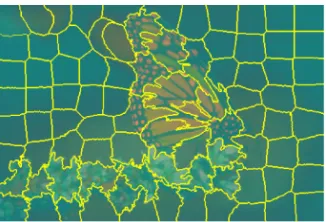
L*a*b* color space is performing good with almost all segmentation techniques. SLIC and Normalized cut have L*a*b* color space conversion at their first step. Since most of the super pixel based segmentation techniques work well with L*a*b* color space. Felzenswalb segmentation is giving better segmented results with L*a*b* color space. Quickshift on the other hand also performing good next to Felzenswalb.
SLIC, Normalized Cut segmentation techniques are performing good among all other techniques with YCbCr color space. Felzenswalb and Quickshift segmentations performing next best with lesser mean squared errors. Watershed segmentation got higher mse compared to all other segmentation techniques with YCbCr color space.
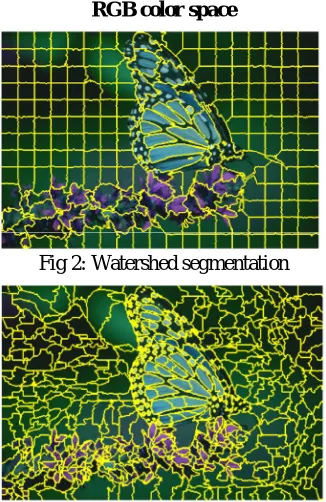
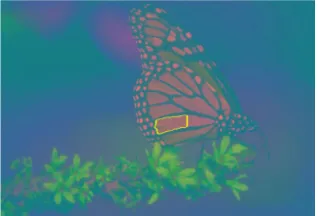
Fig 1: Actual Image
RGB color space
Fig 2: Watershed segmentation
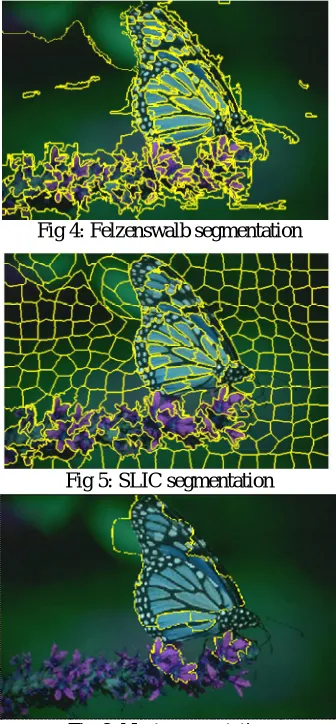
Fig 4: Felzenswalb segmentation
Fig 5: SLIC segmentation
Fig 6: Ncut segmentation
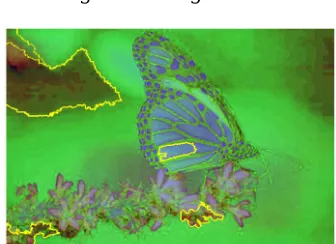
HSV Color Space
Fig 8 :Quickshift segmentation
Fig 9: Felzenswalb segmentation
Fig 10: SLIC segmentation
L*a*b* color space
Fig 12: Watershed segmentation
Fig 13 :Quickshift segmentation
Fig 14: Felzenswalb segmentation
Fig 16: Ncut segmentation
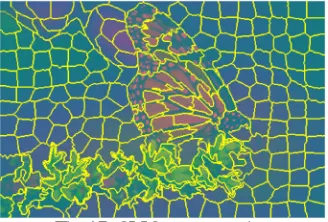
YCbCr color space
Fig 17: Watershed segmentation
Fig 18 :Quickshift segmentation
Fig 20: SLIC segmentation
Fig 21: Ncut segmentation
IV. CONCLUSION
Image segmentation is a field with lots of applications. Whereas color spaces identify a way to find intuitive colors and perform calculations for its processing convenience. Different Segmentation techniques are performing better with various color features. Among all, L*a*b* color space is giving good results with most of the segmentation techniques. HSV color space image is performing better with SLIC and Watershed segmentations. Felzenswalb segmentation segmented YCbCr color space image efficiently. From the color image segmentation methods presented, none of them can be established as the best one. It is necessary to know the features, advantages and disadvantages of the segmentation methods, but also the nature of the application to perform in order to obtain optimal results.
REFERENCES
[1] R. Achanta, A. Shaji, K. Smith, A. Lucchi, P. Fua, S. Ssstrunk, Slicsuperpixels compared to state-of-the-art superpixel methods, IEEE Trans. Pattern Anal. Mach. Intell. 34 (11) (2012) 2274–2282
[2] Young, T., 1802. Bakerian Lecture: On the Theory of Light and Colours. Phil. Trans. R. Soc. Lond. 92:12-48. [3] Hans G. Völz (2001). Industrial Color Testing: Fundamentals and Techniques. Wiley-VCH. ISBN 3-527-30436-3
[4] A. Shama , S. Phadikar , Automatic color image segmentation using spatial con- straint based clustering, in: Emerging Trends in Computing and Communica- tion, Springer, 2014, pp. 113–121 .
[5] K. Leon , D. Mery , F. Pedreschi , J. Leon , Color measurement in la b units from RGB digital images, Food Res. Int. 39 (10) (2006) 1084–1091 .
[7] S. Ito , M. Yoshioka , S. Omatu , K. Kita , K. Kugo , An image segmentation method using histograms and the human characteristics of HSI color space for a scene image, Artif. Life Robot. 10 (1) (2006) 6–10 .
[8] R. Huang , N. Sang , D. Luo , Q. Tang , Image segmentation via coherent cluster- ing in l a b color space, Pattern Recognit. Lett. 32 (7) (2011) 891–902 . [9] T. Uchiyama , M.A. Arbib ,Color image segmentation using competitive learn- ing, IEEE Trans. Pattern Anal. Mach. Intell. 16 (12) (1994) 1197–1206 .
[10] F. Garcia-Lamont , A. Cuevas , Y. Nino , Segmentation of color images by chro- maticity features using self-organizing maps, Ingenieria e Investigacion 36 (2016) 78–89 .
[11] Efficient graph-based image segmentation, Felzenszwalb, P.F. and Huttenlocher, D.P. International Journal of Computer Vision, 2004 [12] Quick shift and kernel methods for mode seeking, Vedaldi, A. and Soatto, S. European Conference on Computer Vision, 2008