University of Windsor University of Windsor
Scholarship at UWindsor
Scholarship at UWindsor
Electronic Theses and Dissertations Theses, Dissertations, and Major Papers
2010
Four Mode Based Dialogue Management with Modified POMDP
Four Mode Based Dialogue Management with Modified POMDP
Model
Model
Sabiha Sathulla
University of Windsor
Follow this and additional works at: https://scholar.uwindsor.ca/etd
Recommended Citation Recommended Citation
Sathulla, Sabiha, "Four Mode Based Dialogue Management with Modified POMDP Model" (2010). Electronic Theses and Dissertations. 7914.
https://scholar.uwindsor.ca/etd/7914
Four Mode Based Dialogue Management with Modified POMDP Model
by
Sabiha Sathulla
A Thesis
Submitted to the Faculty of Graduate Studies through Computer Science
in Partial Fulfillment of the Requirements for the Degree of Master of Science at the University of Windsor
Windsor, Ontario, Canada
2010
1*1
Library and Archives CanadaPublished Heritage Branch
395 Wellington Street Ottawa ON K1A 0N4 Canada
Bibliotheque et Archives Canada
Direction du
Patrimoine de I'edition
395, rue Wellington Ottawa ON K1A 0N4 Canada
Your file Votre reference ISBN: 978-0-494-70594-0 Our file Notre reference ISBN: 978-0-494-70594-0
NOTICE: AVIS:
The author has granted a
non-exclusive license allowing Library and Archives Canada to reproduce, publish, archive, preserve, conserve, communicate to the public by
telecommunication or on the Internet, loan, distribute and sell theses
worldwide, for commercial or non-commercial purposes, in microform, paper, electronic and/or any other formats.
L'auteur a accorde une licence non exclusive permettant a la Bibliotheque et Archives Canada de reproduire, publier, archiver, sauvegarder, conserver, transmettre au public par telecommunication ou par I'lnternet, prefer, distribuer et vendre des theses partout dans le monde, a des fins commerciales ou autres, sur support microforme, papier, electronique et/ou autres formats.
The author retains copyright ownership and moral rights in this thesis. Neither the thesis nor substantial extracts from it may be printed or otherwise reproduced without the author's permission.
L'auteur conserve la propriete du droit d'auteur et des droits moraux qui protege cette these. Ni la these ni des extra its substantiels de celle-ci ne doivent etre imprimes ou autrement
reproduits sans son autorisation.
In compliance with the Canadian Privacy Act some supporting forms may have been removed from this thesis.
Conformement a la loi canadienne sur la protection de la vie privee, quelques formulaires secondaires ont ete enleves de cette these.
While these forms may be included in the document page count, their removal does not represent any loss of content from the thesis.
Bien que ces formulaires aient inclus dans la pagination, il n'y aura aucun contenu manquant.
1*1
Author's Declaration of Originality
I hereby certify that I am the sole author of this thesis and no part of this thesis has been
published or submitted for publication.
I certify that, to the best of my knowledge, my thesis does not infringe upon anyone's
copyright nor violate any proprietary rights. Any ideas, techniques, quotations or any other
material from the work of other people included in my thesis, published or otherwise, are fully
acknowledged in accordance with the standard referencing practices. Furthermore, to the extent
that I have included copyrighted material that surpasses the bounds of fair dealing within the
meaning of the Canada Copyright Act.
I certify that, I have obtained a written permission from the copyright owner(s) to include
such material(s) in my thesis and have included copies of such copyright clearances to my
appendix.
I declare that, this is a true copy of my thesis, including any final revisions, as approved
by my thesis committee and the Graduate Studies office, and this thesis has not been submitted
Abstract
This thesis proposes a method to manage the interaction between the user and the system
dynamically, through speech or text input which updates the user goals, select system actions and
calculate rewards for each system response at each time-stamp. The main focus is made on the
dialog manager, which decides how to continue the dialogue. We have used POMDP technique,
as it maintains a belief distribution on the dialogue states based on the observations over the
dialogue even in a noisy environment. Four contextual control modes are introduced in dialogue
management for decision-making mechanism, and to keep track of machine behaviour for each
dialogue state. The result obtained proves that our proposed framework has overcome the
limitations of prior POMDP methods, and exactly understands the actual intention of the users
within the available time, providing very interactive conversation between the user and the
Dedication
Acknowledgements
First, I would like to thank and express my sincere gratitude to my supervisor Dr. Xiaobu
Yuan, for his support and encouragement with his valuable hints and stimulating suggestions to
proceed with this thesis. Without his support and guidance, this work would be impossible.
Secondly, I would like to take this opportunity to thank Dr. Dan Wu and Dr. Fritz Rieger,
for being in the thesis committee and spending their valuable time in providing me with
encouraging feedback.
I am deeply indebted to express my gratitude to my colleagues Libian Bian and Mohit
Sud for their moral support and valuable suggestions.
Finally, I would like to thank all my friends who were with me by providing moral
Contents
Abstract iv
Dedication v
Acknowledgements vi
List of Figures x
List of Tables xii
1 Introduction and Motivation 1
1.1 Introduction 1
1.2 The Origin 1
1.3 Overview of Spoken Dialog System 3
1.4 Motivation 4
1.5 Problem Statement 4
1.6 Thesis Structure 5
2 Background 6
2.1 Dialogue Management - An Overview 6
2.1.1 Input Mode 7
2.1.2 Fusion 8
2.1.3 Dialogue Manager 8
2.1.4 Fission 9
2.1.5 Output Mode 10
2.2 Review of existing Approaches 10
2.2.1 Finite state-based Approach 11
2.2.2 Frame-based Approach 12
2.2.3 Information state-based Approach 13
2.2.4 Probabilistic Approach 14
2.2.5 Plan-based Approach 15
2.2.6 Agent-based Approach 16
2.3 Contextual Control Model 16
2.3.1 Four Control Modes 17
2.4 Conclusion 19
3 Literature Review of Dialogue Management techniques 20
3.1 Dialogue Management Techniques 20
3.1.1 Handcrafted Dialogue Managers 20
3.1.2 Bayesian Network for Dialogue Management 22
3.1.3 Supervised Learning and Markov Decision Process 24
3.1.4 Semi- Markov Decision Process 30
3.1.5 Partially Observable Markov Decision Process 32
3.1.5.1 Factored POMDP 40
3.1.5.2 Hidden Information State model 43
3.1.6 Limitations of Existing POMDP Approaches 45
3.2 Review of Contextual Control Model 45
3.2.1 Testing COCOM by assessing team behaviour 45
3.3 Conclusion 49
4 Four Mode Based Dialogue Management 50
4.1 Method Description 50
4.2 COCOM for Decision Making in DM 51
4.3 Modified POMDP Approach 52
4.3.1 Rewards 54
4.3.2 Confidence Scores 55
4.4 Conclusion 59
5 Evaluation and Results 60
5.1 Implementation 60
5.2 Results 63
5.3 Discussion 67
5.4 Conclusion 68
6 Conclusions and Future Work 69
Bibliography 71
List of Figures
2.1 General Architecture of Dialogue Management System 7
2.2 General architecture of Dialogue Manager 9
3.1 HC1 handcrafted Dialogue Controller 21
3.2 Dependency graph for Spoken Dialogue Management 23
3.3 Supervised Learning for action selection 25
3.4 Sequential decision Process of ATIS 27
3.5 Three possible strategies of ATIS Spoken Dialog System 28
3.6 A graph of basic MDP underlying the Dialog Manager 29
3.7 The simulated environment interaction for Human-Machine conversations 31
3.8 Structure of a Spoken Dialog System 33
3.9 The agent - Environment Interaction 34
3.10 Influence diagram of continuous POMDP 37
3.11 Example conversation in Pizza- Ordering domain 38
3.12 Frameworks for modeling uncertainty and policy optimisation 40
in Spoken Dialogue Systems
3.13 HIS Dialogue Manager 44
3.14 Internal structure of Contextual Control Model (COCOM) 46
3.15 Contextual Control Model by Eric Hollnagel in 1998 48
4.1 Flow-chart of Proposed Model 58
5.2 Dialogue Manager updates all the activities of the system 62
5.3 User Interface for case 1 experiment 63
5.4 The updated history component of proposed dialogue manager for case 1 64
5.5 User interface for case 2 experiments 64
5.6 The updated history component of proposed dialogue manager for case 2 65
5.7 User Interface for case 3 and 4 experiment 65
List of Tables
4.1 Pseudo- code of Proposed Model 57
Chapter 1
Introduction and Motivation
1.1 Introduction
This chapter introduces the origin and overview of the thesis. First, we have narrated the
origin of the dialogue management systems briefly and the related fields associated with it.
Then the subsequent sections we have illustrated an overview with several examples. Then,
the next section follows the motivation of this thesis followed by the problem statement.
Finally, the chapter ends with a detailed summary of this thesis.
1.2 The Origin
Human- Computer Interaction is concerned with the joint performance of tasks by human
and the machines [Oldsig]. The basic goal is to make the computers interact with the human
users, guide and help them in various domains. This area explored in 1963 by Ivan
Sutherland in Sketchpad, where visible objects on the screen are directly manipulated with a
pointing device such as alight-pen. Then, the actual work started with gesture recognition
using a light-pen which is considered as the first application in HCI [Brad98]. Even though,
many methods and applications in HCI find their application in various products, still some
of basic applications are in the state of research since 1980.
HCI has collaboration with different fields of science. Many of its methods and
are extracted from AI. In AI, few concepts such as gesture and speech recognition are used
for robot navigation. In Multimedia, HCI concepts such as integrated text and graphics are
used to make a movie using video and computer graphics. The basic research is done using
speech, text or gesture as input to process the HCI and AI based systems. The growth and
demand of video games are one such example.
Consequently, lot of research has been done in HCI particularly focussing on the field of
natural language understanding and generation. With the growing demand of various
applications of HCI, gives evolution to a new technology in 1980s known as dialog system in
which text, speech or gestures are used as input to interact with the humans. Even though, lot
of prior research has been done in this field, dialogue systems emerged in various
applications in 1990s. One such application is in the field of telecommunications. It uses a
telephone or text wizard to interact with the human, process and offer services requested by
user using natural language processor. Dialogue management consists of several components
to understand the request and provides service to the user. Basically, these types of systems
are domain- oriented and works according to the background of intelligent systems.
Different applications where dialogue management technology is used are listed below:
• Telephone based system to provide information or support to human users.
• It has a wide application in the field of Robotics such as Robot Navigation System.
• In the field of virtual reality, the users can interact with the computer using sensory
information like speech and gestures in the simulated environment to experience the
real-world environment.
• In medical care, various applications such as access and assistive systems are developed
• In multimedia and 3-D technology, it has a wide growth in developing video games.
1.3 Overview of Spoken Dialogue System
A Spoken Dialogue system is a computational device or agent that engages in interaction
with other human, uses human language in some form such as speech, text, or gesture and
typically engages with human such interaction across multiple turns or sentences [Jods]. It
uses a discourse generator or computational linguistics to extract the information from the
user and provide services according to the request. Several researches have been done to
answer the following questions:
1. What information should be extracted to process the user query?
2. How the information is extracted?
3. How the system decides, what response should be given to the user query?
4. Does the system understand the exact intension of the user?
The first two questions are answered using the existing techniques and deals with input
components of the dialogue management. Next two questions deals with the dialogue
manager which is still under research. The final question is the most challenging part of
Dialogue management and it's been taken care of in this thesis.
1.4 Motivation
In the last decade, though lot of systems are developed on the basis of dialogue management,
a number of issues arise to be taken care of. With the growth and development of different
techniques to solve the prior issues, several limitations also increased which makes the
researchers to concentrate more on numerous applications. Though, the applications use
circumstances. It fails in the case that it is not language independent. Due to higher error rate
and reliability of these types of systems in real-time, lot of applications failed to handle exact
interaction between the human and the computer. Though, it consists of various components,
dialog manager is considered as the heart of the dialogue management system as it is
responsible for decision making. In order to handle the above situations, researchers
developed different techniques to make the dialog manager to make exact decision and give
appropriate response to the user. One such technique is Partially Observable Markov
Decision Process (POMDP). Though, Pomdp has emerged to overcome the failures of prior
techniques, it has its own limitations to be taken care of. This motivates me to conduct a
research on this particular technology and solve the challenges associated with Pomdp based
dialog manager by introducing a decision making mechanism based on four-mode concept.
1.5 Problem Statement
This thesis addresses the limitations of Pomdp and methods proposed to overcome the
limitations by introducing a different decision-making mechanism using Contextual Control
Modes which is addressed as four-mode concept in this thesis. We have modelled a dialogue
manager for a real time Pizza-ordering system and modified the Pomdp dialog manager in
which the application tracks the transition of system states, actions taken by the system to
respond accurately to the user, system response time for the user query, confidence score for
the dialog and change in mode for making decisions. We have also modelled a new reward
1.6 Thesis Structure
The rest of the thesis is organized as follows. Chapter 2 gives a brief background about
dialogue management systems and its components. Literature review of existing techniques
is also discussed in this chapter with examples. Finally, Contextual control model which is
the main heart of the thesis is discussed. Chapter 4 describes the proposed model and
modified POMDP approach in accordance with four Contextual Control Modes.
Experimental results and performance analysis of the proposed method are presented in
Chapter 2
Background
This chapter gives a brief background on different dialog manager. First, the section starts
with Dialogue Management and we have also explained its architecture with some potential
applications. Then the components of the dialog system are discussed, giving main focus on
dialog manager. The main task of dialog manager is decision making. In this thesis, we have
used contextual control modes for making decisions according to user's request. Finally, this
chapter ends with a brief background on contextual control modes followed by its existing
applications.
2.1 Dialogue Management: An Overview
A dialogue management system is a machine that interacts with the people by understanding
their intention/goal and provides the required information services [Infriek]. With the recent
advances in Robotics and Human - Computer Interaction, dialogue management has grabbed
more attention from the researchers. In Nineteenth century, where the computers had less
importance, people used to travel to the shop to get the reviews, choices, merits and demerits
of a particular product from the sales persons. But nowadays, computers play a vital role in
our day to day life. With the advancement of computer Avatars, we can shop anything from
anywhere, talk to a virtual sales person regarding the product on the web sitting in your
drawing room. The Virtual sales assistant is nothing but a computer program which acts like
a human, understands the user requirement and provides service according to human request.
Does the machine offer the user a clear picture of its possible actions? And is it clear what
the results of these actions are and whether they were successfully performed? Do these
machines know what context of interaction is that they are in? [Infriek] These types of
questions always rise up among the researchers while designing a virtual avatar. These types
of dialogue systems are flexible and practical enough to control a natural human - computer
dialogue. They are mostly task-oriented and provide domain portability in order to allow
users in various applications.
Figure 2.1: General Architecture of Dialogue Management System
A dialogue management system consists of the following components: Input mode,
Fusion, Dialogue Manager, Fission and Output mode.
2.1.1 Input Mode
Input of a dialogue system can either be speech, text, touch, human gesture etc. Inputs are
Another, passive input mode denotes the behaviour of the user that is recognized by the
system which doesn't involve any explicit command to the computer [Bui06].
2.1.2 Fusion
The input from the human/user given to the system is extracted and processed in this level.
After it extracts the information from the input, it assigns a semantic representation to the
information which can be understandable by the computer. If there are two or more
combined input is given by the user, then the information is processed and fused using
different levels of fusion. Then, the fused information is integrated and sent to the dialog
manager along with the semantic information.
2.1.3 Dialogue Manager
Dialogue manager is considered as the core component of the dialogue management system
which is nothing but a program which coordinates the activity of several subcomponents in a
system. It acts as the interface to process any task or domain-based actions. The fused
information is processed at this level by updating dialogue context. It is also responsible for
choosing an action, which results in the change of dialogue state. It also stores and updates
dialogue states, decides which dialogue act to perform next and how to continue the dialogue.
If any component has insufficient input to perform its task, the dialogue manager gets an
alert, which can reconsult the previously invoked component for different input. It also
Session Model Updated Dialogue
Context
Dialogue
Manager
Discourse
Generator
Request data
Get data
Figure 2.2: General architecture of Dialogue Manager
2.1.4 Fission
Fission is the next component of dialogue systems in which the abstract message is received
from the dialogue manager in which the information is in machine understandable format. In
fission level, the semantic level information is converted into the output format which is
understandable by the user depending upon the input. The fission module is categorized into
3 types [Foster02]: Content selection and structuring, where the content is arranged in a
structure. Modality Selection in which the type of modality is identified according to the user
output component. Output Coordination, in which different output from the channels are
2.1.5 Output Mode
In this mode, various outputs coordinated in the fission component are displayed to the user
depending upon the user's hardware specification. Output modalities include text, speech,
gesture, graphics, haptics etc.
2.1.6 Multimodal Dialogue management
Previously, the system processes single user input mode such as text, speech or gesture
recognition. Recently, it has been extended to two or more user input modes such as speech
and text, speech and gesture, text and gesture, Facial expression, touch, head and body
movements etc. in a coordinated manner with multimedia system output [Oviatt02]. Such
types of systems are called multimodal dialogue systems.
2.2 Review of Existing Approaches
Dialogue management is classified into different approaches depending upon the task and
domain model. According to [McTear02], dialogue management is classified with three types
of strategies such as: finite state-based, frame-based and agent-based. In [Xu02], Dialogue
management is classified into four categories which is approximately same as the above three
categories. In [Cohen97] and [Catizone02], three categories are mentioned namely, dialogue
grammars, plan-based approach and cooperative approach which are collectively known as
agent-based approaches. Since these approaches are not mutually exclusive and have to
combine any two approaches in a dialogue system, researchers come up with a new type of
approach which is information state and probabilistic approach. To implement this type of
approach, researchers develop a toolkit based on the concept, which can be directly
2.2.1 Finite state-based Approach
This approach is the basic and simplest approach used in the dialogue management system.
In this approach the system's utterances are represented in the form of state transition
network which are pre-determined. According to [Xu02], in this approach both the task
model and dialogue model are implicit. In this approach, the dialogue consists of sequence of
pre-determining steps. To control the dialogue, system produces prompts at each dialogue
state. It can only understand certain words or phrases which are pre-coded in the back end.
So, the user has to answer in a single word or phrase in order for the system to produce next
action. Since, it contains sequence of steps, until the system complete all the steps it is not
possible to verify the previous answer or state.
An example for finite state-based approach is Nuance automatic banking system
[McTear02]. The systems is designed with UK based English and it enables the user to
conduct bank transactions over the telephone. The dialogue flow is modelled by a set of
interconnected dialogue states, in which the system is directed with pre-determined sequence
of questions. For example, consider this dialogue flow [McTear02]:
System: What would you like to do? User: Pay a bill.
System: What company would you like to pay? User: Midland Bank.
System: How much would you like to pay?
User: One hundred and twenty-jive pounds fifty-seven pence.
System: What date would you like the payment to be made on? User: Monday.
System: You want to pay HSBC one hundred fifty-five pounds and fifty seven pence on April 5th? Is this correct?
System: Your payment will be sent. Would you like to pay another bill?
The systems is pre-designed to get three specific value from the user in order to maintain
the flow of the transaction, values such as payee, amount and payment date. Sometimes, if
the user try to give multiple slot values in one dialogue state, the system fail to update the
user's over-informative response and it again prompts a question to answer probably the user
has to respond with the same answer once again. For example,
System: How much would you like to pay? User: One hundred pounds next Monday
System: What date would you like the payment to be made on? User: Monday.
If user wants to complete the transaction very quickly, the system fails to update all the
information provided by the user. It understands only pre-set values for a particular question
and again proceeds with the sequence of questions. Sometimes, the system fails to correct
more than one error at a time, it happens when the user reconfirms multiple values with the
system. These types of limitations may lead to a frustrating and unnatural dialogue system.
Irrespective of these limitations, Nuance automatic banking system was considered as one of
the best applications of Spoken Dialogue System which can handle simple transactions
efficiently and effectively.
2.2.2 Frame-based Approach
To overcome the flexibility issue of finite-based approach, frame-based approach is
developed as an extension. Instead of continuing the dialogue with some sequence of
pre-determined questions, this approach has a form with multiple slots in which the user has to
fill in the information. Here, the task model is represented explicitly and the dialogue model
In [McTear02], an example to frame-based approach, given the Philips automatic train
timetable information system. It provides information over the telephone about the trains
between German cities. This system is a research prototype and developed in German
language. The aim of the dialogue is to enable the system to construct an appropriate
database query that retrieves the information required by the user and then to present that
information in a suitable form.
[Hulstijn96] developed a theatre booking system and [VanZ96] developed a train
timetable enquiry system which relates the entities in the domain to another which has a
meaningful structure for the user queries. In [Goddeau96], an E-form (electronic form) type
has been discussed for the advertisement which is more complex type of form. The E-form
differs from normal type of forms developed in other frame-based systems. These types of
systems are basically developed to get one or multiple entries from the user. However, they
failed to concentrate more on the transition of dialogue states and more natural dialogue
which results the system actions to be very limited and hard to handle complex systems. In
[Bohus03], this E-form type is extended to task structure graphs to handle complex
transaction over telephone which provides the similar structure used in previous models. This
system is designed to determine the behaviour of dialog control and language understanding
module. The applications of this approach include various toolkits such as RAD, UNISYS's
Dialogue Design Assistant (DDA), etc.
2.2.3 Information state-based Approach
To overcome the limitations of previous approaches, Information state-based approach is a
dialogue theory with five different components; each has its own functionality [Traum03].
representation is for the discourse representation structures, modal operators within a logic
etc. A set of update rules for updating the information state and a set of dialogue moves to
trigger the update of information state. An update strategy is to decide which rule to apply.
The general idea of this approach is to develop the multi-layer dialogue model. In this model,
each level contains an information state representing current status of the layer. Trindikit
toolkit is developed based on this approach followed by GodiS [Larsson20] and EDIS
[LarsTrau20]. Several other applications of this approach include MATCH system for
multimodal city help [Johnston02], Virtual Music Center [Hofs03], etc.
2.2.4 Probabilistic Approach
This approach is an extension of Information state approach which uses probabilistic
techniques. The techniques include Markov Decision Process (MDP) or Partially Observable
Markov Decision Process (POMDP). The basic idea is to overcome the limitations of
Multi-layer dialogue model and to provide dynamically changing actions and dialogue strategy
based on rewards of the current state. The dialogue model is designed to use optimal strategy
using some reinforcement learning. The system actions are modelled to system's question
and answers, the rewards are pre-set by the system to rate the dialogue or it is provided to the
user to rate the system at the end of each dialogue [Singh02]. In [Young99], dynamic
programming, Q-learning or sampling-based reinforcement learning is used to optimize the
dialogue cost function. In [LecoOl], inductive logic programming is to extract rules from the
result of reinforcement learning. Apart from the MDP and POMDP techniques, Bayesian
2.2.5 Plan-based Approach
This approach is developed to overcome the complexity of dialogue modelling in the
previous approaches. In this approach, the main task or goal of the user is discovered and
respond appropriately to the user's requirement. The dialogue acts here are considered as
speech acts. The basic idea of this approach is that, the main job of the system is to identify
and respond to the user plan and the user's speech acts are considered as part of the plan. In
Verbmobil project, the dialogue is divided in sub-goals by a set of plan operators derived for
the example dialogues [Churcher97]. This approach is criticized on practical and theoretical
experiments. In some of the cases, it is even hard to predict how this system understands the
actual goal of the user. Sometimes, it lacks to handle plans or goals of the dialogue model. In
some cases, there is no actual specification that what the system should do, that is the actual
interpretation is quiet different form the illocutionary acts.
To overcome these types of issues, a conversational games theory is developed. This
extension combines the dialogue grammars and plan-based approaches by including a goal in
its structure, in order to provide more natural language dialogue. It actually handles the actual
human-computer dialogue in a task-oriented basis. A task-oriented dialogue consists of one
or more levels of conversations, each represents a task. Since, this extension of approach
mainly developed for games, it allows two or more games to be embedded on one game. It
consists of an opening move and an ending move with double checking options and side
sequences. Applications developed on the basis of this approach includes, SUNDIAL
2.2.6 Agent-based Approach
This approach is developed on the basis of viewing dialogue management as collaborative
process between intelligent agents. In this approach, both the user and the system are the
agents and the interaction and dialogue process takes place by mutual understanding between
two agents in a simulated environment. Here, it is designed to capture the motivations behind
the dialogue mechanisms and the discourse phenomena such as confirmation and
clarification. Here the intentions or goal of the agents are modelled as beliefs and the main
goal of this type of system is that the goal of the agent is shared as beliefs among the agents
and the number of agents involved in this system work cooperatively to achieve the
appropriate goal. It also uses several techniques used by the plan-based approach and
previous approaches. Though this approach can handle complex applications, it uses the
concept of dialogue grammars and combined techniques of plan-based approach to
understand the goal of the agent in the environment. So, it cannot handle more complex
applications effectively and efficiently. The application of this approach includes
COLLAGEN, TRIPS, ViewGen, etc.
2.3 Contextual Control Model
In the Human-Computer Interaction, we determine the human performance such as actions,
goals etc. by the context or the situation of the dialogue. Sometimes, to choose a particular
action for the user response, the system should not only understand the intention of the user
but also the current situation of the dialogue between the user and the system. Even there are
lot of techniques been developed to determine the user goals and actions, but to choose action
according to the situation in a dynamic environment, Hollnagel came out with new idea of
for every situation to make an action. This model is developed based on three concepts
namely, competence, control, and constructs [COCOM].
• Competence represents the possible actions the system can take to respond to the user
depending upon the situation according to the user requirements.
• Control represents the characteristics and the performance of the competence and the
way it is applied. This model deliberately sets four control modes namely scrambled,
opportunistic, tactical and strategic. These modes changes from one mode to another
depend on the situation in an application. In some situation, these modes range from
no control at all to completely deterministic performance. Another mode has to do
characteristic performance in a particular mode, that is how the actions are
determined.
• Constructs represents what and how the system assumes about the particular situation
in which the actions take place. This feature is included in this model for selecting
actions and interpreting information.
The important part of this model is planning and the goal should be achieved in given
time-horizon. The planning is influenced by the context and knowledge between the actions
or expectations about the situation. The sequences of actions are the outcome of the planning
which is constructed rather than pre-defined.
2.3.1 Four Control Modes
The control modes are modelled depending upon their characteristics and performance in the
model. Each control mode is associated with its characteristics and type of performance.
These modes of team behavior vary in terms of the degree of forward planning. The
• Scrambled mode: In this mode, the choice of next action is basically irrational or
completely unpredictable. The type of performance is thus, paradoxically
characterized by the lack or absence of any control. In this case, the situation is
paralysed and zero in control, so no corresponding actions will be taken which means
the situation is out of control from planning.
• Opportunistic mode: In this mode, the next action is predictable depending upon the
current context. Here the information is inadequate and due to less competence,
planning and time is limited and the context is not completely understood. In that
situation, there is a possibility of making useless attempts because of the choice of
choosing actions are limited. The application will be in unusual state of environment.
It will not be able to fully assess the situation, often having difficulty finding and
assessing relevant aspects of the environment. For example: providing 'one-click'
mechanisms to delay or cancel it.
• Tactical mode: In this mode, the performance of the application follows a certain
procedure corresponds to the situation. The amount of information sought in this
mode is expected to be beyond what is immediately observable, but may be limited to
what routine procedure requires. Here, the planning is also limited and sometimes the
more features are taken into account in order to select appropriate action for the
situation. For example: Double checking the solution and provide feedback to the
agent on a set of evaluation criteria.
• Strategic mode: This mode has the higher level of control and concentrates on the
long term planning (global view). The amount of information sought and coordination
multiple feasible solutions and iterates several times to make the "best" decision
possible. It has less influence on choosing choice of actions. For example, in airline
support system, the system may compute "optimal" solutions to minimize passenger
delay, maximize aircraft usage, etc.
The Contextual Control Model is used in developing and testing various applications
such as Airline rescheduling tasks, for dynamic decision making in Airline operations to
improve airline recovery from irregular operations, assessing team behaviour in a human
supervisory control task, human reliability analysis, in traffic environment to track the single
driver behaviour, etc.
2.4 Conclusion
Various approaches have been developed to make the dialogue systems to provide services
efficiently and effectively. Also, the complexity increases with the increase in number of
approaches, dialogue model and domain models. We have mentioned various approaches
from finite state-based to agent based which has the simple structure and less complexity.
But all such systems fail to handle critical situations and completely understand the actual
intention of the user because of its construction and pre-defined response. This chapter
address the approaches to achieve goal and select actions according to the user requirement.
Also, Contextual Control model also discussed for planning and select actions according to
Chapter 3
Literature Review of Dialogue Management Techniques
Dialogue manger is core component of the dialogue management system as it is responsible
for analysing user goals and decision making. This chapter gives a brief discussion about
various techniques used in the dialogue manager to understand user's intention to provide
required services. Since the decision making mechanism in our model is dominated by this
contextual control model, we have discussed some of its previous works at the end of this
chapter.
3.1 Dialogue Management Techniques
3.1.1 Handcrafted Dialogue Managers
When the researchers started concentrating on spoken dialogue systems, they designed a
handcraft dialogue manager to map the system states to the system actions and maintain one
dialogue state. Handcrafting process was very time-consuming and more effective in care of
handling speech act errors. Historically, the issue of uncertainty arises in dialogue systems,
the main goal of the researchers were to make the system interact with the human effectively.
Various applications are developed using this handcrafted design and developed using
high-level specification language such as VoiceXML [Balantine99]. This type of dialogue
managers are specified as a policy graph which is a finite-state controller consisting of set of
nodes M. Each controller node is assigned an action M -> A. Arcs are labelled with an
[Jason05] created three handcrafted policies for dialogue managers known as HC1, HC2 and
HC3. A logical diagram of HC1 handcrafted dialogue controller is shown below.
Figure 3.1: HC1 handcrafted Dialogue Controller
HC2 and HC3 handcrafted policies are the extension of HC1 to overcome its limitations.
The system start with the action greet in all three handcrafted controllers. The actions are
performed to fill the from and to fields without any confirmation. It repeats the same action
again and again till it receives a response from the user which is not sensible. HC2
handcrafted controllers overcome this issue by taking a fail action immediately if it receives
any non-sensible observation. Other than this feature, HC2 is identical to HC1. HC3 is also
same as HC1 and HC2, except it confirms each response from the user while filling the slots.
The policy graph uses value function to represent the return from the explicit node. But, in
this case the policy graph does not make an expected return from the nodes. [Hasen98] solve
a linear equation to solve the expected return from each controller node given in V,
Vm(s) = Immediate reward + discount * future reward
The expected value for starting node m and belief state b can be calculated by evaluating
Yjs^m(s)b(s). The result of the above equation leads a set of vectors; one vector for each
node gives the expected return. The belief state b can be calculated from m*,
m* = argmaxmYjVm(s)b(s)
Even though this dialogue manager is handcrafted and simple in its construction and
handling, it has lot of limitations to overcome such as maintaining one dialogue state leads to
an issue in handling complex applications. In spoken dialogue system, it performs least well
as it fails to handle speech act errors and uncertainty in the application.
3.1.2 Bayesian Network for Dialogue Management
A Bayesian Network (BN) is a graphical model used to describe dependencies in a
multivariate probability distribution function (pdf) defined over a set of random variables
[PlamenCB]. Since researcher couldn't handle complexity of developing dialogue systems,
they tried to use Bayesian network in dialogue management which is also a handcrafted
technique in order to have a more sophisticated human- computer interaction. In 2003,
[Plamen03] proposed Bayesian Networks method to develop a spoken dialogue system for
tour-guide robot and visitors in mass exhibition condition. An interpretation of user goal at
each dialogue state is clearly determined in this application. Bayesian network is introduced
to infer the exact goal of the user which exhibit to attend next. Since, it is difficult to predict
the user's intention in an exhibit as more crowds will be gathered and more chance of speech
recognition errors considering acoustic conditions. A laser scanner has been used to detect
the unaffected data assuming user's intentions as dependent data patterns. As such other
spoken dialogue systems, the tour-guide takes the initiative to start the dialogue process and
network is used in the form of directed acyclic graph which consists of nodes and arcs.
Nodes correspond to the variable and arcs represent the conditional dependency assumption
between the variables. Plamen further calculated a continuous probability distribution from
the data for all parent nodes in order to map the exact interference on each node. They also
defined few variables to calculate the probability distribution over the dialogue states. In
[Prodanov04], error handling for this application is introduced as an extension to the prior
work. He stated that during interaction between the visitor and the tour guide, the speech
utterances can be mapped into dialogue states depending upon the user goals which are used
to infer next dialogue state. He has also given a graphical representation of the process in
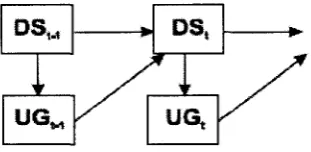
which the UG stands for the user goal and DS for the dialogue state. Initially, the dialogue
state is at time t and user goal at time t-1 which can also affect the user goal at time t.
DS^
»***w»
i ' UGM
/ /
OS,
* '
UGt
Figure 3.2: Dependency graph for Spoken Dialogue Management
Here, tour guide has to interpret the visitor behaviour to user goals which corresponds to
each dialogue state in low-level behavioural events. The basic connection of Bayesian
Network in this application is provided by the evidence that the initiated variable can pass
through the series of diverging connections until an intermediate variable is available. If there
exists, a common child for two or more parents nodes which can affect the state of the other
parent node. [Sang09] developed a Skilligent robot to control the robot behaviour during
run-time. Sub-goals are determined first by clustering similar features of state transition tuples
reconstructing learned networks and increment learning for increasing sub goals. They
further developed a simulated environment with skills like Dribbling-Box-Into-a-Goal
(DBIG) and Obstacle-Avoidance- While-Dribbling-Box (OAWDB) to validate the methods.
[Prodanov05] proposed a probabilistic model based on a Bayesian network framework for
error handling in human-robot spoken dialogue systems under adverse audio conditions. As
the system is based on different multimodal information sources with a complex combination
of spoken dialogue system, it fails to process the sub goals which in some exceptional case,
the entire system has to be reconstructed.
3.1.3 Supervised Learning and Markov Decision Process
Considering more complex systems, handcrafted dialogue managers needs iterative process
to test and is more expensive. Then, the action taken by the system may also affect the long
-time goal of the system for some unusual situation. In order to choose the actions Am
automatically, researcher came out with the idea of Supervised learning and
Markov-Decision process.
Supervised learning is a simplification techniques in which we can maintain the single
dialogue and the actions are learnt from the corpus. Though this techniques has lot of
limitations due to maintain single dialogue state, creating a dialog policy is difficult because
of collecting training data for the corpus. It simply learns the approximate data from a corpus
to create a policy, so the overall performance of the system will be limited. If wizard style
dialogues are included in the system, selecting proper actions at each time step is a tedious
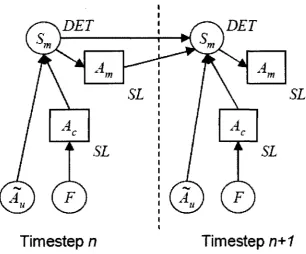
Timestep n Timestep n+1
Figure 3.3: Supervised Learning for action selection
In the figure, the node Am is trained on a corpus of dialogue states. A decision node Ac is
introduced to state which action to be taken next. Though supervised learning techniques are
a simple one, it does not perform effectively in human computer dialogue as the actions are
learnt from a corpus of training data. It will be quite expensive to test and maintain
applications developed using this technique.
Due to increase in complexity and level of uncertainty in decision making process, there
arise many questions which are not answerable. How to choose best actions which won't
affect the long- term goal? Sometimes, the current action gives a solution for long-term goal
but affects fewer states. How to calculate the exact value where the actions are affected?
How to make an assumption that this action doesn't affect the immediate and long-term
goals? How to solve the decision problem? Markov decision process takes care of all this
issues and automates all the processes. E. Levin et. al, introduced the Markov Decision
consists of four components namely, states, actions, transitions and rewards. The transition in
MDP takes care of which action to take for each state. Also, we have to mention the effective
of action for each state. It maintains a probability distribution over the dialogue states.
Rewards are the measures to compare different actions. The rewards are calculated for each
system action for each dialogue state. The solution of mdp is policy (n) which represents the
best action taken for each dialogue state for which the next resulting state, for each state and
action are specified.
Let S be the set the states and for each state s e S, there is an action taken As. Since, the
current state is known and the policy is represented as function of states which is given by,
Tt: S -> A. At time t, the system is initiated to enter a state st and choose an action at
determined by the policy Tt. For each action at time t, a reward is assigned to Tt. If the system
choose the best action, it will receive a positive reward else negative reward to choosing
wrong actions for each state. The system transitions from one state to another at time t+1
from t and so on. MDP maintains a probability over this transitions which is given by,
T(s', a, s) = P(st+i = s'| st = s, at = a)
Where, T (s\ a, s) denotes the probability to enter state s' at time t + 1, given state S and
action a at time t. For deterministic transitions and actions corresponding probabilities can
take only 0 or 1 values. The actual goal of the system is to find the policy %\ which
maximizes the total reward [Ragni06].
R=Sr= Or r + 1
In [Levin20], MDP approach has been tested for learning the strategy of airline task
information system (ATIS). They used the concept of "Day and Month Dialog', in which the
interactions to reserve a ticket. To accomplish this, the objective function is introduced as
follows.
C = Wi {Ni) + Wr {Nr} + Wa {MNo)) + Wm (Fs)
Where, C is the expected cost to achieve the goal and W is the weight to determine the
tradeoffs between the costs. Nj is the number of interactions, Nr denotes the number of errors
obtained from expected value and Nf is the duration of achieving the goal. A set of possible
actions are also given to the system for the day and month values. While executing the
system, it first executes the actions for the values and it then it starts the speech recognition
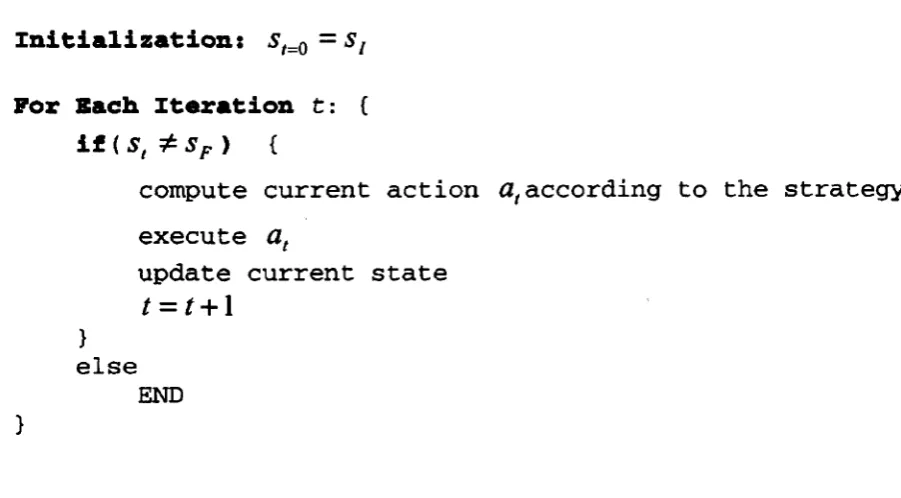
system to get the user response. The description of the system is as follows:
Initialization:
S
t=0=
S
{For Each Iteration
t:
{
LtiS^Sp)
{
compute current action a, according to the
strategy-execute
a
tupdate current state
t = t + \
}
else
END
}
Figure 3.4: Sequential decision Process of ATIS
A dialogue strategy of MDP specifies what action to be performed next for each state.
optimal strategy. The first assumption is that assigning probabilistic model to the state
transitions. According to transition probabilities, while in state st at time t an action is taken
at. Then it transitions to st+i state which is given by,
P(st+i | st, st_i,...., so, at, at_i,..., ao) = P(st+i | st, at)
The second assumption relates to the modelling cost of the system in which the system
receives a feedback cost ct when an action at is executed at state st.
P(ct | st, st-i,...., So, at, at.i,..., ao) = P(ct | st, at)
The dialogue session mentioned in this model is the path in the state space between the
initial and end state which is illustrated in the following diagram [Levin20].
Strategy 1:
C^lWj+2-Wp
[Young20] introduced a probabilities framework for spoken dialogue systems by making
an assumption on the behaviour of the system as Markov Decision Process. He used
sampling method to obtain optimal strategy for the model. [Roy20] proposed a method to
handle noisy and ambiguous utterances from the user by inverting the dialogue state to
represent the user intentions. He used a mobile robot called Florence Nightingale (FLO), a
nursing home assistant to carry out experiments. The MDP is specified by the following,
• A set of states SE {SI,S2, ,sm}
• A set of actions AE {ai, &2, •••-, am}
• A set of transition probabilities T(s', a, s) = P(s' | s,a)
• A set of rewards R : S x A -> R
• An initial state s0
With the increase in different methods of MDP, increases the complexity and limitations.
Even though, MDP try to find the optimal strategy of the application by interacting
effectively with the users, there are fond of reacting to recognition errors and lack in domain
knowledge. The main drawback of MDP is that, it makes decisions based on the current state
alone which cannot be possible in real-world applications.
3.1.4 Semi-Markov Decision Process
[Cuayahuitl09] proposed a hierarchical reinforcement learning to evaluate the dialogue
behaviours of a simulated agent in a simulated environment. He used Semi-Markov Decision
Process to learn the dialogue behaviours in a realistic conversational environment. He mainly
concentrated on the dialog manager part of the spoken dialogue system as the main principle
of the system is to choose best action which results in the change of dialogue states. The
agent in this model learns the behaviour by interacting with the environment, maximizes the
reward model, where the actions are mapped to situations by aiming long-term goal. They
solve an MDP by mapping the current state st to an action at correspond to the dialogue
policy 7i*(st) = arg max Q*(st, at). The Q function denoted the cumulative rewards for each
state - action pair. His proposed method generated both coherent and distorted conversations
which are used as test bed for information-seeking spoken dialogue systems. It consists of
two simulation models namely, ASR error simulation and Simulated user behaviour. The
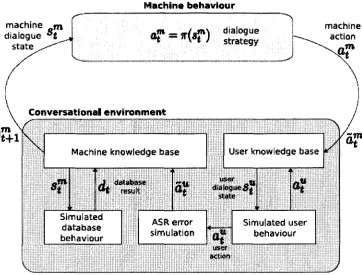
figure 9 shows the execution of simulated environment. It tracks the machine behaviour
using the dialogue strategy and chooses actions accordingly, updating the conversational
Machine behaviour
machine m
dialogue at
state^-""'
Of
*r(sf)
dial05ue strategymachine action
4t
Conversational environment
Machine knowledge base
8 rn database result
Simulated database
behaviour
User knowledge base
user „ <Jia!ogue5f
state B
ASR error simulation user action
«?
Simulated user behaviourFigure 3.7: The simulated environment interaction for Human-Machine conversations.
A human-machine dialogue is modelled by the perception and actions of both conversant.
The user respond with errors are distorted into ASR error simulation and then it is sent to the
knowledge base. The conversant at time t, observes the current knowledge state, selects the
appropriate dialogue type to respond, update the knowledge rich state. The dialogue control
is modelled as Semi-Markov Decision Process (SMDP) in discrete time is denoted as
M = (S, A, T, R). S denotes the set of states, A denotes the set of actions, T denotes the
transition from state s to next state s' with a probability P(s',x | s,a) and R denotes the reward
function for choosing an action. The variable T denotes the time-steps taken to execute an
This method is applied to flight booking domain and travel planning domain to cany out
several levels of testing to learn the dialogue agents outperform in deterministic behaviour in
realistic environment. Even though there is lack in training data, finally they proved that
simulated agents make fewer errors in realistic environment.
3.1.5 Partially Observable Markov Decision Process
Partially Observable Markov Decision Process (POMDP) is an extension to Markov
Decision Process, which is introduced into dialogue management to overcome the issues
addressed by MDPs such as uncertainty, choosing actions upon current state and
experiencing speech act errors in noisy environment. Pomdp concept was developed in 1965
by Astrom, which was basically used in the field of engineering. Later, researchers
incorporate this concept to Artificial Intelligence for analysing the behaviour of agents or
robot using sensors. Since MDP failed to handle ambiguous data, researchers tried to
incorporate Pomdp concept into dialogue management as it maintains probability distribution
over MDP dialogue states called belief state and set of observations to choose a best action
am for each dialogue state st at particular time t. The dialog policy n is based on the belief
state rather than the underlying state. [Roy20] used a nursing home assistant robot
application to compare the results of MDP and POMDP and proved that POMDP performs
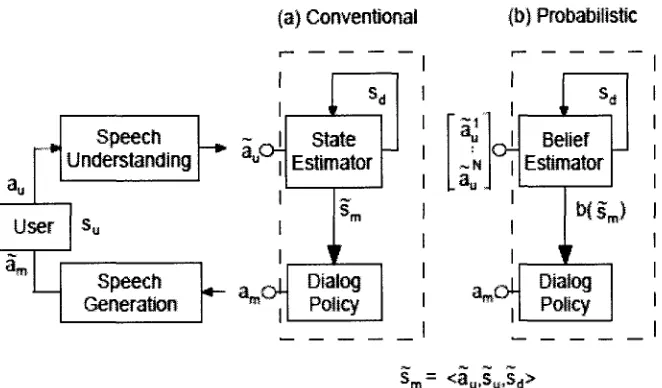
better than MDP in some situations and in noisy environment. The following figure shows
(a) Conventional (b) Probabilistic 4l .,,,# User «.-3ro Speech Understanding
• ^ u
Speech Generation
apf
Estimator State* m J
-a d -
Dia,°9
m ^ Policy
K
CH Estimator Belief
I
mj
tu Dialog
" ^ Policy
Sm = <3u.Sy.Sd>
Figure 3.8: Structure of a Spoken Dialog System
The above figure shows that the conventional dialogue manager maintains a single state
estimation, whereas the probabilistic dialogue manager maintains a distribution over all
dialogue states. The tilde on the system state and actions represents some noise in
environment. This framework provides a mechanism for modelling uncertainty, i.e., what
actually the user requires.
POMDP is defines the set of tuples same as MDP, in addition it has observation O and
observation function Z which is given as {S, A, T, R, O, Z}.
S - set of states
Am - set of actions that a machine may take
T - transition probability, T (s' | s, a)
R - reward for each action,
O - set of observations
Z - observation probability, p (o | s', a)
X - Discount factor (0 < X < 1)
J |
"™™"""™™| | > r
»#»-if
j f j Belief I Policy | |
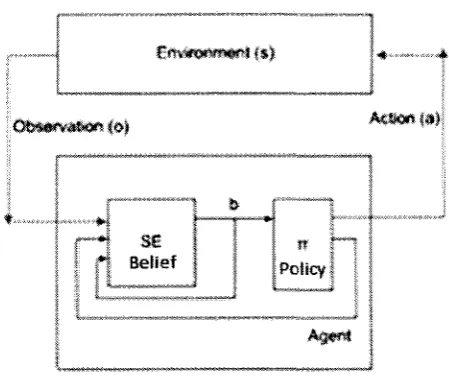
Figure 3.9: The agent - Environment Interaction
At time t, the systems will be in some unobserved state s s S [Young06]. The initial state
s is not known exactly, so Pomdp based systems maintains a probability distribution over the
machine states at time t is known as belief state, b(s). The system selects an action a e A,
based on the current belief state b and receives a reward r(s, a) and transitions to a new
unobserved state s . The system receives an observation o ' e O depends on s' and a. Finally,
the belief state b is updated based on o' and a at a time step t, which is illustrated below.
ti(s) = p(s\o
1a^b)
p(o
!\sf, a, b)p(sf \a, h)
pioy,a)^sp(J\a,b,s)p(s\a,b)
p(o'W, afE
s„sP¥\
ai
s)h(s)
p((^\a, b)
The machine receives a reward r(bt, am,t) at each time step t. So, the expected reward over
belief states is given by,
P(f>t>
amt) = T,
bt(
S)
r(
S>
amt)
seS
The return R is computed by cumulative, infinite horizon and discounted reward.
r=0 /=0 seS
[Roy20] proposed a probabilistic technique for spoken dialogue management. He
compared MDP and POMDP by applying on a home nursing assistant robot. First, he applied
MDP method to analyse how the system performs in the noisy environment. Moreover, the
voice reliability of the mobile robot is poor; MDP does not accurately understand the user
goals and the responses are not related to the user requirement. The solution of MDP is
neither sufficient nor robust. To increase the performance of the mobile robot and perform
partial observability on the dialogue states, Roy et. al introduced POMDP to improve the
performance of mobile robot. He also track step by step process of performance of POMDP
reacting to the dialog states. He also tested with noisy environment, but the results of belief
state values and confidence scores remain the same. Further, it replaces the initial state s0
all belief states. The performance is reduced when dealing with uncertainty and finding
optimal policy for all POMDP applications are computationally expensive. He further
introduced Augmented POMDP by applying some restriction on the belief states in order to
deal with uncertainty problems.
[Pineau03] introduces the point-based value iteration algorithms (PBVI) for POMDP
planning. He selected few belief values, evaluated an exact value iteration solution and
tracked the solution for only those selected belief points. He applied this technique in a Laser
tag application and the results showed that PBVI for POMDP can be applied for large
systems.
In 2004, Poupart introduced a scalable algorithm for large POMDPs by combining Value
Directed Compression (VDC) technique with Bounded Policy Iteration (BPI). He added that
value functions of very good policies are often represented using small vectors. So, the
application can perform better only if the dialogue states are less than 1000. By using this
technique for POMDP, the scalability issue and complexity of the policies are reduced. He
tested these techniques with some network management problem which has 33 million
dialogue states [Poupart04].
In 2005, (Jason, Poupart and Young) introduced a framework for discrete and continuous
observation component for POMDP. They used a simulated dialogue test bed for travel
domain to prove that the optimal policy for continuous POMDP outperforms previous
traditional approaches. Also, the proposed method improved the performance of handcrafted
dialogue manager by incorporating confidence score and belief monitoring. This method
takes additional information of confidence score into account and creates a policy for
information for planning. By contrast, MDP uses lot of confidence score information for
planning but does not have belief monitoring [William05]. The influence diagram of
continuous POMDP is given below.
Ttmestep n ' Timestep n+1
Figure 3.10: Influence diagram of continuous POMDP
In the above figure, the shaded circle shows that the system is in unobserved state and the
dotted box indicates the composite POMDP state, s. The tilde symbol in user action au
denotes that the user may in noisy environment. The system actions am depends on the belief
state b(s), not the unobserved state.
In 2006, William et. al. extended the POMDP with continuous observation for Pizza
ordering domain. The point-based value iteration algorithm used to measure the performance
of this system is Perseus [Spaan04]. To speed up the system processing, Perseus heuristically
selects a small set of representative belief points. They evaluated the confidence score by
assuming two distributions namely, correct and incorrect recognition. Figure 13, shows an
column shows a sample dialogue, confidence score and how the speech recognisor
understand the utterance (shown in brackets). The second column shows how the dialogue
manager understands the user utterance by tracking the dialogue states and confidence
bucket. The third column shows how the POMDP belief state tracks the same dialogue
[William06].
System/User/ASR Traditional dialogue state P0MDP belief state
Prior to start of dialogue
S: How can I fcelp you? U: A smafl peppefoni pizza
|a smaB pepperoni pizza]
Ctmfkimw score: CM
S: And what type of crust? U: Uh |ust noitnai
iiarge normal]
Confidence score: OM
mm: l value: <empty> confidence: «empiy> > mze: { value: small confidence: ) I size: large f?] confidence: fow |?]
>
Smi Med Lrg
Sirt Wed Lrg
$m! Med Lrg
Figure 3.11: Example conversation in Pizza- Ordering domain.
In 2007, Bui with his colleagues proposed a DDN-POMDP approach which focuses on
real- time online belief state for affective frame-based models. Their experiments proved
that, this approach outperforms 3 handcrafted dialogue managers, handle large number of
slots and able to keep track of user's affective state [Bui07]. [Thomson07] proposed a new
about the new policy optimization based on grid- based Q-learning with a summary of belief
space. This type of system allows real time conversation between the user and the system by
recording new dialogues. In summary POMDP, the original actions and belief space are
called master actions and master space respectively, while the summary space actions and
belief space are called summary actions and summary space respectively. When the
conversation starts between the user and system, the system chooses an action at each point
of time which is mapped to summary belief space. The nearest summary point in the grid is
determined and the optimal summary action given by that point is chosen. The experiments
showed that this policy works well with human user as it performed 90% well even without
accessing the training data.
Bui developed a practical dialogue manager using POMDP in 2007 [Bui et. al.07]. They
applied factored POMDP model in three applications such as QA dialogue system, Virtual
guide and route navigation system. The basic goal is to improve the handcrafted policies with
POMDP approach. To accomplish the task, they developed a software toolkit to conduct
experiments and track the performance of this approach. The results of these applications are
compared with the handcrafted dialog managers using two different solvers to evaluate the
performance of the system. In 2008, Jason extended the POMDP approach for tracking
multiple dialogue states using ASR N-best list [Jason08]. In 2010, Thomson and Young
proposed a new framework of POMDP known as Bayesian update of dialogue state using
loopy belief propagation (LBP) algorithm. This approach has been the most effective of
spoken dialog systems because the prompts can be designed to elicit highly restricted user
responses. However, the choice questions for the user are limited. This approach has been