Yousef Agha N*, Haidar S, Al‐Khayat M.A
Dept. of Pharmaceutical Chemistry and Quality control, Faculty of Pharmacy, University of Damascus, Syria.
*Corresponding author’s E-mail:[email protected]
Accepted on: 03-10-2013; Finalized on: 30-11-2013. ABSTRACT
A simple, rapid, and precise reversed-phase high performance liquid chromatographic (RP-HPLC) method has been developed and validated for the determination and separation of Benzophenone-3, Octinoxate, Octisalate and Octocrylene in sunscreen products. Chromatographic separation of Benzophenone-3, Octinoxate, Octisalate and Octocrylene was achieved on a reverse phase C18 column using a mobile phase consisting of methanol: water in the ratio of 85:15 v/v. The mobile phase was pumped at a flow rate of 1 ml /min and the eluents were monitored at 300 nm. The method was successfully validated in accordance to ICH guidelines acceptance criteria for (linearity, accuracy, precision, selectivity, limit of detection, limit of quantification) all validation parameters were within the acceptance range. The proposed method was found to be suitable and accurate for quantitative determination of Benzophenone-3, Octinoxate, Octisalate and Octocrylene in sunscreen creams and it can be used for the quality control of formulation products.
Keywords: Benzophenone-3, Creams, Octinoxate, Octisalate, Octocrylene, RP-HPLC, Validation.
INTRODUCTION
uman exposure to solar radiation has been shown to be strongly associated with skin damage1, skin ageing and skin cancer2,3, consequently sun protection, through the application of sunscreens are important issues with the improvement of the body defense systems. 4
The majority of sunscreen formulations on the market contain UV absorbers which have been primarily directed at protecting against UVB-induced sunburn5 and DNA damage. 6,7
The active sun screening agents are divided in two groups: organic and inorganic.8 The organic compounds protect the skin by absorbing UV radiation, and inorganic compounds scatter UV radiation. 8,10
Octinoxate: the most popular UV filter in sunscreens worldwide 9 protects against UVB (280- 315nm) and also it is oil soluble.10 Octocrylene: is an viscous oil soluble liquid with pale yellow to yellow color and Benzophenone-3 which is a yellow oil soluble powder both are relatively weak UV filters protect against (UVA & UVB, 280-400 nm) which added to the sunscreen formulations for higher SPF and to stabilize the other UV filters in the formulation.10
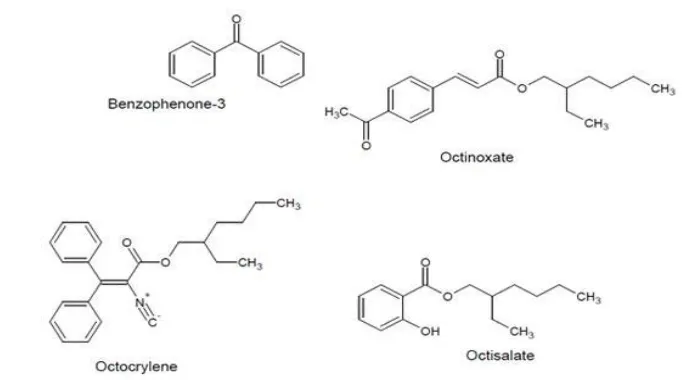
Octylsalicylate (Octisalate): is colorless, viscous oil soluble liquid, relatively weak UV filter protects against UVB (280-315) nm and It must be used in high concentrations. 10 The chemical structure of Benzophenone-3, Octocrylene, Octinoxate and Octisalate 11 are shown in figure 1.
Figure 1: Chemical structure of Octocrylene, Benzophenone-3, Octinoxate and Octisalate.
Development and Validation of RP-HPLC Method for Analysis of Four UV Filters in
Sunscreen Products
H
MATERIALS AND METHODS
Instrumentation
The analysis of drug was carried out on a SHIMADZU HPLC system equipped with a reverse phase C18 column (250x4.6mm, 5µm in particle size), a 20µl injection loop and SPD-M 10A prominence PDA detector, Degasser DGU-14 A.
Reagents and solutions
Reference standards of Benzophenone-3, Octinoxate, Octisalate and Octocrylene HPLC grade water, 2-propanol and methanol were purchased from Merck Ltd., and Shamlab.
Chromatographic conditions
Chromatographic separation of Benzophenone-3, Octinoxate, Octisalate and Octocrylene was achieved on a reverse phase C18 column using a mobile phase consisting of methanol: water in the ratio of 85:15 v/v. The mobile phase was pumped at a flow rate of 1 mL/min and the eluents were monitored at 300 nm.
Stock solution
Accurately weighed 75 mg of each of the following: Benzophenone-3, Octinoxate, Octisalate and Octocrylene were transferred to a 100 mL volumetric flask, 50 mL of methanol 85% and 2 mL of 2- propanol were added and allowed to sonicate for 15 min and finally volume was made up to the mark by methanol 85%.
Standard stock solution of mix standard of these 4 compounds (0.75 mg\mL) was prepared.
Working solutions were prepared daily by appropriate dilution of this stock solution.
Optimization of the chromatographic Conditions:
Benzophenone-3, Octinoxate, Octisalate and Octocrylene are non-polar which preferably analyzed by reverse phase columns. Among C8 and C18, C18 column was selected. Non-polar compound is very attractive with reverse phase columns. So the elution of the compound from the column was influenced by polar mobile phase. Mixture methanol: water in the ratio of 85:15 v/v was selected as mobile phase and the effect of the composition of mobile phase on the retention times of Benzophenone-3, Octinoxate, Octisalate and Octocrylene was thoroughly investigated.
The chromatographic conditions were optimized through several trials to achieve good resolution and symmetric peak shapes, as well as a short run time. It was found that a mixture of methanol: water in the ratio of 85:15 v/v was appropriate.
Procedure
A mixture of methanol: water in the ratio of 85:15 v/v was found to be the most suitable mobile phase for ideal separation of Benzophenone-3, Octinoxate, Octisalate
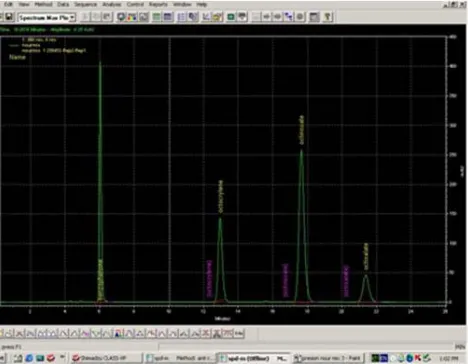
through a 0.45 µm membrane filter and sonicated before use. It was pumped through the column at a flow rate of 1mL/min. The column was equilibrated by pumping the mobile phase through the column for at least 30 min prior to the injection of each drug solution. The detection of each drug was monitored at 300nm. The run time was set at 25 min. Under these optimized chromatographic conditions the retention times obtained for the Benzophenone-3, Octocrylene, Octinoxate and Octisalate were 6.01 min, 13.4 min, 17.3 min and 21.4 min respectively. Atypical chromatogram showing the separation of the compounds is given in Figure 2.
Figure 2: Typical chromatogram of Benzophenone-3, Octocrylene, Octinoxate and Octisalate
Validation procedure
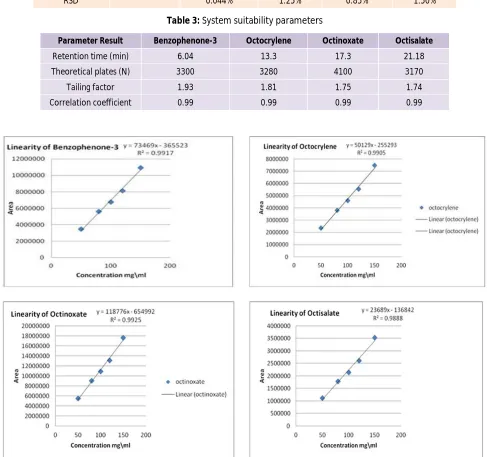
The method was validated according to ICH guidelines12 for linearity, precision (repeatability and intermediate precision), accuracy, specificity, and system suitability. Standard plots were constructed with five concentrations in the range of 0.05 mg\ml to 0.15 mg\ml to test linearity. The peaks area of Benzophenone-3, Octinoxate, Octisalate and Octocrylene were plotted against the concentrations to obtain the linearity plots which are given in Figure 3.
To check the degree of accuracy of the method, recovery studies were performed in triplet by standard addition method at 80%, 100% and 120% concentration levels. Results of recovery studies are shown in Table 1.
The precision of the assay was studied with respect to both repeatability and intermediate precision. The different analysts’ variability or precision data are summarized in Table 2.
Specificity of the method was found out through non‐interference of the blank, excipients peaks and standard peak.
Table 1: Results of recovery studies
Mix standards concentrations
Recovery of Benzophenone-3
Recovery of
Octocrylene Recovery of Octinoxate Recovery of Octisalate
80% 100% 101% 99.67% 99.8%
100% 100% 100% 99.7% 100%
120% 98% 100.2% 101% 101%
Mean recovery 99% 100.3% 100.2% 100.3% Table 2: The different analyst’s variability or precision data
Analysts Mix standards concentrations
Recovery of Benzophenone-3
Recovery of Octocrylene
Recovery of Octinoxate
Recovery of Octisalate
A 80% 100% 102% 99.67% 99.9%
B 100% 100% 99% 100.3% 102%
C 120% 99.9% 100.2% 101% 100.8%
Mean recovery 100% 100.3% 100.4% 101 %
RSD 0.044% 1.25% 0.85% 1.50%
Table 3: System suitability parameters
Parameter Result Benzophenone-3 Octocrylene Octinoxate Octisalate
Retention time (min) 6.04 13.3 17.3 21.18
Theoretical plates (N) 3300 3280 4100 3170
Tailing factor 1.93 1.81 1.75 1.74
Correlation coefficient 0.99 0.99 0.99 0.99
Estimation of Benzophenone-3, Octocrylene, Octinoxate and Octisalate in sunscreen creams
Five commercial brands of sunscreen creams were chosen for testing the suitability of the proposed method to estimate Benzophenone-3, Octocrylene, Octinoxate and Octisalate in sunscreen formulations.
Sample of 60 mg from each cream was weighed which sampled from the top, middle and end of the tube and
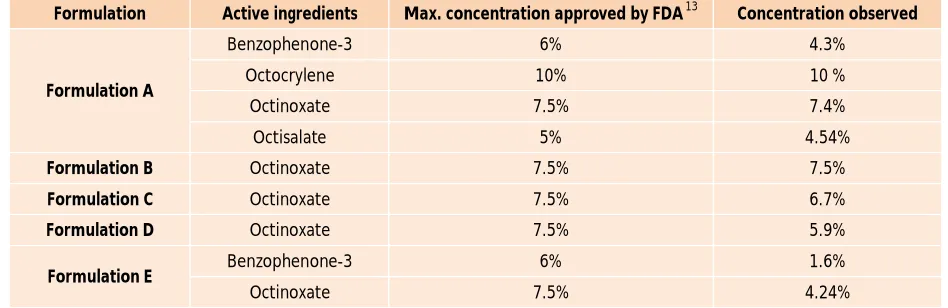
then was transferred into a 100 ml volumetric flask , added 2 mL 2-propanol and dissolved in 50 mL methanol 85% by electric magnetic motor. The contents of each flask were sonicated for 15 min and the volume made up to 100 mL and mix well, each solution was filtered through a 0.45µ membrane filter. These solutions were injected into the column and the amounts of the drug present in each the cream was calculated. The relevant results are furnished in Table 4.
Table 4: Assay and recovery studies
Formulation Active ingredients Max. concentration approved by FDA 13 Concentration observed
Formulation A
Benzophenone-3 6% 4.3%
Octocrylene 10% 10 %
Octinoxate 7.5% 7.4%
Octisalate 5% 4.54%
Formulation B Octinoxate 7.5% 7.5%
Formulation C Octinoxate 7.5% 6.7%
Formulation D Octinoxate 7.5% 5.9%
Formulation E Benzophenone-3 6% 1.6%
Octinoxate 7.5% 4.24%
RESULTS AND DISSCUSION
In the proposed method, the retention times of Benzophenone, Octocrylene, Octinoxate and Octisalate were found to be 6.01 min, 13.4 min, 17.3 min and 21.4 min respectively. The numbers of theoretical plates calculated were 3300, 3280, 4100 and 3170 respectively, which indicates efficient performance of the column. 12 The high percentages of recoveries indicate that the proposed method is highly accurate. The precision (measurements of different analysts) results showed good reproducibility with percent relative standard deviation (RSD %) are below 2.0. This indicated that the method is highly precised. The results of assay indicate that the amounts of each active ingredient in the sunscreen products are within the requirements of the FDA. 13
No interfering peaks were found in the chromatogram of the formulation within the run time indicating that excipients used in creams formulation did not interfere with the estimation of the active ingredients by the proposed HPLC method. The results were found to be accurate, reproducible, free from interference and better than the earlier reported methods.
Most of the earlier reported analytical methods were used UV\visible detector 14-18 with column C8 or C18 in addition to the mobile phases containing acetonitrile 17-18 with buffer 14-17, while this method is used PDA detector to ensure the purity of peaks and the selectivity of method, also the method has been used mobile phase containing cheap solution (methanol) compared with the price of acetonitrile. Also it is easy to prepare the mobile phase, because it does not need to add buffer and adjust
to clean the column between each analysis, however resolution values achieved were acceptable.
CONCLUSION
A simple, accurate, and precise HPLC method has been developed for the determination and separation of Benzophenone-3, Octocrylene, Octinoxate and Octisalate in sunscreen products. The proposed method was found to be suitable and accurate for quantitative determination of Benzophenone-3, Octocrylene, Octinoxate and Octisalate in sunscreen preparations and it can be used for the quality control of formulation products.
REFERENCES
1. Clydesdale GJ, Dandie GW, Muller HK, Ultraviolet light induced injury: immunological and inflammatory effects, Immunol Cell Biol, 79(6), 2001, 547-568.
2. Elwood JM, Jopson J, Melanoma and sun exposure: an overview of published studies, Int. J. Cancer, 73, 1997, 198– 203.
3. Ulrich SE, Sunlight and skin cancer: Lessons from the immune system, Mol. Carcinog, 46(8), 2007, 629-33.
4. WHO media centre, Ultraviolet radiation and human health, fact sheet N◦ 305, December, 2009.
5. Trautinger F, Mechanisms of photo damage of the skin and its functional consequences for skin ageing, Clin. Exp. Dermatol, 26, 2001, 573–577.
6. Griffiths HR, Mistry P, Herbert KE, Lunec J, Molecular and cellular effects of ultraviolet light-induced genotoxicity, Crit. Rev. Clin. Lab. Sci., 35, 1998, 189–237.
8. Latha MS, Martis J, Shobha V, Sham SR, Bangera S, Krishnankutty B, Bellary S, Varughese S, Rao P, Kumar NBR, Sunscreening Agents, J Clin Aesthet Dermatol, 6(1), 2013, 16–26.
9. Venditti E, Spadoni T, Tiano L, Astolfi P, Greci L, Littarru GP, Damiani E, In vitro photostability and photo protection studies of a novel multi-active UV-absorber, Elsevier, 2008.
10. Paye M, Barel AO, Maibach HI, Hand book of cosmetic science and technology, second edition, Marcel Dekker, New York, USA , 2001, 451-455.
11. Salvador A, Chisvert A, Analysis of cosmetic product, first edition, Elservier,. U.K., 2007, Pages 97-100 -101-102-103.
12. ICH Q2 (R1) Validation of Analytical procedures: Text and Methodology, 1996.
13. Code of Federal Regulations, Title 21, Food and drug, chapter I- Food and drug administration, Department of health and human services, subchapter D-Drugs for human use, Parts 352 Sunscreen drug products for over the counter human use: SubpartB- Sunscreen active ingredients, April, 2013.
14. Wharton M, Geary M, O'Connor N, Murphy B, A rapid High Performance Liquid Chromatographic (HPLC) method for the simultaneous determination of seven UV filters found in sunscreen and cosmetics, Int J Cosmet Sci., 33(2), 2011, 164-70.
15. Yao X, Zheng X, Qin X, Qi Q, Determination of sunscreen agents in cosmetic products by reversed-phase high performance liquid chromatography, Se Pu., 16(3), 1998, 223-225.
16. Nyeborg M, Pissavini M, Lemasson Y, Doucet O, Validation of HPLC method for the simultaneous and quantitative determination of 12 UV-filters in cosmetics., Int J Cosmet Sci., 32(1), 2010, 47-53.
17. Simeoni S, Tursilli R, Bianchi A, Scalia S, Assay of common sunscreen agents in suncare products by high-performance liquid chromatography on a cyanopropyl-bonded silica column, J Pharm Biomed Anal, 38(2), 2005, 250-255.
18. Kedor-Hackmann ER, De Lourdes Pérez González ML, Singh AK, Santoro MI, Validation of a HPLC method for simultaneous determination of five sunscreens in lotion preparation, Int J Cosmet Sci, 28(3), 2006, 219-224.