Lucrări ştiinţifice Zootehnie şi Biotehnologii, vol. 42 (1) (2009), Timişoara
BIOPRODUCTIVE EFFECT OF FEED ENERGO-PROTEIC
RATIO ON CAPONS AND PULLETS IN RELATION WITH
THE CARCASE CUTTING PARTS
EFECTUL BIOPRODUCTIV A RAPORTULUI
ENERGO-PROTEIC DIN HRANA ASUPRA CLAPONILOR
Ş
I A
PUICU
Ţ
ELOR DE CARNE ÎN RELA
Ţ
IE CU P
Ă
R
Ţ
ILE
ANATOMICE ALE CARCASELOR
P. OPREA1 , ANA DRIHA 2, D. DRINCEANU 2, C. JULEAN 2
1A.P.A.I.A.CL Arad,.petru_opr@ yahoo.com
2Faculty of Animal Sciences and Biotechnologies, Timişoara, România
In this experiment we have studied the bioproductives effects of energy-protein ratio at diferents levels of crude protein and metabolizabel energy, concerining whith broiler pulets and capons.The experiments was carried out on 80 fowls divided in four experimental groups ; (L1.1, L1.2, L1.3, and L1.3).In this experiment 40 subiects was capons and 40 was pullets.The used hybrid was Ross 308 because of his good versatility and productivity. The experiment was carried out in two phases of feeding program. First feeding stage was for gowing and begun at 54 days and was finished at 110 days. Second feeding stage was for finishing and begun at 111 days and finished at 130 days. At 84 days, we are proceeding for assessment slaughtering; therefore, we choose randomly 5 capons and 5 pullets for each groups. After slaughtering was made cutting by anatomical parts. Finaly was also carried out at slaughtering and cutting by anatomical parts.For all period we weighing all fowls and calculated feed conversion and mortality.
Keywords: capons, pullets, energy-protein ratio, bioproductive indicces, compensatory growth
Introduction
In the context of economy globalization, of adhesion to UE, and the apparition of a competition market, the obtaining of broiler pullets and the capons carcass of better quality, the assurance of commercial aspect of products and a competitive price of these represents an essential condition for the development in Romania of poultry meat production (Ana Driha 2000).
Bibliography is very scanty relating capons topics. It knows about capons such as symbolic meat for Christmas and Easter that is increase importance in countries like France, Italy, Portugal, U.S.A. and even China (Garcia, E. M. 2007), (Horst van der, Florence 2002).
In other point of view moderns hybrids has strong capacity of compensatory growth and channeling of nutrients toward strategically deposits such as breast muscle and thighs muscles(Larbier M., Leclercq B. 1994). Even when is feeding with low concentrated recipes ad libitum chicken is able to gowning and deposit nutrients in body mass.(Drinceanu, D. 1994), (Leeson S. and Summers J.D., 1997) (Grossu Doina Valentina and all. 2004)
Materials and Methods
The experiment was performed in Avicola-Petra Arad.
There has assigned randomly 40 pullets and 40 capons in four groups.Bird has been choosing randomly from a large group of bird at the age of 48 days. Male has prepared for castrating operation receiving before for 5 days K vitamin in drinking water. Before operating, male is fasting for 36 hours. Method for castrating issurgical bilateral .(Stromberg, L., 1998)
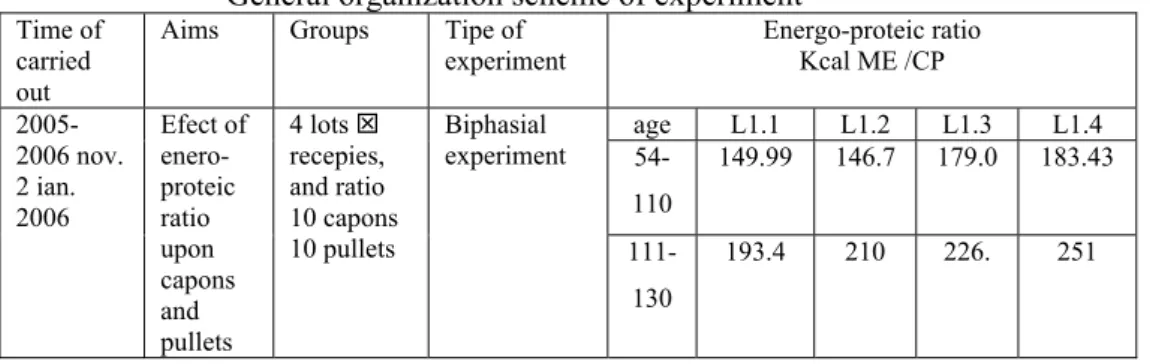
Receipts was izoproteic, varying level of each ratio rapport. Each group received the same receipt for capons and for pullets. Schedule for feeding is maintained from 54 to 110 days. At the 111 days has changed receipts for rearing, with finishing formula.Energo-proteic ratio was according experiment scheme of table number 1.
Statistical assesments was brought about whith Snedecor (F) test, multiple Students Test and Tukey test.
Table 1
General organization scheme of experimentTime of carried out
Aims Groups Tipe of
experiment Energo-proteic ratio Kcal ME /CP
2005-2006 nov. 2 ian. 2006
Efect of enero-proteic ratio upon capons and pullets
4 lots recepies, and ratio 10 capons 10 pullets
Biphasial experiment
age L1.1 L1.2 L1.3 L1.4
54-110
149.99 146.7 179.0 183.43
111-130
193.4 210 226. 251
Results and Discussion
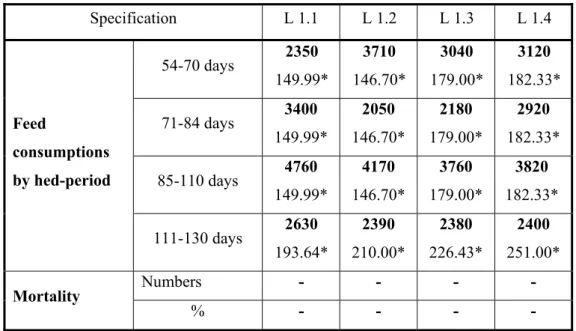
Feeding consume was according whith table 2 been high at groups L1.1 and L1.2, the same for pullet and capons. Groups L1.3 and L1.4 which received a high level of energy, consume low level of feed; feed conversion was 2,2 at group 2.3.
In the first week, pullets surpass the capons in weighting. After convalescence capons surpass pullets. Between the ages of 71-84 days appear compensatory growth phenomena at group L1.1. However group L1.4 is the best in weighing. Because of high level of protein at the group L1.1 appear problems with litter and feet-pad
At 84 days, we are proceeding for assesment slaughtering; therefore, we choose randomly 5 capons and 5 pullets for each groups. After slaughtering was made cutting by anatomical parts. At slaughtering assessment, group L1.4 of capons and pullets was weightier breast like others groups. At the same time, group L1.3 has largest thighs. That show us that level of energy is limitative factor in growth of anatomical cuttings, energy enhancing muscle mass.
Following slaughtering assessment remaining birds was feed with the same schedule up to 110 days. It was maintain the same tendency of feed conversion for a group L1.1 versus group L1.4. Birds lined the weight and statistical assessments not observe significant differences for body mass.
At 111 days has changed feed with finishing. France tradition used 10-15% of powder skimmed milk for blanching the meat. We test also this effect. At a group L1.3 and L1.4 on slaughtered carcass we observed pale meat. It is very probably that excessive calcium reduce iron absorption.
Table 2 Feed consumptions and mortality of capons and pullets
Specification L 1.1 L 1.2 L 1.3 L 1.4
Feed
consumptions by hed-period
54-70 days 2350 149.99*
3710 146.70*
3040 179.00*
3120 182.33*
71-84 days 3400 149.99*
2050 146.70*
2180 179.00*
2920 182.33*
85-110 days 4760 149.99*
4170 146.70*
3760 179.00*
3820 182.33*
111-130 days 2630 193.64*
2390 210.00*
2380 226.43*
2400 251.00*
Mortality Numbers - - - -
% - - - -
* energy-protein ratio (EM/CP)
1000 2000 3000 4000 5000 6000 7000
70 84 110 130
L 1.1 L 1.2
L 1.3 L 1.4
age (days)
body mass(gr)
1.5 3.5 5.5 7.5 9.5 11.5 13.5
fe
ed consumpt
ion (
k
g NC/
kg gai
n
)
54-70 70-84 84-110 110-130
L 1.1 L 1.2
L 1.3 L 1.4
age (days)
Figure 2. Feed consumption stright-run (mixted groups)
0 500 1000 1500 2000 2500
L 1.1 C L 1.1 P L 1.2 C L 1.2 P L 1.3 C L 2.3 P L 2.4 C L 1.4 P bone-in brest thighs back-neck wings abdominal fat pad
ca
rca
ss an
ato
m
ical
cu
t par
ts
(g)
Figure 3. Weight for commercial cuttings of carcasses, at 130 days of age
LEGEND Correlation brest-thighs Coreltation wings-back Corelaţion fat-thighs
Conclusions
First conclusion it namely both capons and pullets has a good compensatory growth, but capons in the first two week after caponization are surgical affected, compensated better after 70 days of age.
Energo-proteic ratio wide (179-183) (but whith good level of energy 3150 kcal) obtain best daily gain 86,4 gr/day. Goup L1,1 which was feed whith narow energo-proteic ratio, but with low level of energy (2596 kcal ME) at group 1 running slow the compensatory-effect probably because high level of celulose wich decrease digestibility.
Puletts seems to be more sensitive to energo-proteic ratio because are in a puberty age, and accumulated energy for reproduction period been semnificative heavy (p=0,1%) at group 4.whith energy-protein ratio 182,3
Both capons and pullets show good response at a high level of energy 3080 kcal ME/kg which is in group L1.4.
Energy-protein ratio not influence very much at this age, weight of anatomical cut parts of carcass, but breast and thighs is significantly weighty at group L 1.4 which is feed with high level of energy.
Hence it is necessary to continue this kind of experiences because new post-industrial agriculture demands a new product like Capon and pullet.
References
1. Drinceanu, D.,1994, Alimentaţia animalelor; Editura Euroart, Timisoara 2. Driha, Ana 2000, Curs de tehnologia creşterii păsărilor; Editura Mirton, Timişoara
3. Garcia, E.M.,2007, Capones y pulardas, Ed. Provial, Spania
4. Horst van der, Florence, 2002, La production du chapon, Ed. ITAVI, Paris 5. Larbier, M. Leclercq, B.1994, Nutriţia şi alimentaţia păsărărilor, Editura Alutus Bucureşti
6. Grossu Doina Valentina, Burlacu R., Burlacu G., Marinescu A.G., 2004, Modelarea matematică a proceselor de metabolism la păsări Editura Cartea Universitară Bucureşti
7. Leeson, S., and Summers, J.D., (1997) Comercial Poultry Nutrition Universty Books Guelph Ontario Canada