ISSN:1991-8178
Australian Journal of Basic and Applied Sciences
Journal home page: www.ajbasweb.com
Corresponding Author: Suzani Mohamad Samuri, Computing Department, Faculty of Arts, Computing and Creative Industry, Sultan Idris Education University, 35900 Tanjong Malim, Perak, Malaysia.
E-mail: [email protected]
Computational Intelligence for Mapping Patients' State after Cardiac Surgery
1Suzani Mohamad Samuri, 2Nurul Syakilah Ab Aziz, 3Bahbibi Rahmatullah1,2,3Department of Computing, Faculty of Arts, Computing and Creative Industry, Sultan Idris Education University, 35900 Tanjong Malim, Perak, Malaysia.
A R T I C L E I N F O A B S T R A C T Article history:
Received 10 January 2016 Accepted 15 February 2016 Available online 28 February 2016
Keywords:
Computational Intelligence, Data-driven Modelling, Patients' State Mapping System.
Postoperative patients in Cardiac Intensive Care Unit (CICU) have more complexities compared to their condition before the operation. Complexities that discussed here is in terms of postoperative complications and data management. Postoperative complications related to cardiac function have a wide variation in rate of severity and progression. In addition to this, the increase in number of patients and the amount of data recorded, make it unfeasible for clinicians to accurately analyze those huge amounts of data and predict the patients’ state in response to the devised therapeutic interventions. These complexities in patients’ condition and data management can lead to lack of adequate continuity of care to the patients by the clinicians, hence increase the rate of patient readmission to the hospital. Looking at these problems, it is foreseen that there is a need for a computerized model that can utilize patients’ hemodynamic data and predict the patients’ state in order to assist clinicians in patients monitoring and clinical care. This research is aimed to develop a mapping system that can predict the patients' state based on changes in different hemodynamic parameters of patients after cardiac surgery. Previously developed physiological model which is also known as cardiovascular system (CVS) model has been used to produce data for different patients' condition after cardiac surgery such as hypertension (related to high blood pressure), hypervolemic (related to blood loss) and vasodilation (related to widening of blood vessel). This physiological model has been comprehensively validated and therefore can be effectively used to simulate the physiological profiles of the patients. The proposed method for predicting the state of these patients is using Computational Intelligence (CI) models, whereby the logical constructs used in this system is easy to describe and closely approximate the thinking processes used in clinical decision making. The availability of this CI has been recognized to perform as intelligent assistants to clinicians providing constantly monitoring electronic data streams for important trends.
© 2016 AENSI Publisher All rights reserved. To Cite This Article: Suzani Mohamad Samuri, Nurul Syakilah Ab Aziz, Bahbibi Rahmatullah, Computational Intelligence for Mapping Patients' State After Cardiac Surgery. Aust. J. Basic & Appl. Sci., 10(7): 91-98, 2016
INTRODUCTION
After cardiac surgery, patients will undergo risk of life threatening conditions due to complications that may be experienced as the results of the surgery. Impaired cardiovascular function which relates to disorders of heart (cardio) and network of blood vessels (vascular) is one of the conditions that might happen to patients after cardiac surgery (Jones, 2010; Mandal, 2013). In critical care environment, patients with impaired cardiovascular function are often associated with various physiological changes that severely alter a patient’s hemodynamic status. These may result from many different possible causes which may be present singly and cause direct disturbance, or be multiple and interlinked (Bojar, 2011). They can include hypertension (high blood pressure), hypotension (low blood pressure) arising
data/information that is available, calls for an intelligent system that can fuse and interpret them accurately to provide a more objective and efficient therapy for patients.
1.1 Computational Intelligence for Prediction of
Cardiac Disease Symptoms:
The ability of Computational Intelligence (CI) methods such as ANFIS, Fuzzy Logic and Neural Network in understanding and managing a complex data as well as providing good prediction of patients' condition have drawn the attention of researchers for several years. Prediction of a complex heart disease for example, can be realised using one of these CI methods. A study by Abidin et al., 2009 shows that ANFIS has performed better as compared to regression model in predicting a likelihood of coronary heart disease (CHD) for individuals in Malaysia based on knowledge of their biomarkers, risk habits and demographic profiles. Vimala and Kalaivani (2013) have presented the use of ANFIS method along with discrete wavelet transform (DWT) based on ECG signals to develop a real-time classifier of cardiovascular disease (CVD). The system is able to predict normal heart beat and irregular heart beat: tachycardia, arrhythmia, bradycardia arrhythmia and ischemia with 97.68% accuracy. In 2014, Ziasabounchi and Askerzade have developed an ANFIS based classification model for heart disease prediction. The study used Cleveland heart disease dataset which contains 303 cases, 13 input fields and one output field. Results from model were compared with results from past studies that used Cleveland heart disease dataset and the verdict shows that the proposed ANFIS model is the best classifier with the accuracy of 92.3%.
Apart from ANFIS, artificial neural networks (ANNs) is another popular method in CI that has been used in medical diagnosis of some areas of
specialization including cancer, thyroid,
cardiovascular diseases and diabetes (Alkim et al., 2012; Amato et al., 2013). The concept of ANNs implementation in medical fields was first set out by Szolovits in 1988 while the implementation of ANNs in cardiovascular disease and related topics have been studied extensively since then (Amato et al., 2013). In the study by Atkov et al., (2012), ANNs was implemented in the development of a diagnostic model for coronary heart disease (CHD). A total of 487 patients underwent clinical examination, coronary angiography and genetic analysis and the information gathered were used to create patients
database. The CHD diagnostic model using MLP ANNs has been able to produce result with 64 – 94% accuracy. Another findings on neural networks application in medical field have been reported by Mitra and Samanta, 2013. They have presented cardiac arrhythmia classifier which used incremental backpropagation neural network (IBPLN) and Lavenberg-Marquardt (LM) algorithm with 87.71% testing accuracy that can differentiate the presence and absence of cardiac arrhythmia and classified between normal person and person with cardiac arrhythmia.
These significant amount of researches on application of CI methods (i.e ANFIS and neural networks) for cardiac disease symptoms, has so far been devoted to investigating the feasibility of CI methods to diagnose and/or predict the absence or presence of specific cardiac diseases. But very few have studied on the effect of changes in hemodynamic parameters to the patients' condition, especially those patients after cardiac surgery.
Therefore, in this paper, the concept of
computational intelligence (CI) for mapping the patients' condition/state after cardiac surgery based on changes in hemodynamic parameters shall be presented and organised as follows: section 2 focuses on the methods used to identify and acquire the appropriate hemodynamic parameters for the development of the Patients' State Mapping System (PSMS) , section 3 will be overviewing the
data-driven modelling based on computational
intelligence (CI) methods that shall be used in predicting the patients' state, section 4 shall described the proposed Patients' State Mapping System (PSMS) and finally section 5 will be the conclusion and future work.
2.0 Hemodynamic Parameters Identification And Acquisition:
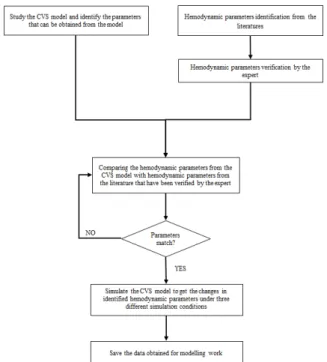
According to Zellinger (2010), hemodynamic monitoring of post cardiac surgery patients is the standard procedure in the CICU. In this work, selection of the most appropriate and/or important parameters to be used in the development of this Patiens' State Mapping System (PSMS) were not only based on literature, but also studies on the physiological model which is also known as cardiovascular system (CVS) model (Denai et al., 2009) as well as expert verification. The processes involved in identifying and acquiring those appropriate and/or important parameters are as shown in Figure 1.
Fig. 1: Processes involved in identifying and acquiring the hemodynamic parameters
2.1 Hemodynamic Parameters Identification From
The Literatures:
This finding is based on the literatures from books and journals related to postoperative care of cardiac patients. The papers are from the year 2000 until 2014. There are 41 hemodynamic parameters that have been identified, as shown in Table 1. The first column of the table shows the hemodynamic parameters which are monitored by clinician for postoperative patients in CICU according to the literatures. The next 3 columns show number of literatures published in respective years mentioning about respective hemodynamic parameters. Finally, the last column shows the total number of literatures published from the year 2000-2014 mentioning about the respective parameters. Therefore, from this observation, we have decided to choose 12 parameters which have been mentioned the most in the literatures as shown in Table 2.
2.2 Hemodynamic Parameters Verification By The
Expert:
After conducting the literature research on the hemodynamic parameters, we have presented the findings to the expert for verification. The expert has agreed with most of the parameters except one, which is pulmonary artery occlusive pressure (PAOP)/ pulmonary capillary wedge pressure (PCWP) as it is not routinely performed in CICU. Therefore, we have removed this parameter and left with only 11 parameters.
2.3 Hemodynamic Parameters Identification From
The Study of Cardiovascular System (CVS) Model :
In this work, the physiological model which has been used by Denai et al., 2009 for simulating patient
states was studied and analysed. This physiological model is used to simulate the physiological profiles of the patients, which includes cardiovascular function and the hemodynamic response to drugs and physiological fluids. This physiological model has been comprehensively validated and therefore can be effectively used to simulate the physiological profiles of the patients. Historically, this model which is also known as cardiovascular system (CVS) model was originally proposed by Randall, 1986. The model has been extended to include non-linear compliances, a baroreflex and drug effects (Mason, 1989), which was formulated in terms of an electric analog circuit comprising four compartments including the right and left ventricles, the systemic and pulmonary circulations.
Upon simulating the CVS model, it was observed that the model is able to generate several patients’ hemodynamic parameters which includes:
i) Systemic vascular resistance (SVR), ii) Cardiac output (CO),
iii) Mean Arterial Pressure, (MAP), iv) Partial pressure of oxygen (PaO2),
v) Partial pressure of carbon dioxide (PaCO2), vi) Contraction of the heart,
vii) Blood oxygen saturation (SaO2),
viii) Peripheral capillary oxygen saturation (SpO2),
ix) Mixed venous oxygen saturation (SvO2)
2.4 Selecting Hemodynamics Parameters Based On
Literature Findings, Expert Verification And CVS Model:
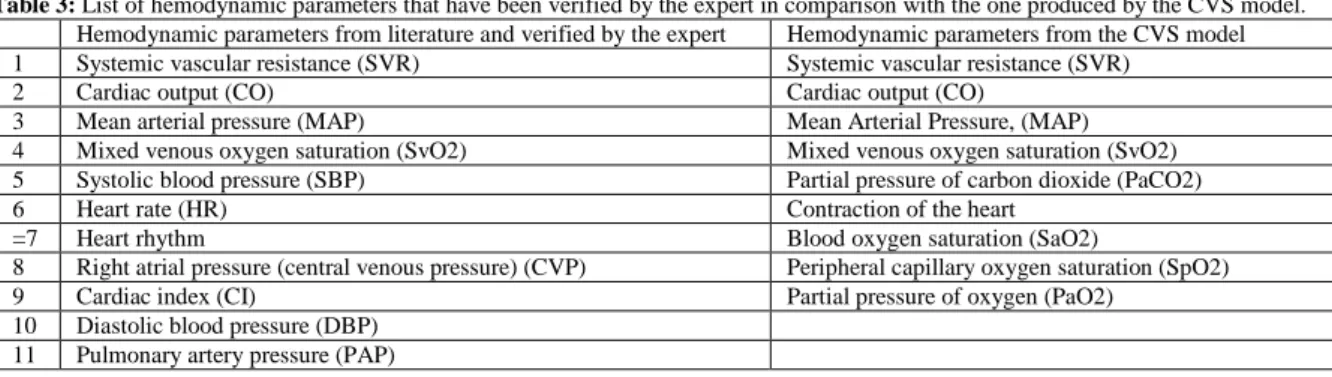
compare these parameters with the one that have been verified by the expert as mentioned in sub-section 2.2. Table 3 shows the hemodynamic
parameters produced by the CVS model, and the one that has been verified by the expert.
Table 1: Literature findings on the monitored hemodynamic parameters for postoperative patients in CICU from the year 2000 until 2014
Hemodynamic Parameters No. of papers according to years Total no. of papers
2000 - 2005 2006 - 2010 2011 - 2014 Right atrial pressure
(central venous pressure) (CVP)
2 6 4 12
Cardiac index (CI) 3 4 4 11
Mean arterial pressure (MAP) 2 5 3 10
Cardiac output (CO) 2 3 4 9
Pulmonary artery occlusive pressure (PAOP) / Pulmonary capillary wedge pressure (PCWP)
2 3 3 8
Heart rate (HR) 2 2 4 8
Mixed venous oxygen saturation (SvO2) 2 2 3 7
Heart rhythm 2 1 3 6
Systolic blood pressure (SBP) 1 2 3 5
Diastolic blood pressure (DBP) 1 2 2 5
Pulmonary artery pressure (PAP) 1 3 1 5
Systemic vascular resistance (SVR) 1 3 1 5
Hemoglobin (HB) 3 0 1 4
Temperature (TEMP) 0 1 3 4
Blood loss 1 0 3 4
Pulmonary vascular resistance (PVR) 1 2 1 4
Peripheral capillary oxygen saturation (SpO2) 0 1 3 4
Systemic vascular resistance index (SVRI) 1 2 0 3
Pulmonary vascular resistance index (PVRI) 1 2 0 3
Left atrial pressure (LAP) 0 2 0 2
Systemic arterial pressure 1 0 1 2
Right ventricular stroke work index 1 1 0 2
Left ventricular stroke work index 1 1 0 2
Oxygen delivery 0 2 0 2
End tidal carbon dioxide (ETCO2) tension 0 1 1 2
Central venous oxygen saturation (ScvO2) 0 2 0 2
Right ventricular pressure 0 1 0 1
Pulmonary artery mean pressure (PAM) 0 1 0 1
Pulmonary artery wedge pressure (PAWP/Wedge) 0 1 0 1
Right ventricular stroke work 0 1 0 1
Left ventricular stroke work 0 1 0 1
Left Ventricular End-Diastolic Area Index (LV-EDAI)
0 1 0 1
Intrathoracic blood volume index (ITVBI) 0 1 0 1
Global End-Diastolic Volume Index (GEDVI) 0 1 0 1
Arterial oxygen saturation 0 1 0 1
Arterial oxygen content 0 1 0 1
Venous oxygen content 0 1 0 1
Oxygen consumption 0 1 0 1
Oxygen extraction ratio 0 1 0 1
Respiration (RESP) 0 0 1 1
Systemic venous oxygen saturation 1 0 0 1
Table 2: The most mentioned (in literature) hemodynamic parameters that are monitored for postoperative patients in CICU. Hemodynamic Parameters
1 Right atrial pressure (central venous pressure) (CVP) 2 Cardiac index (CI)
3 Mean arterial pressure (MAP) 4 Cardiac output (CO)
5 Pulmonary artery occlusive pressure (PAOP) / Pulmonary capillary wedge pressure (PCWP) 6 Heart rate (HR)
7 Mixed venous oxygen saturation (SvO2) 8 Heart rhythm
Table 3: List of hemodynamic parameters that have been verified by the expert in comparison with the one produced by the CVS model. Hemodynamic parameters from literature and verified by the expert Hemodynamic parameters from the CVS model
1 Systemic vascular resistance (SVR) Systemic vascular resistance (SVR)
2 Cardiac output (CO) Cardiac output (CO)
3 Mean arterial pressure (MAP) Mean Arterial Pressure, (MAP)
4 Mixed venous oxygen saturation (SvO2) Mixed venous oxygen saturation (SvO2)
5 Systolic blood pressure (SBP) Partial pressure of carbon dioxide (PaCO2)
6 Heart rate (HR) Contraction of the heart
=7 Heart rhythm Blood oxygen saturation (SaO2)
8 Right atrial pressure (central venous pressure) (CVP) Peripheral capillary oxygen saturation (SpO2)
9 Cardiac index (CI) Partial pressure of oxygen (PaO2)
10 Diastolic blood pressure (DBP) 11 Pulmonary artery pressure (PAP)
From Table 3, we found out that there are 4 hemodynamic parameters which produced by the CVS model agreed with the parameters verified by the expert (parameter 1 -4). It is important to note that the hemodynamic parameters chose are not only verified by the expert but also can be generated by the CVS model since this model will act as patients after cardiac surgery and all data will be obtained based on model simulation. In this case, we have chosen the first 3 parameters that are SVR, CO, SvO2 and MAP to be the used in the next stage of our work which is to obtain the parameters' reading based on three different simulation conditions of the patients using the CVS model.
2.5 Hemodynamic Data Acquisition From
Different Simulation Conditions of Patients Using The CVS Model:
In the actual clinical environment, patients' clinical condition may deteriorate or improve over time. Therefore, in this study, the CVS model has been utilized to simulate 3 different conditions that might be experienced by the patients after cardiac surgery, which includes:
i) Simulation of hypotension ii) Simulation of hypovolemic iii) Simulation of vasodilation
In the study by Denai et al., (2009), the CVS model can simulate 4 conditions of post cardiac surgery patient, which includes hypertension,
hypovolemia, vasodilation and Systemic
Inflammatory Response Syndrome (SIRS). The 4 conditions have been described by 3 different intensities that are 'mild', ‘moderate’ and ‘severe'. These intensities of simulated patients' conditions were set by changing certain parameters in the CVS model as described in Denai et al., (2009). However, in this study, we chose to simulate only 3 conditions as stated above, with 4 intensities for each condition, that are 'normal', 'mild', 'moderate' and 'severe'. These simulated data shall then be used in modelling different conditions of the patients after cardiac surgery using various methods in computational intelligence (CI).
3.0 Overview Of The Models For Predicting The Patients' State Based On Hemodynamic Changes:
For several years researchers have attempted to model the relationship between patients' state with changes in hemodynamic parameters, for patients in intensive care unit. Singh, A., et al., (2010) for example have exploited a Hidden Markov Models to predict the onset of acute hypotension, using blood pressure measurements acquired from the PhysioNet physiological signal database. They have tested the proposed technique and obtained promising results. They have concluded that this technique has the potential to be used in real time health monitoring systems. In this study, relationship between the simulated hemodynamic parameters such as CO, SVR and SvO2 and simulated patients' state after cardiac surgery will be modeled. Mean arterial pressure (MAP) shall be chosen as an index to represent the patients' state. As mentioned in section 1, computational intelligence (CI) methods are the most well-liked method among the researchers in predicting patients' state. The term of Computational Intelligence (CI) defined as the use of computer to execute numerical calculations to solve diverse artificial intelligence problems. Therefore, in this study, development of the models using adaptive neuro-fuzzy inference system (ANFIS) and different types of artificial neural networks (ANNs) shall be considered.
3.1 Adaptive Neuro-Fuzzy Inference System
(ANFIS):
Takagi and Sugeno, 1985)). A typical fuzzy rule in Sugeno fuzzy model has the following form:
IF x is A and y is B THEN z = f(x,y)
Where x and y are the inputs to the system, A and B are linguistic labels such as: low, moderate and high, while z = f(x,y) is a crisp function in the consequent.
3.2 Multilayer Perceptron Neural Network
(MLPNN):
Multilayer perceptron (MLP) neural network consist of a set of sensory units that constitute the input layer, one or more hidden layers of computation nodes and an output layer of computation nodes. The input signal propagates through the network in a forward direction, on a layer-by-layer basis. The model of each neuron in the MLP network includes nonlinearity at the output end. According to Negnevitsky (2011), the most popular learning algorithm for MLP is a backpropagation method proposed by Bryson and Ho (1969).The neural network with standard backpropagation
learning method may get stuck in a shallow local minimum as the algorithm is based on the steepest descent (gradient) algorithm. Therefore, a highly popular algorithm known as the Levenberg-Marquardt algorithm is employed to enable the MLP-NN to slide through local minima and converge faster.
3.3 Elman Recurrent Neural Network (ERNN):
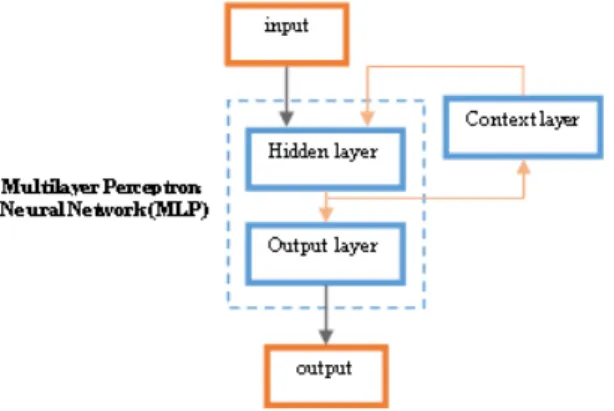
Elman Recurrent Neural Network (ERNN) or Simple Recurrent Network (SRN) was first introduced by Elman (1990) in the paper entitled “Finding structure in time”. ERNN is a multilayer perceptrons neural network (MLP) with an additional layer called the context layer. The context layer store the output value of the hidden layer and it will fed as additional input to the hidden layer during the next stage, then the hidden layer will activate the output layer. The common structure of an ERNN is shown in Figure 2. In the next part of the work, results from these models will be analysed and compared before the predicted patients' state are being mapped out.
Fig. 2: The structure of an Elman Recurrent Neural Network (ERNN)
4.0 Overview Of The Proposed Patients' State Mapping System (Psms):
The ultimate goal of this research is to develop the Patients' State Mapping System (PSMS) that can predict the patients' state based on changes in
different hemodynamic parameters of patients after cardiac surgery using different types of CI models and mapped out the results through a graphical user interface (GUI). Figure 3 shows the model diagram for the proposed PSMS.
Fig. 3: Model diagram for the proposed Patients’ State Mapping System (PSMS)
5.0 Conclusions And Future Work:
Managing postoperative patients in Cardiac Intensive Care Unit (CICU) following cardiac surgery is very challenging. Various physiological
changes that can severely alter patients'
hemodynamic status demand for a routine
monitoring and analysis of huge amounts of data by the clinicians to predict the patients’ state in response to the devised therapeutic interventions. These complexities in patients’ state and data management can lead to lack of adequate continuity of care to the patients by the clinicians. Therefore, in this paper, the Patients' State Mapping System (PSMS) has been proposed. The data that has been verified will be used to develop patients’ state model using different computational intelligence methods. Results from these models will be analysed and compared before the predicted patients' state are being mapped out. This system is reckoned to be able to predict the patients' state based on hemodynamic parameters of patients as well as visually map the patients' state via graphical user interface (GUI).
ACKNOWLEDGEMENT
This work is supported by the Research Acculturation Grant Scheme (RAGS) Ministry of Higher Education, Malaysia under Grant 2013-0158-109-72.
REFERENCES
Guyton, A.C., T.A. Coleman and H.J. Grander, 1972. Circulation: Overall regulation. Annual Review of Physiology, 41: 13-41.
Abidin, B., R.M. Dom, A.R.A. Rahman and R.A. Bakar, 2009. Use of fuzzy neural network to predict coronary heart disease in a Malaysian sample. In M. Demiralp, N. A. Baykara, & N. E. Mastorakis
(Eds.), WSEAS International Conference.
Proceedings. Mathematics and Computers in Science and Engineering (No. 8). World Scientific and Engineering Academy and Society.
Alkim, E., E. Gurbuz and E. Kilic, 2012. A fast and adaptive automated disease diagnosis method with an innovative neural network model. Neural Networks, 33: 88-96.
Amato, F., A. Lopez, E. Pena-Mendez, P. Vanhara, A. Hampl and J. Havel, 2013. Artificial neural networks in medical diagnosis. Journal of
Applied Biomedicine, 11: 47-58. doi:
10.2478/v10136-012-0031-x.
Anooj, P.K., 2012. Clinical decision support system: risk level prediction of heart disease using decision tree fuzzy rules. Int J Res Rev Comput Sci., 3(3): 1659-1667.
Atkov, O.Y., S.G. Gorokhova, A.G. Sboev, E.V. Generozov, E.V. Muraseyeva, S.Y. Moroshkinad and N.N. Cherniyc, 2012. Coronary heart disease diagnosis by artificial neural networks including genetic polymorphisms and clinical parameters. Journal of Cardiology, 59: 190-194.
Bojar R.M., 2011. Manual of Perioperative Care in Adult Cardiac Surgery. Wiley-Blackwell. ISBN: 978-1-4443-3143-1.
Bryson, A.E. And Y.C. Ho, 1969. Applied Optimal Control. Blaisdell, New York.
Coleman, T.G and J.E. Randall, 1983. Human –
A comprehensive physiological model, The
Physiologist, 26: 15-21.
Elman, J.L., 1990. Finding structure in time. Cognitive Science, 14(2): 179-211.
Hardin, S.R. and R. Kaplow, 2010. Cardiac surgery essentials for critical care nursing. Jones & Bartlett Publishers. (pp. 1-11).
Jang, J., 1993. ANFIS: Adaptive-network-based fuzzy inference system. IEEE Transactions on System, Man, and Cybernetics, 23: 665-685.
Jones, B., 2010. Postoperative complications of
cardiac surgery and nursing interventions.
ESSENTIALSFOR, 257.
Denai, M.A., M. Mahfouf, J.J. Ross., 2009. A hybrid hierarchical decision support system for cardiac surgical intensive care patients, part I-Physiological modelling and decision support design, Artificial Intelligence in Medecine, 45(1): 35-52.
Mamdani, E.H., 1974. Application of fuzzy algorithms for control of simple dynamic plant. In: Proceedings IEEE. 1585-1588.
Mandal, A., 2013. What is cardiovascular
disease? Retrieved from
http://www.news- medical.net/health/What-is-Cardiovascular-Disease.aspx
Mason, D.G., 1989. Comprehensive Circulatory Management of Seriously Ill patients with a Closed-loop System, Ph.D Thesis for Dept of Electrical and Electronic Engineering, University of Melbourne.
Mitra, M., and R.K. Samanta, 2013. Cardiac arrhythmia classification using neural networks with selected features. Procedia Technology, 10: 76-84.
Montani, J.P and B.N. Van Vliet, 2009. Understanding the contribution of the Guyton’s large circulatory model to long-term control of arterial pressure, Experimental Physiology, 94: 382-288.
Negnevitsky, M., 2011. Artificial intelligence: a guide to intelligent systems, third edition. Essex, England: Pearson Education Limited.
Rabiah A. Kadir., Abdul Rahman Ali Ali Al Maweri and M. Zamrin Dimon, 2012. A heuristic rule-based approach for monitoring of hemodynamic data in cardiothoracic intensive care unit.
eProceeding of Knowledge Management
International Conference, (pp. 657-660). Sintok, Malaysia: Universiti Utara Malaysia.
Randall, J.E., 1986. A Cardiovascular System Model in: Microcomputers and Physiological Simulation, Raven Press.
Roekaerts, P.M. and J.H. Heijmans, 2012. Early Postoperative Care After Cardiac Surgery. INTECH Open Access Publisher.
Singh, A., T. Tamminedi, G. Yosiphon, A. Ganguli and J. Yadegar, 2010. Hidden Markov Models for modeling blood pressure data to predict acute hypotension. In Acoustics Speech and Signal Processing (ICASSP), 2010 IEEE International Conference on, pp: 550-553.
Sugeno, M., G.T. Kang, 1988. Structure Identification of Fuzzy Model, Fuzzy Sets and systems, 28: 15-33.
Takagi, T., M. Sugeno, 1985. Fuzzy
identification of systems and its applications to modelling and control. IEEE Trans. Systems, Man., and Cybernatics, 15: 166-132.
Tehrani, F.T., J.H. Roum, 2008. “FLEX: A New Computerised System for Mechanical Ventilation.” Journal of Clinical Monitoring and Computing, 22: 121-130.
Vimala, K. and V. Kalaivani, 2013.
Classification of cardiac vascular disease from ECG signals for enhancing modern health care scenario. Health Informatics-An International Journal, 2(4): 63-72.
Zellinger, M., 2010. Hemodynamic monitoring. In Hardin, S. R. & Kaplow, R. (Eds.), Cardiac Surgery Essentials for Critical Care Nursing, pp: 145-164.