www.ijemst.com
A Review of the Literature: How
Pre-service Mathematics Teachers Develop
Their Technological, Pedagogical, and
Content Knowledge
Melike Yigit
Purdue University
To cite this article:
Yigit, M. (2014). A review of the literature: How pre-service mathematics teachers develop
their technological, pedagogical, and content knowledge.
International Journal of Education
in Mathematics, Science and Technology, 2
(1), 26-35.
This article may be used for research, teaching, and private study purposes.
Any substantial or systematic reproduction, redistribution, reselling, loan, sub-licensing,
systematic supply, or distribution in any form to anyone is expressly forbidden.
Authors alone are responsible for the contents of their articles. The journal owns the
copyright of the articles.
International Journal of Education in Mathematics, Science and Technology
Volume 2, Number 1, January 2014, Page 26-35
ISSN: 2147-611X
A Review of the Literature: How Pre-service Mathematics Teachers
Develop Their Technological, Pedagogical, and Content Knowledge
Melike Yigit1*
1
Purdue University
Abstract
In recent years, researchers have advanced the Technological, Pedagogical, and Content Knowledge (TPACK) framework to describe both in-service and pre-service teachers’ knowledge related to effectively integrating technology. This study is a systematic literature review about pre-service mathematics teachers’ (PSMTs) development of TPACK, and the review is limited to the peer reviewed articles published between 2005 and 2013 (February). The main purpose of this study is to investigate and analyze the articles in mathematics education research that have explored how PSMTs develop their TPACK and how their development impacts their future teaching of mathematics. Specifically, the literature review attempts to identify PSMTs’ development of the components of the TPACK framework, their perspectives for their future teaching, how their development of TPACK can be measured, and strategies to develop their TPACK. Findings show that PSMTs’ active involvement in technology-enhanced lessons or courses is the major strategy to develop their TPACK and to improve their future teaching of mathematics.
Key words: Technological Pedagogical and Content Knowledge, TPCK, TPACK, Pre-service Mathematics Teachers’ Education, Pre-service Mathematics Teachers’ Knowledge
Introduction
Two hundred years ago teachers only needed to know and understand the content determined by the particular grade level that they taught (Niess, 2008). Today’s beliefs about what teachers need to know have completely changed based on the development of teacher preparation programs and technology. For instance, Shulman (1986) was eager to learn, “How do teachers decide what to teach, how to represent it, how to question students about it, and how to deal with problem of misunderstanding?” (p. 8). Therefore, Shulman and his colleagues constructed a theoretical framework, pedagogical content knowledge (PCK) which has been an effective framework to analyze teachers’ knowledge and teacher preparation programs. Shulman (1986) defined PCK as the notion of the transformation of the subject matter for teaching. Shulman (1986) stated that teachers with strong PCK support students’ understanding taught content. If teachers have strong PCK, they simultaneously have the knowledge of concepts, of the representation and formulation of concepts, and of pedagogical techniques, and teachers will have the ability to evaluate students’ existing knowledge, and theories of epistemology (Mishra & Koehler, 2006).
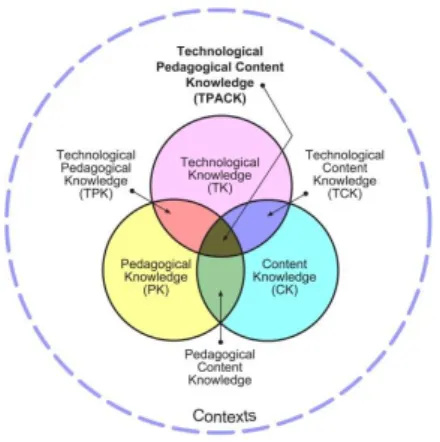
Additionally, the sharp development of technology over the last few decades has changed according to what teachers need to know and understand. Based on the development of technology, Mishra and Koehler (2006) defined a conceptual framework on technological, pedagogical and content knowledge (TPCK) (See Figure 1). In order to develop this framework, they started with Shulman’s framework of PCK, and considered and added technology knowledge to the framework. Their main goal in defining the conceptual framework is to describe and understand the goals of technology in teacher education. In 2007, the acronym TPCK was changed into technological, pedagogical, and content knowledge (TPACK).
Before Mishra and Koehler (2006) advanced their framework, numerous researchers had already defined similar frameworks to investigate how teachers used their technological knowledge (Angeli & Valanides, 2005; Niess, 2005). These researchers used different names for their frameworks such as information and communication technology (ICT)-related PCK and technology-enhanced PCK, but the contents of the frameworks are similar.
*
All these researchers have investigated both in-service and pre-service teachers’ development of technological, pedagogical, and content knowledge by using a framework similar to the TPACK framework.
Figure 1. The TPACK framework and its knowledge components (Adapted from Koehler and Mishra, 2009).
However, TPCK is defined as an emergent form of knowledge that goes beyond all three forms of knowledge: content knowledge (CK), pedagogical knowledge (PK), and technological knowledge (TK) (Mishra & Koehler, 2006; Koehler & Mishra, 2008, 2009). Mishra and Koehler (2006) specifically indicated that TPACK is different from knowledge of all three primary factors— CK, PK, and TK— individually, and that it is based on multiple interactions among CK, PK, and TK, as well as PCK, technological content knowledge (TCK), and technological pedagogical knowledge (TPK). TPACK includes understanding, knowing and communicating representations of concepts using technologies, pedagogical techniques, knowledge of whether concepts are difficult or easy to learn, and knowledge of how technology can help and develop students’ learning (Harris et al., 2009). In addition, TPACK is essential for effectively integrating technology into teachers’ teaching. Teachers with TPACK have the ability to interpret the interrelations between CK, PK, and TK; this interpretation allows teachers to teach by using appropriate pedagogical and technological strategies (Schmidt, Baran, Thompson, Mishra, Koehler, & Shin, 2009). For instance, if teachers use any type of dynamic geometry software (DGS) to teach a geometrical concept, they must understand how to use the representations of the concept in DGS. They also must understand the related pedagogical techniques needed to best illustrate the concept in DGS, along with understanding any challenges or benefits of using DGS. In addition, they must understand how DGS could be helpful for students to investigate and learn the concept.
In this review, the author specifically analyzed the articles that are related to pre-service mathematics teachers’ (PSMTs) development of the elements of TPACK in response to the questions “How do PSMT develop their TPACK?” and “How does PSMTs’ development of TPACK impact their future teaching of mathematics?” Therefore, the purpose of the review is to investigate the articles in mathematics education research that explored how PSMTs develop their TPACK and how their development impacts their future teaching of mathematics.
Method
The literature review was conducted in three scientific databases: Education Resources Information Center (ERIC), JSTOR-Scholarly Journal Archive, and PsychINFO. It has been known that the TPACK framework has been in development since 2005, so the review is limited to the articles published between 2005 and 2013 (February). Any conference proceedings, Ph.D. dissertations, and reports were eliminated in the review since the review is conducted based on only peer reviewed articles published in scholarly journals.
28 Yigit
development of TPACK, and this analysis yielded 45 articles. Then, the articles were screened full-text. From the full text screening, if the article was not used to describe PSMTs’ development of TPACK, it was not included in this review. For instance, Polly, McGee, and Sullivan (2010) used the TPACK framework to analyze how professional development program can develop teachers’ TPACK through the exploration of technology rich-mathematical tasks. They did not specifically focus on PSMTs’ professional development, so the study was not included in this review. Seventeen articles remained for in-depth analysis. Of these articles, 2 articles reported theoretical reflections, and 15 articles presented empirical findings on PSMTs’ development of the elements of TPACK. In these empirical studies, the following quality criteria was created to ensure the scientific evidence of the studies:
Consistency: Do the purpose of the study and research question align with the data collection and analysis, and results of the study?
Data Collection: Was their data collection appropriate to answer their research question? What kind of instruments did they use to collect the data? Did they discuss the instruments and procedure in their studies?
Data Analysis: How did they analyze the data? Did they explain the procedure of data analysis? Was the data analysis appropriate to answer the research questions?
Results: Do the results of the studies explore how PSMTs develop of the elements of TPACK and PSMTs’ perspectives of their future teaching?
Table 1. Main themes of the study
Authors PSMTs’ Development of TPACK Development of TPACK concept (specific knowledge type) PSMTs’ perspective of their future teaching based on the development of their TPACK Strategies to develop PSMTs’ TPACK How to measure PSMTs’ TPACK
Agyei, D., & Voogt, J.(2012)
X X X
Bowers, J., & Stephens, B. (2011)
X X
Haciomeroglu, E., Bu, L., Schoen, R., & Hohenwarter, M. (2011)
X X X
Hahkioniemi, M., & Leppaaho, H. (2012)
X
Hardy, M. (2010) X
Larkin, K., Jamieson-Proctor R., & Finger, G. (2012)
X X
Lee, H., & Hollebrands, K. (2008)
X X X
Meagher, M., Ozgun-Koca, A. & Edwards, M.T. (2011)
X X
Niess, M. L. (2005) X X
Niess, M. L., et al. (2009)
X X
Ozgun-Koca, S., Meagher, M., & Edwards, M. T. (2010)
X X X X
Ozmantar et al. (2010)
X
collection is not clearly described, it was labeled as ‘sufficient’. However, if an article meets the criteria of data collection and analysis, but it does not meet the results, then it was labeled as ‘insufficient’. Five articles were ‘insufficient’ since the articles only describe how to integrate mathematical, pedagogical and technological knowledge into teacher preparation programs, and teachers’ development of TPACK. Thus, they are not directly related to PSMTs’ development of TPACK. The remaining 12 articles (11 articles are empirical and 1 article is theoretical) will be used in this review. PSMTs’ development of TPACK was addressed in the following sub-themes: PSMTs’ development of TPACK, PSMTs’ development of the elements of TPACK (specific knowledge type such as CK, PK, TK, TCK, TPK, PCK, and TPACK), PSMTs’ perspectives of their future teaching based on the development of TPACK, strategies to develop PSMTs’ TPACK, and how to measure development of PSMTs’ TPACK. After the author identified the main themes, the articles were read again to identify their contributions to the sub-themes (See Table 1).
Findings
PSMTs’ Development of TPACK
In terms of PSMTs’ development of TPACK, the author specifically looked for how PSMTs understand, know, and communicate representations of concepts using technologies, pedagogical techniques, their knowledge of whether concepts are difficult or easy to learn, and their knowledge of how technology can help and develop students’ learning. The author analyzed how the selected articles in the database explored PSMTs’ development of TPACK. Eight articles emphasized PSMTs’ development of TPACK, and seven of these articles highlighted their development based on the lessons, the courses, or the projects the researchers created. Only one article reported theoretical reflections, and the authors of this article developed mathematics teacher TPACK standards and a development model as guides which might be effective factors in PSMTs’ development of TPACK knowledge (Niess et al., 2009).
To start, Niess (2005) developed the TPCK framework as a guide to prepare mathematics and science teachers for teaching with technology. Niess (2005) adapted Grosmann’s (1989, 1991) four central components for PCK, then she extended these components and described four different aspects that clarify TPCK development for teacher preparation programs:
(1) an overarching conception of what it means to teach a particular subject integrating technology in the learning process; (2) knowledge of instructional strategies and representations to teach specific subject with technology; (3) knowledge of students’ understandings, thinking, and learning with technology; and (4) knowledge of curriculum and curriculum materials that integrate technology. (Niess, 2006, p. 197)
By considering all these components, Niess (2005) designed a course, and examined PSMTs’ TPACK in science and mathematics teachers’ preparation program that technology integrated to teach and learn the concept. Niess (2005) explored that all the participants made varying degrees of progress in the development of TPCK throughout the course that she designed.
Lee and Hollebrands (2008) addressed the areas described by both Niess (2005) and Mishra and Koehler (2006), and they went further and used the TPACK framework to develop an assessment to measure PSMTs’ understandings of a mathematical concept. Their main goal was to develop methods for preparing PSMTs to teach mathematics using appropriate technologies. Based on the TPACK framework and mathematics teacher TPACK standards (Niess et al., 2009), Lee and Hollebrands (2008) designed an education program that combined mathematics content with technology and pedagogy. In the program, they described and gave examples of the materials prepared for the teacher education program Preparing to Teach Mathematics with Technology (PTMT) project. They suggested that the project they created would be useful to identify and develop PSMTs’ TPACK reasoning.
30 Yigit
gathered from PSMTs’ lesson plans, written reflections, and presentations. The authors used the collected data to assess and identify the PSMTs’ learning experiences, including their understandings of the content, pedagogy, and technology. They determined that all the PSMTs had positive impressions of teaching and learning mathematics using GeoGebra. The authors also pointed out that designing and presenting lessons with GeoGebra helped the PSMTs develop their TPACK. Furthermore, Meagher, Ozgun-Koca and Edwards (2011) explored the PSMTs’ experiences with advanced digital technologies in their student teaching under the lens of their TPACK. They analyzed how PSMTs could reflect their knowledge into their field experiences and how they could use advanced digital technologies in inquiry-based lessons for both teaching and learning. The authors suggested that PSMTs would develop their TPACK knowledge in technology-based mathematics classrooms that they designed.
Larkin, Jamieson-Proctor, and Finger (2012) also explored how PSMTs’ educators use information communication technology (ICT) to enhance PSMTs’ personal TPACK, and whether ICT is an appropriate tool to develop PSMTs’ TPACK components. They concluded that the course they designed based on an ICT-integrated approach to teaching mathematics improved PSMTs’ TPACK. In addition, Agyei and Voogt (2012) explored how PSMTs’ teaching spreadsheet-supported lessons could be operationalized as their TPACK. They specifically focused on how PSMTs integrate the developed technology-enhanced lesson materials into their teaching and how they learned the TPACK development. They concluded that more systematic programs and efforts would be helpful to engage PSMTs in technology-based activities and to develop their TPACK knowledge. They also suggested that integrating the TPACK framework to teaching mathematics is an effective way to develop PSMTs’ experiences in technology integrated mathematics classrooms.
On the other hand, Niess et al.—the Association of Mathematics Teacher Educators (AMTE) Technology and Mathematics Education Committee—(2009) created a set of mathematics teacher TPACK standards that encouraged educators and teachers to use technology in preK-12 mathematics education. These new standards were intended to provide a framework for mathematics teaching and learning. They also created a model for mathematics teachers’ TPACK development in the light of the TPACK framework. Niess et al. (2009) identified how mathematics teachers improve their TPACK knowledge, and they analyzed the process by which teachers gain mathematics TPACK knowledge. Niess et al. (2009) re-framed Roger’s (1995) model of the innovation-decision process. Then, they proposed that teachers progressed through a five-stage developmental process while learning to integrate a particular technology into their teaching and learning of mathematics: (1) recognizing (knowledge); (2) accepting (persuasion); (3) adapting (decision); (4) exploring (implementation); and (5) advancing (confirmation). Based on the model they created, Niess et al. (2009) claimed that TPACK’s development starts with teachers’ development of PCK, and then develops through the integration of technology, clearly moving through the five stages (recognizing, accepting, adapting, exploring, and advancing) for each new technology. When teachers progress through this developmental model, the intersections of technology with content and pedagogy are formed and expanded (Niess et al., 2009).
To sum up, these researchers explored PSMTs’ development of TPACK. The majority of the studies indicated that a lesson or a course is significantly effective for development of PSMTs’ TPACK. They specifically emphasized that the TPACK framework could be used to develop assessments and to identify the development of PSMTs’ knowledge and their understandings of the lesson or the course, and to design instructions, activities and practices throughout the lesson or the course they created.
Development of PSMTs’ Components of TPACK
In terms of the development of the components of the TPACK framework, the author explored how the articles focused on PSMTs’ development of TK, PK, CK, PCK, TCK, TPK, and TPACK, individually. Two articles in the database mentioned about PSMTs’ development of the components of TPACK. Lee and Hollebrands’s (2008) PTMT project was designed based on an education program that combined mathematics content with technology and pedagogy. They repeated the program for five consecutive semesters. Throughout the years, they developed their instructional model based on the collected data. They stated that the questions they created developed PSMTs’ CK, their use of technology for particular mathematical tasks (their TCK), and pedagogical decisions PSMTs might use when they teach specific mathematical concept with technology or without technology (their TPACK or PCK). Hence, the instructional model might be used to engage PSMTs in solving mathematics tasks by using technology tools and in improving their TPACK.
instantaneous responses and skills in their use of CK, TK and PCK. To determine students’ particular knowledge, the authors used participants’ high school mathematics knowledge as their CK, participants’ learning theories and instructional methods as their PCK, and the knowledge of how participants incorporated and operated technology-oriented tools to the activities as their TK. After coding the data into specific types of knowledge, the researchers developed the codes for each of the possible interactions between CK, TK, and PCK. In this process, the TPACK framework was helpful to determine how the PSMTs took advantage of technology to engage students in inquiry-based tasks and to develop their TPACK. The researchers concluded that PSMTs developed their CK, PK, and TK separately. To sum up, only two of twelve articles mentioned about PSMTs’ development of the components of TPACK. These two articles highlighted that PSMTs’ development of the components of TPACK is related to the project and the course they designed. TPACK was considered as a unique body of knowledge in other ten studies.
Perspectives of PSMTs’ Future Teaching
Interrogating PSMTs’ thoughts about their own knowledge and future teaching could be an effective step to develop their TPACK knowledge. Two articles in the database stated PSMTs’ perspectives of their future teaching. Ozgun-Koca et al. (2010) stated that PSMTs’ development of TPACK is related to their shift from being learners of mathematics to be the teachers of mathematics. They explored that PSMTs’ perspectives of their future teaching are directly related to the method course that they are taught. Additionally, Haciomeroglu et al. (2011) explored how PSMTs would teach their lessons, consider how their future students would explore the concept illustrated with GeoGebra, and explain what and how they would expect their future students to learn through their activities. They suggested that PSMTs’ own thoughts about their future teaching were effective factors in development of their TPACK knowledge. If PSMTs have an ability to explain their expectation from their future students, PSMTs would explicitly think about the concept, and they would develop their TPACK.
Strategies to Develop PSMTs’ TPACK
All twelve articles addressed strategies that would be helpful to develop PSMTs’ TPACK. Technology-enhanced lesson or course design was determined as the major strategy to develop PSMTs’ TPACK. Eleven of the selected articles focused on the importance and benefits of the technology. The majority of these eleven articles explored the modeling of how to teach in technology-based classrooms. Only one article emphasized the general ways and strategies to improve PSMTs’ development of TPACK knowledge (Niess et al., 2009).
To start, Niess (2005) suggested that if we integrate the technology into teacher education programs, and teach them with technology, we would improve PSMTs’ overarching conceptions of what it means to teach a particular subject with technology. Additionally, they might develop their knowledge of instructional strategies and representations to teach specific subject, knowledge of students’ understandings, thinking, and learning, and knowledge of curriculum and curriculum materials. Based on the course they designed, Lee and Hollebrands (2008) also suggested that the combination of collected methods—have PSMTs predict student reasoning, observe a technology lesson, and work in groups—would be useful to both identify and develop PSMTs’ TPACK reasoning.
32 Yigit
Bowers and Stephens (2011) went further; they designed a course, and explored the ways in which the TPACK framework might be used to support and to assess PSMTs’ knowledge of how to integrate technology into their mathematics classrooms. They used the TPACK framework as an assessment guide to examine how PSMTs used technology in pedagogically productive ways in mathematics teaching, and they developed a rubric to determine PSMTs’ TPACK. This rubric helped them identify what knowledge PSMTs’ need in order to integrate technology into teaching practices. They believed that the rubric they investigated is helpful for teachers to develop technological habits of mind, and for students to explore and understand the mathematical concept and their relations to real world outside of the school.
Additionally, Larkin, Jamieson-Proctor, and Finger (2012) planned a course, and suggested some ways to overcome the problems faced by many teacher educators, and to develop PSMTs’ TPACK. They moved the existing course content, constructivist teaching and learning practices to an online environment, and then they offered the course solely online. They integrated ICT into the course to teach and learn mathematics in online environment. They pointed out that the method they used is a process, and it would be effective to improve PSMTs’ TPACK. Furthermore, Hahkioniemi and Leppaaho (2012) also explored how PSMTs guide students’ reasoning in GeoGebra-enhanced inquiry mathematics. They identified that PSMTs struggled to apply inquiry mathematics in their reasoning about the students’ solutions. The authors found that their difficulties were based on justifying students’ findings, software program’s trial and error solution methods, creating unexpected ideas, and encouraging students to develop their knowledge. They suggested that PSMTs need more support about how to guide students to justify conjectures. Additionally, the authors proposed that PSMTs should be informed about how technology can be used to engage students in mathematics classrooms. In order to overcome PSMTs’ difficulties, they offer the activity of hypothetical teaching situations which would be a beneficial way to develop PSMTs’ TPACK.
On the other hand, Niess et al. (2009) created a set of mathematics teacher TPACK standards and created mathematics teacher TPACK development model to encourage educators and teachers to use technology in preK-12 mathematics education. Niess et al. (2009) also claimed that development model and mathematics teacher TPACK standards might be used to provide specific and identifiable constructs of teachers’ knowledge associated with TPACK. They suggested that these new standards were intended to provide a framework for mathematics teaching and learning, and it could be relevant to assess PSMTs’ level of mathematics TPACK and their professional development in mathematics instructional technology. Additionally, it could be helpful to identify how PSMTs engage with their TPACK as they develop their knowledge and understandings in ways— the ways that merge multiple knowledge bases of technology, content and pedagogy—. Using this model could be helpful to identify PSMTs’ level of mathematics TPACK, and then develop their TPACK.
All the studies suggested effective ways to develop PSMTs’ TPACK. Majority of the studies emphasized that we should integrate technology into teacher education programs, and we should teach them how to teach in technology-based classrooms. They explored that if we develop their knowledge of instructional strategies and representations to teach specific subject with technology, knowledge of students’ understandings, thinking, and learning, we would improve their TPACK and it might directly affect their perspectives of future teaching.
How to Measure Development of PSMTs’ TPACK
Even though most of the researchers in the selected articles developed a lesson, a course, or a rubric to determine PSMTs’ TPACK knowledge, they did not clearly describe how they measured the development. Only two articles explicitly explained the measuring process. In order to determine and measure PSMTs’ knowledge types, Bowers and Stephens (2011) used a rubric. Their main goal is to identify PSMTs’ five knowledge components: CK, TK, TCK, TPK, and TPACK. To determine PSMTs’ knowledge, they were required to choose a mathematical topic and develop Geometer’s Sketchpad sketch to explore how technology could be used to teach mathematics. The authors then assessed the PSMTs’ projects to determine the level of TPACK when each PSMT was demonstrating based on the rubric. Two of the authors analyzed PSMTs’ projects on the five components of the rubric. For instance, if a PSMT clearly indicated a strong emphasis on the use of technology and determined the mathematical relationship behind a concept, then the PSMT would have been assessed at the TPACK level.
two times as pre- and post-surveys. They used the pre- and post-surveys to evaluate their understanding and use of spreadsheets (as their TK), possibilities for teaching and learning with spreadsheets (as their TPK), how they use spreadsheets to improve understanding of the concepts (as their TCK), and how they understand the changes based on teaching and learning mathematics with the application of spreadsheets (as their TPACK). Based on the students’ responses, they calculated pre- and post-test mean score of participants’ TPACK subscales. They suggested that the method they used could be considered to determine PSMTs’ development of TPACK knowledge.
Many of the selected studies explored PSMTs’ TPACK development through a combination of many instruments. However, only two studies explicitly described the instruments which they used to measure the development of TPACK. In order to measure PSMTs’ TPACK, most of the studies used self-assessment surveys, lesson plans, class activities, and PSMTs’ assignments and presentations as instruments.
Discussion and Conclusion
The purpose of this review is to identify how PSMTs’ develop their TPACK and how their development of TPACK impacts their future teaching of mathematics. Specifically, the review attempt to identify PSMTs’ development of the components of TPACK, their perspectives for their future teaching, how their development of TPACK can be measured, and strategies to develop their TPACK. However, the TPACK framework was not investigated in mathematics education research, so there were not many studies about the use of the TPACK framework in the literature.
According to the limited studies in mathematics education research, it is accurate that actively involving PSMTs in technology-enhanced lesson or course is the major strategy to develop PSMTs’ TPACK as it is shown in findings of the selected articles. It is interpreted that a course or a lesson might support and assess PSMTs’ knowledge of how to integrate technology into their mathematics classrooms (e.g. Bowers & Stephens, 2011; Lee & Hollebrands, 2008; Ozgun-Koca et al., 2010). The review found that PSMTs might get experience in classroom activities, teaching, and learning mathematic concepts in technology-based classrooms. Therefore, these studies could be used as a framework to improve technology-enhanced education system in PSMTs’ education.
Additionally, Niess et al. (2009) suggested mathematics teachers TPACK standards and the development model to support PSMTs to teach with technology. The overarching construct of the standards and the development model might provide specific and identifiable knowledge to construct teachers’ knowledge associated with TPACK. The themes, levels, and descriptors might enable an idea to develop PSMTs’ TPACK. These standards and the model also might be used to design a lesson, a course and a project. Niess et al.’s (2009) suggestions about the roles of the standards and the development model might be used to design a lesson, a course, and a project. Specifically, the standards and the development model might be used to assess PSMTs’ level of mathematics knowledge, to see how PSMTs acquire and develop their knowledge, and to explicitly identify how PSMTs acquire their understanding of content, pedagogy, technology, and context. In addition, the five levels (recognizing, accepting, adapting, exploring, and advancing) of the development model could be used to assess PSMTs’ level of mathematics TPACK by using the descriptors and examples. By doing this, one might analyze how PSMTs develop and engage in their subject matter (their CK) and how technology helps them to investigate concepts (their TK). Moreover, one might explore their instructional approaches (their PCK, TPK and TPACK), professional developments (their PCK), and the use of technological tools (their TK).
However, there are limited number of studies about PSMTs’ development of the components of TPACK and how to measure their development. When mathematics educators talk about the development of PSMTs’ TPACK knowledge, they should clearly explain their development of the level of the components of TPACK. On that account, their lack of knowledge might be determined, and the educators might propose some solutions to overcome their deficiency. Additionally, the researchers did not explicitly describe the instruments they used to measure PSMTs’ development of TPACK. The selected articles’ findings were determined based on self-assessment surveys, lesson plans, class activities, and PSMTs’ assignments and presentations. Other than that, there was not a variety of measurement methods for determining the development of TPACK. Therefore, researchers should clearly define and design their measurement methods to determine PSMTs’ development of TPACK.
34 Yigit
TPACK development impacts their perspectives about their future teaching. Hence, this review and existing studies would be used as a guide to help PSMTs’ TPACK development and their teaching experiences for their future teachings. For instance, future studies might explore PSMTs’ development of TPACK by using mathematics teacher TPACK standards and the development model (Niess et al., 2009). In addition, this study shows that majority of the studies did not provide a clear description of instruments to measure PSMTs’ TPACK development, so future studies might address and investigate a rubric or a framework to measure PSMTs’ development of TPACK.
References
Agyei, D. D., & Voogt, J. (2012). Developing technological pedagogical content knowledge in pre-service mathematics teachers through collaborative design. Australian Journal of Educational Technology,
28(4), 547-564.
Angeli C., &Valanides N. (2005) Preservice elementary teachers as information and communication technology designers: An instructional systems design model based on an expanded view of pedagogical content knowledge. Journal of Computer Assisted Learning,21, 292–302.
Bowers, J. S., & Stephens, B. (2011). Using technology to explore mathematical relationships: A framework for orienting mathematics courses for prospective teachers. Journal of Mathematics Teacher Education, 14, 285-304.
Haciomeroglu, E. S., Bu, L., Schoen, R. C., & Hohenwarter, M. (2011). Prospective teachers’ experience in developing lessons with dynamic mathematics software. International Journal for Technology in
Mathematics Education, 18(2), 71-82.
Hahkioniemi, M., & Leppaaho, H. (2012). Prospective mathematics teachers’ ways of guiding high school students in GeoGebra-supported inquiry tasks. The International Journal for Technoloy in Mathematics
Education, 19(2), 45-57.
Hardy, M. (2010). Enhancing preservice mathematics teachers’ TPACK. Journals of Computers in Mathematics
and Science Teaching, 29(1), 73-86.
Harris, J., Mishra, P., & Koehler, M. J. (2009). Teachers’ technological pedagogical content knowledge and learning activity types: Curriculum-based technology integration reframed. Journal of Research on
Technology in Education, 41(4), 393-416.
Grossman, P. L. (1989). A study in contrast: Sources of pedagogical content knowledge for secondary English.
Journal of Teacher Education, 40(5), 24–31.
Grossman, P. L. (1991). Overcoming the apprenticeship of observation in teacher education coursework.
Teaching and Teacher Education, 7, 245–257.
Larkin, K., Jamieson-Proctor R., & Finger, G. (2012). TPACK and pre-service teacher mathematics education: Defining a signature pedagogy for mathematics education using ICT and based on the metaphor “mathematics is a language”. Computers in the Schools, 29, 207-226.
Lee, H., & Hollebrands, K. (2008). Preparing to teach mathematics with technology: An integrated approach to developing technological pedagogical content knowledge. Contemporary Issues in Technology and
Teacher Education, 8(4), 326-341.
Koehler, M. J., & Mishra, P. (2008). Introducing TPCK. In AACTE Committee on Innovation and Technology (Ed.), Handbook of technological pedagogical content knowledge (TPCK) for educators (pp. 3-29). New York, NY: Routledge.
Koehler, M. J., & Mishra, P. (2009). What is technological pedagogical content knowledge? Contemporary
Issues in Technology and Teacher Education, 9(1), 60-70.
Meagher, M., Ozgun-Koca, A. & Edwards, M.T. (2011). Pre-service teachers’ experiences with advanced digital technologies: The interplay between technology in a pre-service classroom and in field placements. Contemporary Issues in Technology and Teacher Education, 11(3), 243-270.
Mishra, P., & Koehler, M. J. (2006). Technological pedagogical content knowledge: A new framework for teacher knowledge. Teachers College Record, 108(6), 1017-1054.
Niess, M. L. (2005). Preparing teachers to teach science and mathematics with technology: Developing a technology pedagogical content knowledge. Teaching and Teacher Education, 21(5), 509-523. Niess, M. L. (2006). Guest Editorial: Preparing teachers to teach mathematics with technology. Contemporary
Issues in Technology and Teacher Education, 6(2), 195–203.
Niess, M. L. (2008). Guiding preservice teachers in developing TPCK. In AACTE Committee on Innovation and Technology (Ed.), Handbook of technological pedagogicalcontent knowledge (TPCK) for
Niess, M. L., Ronau, R. N., Shafer, K. G., Driskell, S. O., Harper S., Johnston, C., Browning, C.,Ozgun-Koca, S. A., & Kersaint, G. (2009). Mathematics teacher TPACK standards and development model. Contemporary Issues in Technology and Teacher Education, 9(1), 4-24.
Ozgun-Koca, S., Meagher, M., & Edwards, M. T. (2010). Preservice teachers’ emerging TPACK in a technology-rich methods class. Mathematics Educator, 19(2), 10-20.
Ozmantar, M. F., Akkoc, H., Bingolbali, E., Demir, S., and Ergene B. (2010). Pre-service mathematics teachers’ use of multiple representations in technology rich environments. Eurasia Journal of Mathematics,
Science and Technology Education, 6(1), 19-36.
Polly, D., McGee, J. R. & Sullivan, C. (2010). Employing technology-rich mathematical tasks to develop teachers’ technological, pedagogical, and content knowledge (TPACK). Journal of Computers in
Mathematics and Science Teaching, 29(4), 455-472.
Rogers, E. M. (1995). Diffusion of innovations. New York, NY: Free Press.
Schmidt, D. A., Baran, E., Thompson, A. D., Mishra, P., Koehler, M. J., & Shin, T. S. (2009). Technological pedagogical content knowledge (TPACK): The development and validation of an assessment instrument for preservice teachers. Journal of Research on Technology in Education, 42(2), 123-149. Shulman, L. S. (1986). Those who understand: Knowledge growth in teaching. Educational Researcher, 15(2),