1Department of Adult Health Nursing, Nursing and Midwifery Care Research Center, Faculty of Nursing and Midwifery, Isfahan University of Medical Sciences, Isfahan, Iran
Address for correspondence: Dr. Masoud Bahrami, Department of Adult Health Nursing, Nursing and Midwifery Care Research Center, School of Nursing and Midwifery, Isfahan University of Medical Sciences, Isfahan, Iran.
Email:[email protected]
cancer is the most prevalent type of cancer in Iranian women (24.85%) and in Isfahan (27.67%).[3] Based on the reported statistics, prevalence of breast cancer in Iran and the province of Isfahan is high, and necessitates provision of high‑quality services to these patients. There has been a change in giving services to the women with breast cancer, like other sections of health system in the world. The most important change has occurred in taking care of the patients at their homes, which leads to more services given to these patients by their family members.[4,5] In fact, family members act as key members of the treatment team and are named caregivers.[6] Caregiving is an important phenomenon in today’s world,[7] and family caregivers are at the frontline of giving care to the patients with chronic diseases like cancer.[8] There is no statistics about the population of caregivers in Iran. Parallel to the increase of
I
ntroductIonC
ancer is one of the major health problems in theworld.[1] In 2008, the World Health Organization (WHO) has estimated cancer as the cause for 12% of mortality from non‑communicable diseases in the world and as the fourth cause of mortality in Iran.[2] Breast
Original
Article
The effect of a supportive educational program based
on COPE model on caring burden and quality of life in
family caregivers of women with breast cancer
Masoud Bahrami1, Saba Farzi1
A
bstrActBackground: The family caregivers of the people with cancer such as breast cancer experience a decrease in their quality of life and an increase of their caring burden. In most of the cases, the researchers consider the quality of life and physical and psychological problems in patients with cancer and pay less attention to the family caregivers. To reduce the caring burden imposed to the caregivers and improve their quality of life, supportive strategies such as problem solving can be used. These interventions may have benefits for the caregivers although the research results are contradictory. The aim of this research was to determine the effect of a supportive educational program, based on COPE model, which focuses on creativity, optimism, planning, and expert information on individuals, on the caring burden and quality of life in the family caregivers of women with breast cancer.
Materials and Methods: The present study is a clinical trial, which was conducted in Seyed-Al-Shohada Hospital of Isfahan University of Medical Sciences and a private center of chemotherapy in 2012. In this study, researchers investigated the effect of a supportive educational program based on COPE model on the caring burden and quality of life in the family caregivers of women with breast cancer. This supportive educational program included two hospital visits and two telephone sessions based on COPE model for 9 days. A total of 64 patients were selected based on the inclusion criteria and randomly assigned into two groups. Data were collected by use of Caregiver Quality of Life Index‑Cancer (CQOL‑C), World Health Organization Quality of Life — Bref(WHOQOL-Bref)_, and Zarit caring burden at the beginning of the intervention and a month after the intervention. Results: The results showed that in the experimental group, the mean score of physical, mental, spiritual, environmental domains and overall quality of life in the family caregivers was significantly increased compared to the control group, but there was no change in the social domain of quality of life in the two groups. In the experimental group, the mean score of caring burden among the caregivers was significantly decreased compared to the control group.
Conclusion: Results of the present study suggested that a supportive educational program can improve physical, mental, spiritual, environmental domains and overall quality of life. It can also decrease the caring burden in the family caregivers of women with breast cancer. Further studies are needed to evaluate the impact of these interventions on quality of life and caring burden in the family caregivers of women with breast cancer undergoing other cancer treatments.
care given by the family members, they need more time to spend on the patients.[9]
Research shows the hazardous effects of a caring role include negative emotional,[10‑12] social,[7] physical,[7,9,10,12,13]
professional, and economic outcomes,[14] so that
consequently, caregivers’ quality of life is impaired.[15,16] Previous studies have shown low quality of life among the family caregivers of cancer patients.[15,17,20] Preservation of caregivers’ quality of life is not only to their benefit but also is associated with their ability to provide the cancer patients with care and for the fulfillment of their needs.[21] Caregivers’ quality of life is influenced by the caring burden they tolerate. [19] On the contrary, their caring burden can be diminished through preservation and improvement of their quality of life.[22] Caring burden is a distress that is felt by a caregiver when giving care.[9] Family caregivers’ caring burden has been reported minor,[14,23,24] moderate,[25] and high in most of the studies, and its severity has been reported in breast cancer patients. [14] Caring burden is a product of caring duties.[25] Sign control in patients with breast cancer is among these given duties. Although this kind of care is provided by the family caregivers for a long time, they do not receive adequate preparation, information, and /or support in relation with this issue from health providers.[5]
The patients and their families have reported to use trial and error to manage most of these signs, which consequently leads to caregivers’ high financial burden and stress.[27] Therefore, fulfillment of these needs in family caregivers should be considered. One of the conducted interventions, demanded by the caregivers, is supportive interventions.[9,22] Supportive interventions include provision of information and psychological support in the form of counseling sessions held through face‑to‑face or phone counseling.[9] Some of the studies have reported that this program may have positive effects in terms of reduction of caring burden and improvement of the patient–caregiver communication.[25] In this regard, caregivers’ educational needs should be specified, and then, planning and education through family conference, skills education, use of texts, a video, a CD, a website and problem‑solving strategies occur. Educating problem‑solving strategies is one of the educational methods. Problem‑solving approach can lead to reduction of reliance and increase of stress and burden, and results in positive consequences for the patients.[9]
Among these strategies, development of problem‑solving skills can be named, which is conducted by use of various models. One of these models is COPE model[12] designed by Houts et al. (1996), which focuses on promotion of creativity, optimism, planning, and expert information
in individuals.[28] The results of its application have been various in different parts of the world. For instance, some studies have reported its positive effects on patients’ and caregivers’ quality of life,[29,30] while some have not.[31‑34] No study on supportive programs was conducted in Iran, especially through problem‑solving method with participation of the caregivers of the patients with breast cancer.
Therefore, this study aimed to define the effect of a supportive educational program based on COPE model on the promotion of quality life and reduction of family caregivers’ caring burden of women with breast cancer.
M
AterIAls AndM
ethodsThis is a two‑group two‑step before–after clinical trial that was conducted in 3½ months during August–November 2012. The subjects comprised 64 family caregivers of the women with breast cancer, undergoing chemotherapy and referring to Seyed‑Al‑Shohada University Hospital affiliated to Isfahan University of Medical Sciences and a private oncology center in Isfahan, Iran.The sample size was calculated by power of P = 0.08, significance level of 5%, and d = 0.7. The inclusion criteria were: caregivers of age 18‑60 years, not being health care personnel, not taking care of another chronic patient concurrently, subjects’ self‑ report of having physical and psychological ability to attend the study, being allocated as the main caregiver based on caregivers’ self‑report and the involved patients’ claim, being interested in attending the study, and the patient the caregiver was taking care of should have been suffering from breast cancer with no history of psychological disorders, referring to the related centers for chemotherapy at the time of study, and have had passed at least one session of chemotherapy. The exclusion criteria were occurrence of any problems prohibiting the caregivers attending the study, patients’ death during the study and caregivers’ absenteeism in one phone and/or one hospital session.
Data collection tool included a four‑section questionnaire. The first section was on breast cancer patients’ demographic characteristics including age, education level, employment status, and the length of the disease. In relation with the caregivers, age, sex, education, marital status, occupation, income, participation of any other persons in care and their relationship with the patient were inquired.
The second section included a questionnaire of cancer patients’ caregivers’ quality of life. This questionnaire was designed by Weitzner et al.[35] in 1999 and contains 35 items. It is scored in 5‑point Likert scale as 0 (never), 1 (little), 2 (somehow), 3 (much), and 4 (very much).The total score
is converted to a 100‑score scale in which higher scores show better quality of life. Validity and reliability of this questionnaire have been measured by Khanjari[36] in Iran and Skoie and Langius‑Eklof (2012) in the family caregivers of women with breast cancer. Its internal reliability was reported to be 0.72‑0.94.
The third section included WHO brief questionnaire of the quality of life that measures physical, psychological, and spiritual, social, and environmental dimensions of the quality of life.
In contains 26 questions, scored 1‑5, and measures quality of life in four dimensions of physical (7 questions), psychological and spiritual (6 questions), social (3 questions), and environmental (8 questions) domains. Higher scores show better quality of life for all items except for items 3, 4, and 26. The obtained score is converted to a 100‑score scale. Its validity and reliability were confirmed by Nejat et al.,[37] and its Cronbach’s alpha was reported to be 0.7 for its all dimensions except for social dimension. Social dimension includes only three questions which can be a reason for its low obtained Cronbach’s alpha (0.59). The fourth section was a caregivers’ caring burden questionnaire, which was designed by Ziret et al. in 1980, and includes 22 items. The scoring scale is a 5‑point Likert scored as 0 (never), 1 (seldom), 2 (sometimes), 3 (very often), and 4 (always). The lowest caring burden score was zero which meant lack of burden and the highest was 88 which meant the highest caring burden38. Its validity and reliability were confirmed by Navidian et al.[39] in 2004 (r = 94%). In the present study, the subjects were selected through convenient sampling after obtaining their informed written consent. Then, they were randomly assigned to the study (n = 32) and control (n = 32) groups. Randomization was done by random numbers table. With regard to a pilot study and similar studies,[29,40] two sessions were held for the caregivers attending the research, in the hospital during the first 9 days of caregiving.
The caregivers were called once between the first and the second sessions and once after the second session in the hospital by the researcher. The first session lasted for 60 min. Researcher explained the steps of problem solving and the four components of COPE model for 30‑35 min by use of a flip chart. With regard to the component of creativity, the caregiver was encouraged to have a new approach toward the problem to design new alternatives. For instance, a goal for the caregiver was “I apply creativity to control the nausea of the patient under my care.” In the component of optimism, the caregiver was encouraged to have a positive
and realistic attitude in relation with the problem‑solving process. Caregivers were educated to communicate with the patients with optimism and realism to show them their perception and hope and to involve the patient in planning as much as possible: For instance, “I believe that the nausea of the patient under my care can be controlled.” In the component of planning, logical goals were determined and necessary interventions were defined to access them: For instance, a goal of care was “I can schedule medication of the patient under my care so that he/she can also enjoy the time being with the family.”
In the component of expert information, the caregivers learned how to get help from the experts to solve the problem. Then, in the rest of the session, the caregivers were encouraged to state their experiences and ask questions. They were also asked to make a list of the problems they faced, based on the priority of the problem. If needed, the researcher guided the subjects.
The second session lasted for 30 min and was held on the 5th day. During this session, COPE model was reviewed. The interventions, discussed in the former session, were reviewed and checked, and the next problem was considered and its related chapter in the log book was reviewed. With regard to similar previous studies34, the caregivers were contacted through a 30‑min phone call after each session by the researcher to follow‑up the conducted care, encourage the caregiver to administer it, and reply to caregivers’ questions. The subjects in the control group received conventional care. The questionnaire was completed in both groups on the 1st and 30th days of the study through questioning. The data were analyzed by descriptive and inferential statistical tests through SPSS version 11. P ≤ 0.05 was considered
significant.
r
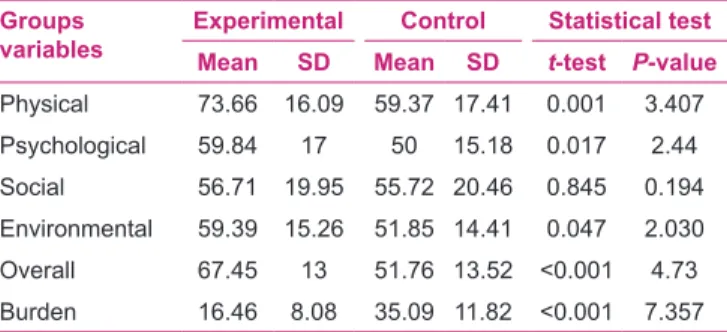
esultsIndependent t‑test, Mann–Whitney, chi‑square, and Fisher’s tests showed no significant difference between the two groups of study and control, concerning demographic characteristics [Tables 1 and 2]. Independent t‑test showed no significant difference between the mean scores of quality of life and caregivers’ caring burden before intervention in the study and control groups [Table 3]. There was a significant difference in the mean scores of physical (P < 0.001), psychological and spiritual (P = 0.017), environmental (P = 0.047) dimensions, and overall quality of life (P < 0.001) among the caregivers in the study and control groups [Table 4]. The t‑test showed no significant difference in subjects’ mean scores of quality of life in social dimension in the study and control groups after intervention (P = 0.845) [Table 4]. Independent t‑test showed a significant difference between the mean scores
Table 1: Demographic characteristics of patients
Statistical test
P-value Experimental group mean
(standard deviation) Control group mean
(standard deviation) Demographic characteristics t=0.03 0971 49.8 (9.9) 49.7 (10.5) Age (years) Educational z=1.13 0.255 21 (65.6%) 25 (78.1%)
Sixth grade and lower
9 (28.1%) 6 (18.8%) Diploma 0 1 (3.1%) BSc 2 (6.2%) 0
MSc and higher degree
Employment status 0.246 2 (6.2%) 0 Employed 30 (93.8%) 32 (100%) Unemployed t=0.13 0.901 4.7 (1.7%) 4.8 (2.3%)
Time since diagnosis (months)
Table 2: Demographic characteristics of caregivers
Statistical test
P-value Experimental group mean
(standard deviation) Control group mean
(standard deviation) Demographic characteristics t=0.76 0.452 36.94(11.3) 38.97 (10.2) Age(year) Sex
c2=1.697 18 (56.2%) 23 (71.9%) Female 0.193 14 (43.8%) 9 (28.1%) Male Educational Z=1.009 0.313 8 (25%) 13 (40.6%)
Sixth grade and lower
15 (46.9%) 11 (34.4%) Diploma 3 (9.4%) 3 (9.4%) BSc 6 (18.8%) 5 (15.6%)
MSc and higher degree
Marital status
c2=2.480 0.289 26 (81.2%) 28 (87.5%) Married 6 (18.8%) 3 (9.4%) Single 0 1 (3.1%) Divorced 0 0 Widowed Occupational status
c2=7.177 0.127 4 (12.5%) 6 (18.8%) Unemployed 8 (25%) 15 (43.8%) Housewife 15 (46.9%) 11 (34.4%) Employed 3 (9.4%) 0 Student 2 (6.2%) 1 (3.1%) Retired t=0.61 0.540 171 (57) 162 (58)
Family income (per month) Relationship with patients
c2=2.435 0.656 1 (3.1%) 1 (3.1%) Parents 5 (15.6%) 8 (25%) Sister 1 (3.1%) 0 Brother 17 (53.1%) 14 (43.8%) Daughter/son 8 (25%) 9 (28.1%) Husband Care assistance
c2=0.080 0.777 23 (71.9%) 24 (75%) Yes 9 (28.1%) 8 (25%) No t=0.42 0.672 8.4 (6.7) 9 (6.8)
of caring burden in the study and control groups after intervention (P < 0.001) [Table 4].
d
IscussIonThis is a clinical trial aimed to define the effect of problem‑solving education based on COPE model on caring burden and quality of life of the family caregivers of women with breast cancer. This study is among the first studies conducted in the context of investigation and promotion of caregivers’ care quality in Iran. As both groups were almost identical concerning patients’ and caregivers’ demographic characteristics, caregivers’ scores promotion after intervention revealed the positive effect of intervention on promotion of quality of life in physical, psychological and spiritual, and environmental dimensions, and on caregivers’ caring burden reduction. These studies, if repeated, can be a good evidence for the use of models, and give an appropriate structure to the care. The results showed that most of family caregivers were middle‑aged women with high school education or lower and with low economic status. Such a group may face numerous problems in fulfillment of their personal educational and supportive needs.
Unfortunately, with regard to the existing conditions in governmental and even private hospitals in Iran,
these needs have rarely received logical responses. This program could provide the caregivers with the required information as well as an appropriate approach to confront the problems in the form of problem solving in an easy and understandable way. On the other hand, most of the caregivers were the children of the patients, their spouse or sister, who were mostly (70%) helped by someone else or other individuals in care. Meanwhile, on the average, the caregivers spend 8 h on caring in a day. These results show the high amount of time the family caregivers spend on breast cancer patients at early stages of the disease. One of our results was improvement of quality of life in the physical dimension.
Achievement of caregivers’ health preservation and its promotion in our educational supportive program is not only important in relation with the care itself but also is a must for the caregivers in playing their caring role. This effect may be as a result of the log book given to the caregivers, in which the caregivers were encouraged to manifest healthy behavior, which may have led to their increased attention to their health and having healthy behavior as much as possible.
We recommended the caregivers to care their own health, if they wanted to take care of their beloved well and to follow recommended behavior to achieve this goal. For instance, we asked them to get help from other family members or friends in case of 24 h care to have enough time to rest. This finding is consistent with the study of Nourthouse et al.,[41] but is not in line with the findings of Nourthouse et al.,[34] Northouse et al.,[42] and Demiris et al.[30] The difference between our findings and those of other studies can be as a result of the type of the used tool, subjects, and intervention.
Northouse et al. (2005) used a combination of physical dimension in Functional Assessment of Cancer Therapy‑ General population(FACT‑G )questionnaire and Short Form‑36 (SF‑36) questionnaire to measure the physical dimension of quality of life. They claim that this combination may not be strict. We used the World Organization Quality of Life Bref(WHOQOL‑Bref )questionnaire, which is a universal tool with confirmed validity and reliability and can measure this dimension better.
On the other hand, the subjects in the other studies[30,34,42] were caregivers of the patients with various acute and recurrent types of cancer, while in the present study, the subjects were caregivers of women with primary breast cancer with lesser need of care. Naturally, acute cases of cancer like lung cancer and more recurrent cases can be the cause for the difference between our results and theirs.
Table 3: Comparison of mean scores of four dimensions and total scores of quality of life and caring burden in the two groups of study and control before intervention
Groups
variables ExperimentalMean SD MeanControlSD Statistical testt-test P-value Physical 64.06 13.33 63.39 16.50 0.859 0.178 Psychological 55.68 16.56 54.29 17.53 0.746 0.325 Social 59.06 17.38 57.29 19.25 0.701 0.386 Environmental 53.62 17.59 52.53 15.11 0.791 0.266 Overall 52.03 11.57 51.29 14.38 0.822 0.22 Burden 29.25 8.40 31.37 11.18 0.394 0.859 Table 4: Comparison of mean scores of four dimensions and total scores of quality of life and burden in the two groups of study and control after intervention
Groups
variables ExperimentalMean SD Mean SD Control Statistical testt-test P-value Physical 73.66 16.09 59.37 17.41 0.001 3.407 Psychological 59.84 17 50 15.18 0.017 2.44 Social 56.71 19.95 55.72 20.46 0.845 0.194 Environmental 59.39 15.26 51.85 14.41 0.047 2.030 Overall 67.45 13 51.76 13.52 <0.001 4.73 Burden 16.46 8.08 35.09 11.82 <0.001 7.357
Although in both studies problem‑solving process has been educated, the used models are different so that one model may have been easier and more understandable. Our other finding is improvement in psychological and spiritual dimension of quality of life in caregivers in the study group. In our study, at the end of the sessions, the subjects were encouraged to express their feelings. They expressed their positive and negative experiences related to their caring role. As the sessions were held by just attendance of the caregivers, they could express their feelings more conveniently, and this could have acted as an emotional support for the caregivers leading to the promotion of psychological dimension, which is an inseparable component of complete health. This obtained finding is in concordance with that of Northouse et al. In the study of Meyers et al. (2011), caregivers’ mean scores of psychological dimension in quality of life showed a reduction in the study and control groups after intervention, with a significantly less reduction in the study group. The subjects in their study comprised caregivers of the patients in a critical condition, which could have affected their psychological aspect as a result of the severity of the manifested signs in their subjects compared to the subjects in the present study. On the contrary, Northouse et al. (2005) obtained different results. We observed promotion of caregivers’ quality of life in environmental dimension in the study group, which is an important finding. However, the effect of intervention on some measurement items of this dimension in the questionnaire of WHO, such as the level of access to daily information, can be reasoned. Among the other possible causes, promotion of economic status, residential area, and other issues in the study group can be indicated, of which some have been measured at the beginning of our study but not at the end, and some others were not measured at all. It is suggested to consider these issues in future studies. On the other hand, with regard to the interventions, promotion in this dimension may have occurred with no change in the aforementioned items and following individuals’ positive attitude change toward life. Another important finding of the present study was lack of improvement in caregivers’ score in social dimension of quality of life, which is consistent with the finding of Demiris et al. (2010), while in the study of Meyers et al. (2011), caregivers’ scores of social dimension in quality of life diminished in the study and control groups after intervention, with a milder significant reduction in the study group. In the study of Northouse et al. (2012), the score of social dimension in the two intervention groups remained steady in the 3rd and the 6th months of study, while it had a significant reduction in the control group in the 3rd month. Despite lack of improvement, no reduction occurred in this dimension, which can be a positive sign
although it was steady in the control group. With regard to the other studies, it seems that a more sensible scale should be used in this dimension.
Despite the observed changes in various dimensions of quality of life after the intervention, educational and supportive program based on COPE model has been able to result in promotion of patients’ quality of life.
These results are also in line with the part of findings revealing that total score of quality of life, measured by cancer patients’ caregivers’ quality of life was promoted. Caregivers’ caring burden was significantly decreased in the study group after intervention compared to the control group. Mac Millan et al. (2006) reported a significant promotion in symptoms’ burden and the burden due to the duties in the study group. Reduction in caring burden can support the promotion in quality of life which we have attained. Sherwood et al.[32] and Demiris et al. (2010) reported promotion in one component (caring self‑confidence) by use of another tool measuring caring burden. Sherwood et al. (2012) found no change in the other four dimensions, while Demiris et al. showed its reduction. Overall, as the used tool in the present study is different from that of other studies, an absolute conclusion cannot be arrived at. Further studies should be conducted with regard to the importance of caring burden reduction and its association with quality of life. The findings of the present study should be considered in the frame of its limitations including small sample size, which was inevitable with regard to conducting such a research among these clients and their families in the form of master’s dissertation.
c
onclusIonIt can be concluded that provision of support and education for family caregivers of women with breast cancer can lead to reduction of their caring burden and promotion of their quality of life. It is suggested to conduct studies with a larger sample size, focusing on educating the caregivers concerning problem‑solving process in patients with higher grade of breast cancer.
A
cknowledgMentHereby, the researchers appreciate the Faculty of Nursing and Midwifery of Isfahan University of Medical Sciences to approve the study. We also thank Seyed‑Al‑Shohada Hospital to give consent to conduct the study and all the staff, and women with breast cancer, who referred to this Hospital, and their family for their contribution in this research study.
r
eferences1. Jemal A, Bray F, Center MM, Ferlay J, Ward E, Forman D. Global Cancer statistics. CA Cancer J Clin 2011;61:69‑90.
2. world health Organization. Available from: http://www.who.int/ countries/irn/en/ [Last accessed on 2012 Nov 18].
3. Ministry of Health and Medical Education Department of Health, Center for Disease Control, Non‑Communicable Diseases Unit, Department of Cancer. Country Reports cancerous material recorded in 1387. Tehran: Ministry of Health and Medical Education; 1389.
4. Papastavrou E, Charalambous A, Tsangari H. Exploring the other side of cancer care: The informal caregiver. J Eur J Oncol Nurs 2009;13:128‑36.
5. Northouse L, Katapodi M, Song L, Zhang L, Mood D. Meta‑ Analysis of randomized trials, interventions with family caregivers of cancer patients. J Cancer Clin 2010;60:317‑39. 6. Sharpe L, Butow P, Smith C, McConnell D, Clarke S. The
Relationship between available support, unmet needs and caregiver burden in patients with advanced cancer and their carers. J Psychooncol 2005;14:102‑14.
7. Kim H, Rose K. Sleep disturbances in family caregivers: An overview of the State of the Science. J Arch Psychiatr Nurs 2011;25:456‑68.
8. Preciousa E, Haran S, Lowe D, Rogers NS. Head and neck cancer patient’s perspective of carer burden. J Oral Maxillo Facial Surg 2012;50:202‑27.
9. Given B, Given C, Kozachik S. Family support in advanced cancer. Cancer J Clin 2001;51:213‑31.
10. Lutgendorf S, Laudenslager I. Care of the caregiver: Stress and dysregulation of Inflammatory control in cancer caregivers. J Clin Oncol 2009;27:2894‑5.
11. Carter PA. Brief behavioral sleep intervention for family caregivers of persons with cancer. J Cancer Nurs 2006;29:95‑103.
12. Given B, Sherwood P. Family care for the older person with cancer. Semin Oncol Nurs 2006;22:43‑50.
13. Blum K, Sherman D. Understanding the experience of caregivers: A focus on Transitions. J Semin Oncol Nurs 2010;26:243‑58.
14. Grunfeld E, Coyle D, Whelan T, Clinch J, Reyno L, Earle C,
et al. Family caregiver burden: Results of a longitudinal study of breast cancer patients and their principal caregivers. CMAJ 2004;170:1795‑801.
15. Chen M, Chu L, Chen H. Impact of cancer patients quality of life on that of spouse caregivers. J Support Care Cancer 2004;12:469‑75. 16. Northouse L, Song L. Family and Caregiver Issues. in Cancer
Nursing Principles and Practice. 7th ed. In: Yarbro H, Wujcik D, Gobeli B, editors. United state American: Jones and Bartlett Publishers; 2011. p. 1783‑7.
17. Meyers LJ, Gray NL. The relationships between family primary caregiver characteristics and satisfaction with hospice care, quality of life, and burden. J Cancer Oncol Nurses Forum 2001;28:73‑82.
18. Northouse L, Mood D, Kershaw T, Schafenacker A, Mellon S, Walker J, et al. Quality of life of women with recurrent breast cancer and their family members. J Clin Oncol 2002;20:4050‑64.
19. Song JI, Shin DW, Choi J, Kang J, Baik YJ, Mo H, et al. Quality of life and mental health in family caregivers of patients with terminal cancer. J Support Care Cancer 2011;19:1519‑26. 20. Fotokian Z, Alikhani M, Salman Yazdi N, Jamshidi R. Quality
of lifes of primary relatives providing care for their cancer patients. IJN 2004;17:42‑50.
21. Bahrami M. Do nurses provide holistic care to cancer patients?. Iran J Nurse Midwifery Res 2010;15:245‑51
22. Honea N, Brintnall R, Given B, Sherwood P, Colao D, Somers S,
et al. Putting evidence into practice nursing assessment and interventions to reduce family caregiver strain and burden. Clin J Oncol Nurs 2008;12:507‑16.
23. Andrews SC. Caregiver burden and symptom distress in people with cancer receiving hospice care. J Oncol Nurs Forum 2001;28:1469‑74.
24. Goldstein N, Concato J, Fried RT, Kasal VS. Factors Associated With caregiver burden of terminally III patients with cancer. J Palliat Care 2004;20:38‑43.
25. Chen Y, Hedrick S, Young H. A pilot evaluation of the family caregiver support program. J Chall Eval Environ Educ Programs Policies 2010;33:113‑9.
26. Houtven C, Ramsey S, Ryn M, Hornbrook M, Atienza A. Economic burden for informal caregivers of lung and colorectal cancer patients. J Oncol 2010;15:883‑93.
27. Reinhard S, Given B, Petlick N, Bemis A. Supporting family caregivers in providing care. in patient safety and quality: An Evidence‑Based Handbook for Nurses. In: Hughes RG, editor. Available from: http://www.ncbi.nlm.nih.gov/books/NBK2665/. [Last accessed on 2008].
28. Houts PS, Nezu AM, Nezu CM, Bucher JA. The prepared family caregiver: A problem‑solving approach to family caregiver education. J Patient Educ Couns 1996;27:63‑73.
29. McMillan S, Small B, Weitzner M, Schonwetter R, Tittle M, Moody L, et al. Impact of coping skills intervention with family, caregivers of hospice patients with cancer, A randomized clinical trial. J Cancer 2006;106:214‑22.
30. Demiris G, Oliver DP, Washington K, Fruehling LT, Haggarty‑ Robbins D, Doorenbos A, et al. A problem solving intervention for hospice caregivers: A pilot study”. J Palliat Med 2010;13:1005‑11. 31. McMillan S, Small B. Using the COPE intervention for family
caregivers to improve symptoms of hospice homecare patients: A clinical trial. J Oncol Nurs Forum 2007;34:313‑21.
32. Sherwood P, Given B, Given C, Sikorskii A, You M, Prince J. The impact of a problem‑solving intervention on increasing caregiver assistance and improving caregiver health. J Support Care Cancer 2012;20:1937‑47.
33. Campbell L, Keefe F, Scipio C, McKee D, Edwards C, Herman S,
et al. Facilitating research participation and improving quality of life for African American prostate cancer survivors and their intimate partners: A pilot study of telephone‑based coping skills training. J Cancer Suppl 2007;109:414‑24
34. Northouse L, Kershaw T, Mood D, Schafenacker A. Effect of family intervention on quality of lif of women with recurrent breast cancer and their family caregivers. J Psychoncol 2005;14:478‑91.
35. Weitzner MA, Jacobsen PB, Wagner H, Friedland JJ. The Caregiver Quality of Life Index–Cancer (CQOLC) scale: Development and validation of an instrument to measure quality of life of the family caregiver of patients with cancer. J Life Res 1999;8:55‑63.
36. Khanjari S, Oskouie F, Langius‑Eklof A. Psychometric testing of the Caregiver Quality of Life Index‑Cancer scale in an Iranian sample of family caregivers to newly diagnosed breast cancer women. J Clin Nurs 2012;21:573‑84.
37. Nejat S, Montazeri A, Holakouie Naieni K, Kazem M, Majd Zadeh SR. Standardizing the quality of life questionnaire–checking
out the Persian translated version. Sch Public Health Inst Public Health Res 2006;4:1‑12.
38. Navidian A, Pahlavanzadeh S, Yazdani M. The effectiveness of family training on family caregivers of inpatients with mental disorders. J Iranian J Psychiatry Clin Psychol 2010;16:99‑106. 39. Navidian A, Salar A and Kermansaravi, F. Study of burden
experienced by family caregivers of patients with mental disorder in mentally ill hospital and psychiatric center. J Teb va Tazkiyeh 2004;19:25‑52.
40. Cameron J, Shin J, Williams D, Stewart D. A brief problem‑ solving intervention for family caregivers to individuals with advanced cancer. J Psychosom Res 2004;57:137‑43.
41. Northouse LL, Mood DW, Schafenacker A, Montie JE, Sandler HM, Forman JD. Randomized clinical trial of a Family intervention for prostate cancer patients and their Spouses. J Cancer 2007;110:2809‑28.
42. Northouse LL, Mood DW, Schafenacker A, Kalemkerian G,
Zalupski M, LoRusso P, et al. Randomized clinical trial of a brief and extensive dyadic intervention for advanced cancer patients and their family caregivers. J Psychooncol 2012 [In Press]. Available from: htttp://www.ncbi.nlm.nih.gov/pubmed/22290823. [Last accessed on 2012].
43. Meyers FJ, Carducci M, Loscalzo MJ, Linder J, Greasby T, Beckett LA. Effects of a problem‑solving intervention (COPE) on quality of life for patients with advanced cancer on clinical trials and their caregivers: Simultaneous care educational intervention (SCEI): Linking palliation and clinical trials. J Palliat Med 2011;41:465‑73.
How to site: Bahrami M, Farzi S. The effect of a supportive educational program based on COPE model on caring burden and quality of life in family caregivers of women with breast cancer. Iranian Journal of Nursing and Midwifery Research 2014;19:119-26. Source of Support: Isfahan University of Medical Sciences.