ISSN-L: 2501 - 1235 Available on-line at: www.oapub.org/edu
Copyright © The Author(s). All Rights Reserved.
doi: 10.5281/zenodo.2558446 Volume 5 │ Issue 5 │ 2019
EFFECTIVENESS IN APPLYING SOLUTIONS TO
IMPROVE SWIMMING PRACTICE SKILLS OF STUDENT
AT THU DAU MOT UNIVERSITY, VIETNAM
Nguyen Duc Thanh1i,
Trinh Phuoc Thanh2
1PhD, Vice Manager of Physical and Defense Education Center, University of Technical Education, Ho Chi Minh City, Vietnam 2MA, Lecturer, Physical and
Defense Education Center, Thu Dau Mot University, Vietnam
Abstract:
Based on assessing the current situation of teaching and finding feasible solutions to improve students’ practical capacity of swimming at Thu Dau Mot University, the paper has assessed the effectiveness of innovatory solutions application. The results indicated that students’ health, technical skills and achievement were improved significantly.
Keywords: swimming, solution, capacity, students, practice, Thu Dau Mot University
1. Introduction
Vietnam has more than 3200 kilometers of coastline, more than 3112 large and small rivers (more than 41,000 kilometers in total length of rivers) and many intermingled canals, ditches and canals. [12, 13] That is the reason why the country has a high child death rate from drowning. [1]
In May, 2012, Ministry of Labor, Invalids and Social Affairs announced the results of the "National Injury Survey in 2010". In it, drowning is the leading cause of death for children, with about 4,500 children dying each year. On average, 12 children per day die because of drowning. [2]
In the period of 2015-2017, the situation of drowning deaths in children has decreased compared to the previous period, but there are still about 2,000 deaths per year on average and this is still the leading cause of death due to injury in children. [4]
Therefore, teaching and learning to swim for high school students to both develop physical and swimming ability and contribute to improve life skills is essential and urgent in human life.
In Vietnam, there are many studies on swimming [3, 5, 6. 7] but in Binh Duong province, there are no works in the field. Binh Duong, due to its geographical location, has a small number of rivers, so the majority of students are unable to swim, so it is difficult to practice swimming skills. For that, how to teach non-swimmers to become good lecturers for most students who cannot swim in a limited time? What should be done to improve the quality of teaching practice of movement techniques while fostering practical teaching skills in general and swimming in particular for lecturers? From all above urgent situations, we found that implementing the research topic: "Effectiveness in applying solutions to improve swimming practice skills of student at Thu Dau Mot University" is very necessary.
2. Methodology
2.1. Participants
Pedagogical experiment is conducted on both subjects who are male students and female students learning specialized physical education and non-specialized at Thu Dau Mot University. In which, 2 experimental groups include of 28 male specialized students and 45 non-specialized female students who learn to swim according to improved solutions; 2 control groups consist of 27 male non-specialized students and 45 female non-specialized students learning swimming by old way.
2.2. Procedures
The study was conducted from January to September 2016 at Thu Dau Mot University, Viet Nam. Experimental period is 1 semester (4 months).
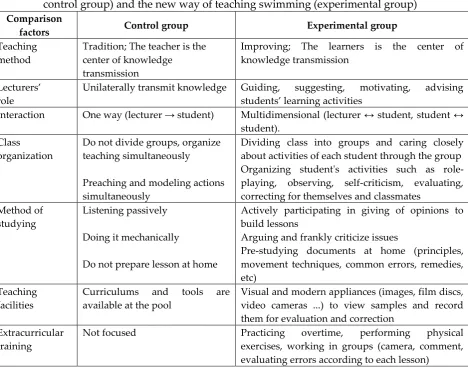
Table 1: Factors showing the difference between the old swimming teaching method (the control group) and the new way of teaching swimming (experimental group) Comparison
factors Control group Experimental group
Teaching method
Tradition; The teacher is the center of knowledge transmission
Improving; The learners is the center of knowledge transmission
Lecturers’ role
Unilaterally transmit knowledge Guiding, suggesting, motivating, advising students’ learning activities
Interaction One way (lecturer → student) Multidimensional (lecturer ↔ student, student ↔ student).
Class organization
Do not divide groups, organize teaching simultaneously
Preaching and modeling actions simultaneously
Dividing class into groups and caring closely about activities of each student through the group Organizing student's activities such as role-playing, observing, self-criticism, evaluating, correcting for themselves and classmates
Method of studying
Listening passively
Doing it mechanically
Do not prepare lesson at home
Actively participating in giving of opinions to build lessons
Arguing and frankly criticize issues
Pre-studying documents at home (principles, movement techniques, common errors, remedies, etc)
Teaching facilities
Curriculums and tools are available at the pool
Visual and modern appliances (images, film discs, video cameras ...) to view samples and record them for evaluation and correction
Extracurricular training
Not focused Practicing overtime, performing physical exercises, working in groups (camera, comment, evaluating errors according to each lesson)
2.3. Measurements
Common methods used in the process of performing research tasks include synthesizing and analyzing relevant documents method; interviewing method; pedagogical testing method; pedagogical experiment method; Statistical and calculation method.
In those methods, pedagogical testing is used to check and evaluate student’s general fitness criterion such as 30m print, standing long jumping, running 800m/1500m. Meanwhile, experiment method to assess students' swimming performance in breaststroke and crawl (25m distance).
3. Results
3.1. Current status of teaching swimming at Thu Dau Mot University
3.1.1. The general situation of teaching swimming at Thu Dau Mot University
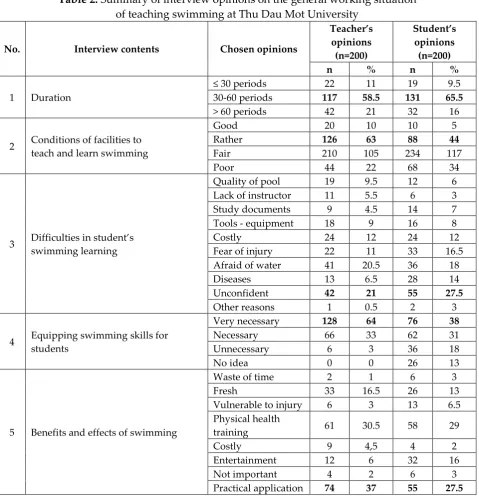
Survey results were presented in Table 2 show:
Table 2: Summary of interview opinions on the general working situation of teaching swimming at Thu Dau Mot University
No. Interview contents Chosen opinions
Teacher’s opinions (n=200)
Student’s opinions (n=200)
n % n %
1 Duration
≤ 30 periods 22 11 19 9.5
30-60 periods 117 58.5 131 65.5
> 60 periods 42 21 32 16
2 Conditions of facilities to teach and learn swimming
Good 20 10 10 5
Rather 126 63 88 44
Fair 210 105 234 117
Poor 44 22 68 34
3 Difficulties in student’s swimming learning
Quality of pool 19 9.5 12 6 Lack of instructor 11 5.5 6 3 Study documents 9 4.5 14 7 Tools - equipment 18 9 16 8
Costly 24 12 24 12
Fear of injury 22 11 33 16.5 Afraid of water 41 20.5 36 18
Diseases 13 6.5 28 14
Unconfident 42 21 55 27.5
Other reasons 1 0.5 2 3
4 Equipping swimming skills for students
Very necessary 128 64 76 38
Necessary 66 33 62 31
Unnecessary 6 3 36 18
No idea 0 0 26 13
5 Benefits and effects of swimming
Waste of time 2 1 6 3
Fresh 33 16.5 26 13
Vulnerable to injury 6 3 13 6.5 Physical health
training 61 30.5 58 29
Costly 9 4,5 4 2
Entertainment 12 6 32 16
Not important 4 2 6 3
Practical application 74 37 55 27.5
The content of swimming so far for specialized and non-specialized education students is quite simple, only one type of swimming (breaststroke).
The duration of the whole course is only 30 periods, conducted in 15 lessons, encapsulated in one semester (2 periods/a session/a week). Both students and lecturers have said that these studying durations is quite short, not satisfying the demand for swimming as well as forming good swimming skills which ensure that students can apply fluently after graduation. Most lecturers and students believe that the appropriate time for swimming program is appropriately from 30 to 60 periods.
The common difficulty arising from subjective factors of learners is still significant, notably 21% of students and 27.5% of lecturers perceive that due to lack of confidence in learners; 20.5% of students and 18% of lecturers think that learners are afraid of water.
Both lecturers and students are highly aware and attach special importance to the role of swimming. When asked about equipped swimming skills for students, there is up to 97% of lecturers and 38% of students said that "very necessary"; "; 33% of lecturers and 31% of students said it was "necessary"; The number of lecturers' denial or "no opinion" is negligible (only about 3%). (Figure 1)
Figure 1: Evaluate the necessity of equipping swimming skills for students
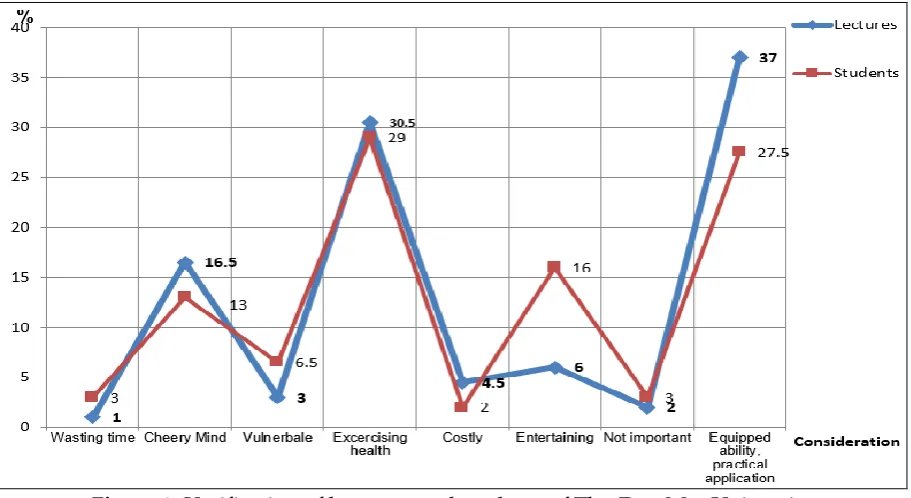
Although there are some differences between lecturers and students's judgment towards swimming role in each criteria, in general, these ideas have similarities in the positive direction that swimming has brought to learners. (Figure 2)
Figure 2: Verification of lecturers and students of Thu Dau Mot University
3.1.2. Current status of swimming teaching activities
The research results presented in Table 3 are noted as following:
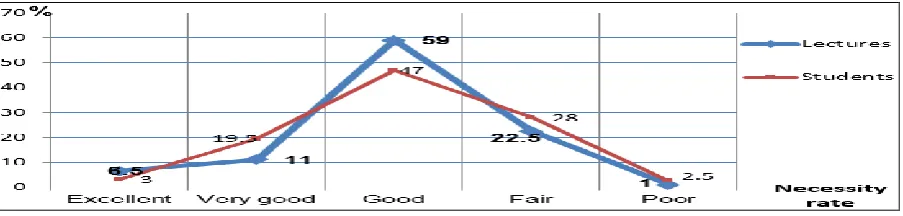
Swimming lecturers’ professional competencies are good for this subject. However, lecturers mainly use the traditional method in class (such as presenting, focusing on the content of the lecture, instructing generally for the whole class, repairing mistakes, personalizing the characteristics of the learner object, etc...). Clearly, these swimming teaching methods have not really shown new points to promote the positive of learners. (Figure 3)
Figure 3: Verification of lecturer’s ability in teaching swimming
The results of the interview show that lecturers are mainly using traditional methods that means just giving presentations, focusing on the content of the lecture but rarely changing, expanding the mind, setting the problem, assigning and dividing class into the groups, playing the role so that the students can learn, analyze, evaluate, criticize, solve cases study (opinions of 41.5% of lecturers and 38% of students). In addition, the method of general guidance for the whole class still prevails absolutely but not towards the fault, individual learners (judgment of 48% lecturers and 53.5% student).
The role of lecturers in swimming class is expressed as unilateral person who has
power in class time, and is arbitrary in the role of the teacher, which should have expressed as an instructor, advisor, suggester,... in learners' activities.
Swimming examination has not yet directed to individual ability of learners, but
professional, periodic, not comprehensive and large in scope.
Table 3: Summary of interviews related to the status of swimming teaching methods
at Thu Dau Mot University
No. Interview
content Chosen opinions
Teacher’s opinions (n=200)
Student’s opinions (n=200)
n % n %
1 Teacher’s capacities
Excellent 13 6.5 6 3
Very good 22 11 39 19.5
Good 118 59 94 47
Fair 45 22.5 56 28
Poor 2 1 5 2.5
2 Teacher’s method in class
Presentation focuses on lesson content 83 41.5 76 38
follow
Grouping, making the case, assigning to learn,
solve the case 15 7,5 10 5
Role-playing 6 3 7 3.5
3 The role of lecturers
Transmitting knowledge unilaterally 90 45 58 29
Domineering, showing the highest power 63 31.5 93 46.5
Guiding and suggesting activities for students to
self-control their learning content 28 14 26 13 Encouraging and advising learning activities for
students to actively achieve the objectives of knowledge and skills
19 9.5 23 11.5
4
Assessing learning outcomes
Final exam 75 37.5 56 28
Learning process test 114 57 125 62.5
Highlights of students in theoretical and
practical lessons 7 3.5 11 5.5
The process of performance and contribution of
students throughout the course 4 2 8 4
3.1.3. Current status of swimming learning activities
The results presented in Table 4 show that lecturers have not built a friendly learning environment so that students can be confident, flexible and creative.
Table 4: Summary of interview ideas related to the status of swimming activities
at Thu Dau Mot University
No. Interview content Chosen opinions
Teacher’s opinions (n=200) Student’s opinions (n=200)
n % n %
1 Classroom environment
Formalistic 81 40.5 62 31
Constants, stereotypes are almost unchanged 77 38.5 75 37.5
Students are self-control and flexible 26 13 24 12
Intimate and close. 16 8 39 19.5
2
Activities of students in swimming class
Focus on listening, taking notes 113 56.5 74 37
Remember and repeat 66 33 97 48.5
Observation, analysis, discussion 14 7 23 11.5
Finding and research materials in advance 7 3,5 6 3
3 Method of acquiring lessons
Passively listening 73 36.5 65 32.5
Follow lecturers’ instructions mechanically 67 33.5 68 34
Proactively, actively participate in speaking,
building lessons 45 22.5 34 17
Frankly criticize, debate related issues
according to learner's position / viewpoint 15 7.5 33 16.5
4 Independence in learning
Depends on lecturers’ lessons content 73 36.5 84 42
Depends entirely on the contents as well as the teaching methods that are imposed by lecturers
114 57 92 46
Promoting initiative capacity 9 4.5 11 5.5
Promoting the ability to criticize and state
Learning activities of students in swimming class are mainly focused on listening, writing and memorizing many things and repeat what lecturers communicate.
Meanwhile, lecturers don't attach special important to ask learners to observe, brainstorm, role-play, discuss or assign tasks as well as encourage learners to explore and research materials at home.
Students mostly take lessons by listening passively (judgments of 36% of lecturers and 49.5% of students), then follow lecturers’ requirements mechanically and lacking in creation (judgments of 51.5% lecturers and 43.5% students).
It is very essential to improve the quality of training comprehensively by promoting learners’ independence and autonomy. Interview results from lecturers and students showed that the independence, autonomy, activeness and critical ability of students in swimming classes are not very high or even too passive and dependent entirely on lecturers’ teaching methods.
3.1.4. Current situation of teacher-student interaction and knowledge results gained from learning swimming
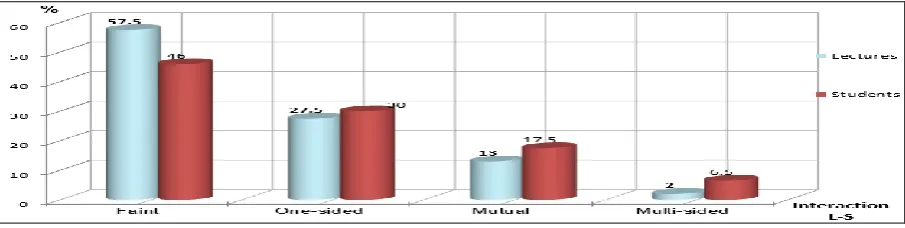
The interaction between lecturers and students is considered as the key to open successful door in teaching and learning quality in swimming class. Survey results are presented in Figure 4 reflecting:
In fact, the interaction between teachers and students in swimming class is quite faint, mainly one-sided, derived from teachers to students. Meanwhile, there is a lack of feedback between teachers and learners as well as multidimensional impacts (between teachers and learners, between learners and learners).
Swimming lecturers have not focused on guiding students to actively learn, collect, study materials to improve swimming techniques.
As a result, swimming knowledge that students receive from the teachers is academic, mold-based, lack of applicability.
Figure 4: Current situation of interaction between lecturers and students in swimming class
3.1.5. Current status of extracurricular activities and students’ needs of practice
The results are also recorded that:
Students have very few chances to participate in extra training courses at the exterior swimming pools.
Student's need to practice extracurricular swimming is real and very high.
3.1.6. Synthesis of the opinions of lecturers and students toward factors that need to be improved to enhance the quality of teaching swimming at Thu Dau Mot University
Summary of the above factors indicates that the current status of teaching swimming is quite inadequate and it is necessary to complement more appropriate innovation solutions.
Table 5: Synthesis the selection of factors to improve the quality of teaching swimming at Thu Dau Mot University No. Elements need to be innovated Lecturers’ opinions
(n=200)
Students’ opinions (n=200)
Comparison
n % n % 2 P
1 Swimming pool, auxiliary equipment 12 6 19 9,5 9.49 >0.05
2 Curriculum 43 21.5 24 12
3 Teaching method 68 34 63 31.5
4 Lecturers’ capacity 27 13.5 29 14.5
5 Lecturers and students’ awareness 22 11 32 16
6 Extracurricular swimming activities 28 14 33 16.5
Through analyzing the opinions of two subjects, lecturers and students with the
index
2
of recognition, there is a similarity in identifying 6 factors (subjective and
objective as presented in Table 5) that need improvement to improve the quality of
teaching swimming (2 is calculated as (= 9.49) <2table (= 37.65) with P> 0.05). This is the main basis for making the necessary changes.
3.2. Evaluating of effectiveness of innovative solutions in teaching swimming 3.2.1. Organize the experimental process
Specific tasks: First, evaluating the effectiveness of new solutions for students in terms of fitness after the course (before and after experiment period). Second, evaluating the effectiveness of new solutions for students in terms of technique (swimming techniques and swimming achievements) after the course.
Experimental results are presented below:
3.2.2. Evaluate the effectiveness of new solutions for students in terms of physical strength (before and after experiment period)
Basically, before the experiment the physical strength between the experimental groups and controlling groups of male specialized in physical education students as well as of female non-specialized in physical education students are similar.
After the experiment period, the result of comparison the physical strength between two experimental groups to 2 control groups presented in Table 6 and Table 7.
A. For male students specialized in physical education: Both the male experimental group and the male control group had physical growth after the experiment period. Horizontal comparing between these two groups found that: only one third of male experiment group's fitness criteria (namely running 1500m) outperformed to male controlled group's with P <0.05. Particularly, median value difference of two criterion (include standing long jumping and 30m print) were not statistically significant with P> 0.05. (Table 6)
Table 6: Comparison of physical fitness before experiment period
between male experimental group and male controlled group in specialized education No. Targets Male experimental
group (n = 28)
Male control Group (n=27)
Comparison
x
A +SA Cv(%) εx
B +SB Cv(%) ε t P 1 30m print (s) 5.15 0.24 4.66 0.02 5.19 0.26 5.01 0.01 1.6 >0.052 Standing long jumping (cm) 225.3 9.75 4.33 0.01 224.4 3.42 1.52 0.01 1.53 >0.05
3 Running 1500m (s) 388.7 9.53 2.45 0.01 390.7 7.33 1.88 0.01 1.95 >0.05
B. For female students not specialized in physical education: There were no significant physical differences between female experimental group and female control group except for the criteria of running 1500m (d = 5.44s), the difference in median values was statistically significant with P> 0.05. (Table 7)
Table 7: Comparison of physical fitness before experiment period
between female experimental group and female controlled group in non-specialized education No. Targets Female experimental
group (n = 45)
Female control group (n=45)
Comparison
x
A +SA Cv(%) εx
B +SB Cv(%) ε t P 1 30m print (s) 5.42 0.46 8.49 0.03 5.51 0.6 10.89 0.04 1.68 >0.052 Standing long jumping (cm) 172.16 16.79 9.75 0.01 169.4 17.07 10.08 0.04 1.63 >0.05
3 Running 800m (s) 281.1 20.61 7.33 0.01 284.4 25.7 9.06 0.03 1.45 >0.05
3.2.3. Evaluate the effectiveness of new solutions for students in terms of speciality (swimming techniques and swimming achievements) after experimental period
The effectiveness of new professional solutions for students after the course is compared with the following aspects:
For male specialized in physical education students: involving swimming
techniques (number of swimming types) and swimming achievements (calculated according to swimming time - s);
For female non-specialized in physical education students: involving swimming
techniques (number of swimming styles) and swimming achievements (calculated by swimming distance - m).
A. For male students specialized in physical education:
Regarding swimming techniques: After experimental period, the male
experimental group was expert in and well trained both swimming styles (breaststroke and crawl). Meanwhile, the male control group was only well-informed and skillful in only breaststroke.
Regarding swimming achievement (s): By observing the breaststroke after the
experimental period, it was noted that 100% of the students of the male experimental group and the male control group completed entire required distance at the final test (25m). However, in terms of swimming performance (swimming time calculated in second), there is a statistically significant difference between these two groups but the advantage belongs to the experimental group (t calculation = 2, 38> t table = 2 with P <0.05). Test results are presented in Table 3.13 and Figure 3.26.
B. For female students non-specialized in physical education:
Regarding swimming techniques: The female control group only practiced one
swimming style (breaststroke), while the female experimental group was more fully equipped so after the course the students of this group were able to swim well both popular swimming styles (breaststroke and crawl).
Regarding the swimming performance (s): Observation of breaststroke-style test
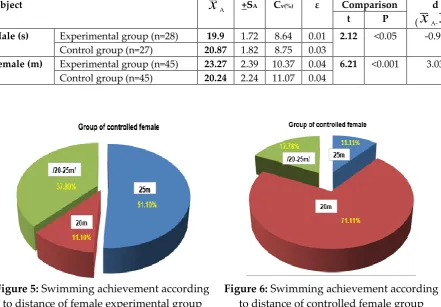
touch and pass 20m distance. But in terms of swimming achievements recorded that, the female experimental group has the number of students completing the swimming range (25m) with a relatively high rate (68%); The number of students achieving the range from 20m to under 25m is 32%; No students have achievements of under 20m.
While the female control group had only 11% completed the distance of 25m; The number of students achieving a range of between 20m and <25m is 17.8%, while the number of students who can only reach the range of less than 20m is 71%. The difference in mean values between these two groups was statistically significant but superior belong to the female experimental group (t calculation = 2.62> t table = 2 with P <0.05). Test results are presented in Table 8, Figure 5, Figure 6.
Table 8: Comparison of swimming performance (25m) after the course between Experiment groups and Control group
Object
x
A +SA Cv(%) ε Comparison d(
x
A-x
B)t P
Male (s) Experimental group (n=28) 19.9 1.72 8.64 0.01 2.12 <0.05 -0.91 Control group (n=27) 20.87 1.82 8.75 0.03
Female (m) Experimental group (n=45) 23.27 2.39 10.37 0.04 6.21 <0.001 3.03 Control group (n=45) 20.24 2.24 11.07 0.04
Figure 5: Swimming achievement according
to distance of female experimental group
Figure 6: Swimming achievement according
to distance of controlled female group
4. Conclusion
Current status of teaching swimming for students at Thu Dau Mot university has
many shortcomings that need to be changed such as: content, duration, swimming teaching facilities and obstacles from learners; The main methods of teaching are traditional, not really aimed at promoting the learners more positive; Teacher’s role in swimming class is expressed as unilateral person during class time; the current way of examining and evaluating swimming is only about professional, periodic, but not comprehensive and overall, not yet directed to the individual ability of learners; Learning environment is not really friendly and close; Student activities in swimming class are passive, mechanical, lack of creativity, independence, autonomy in lesson construction; Interaction between lecturers and students in swimming class is rather faint, mostly one-sided; Students have not actively studied and collected related documents; Swimming knowledge is academic according to books but lacking in applicability; The student's demand to practice swimming is very high but there are few conditions to participate in extracurricular activities.
Through studying the inadequacies of the situation, the topic has provided some
positive solutions to improve swimming practical capacity of students. They consist of propaganda organizing, enhancing awareness of the significance and role of swimming; ensure facilities and convenience for teaching and learning swimming; improve the qualifications of lecturers; manage and organize the classes effectively; enhance extracurricular swimming activities for students. In particular, the topic pays special attention to improve the teaching and learning methods, which should be emphasized such as role playing method, grouping method so that students can find errors and correct mistakes for themselves.
Pedagogical experiment has proved the effectiveness and outstanding
advantages of new solutions in teaching and learning swimming compared to the old method. Although the physical disparity is not significant, it thanks to the application of innovative learning and teaching swimming solutions which were proposed by the topic that the swimming technique and achievements of experiment groups were better compared to control group after the course.
References
1. Luong Mai Anh. (2014). Report on community drowning prevention in the
health sector and orientation for the plan in the coming period. Department of Health Environmental Management.
2. Phuong Chi. (2013). Popularizing swimming into schools. VOV.VN (Vietnamese
Broadcast online newspaper). August 15, 2013.
3. Nguyen Thi Minh Ha. (2001). Improve the initial swimming curriculum for 6-7
4. Thu Hang. (2018). The death of drowning in Vietnamese children is the highest
in Southeast Asia, according to thanhnien.vn. [Online] Available:
https://thanhnien.vn/thoi-su/tu-vong-do-duoi-nuoc-o-tre-em-viet-nam-cao-nhat-dong-nam-a-977185.html. (June 26, 2018)
5. Nguyen Huu Hien. (2006). Using grouping method in swimming teaching for
students of Irrigation University. Collection of research on physical education and health education in schools at all levels (4th Conference). Sports Publishing House.
6. Đao Trong Kien. (2006). Study to select strength development exercises for
athletes 12-13 years old in the Northern swimming training centers (initial specialization stage). Collection of sports science research in 2006. Sports Publishing House.
7. Pham Trong Thanh, Vu Bich Hue, Tran Long. (1993). Some research results on
capacity to acquire swimming techniques for students of small ages 7-11 years. Collection of research on health and physical education science in schools at all levels (1st Conference). Sports Publishing House.
8. Nguyen Duc Thuan. (2001). Researching the physical growth rate of intensive
swimming students of the University of Physical Education and Sports I. Collection of scientific and health education science in schools at all levels (3rd Conference). Sports Publishing House.
9. Vu Chung Thuy. (2006). Research and develop standards for assessing the level
of training for young swimming athletes of University of Physical Education and Sports I. Collection of physical education and school health research (4th Conference). Sports Publishing House.
10.Nguyen Van Thoi. (2010). Content and method of teaching traditional swimming
for grade 6 of Chuong My district secondary school – Hanoi. Collection of physical education and school health research (5th Conference). Sports Publishing House.
11.Phan Thanh Tin. (2010). Effectiveness of the application of teaching methods to
promote the positive in teaching swimming for intensive students and to popularize Danang University of Sports. Collection of physical education and school health research (4th Conference). Sports Publishing House.
12.Nguyen Van Trach. (1999). Swimming. Sports Publishing House.
13.Nguyen Van Trach, Nguyen Duc Chuong, Nguyen Bich Van. (1993). Study the
Creative Commons licensing terms