Screening Yield of HIV Antigen/Antibody Combination
and Pooled HIV RNA Testing for Acute HIV Infection
in a High-Prevalence Population
Philip J. Peters, MD; Emily Westheimer, MSc; Stephanie Cohen, MD, MPH; Lisa B. Hightow-Weidman, MD, MPH; Nicholas Moss, MD, MPH; Benjamin Tsoi, MD, MPH; Laura Hall, MPH; Charles Fann; Demetre C. Daskalakis, MD, MPH; Steve Beagle, BS; Pragna Patel, MD, MPH; Asa Radix, MD; Evelyn Foust, MPH; Robert P. Kohn, MPH; Jenni Marmorino, PhD; Mark Pandori, PhD; Jie Fu, PhD; Taraz Samandari, MD; Cynthia L. Gay, MD, MPH
IMPORTANCEAlthough acute HIV infection contributes disproportionately to onward HIV transmission, HIV testing has not routinely included screening for acute HIV infection.
OBJECTIVETo evaluate the performance of an HIV antigen/antibody (Ag/Ab) combination assay to detect acute HIV infection compared with pooled HIV RNA testing.
DESIGN, SETTING, AND PARTICIPANTS Multisite, prospective, within-individual comparison study conducted between September 2011 and October 2013 in 7 sexually transmitted infection clinics and 5 community-based programs in New York, California,
and North Carolina. Participants were 12 years or older and seeking HIV testing, without known HIV infection.
EXPOSURES All participants with a negative rapid HIV test result were screened for acute HIV infection with an HIV Ag/Ab combination assay (index test) and pooled human immunodeficiency virus 1 (HIV-1) RNA testing. HIV RNA testing was the reference standard, with positive reference standard result defined as detectable HIV-1 RNA on an individual RNA test.
MAIN OUTCOMES AND MEASURESNumber and proportion with acute HIV infections detected.
RESULTS Among 86 836 participants with complete test results (median age, 29 years; 75.0% men; 51.8% men who have sex with men), established HIV infection was diagnosed in 1158 participants (1.33%) and acute HIV infection was diagnosed in 168 participants (0.19%). Acute HIV infection was detected in 134 participants with HIV Ag/Ab combination testing (0.15% [95% CI, 0.13%-0.18%]; sensitivity, 79.8% [95% CI, 72.9%-85.6%]; specificity, 99.9% [95% CI, 99.9%-99.9%]; positive predictive value, 59.0% [95% CI, 52.3%-65.5%]) and in 164 participants with pooled HIV RNA testing (0.19% [95% CI, 0.16%-0.22%]; sensitivity, 97.6% [95% CI, 94.0%-99.4%]; specificity, 100% [95% CI, 100%-100%]; positive predictive value, 96.5% [95% CI, 92.5%-98.7%]; sensitivity comparison,P< .001). Overall HIV Ag/Ab combination testing detected 82% of acute HIV infections detectable by pooled HIV RNA testing. Compared with rapid HIV testing alone, HIV Ag/Ab combination testing increased the relative HIV diagnostic yield (both established and acute HIV infections) by 10.4% (95% CI, 8.8%-12.2%) and pooled HIV RNA testing increased the relative HIV diagnostic yield by 12.4% (95% CI, 10.7%-14.3%).
CONCLUSIONS AND RELEVANCEIn a high-prevalence population, HIV screening using an HIV Ag/Ab combination assay following a negative rapid test detected 82% of acute HIV infections detectable by pooled HIV RNA testing, with a positive predictive value of 59%. Further research is needed to evaluate this strategy in lower-prevalence populations and in persons using preexposure prophylaxis for HIV prevention.
JAMA. 2016;315(7):682-690. doi:10.1001/jama.2016.0286
Supplemental contentat jama.com
CME Quizat
jamanetworkcme.comand CME Questionspage 702
Author Affiliations:Author affiliations are listed at the end of this article.
Corresponding Author:Philip J. Peters, MD, Division of HIV/AIDS Prevention, Centers for Disease Control and Prevention, 1600 Clifton Rd NE, MS E-45, Atlanta, GA 30329 ([email protected]).
A
cute HIV infection contributes disproportionately to HIV transmission.1-4A high viral load,5which oftenpeaks at levels greater than 10 000 000 copies/mL, and homogeneity of viral variants recently selected for transmission3,6both contribute to this highly infectious
phase. Individuals with acute HIV infection have de facto engaged in high-risk behaviors and are often unaware that they are infected with HIV. Identifying individuals with acute HIV infection is critical to prevent further HIV transmission,7as diagnosis can lead to several effective HIV
prevention interventions. Acute HIV infection is character-ized as the interval between the appearance of HIV RNA and detection of HIV-specific antibodies.8Acute HIV infection
can be diagnosed with assays that detect either HIV RNA (the reference standard) or the p24 antigen (an HIV core protein), which are both detectable early after HIV infection and before an antibody response develops (eFigure in the Supplement).8,9Although HIV RNA testing using a pooled
protocol (in which multiple HIV antibody–negative speci-mens are combined and tested together) can effectively detect acute HIV infection, it has not been widely imple-mented because only 1 RNA assay is US Food and Drug Administration (FDA)–approved for HIV diagnosis, the pool-ing protocol is logistically complex and time intensive, and it may not be cost-effective.10HIV immunoassays that
detect both the p24 antigen and anti-HIV antibody (fourth generation antigen/antibody [Ag/Ab] combination immuno-assays) are currently being implemented as the initial screening test in the 2014 Centers for Disease Control and Prevention (CDC) and Association of Public Health Labora-tories (APHL)–recommended HIV diagnostic algorithm,8can
be performed rapidly, and are likely cost-effective.11
How-ever, HIV Ag/Ab combination assays have a lower sensitivity compared with pooled HIV RNA testing, and its perfor-mance at detecting acute HIV infection has not been estab-lished. In a prospective study we evaluated the performance of an HIV Ag/Ab combination assay to detect acute HIV infection compared with pooled HIV RNA testing in a high-prevalence population.
Methods
Study Design and Participants
This study was approved by local institutional review boards, as indicated by local policies, for the University of California at San Francisco, the University of North Carolina at Chapel Hill, and the New York City Department of Health and Mental Hygiene, and was approved by CDC through a research determination in accordance with federal human participants protection regulations and CDC policies and procedures.13,14Participants provided medical consent for
HIV testing (including screening for acute HIV infection), and the study had a waiver of participant consent for research based on an exempt status determined by local institutional review boards. The Screening Targeted Popula-tions to Interrupt On-going Chains of HIV Transmission with Enhanced Partner Notification (STOP) study was a
pro-spective study examining implementation of HIV Ag/Ab combination testing to detect acute HIV infection linked to enhanced partner services in New York City, New York; San Francisco, California; and Raleigh, Durham, and Winston-Salem, North Carolina.12Participants were 12 years or older
and receiving HIV testing at 1 of 12 facilities, including sexu-ally transmitted infection clinics and community-based pro-grams. Participants self-reported demographic (eg, age, race, and ethnicity) and behavioral information based on fixed categories. Race was included as a variable because HIV disproportionately affects certain racial and ethnic groups. Acute HIV testing was offered to consecutive sexu-ally active men who have sex with men (MSM) at testing venues in New York and California, and to all consecutive patients (including MSM) receiving HIV testing at 3 sexually transmitted infection clinics in North Carolina (Table 1).
Test Methods
Specimens from participants were initially screened with a point-of-care rapid HIV test (OraQuick ADVANCE Rapid HIV-1/2 Antibody Test, OraSure Technologies or Clearview HIV 1/2 STAT-PAK assay, Alere). Specimens with a negative test result for the rapid test were tested for acute HIV infection with the index test, a laboratory-based, fourth-generation HIV Ag/Ab combination immunoassay (Abbott Architect HIV Ag/Ab Combo Assay; Abbott Diagnostics) according to the manufacturer’s specifications15(eAppendix 1 in the
Supplement) and with pooled human immunodeficiency virus 1 (HIV-1) RNA testing. The HIV Ag/Ab combination immunoassay was considered reactive if the signal:cutoff ratio result was 1.00 or more on the initial test and on at least 1 of 2 additional repeat tests (ie, all reactive specimens had 3 signal:cutoff ratio results).15
A combination of pooled and individual HIV-1 RNA test-ing was used as the reference standard for acute HIV infec-tion because HIV RNA is the first laboratory marker to become detectable in the plasma after HIV infection (eFigure in theSupplement).5,8,9Because HIV RNA testing is
expen-sive and time intenexpen-sive, multiple specimens that had tested negative for HIV antibody (ie, do not have established HIV infection) were combined into a pool and the HIV RNA assay was performed on the pool.16Although pooling increases the
negative HIV rapid test result pooled together for an HIV RNA test) ranged from 10 in California (LLQ = 400 copies/ mL), to 16 in New York (LLQ = 480 copies/mL), and to 80 in North Carolina (LLQ = 2400 copies/mL).
The HIV Ag/Ab combination immunoassay and the pooled HIV RNA testing were performed in parallel and a final result was assigned for each assay without information on the other assay’s result. If the HIV Ag/Ab combination immunoassay and the pooled HIV RNA testing were discor-dant, an additional individual HIV RNA test was performed. In summary, if HIV Ag/Ab combination immunoassay was nonreactive, the HIV-1 RNA reference standard was classi-fied negative if the pooled HIV RNA result was undetect-able. If either the HIV Ag/Ab combination immunoassay or the pooled HIV RNA test result was positive, the HIV-1 RNA reference standard result (positive or negative) was deter-mined by the additional individual HIV RNA result (detect-able or undetect(detect-able).
Reactive HIV Ag/Ab combination assay specimens were also tested with 2 antibody-based confirmatory tests includ-ing the Multispot HIV-1/HIV-2 Rapid Test (Bio-Rad Laborato-ries) and either an HIV-1 Western blot (Bio-Rad LaboratoLaborato-ries) or an HIV-1 immunofluorescent assay (Sanochemia) per package insert.18The Multispot was included in this
analy-sis because it is now the recommended confirmatory test for HIV diagnosis in the 2014 CDC/APHL HIV laboratory testing recommendations8(eAppendix 1 in theSupplement).
Acute HIV infection was defined by a negative result for the rapid HIV test followed by a reactive result for the HIV Ag/Ab combination assay, or detectable HIV RNA on pooled HIV RNA testing confirmed with an individual HIV RNA test. Established HIV infection was defined as HIV infection detected by a rapid HIV test and confirmed by a reactive Multispot or positive HIV-1 Western blot result, with discor-dant confirmatory results resolved with HIV-1 RNA testing. Because the majority of testing occurred among MSM at 2 of Table 1. Characteristics and Risk Behavior Information Stratified by Sitea
Variable
No. (%)
New York (n = 20 884)
California (n = 29 335)
North Carolina (n = 36 617)
Total (N = 86 836)b
Age, y
<25 4716 (22.6) 3520 (12.0) 15 400 (42.1) 23 636 (27.2)
25 to 34 10 691 (51.2) 12 144 (41.4) 11 378 (31.1) 34 213 (39.4)
35 to 44 3495 (16.7) 7221 (24.6) 5109 (14.0) 15 825 (18.2)
≥45 1982 (9.5) 6405 (21.8) 3649 (10.0) 12 036 (13.9)
Missing 0 45 (0.2) 1081 (2.6) 1126 (1.3)
Median (IQR) 29 (25-35) 33 (27-43) 26 (22-34) 29 (24-38)
Gender
Male 19 670 (94.2) 28 541 (97.3) 16 875 (46.1) 65 086 (75.0)
Female 1141 (5.5) 641 (2.2) 18 708 (51.1) 20 490 (23.6)
Transgender or other 73 (0.4) 123 (0.5) 6 (0.02) 202 (0.2)
Missing 0 30 (0.1) 1028 (2.8) 1058 (1.2)
Race/ethnicity
Black/African American 4005 (19.2) 1404 (4.8) 25 572 (69.8) 30 981 (35.7)
Hispanic/Latino 4518 (21.6) 5475 (18.7) 4147 (11.3) 14 140 (16.3)
White 9703 (46.5) 16 929 (57.7) 4801 (13.1) 31 433 (36.2)
Asian 1425 (6.8) 3486 (11.9) 134 (0.4) 5045 (5.8)
Other 22 (0.1) 616 (2.1) 63 (0.2) 701 (0.8)
Unknown 1211 (5.8) 1425 (4.9) 1900 (5.2) 4536 (5.2)
Risk Behaviors in Previous 12 Monthsc
Male participants only (n = 65 086)
Sex with men 17 910 (91.1) 25 355 (88.8) 1690 (10.0) 44 955 (69.1)
Sex with women only 0 1136 (4.0) 11 978 (71.0) 13 114 (20.2)
Female participants only (n = 20 490)
Sex with MSM 147 (12.9) 103 (16.1) 60 (0.3) 310 (1.5)
Sex with men (but not MSM) 0 460 (71.8) 14 942 (79.9) 15 402 (75.2)
Sex with women only 0 22 (3.4) 367 (2.0) 389 (1.9)
All participants (n = 86 836)
Sex with an HIV-infected sex partner 1145 (5.5) 6758 (23.0) 337 (0.9) 8240 (9.5)
Sex in exchange for money or drugs 0 17 (0.1) 234 (0.6) 251 (0.3)
Injection drug use 134 (0.6) 519 (1.8) 88 (0.2) 741 (0.9)
Abbreviations: IQR, interquartile range; MSM, men who have sex with men.
aCharacteristics and risk behavior
information are self-reported at the time of testing. The test result (and information collected at that test event) is the unit of analysis. Participants could be diagnosed with HIV infection (either acute or established) only once in this study, but participants with a negative HIV test result could be tested again.
b
Thirty-one participants without complete HIV testing (missing a combination Ag/Ab combination assay or pooled HIV RNA result) were excluded.
cEach risk behavior (eg, sex with
the sites, an analysis of risk for acute HIV infection was con-ducted among MSM only.
Statistical Analysis
The primary analysis was a within-individual comparison of HIV Ag/Ab combination and pooled HIV RNA test results. The unit of analysis was a test; although an individual could contribute only 1 positive result (subsequent tests were excluded after an HIV diagnosis), individuals with negative test results were encouraged to return every 3 months for testing. The frequencies of acute HIV infection detected with these 2 assays were described and compared. The McNemar test was used to test for differences in propor-tions (categorical variables). Indeterminate HIV Ag/Ab combination or pooled HIV RNA test results were repeated and participants missing either test were excluded from the analysis. The Wilcoxon rank sum test (continuous variables), the χ2and Fisher exact tests (2-level categorical
variables), and a log-linked binomial regression model (Proc Genmod; >2-level categorical variables19) were used to
evaluate for associations between acute HIV infection and demographic and behavioral information.20Missing
demo-graphic data (eg, race) was categorized into a “missing” cat-egory if not present on the data collection form or if the par-ticipant refused to provide an answer, and this “missing” category was included in the analysis. Statistical signifi-cance was indicated by a 2-sidedPvalue less than .05. All analyses, including calculations of sensitivity, specificity, and positive predictive value and their respective 95% con-fidence intervals by exact (Clopper-Pearson) methods, were performed using SAS (SAS Institute), version 9.3. The intended sample size for this study was 109 acute HIV infec-tions, which would provide adequate power (β = .1 and α = .05) to detect a 13% difference in the proportion of acute HIV infections detected by the HIV Ag/Ab combination assay compared with pooled HIV RNA testing.
Results
Between September 2011 and October 2013, 86 867 HIV tests were performed (Figure 1). Among 86 836 with com-plete HIV testing results, the median age was 29 years (in-terquartile range [IQR], 24-38), the majority (75.0%) of those testing were men (Table 1), and 51.8% were MSM. Among male participants (n = 65 086), 69.1% reported hav-ing sex with men. The majority of female participants (n = 18 708 of 20 490; 91.3%) and male participants who reported having sex with women only (n = 11 978 of 13 114; 91.3%) were tested in North Carolina (Table 1).
Established HIV infection (rapid HIV test reactive and confirmed) was diagnosed in 1158 individuals (1.33%), with few rapid HIV test results (n = 19; 0.02% of all tests, 1.6% of all positive tests) determined to be false-positive (Figure 2). The HIV Ag/Ab combination assay result was repeatedly reactive for all 1158 with established HIV infec-tion and negative for all 19 rapid specimens with a false-positive result. Western blot and immunofluorescent assay
test results were positive in 1143 of the 1158 specimens (98.7%) determined to have established HIV infection but were indeterminate (n = 9; 0.8%) or negative (n = 6; 0.5%) in 15 established HIV infection specimens (Figure 2). Mul-tispot confirmatory testing was HIV-1 reactive in 1140 of the 1158 specimens (98.4%) determined to have established HIV infection but was indeterminate (n = 10; 0.9%) or negative (n = 4; 0.3%) in 14 established HIV infection specimens (Figure 2).
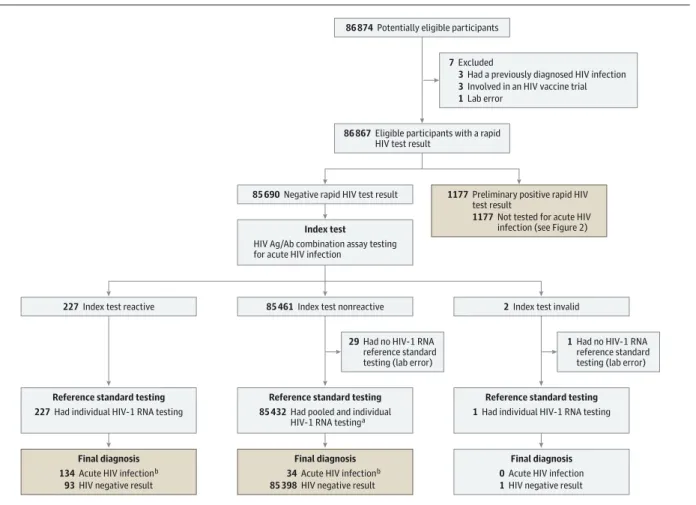
Acute HIV infection was diagnosed in 168 individuals (0.19%) by testing specimens that were negative by rapid HIV testing (n = 85 690) with HIV Ag/Ab combination and pooled HIV RNA assays (eTable 1 in theSupplement). The Ag/Ab combination assay was reactive in 227 of these specimens, of which 134 (0.15% [95% CI, 0.13%- 0.18%]) were confirmed as acute HIV infection on individual HIV RNA testing, and 93 (0.11% [95% CI, 0.09%-0.13%]) were determined to be false-positive test results (Figure 1). The positive predictive value for acute HIV infection of a reac-tive Ag/Ab combination assay result after a negareac-tive rapid HIV test was 59.0% (95% CI, 52.3%-65.5%). Pooled HIV-1 RNA testing was reactive in 170 of 85 690 rapid negative specimens (0.20%), of which 164 (0.19%) were determined to be acute HIV infection on individual HIV-1 RNA testing. Four results from pooled HIV-1 RNA testing (0.005% of the rapid negative specimens [95% CI, 0.00%– 0.02%]) were determined to be false-negative, and 6 results (0.007% [95% CI, 0.00%-0.02%]) were determined to be false-positive.
Of 168 acute HIV infections diagnosed in this study, HIV Ag/Ab combination testing detected 134 acute infections (acute HIV infection: sensitivity, 79.8% [95 CI, 72.9%-85.6%]; specificity, 99.9% [95% CI, 99.9%-99.9%]; positive predictive value, 59.0% [95% CI, 52.3%-65.5%]). Pooled HIV RNA testing detected 164 acute infections (sensitivity, 97.6% [95% CI, 94.0%-99.4%]; specificity, 100% [95% CI, 100%-100%]; positive predictive value, 96.5% [95% CI, 92.5%-98.7%]) (sensitivity comparison,P< .001). Overall, HIV Ag/Ab combination testing detected 82% of acute HIV infections detectable by pooled HIV RNA testing. Acute infections detectable by pooled HIV RNA testing only (n = 34) had a lower median HIV-1 v iral load (6019 copies/mL [IQR, 1225-25 866]) than those reactive on HIV Ag/Ab combination testing (750 000 copies/mL [IQR, 224 152-2 033 422];P< .001). The full testing results of the 4 acute infections (2.4%) that were reactive on the Ag/Ab combination testing but negative on pooled HIV RNA test-ing are available online (eTable 2 in theSupplement). All acute infections detected by HIV Ag/Ab combination testing were also tested with the Multispot antibody assay (eAppen-dix 2 in theSupplement).
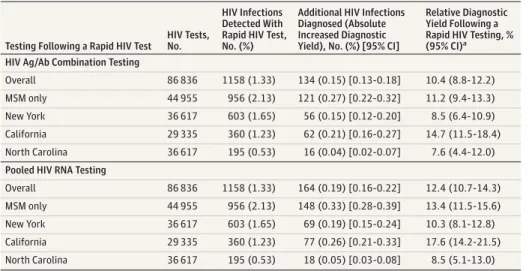
and 12.4% (95% CI, 10.7%-14.3%), respectively, compared with rapid HIV testing (Table 2), and by 0.04% (95% CI, 0.03%-0.05%) and 2.6% (95% CI, 1.8%-3.6%), respectively, compared with HIV Ag /Ab combination testing. This increase in absolute diagnostic yield from Ag/Ab combina-tion testing ranged from an increase of 0.04% in North Carolina and 0.15% in New York, to 0.21% in California. The increase in relative diagnostic yield from Ag/Ab combina-tion testing ranged from 7.6% in North Carolina and 8.5% in New York, to 14.7% in California (Table 2).
Because HIV testing focused on sexually active MSM in both New York City, New York, and San Francisco, California (86% of all tests), a subanalysis of MSM was conducted to evaluate risk factors for acute HIV infection (Table 3). Among 44 955 MSM tested at all 3 sites, 1107 (2.46%) were diagnosed with HIV infection, including 956 (2.13%) with established HIV infection and 151 (0.34%) with acute HIV infection. Among only MSM, the addition of Ag/Ab combi-nation testing to rapid HIV testing alone increased the rela-tive diagnostic yield by 11.2% (95% CI, 9.4% to 13.3%), and
pooled HIV RNA testing increased the relative diagnostic yield by 13.4% (95% CI, 11.5% to 15.6%). Younger (<25 years of age) MSM had a higher frequency of acute HIV infection compared with older (≥45 years) MSM, but the difference was not statistically significant (0.40% for younger MSM vs 0.28% for older MSM; risk difference [RD], 0.12% [95% CI, −0.06% to 0.31%];P= .19). Compared with white MSM, there were higher frequencies of acute HIV infection among African American or black MSM (0.54% for African Ameri-can or black MSM vs 0.28% for white MSM; RD, 0.26% [95% CI, 0.05% to 0.48%];P= .01) and Hispanic or Latino MSM (0.43% for Hispanic or Latino MSM vs 0.28% for white MSM; RD, 0.16% [95% CI, 0.01% to 0.31%];P= .04). Overall, o n l y 1 6.9 % ( n = 7 6 03 ) o f M S M re p o r te d h av i ng a n HIV-infected sex partner at the time of testing, but these MSM had a higher frequency of acute HIV infection than MSM who did not report an HIV-infected sex partner (0.47% for MSM with HIV-infected sex partner vs 0.31% for MSM without HIV-infected sex partner; RD, 0.16% [95% CI, 0.00% to 0.33%];P= .048).
Figure 1. Flow of Specimens Screened for Acute HIV Infection With an HIV Ag/Ab Combination Assay (Index Test) and HIV-1 RNA Testing (Reference Standard Test)
7Excluded
3Had a previously diagnosed HIV infection 3Involved in an HIV vaccine trial 1Lab error
86 874Potentially eligible participants
86 867Eligible participants with a rapid HIV test result
85 690Negative rapid HIV test result
227Index test reactive 85 461Index test nonreactive 2Index test invalid
Reference standard testing 227Had individual HIV-1 RNA testing
Reference standard testing 1Had individual HIV-1 RNA testing Reference standard testing
85 432Had pooled and individual HIV-1 RNA testing a
Index test
HIV Ag/Ab combination assay testing for acute HIV infection
Final diagnosis 134Acute HIV infection b
93HIV negative result
Final diagnosis 34Acute HIV infection b
85 398HIV negative result
Final diagnosis 0Acute HIV infection 1HIV negative result 29Had no HIV-1 RNA
reference standard testing (lab error)
1Had no HIV-1 RNA reference standard testing (lab error) 1177Preliminary positive rapid HIV
test result
1177Not tested for acute HIV infection (see Figure 2)
Ag indicates antigen; Ab, antibody; HIV-1, human immunodeficiency virus 1. Brown boxes indicate specimens with complete HIV test results and included in the primary analysis.
aAn additional individual HIV-1 RNA assay was performed if the pooled HIV-1
RNA testing had a positive result.
b
Discussion
In this prospective study evaluating HIV testing in a high–HIV prevalence population, the HIV Ag/Ab combination assay in place of rapid HIV testing increased the absolute HIV nostic yield by 0.15% (a 10.4% increase in the relative diag-nostic yield) and diagnosed 82% of the acute HIV infections detectable by pooled RNA testing. Because rapid HIV testing detected HIV infection in only 87.3% of HIV-infected partici-pants, alternative strategies such as using a laboratory-based HIV Ag/Ab combination assay that can detect acute infection should be considered in high-prevalence populations in the United States.
These data are novel in several respects. First, this study detected more acute HIV infections (n = 168) than have been previously diagnosed in a study in the United States to our knowledge. Diagnosing acute HIV infection has been considered a rare event; preliminary data from the US National HIV Surveillance System on a subset of new HIV diagnoses indicated that only 3.1% of HIV infections were diagnosed in the acute phase from 2008 through 2012.21In
our study, almost 12% of HIV infections were detected in the acute phase, demonstrating that acute infection can be diagnosed if the testing strategy has adequate acute HIV infection sensitivity. Second, to our knowledge, this is the only US prospective study to evaluate the performance of the HIV Ag/Ab combination assay compared with the refer-ent standard, HIV RNA testing. Previous studies have evalu-ated the relative performance of these tests in vitro with ret-rospective testing of stored specimens22,23or have been
performed in Asia, where the proportion of HIV diagnoses in the acute phase of infection was low (1.4%), and pooled HIV RNA testing was only performed in participants with a negative HIV Ag/Ab combination assay result.24Third, this
study prospectively compared the performance of the HIV Ag/Ab combination test and HIV RNA testing following rapid point-of-care testing. In 2013, 58.5% of all CDC-funded HIV tests performed in persons at high risk for HIV
infection were rapid HIV antibody tests25and in our study
greater than 12% of HIV diagnoses were not detected with rapid HIV testing alone.
Pooled HIV-1 RNA testing detected almost all of the acute infections in this study, consistent with data from seroconversion studies demonstrating that HIV RNA can be detected approximately 6 days before the earliest detection of p24 antigen.22However, few HIV testing sites have access
to a laboratory with the logistic capacity to perform timely pooled testing at a sustainable cost; including labor costs, HIV-1 RNA testing costs approximate $160.07 per test com-pared with $4.23 per test for Ag/Ab combination testing.11In
Figure 2. Flow of Additional HIV Testing on Specimens With a Reactive Rapid HIV Test Result
1177Participants had a preliminary positive rapid HIV test result
HIV Ag/Ab combination assay testing
Established HIV infection
1143Positive 9Indeterminate a
6Negative a
0Not tested Western blot or HIV-1 immunofluorescent assay result
1140HIV-1 reactive 10HIV-1 indeterminate a
1HIV-1 and HIV-2 reactive a
4Negative a
3Not tested a
Multispot result
1158Reactive 19Nonreactive
False-positive rapid HIV test
0Positive 2Indeterminate b
15Negative 2Not tested b
Western blot or HIV-1 immunofluorescent assay result
1HIV-1 reactive b
0HIV-1 indeterminate 0HIV-1 and HIV-2 reactive 14Negative
4Not tested b
Multispot result
Ag indicates antigen; Ab, antibody.
aThese specimens were reactive on HIV-1 RNA testing confirming HIV infection. b
These specimens had a negative result with additional testing.
Table 2. Diagnostic Yield With the Addition of Assays That Detect Acute HIV Infection
Testing Following a Rapid HIV Test
HIV Tests, No.
HIV Infections Detected With Rapid HIV Test, No. (%)
Additional HIV Infections Diagnosed (Absolute Increased Diagnostic Yield), No. (%) [95% CI]
Relative Diagnostic Yield Following a Rapid HIV Testing, % (95% CI)a HIV Ag/Ab Combination Testing
Overall 86 836 1158 (1.33) 134 (0.15) [0.13-0.18] 10.4 (8.8-12.2)
MSM only 44 955 956 (2.13) 121 (0.27) [0.22-0.32] 11.2 (9.4-13.3)
New York 36 617 603 (1.65) 56 (0.15) [0.12-0.20] 8.5 (6.4-10.9)
California 29 335 360 (1.23) 62 (0.21) [0.16-0.27] 14.7 (11.5-18.4)
North Carolina 36 617 195 (0.53) 16 (0.04) [0.02-0.07] 7.6 (4.4-12.0)
Pooled HIV RNA Testing
Overall 86 836 1158 (1.33) 164 (0.19) [0.16-0.22] 12.4 (10.7-14.3)
MSM only 44 955 956 (2.13) 148 (0.33) [0.28-0.39] 13.4 (11.5-15.6)
New York 36 617 603 (1.65) 69 (0.19) [0.15-0.24] 10.3 (8.1-12.8)
California 29 335 360 (1.23) 77 (0.26) [0.21-0.33] 17.6 (14.2-21.5)
North Carolina 36 617 195 (0.53) 18 (0.05) [0.03-0.08] 8.5 (5.1-13.0)
Abbreviations: Ab, antibody; Ag, antigen; MSM, men who have sex with men.
aThe relative diagnostic yield was
addition, health insurance can be billed for HIV Ag/Ab com-bination testing under a specificCurrent Procedural Termi-nologycode and the cost is covered without patient copay by Affordable Care Act insurance plans and Medicaid because HIV screening has a US Preventive Services Task Force grade A recommendation.26In addition, HIV Ag/Ab
combination testing can be performed in 30 minutes (if results are negative) to 60 minutes (if results are reactive), whereas the HIV RNA test requires 6 hours and the pooling process can delay results by 4 to 7 days.
Although rapid HIV testing has certain advantages such as the immediate provision of a result and the ability to test in nonclinical outreach settings, our findings indicate that the lower sensitivity for acute HIV infection is a major limitation.23,27The sensitivity of rapid, point-of-care HIV
testing for acute HIV infection may improve with the intro-duction of rapid tests that can detect both HIV antigen and antibody28(approved by the FDA in 2014) or point-of-care
HIV-1 RNA tests29(in development), although field testing
of point-of-care HIV antigen/antibody assays have hitherto not had sufficient sensitivity for acute HIV infection.30
To address the low yield of currently available rapid HIV antibody tests for acute HIV infection, 3 testing strategies could increase the likelihood that high-risk individuals such as MSM are accurately diagnosed. In the first strategy, laboratory-based Ag/Ab combination testing would replace
the rapid HIV test as the initial screening test. This strategy is consistent with the CDC/APHL HIV diagnostic testing algorithm, sensitive for acute HIV infection, and cost-effective, but patients would not receive an immediate result. This strategy could be particularly useful for MSM who (1) are testing on a regular basis, (2) are aware of the advantages of Ag/Ab combination testing and willing to be tested using phlebotomy, and (3) have reliable contact infor-mation to receive their results.
In a second strategy, the rapid HIV test would continue to be the initial screening test, and if preliminarily positive, con-firmatory testing and linkage to care would be performed. If the result were negative, MSM and others at substantial risk of HIV would be offered an additional laboratory-based Ag/Ab combination test to diagnose acute HIV infection potentially missed with rapid testing. Although this approach is pre-dicted to be cost-effective,31the positive predictive value of a
reactive HIV Ag/Ab combination test after a negative rapid HIV test was only 59% in our study, highlighting the importance of confirming the diagnosis with an individual HIV RNA test and indicating that this approach would be unsuited to low– HIV prevalence populations.
In a third strategy, a rapid HIV test would be the initial screening test, and if negative, HIV RNA testing would be offered to MSM and others at substantial risk. This strategy is resource intensive but also the most sensitive for acute Table 3. Characteristics and Risk Behavior Information of Men Who Have Sex With Men Stratified by
HIV Statusa
Variable
HIV Infection Status, No. (%)
Relative Risk of Acute HIV Infection
(95% CI)b PValue Acute
(n = 151 [0.34%])
Established (n = 956 [2.13%])
Negative (n = 43 848 [97.54%])
Site
New York 62 (0.35) 542 (3.03) 17 306 (96.63) 1 [Reference]
California 78 (0.31) 331 (1.31) 24 946 (98.39) 0.87 (0.63-1.22) .42
North Carolina 11 (0.65) 83 (4.91) 1596 (94.44) 1.92 (1.01-3.63) .046
Age, y
<25 32 (0.40) 230 (2.89) 7704 (96.71) 1.46 (0.84-2.55) .18
25-34 70 (0.34) 426 (2.09) 19 914 (97.57) 1.24 (0.75-2.03) .40
35-44 29 (0.31) 184 (1.96) 9180 (97.73) 1.11 (0.63-1.96) .72
≥45 20 (0.28) 115 (1.60) 7032 (98.12) 1 [Reference]
Missing 0 1 (0.10) 18 (0.04) NC NC
Race/ethnicity
Black/African American 28 (0.54) 262 (5.07) 4875 (94.39) 2.03 (1.31-3.15) .002
Hispanic/Latino 39 (0.43) 230 (2.56) 8700 (97.00) 1.59 (1.07-2.35) .02
White 66 (0.28) 328 (1.38) 23 379 (98.34) 1 [Reference]
Asian 11 (0.26) 60 (1.41) 4172 (98.33) 0.93 (0.49-1.77) .83
Other 2 (0.36) 12 (2.13) 549 (97.51) 1.29 (0.32-5.25) .72
Unknown 5 (0.22) 64 (2.85) 2173 (96.92) 0.82 (0.33-2.02) .66
Risk behaviorsc
Sex with a known HIV-positive partner
36 (0.47) 199 (2.62) 7368 (96.91) 1.55 (1.07-2.25) .02
Injection drug use 8 (1.75) 29 (6.33) 421 (91.92) 5.68 (2.81-11.51) <.001
Exchange sex for money or drugs
0 1 (2.94) 33 (97.06) NC NC
Sex while high on drugs or intoxicated
20 (0.23) 138 (1.56) 8662 (98.21) 0.62 (0.39-0.99) .047
Abbreviation: NC, not calculated (1 cell included a 0).
aCharacteristics and risk behavior
information is self-reported at the time of testing. The test result (and information collected at that test event) is the unit of analysis. Participants can only be diagnosed with HIV infection (either acute or established) once in this study but participants who have an HIV test negative result can be tested again.
b
Relative risk of acute HIV infection compared participants with acute HIV infection and participants with a negative HIV test result only (excluding established HIV infection in the denominator) and was calculated using a log-linked binomial regression model (GENMOD Procedure).
c
HIV infection, and accordingly the most useful in settings with the highest rates of acute HIV infection. Of note, HIV RNA testing alone is not recommended, because approxi-mately 3% to 5% of people with HIV will have a negative RNA test result due to undisclosed antiretroviral use or elite control of their HIV infection.32Each strategy has
advan-tages in different settings, but all allow for acute HIV infec-tion diagnosis, which is an important advantage over rapid HIV antibody testing alone.
This study has several limitations. First, HIV testing was conducted in high-risk populations (sexually transmitted infection clinics and testing venues that focus on HIV test-ing in MSM) and a majority of acute infections were detected in MSM. These results may not be generalizable to low-risk and non-MSM populations such as women. Never-theless, MSM remain disproportionately affected by HIV,18
and implementation of effective strategies to diagnose acute HIV infection in MSM and other at-risk populations is needed. Second, preexposure prophylaxis and
postexpo-sure prophylaxis were not widely used at the time of this study. Although there have not been false-negative results with assays that detect HIV antibody or HIV RNA in persons who become HIV infected while taking preexposure prophy-laxis in clinical trials,33HIV detection assays should be
fur-ther evaluated in this context as antiretroviral medications can suppress HIV RNA and delay seroconversion when given during acute infection.34
Conclusions
In a high-prevalence population, HIV screening using an HIV Ag/Ab combination assay following a negative rapid test de-tected 82% of acute HIV infections detectable by pooled HIV RNA testing, with a positive predictive value of 59%. Further research is needed to evaluate this strategy in lower-prevalence populations and in persons using preexposure pro-phylaxis for HIV prevention.
ARTICLE INFORMATION
Author Contributions:Dr Peters had full access to all of the data in the study and takes responsibility for the integrity of the data and the accuracy of the data analysis.
Study concept and design:Peters, Westheimer, Patel, Hightow-Weidman, Gay.
Acquisition, analysis, or interpretation of data: Peters, Westheimer, Cohen, Hightow-Weidman, Moss, Tsoi, Hall, Fann, Daskalakis, Beagle, Patel, Radix, Foust, Kohn, Marmorino, Pandori, Fu, Samandari, Gay.
Drafting of the manuscript:Peters, Westheimer, Cohen, Hightow-Weidman, Gay.
Critical revision of the manuscript for important intellectual content:Peters, Westheimer, Cohen, Hightow-Weidman, Moss, Tsoi, Hall, Fann, Daskalakis, Beagle, Patel, Radix, Foust, Kohn, Marmorino, Pandori, Fu, Samandari, Gay. Statistical analysis:Peters, Hall.
Obtained funding:Peters, Westheimer, Moss, Patel, Hightow-Weidman, Samandari, Gay
Administrative, technical, or material support:Hall. Study supervision:Peters, Westheimer, Cohen, Hightow-Weidman, Moss, Gay.
Author Affiliations:Division of HIV/AIDS Prevention, Centers for Disease Control and Prevention, Atlanta, Georgia (Peters, Patel, Samandari); New York City Department of Health and Mental Hygiene, New York City (Westheimer, Tsoi, Daskalakis, Fu); San Francisco Department of Public Health, San Francisco, California (Cohen, Moss, Fann, Kohn, Pandori); University of North Carolina at Chapel Hill, Chapel Hill (Hightow-Weidman, Beagle, Marmorino, Gay); Alameda County Department of Public Health, Oakland, California (Moss, Pandori); ICF International, Atlanta, Georgia (Hall); Mount Sinai School of Medicine, New York City, New York (Daskalakis); Callen Lorde Community Health Center, New York City, New York (Radix); North Carolina Department of Public Health, Raleigh (Foust).
Conflict of Interest Disclosures:All authors have completed and submitted the ICMJE Form for Disclosure of Potential Conflicts of Interest and none were reported.
Funding/Support:This research was supported by a cooperative agreement between the Centers for Disease Control and Prevention (CDC) and the San Francisco Department of Public Health (5U01PS001564), New York City Department of Health and Mental Hygiene (5U01PS001561), and the University of North Carolina at Chapel Hill (5U01PS001559).
Role of the Funder/Sponsor:The CDC approved the design and conduct of the study. The study sponsors had no role in data collection; management, analysis, or interpretation of the data; or preparation of the manuscript. The CDC formally reviewed the submitted manuscript; the study sponsors had no role in the decision to submit the manuscript for publication.
Disclaimer:The findings and conclusions in this manuscript are those of the authors and do not necessarily represent the views of the CDC. The use of trade names and commercial sources is for identification only and does not imply endorsement by CDC.
REFERENCES
1. Pilcher CD, Tien HC, Eron JJ Jr, et al; Quest Study; Duke-UNC-Emory Acute HIV Consortium. Brief but efficient: acute HIV infection and the sexual transmission of HIV.J Infect Dis. 2004;189(10): 1785-1792.
2. Brenner BG, Roger M, Routy JP, et al; Quebec Primary HIV Infection Study Group. High rates of forward transmission events after acute/early HIV-1 infection.J Infect Dis. 2007;195 (7):951-959.
3. Wawer MJ, Gray RH, Sewankambo NK, et al. Rates of HIV-1 transmission per coital act, by stage of HIV-1 infection, in Rakai, Uganda.J Infect Dis. 2005;191(9):1403-1409.
4. Lewis F, Hughes GJ, Rambaut A, Pozniak A, Leigh Brown AJ. Episodic sexual transmission of HIV revealed by molecular phylodynamics.PLoS Med. 2008;5(3):e50.
5. Quinn TC. Acute primary HIV infection.JAMA. 1997;278(1):58-62.
6. Ma ZM, Stone M, Piatak M Jr, et al. High specific infectivity of plasma virus from the pre-ramp-up and ramp-up stages of acute simian
immunodeficiency virus infection.J Virol. 2009;83 (7):3288-3297.
7. Powers KA, Ghani AC, Miller WC, et al. The role of acute and early HIV infection in the spread of HIV and implications for transmission prevention strategies in Lilongwe, Malawi: a modelling study.
Lancet. 2011;378(9787):256-268.
8. Centers for Disease Control and Prevention and Association of Public Health Laboratories. Laboratory testing for the diagnosis of HIV infection: updated recommendations.http://stacks .cdc.gov/view/cdc/23447.Accessed July 3, 2014.
9. Branson BM. The future of HIV testing.J Acquir Immune Defic Syndr. 2010;55(suppl 2):S102-S105.
10. Hutchinson AB, Patel P, Sansom SL, et al. Cost-effectiveness of pooled nucleic acid amplification testing for acute HIV infection after third-generation HIV antibody screening and rapid testing in the United States: a comparison of 3 public health settings.PLoS Med. 2010;7(9): e1000342.
11. Hutchinson AB, Ethridge SF, Wesolowski LG, et al. Costs and outcomes of laboratory diagnostic algorithms for the detection of HIV.J Clin Virol. 2013;58(suppl 1):e2-7.
12. Centers for Disease Control and Prevention (CDC). Detection of acute HIV infection in 2 evaluations of a new HIV diagnostic testing algorithm—United States, 2011-2013.MMWR Morb Mortal Wkly Rep. 2013;62(24):489-494.
13. US Department of Health and Human Services. Code of federal regulations: protection of human subjects.http://archive.hhs.gov/ohrp
/humansubjects/guidance/45cfr46.htm.Accessed March 5, 2015.
15. The ARCHITECT HIV Ag/Ab combo assay [package insert]. Wiesbaden, Germany: Abbott Laboratories; 2009.http://www.fda.gov/downloads /BiologicsBloodVaccines/.../UCM216309.p.Accessed March 5, 2015.
16. Quinn TC, Brookmeyer R, Kline R, et al. Feasibility of pooling sera for HIV-1 viral RNA to diagnose acute primary HIV-1 infection and estimate HIV incidence.AIDS. 2000;14(17):2751-2757.
17. Ren A, Louie B, Rauch L, et al. Screening and confirmation of human immunodeficiency virus type 1 infection solely by detection of RNA.J Med Microbiol. 2008;57(Pt 10):1228-1233.
18. Multispot HIV-1/HIV-2 rapid test [package insert]. Hercules, California:Bio-Rad Laboratories; 2013.http://www.bio-rad.com/en-us/product /retrovirus-hiv-mdash-rapid-test/multispot-hiv-1 -hiv-2-rapid-test.Accessed July 12, 2013.
19. Spiegelman D, Hertzmark E. Easy SAS calculations for risk or prevalence ratios and differences.Am J Epidemiol. 2005;162(3):199-200.
20. Altman DG.Practical statistics for medical research. London, UK: Chapman and Hall; 1991.
21. Linley LAQ, Gray KM, Oster A, Hernandez A. Detection of Acute HIV Infection, US National HIV Surveillance System, 2008–2012. Paper presented at: Conference on Retroviruses and Opportunistic Infections; February 23-26, 2015; Seattle, WA.
22. Masciotra S, McDougal JS, Feldman J, Sprinkle P, Wesolowski L, Owen SM. Evaluation of an alternative HIV diagnostic algorithm using
specimens from seroconversion panels and persons with established HIV infections.J Clin Virol.2011;52 (suppl 1):S17-22.
23. Pilcher CD, Louie B, Facente S, et al. Performance of rapid point-of-care and laboratory tests for acute and established HIV infection in San Francisco.PLoS One. 2013;8(12):e80629.
24. De Souza MS, Phanuphak N, Pinyakorn S, et al; RV254SEARCH 010 Study Group. Impact of nucleic acid testing relative to antigen/antibody combination immunoassay on the detection of acute HIV infection.AIDS. 2015;29(7):793-800.
25. Centers for Disease Control and Prevention. CDC-Funded HIV Testing: United States, Puerto Rico, and the US Virgin Islands, 2013.http://www .cdc.gov/hiv/library/reports/index.html.Accessed September 10, 2015.
26. Moyer VA; US Preventive Services Task Force. Screening for HIV: US Preventive Services Task Force recommendation statement.Ann Intern Med. 2013;159(1):51-60.
27. Stekler JD, O'Neal JD, Lane A, et al. Relative accuracy of serum, whole blood, and oral fluid HIV tests among Seattle men who have sex with men.
J Clin Virol.2013;58(suppl 1):e119-122.
28. Alere Determine HIV–1/2 Ag/Ab Combo [package insert]. Orlando, Florida: Alere North America; 2014.http://www.fda.gov/downloads /BiologicsBloodVaccines/BloodBloodProducts /ApprovedProducts/PremarketApprovalsPMAs /UCM364698.pdf.Accessed November 21, 2014.
29. Jani IV, Meggi B, Mabunda N, et al. Accurate early infant HIV diagnosis in primary health clinics using a point-of-care nucleic acid test.J Acquir Immune Defic Syndr. 2014;67(1):e1-e4.
30. Rosenberg NE, Kamanga G, Phiri S, et al. Detection of acute HIV infection: a field evaluation of the determine HIV-1/2 Ag/Ab combo test.J Infect Dis. 2012;205(4):528-534.
31. Hutchinson AB, Cohen S, Westheimer E, et al. Cost Effectiveness of Adding 4th-Generation Immunoassay Screening after a Negative Rapid HIV Test. Paper presented at: The 21st Conference on Retroviruses and Opportunistic Infections; March 4-7, 2014; Boston, MA.
32. Westheimer E, Fu J, Radix A, et al. An HIV-1 RNA test following a reactive fourth-generation antigen/antibody combination assay confirms a high proportion of HIV infections.J Clin Virol. 2014; 61(4):623-624.
33. Grant RM, Lama JR, Anderson PL, et al; iPrEx Study Team. Preexposure chemoprophylaxis for HIV prevention in men who have sex with men.
N Engl J Med. 2010;363(27):2587-2599.