Building Web-Interfaces for Vector Semantic Models with the WebVectors
Toolkit
Andrey Kutuzov
University of Oslo Oslo, Norway
Elizaveta Kuzmenko
Higher School of Economics Moscow, Russia
eakuzmenko [email protected]
Abstract
We present WebVectors, a toolkit that facilitates using distributional semantic models in everyday research. Our toolkit has two main features: it allows to build web interfaces to query models using a web browser, and it provides the API to query models automatically. Our system is easy to use and can be tuned according to individual demands. This software can be of use to those who need to work with vector semantic models but do not want to develop their own interfaces, or to those who need to deliver their trained models to a large audience. WebVectors features vi-sualizations for various kinds of semantic queries. For the present moment, the web services with Russian, English and Nor-wegian models are available, built using WebVectors.
1 Introduction
In this demo we present WebVectors, a free and open-source toolkit1 helping to deploy web
ser-vices which demonstrate and visualize distribu-tional semantic models (widely known as word embeddings). We show its abilities on the example of the living web service featuring distributional models for English and Norwegian2.
Vector space models, popular in the field of distributional semantics, have recently become a buzzword in natural language processing. In fact, they were known for decades, and an ex-tensive review of their development can be found in (Turney et al., 2010). Their increased popu-larity is mostly due to the new prediction-based
1https://github.com/akutuzov/ webvectors
2http://ltr.uio.no/semvec
approaches, which allowed to train distributional models with large amounts of raw linguistic data very fast. The most established word embedding algorithms in the field are highly efficient Continu-ous Skip-GramandContinuous Bag-of-Words, im-plemented in the famousword2vectool (Mikolov et al., 2013b; Baroni et al., 2014), andGloVe in-troduced in (Pennington et al., 2014).
Word embeddings represent the meaning of words with dense real-valued vectors derived from word co-occurrences in large text corpora. They can be of use in almost any linguistic task: named entity recognition (Siencnik, 2015), sentiment analysis (Maas et al., 2011), machine translation (Zou et al., 2013; Mikolov et al., 2013a), cor-pora comparison (Kutuzov and Kuzmenko, 2015), word sense frequency estimation for lexicogra-phers (Iomdin et al., 2016), etc.
Unfortunately, the learning curve to master word embedding methods and how to present the results to general public may be steep, especially for people in (digital) humanities. Thus, it is im-portant to facilitate research in this field and to provide access to relevant tools for various linguis-tic communities.
With this in mind, we are developing the Web-Vectorstoolkit. It allows to quickly deploy a stable and robust web service for operations on word em-bedding models, including querying, visualization and comparison, all available even to users who are not computer-savvy.
WebVectorscan be useful in a very common sit-uation when one has trained a distributional se-mantics model for one’s particular corpus or lan-guage (tools for this are now widespread and sim-ple to use), but then there is a need to demonstrate the results to the general public. The toolkit can be installed on any Linux server with a small set of standard tools as prerequisites, and generally works out-of-the-box. The administrator needs
only to supply a trained model or models for one’s particular language or research goal. The toolkit can be easily adapted for specific needs.
2 Deployment
The toolkit serves as a web interface between dis-tributional semantic models and users. Under the hood it uses the following software:
∙ Gensim library ( ˇReh˚uˇrek and Sojka, 2010) which is responsible for actual interaction with models3;
∙ PythonFlask framework responsible for the user interface. It runs either on top of a reg-ularApacheHTTP server or as a standalone service (usingGunicornor other standalone WSGI server).
Flask communicates withGensim(functioning as a daemon with our wrapper) via sockets, send-ing user queries and receivsend-ing answers from mod-els.
This architecture allows fast simultaneous pro-cessing of multiple users querying multiple mod-els over network. Modmod-els themselves are per-manently stored in memory, eliminating time-consuming stage of loading them from permanent storage every time there is a need to process a query.
The setup process is extensively covered by the installation instructions available athttps:
//github.com/akutuzov/webvectors.
3 Main features of WebVectors
OnceWebVectorsis installed, one can interact with the loaded model(s) via a web browser. Users are able to:
1. find semantic associates: words semanti-cally closest to the query word (results are returned as lists of words with correspond-ing similarity values); an illustration of how it looks like in our demo web service is in Figure 1;
2. calculate exactsemantic similaritybetween pairs of words (results are returned as cosine similarity values, in the range between -1 and 1);
3Can be any distributional model represented as a list of vectors for words:word2vec,GloVe, etc.
Figure 1: Computing associates for the word ‘lin-guistics’ based on the models trained on English Wikipedia and BNC.
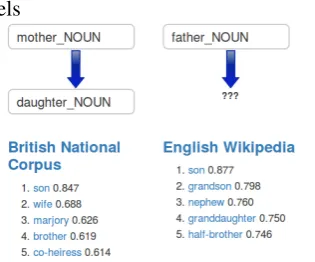
3. applyalgebraic operationsto word vectors: addition, subtraction, finding average vector for a group of words (results are returned as lists of words nearest to the product of the operation and their corresponding similarity values); this can be used for analogical infer-ence, widely known as one of the most inter-esting features of word embeddings (Mikolov et al., 2013b);
4. visualizesemantic relations between words.
As a user enters a set of words, the ser-vice builds a map of their inter-relations in the chosen model, and then returns a 2-dimensional version of this map, projected from the high-dimensional vector space, us-ing t-SNE (Van der Maaten and Hinton, 2008). An example of such visualization is shown in Figure 2;
5. get theraw vector(array of real values) for the query word.
Figure 2: Visualizing the positions of several words in the semantic space
differentiate between homonyms belonging to dif-ferent parts of speech.WebVectorscan also use an external tagger to detect PoS for query words, if not stated explicitly by the user. By default, Stan-ford CoreNLP (Manning et al., 2014) is used for morphological processing and lemmatization, but one can easily adaptWebVectorsto any other PoS-tagger.
In fact, one can use not only PoS tags, but any other set of labels relevant for a particular research project: time stamps, style markers, etc. WebVec-tors will provide the users with the possibility to filter the models’ output with respect to these tags.
Another feature of the toolkit is the possibility to display results from more than one model si-multaneously. If several models are enumerated in the configuration file, the WebVectors daemon loads all of them. At the same time, the user inter-face allows to choose one of the featured models or several at once. The results (for example, lists of nearest semantic associates) for different mod-els are then presented to the user side-by-side, as in the Figure 3. This can be convenient for re-search related to comparing several distributional semantic models (trained on different corpora or with different hyperparameters).
[image:3.595.309.467.86.217.2]Last but not least, WebVectors features a sim-ple API that allows to query the service automat-ically. It is possible to get the list of semantic as-sociates for a given word in a given model or to compute semantic similarity for a word pair. The user performs GET requests to URLs following a
Figure 3: Analogical inference with several mod-els
specific pattern described in the documentation; in response, a file with the first 10 associates or the semantic similarity score is returned. There are two formats available at the present moment:json
and tab-separated text files.
4 Live demos
The reference web service running on our code base is athttp://ltr.uio.no/semvec. It allows queries to 4 English models trained with the
Continuous Skipgram algorithm (Mikolov et al., 2013b): the widely known Google News model published together with the word2vec tool, and the models we trained on Gigaword, British Na-tional Corpus (BNC) and English Wikipedia dump from September 2016 (we plan to regularly update this last one). Additionally, it features a model trained on the corpus of Norwegian news texts,
Norsk aviskorpus(Hofland, 2000). To our knowl-edge, this is the first neural embedding model trained on the Norwegian news corpus made avail-able online; (Al-Rfou et al., 2013) published dis-tributional models for Norwegian, but they were trained on the Wikipedia only, and did not use the current state-of-the-art algorithms.
Prior to training, each word token in the train-ing corpora was not only lemmatized, but also augmented with a Universal PoS tag (Petrov et al., 2012) (for example,boot VERB). Also, some amount of strongly related bigram collocations like ‘Saudi::Arabia PROPN’ was extracted, so that they receive their own embeddings after the training. The Google News model already features ngrams, but lacks PoS tags. To make it more com-parable with other models, we assigned each word in this model a PoS tag withStanford CoreNLP.
[image:3.595.74.288.98.263.2]rusvectores.org (Kutuzov and Kuzmenko, 2016). It features 4 Continuous Skipgram and
Continuous Bag-of-Words models for Russian trained on different corpora: the Russian National Corpus (RNC)4, the RNC concatenated with the
Russian Wikipedia dump from November 2016, the corpus of 9 million random Russian web pages collected in 2015, and the Russian news corpus (spanning time period from September 2013 to November 2016). The corpora were linguistically pre-processed in the same way, lending the mod-els the ability to better handle rich morphology of Russian. The RusVectores is already being em-ployed in academic studies in computational lin-guistics and digital humanities (Kutuzov and An-dreev, 2015; Kirillov and Krizhanovskij, 2016; Loukachevitch and Alekseev, 2016) (several other research projects are in progress as of now).
One can use the aforementioned services as live demos to evaluate the WebVectors toolkit before actually employing it in one’s own workflow.
5 Conclusion
The main aim ofWebVectorsis to quickly deploy web services processing queries to word embed-ding models, independently of the nature of the underlying training corpora. It allows to make complex linguistic resources available to wide au-dience in almost no time. We continue to add new features aiming at better understanding of embed-ding models, incluembed-ding sentence similarities, text classification and analysis of correlations between different models for different languages. We also plan to add models trained using other algorithms, like GloVe (Pennington et al., 2014) andfastText
(Bojanowski et al., 2016).
We believe that the presented open source toolkit and the live demos can popularize distri-butional semantics and computational linguistics among general public. Services based on it can also promote interest among present and future students and help to make the field more com-pelling and attractive.
References
Rami Al-Rfou, Bryan Perozzi, and Steven Skiena. 2013. Polyglot: Distributed word representations for multilingual NLP. InProceedings of the Seven-teenth Conference on Computational Natural
Lan-4http://www.ruscorpora.ru/en/
guage Learning, pages 183–192, Sofia, Bulgaria, August. Association for Computational Linguistics. Marco Baroni, Georgiana Dinu, and Germ´an Kruszewski. 2014. Don’t count, predict! a systematic comparison of context-counting vs. context-predicting semantic vectors. InProceedings of the 52nd Annual Meeting of the Association for Computational Linguistics, volume 1.
Piotr Bojanowski, Edouard Grave, Armand Joulin, and Tomas Mikolov. 2016. Enriching word vec-tors with subword information. arXiv preprint arXiv:1607.04606.
Knut Hofland. 2000. A self-expanding corpus based on newspapers on the web. InProceedings of the Second International Conference on Language Re-sources and Evaluation (LREC-2000).
B. L. Iomdin, A. A. Lopukhina, K. A. Lopukhin, and G. V. Nosyrev. 2016. Word sense frequency of similar polysemous words in different languages. InComputational Linguistics and Intellectual Tech-nologies. Dialogue, pages 214–225.
A. N. Kirillov and A. A. Krizhanovskij. 2016. Model’ geometricheskoj struktury sinseta [the model of ge-ometrical structure of a synset]. Trudy Karel’skogo nauchnogo centra Rossijskoj akademii nauk, (8). Andrey Kutuzov and Igor Andreev. 2015. Texts in,
meaning out: neural language models in seman-tic similarity task for Russian. In Computational Linguistics and Intellectual Technologies. Dialogue, Moscow. RGGU.
Andrey Kutuzov and Elizaveta Kuzmenko. 2015. Comparing neural lexical models of a classic na-tional corpus and a web corpus: The case for Rus-sian. Lecture Notes in Computer Science, 9041:47– 58.
Andrey Kutuzov and Elizaveta Kuzmenko. 2016. We-bvectors: a toolkit for building web interfaces for vector semantic models (in press).
Natalia Loukachevitch and Aleksei Alekseev. 2016. Gathering information about word similarity from neighbor sentences. In International Conference on Text, Speech, and Dialogue, pages 134–141. Springer.
Andrew L. Maas, Raymond E. Daly, Peter T. Pham, Dan Huang, Andrew Y. Ng, and Christopher Potts. 2011. Learning word vectors for sentiment analysis. In Proceedings of the 49th Annual Meeting of the Association for Computational Linguistics: Human Language Technologies-Volume 1, pages 142–150. Association for Computational Linguistics.
Tomas Mikolov, Quoc V. Le, and Ilya Sutskever. 2013a. Exploiting similarities among lan-guages for machine translation. arXiv preprint arXiv:1309.4168.
Tomas Mikolov, Ilya Sutskever, Kai Chen, Greg S. Cor-rado, and Jeff Dean. 2013b. Distributed representa-tions of words and phrases and their composition-ality. Advances in Neural Information Processing Systems 26, pages 3111–3119.
Jeffrey Pennington, Richard Socher, and Christo-pher D. Manning. 2014. Glove: Global vectors for word representation. InEmpirical Methods in Nat-ural Language Processing (EMNLP), pages 1532– 1543.
Slav Petrov, Dipanjan Das, and Ryan McDonald. 2012. A universal part-of-speech tagset. In Proceedings of the Eighth International Conference on Language Resources and Evaluation (LREC-2012). European Language Resources Association (ELRA).
Radim ˇReh˚uˇrek and Petr Sojka. 2010. Software Framework for Topic Modelling with Large Cor-pora. InProceedings of the LREC 2010 Workshop on New Challenges for NLP Frameworks, pages 45– 50, Valletta, Malta, May. ELRA.
Scharolta Katharina Siencnik. 2015. Adapting word2vec to named entity recognition. In Nordic Conference of Computational Linguistics NODAL-IDA 2015, page 239.
Peter D. Turney, Patrick Pantel, et al. 2010. From frequency to meaning: Vector space models of se-mantics. Journal of artificial intelligence research, 37(1):141–188.
Laurens Van der Maaten and Geoffrey Hinton. 2008. Visualizing data using t-SNE. Journal of Machine Learning Research, 9(2579-2605):85.
Will Y. Zou, Richard Socher, Daniel M. Cer, and Christopher D. Manning. 2013. Bilingual word em-beddings for phrase-based machine translation. In