Vector Space Semantic Parsing: A Framework for
Compositional Vector Space Models
Jayant Krishnamurthy
Carnegie Mellon University 5000 Forbes Avenue Pittsburgh, PA 15213
Tom M. Mitchell
Carnegie Mellon University 5000 Forbes Avenue Pittsburgh, PA 15213
Abstract
We presentvector space semantic parsing
(VSSP), a framework for learning compo-sitional models of vector space semantics. Our framework uses Combinatory Cate-gorial Grammar (CCG) to define a cor-respondence between syntactic categories and semantic representations, which are vectors and functions on vectors. The complete correspondence is a direct con-sequence of minimal assumptions about the semantic representations of basic syn-tactic categories (e.g., nouns are vectors), and CCG’s tight coupling of syntax and semantics. Furthermore, this correspon-dence permits nonuniform semantic repre-sentations and more expressive composi-tion operacomposi-tions than previous work. VSSP builds a CCG semantic parser respecting this correspondence; this semantic parser parses text into lambda calculus formulas that evaluate to vector space representa-tions. In these formulas, the meanings of words are represented by parameters that can be trained in a task-specific fashion. We present experiments using noun-verb-noun and adverb-adjective-noun-verb-noun phrases which demonstrate that VSSP can learn composition operations that RNN (Socher et al., 2011) and MV-RNN (Socher et al., 2012) cannot.
1 Introduction
Vector space models represent the semantics of natural language using vectors and operations on vectors (Turney and Pantel, 2010). These models are most commonly used for individual words and short phrases, where vectors are created using dis-tributional information from a corpus. Such mod-els achieve impressive performance on standard-ized tests (Turney, 2006; Rapp, 2003), correlate
well with human similarity judgments (Griffiths et al., 2007), and have been successfully applied to a number of natural language tasks (Collobert et al., 2011).
While vector space representations for indi-vidual words are well-understood, there remains much uncertainty about how to compose vector space representations for phrases out of their com-ponent words. Recent work in this area raises many important theoretical questions. For exam-ple, should all syntactic categories of words be represented as vectors, or are some categories, such as adjectives, different? Using distinct se-mantic representations for distinct syntactic cate-gories has the advantage of representing the opera-tional nature of modifier words, but the disadvan-tage of more complex parameter estimation (Ba-roni and Zamparelli, 2010). Also, does semantic composition factorize according to a constituency parse tree (Socher et al., 2011; Socher et al., 2012)? A binarized constituency parse cannot di-rectly represent many intuitive intra-sentence de-pendencies, such as the dependence between a verb’s subject and its object. What is needed to resolve these questions is a comprehensive theo-retical framework for compositional vector space models.
In this paper, we observe that wealready have such a framework: Combinatory Categorial Gram-mar (CCG) (Steedman, 1996). CCG provides a tight mapping between syntactic categories and semantic types. If we assume that nouns, sen-tences, and other basic syntactic categories are represented by vectors, this mapping prescribes semantic types for all other syntactic categories.1 For example, we get that adjectives are functions from noun vectors to noun vectors, and that
prepo-1It is not necessary to assume that sentences are vectors. However, this assumption simplifies presentation and seems like a reasonable first step. CCG can be used similarly to explore alternative representations.
Input: Log. Form:
“red ball”→ semantic
parsing →Aredvball→ evaluation →
„
◦ ◦
«
↑ ↑
Lexicon:red:=λx.Aredx
ball:=vball Params.:Ared=
„
◦ ◦ ◦ ◦
«
vball= „
◦ ◦
«
Figure 1: Overview of vector space semantic pars-ing (VSSP). A semantic parser first translates nat-ural language into a logical form, which is then evaluated to produce a vector.
sitions are functions from a pair of noun vectors to a noun vector. These semantic type specifica-tions permit a variety of different composition op-erations, many of which cannot be represented in previously-proposed frameworks. Parsing in CCG applies these functions to each other, naturally de-riving a vector space representation for an entire phrase.
[image:2.595.72.289.62.152.2]The CCG framework provides function type specifications for each word’s semantics, given its syntactic category. Instantiating this framework amounts to selecting particular functions for each word.Vector space semantic parsing(VSSP) duces these per-word functions in a two-step pro-cess. The first step chooses a parametric func-tional form for each syntactic category, which con-tains as-yet unknown per-word and global param-eters. The second step estimates these parameters using a concrete task of interest, such as predicting the corpus statistics of adjective-noun compounds. We present a stochastic gradient algorithm for this step which resembles training a neural network with backpropagation. These parameters may also be estimated in an unsupervised fashion, for ex-ample, using distributional statistics.
Figure 1 presents an overview of VSSP. The input to VSSP is a natural language phrase and a lexicon, which contains the parametrized func-tional forms for each word. These per-word repre-sentations are combined by CCG semantic pars-ing to produce a logical form, which is a sym-bolic mathematical formula for producing the vec-tor for a phrase – for example, Aredvball is a
for-mula that performs matrix-vector multiplication. This formula is evaluated using learned per-word and global parameters (values forAredandvball)
to produce the language’s vector space representa-tion.
The contributions of this paper are threefold.
First, we demonstrate how CCG provides a the-oretical basis for vector space models. Second, we describe VSSP, which is a method for con-cretely instantiating this theoretical framework. Finally, we perform experiments comparing VSSP against other compositional vector space mod-els. We perform two case studies of composition using noun-verb-noun and adverb-adjective-noun phrases, finding that VSSP can learn composition operations that existing models cannot. We also find that VSSP produces intuitively reasonable pa-rameters.
2 Combinatory Categorial Grammar for
Vector Space Models
Combinatory Categorial Grammar (CCG) (Steed-man, 1996) is a lexicalized grammar formalism that has been used for both broad coverage syntac-tic parsing and semansyntac-tic parsing. Like other lexi-calized formalisms, CCG has a rich set of syntac-tic categories, which are combined using a small set of parsing operations. These syntactic cate-gories are tightly coupled to semantic represen-tations, and parsing in CCG simultaneously de-rives both a syntactic parse tree and a seman-tic representation for each node in the parse tree. This coupling between syntax and semantics moti-vates CCG’s use in semantic parsing (Zettlemoyer and Collins, 2005), and provides a framework for building compositional vector space models.
2.1 Syntax
The intuition embodied in CCG is that, syntac-tically, words and phrases behave like functions. For example, an adjective like “red” can com-bine with a noun like “ball” to produce another noun, “red ball.” Therefore, adjectives are natu-rally viewed as functions that apply to nouns and return nouns. CCG generalizes this idea by defin-ing most parts of speech in terms of such func-tions.
syn-Part of speech Syntactic category Example usage Semantic type Example log. form
Noun N person:N Rd vperson
Adjective N/Nx goodperson:N hRd,Rdi λx.Agoodx
Determiner N P/Nx theperson:N P hRd,Rdi λx.x
Intrans. Verb S\N Px the personran:S hRd,Rdi λx.Aranx+bran Trans. Verb S\N Py/N Px the personranhome:S hRd,hRd,Rdii λx.λy.(Tranx)y
Adverb (S\N P)\(S\N P) ranlazily:S\N P hhRd,Rdi,hRd,Rdii [λy.Ay→λy.(TlazyA)y]
(S\N P)/(S\N P) lazilyran:S\N P hhRd,Rdi,hRd,Rdii [λy.Ay→λy.(TlazyA)y]
(N/N)/(N/N) verygood person:N hhRd,Rdi,hRd,Rdii [λy.Ay→λy.(TveryA)y] Preposition (N\Ny)/Nx personinFrance:N hRd,hRd,Rdii λx.λy.(Tinx)y
(S\N Py)\(S\N P)f/N Px raninFrance:S\N P hRd,hhRd,Rdi,hRd,Rdiii λx.λf.λy.(Tinx)(f(y)) Table 1: Common syntactic categories in CCG, paired with their semantic types and example logical forms. The example usage column shows phrases paired with the syntactic category that results from using the exemplified syntactic category for the bolded word. For ease of reference, each argument to a syntactic category on the left is subscripted with its corresponding semantic variable in the example logical form on the right. The variables x, y, b, v denote vectors, f denotes a function, A denotes a matrix, andT denotes a tensor. Subscripted variables (Ared) denote parameters. Functions in logical
forms are specified using lambda calculus; for example λx.Axis the function that accepts a (vector) argumentx and returns the vector Ax. The notation [f → g]denotes the higher-order function that, given input functionf, outputs functiong.
tactic categories. These categories represent func-tions that accept an argument of category Y and return a phrase of category X. The direction of the slash defines the expected location of the argu-ment:X/Y expects an argument on the right, and X\Y expects an argument on the left.2 For ex-ample, adjectives are represented by the category N/N – a function that accepts a noun on the right and returns a noun.
The left part of Table 1 shows examples of common syntactic categories, along with exam-ple uses. Note that some intuitive parts of speech, such as prepositions, are represented by multiple syntactic categories. Each of these categories cap-tures a different use of a preposition, in this case the noun-modifying and verb-modifying uses.
2.2 Semantics
Semantics in CCG are given by first associating a semantic type with each syntactic category. Each word in a syntactic category is then assigned a semantic representation of the corresponding se-mantic type. These sese-mantic representations are known aslogical forms. In our case, a logical form is a fragment of a formula for computing a vector space representation, containing word-specific pa-rameters and specifying composition operations.
In order to construct a vector space model, we associate all of the atomic syntactic categories,
2As a memory aid, note that the top of the slash points in the direction of the expected argument.
N, N P, S, and P P, with the type Rd. Then, the logical form for a noun like “ball” is a vec-tor vball ∈ Rd. The functional categories X/Y andX\Y are associated with functions from the semantic type ofXto the semantic type ofY. For example, the semantic type ofN/N ishRd,
Rdi, representing the set of functions fromRd toRd.3 This semantic type captures the same intuition as adjective-noun composition models: semantically, adjectives are functions from noun vectors to noun vectors.
The right portion of Table 1 shows semantic types for several syntactic categories, along with example logical forms. All of these mappings are a direct consequence of the assumption that all atomic categories are semantically represented by vectors. Interestingly, many of these semantic types contain functions that cannot be represented in other frameworks. For example, adverbs have type hhRd,
Rdi,hRd,Rdii, representing functions that accept an adjective argument and return an adjective. In Table 1, the example logical form applies a 4-mode tensor to the adjective’s matrix. Another powerful semantic type ishRd,h
Rd,Rdii, which corresponds to transitive verbs and
prepo-3
the N P/N
λx.x
red N/N λx.Aredx
ball N vball
N:Aredvball
N P :Aredvball
on (N P\N P)/N P λx.λy.Aonx+Bony
the N P/N
λx.x table
N vtable
N P :vtable
N P\N P :λy.Aonvtable+Bony
N P :Aonvtable+BonAredvball
Figure 2: Syntactic CCG parse and corresponding vector space semantic derivation.
sitions. This type represents functions from two argument vectors to an output vector, which have been curried to accept one argument vector at a time. The example logical form for this type uses a 3-mode tensor to capture interactions between the two arguments.
Note that this semantic correspondence permits a wide range of logical forms for each syntactic category. Each logical form can have an arbitrary functional form, as long as it has the correct se-mantic type. This flexibility permits experimenta-tion with different composiexperimenta-tion operaexperimenta-tions. For ex-ample, adjectives can be represented nonlinearly by using a logical form such asλx.tanh(Ax). Or, adjectives can be represented nonparametrically by using kernel regression to learn the appropriate function from vectors to vectors. We can also in-troduce simplifying assumptions, as demonstrated by the last entry in Table 1. CCG treats preposi-tions as modifying intransitive verbs (the category S\N). In the example logical form, the verb’s semantics are represented by the function f, the verb’s subject noun is represented byy, andf(y)
represents the sentence vector created by compos-ing the verb with its argument. By only operatcompos-ing onf(y), this logical form assumes that the action of a preposition is conditionally independent of the verbf and nouny, given the sentencef(y).
2.3 Lexicon
The main input to a CCG parser is alexicon, which is a mapping from words to syntactic categories and logical forms. A lexicon contains entries such as:
ball:=N :vball
red:=N/N :λx.Aredx
red:=N :vred
flies:= ((S\N P)/N P) :λx.λy.(Tf liesx)y
Each entry of the lexicon associates a word (ball) with a syntactic category (N) and a logical form (vball) giving its vector space representation.
Note that a word may appear multiple times in the
lexicon with distinct syntactic categories and log-ical forms. Such repeated entries capture words with multiple possible uses; parsing must deter-mine the correct use in the context of a sentence.
2.4 Parsing
Parsing in CCG has two stages. First, a category for each word in the input is retrieved from the lex-icon. Second, adjacent categories are iteratively combined by applying one of a small number of combinators. The most common combinator is function application:
X/Y :f Y :g =⇒ X:f(g)
Y :g X\Y :f =⇒ X:f(g)
The function application rule states that a cate-gory of the formX/Y behaves like a function that accepts an input categoryY and returns category X. The rule also derives a logical form for the re-sult by applying the functionf (the logical form forX/Y) tog(the logical form forY). Figure 2 shows how repeatedly applying this rule produces a syntactic parse tree and logical form for a phrase. The top row of the parse represents retrieving a lexicon entry for each word in the input. Each following line represents a use of the function ap-plication combinator to syntactically and semanti-cally combine a pair of adjacent categories. The order of these operations is ambiguous, and dif-ferent orderings may result in difdif-ferent parses – a CCG parser’s job is to find a correct ordering. The result of parsing is a syntactic category for the en-tire phrase, coupled with a logical form giving the phrase’s vector space representation.
3 Vector Space Semantic Parsing
logi-Semantic type Example syntactic categories Logical form template
Rd N, N P, P P, S vw
hRd,Rdi N/N,N P/N,S/S,S\N P λx.σ(Awx) hRd,hRd,Rdii (S\N P)/N P,(N P\N P)/N P λx.λy.σ((Twx)y)
[image:5.595.139.457.63.116.2]hhRd,Rdi,hRd,Rdii (N/N)/(N/N) [λy.σ(Ay)→λy.σ((TwA)y)]
Table 2: Lexicon templates used in this paper to produce a CCG semantic parser. σ represents the sigmoid function,σ(x) = 1+exex.
cal form produces the sentence’s vector space rep-resentation.
While it is relatively easy to devise vector space representations for individual nouns, it is more challenging to do so for the fairly complex func-tion types licensed by CCG. VSSP defines these functions in two phases. First, we create a lexi-con mapping words to parametrized logical forms. This lexicon specifies a functional form for each word, but leaves free some per-word parame-ters. Parsing with this lexicon produces logical forms that are essentially functions from these per-word parameters to vector space representa-tions. Next, we train these parameters to pro-duce good vector space representations in a task-specific fashion. Training performs stochastic gra-dient descent, backpropagating gragra-dient informa-tion through the logical forms.
3.1 Producing the Parametrized Lexicon
We create a lexicon using a set of manually-constructed templates that associate each syntactic category with a parametrized logical form. Each template contains variables that are instantiated to define per-word parameters. The output of this step is a CCG lexicon which can be used in a broad coverage syntactic CCG parser (Clark and Curran, 2007) to produce logical forms for input language.4
Table 2 shows some templates used to create logical forms for syntactic categories. To reduce annotation effort, we define one template per se-mantic type, covering all syntactic categories with that type. These templates are instantiated by re-placing the variable w in each logical form with the current word. For example, instantiating the second template for “red” produces the logical formλx.σ(Aredx), whereAredis a matrix of
pa-rameters.
4
In order to use the lexicon in an existing parser, the gen-erated syntactic categories must match the parser’s syntac-tic categories. Then, to produce a logical form for a sen-tence, simply syntactically parse the sensen-tence, generate log-ical forms for each input word, and retrace the syntactic derivation while applying the corresponding semantic oper-ations to the logical forms.
Note that Table 2 is a only starting point – devis-ing appropriate functional forms for each syntactic category is an empirical question that requires fur-ther research. We use these templates in our ex-periments (Section 4), suggesting that they are a reasonable first step. More complex data sets will require more complex logical forms. For example, to use high-dimensional vectors, all matrices and tensors will have to be made low rank. Another possible improvement is to tie the parameters for a single word across related syntactic categories (such as the transitive and intransitive forms of a verb).
3.2 Training the Logical Form Parameters
The training problem in VSSP is to optimize the logical form parameters to best perform a given task. Our task formulation subsumes both clas-sification and regression: we assume the input is a logical form, and the output is a vector. Given a data set of this form, training can be performed us-ing stochastic gradient descent in a fashion similar to backpropagation in a neural network.
The data set for training consists of tuples, {(`i, yi)}n
i=1, where`is a logical form andyis a
label vector representing the expected task output. Each logical form`is treated as a function from parameter vectorsθto vectors inRd. For example, the logical formAredvballis a function fromAred
andvball to a vector. We use θ to denote the set
of all parameters; for example,θ={Ared, vball}.
We further assume a loss functionLdefined over pairs of label vectors. The training problem is therefore to minimize the objective:
O(θ) =
n X
i=1
L(yi, g(`i(θ)) +λ 2||θ||
2
pre-dicted and target distributions, andg represents a softmax classifier.
We optimize the objective O by running stochastic gradient descent. The gradients of the parameters θ can be computed by iteratively ap-plying the chain rule to `, which procedurally resembles performing backpropagation in a neu-ral network (Rumelhart et al., 1988; Goller and K¨uchler, 1996).
4 Comparing Models of Semantic
Composition
This section compares the expressive power of VSSP to previous work. An advantage of VSSP is its ability to assign complex logical forms to categories like adverbs and transitive verbs. This section examines cases where such complex logi-cal forms are necessary, using synthetic data sets. Specifically, we create simple data sets mimick-ing expected forms of composition in noun-verb-noun and adverb-adjective-noun-verb-noun phrases. VSSP is able to learn the correct composition operations for these data sets, but previously proposed mod-els cannot.
We compare VSSP against RNN (Socher et al., 2011) and MV-RNN (Socher et al., 2012), two recursive neural network models which factorize composition according to a binarized constituency parse tree. The RNN model represents the seman-tics of each parse tree node using a single vector, while the MV-RNN represents each node using both a matrix and a vector. These representations seem sufficient for adjectives and nouns, but it is unclear how they generalize to other natural lan-guage constructions.
In these experiments, each model is used to map an input phrase to a vector, which is used to train a softmax classifier that predicts the task output. For VSSP, we use the lexicon templates from Table 2. All nouns are represented as two-dimensional vec-tors, and all matrices and tensors are full rank. The parameters of each model (i.e., the per-word vec-tors, matrices and tensors) and the softmax classi-fier are trained as described in Section 3.2.
4.1 Propositional Logic
The propositional logic experiment examines the impact of VSSP’s representation of transitive verbs. VSSP directly represents these verbs as two-argument functions, allowing it to learn op-erations with complex interactions between both
[image:6.595.307.523.61.96.2]false and false 0,1 false or false 0,1 false xor false 0,1 true and false 0,1 true or false 1,0 true xor false 1,0 false and true 0,1 false or true 1,0 false xor true 1,0 true and true 1,0 true or true 1,0 true xor true 0,1
Table 3: Data for propositional logic experiment.
Composition Formula KL divergence
RNN 0.44
MV-RNN 0.12
[image:6.595.325.505.120.174.2]VSSP 0.01
Table 4: Training error on the propositional logic data set. VSSP achieves zero error because its verb representation can learn arbitrary logical op-erations.
arguments. In contrast, the RNN and MV-RNN models learn a set of global weights which are used to combine the verb with its arguments. The functional forms of these models limit the kinds of interactions that can be captured by verbs.
We evaluated the learnability of argument in-teractions using the simple data set shown in Ta-ble 3. In this data set, the words “and,” “or,” and “xor” are treated as transitive verbs, while “true” and “false” are nouns. The goal is to predict the listed truth values, which are represented as two-dimensional distributions over true and false.
Table 4 shows the training error of each model on this data set, measured in terms of KL diver-gence between the model’s predictions and the true values. VSSP achieves essentially zero train-ing error because its 3-mode tensor representa-tion of transitive verbs is trivially able to learn arbitrary logical operations. RNN and MV-RNN can learn each logical operation independently, but cannot learn all three at the same time – this phe-nomenon occurs because XOR requires different global weight matrices than AND/OR. As a re-sult, these models learn bothANDandOR, but fail to learn XOR. This result suggests that much of the learning in these models occurs in the global weight matrices, while the verb representations can have only limited influence.
very big elephant 1,0 very big mouse 0.3,0.7 pretty big elephant 0.9,0.1 pretty big mouse 0.2,0.8 pretty small elephant 0.8,0.2 pretty small mouse 0.1,0.9 very small elephant 0.7,0.3 very small mouse 0,1
Table 5: Data for adverb-adjective-noun compo-sition experiment. Higher first dimension values represent larger objects.
Composition Model KL divergence
RNN 0.10
MV-RNN 0.10
VSSP 0.00
Table 6: Training error of each composition model on the adverb-adjective-noun experiment.
can be eaten, but not all animals eat all other an-imals; whether or not “X eatsY” is true depends on an interaction betweenXandY.
4.2 Adverb-Adjective-Noun Composition
Adverbs can enhance or attenuate the properties of adjectives, which in turn can enhance or attenu-ate the properties of nouns. The adverb-adjective-noun experiment compares each model’s ability to learn these effects using a synthetic object size data set, shown in Table 5. The task is to predict the size of each described object, which is repre-sented as a two-dimensional distribution over big and small. The challenge of this data set is that an adverb’s impact on size depends on the adjec-tive being modified – a very big elephant is big-gerthan a big elephant, but a very small elephant is smaller than a small elephant. Note that this task is more difficult than adverb-adjective com-position (Socher et al., 2012), since in this task the adverb has to enhance/attenuate the enhanc-ing/attenuating properties of an adjective.
Table 6 shows the training error of each model on this data set. VSSP achieves zero training error because its higher-order treatment of adverbs al-lows it to accurately represent their enhancing and attenuating effects. However, none of the other models are capable of representing these effects. This result is unsurprising, considering that the RNN and MV-RNN models essentially add the adverb and adjective parameters using a learned linear operator (followed by a nonlinearity). Such additive combination forces adverbs to have a con-sistent direction of effect on the size of the noun, which is incompatible with the desired enhancing and attenuating behavior.
Examining VSSP’s learned parameters clearly demonstrates its ability to learn enhancing and
“elephant”
„ 1.6 −0.1
«
“mouse” „
−0.1 1.6
«
“small” „0.22 0
0 1.7
« “big” „1.7 −1.1 0 0.22
«
“very small” „ 0.25 −.12
−1.34 2.3
« “very big”„ 2.3
−1.34
−0.12 0.25
«
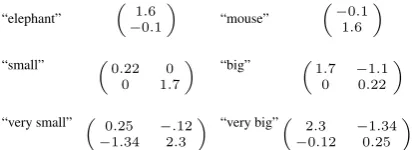
Figure 3: Parameters for nouns, adjectives and ad-jective phrases learned by VSSP. When the adverb “very” is applied to “small” and “big,” it enhances their effect on a modified noun.
attenuating phenomena. Figure 3 demonstrates VSSP’s learned treatment of “very.” In the fig-ure, a high first dimension value represents a large object, while a high second dimension value rep-resents a small object; hence the vectors for ele-phant and mouse show that, by default, eleele-phants are larger than mice. Similarly, the matrices for big and small scale up the appropriate dimension while shrinking the other dimension. Finally, we show the computed matrices for “very big” and “very small” – this operation is possible because these phrases have an adjective’s syntactic cate-gory, N/N. These matrices have the same di-rection of effect as their unenhanced versions, but produce a larger scaling in that direction.
5 Related Work
[image:7.595.94.268.146.201.2]similarly-typed objects lie in the same vector space (Clark et al., 2008; Coecke et al., 2010; Grefenstette and Sadrzadeh, 2011). VSSP generalizes this work by allowing nonlinear composition opera-tions and considering supervised parameter esti-mation. Several recent neural network models im-plicitly use a framework which assumes that com-position factorizes according to a binarized con-stituency parse, and that words and phrases have uniform semantic representations (Socher et al., 2011; Socher et al., 2012). Notably, Hermann and Blunsom (2013) instantiate such a framework using CCG. VSSP generalizes these approaches, as they can be implemented within VSSP by choosing appropriate logical forms. Furthermore, our experiments demonstrate that VSSP can learn composition operations that cannot be learned by these approaches.
The VSSP framework uses semantic parsing to define a compositional vector space model. Se-mantic parsers typically map sentences to logi-cal semantic representations (Zelle and Mooney, 1996; Kate and Mooney, 2006), with many sys-tems using CCG as the parsing formalism (Zettle-moyer and Collins, 2005; Kwiatkowski et al., 2011; Krishnamurthy and Mitchell, 2012). Al-though previous work has focused on logical se-mantics, it has demonstrated that semantic parsing is an elegant technique for specifying models of compositional semantics. In this paper, we show how to use semantic parsing to produce composi-tional models of vector space semantics.
6 Discussion and Future Work
We present vector space semantic parsing (VSSP), a general framework for building compositional models of vector space semantics. Our frame-work is based on Combinatory Categorial Gram-mar (CCG), which defines a correspondence be-tween syntactic categories and semantic types rep-resenting vectors and functions on vectors. A model in VSSP instantiates this mapping in a CCG semantic parser. This semantic parser parses nat-ural language into logical forms, which are in turn evaluated to produce vector space representations. We further propose a method for constructing such a semantic parser using a small number of logi-cal form templates and task-driven estimation of per-word parameters. Synthetic data experiments show that VSSP’s treatment of adverbs and tran-sitive verbs can learn more functions than prior
work.
An interesting aspect of VSSP is that it high-lights cases where propositional semantics seem superior to vector space semantics. For example, compare “the ball that I threw” and “I threw the ball.” We expect the semantics of these phrases to be closely related, differing only in that one phrase refers to the ball, while the other refers to the throwing event. Therefore, our goal is to de-fine a logical form for “that” which appropriately relates the semantics of the above expressions. It is easy to devise such a logical form in propositional semantics, but difficult in vector space semantics. Producing vector space solutions to such problems is an area for future work.
Another direction for future work is joint train-ing of both the semantic parser and vector space representations. Our proposed approach of adding logical forms to a broad CCG coverage parser has the advantage of allowing VSSP to be applied to general natural language. However, using the syn-tactic parses from this parser may not result in the best possible factorization of semantic com-position. Jointly training the semantic parser and the vector space representations may lead to better models of semantic composition.
We also plan to apply VSSP to real data sets. We have made some progress applying VSSP to SemEval Task 8, learning to extract relations be-tween nominals (Hendrickx et al., 2010). Al-though our work thus far is preliminary, we have found that the generality of VSSP makes it easy to experiment with different models of composi-tion. To swap between models, we simply mod-ify the CCG lexicon templates – all of the remain-ing infrastructure is unchanged. Such preliminary results suggest the power of VSSP as a general framework for learning vector space models.
Acknowledgments
This research has been supported in part by DARPA under award FA8750-13-2-0005, and in part by a gift from Google. We thank Matt Gardner, Justin Betteridge, Brian Murphy, Partha Talukdar, Alona Fyshe and the anonymous review-ers for their helpful comments.
References
Proceedings of the 2010 Conference on Empirical Methods in Natural Language Processing.
Stephen Clark and James R. Curran. 2007. Wide-coverage efficient statistical parsing with CCG and log-linear models. Computational Linguistics, 33(4):493–552.
Stephen Clark and Stephen Pulman. 2007. Combining symbolic and distributional models of meaning. In
Proceedings of AAAI Spring Symposium on Quan-tum Interaction.
Stephen Clark, Bob Coecke, and Mehrnoosh Sadrzadeh. 2008. A compositional distribu-tional model of meaning. Proceedings of the Second Symposium on Quantum Interaction.
Bob Coecke, Mehrnoosh Sadrzadeh, and Stephen Clark. 2010. Mathematical Foundations for a Com-positional Distributed Model of Meaning. Lambek Festschirft, Linguistic Analysis, 36.
Ronan Collobert, Jason Weston, L´eon Bottou, Michael Karlen, Koray Kavukcuoglu, and Pavel Kuksa. 2011. Natural language processing (almost) from scratch. Journal of Machine Learning Research, 12:2493–2537, November.
Christoph Goller and Andreas K¨uchler. 1996. Learn-ing task-dependent distributed representations by backpropagation through structure. InProceedings of the International Conference on Neural Networks (ICNN-96), pages 347–352. IEEE.
Edward Grefenstette and Mehrnoosh Sadrzadeh. 2011. Experimental support for a categorical composi-tional distribucomposi-tional model of meaning. In Proceed-ings of the Conference on Empirical Methods in Nat-ural Language Processing.
Thomas L. Griffiths, Joshua B. Tenenbaum, and Mark Steyvers. 2007. Topics in semantic representation.
Psychological Review 114.
Emiliano Guevara. 2010. A regression model of adjective-noun compositionality in distributional se-mantics. In Proceedings of the 2010 Workshop on Geometrical Models of Natural Language Seman-tics.
Iris Hendrickx, Su Nam Kim, Zornitsa Kozareva, Preslav Nakov, Diarmuid ´O. S´eaghdha, Sebastian Pad´o, Marco Pennacchiotti, Lorenza Romano, and Stan Szpakowicz. 2010. Semeval-2010 task 8: Multi-way classification of semantic relations be-tween pairs of nominals. InProceedings of the 5th International Workshop on Semantic Evaluation.
Karl Moritz Hermann and Phil Blunsom. 2013. The Role of Syntax in Vector Space Models of Composi-tional Semantics. InProceedings of the 51st Annual Meeting of the Association for Computational Lin-guistics.
Rohit J. Kate and Raymond J. Mooney. 2006. Us-ing strUs-ing-kernels for learnUs-ing semantic parsers. In
21st International Conference on Computational Linguistics and 44th Annual Meeting of the Asso-ciation for Computational Linguistics, Proceedings of the Conference.
Walter Kintsch. 2001. Predication. Cognitive Science, 25(2).
Jayant Krishnamurthy and Tom M. Mitchell. 2012. Weakly supervised training of semantic parsers. In
Proceedings of the 2012 Joint Conference on Empir-ical Methods in Natural Language Processing and Computational Natural Language Learning.
Tom Kwiatkowski, Luke Zettlemoyer, Sharon Goldwa-ter, and Mark Steedman. 2011. Lexical general-ization in ccg grammar induction for semantic pars-ing. InProceedings of the Conference on Empirical Methods in Natural Language Processing.
Jeff Mitchell and Mirella Lapata. 2008. Vector-based models of semantic composition. InProceedings of ACL-08: HLT.
Jeff Mitchell and Mirella Lapata. 2010. Composition in Distributional Models of Semantics. Cognitive Science, 34(8):1388–1429.
Tony Plate. 1991. Holographic reduced represen-tations: convolution algebra for compositional dis-tributed representations. InProceedings of the 12th International Joint Conference on Artificial Intelli-gence - Volume 1.
Reinhard Rapp. 2003. Word sense discovery based on sense descriptor dissimilarity. InProceedings of the Ninth Machine Translation Summit.
David E. Rumelhart, Geoffrey E. Hinton, and Ronald J. Williams. 1988. Neurocomputing: foundations of research. chapter Learning internal representations by error propagation.
Richard Socher, Jeffrey Pennington, Eric H. Huang, Andrew Y. Ng, and Christopher D. Manning. 2011. Semi-Supervised Recursive Autoencoders for Pre-dicting Sentiment Distributions. In Proceedings of the 2011 Conference on Empirical Methods in Nat-ural Language Processing (EMNLP).
Richard Socher, Brody Huval, Christopher D. Man-ning, and Andrew Y. Ng. 2012. Semantic Composi-tionality Through Recursive Matrix-Vector Spaces. In Proceedings of the 2012 Conference on Em-pirical Methods in Natural Language Processing (EMNLP).
Mark Steedman. 1996. Surface Structure and Inter-pretation. The MIT Press.
Peter D. Turney. 2006. Similarity of semantic rela-tions. Computational Linguistics, 32(3), September.
Dominic Widdows. 2008. Semantic vector products: Some initial investigations. In Proceedings of the Second AAAI Symposium on Quantum Interaction.
John M. Zelle and Raymond J. Mooney. 1996. Learn-ing to parse database queries usLearn-ing inductive logic programming. InProceedings of the thirteenth na-tional conference on Artificial Intelligence.