Capacitated Single-Assignment Hub Covering
Location Problem under Fuzzy Environment
Abbas Mirakhorli
Abstract- This paper studies capacitated single-allocation hub covering location problem with fuzzy cover radius and travel time. Objective of hub covering problem is to find the minimum number of hubs considering the maximum allowable travel time. Computational results show that due to uncertainty, number of hubs and the allocation of non-hub nodes to hub nodes are changed. This paper proposes heuristic algorithm based on genetic algorithm to solve the problem. CAB and AP data set are used to show the performance of the proposed algorithm
Index Terms—hub location, hub covering, fuzzy cover radius and travel time, genetic algorithm
I. INTRODIUCTION
Hub location problem is one of the most important issues in location problems because it is widely used in many telecommunication and transportation networks. Hubs are facilities that serve as transshipment and switching point to consolidate flows at certain locations for transportation and telecommunication systems [1-2]. Hub covering problem can be used to model different telecommunication networks and mobile communications: such as wireless network, internet networks, computer networks. The coverage radius controls the number of hubs and the assignment of nodes to hubs. Determining the coverage radius in hub covering problem depends on many factors like demand growth over planning horizon, moreover environmental and meteorological condition affect the cover radius and travel time. The association of different uncertainty with these parameters makes determination of coverage radius complicated. These uncertainties affect the coverage radius and the coverage radius has in turn the great impact on the structure of the network. Designing a network with desirable reliability level which guaranty the performance and survivability of network from any disruption and malfunction, is the most importand issue in network design problems [8-9]. Hub location problem is a strategic decision making activity which should be considered for a long time and it should take into account the long term goals of the system. These kind of decisions can not be changed easily because any changes incure heavy costs and expenses to the system.
Department of Industrial Engineering, University of Kurdistan, Sanandaj, Iran (corresponding author to provide phone: +98(21-44449892) ; email : [email protected]
Because of vulnerability of hubs to disrubtion or unpredicted flow changes, designing more reliable networks is an important issues in hub and spokes network design problems [10-11]. For example, demand growth over planing horizon in telecommunication or internet network can cause grate flow increase in future which in turn can lead to greate malfunctions of entire network. So taking such these important uncertainties in process of decision making is an important issue. The location and number of hubs are importand issues in hub and spoke network design problems as they play a crusial role in the performance and efficiency of the network. Any failure at a hub cause break down of the entire system. Hub location problems can be categorized to four main categories as follows: 1- P-hub median problem, 2- Hub location problem with fixed costs, 3- P-hub center problem and 4- the hub covering problem [3]. Objective of hub covering problem (HCP) is to find the best location of hubs and assignment of non-hub nodes to hubs, considering cover radius, in order to minimize total number of hubs or total operating cost associated with each hub. First published formulation for HCP was presented in [4]. In this formulation every possible path between each origin-destination node pair is taken into account. Campbel presented the variable Y as a fraction of flow from node i to j via hub K and L. Kara and Tansel [5] presented linear model for hob covering problem and compare the computational time of their model with the other presented before. Tan and Kara [6] presented the covering version of latest arrival hub problem of Kara and Tansel [5]. Wagner [7] proposeed the pre-processing methods to fix the value of some of the decision variables and to reduce the size of the problem by removing redundant constraints. His model achieves better computational performance than the model presented by [5]. Rest of the paper is organized as follows: Section 2 describes fuzzy linear programming and presents capacitated single assignment hub covering problem with fuzzy cover radius and travel time. Section 3 describes the proposed genetic based heuristic algorithm. computational results are presented in section 4. Conclusion and further research are presented in section 5.
II. FUZZY LINEAR PROGRAMMING AND FUZZY NUMBERS
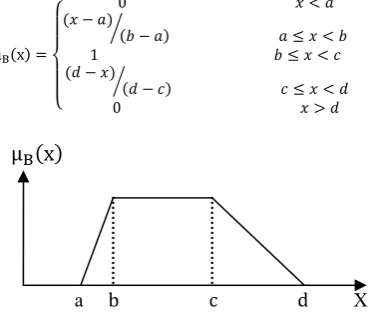
theory presented by Zadeh [12]. Fuzzy numbers plays an important role in fuzzy programming model. A fuzzy number is a convex normalized fuzzy set B on the real line R with membership function μ x . There are different ways to represent fuzzy numbers like L-R [13-15]. Theses papers use trapezoidal fuzzy number as illustrated in figure 1 to represent the uncertainty of cover radius and travel time. Trapezoidal fuzzy number B can be represented as follows:
μ x
0
1
0
μ x
[image:2.595.52.245.150.307.2]
a b c d X
Fig 1. Membership functions of trapezoid fuzzy number.
A mathematical programming with fuzzy parameters can be written as follows:
Max CX (1)
s.t: A X b and x 0 (2)
Where A (a1,a2,a3,a4) and b (b1,b2,b3,b4) are (L-R) trapeozid fuzzy numbers. Because of uncertain parameters in constraints, the above mentioned model should be converted to its crisp equivalent. This paper applied Ramike and Rimanek’s approach [16] to convert the model to its crisp equvalent using set inclusion consept. Constraint 2 can be represented as follows : min cx a x ⊕a x ⊕ … ⊕a x ≲b ∀ I (3)
where a x ⊕ a x ⊕ … ⊕ a x = ( ∑ a1 x , ∑ a2 x , ∑ a3 x , ∑ a4 x . By considering two fuzzy numbers A (a1,a2,a3,a4) and b (b1,b2,b3,b4) based on Ramike and Rimanek’s approach A b if a1 b1i, a1 - a3 b1- b3 , a2 b2 and a2 a4 b2 + b4 . the crisp linear programming problem can be presented as follows : min cx s.t ∑ a1ij Xj b1 (4)
∑ a1ij a3ij Xj b1 b3 (5)
∑ a2ij Xj b2 (6)
∑ a2ij a3ij Xj b1 b3 (7)
Capacitated single allocation hub covering problem with trapezoid fuzzy cover radius and travel time can be expressed as follows: Problem (1) Min ∑ X (8)
t ∝ t Xir t Xjk β ∀ i, j , k , r (9)
∑ = 1 ∀ i N (10)
∀ i , k N (11)
∑ O Γ X ∀ k (12)
{0, 1} ∀ k (13)
Where O represent the total amount of flow originating at node i (O = ∑ W where W is amount of flow from node i to j). The objective function minimizes total number of hubs. Equation (11) is constraining the coverage criteria. Constraint (12) and (13) state that demand only flow between open hubs. Constraint (14) states that total amount of flow entered each hub cannot exceed its capacity Where Γ represents the capacity of each hub. = 1 0 = 1 0 In problem (3) the cover radius and travel time are assumed to be trapezoid fuzzy numbers due to uncertainty assumption. In real world situations, it is not easy to precisely estimate the coverage criteria based on time, cost or distance; moreover this paper takes into account capacity limit on the amount of flow that can be processed by each hub, because hubs are usually capacitated in practical problems. model 1 can be converted to its crisp equivalent as follows: Problem (2) Min ∑ ( 1 + ∝ 1 ) + 1 β1 ∀ i, j , k , r (14)
(( 1 + ∝ 1 ) – ( 3 + ∝ 3 ) ) + ( 1 3 β1- β3 ∀ i, j, k, r (15)
( 2 + ∝ 2 ) + 2 β2 ∀ i, j , k , r (16)
(( 2 + ∝ 2 ) + ( 3 + ∝ 3 ) ) + ( 2 3 β1 β3 ∀ i, j, k, r (17)
III. GENETIC BASED HEURISTIC ALGORITHM
Genetic algorithm was first presented by Holland [17] has been applied to different problems in various fields. Genetic algorithms operate on population of individuals which are the potential solution of the problem. Members of the population are randomly selected for recombination based on their fitness value. Cross over and mutation operators are applied to generate the new population. There are various sources for detailed information about GA like Goldberg [18] and Michell [19].
A. String Representation
In presented GA-based algorithm the chromosome is 1*2n array where n is the total number of nodes. The proposed chromosome consists of two parts: the first part is hub array (1 up to n) and the second part is assign array (n+1 up to 2n). The hub array is a binary string (0 and 1) where 1 indicates that a node is chosen as hub and 0 otherwise. The assign array shows the assignments of the non-hub nodes (spokes) to hub-nodes. Figure 2 shows a chromosome which is used in this algorithm.
[image:3.595.305.508.77.204.2]1 . . n n+1 . . 2n Hub array assign array
Fig. 2 chromosome
Figure 3 represents a chromosome for a hub and spoke network with 5 nodes.
1 0 0 1 0 1 4 1 4 1
Fig. 3 hub and spoke network represented by chromosome
Figure 3 indicates that node 1 and 4 are chosen as hub and non-hub nodes 2,3,5 are assigned to hubs 4,1,1 respectively. hubs 1 and 4 are assigned to themselves in assaign array.
B. Initial Population Generation
The chromosome is randomly generated. The first part of the chreomosome is randomly generated with 0 and 1 values and the second part of the chromosome is generated based on the first part of it in which the hub-nodes are assaigned to themselves and the non-hub nodes are assaigned to their nearst hub.
C. Crossover Operator
Crossover is a very controvercial operator due to its disrubtive mechanism. There are different types of crossover operators such as one-point crossover, multiple-point crossover, Uniform-order crossover – UOX [20]. This paper applied 2-point crossover. Two parents are chosen randomly and crossover probability ( ) is defined in order to chose parents for crossover operator. For each individual a random number R in [0 1] interval is chosen. If R< the respective
individual is selected for crossover operator otherwise it is not selected. For determining the break points of the crossover operator two random numbers between 1 and 2n is chosen (i and j) then all entries between i and j from parent 1 is replaced with the same entries of parent 2 and vise versa. In this way two offspring can be generated from two parents
as ilustrated in figure 4.
1 0 0 1 0 1 4 1 4 1
Parent1
0 1 1 0 0 2 2 3 3 2
Parent2
1 0 1 0 0 2 2 1 4 1
offspring1
0 1 0 1 0 1 4 3 3 2
offspring2
Fig. 4 croosover operator
After applying the crosover, feasibility of new ofspring should be cheked because the position of hubs are changed due to aplying two-point crossover. The non-hob nodes should be assigned to their nearst hub.
1 0 1 0 0 1 3 3 1 1
0 1 0 1 0 2 2 4 4 4
Fig. 5 corrected offspring
D. Mutation Operator
Mutation operator is applied by randomly changing the gens in hub array in which two gens from hub array are randomly selected and are replaced with each other. In this way the location of hubs are changed. For each individual a random number R in [0 1] interval is chosen. If R < P the respective individual is selected for mutation operator otherwise it is not selected.
E. Replacement
[image:3.595.345.507.297.348.2]There are different approaches to chose parent for replacement; for example in uniform replacement the parents are chosen randomly. One can transferes the best chromosome to next generation or the worst individual is omitted and the rest is transferred to the next generation. Among these strategies the elitist strategy is the most popular strategy wich is used in different compinatorial optimization problems. In elitist strategy the K best chromosome are copied into next generation. The elitist strategy is illustrated in figure 6.
Fig. 6 elitist strategy
Best chosen
chromosomes
Other
chromosomes
Transferred
chromosomes
Newly
generated
chromosomes
[image:3.595.320.539.624.756.2]
F. Heuristic Algorithm
This section presents the heuristic algorithm which is hybridized with GA to find better solution for problem (2). This algorithm gets the best chromosome found by GA and modifies it in a way that minimize the objective function. In this procedure the best chromosome found by genetic algorithm is chosen and one of the hubs which is chosen randomly is omitted. It means that one hub is reduced, then the assignment of the spokes which were assaigned to ommitted hub should be corrected in way that they are assaigned to their nearst hub. This procedure is repeated unless the constarint (14-17) which garanti the coverage criteria is satisfied.the pseudo code of proposed algorithm is presented in figure 7.
Algorithm
get the best chromosome found by GA S
while(the cover radius constranit is met) do
randomly omit a hub in hub array of S
corect the assainment of spokes of S
End
Report (S)
Fig7. Huristic algorithm
IV. COMPUTATIOAL RESULT
This section presents the result of fuzzy capacitated single-allocation hub covering location problem. This paper uses CAB and AP data set to do the experiment. The CAB data set [21] comes from The Civil Aeronautics Board, USA and is one of the most commonly used data set for hub location problems. The experimental study on CAB data set is grouped into four problem sizes n= {10, 15, 20, 25} with α = .4. Capacity is not included in CAB data set, so this paper uses the method presented in [22] to generate Capacity for each hub. For parameter β, this paper use the radius presented in [5] as follows: This paper assumes the cover radius as trapezoid fuzzy number β (β1,β2, β3, β4). For example for n= 10, α = .4 the cover radiuses are 1627,1185,970,863 as stated in [5]. So in this case the membership function for fuzzy parameter β can be expressed as follows:
.
Fig8. flowchart of Heuristic algorithm
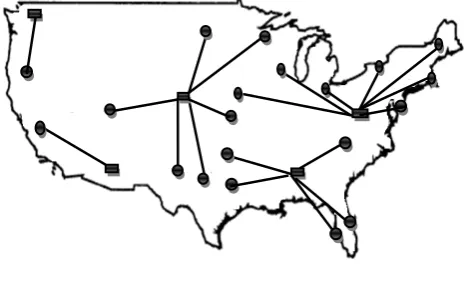
Computational results indicate that the number of hubs will increase when the cover radius and travel time are imprecise. It is rational to increase the number of hubs in order to meet customer demand as soon as possible and with least possible delay. As an example, for capacitated single-allocation with precise cover radius in case n= 10 and ∝ = .4 the number of hubs is as follows: When the cover radius is precise, optimal solution has four hubs. But when the cover radius is considered imprecise and due to demand change, the number of hubs is increased to 5. Figure 9 shows the result of experiment for n= 25 and ∝ = .4 with precise cover radius 2400, there are four hubs as presented in figure 9. But if the cover radius is considered imprecise, the number of hubs is increased to 5 (figure 10) . The proposed algorithm can reach the solution found by LINGO 8 in reasonable time. When the number of nodes are increased LINGO 8 can not solve the problem. the problem is solved on a personal computer pentium 4 CPU 2.40 GHz and 1GB of RAM. the proposed algorithm is coded in MATLAB programming language (7.6). Comparison between the solution obtaoined by the algorithm and LINGO 8 software is presented in table 2 in order to show the efficiency of the proposed algorithm. The discount factor on the hub links is considered at one x<800
800 x < 1200
1200 x < 1400
1400 x < 1600 x > 1600 μ x
0 800
400 1 1600
300 0
Stop?
Get the best chromosome found by GA
Omit a hub of hub array randomly
Correct the assignment of spokes
Coverage constraint is met
Yes Report the
best solution No
No
Yes
Initial population
Selection
Crossover
Mutation
Fitness Evaluation
level .4 for all instances. the same result as presented in table 1 is obtained for the other discount factors.
Table1 computational comparison of LINGO and Heuristic algorithm (CAB data set)
n Obj
CPU Time (S)
10 5 1 15 5 2
LINGO 20 6 6
25 not found
10 5 4
15 5 8
Heuristic
algorithm 20 6 10
25 11 52
As presented in table 1 for n=25 LINGO could not found any solution due to memorry error. for the other instances the heuristic algotiothm reach the solution found by LINGO. Result of the problem for discount factor .4 is presented in table1, but the similar result is obtained for the other discount factors. AP data set is used in order to observe the efficiency of proposed heuristic algorithm on larger instances. this paper uses the same procedure as applied for CAB data set on AP data set to generate memebership function asociated with each fuzzy cover radius. For example for n= 10 the cover radius is 40382.7,34772.4,32574.2,32531.2 as stated in [23]. table 2 shows the computational result for AP data set.
Table2 computational comparison of LINGO and Heuristic algorithm (AP data set)
n Obj
CPU Time (S)
10 5 0.2 20 4 3
LINGO 25 5 16
40 not found
50 not found
100 not found
10 5 0.55
20 4 5
Heuristic
algorithm 25 5 23.8
40 7 40.08
50 9 86.3 100 12 312.4
As presented in table 2 when the number of nodes are less than 40 ( for n= 10 ,20,25) the heuristic algorithm is able to reach the optimal solution found by LINGO. When the number of nodes are more than 25 ( for n=40,50,100)
[image:5.595.309.545.287.429.2]LINGO software can not solve the problem due to memory error.
Fig 9. Optimal location and allocations for n= 25 and ∝ = .4 and cover radius 2400
Fig 10. Optimal location and allocations for n= 25 and ∝ = .4 with fuzzy cover radius
V. CONCLUSION
This paper studies capacitated single-allocation hub covering problem under fuzzy environment. The computational results show that the number of hubs are increased by considering the problem under fuzzy environment. When travel time and cover radius are imprecise, the DM should increases the number of hubs to satisfy customer demand in the shortest time and by a reasonable cost. by increasing the number of hubs, uncertainty of real-world problems can be handled. As the Extentiono f this work, this paper is going to examin a non linear non-linear membership functions which are more appropriate with real-world situation.
REFERENCES
[1] Toh RS and Higgins RC. “The impact of hub and spoke network centralization and route monopoly on domestic airline profitability”.
Transport J 24: 16-27. 1985.
[2] Kuby MJ and Gray RG. “The hub network design problem with stopover and feeders: The case of Federal Express”. Transport Res A-Pol 27A: 1-12. 1993.
[4] Campbell, J. F.“Integer programming formulations of discrete hub location problems” European Journal of Operational Research 72, 387–405.1994
[5] Kara BY and Tansel BC. “The single-assignment hub covering problem: models and linearization”, Journal of the Operational Research Society, 54:59-64, 2003.
[6] Tan, P. Z. and B. Y. Kara. “A hub covering model for cargo delivery systems”. Networks 49, 28–39. 2007
[7] Wagner, B.“Model formulations for hub covering problems”.
Forthcoming in the Journal of the Operational Research Society,55.932-938.2007
[8] M E. O’Kelly, Hyun Kim, and Changjoo Kim, “Internet Reliability With Realistic Peering “ Environment and Planing B: Planing and design. 33(3) May, pp. 325-343, 2206
[9] Grover, W., and D. Tipper.”Design and Operation of Survivable Networks” Journal of Network and Systems Management (special issue on Designing and Managing Optical Networks and Service Reliability) 13(1), 7-12. 2005
[10] Klincewicz, J. G.”Optimization issues in Quality Service” In Handbook of Obtimization in Telecommunications, 435-58 edited by M. G. C Resende and P. M Pradalos. New York: Springer
[11] Slorin-Kapov,Skorin-Kapov, and Boljuncic. Location Problems in Telecommunications, 517-44 editted by M. G. C Resende and P. M Pradalos. New York: Springer,2006
[12] Zadeh, L.A.“Fuzzy sets a basis for a theory of possibility”. Fuzzy Sets and Systems 1, 3–28. 1978
[13] Dubois, D., Prade, H “Systems of linear fuzzy constraints”. Fuzzy Sets and Systems 3, 37–48.
[14] Slowinski, R.A “multi-criteria fuzzy linear programming method for water supply system development planning”. Fuzzy Sets and Systems
19, 217–237.1986
[15] Liu, B., Uncertainty Theory, 2nd ed., Springer-Verlag, Berlin, 2007
[16] Young-Jou Lai, Ching-Lai Hwang. fuzzy mathematical programming-
method and applications, Springer-Verlag, 1993
[17] Holland JH. Adaptation in natural and arti<cial systems. Michigan: University of Michigan Press; 1975.
[18] Goldberg DE. Genetic algorithms in search, optimization and machine learning. Reading, MA: Addison-Wesley; 1989.
[19] Mitchell M. An introduction to genetic algorithms. Cambridge, MA: MIT Press; 1998
[20] K. Y. Lee and M. A. El-Sharkawi, Eds., Modern Heuristic Optimization Techniques: Theory and Applications to Power Systems. New York: Wiley-IEEE Press, 2008, pp. 285-335.
[21] Beasley JE. OR-library: “distributing test problems by electronic mail”. Journal of the Operational Research; 41:pp1069–72. 1990 [22] Ebery.j et al. “the capacitated multiple allocation hub location
problem formulation and algorithms”. European Journal of operation Research 120;614-631.2000