Simultaneous Word-Morpheme Alignment for
Statistical Machine Translation
Elif Eyig¨oz Computer Science University of Rochester
Rochester, NY 14627
Daniel Gildea Computer Science University of Rochester
Rochester, NY 14627
Kemal Oflazer Computer Science Carnegie Mellon University PO Box 24866, Doha, Qatar
Abstract
Current word alignment models for statisti-cal machine translation do not address mor-phology beyond merely splitting words. We present a two-level alignment model that dis-tinguishes between words and morphemes, in which we embed an IBM Model 1 inside an HMM based word alignment model. The model jointly induces word and morpheme alignments using an EM algorithm. We eval-uated our model on Turkish-English parallel data. We obtained significant improvement of BLEU scores over IBM Model 4. Our results indicate that utilizing information from mor-phology improves the quality of word align-ments.
1 Introduction
All current state-of-the-art approaches to SMT rely on an automatically word-aligned corpus. However, current alignment models do not take into account the morpheme, the smallest unit of syntax, beyond merely splitting words. Since morphology has not been addressed explicitly in word alignment models, researchers have resorted to tweaking SMT systems by manipulating the content and the form of what should be the so-called “word”.
Since the word is the smallest unit of translation from the standpoint of word alignment models, the central focus of research on translating morphologi-cally rich languages has been decomposition of mor-phologically complex words into tokens of the right granularity and representation for machine transla-tion. Chung and Gildea (2009) and Naradowsky and Toutanova (2011) use unsupervised methods to find
word segmentations that create a one-to-one map-ping of words in both languages. Al-Onaizan et al. (1999), ˇCmejrek et al. (2003), and Goldwater and McClosky (2005) manipulate morphologically rich languages by selective lemmatization. Lee (2004) attempts to learn the probability of deleting or merg-ing Arabic morphemes for Arabic to English trans-lation. Niessen and Ney (2000) split German com-pound nouns, and merge German phrases that cor-respond to a single English word. Alternatively, Yeniterzi and Oflazer (2010) manipulate words of the morphologically poor side of a language pair to mimic having a morphological structure similar to the richer side via exploiting syntactic structure, in order to improve the similarity of words on both sides of the translation.
We present an alignment model that assumes in-ternal structure for words, and we can legitimately talk about words and their morphemes in line with the linguistic conception of these terms. Our model avoids the problem of collapsing words and mor-phemes into one single category. We adopt a two-level representation of alignment: the first two-level in-volves word alignment, the second level inin-volves morpheme alignment in the scope of a given word alignment. The model jointly induces word and morpheme alignments using an EM algorithm.
We develop our model in two stages. Our initial model is analogous to IBM Model 1: the first level is a bag of words in a pair of sentences, and the sec-ond level is a bag of morphemes. In this manner, we embed one IBM Model 1 in the scope of another IBM Model 1. At the second stage, by introducing distortion probabilities at the word level, we develop an HMM extension of the initial model.
We evaluated the performance of our model on the
Turkish-English pair both on hand-aligned data and by running end-to-end machine translation experi-ments. To evaluate our results, we created gold word alignments for 75 Turkish-English sentences. We obtain significant improvement of AER and BLEU scores over IBM Model 4. Section 2.1 introduces the concept of morpheme alignment in terms of its relation to word alignment. Section 2.2 presents the derivation of the EM algorithm and Section 3 presents the results of our experiments.
2 Two-level Alignment Model (TAM)
2.1 Morpheme Alignment
Following the standard alignment models of Brown et al. (1993), we assume one-to-many alignment for both words and morphemes. A word alignmentaw (or onlya) is a function mapping a set of word po-sitions in a source language sentence to a set of word positions in a target language sentence. A mor-pheme alignmentam is a function mapping a set of
morpheme positions in a source language sentence to a set of morpheme positions in a target language sentence. A morpheme position is a pair of integers
(j, k), which defines a word positionjand a relative morpheme positionkin the word at positionj. The alignments below are depicted in Figures 1 and 2.
aw(1) = 1 am(2,1) = (1,1) aw(2) = 1
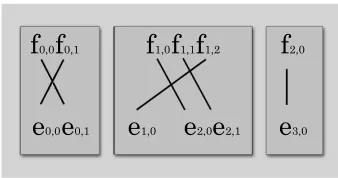
Figure 1 shows a word alignment between two sen-tences. Figure 2 shows the morpheme alignment be-tween same sentences. We assume that all unaligned morphemes in a sentence map to a special null mor-pheme.
A morpheme alignmentamand a word alignment
awarecompatibleif and only if they satisfy the
fol-lowing conditions: If the morpheme alignmentam maps a morpheme ofeto a morpheme off, then the word alignmentaw mapsetof. If the word align-mentaw mapsetof, then the morpheme alignment ammaps at least one morpheme ofeto a morpheme
off. If the word alignmentaw mapseto null, then
all of its morphemes are mapped to null. In sum, a morpheme alignmentam and a word alignmentaw
arecompatibleif and only if:
∀j, k, m, n∈N+, ∃s, t∈N+ [am(j, k) = (m, n)⇒aw(j) =m]∧
[aw(j) =m⇒am(j, s) = (m, t)]∧
[aw(j) =null⇒am(j, k) =null] (1)
Please note that, according to this definition of com-patibility, ‘am(j, k) =null’ does not necessarily
im-ply ‘aw(j) =null’.
A word alignment induces a set of compati-ble morpheme alignments. However, a morpheme alignment induces a unique word alignment. There-fore, if a morpheme alignmentamand a word
align-mentaware compatible, then the word alignment is
awis recoverable from the morpheme alignmentam.
The two-level alignment model (TAM), like IBM Model 1, defines an alignment between words of a sentence pair. In addition, it defines a mor-pheme alignment between the mormor-phemes of a sen-tence pair.
The problem domain of IBM Model 1 is defined over alignments between words, which is depicted as the gray box in Figure 1. In Figure 2, the smaller boxes embedded inside the main box depict the new problem domain of TAM. Given the word align-ments in Figure 1, we are presented with a new alignment problem defined over their morphemes. The new alignment problem is constrained by the given word alignment. We, like IBM Model 1, adopt a bag-of-morphemes approach to this new problem. We thus embed one IBM Model 1 into the scope of another IBM Model 1, and formulate a second-order interpretation of IBM Model 1.
TAM, like IBM Model 1, assumes that words and morphemes are translated independently of their context. The units of translation are both words and morphemes. Both the word alignment aw and the morpheme alignment am are hidden variables that
need to be learned from the data using the EM algo-rithm.
In IBM Model 1,p(e|f), the probability of trans-lating the sentence f into ewith any alignment is computed by summing over all possible word align-ments:
p(e|f) =X a
Figure 1: Word alignment Figure 2: Morpheme alignment
In TAM, the probability of translating the sentence
f into ewith any alignment is computed by sum-ming over all possible word alignments and all pos-sible morpheme alignments that are compatible with a given word alignmentaw:
p(e|f) =X aw
p(aw,e|f)X am
p(am,e|aw,f) (2)
wheream stands for a morpheme alignment. Since
the morpheme alignment am is in the scope of a
given word alignmentaw,amis constrained byaw.
In IBM Model 1, we compute the probability of translating the sentence f into eby summing over all possible word alignments between the words off ande:
p(e|f) =R(e,f)
|e| Y
j=1
|f| X
i=0
t(ej|fi) (3)
where t(ej|fi) is the word translation probability ofej givenfi. R(e,f) substitutes P(le|lf)
(lf+1)le
for easy
readability.1
In TAM, the probability of translating the sen-tencefintoeis computed as follows:
Word
R(e,f)
|e| Y
j=1
|f| X
i=0
t(ej|fi)
R(ej, fi)
|ej| Y
k=1
|fi| X
n=0
t(ekj|fin)
!
Morpheme
wherefin is the nth morpheme of the word at po-sition i. The right part of this equation, the con-tribution of morpheme translation probabilities, is
1
le=|e|is the number of words in sentenceeandlf=|f|.
in the scope of the left part. In the right part, we compute the probability of translating the word fi
into the wordej by summing over all possible mor-pheme alignments between the mormor-phemes ofejand fi. R(ej, fi)is equivalent toR(e,f)except for the fact that its domain is not the set of sentences but the set of words. The length of wordsej and fi in
R(ej, fi)are the number of morphemes ofejandfi.
The left part, the contribution of word transla-tion probabilities alone, equals Eqn. 3. Therefore, canceling the contribution of morpheme translation probabilities reduces TAM to IBM Model 1. In our experiments, we call this reduced version of TAM ‘word-only’ (IBM). TAM with the contribu-tion of both word and morpheme translacontribu-tion proba-bilities, as the equation above, is called ‘word-and-morpheme’. Finally, we also cancel out the con-tribution of word translation probabilities, which is called ‘morpheme-only’. In the ‘morpheme-only’ version of TAM, t(ej|fi) equals 1. Bellow is the equation ofp(e|f)in the morpheme-only model.
p(e|f) =
R(e,f)
|e| Y
j=1
|f| X
i=0
|ej| Y
k=1
|fi| X
n=0
R(ej, fi)t(ekj|fin) (4)
Please note that, although this version of the two-level alignment model does not use word translation probabilities, it is also a word-aware model, as mor-pheme alignments are restricted to correspond to a valid word alignment according to Eqn. 1. When presented with words that exhibit no morphology, the morpheme-only version of TAM is equivalent to IBM Model 1, as every single-morpheme word is it-self a morpheme.
[image:3.612.86.292.533.645.2]word-and-morpheme and the word-and-morpheme-only versions. The word-and-morpheme version of the model is defi-cient whereas the morpheme-only model is not.
The word-and-morpheme version is deficient, be-cause some probability is allocated to cases where the morphemes generated by the morpheme model do not match the words generated by the word model. Moreover, although most languages exhibit morphology to some extent, they can be input to the algorithm without morpheme boundaries. This also causes deficiency in the word-and-morpheme ver-sion, as single morpheme words are generated twice, as a word and as a morpheme.
Nevertheless, we observed that the deficient ver-sion of TAM can perform as good as the non-deficient version of TAM, and sometimes performs better. This is not surprising, as deficient word align-ment models such as IBM Model 3 or discriminative word alignment models work well in practice.
Goldwater and McClosky (2005) proposed a mor-pheme aware word alignment model for language pairs in which the source language words corre-spond to only one morpheme. Their word alignment model is:
P(e|f) = K
Y
k=0
P(ek|f)
whereek is thekth morpheme of the worde. The morpheme-only version of our model is a general-ization of this model. However, there are major dif-ferences in their and our implementation and exper-imentation. Their model assumes a fixed number of possible morphemes associated with any stem in the language, and if the morphemeek is not present, it is assigned a null value.
The null word on the source side is also a null morpheme, since every single morpheme word is it-self a morpheme. In TAM, the null word is the null morpheme that all unaligned morphemes align to.
2.2 Second-Order Counts
In TAM, we collect counts for both word translations and morpheme translations. Unlike IBM Model 1, R(e, f)= P(le|lf)
(lf+1)le
does not cancel out in the counts
of TAM. To compute the conditional probability P(le|lf), we assume that the length of worde(the
number of morphemes of worde) varies according
to a Poisson distribution with a mean that is linear with length of the wordf.
P(le|lf) =FPoisson(le, r·lf)
= exp(−r·lf)(r·lf) le
le!
FPoisson(le, r·lf)expresses the probability that there
are le morphemes in e if the expected number of
morphemes ineisr·lf, wherer = EE[[lle]
f] is the rate parameter. Sincelf is undefined for null words, we omitR(e, f)for null words.
We introduce T(e|f), the translation probability ofegivenfwith all possible morpheme alignments, as it will occur frequently in the counts of TAM:
T(e|f) =t(e|f)R(e, f)
|e| Y
k=1
|f| X
n=0
t(ek|fn)
The role of T(e|f) in TAM is very similar to the role oft(e|f)in IBM Model 1. In finding the Viterbi alignments, we do not take max over the values in the summation inT(e|f).
2.2.1 Word Counts
Similar to IBM Model 1, we collect counts for word translations over all possible alignments, weighted by their probability. In Eqn. 5, the count function collects evidence from a sentence pair
(e,f)as follows: For all wordsej of the sentencee
and for all word alignmentsaw(j), we collect counts for a particular input wordf and an output worde iffej =eandfaw(j) =f.
cw(e|f;e,f, aw) = X
1≤j≤|e|
s.t. e=ej f=faw(j)
T(e|f)
|f| P
i=0
T(e|fi)
(5)
2.2.2 Morpheme Counts
As for morpheme translations, we collect counts over all possible word and morpheme alignments, weighted by their probability. The morpheme count function below collects evidence from a word pair
(e, f) in a sentence pair (e,f) as follows: For all words ej of the sentence e and for all word
align-mentsaw(j), for all morphemesekj of the wordej
and for all morpheme alignmentsam(j, k), we
output morphemehiffej = eand faw(j) =f and
h=ekj andg=fam(j,k).
cm(h|g;e,f, aw, am) =
X
1≤j≤|e|
s.t. e=ej f=faw(j)
X
1≤k≤|e|
s.t. h=ek
j g=fam(j,k)
T(e|f)
|f| P
i=0
T(e|fi)
t(h|g)
|f| P
i=1
t(h|fi)
The left part of the morpheme count function is the same as the word-counts in Eqn. 5. Since it does not containhorg, it needs to be computed only once for each word. The right part of the equation is familiar from the IBM Model 1 counts.
2.3 HMM Extension
We implemented TAM with the HMM extension (Vogel et al., 1996) at the word level. We redefine p(e|f)as follows:
R(e,f)X aw
|e| Y
j=1
p(s(j)|C(faw(j−1)))t(ej|faw(j))
R(ej, faw(j)) X
am |ej| Y
k=1
t(ekj|fam(j,k))
!
where the distortion probability depends on the rel-ative jump width s(j) = aw(j − 1) − aw(j),
as opposed to absolute positions. The distortion probability is conditioned on class of the previous aligned word C(faw(j−1)). We used the mkcls
tool in GIZA (Och and Ney, 2003) to learn the word classes.
We formulated the HMM extension of TAM only at the word level. Nevertheless, the morpheme-only version of TAM also has an HMM extension, as it is also a word-aware model. To obtain the HMM extension of the morpheme-only version, substitute t(ej|faw(j))with 1 in the equation above.
For the HMM to work correctly, we must han-dle jumping to and jumping from null positions. We learn the probabilities of jumping to a null position from the data. To compute the jump probability from a null position, we keep track of the nearest previous source word that does not align to null, and use the position of the previous non-null word to calculate the jump width. For this reason, we use a total of
2lf −1 words for the HMM model, the positions > lfstand for null positions between the words off (Och and Ney, 2003). We do not allow null to null jumps. In sum, we enforce the following constraints:
P(i+lf+ 1|i0) =p(null|i0)
P(i+lf + 1|i0+lf + 1) = 0
P(i|i0+lf + 1) =p(i|i0)
In the HMM extension of TAM, we perform forward-backward training using the word counts in Eqn. 5 as the emission probabilities. We calculate the posterior word translation probabilities for each ej andfisuch that1≤j ≤leand1≤i≤2lf −1
as follows:
γj(i) =
αj(i)βj(i)
2lf−1 P
m=1
αj(m)βj(m)
whereαis the forward andβis the backward prob-abilities of the HMM. The HMM word counts, in turn, are the posterior word translation probabilities obtained from the forward-backward training:
cw(e|f;e,f, aw) =
X
1≤j≤|e|
s.t. e=ej f=faw(j)
γj(aw(j))
Likewise, we use the posterior probabilities in HMM morpheme counts:
cm(h|g;e,f, aw, am) =
X
1≤j≤|e|
s.t. e=ej f=faw(j)
X
1≤k≤|e|
s.t. h=ek
j g=fam(j,k)
γj(aw(j)) t(h|g)
|f| P
i=1
t(h|fi)
The complexity of the HMM extension of TAM is O(n3m2), wherenis the number of words, andm is the number of morphemes per word.
2.4 Variational Bayes
(a) Kasım 1996’da, T¨urk makamları, ˙Ic¸is¸leri Bakanlı˘gı b¨unyesinde bir kayıp kis¸ileri arama birimi olus¸turdu.
(b) Kasım+Noun 1996+Num–Loc ,+Punc T¨urk+Noun makam+Noun–A3pl–P3sg ,+Punc ˙Ic¸is¸i+Noun–A3pl– P3sg Bakanlık+Noun–P3sg b¨unye+Noun–P3sg–Loc bir+Det kayıp+Adj kis¸i+Noun–A3pl–Acc ara+Verb– Inf2 birim+Noun–P3sg olus¸+Verb–Caus–Past .+Punc
(c) In November 1996 the Turkish authorities set up a missing persons search unit within the Ministry of the Interior.
(d) in+IN November+NNP 1996+CD the+DT Turkish+JJauthor+NN–ity+N|N.–NNSset+VB–VBD up+RP a+DT miss+VB–VBG+JJ person+NN–NNS search+NN unit+NN within+IN the+DT minister+NN– y+N|N. of+IN the+DT interior+NN .+.
(e) In+IN November+NNP 1996+CD the+DT Turkish+JJ authorities+NNS set+VBD up+RP a+DT missing+JJ persons+NNS search+NN unit+NN within+IN the+DT Ministry+NNP of+IN the+DT Interior+NNP .+.
Figure 3: Turkish-English data examples
amounts to a small change to the M step of the orig-inal EM algorithm. We introduce Dirichlet priorsα to perform an inexact normalization by applying the functionf(v) = exp(ψ(v))to the expected counts collected in the E step, where ψ is the digamma function (Johnson, 2007).
θx|y = f(E[c(x|y)] +α)
f(P
jE[c(xj|y)] +α)
We setαto10−20, a very low value, to have the ef-fect of anti-smoothing, as low values ofαcause the algorithm to favor words which co-occur frequently and to penalize words that co-occur rarely.
3 Experimental Setup 3.1 Data
We trained our model on a Turkish-English paral-lel corpus of approximately 50K sentences, which have a maximum of 80 morphemes. Our parallel data consists mainly of documents in international relations and legal documents from sources such as the Turkish Ministry of Foreign Affairs, EU, etc. We followed a heavily supervised approach in logical analysis. The Turkish data was first morpho-logically parsed (Oflazer, 1994), then disambiguated (Sak et al., 2007) to select the contextually salient in-terpretation of words. In addition, we removed mor-phological features that are not explicitly marked by an overt morpheme — thus each feature symbol be-yond the root part-of-speech corresponds to a mor-pheme. Line (b) of Figure 3 shows an example of
a segmented Turkish sentence. The root is followed by its part-of-speech tag separated by a ‘+’. The derivational and inflectional morphemes that follow the root are separated by ‘–’s. In all experiments, we used the same segmented version of the Turkish data, because Turkish is an agglutinative language.
For English, we used the CELEX database (Baayen et al., 1995) to segment English words into morphemes. We created two versions of the data: a segmented version that involves both derivational and inflectional morphology, and an unsegmented POS tagged version. The CELEX database provides tags for English derivational morphemes, which in-dicate their function: the part-of-speech category the morpheme attaches to and the part-of-speech cate-gory it returns. For example, in ‘sparse+ity’ = ‘spar-sity’, the morpheme-ityattaches to an adjective to the right and returns a noun. This behavior is repre-sented as ‘N|A.’ in CELEX, where ‘.’ indicates the attachment position. We used these tags in addition to the surface forms of the English morphemes, in order to disambiguate multiple functions of a single surface morpheme.
The English sentence in line (d) of Figure 3 ex-hibits both derivational and inflectional morphology. For example, ‘author+ity+s’=‘authorities’ has both an inflectional suffix-sand a derivational suffix-ity, whereas ‘person+s’ has only an inflectional suffix-s.
indi-Words Morphemes
Tokens Types Tokens Types
English Der+Inf 1,033,726 27,758 1,368,188 19,448
English POS 1,033,726 28,647 1,033,726 28,647
[image:7.612.170.443.62.167.2]Turkish Der+Inf 812,374 57,249 1,484,673 16,713
Table 1: Data statistics
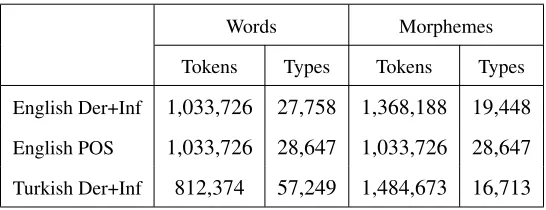
visible units. Table 1 shows the number of words, the number of morphemes and the respective vocab-ulary sizes. The average number of morphemes in segmented Turkish words is 2.69, and the average length of segmented English words is 1.57.
3.2 Experiments
We initialized our baseline word-only model with 5 iterations of IBM Model 1, and further trained the HMM extension (Vogel et al., 1996) for 5 iterations. We call this model ‘baseline HMM’ in the discus-sions. Similarly, we initialized the two versions of TAM with 5 iterations of the model explained in Section 2.2, and then trained the HMM extension of it as explained in Section 2.3 for 5 iterations.
To obtain BLEU scores for TAM models and our implementation of the word-only model, i.e. baseline-HMM, we bypassed GIZA++ in the Moses toolkit (Och and Ney, 2003). We also ran GIZA++ (IBM Model 1–4) on the data. We translated 1000 sentence test sets.
4 Results and Discussion
We evaluated the performance of our model in two different ways. First, we evaluated against gold word alignments for 75 Turkish-English sentences. Second, we used the word Viterbi alignments of our algorithm to obtain BLEU scores.
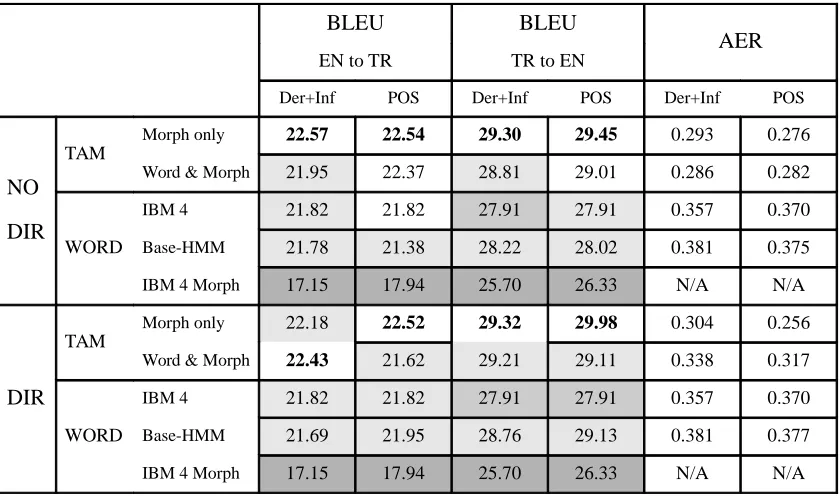
Table 2 shows the AER (Och and Ney, 2003) of the word alignments of the Turkish-English pair and the translation performance of the word alignments learned by our models. We report the grow-diag-final (Koehn et al., 2003) of the Viterbi alignments. In Table 2, results obtained with different versions of the English data are represented as follows: ‘Der’ stands for derivational morphology, ‘Inf’ for inflec-tional morphology, and ‘POS’ for part-of-speech
tags. ‘Der+Inf’ corresponds to the example sen-tence in line (d) in Figure 3, and ‘POS’ to line (e). ‘DIR’ stands for models with Dirichlet priors, and ‘NO DIR’ stands for models without Dirichlet pri-ors. All reported results are of the HMM extension of respective models.
Table 2 shows that using Dirichlet priors hurts the AER performance of the word-and-morpheme model in all experiment settings, and benefits the morpheme-only model in the POS tagged experi-ment settings.
In order to reduce the effect of nondeterminism, we run Moses three times per experiment setting, and report the highest BLEU scores obtained. Since the BLEU scores we obtained are close, we did a sig-nificance test on the scores (Koehn, 2004). Table 2 visualizes the partition of the BLEU scores into sta-tistical significance groups. If two scores within the same column have the same background color, or the border between their cells is removed, then the dif-ference between their scores is not statistically sig-nificant. For example, the best BLEU scores, which are in bold, have white background. All scores in a given experiment setting without white background are significantly worse than the best score in that ex-periment setting, unless there is no border separating them from the best score.
BLEU
EN to TR
BLEU
TR to EN
AER
Der+Inf POS Der+Inf POS Der+Inf POS
NO
DIR TAM
Morph only 22.57 22.54 29.30 29.45 0.293 0.276
Word & Morph 21.95 22.37 28.81 29.01 0.286 0.282
WORD
IBM 4 21.82 21.82 27.91 27.91 0.357 0.370
Base-HMM 21.78 21.38 28.22 28.02 0.381 0.375
IBM 4 Morph 17.15 17.94 25.70 26.33 N/A N/A
DIR TAM
Morph only 22.18 22.52 29.32 29.98 0.304 0.256
Word & Morph 22.43 21.62 29.21 29.11 0.338 0.317
WORD
IBM 4 21.82 21.82 27.91 27.91 0.357 0.370
Base-HMM 21.69 21.95 28.76 29.13 0.381 0.377
[image:8.612.95.515.78.326.2]IBM 4 Morph 17.15 17.94 25.70 26.33 N/A N/A
Table 2: AER and BLEU Scores
ulary, benefits from the use of Dirichlet priors more than the TAM models.
In four out of eight experiment settings, the morpheme-only model performs better than the word-and-morpheme version of TAM. However, please note that our extensive experimentation with TAM models revealed that the superiority of the morpheme-only model over the word-and-morpheme model is highly dependent on segmenta-tion accuracy, degree of segmentasegmenta-tion, and morpho-logical richness of languages.
Finally, we treated morphemes as words and trained IBM Model 4 on the morpheme segmented versions of the data. To obtain BLEU scores, we had to unsegment the translation output: we con-catenated the prefixes to the morpheme to the right, and suffixes to the morpheme to the left. Since this process creates malformed words, the BLEU scores obtained are much lower than the scores obtained by IBM Model 4, the baseline and the TAM Models.
5 Conclusion
We presented two versions of a two-level alignment model for morphologically rich languages. We
ob-served that information provided by word transla-tions and morpheme translatransla-tions interact in a way that enables the model to be receptive to the par-tial information in rarely occurring words through their frequently occurring morphemes. We obtained significant improvement of BLEU scores over IBM Model 4. In conclusion, morphologically aware word alignment models prove to be superior to their word-only counterparts.
Acknowledgments Funded by NSF award IIS-0910611. Kemal Oflazer acknowledges the gen-erous support of the Qatar Foundation through Carnegie Mellon University’s Seed Research pro-gram. The statements made herein are solely the responsibility of this author(s), and not necessarily that of Qatar Foundation.
References
Technical report, Final Report, JHU Summer Work-shop.
R.H. Baayen, R. Piepenbrock, and L. Gulikers. 1995.
The CELEX Lexical Database (Release 2) [CD-ROM]. Linguistic Data Consortium, University of Pennsylva-nia [Distributor], Philadelphia, PA.
Matthew J. Beal. 2003. Variational Algorithms for Ap-proximate Bayesian Inference. Ph.D. thesis, Univer-sity College London.
Peter F. Brown, Stephen A. Della Pietra, Vincent J. Della Pietra, and Robert L. Mercer. 1993. The mathematics of statistical machine translation: Parameter estima-tion.Computational Linguistics, 19(2):263–311. Tagyoung Chung and Daniel Gildea. 2009.
Unsu-pervised tokenization for machine translation. In
EMNLP, pages 718–726.
Martin ˇCmejrek, Jan Cuˇr´ın, and Jiˇr´ı Havelka. 2003. Czech-English dependency-based machine transla-tion. InEACL, pages 83–90, Morristown, NJ, USA. Association for Computational Linguistics.
Sharon Goldwater and David McClosky. 2005. Improv-ing statistical MT through morphological analysis. In
HLT-EMNLP.
Mark Johnson. 2007. Why doesn’t EM find good HMM POS-taggers? In EMNLP-CoNLL, pages 296–305, Prague, Czech Republic, June. Association for Com-putational Linguistics.
Philipp Koehn, Franz Josef Och, and Daniel Marcu. 2003. Statistical phrase-based translation. In HLT-NAACL.
Philipp Koehn. 2004. Statistical significance tests for machine translation evaluation. In EMNLP, pages 388–395.
Young-suk Lee. 2004. Morphological analysis for statis-tical machine translation. InHLT-NAACL, pages 57– 60.
Robert C. Moore. 2004. Improving IBM word alignment model 1. InACL, pages 518–525, Barcelona, Spain, July.
Jason Naradowsky and Kristina Toutanova. 2011. Unsu-pervised bilingual morpheme segmentation and align-ment with context-rich Hidden Semi-Markov Models. InProceedings of the 49th Annual Meeting of the As-sociation for Computational Linguistics: Human Lan-guage Technologies, pages 895–904, Portland, Ore-gon, USA, June. Association for Computational Lin-guistics.
Sonja Niessen and Hermann Ney. 2000. Improving SMT quality with morpho-syntactic analysis. In Computa-tional Linguistics, pages 1081–1085, Morristown, NJ, USA. Association for Computational Linguistics. Franz Josef Och and Hermann Ney. 2003. A
system-atic comparison of various statistical alignment mod-els.Computational Linguistics, 29(1):19–51.
Kemal Oflazer. 1994. Two-level description of Turkish morphology.Literary and Linguistic Computing, 9(2). Has¸im Sak, Tunga G¨ung¨or, and Murat Sarac¸lar. 2007. Morphological disambiguation of Turkish text with perceptron algorithm. In CICLing, pages 107–118, Berlin, Heidelberg. Springer-Verlag.
Stephan Vogel, Hermann Ney, and Christoph Tillmann. 1996. HMM-based word alignment in statistical trans-lation. InCOLING, pages 836–841.
Reyyan Yeniterzi and Kemal Oflazer. 2010. Syntax-to-morphology mapping in factored phrase-based statis-tical machine translation from English to Turkish. In