A Comparative Study on Reordering Constraints in Statistical Machine
Translation
Richard Zens and Hermann Ney Chair of Computer Science VI RWTH Aachen - University of Technology
{zens,ney}@cs.rwth-aachen.de
Abstract
In statistical machine translation, the gen-eration of a translation hypothesis is com-putationally expensive. If arbitrary word-reorderings are permitted, the search prob-lem is NP-hard. On the other hand, if we restrict the possible word-reorderings in an appropriate way, we obtain a polynomial-time search algorithm.
In this paper, we compare two different re-ordering constraints, namely the ITG con-straints and the IBM concon-straints. This comparison includes a theoretical dis-cussion on the permitted number of re-orderings for each of these constraints. We show a connection between the ITG constraints and the since 1870 known Schr¨oder numbers.
We evaluate these constraints on two tasks: the Verbmobil task and the Cana-dian Hansards task. The evaluation con-sists of two parts: First, we check how many of the Viterbi alignments of the training corpus satisfy each of these con-straints. Second, we restrict the search to each of these constraints and compare the resulting translation hypotheses.
The experiments will show that the base-line ITG constraints are not sufficient on the Canadian Hansards task. There-fore, we present an extension to the ITG constraints. These extended ITG con-straints increase the alignment coverage from about 87% to 96%.
1 Introduction
In statistical machine translation, we are given a source language (‘French’) sentence f1J =
f1. . . fj. . . fJ, which is to be translated into a target language (‘English’) sentenceeI1 = e1. . . ei. . . eI. Among all possible target language sentences, we will choose the sentence with the highest probabil-ity:
ˆ
eI1 = argmax eI
1
{P r(eI1|f1J)} (1)
= argmax eI
1
{P r(eI1)·P r(f1J|eI1)} (2)
The decomposition into two knowledge sources in Eq. 2 is the so-called source-channel approach to statistical machine translation (Brown et al., 1990). It allows an independent modeling of tar-get language model P r(eI1) and translation model
P r(fJ
1|eI1). The target language model describes
the well-formedness of the target language sentence. The translation model links the source language sen-tence to the target language sensen-tence. It can be fur-ther decomposed into alignment and lexicon model. The argmax operation denotes the search problem, i.e. the generation of the output sentence in the tar-get language. We have to maximize over all possible target language sentences.
1999). Therefore, we have to restrict the possible reorderings in some way to make the search prob-lem feasible. Here, we will discuss two such con-straints in detail. The first concon-straints are based on inversion transduction grammars (ITG) (Wu, 1995; Wu, 1997). In the following, we will call these the ITG constraints. The second constraints are the IBM constraints (Berger et al., 1996). In the next section, we will describe these constraints from a theoretical point of view. Then, we will describe the resulting search algorithm and its extension for word graph generation. Afterwards, we will analyze the Viterbi alignments produced during the training of the align-ment models. Then, we will compare the translation results when restricting the search to either of these constraints.
2 Theoretical Discussion
In this section, we will discuss the reordering con-straints from a theoretical point of view. We will answer the question of how many word-reorderings are permitted for the ITG constraints as well as for the IBM constraints. Since we are only interested in the number of possible reorderings, the specific word identities are of no importance here. Further-more, we assume a one-to-one correspondence be-tween source and target words. Thus, we are inter-ested in the number of word-reorderings, i.e. permu-tations, that satisfy the chosen constraints. First, we will consider the ITG constraints. Afterwards, we will describe the IBM constraints.
2.1 ITG Constraints
Let us now consider the ITG constraints. Here, we interpret the input sentence as a sequence of blocks. In the beginning, each position is a block of its own. Then, the permutation process can be seen as fol-lows: we select two consecutive blocks and merge them to a single block by choosing between two op-tions: either keep them in monotone order or invert the order. This idea is illustrated in Fig. 1. The white boxes represent the two blocks to be merged.
Now, we investigate, how many permutations are obtainable with this method. A permutation derived by the above method can be represented as a binary tree where the inner nodes are colored either black or white. At black nodes the resulting sequences of the children are inverted. At white nodes they are kept in monotone order. This representation is equivalent to
source positions
target positions
[image:2.612.322.535.74.205.2]without inversion with inversion
Figure 1: Illustration of monotone and inverted con-catenation of two consecutive blocks.
the parse trees of the simple grammar in (Wu, 1997). We observe that a given permutation may be con-structed in several ways by the above method. For instance, let us consider the identity permutation of 1,2, ..., n. Any binary tree withnnodes and all in-ner nodes colored white (monotone order) is a pos-sible representation of this permutation. To obtain a unique representation, we pose an additional con-straint on the binary trees: if the right son of a node is an inner node, it has to be colored with the oppo-site color. With this constraint, each of these binary trees is unique and equivalent to a parse tree of the ’canonical-form’ grammar in (Wu, 1997).
In (Shapiro and Stephens, 1991), it is shown that the number of such binary trees with n nodes is the (n−1)th large Schr¨oder number Sn−1. The
(small) Schr¨oder numbers have been first described in (Schr¨oder, 1870) as the number of bracketings of a given sequence (Schr¨oder’s second problem). The large Schr¨oder numbers are just twice the Schr¨oder numbers. Schr¨oder remarked that the ratio between two consecutive Schr¨oder numbers approaches3 + 2√2 = 5.8284... . A second-order recurrence for the large Schr¨oder numbers is:
(n+ 1)Sn = 3(2n−1)Sn−1−(n−2)Sn−2
withn≥2andS0= 1,S1 = 2.
subsequences can be found in (West, 1995). The interesting point is that a search with the ITG straints cannot generate a word-reordering that con-tains one of these two subsequences. In (Wu, 1997), these forbidden subsequences are called ’inside-out’ transpositions.
Another interpretation of the Schr¨oder numbers is given in (Knuth, 1973): The number of permutations that can be sorted with an output-restricted double-ended queue (deque) is exactly the large Schr¨oder number. Additionally, Knuth presents an approxi-mation for the large Schr¨oder numbers:
Sn ≈ c·(3 + √
8)n·n−32 (3)
where c is set to 12
q
(3√2−4)/π. This approxi-mation function confirms the result of Schr¨oder, and we obtainSn ∈ Θ((3 +
√
8)n), i.e. the Schr¨oder numbers grow like(3 +√8)n≈5.83n.
2.2 IBM Constraints
In this section, we will describe the IBM constraints (Berger et al., 1996). Here, we mark each position in the source sentence either as covered or uncovered. In the beginning, all source positions are uncovered. Now, the target sentence is produced from bottom to top. A target position must be aligned to one of the first k uncovered source positions. The IBM con-straints are illustrated in Fig. 2.
J uncovered position
covered position
uncovered position for extension
[image:3.612.97.279.469.630.2]1 j
Figure 2: Illustration of the IBM constraints.
For most of the target positions there are k per-mitted source positions. Only towards the end of the sentence this is reduced to the number of remaining uncovered source positions. Letndenote the length of the input sequence and letrndenote the permitted
number of permutations with the IBM constraints. Then, we obtain:
rn =
½
kn−k·k! n > k
n! n≤k (4)
Typically, k is set to 4. In this case, we obtain an asymptotic upper and lower bound of4n, i.e. rn ∈ Θ(4n).
In Tab. 1, the ratio of the number of permitted re-orderings for the discussed constraints is listed as a function of the sentence length. We see that for longer sentences the ITG constraints allow for more reorderings than the IBM constraints. For sentences of length 10 words, there are about twice as many reorderings for the ITG constraints than for the IBM constraints. This ratio steadily increases. For longer sentences, the ITG constraints allow for much more flexibility than the IBM constraints.
3 Search
Now, let us get back to more practical aspects. Re-ordering constraints are more or less useless, if they do not allow the maximization of Eq. 2 to be per-formed in an efficient way. Therefore, in this sec-tion, we will describe different aspects of the search algorithm for the ITG constraints. First, we will present the dynamic programming equations and the resulting complexity. Then, we will describe prun-ing techniques to accelerate the search. Finally, we will extend the basic algorithm for the generation of word graphs.
3.1 Algorithm
The ITG constraints allow for a polynomial-time search algorithm. It is based on the following dy-namic programming recursion equations. During the search a table Qjl,jr,eb,et is constructed. Here, Qjl,jr,eb,et denotes the probability of the best
hy-pothesis translating the source words from position
jl(left) to positionjr(right) which begins with the target language wordeb (bottom) and ends with the wordet(top). This is illustrated in Fig. 3.
Table 1: Ratio of the number of permitted reorderings with the ITG constraintsSn−1and the IBM constraints
rnfor different sentence lengthsn.
n 1 ... 6 7 8 9 10 11 12 13 14 15 16 17 18 19 20
Sn−1/rn ≈1.0 1.2 1.4 1.7 2.1 2.6 3.4 4.3 5.6 7.4 9.8 13.0 17.4 23.3 31.4
j
l jr
e b
e
t
Figure 3: Illustration of theQ-table.
as possible to the search with the IBM constraints. We introduce a new parameterpm(m=ˆ monotone), which denotes the probability of a monotone combi-nation of two partial hypotheses.
Qjl,jr,eb,et = (5)
max
jl≤k<jr, e0,e00
n
Q0jl,jr,eb,et,
Qjl,k,eb,e0·Qk+1,jr,e00,et·p(e00|e0)·pm,
Qk+1,jr,eb,e0·Qjl,k,e00,et·p(e00|e0)·(1−pm)
o
We formulated this equation for a bigram lan-guage model, but of course, the same method can also be applied for a trigram language model. The resulting algorithm is similar to the CYK-parsing al-gorithm. It has a worst-case complexity ofO(J3 ·
E4). Here, J is the length of the source sentence andEis the vocabulary size of the target language.
3.2 Pruning
Although the described search algorithm has a polynomial-time complexity, even with a bigram language model the search space is very large. A full search is possible but time consuming. The situation gets even worse when a trigram language model is used. Therefore, pruning techniques are obligatory to reduce the translation time.
Pruning is applied to hypotheses that translate the same subsequence fjjlr of the source sentence. We
use pruning in the following two ways. The first pruning technique is histogram pruning: we restrict the number of translation hypotheses per sequence
fjr
jl. For each sequence f
jr
jl, we keep only a fixed
number of translation hypotheses. The second prun-ing technique is threshold prunprun-ing: the idea is to re-move all hypotheses that have a low probability rela-tive to the best hypothesis. Therefore, we introduce a threshold pruning parameterq, with0 ≤ q ≤ 1. Let Q∗jl,jr denote the maximum probability of all translation hypotheses for fjjlr. Then, we prune a hypothesis iff:
Qjl,jr,eb,et < q·Q∗jl,jr
Applying these pruning techniques the computa-tional costs can be reduced significantly with almost no loss in translation quality.
3.3 Generation of Word Graphs
The generation of word graphs for a bottom-top search with the IBM constraints is described in (Ueffing et al., 2002). These methods cannot be applied to the CYK-style search for the ITG con-straints. Here, the idea for the generation of word graphs is the following: assuming we already have word graphs for the source sequencesfjkl andfjr
k+1,
then we can construct a word graph for the sequence
fjr
jl by concatenating the partial word graphs either
in monotone or inverted order.
Now, we describe this idea in a more formal way. A word graph is a directed acyclic graph (dag) with one start and one end node. The edges are annotated with target language words or phrases. We also al-low ²-transitions. These are edges annotated with the empty word. Additionally, edges may be anno-tated with probabilities of the language or translation model. Each path from start node to end node rep-resents one translation hypothesis. The probability of this hypothesis is calculated by multiplying the probabilities along the path.
is done in the following way: we are given two word graphs w1 and w2 with start and end nodes
(s1, g1) and (s2, g2), respectively. First, we add
an ²-transition (g1, s2) from the end node of the
first graphw1 to the start node of the second graph
w2 and annotate this edge with the probability of a
monotone concatenation pm. Second, we create a copy of each of the original word graphsw1andw2.
Then, we add an ²-transition (g2, s1) from the end
node of the copied second graph to the start node of the copied first graph. This edge is annotated with the probability of a inverted concatenation1−pm. Now, we have obtained two word graphs: one for a monotone and one for a inverted concatenation. The final word graphs is constructed by merging the two start nodes and the two end nodes, respectively.
Let W(jl, jr) denote the word graph for the source sequence fjjlr. This graph is constructed from the word graphs of all subsequences of(jl, jr). Therefore, we assume, these word graphs have al-ready been produced. For all source positionskwith
jl≤k < jr, we combine the word graphsW(jl, k) andW(k+ 1, jr) as described above. Finally, we merge all start nodes of these graphs as well as all end nodes. Now, we have obtained the word graph
W(jl, jr)for the source sequencefjjlr. As initializa-tion, we use the word graphs of the monotone IBM4 search.
3.4 Extended ITG constraints
In this section, we will extend the ITG constraints described in Sec. 2.1. This extension will go beyond basic reordering constraints.
We already mentioned that the use of consecutive phrases within the ITG approach is straightforward. The only thing we have to change is the initializa-tion of theQ-table. Now, we will extend this idea to phrases that are non-consecutive in the source lan-guage. For this purpose, we adopt the view of the ITG constraints as a bilingual grammar as, e.g., in (Wu, 1997). For the baseline ITG constraints, the resulting grammar is:
A → [AA] | hAAi | f /e | f /² | ²/e
Here, [AA]denotes a monotone concatenation and hAAidenotes an inverted concatenation.
Let us now consider the case of a source phrase consisting of two partsf1 andf2. Letedenote the
corresponding target phrase. We add the productions
A → [e/f1 A ²/f2] | he/f1 A ²/f2i
to the grammar. The probabilities of these pro-ductions are, dependent on the translation direction,
p(e|f1, f2) or p(f1, f2|e), respectively. Obviously,
these productions are not in the normal form of an ITG, but with the method described in (Wu, 1997), they can be normalized.
4 Corpus Statistics
In the following sections we will present results on two tasks. Therefore, in this section we will show the corpus statistics for each of these tasks.
4.1 Verbmobil
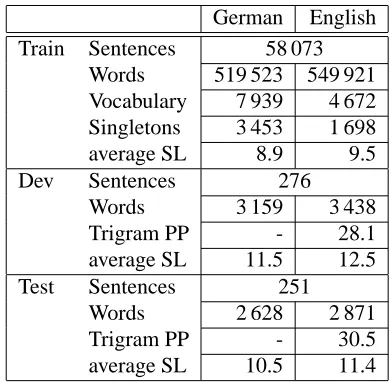
[image:5.612.328.523.512.703.2]The first task we will present results on is the Verb-mobil task (Wahlster, 2000). The domain of this corpus is appointment scheduling, travel planning, and hotel reservation. It consists of transcriptions of spontaneous speech. Table 2 shows the corpus statistics of this corpus. The training corpus (Train) was used to train the IBM model parameters. The remaining free parameters, i.e. pm and the model scaling factors (Och and Ney, 2002), were adjusted on the development corpus (Dev). The resulting sys-tem was evaluated on the test corpus (Test).
Table 2: Statistics of training and test corpus for the Verbmobil task (PP=perplexity, SL=sentence length).
German English Train Sentences 58 073
Words 519 523 549 921 Vocabulary 7 939 4 672 Singletons 3 453 1 698 average SL 8.9 9.5 Dev Sentences 276
Words 3 159 3 438 Trigram PP - 28.1 average SL 11.5 12.5 Test Sentences 251
Table 3: Statistics of training and test corpus for the Canadian Hansards task (PP=perplexity, SL=sentence length).
French English Train Sentences 1.5M
Words 24M 22M
Vocabulary 100 269 78 332 Singletons 40 199 31 319 average SL 16.6 15.1 Test Sentences 5432
Words 97 646 88 773 Trigram PP – 179.8 average SL 18.0 16.3
4.2 Canadian Hansards
Additionally, we carried out experiments on the Canadian Hansards task. This task contains the pro-ceedings of the Canadian parliament, which are kept by law in both French and English. About 3 million parallel sentences of this bilingual data have been made available by the Linguistic Data Consortium (LDC). Here, we use a subset of the data containing only sentences with a maximum length of 30 words. Table 3 shows the training and test corpus statistics.
5 Evaluation in Training
In this section, we will investigate for each of the constraints the coverage of the training corpus align-ment. For this purpose, we compute the Viterbi alignment of IBM Model 5 with GIZA++ (Och and Ney, 2000). This alignment is produced without any restrictions on word-reorderings. Then, we check for every sentence if the alignment satisfies each of the constraints. The ratio of the number of satisfied alignments and the total number of sentences is re-ferred to as coverage. Tab. 4 shows the results for the Verbmobil task and for the Canadian Hansards task. It contains the results for both translation direc-tions German-English (S→T) and English-German (T→S) for the Verbmobil task and French-English (S→T) and English-French (T→S) for the Canadian Hansards task, respectively.
[image:6.612.86.282.118.259.2]For the Verbmobil task, the baseline ITG con-straints and the IBM concon-straints result in a similar coverage. It is about 91% for the German-English translation direction and about 88% for the English-German translation direction. A significantly higher
Table 4: Coverage on the training corpus for align-ment constraints for the Verbmobil task (VM) and for the Canadian Hansards task (CH).
coverage [%] task constraint S→T T→S
VM IBM 91.0 88.1
ITG baseline 91.6 87.0 extended 96.5 96.9
CH IBM 87.1 86.7
ITG baseline 81.3 73.6 extended 96.1 95.6
coverage of about 96% is obtained with the extended ITG constraints. Thus with the extended ITG con-straints, the coverage increases by about 8% abso-lute.
For the Canadian Hansards task, the baseline ITG constraints yield a worse coverage than the IBM constraints. Especially for the English-French trans-lation direction, the ITG coverage of 73.6% is very low. Again, the extended ITG constraints obtained the best results. Here, the coverage increases from about 87% for the IBM constraints to about 96% for the extended ITG constraints.
6 Translation Experiments
6.1 Evaluation Criteria
In our experiments, we use the following error crite-ria:
• WER (word error rate):
The WER is computed as the minimum num-ber of substitution, insertion and deletion oper-ations that have to be performed to convert the generated sentence into the target sentence.
• PER (position-independent word error rate): A shortcoming of the WER is the fact that it requires a perfect word order. The PER com-pares the words in the two sentences ignoring the word order.
• BLEU score:
This score measures the precision of unigrams, bigrams, trigrams and fourgrams with respect to a whole set of reference translations with a penalty for too short sentences (Papineni et al., 2001). BLEU measures accuracy, i.e. large BLEU scores are better.
• SSER (subjective sentence error rate):
For a more detailed analysis, subjective judg-ments by test persons are necessary. Each translated sentence was judged by a human ex-aminer according to an error scale from 0.0 to 1.0 (Nießen et al., 2000).
6.2 Translation Results
In this section, we will present the translation results for both the IBM constraints and the baseline ITG constraints. We used a single-word based search with IBM Model 4. The initialization for the ITG constraints was done with monotone IBM Model 4 translations. So, the only difference between the two systems are the reordering constraints.
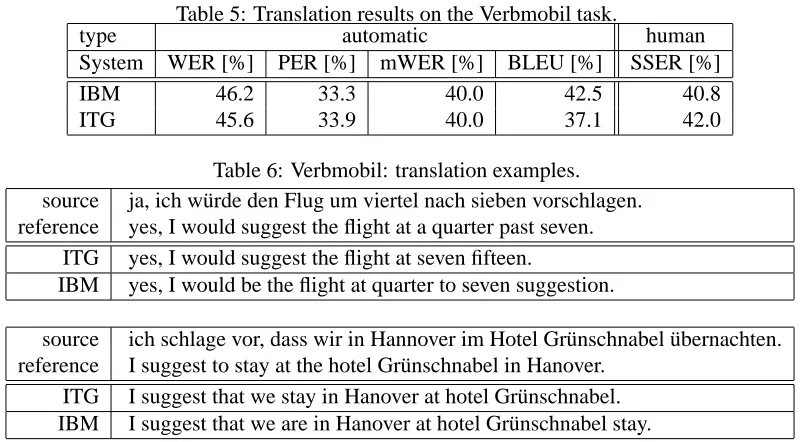
In Tab. 5 the results for the Verbmobil task are shown. We see that the results on this task are sim-ilar. The search with the ITG constraints yields slightly lower error rates.
Some translation examples of the Verbmobil task are shown in Tab. 6. We have to keep in mind, that the Verbmobil task consists of transcriptions of spontaneous speech. Therefore, the source sen-tences as well as the reference translations may have an unorthodox grammatical structure. In the first example, the German verb-group (“w¨urde vorschla-gen”) is split into two parts. The search with the ITG constraints is able to produce a correct transla-tion. With the IBM constraints, it is not possible to translate this verb-group correctly, because the dis-tance between the two parts is too large (more than four words). As we see in the second example, in German the verb of a subordinate clause is placed at the end (“¨ubernachten”). The IBM search is not able to perform the necessary long-range reordering, as it is done with the ITG search.
7 Related Work
The ITG constraints were introduced in (Wu, 1995). The applications were, for instance, the segmenta-tion of Chinese character sequences into Chinese
“words” and the bracketing of the source sentence into sub-sentential chunks. In (Wu, 1996) the base-line ITG constraints were used for statistical ma-chine translation. The resulting algorithm is simi-lar to the one presented in Sect. 3.1, but here, we use monotone translation hypotheses of the full IBM Model 4 as initialization, whereas in (Wu, 1996) a single-word based lexicon model is used. In (Vilar, 1998) a model similar to Wu’s method was consid-ered.
8 Conclusions
We have described the ITG constraints in detail and compared them to the IBM constraints. We draw the following conclusions: especially for long sentences the ITG constraints allow for higher flexibility in word-reordering than the IBM constraints. Regard-ing the Viterbi alignment in trainRegard-ing, the baseline ITG constraints yield a similar coverage as the IBM constraints on the Verbmobil task. On the Canadian Hansards task the baseline ITG constraints were not sufficient. With the extended ITG constraints the coverage improves significantly on both tasks. On the Canadian Hansards task the coverage increases from about 87% to about 96%.
We have presented a polynomitime search al-gorithm for statistical machine translation based on the ITG constraints and its extension for the gen-eration of word graphs. We have shown the trans-lation results for the Verbmobil task. On this task, the translation quality of the search with the base-line ITG constraints is already competitive with the results for the IBM constraints. Therefore, we ex-pect the search with the extended ITG constraints to outperform the search with the IBM constraints.
Future work will include the automatic extraction of the bilingual grammar as well as the use of this grammar for the translation process.
References
A. L. Berger, P. F. Brown, S. A. D. Pietra, V. J. D. Pietra, J. R. Gillett, A. S. Kehler, and R. L. Mercer. 1996. Language translation apparatus and method of using context-based translation models, United States patent, patent number 5510981, April.
Table 5: Translation results on the Verbmobil task.
type automatic human
System WER [%] PER [%] mWER [%] BLEU [%] SSER [%]
IBM 46.2 33.3 40.0 42.5 40.8
ITG 45.6 33.9 40.0 37.1 42.0
Table 6: Verbmobil: translation examples. source ja, ich w¨urde den Flug um viertel nach sieben vorschlagen. reference yes, I would suggest the flight at a quarter past seven.
ITG yes, I would suggest the flight at seven fifteen.
IBM yes, I would be the flight at quarter to seven suggestion.
source ich schlage vor, dass wir in Hannover im Hotel Gr¨unschnabel ¨ubernachten. reference I suggest to stay at the hotel Gr¨unschnabel in Hanover.
ITG I suggest that we stay in Hanover at hotel Gr¨unschnabel. IBM I suggest that we are in Hanover at hotel Gr¨unschnabel stay.
translation. Computational Linguistics, 16(2):79–85, June.
K. Knight. 1999. Decoding complexity in word-replacement translation models. Computational
Lin-guistics, 25(4):607–615, December.
D. E. Knuth. 1973. The Art of Computer Program-ming, volume 1 - Fundamental Algorithms.
Addison-Wesley, Reading, MA, 2nd edition.
S. Nießen, F. J. Och, G. Leusch, and H. Ney. 2000. An evaluation tool for machine translation: Fast eval-uation for MT research. In Proc. of the Second Int.
Conf. on Language Resources and Evaluation (LREC),
pages 39–45, Athens, Greece, May.
F. J. Och and H. Ney. 2000. Improved statistical align-ment models. In Proc. of the 38th Annual Meeting of
the Association for Computational Linguistics (ACL),
pages 440–447, Hong Kong, October.
F. J. Och and H. Ney. 2002. Discriminative training and maximum entropy models for statistical machine translation. In Proc. of the 40th Annual Meeting of
the Association for Computational Linguistics (ACL),
pages 295–302, July.
K. A. Papineni, S. Roukos, T. Ward, and W. J. Zhu. 2001. Bleu: a method for automatic evaluation of machine translation. Technical Report RC22176 (W0109-022), IBM Research Division, Thomas J. Watson Research Center, September.
E. Schr¨oder. 1870. Vier combinatorische Probleme.
Zeitschrift f¨ur Mathematik und Physik, 15:361–376.
L. Shapiro and A. B. Stephens. 1991. Boostrap percola-tion, the Schr¨oder numbers, and then-kings problem.
SIAM Journal on Discrete Mathematics, 4(2):275–
280, May.
N. Ueffing, F. J. Och, and H. Ney. 2002. Generation of word graphs in statistical machine translation. In
Proc. Conf. on Empirical Methods for Natural Lan-guage Processing, pages 156–163, Philadelphia, PA,
July.
J. M. Vilar. 1998. Aprendizaje de Transductores
Subse-cuenciales para su empleo en tareas de Dominio Re-stringido. Ph.D. thesis, Universidad Politecnica de
Va-lencia.
W. Wahlster, editor. 2000. Verbmobil: Foundations of speech-to-speech translations. Springer Verlag, Berlin, Germany, July.
J. West. 1995. Generating trees and the Catalan and Schr¨oder numbers. Discrete Mathematics, 146:247– 262, November.
D. Wu. 1995. Stochastic inversion transduction gram-mars, with application to segmentation, bracketing, and alignment of parallel corpora. In Proc. of the 14th
International Joint Conf. on Artificial Intelligence (IJ-CAI), pages 1328–1334, Montreal, August.
D. Wu. 1996. A polynomial-time algorithm for statis-tical machine translation. In Proc. of the 34th Annual
Conf. of the Association for Computational Linguistics (ACL ’96), pages 152–158, Santa Cruz, CA, June.
D. Wu. 1997. Stochastic inversion transduction gram-mars and bilingual parsing of parallel corpora.



![Table 4: Coverage on the training corpus for align-ment constraints for the Verbmobil task (VM) andfor the Canadian Hansards task (CH).coverage [%]](https://thumb-us.123doks.com/thumbv2/123dok_us/258121.525226/6.612.86.282.118.259/table-coverage-training-constraints-verbmobil-canadian-hansards-coverage.webp)