organic papers
o896
Patilet al. C16H13NO4 doi:10.1107/S1600536806003564 Acta Cryst.(2006). E62, o896–o898Acta Crystallographica Section E Structure Reports Online
ISSN 1600-5368
3-(4-Methoxyphenyl)-1-(4-nitrophenyl)prop-2-en-1-one
P. S. Patil,aJeannie Bee-Jan Teh,b Hoong-Kun Fun,b* Ibrahim Abdul Razakb and S. M. Dharmaprakasha
aDepartment of Studies in Physics, Mangalore
University, Mangalagangotri, Mangalore 574 199, India, andbX-ray Crystallography Unit, School of Physics, Universiti Sains Malaysia, 11800 USM, Penang, Malaysia
Correspondence e-mail: [email protected]
Key indicators
Single-crystal X-ray study
T= 100 K
Mean(C–C) = 0.002 A˚
Rfactor = 0.035
wRfactor = 0.096
Data-to-parameter ratio = 11.8
For details of how these key indicators were automatically derived from the article, see http://journals.iucr.org/e.
Received 25 January 2006 Accepted 30 January 2006
#2006 International Union of Crystallography All rights reserved
The enone group and the benzene rings of the title compound, C16H13NO4, are each planar. In the crystal structure,
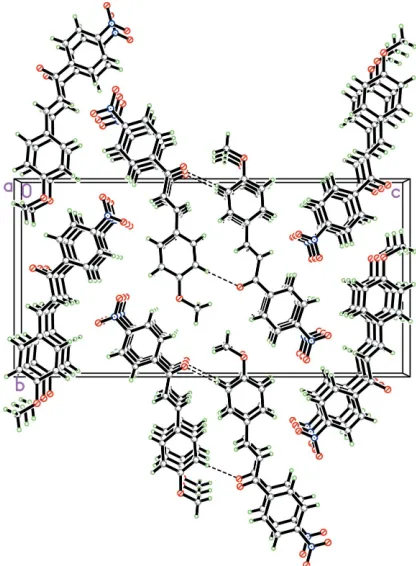
inter-molecular C—H O interactions form chains along theaaxis.
Comment
In the last two decades, much effort has been focused on the discovery of new organic materials which exhibit large non-linear optical (NLO) properties (Chemla & Zyss, 1987) and would thus have applications in the field of opto-electronics and photonics. In order to obtain second-order NLO single crystals, the main requirements are the choice of molecules with a large hyperpolarizability () and the alignment of these molecules in a non-centrosymmetric space group with optimal orientation in the crystal structure. Among the many known organic NLO materials, chalcone derivatives are interesting as they exhibit extremely high and fast non-linearity (Fichou et al., 1988; Uchidaet al., 1998; Gotoet al., 1991; Zhaoet al., 2000) and show a preference to crystallize as non-centrosymmetric structures. In this connection we synthesized the title compound, (I), as a potential second-order NLO material and, in order to obtain detailed information on its crystal structure, an X-ray crystal structure determination of (I) has been carried out.
The non-centrosymmetric space group of (I) is consistent with the non-zero SHG signal observed. Our measurements of the SHG conversion efficiency of (I) show that it is five times that of urea.
attached at C3 is twisted away from the C1–C6 benzene ring, with torsion angles O1—N1—C3—C2 of 10.9 (2) and O2— N1—C3—C4 of 11.7 (2). Meanwhile, the methoxy group attached at C13 is coplanar with the C10–C15 benzene ring.
In the molecular structure of (I), each of the C5–H5A O3 and C9–H9A O3 interactions generates an S(5) ring motif (Bernsteinet al., 1995). The crystal structure is stabilized by C—H O interactions (Table 1), which form molecular chains along theaaxis (Fig. 2).
Experimental
Compound (I) was prepared by the condensation of 4-methoxy-benzaldehyde (0.01 mol) with 4-nitroacetophenone (0.01 mol) in ethanol (60 ml) in the presence of NaOH (5 ml, 30%). After stirring for 2 h, the contents of the flask were poured into ice-cold water, and the resulting crude solid was collected by filtration. The compound was dried and recrystallized from acetone. Crystals suitable for X-ray
diffraction study were grown by slow evaporation of an acetone solution. The SHG measurements were carried out by the classical powder technique (Kurtz & Perry, 1968) using a pulsed Nd:YAG laser (1.064mm, 10 ns, 5 mJ).
Crystal data
C16H13NO4
Mr= 283.27
Orthorhombic,P212121
a= 3.8765 (1) A˚
b= 12.9341 (2) A˚
c= 25.9060 (5) A˚
V= 1298.90 (5) A˚3
Z= 4
Dx= 1.449 Mg m
3
MoKradiation Cell parameters from 9254
reflections
= 1.8–30.0
= 0.11 mm1
T= 100.0 (1) K Block, yellow 0.790.420.17 mm
Data collection
Bruker SMART APEX2 CCD area-detector diffractometer
!scans
Absorption correction: multi-scan (SADABS; Bruker, 2005)
Tmin= 0.813,Tmax= 0.982
15897 measured reflections
2247 independent reflections 2164 reflections withI> 2(I)
Rint= 0.028
max= 30.0
h=5!5
k=18!18
l=35!35
Refinement
Refinement onF2
R[F2> 2(F2)] = 0.035
wR(F2) = 0.096
S= 1.06 2247 reflections 190 parameters
H-atom parameters constrained
w= 1/[2(F
o2) + (0.0585P)2
+ 0.3408P]
whereP= (Fo2+ 2Fc2)/3
(/)max= 0.001
max= 0.32 e A˚
3
min=0.22 e A˚
3
Table 1
Hydrogen-bond geometry (A˚ ,).
D—H A D—H H A D A D—H A
C5—H5 O3 0.93 2.42 2.746 (2) 100 C9—H9 O3 0.93 2.41 2.781 (2) 104 C12—H12 O3i
0.93 2.54 3.470 (2) 175
Symmetry code: (i)x1 2;yþ
1 2;zþ1.
H atoms were placed in calculated positions, with C—H distances of 0.93 or 0.96 A˚ . TheUiso(H) values were constrained to be 1.5Ueqof
the carrier atom for methyl H atoms and 1.2Ueqfor the remaining H
atoms. In the absence of significant anomalous dispersion effects, Friedel pairs were merged before the final refinement.
Data collection:APEX2(Bruker, 2005); cell refinement:APEX2; data reduction: SAINT (Bruker, 2005); program(s) used to solve structure: SHELXTL (Sheldrick, 1998); program(s) used to refine structure:SHELXTL; molecular graphics:SHELXTL; software used to prepare material for publication:SHELXTL,PARST(Nardelli, 1995) andPLATON(Spek, 2003).
The authors thank the Malaysian Government and Universiti Sains Malaysia for the Scientific Advancement Grant Allocation (SAGA) grant No.304/PFIZIK/653003/A118 and the USM short-term grant No. 304/PFIZIK/635028.
References
Allen, F. H., Kennard, O., Watson, D. G., Brammer, L., Orpen, A. G. & Taylor, R. (1987).J. Chem. Soc. Perkin Trans. 2, pp. S1–19.
organic papers
[image:2.610.46.295.72.168.2] [image:2.610.66.274.212.495.2]Acta Cryst.(2006). E62, o896–o898 Patilet al. C16H13NO4
o897
Figure 1
The structure of (I), showing 50% probability displacement ellipsoids and the atomic numbering. Dashed lines represent hydrogen bonds.
Figure 2
Bernstein, J., Davis, R. E., Shimoni, L. & Chang N.-L. (1995).Angew. Chem. Int. Ed. Engl.34, 1555–1573.
Bruker (2005).APEX2(Version 1.27),SAINTandSADABS. Bruker AXS Inc., Madison, Wisconsin, USA.
Chemla, D. S. & Zyss, J. (1987). Nonlinear Optical Properties of Organic Molecules & Crystals, Vol. 1 and 2. New York: Academic Press.
Fichou, D., Watanabe, T., Takeda, T., Miyata, S., Goto, Y. & Nakayama, M. (1988).Jpn J. Appl. Phys.27, L429–L430.
Goto, Y., Hayashi, A., Kimura, Y. & Nakayama, M. (1991).J. Cryst. Growth,
108, 688–698.
Kurtz, S. K. & Perry, T. T. (1968).J. Appl. Phys.39, 3798–3813. Nardelli, M. (1995).J. Appl. Cryst.28, 659.
Ng, S. L., Patil, P. S., Razak, I. A., Fun, H. -K. & Dharmaprakash, S. M. (2006).
Acta Cryst.E62, o893–o895.
Ravishankar, T., Chinnakali, K., Nanjundan, S., Selvam, P., Fun, H.-K. & Yu, X. -L. (2005).Acta Cryst.E61, o405–o407.
Sathiya Moorthi, S., Chinnakali, K., Nanjundan, S., Radhika, R., Fun, H.-K. & Yu, X.-L. (2005).Acta Cryst.E61, o480–o482.
Sathiya Moorthi, S., Chinnakali, K., Nanjundan, S., Santhi, R. & Fun, H.-K. (2005).Acta Cryst.E61, o3514–o3516.
Sathiya Moorthi, S., Chinnakali, K., Nanjundan, S., Unnithan, C. S., Fun, H.-K. & Yu, X.-L. (2005).Acta Cryst.E61, o483–o485.
Sheldrick, G. M. (1998).SHELXTL. Version 5.10. Bruker AXS Inc., Madison, Wisconsin, USA.
Spek, A. L. (2003).J. Appl. Cryst.36, 7–13.
Teh, J. B. J., Patil, P. S., Fun, H.-K. Razak, I. A., & Dharmaprakash, S. M. (2006).Acta Cryst.E62, o890–o892.
Uchida, T., Kozawa, K., Sakai, T., Aoki, M., Yoguchi, H., Abdureyim, A. & Watanebe, Y. (1998).Mol. Cryst. Liq. Cryst.314, 135–140.
Zhao, B., Lu, W.-Q., Zhou, Z.-H. & Wu, Y. (2000).J. Mater. Chem.10, 1513– 1517.
organic papers
supporting information
sup-1 Acta Cryst. (2006). E62, o896–o898
supporting information
Acta Cryst. (2006). E62, o896–o898 [https://doi.org/10.1107/S1600536806003564]
3-(4-Methoxyphenyl)-1-(4-nitrophenyl)prop-2-en-1-one
P. S. Patil, Jeannie Bee-Jan Teh, Hoong-Kun Fun, Ibrahim Abdul Razak and S. M. Dharmaprakash
3-(4-Methoxyphenyl)-1-(4-nitrophenyl)prop-2-en-1-one
Crystal data
C16H13NO4
Mr = 283.27
Orthorhombic, P212121
Hall symbol: P 2ac 2ab a = 3.8765 (1) Å b = 12.9341 (2) Å c = 25.9060 (5) Å V = 1298.90 (5) Å3
Z = 4
F(000) = 592 Dx = 1.449 Mg m−3
Mo Kα radiation, λ = 0.71073 Å Cell parameters from 9254 reflections θ = 1.8–30.0°
µ = 0.11 mm−1
T = 100 K Block, yellow
0.79 × 0.42 × 0.17 mm
Data collection
Bruker SMART APEX2 CCD area-detector diffractometer
Radiation source: fine-focus sealed tube Graphite monochromator
Detector resolution: 8.33 pixels mm-1
ω scans
Absorption correction: multi-scan (SADABS; Bruker, 2005) Tmin = 0.813, Tmax = 0.982
15897 measured reflections 2247 independent reflections 2164 reflections with I > 2σ(I) Rint = 0.028
θmax = 30.0°, θmin = 1.8°
h = −5→5 k = −18→18 l = −35→35
Refinement
Refinement on F2
Least-squares matrix: full R[F2 > 2σ(F2)] = 0.035
wR(F2) = 0.096
S = 1.06 2247 reflections 190 parameters 0 restraints
Primary atom site location: structure-invariant direct methods
Secondary atom site location: difference Fourier map
Hydrogen site location: inferred from neighbouring sites
H-atom parameters constrained w = 1/[σ2(F
o2) + (0.0585P)2 + 0.3408P]
where P = (Fo2 + 2Fc2)/3
(Δ/σ)max = 0.001
Δρmax = 0.32 e Å−3
Δρmin = −0.22 e Å−3
Special details
supporting information
sup-2 Acta Cryst. (2006). E62, o896–o898
Refinement. Refinement of F2 against ALL reflections. The weighted R-factor wR and goodness of fit S are based on F2,
conventional R-factors R are based on F, with F set to zero for negative F2. The threshold expression of F2 > σ(F2) is used
only for calculating R-factors(gt) etc. and is not relevant to the choice of reflections for refinement. R-factors based on F2
are statistically about twice as large as those based on F, and R- factors based on ALL data will be even larger.
Fractional atomic coordinates and isotropic or equivalent isotropic displacement parameters (Å2)
x y z Uiso*/Ueq
O1 0.6403 (4) −0.27796 (9) 0.22026 (4) 0.0251 (3)
O2 0.4397 (5) −0.39845 (8) 0.27006 (5) 0.0376 (4)
O3 −0.3158 (3) −0.04627 (8) 0.42950 (4) 0.0194 (2)
O4 −0.3233 (3) 0.60111 (7) 0.41986 (4) 0.0189 (2)
N1 0.4760 (4) −0.30697 (9) 0.25816 (5) 0.0199 (3)
C1 0.1437 (4) −0.05452 (10) 0.30714 (5) 0.0159 (3)
H1 0.1280 0.0141 0.2967 0.019*
C2 0.2986 (4) −0.12702 (10) 0.27478 (5) 0.0165 (3)
H2 0.3894 −0.1077 0.2430 0.020*
C3 0.3133 (4) −0.22904 (10) 0.29147 (5) 0.0155 (3)
C4 0.1855 (5) −0.26107 (10) 0.33886 (5) 0.0179 (3)
H4 0.1999 −0.3299 0.3491 0.022*
C5 0.0361 (4) −0.18755 (10) 0.37044 (5) 0.0173 (3)
H5 −0.0500 −0.2072 0.4025 0.021*
C6 0.0119 (4) −0.08409 (10) 0.35511 (5) 0.0142 (3)
C7 −0.1647 (4) −0.01081 (10) 0.39167 (5) 0.0150 (3)
C8 −0.1495 (4) 0.10163 (10) 0.38147 (5) 0.0161 (3)
H8 −0.0253 0.1272 0.3535 0.019*
C9 −0.3188 (4) 0.16629 (10) 0.41335 (5) 0.0154 (3)
H9 −0.4474 0.1350 0.4393 0.018*
C10 −0.3266 (4) 0.27903 (10) 0.41244 (5) 0.0147 (3)
C11 −0.4791 (4) 0.32974 (10) 0.45424 (5) 0.0156 (3)
H11 −0.5821 0.2903 0.4800 0.019*
C12 −0.4829 (4) 0.43672 (10) 0.45886 (5) 0.0159 (3)
H12 −0.5812 0.4685 0.4875 0.019*
C13 −0.3360 (4) 0.49509 (10) 0.41952 (5) 0.0152 (3)
C14 −0.1888 (4) 0.44696 (10) 0.37629 (5) 0.0169 (3)
H14 −0.0966 0.4868 0.3498 0.020*
C15 −0.1805 (4) 0.34024 (10) 0.37303 (5) 0.0165 (3)
H15 −0.0780 0.3086 0.3447 0.020*
C16 −0.4742 (5) 0.65134 (11) 0.46364 (6) 0.0210 (3)
H16C −0.4514 0.7249 0.4600 0.032*
H16A −0.3583 0.6293 0.4945 0.032*
H16B −0.7142 0.6335 0.4658 0.032*
Atomic displacement parameters (Å2)
U11 U22 U33 U12 U13 U23
supporting information
sup-3 Acta Cryst. (2006). E62, o896–o898
O3 0.0238 (6) 0.0180 (4) 0.0163 (4) −0.0009 (5) 0.0034 (5) −0.0002 (3) O4 0.0245 (6) 0.0132 (4) 0.0190 (5) 0.0006 (5) 0.0037 (5) −0.0012 (3) N1 0.0226 (6) 0.0179 (5) 0.0191 (6) 0.0016 (6) 0.0007 (6) −0.0037 (4) C1 0.0192 (7) 0.0132 (5) 0.0153 (6) −0.0003 (6) 0.0000 (6) 0.0008 (4) C2 0.0194 (7) 0.0159 (5) 0.0142 (5) −0.0011 (6) 0.0012 (6) −0.0004 (4) C3 0.0156 (6) 0.0140 (5) 0.0167 (6) −0.0004 (6) −0.0003 (6) −0.0032 (4) C4 0.0210 (7) 0.0134 (5) 0.0194 (6) −0.0003 (6) 0.0009 (6) 0.0007 (5) C5 0.0209 (7) 0.0157 (5) 0.0154 (6) −0.0003 (6) 0.0022 (6) 0.0016 (4) C6 0.0132 (6) 0.0138 (5) 0.0155 (5) −0.0005 (5) −0.0016 (5) −0.0005 (4) C7 0.0152 (6) 0.0152 (5) 0.0147 (6) −0.0003 (6) −0.0015 (6) −0.0012 (4) C8 0.0173 (7) 0.0144 (5) 0.0165 (6) 0.0003 (6) 0.0003 (5) 0.0006 (4) C9 0.0149 (6) 0.0161 (5) 0.0150 (6) 0.0002 (6) −0.0011 (6) 0.0002 (4) C10 0.0134 (6) 0.0152 (5) 0.0155 (6) 0.0012 (6) −0.0013 (6) −0.0007 (4) C11 0.0155 (6) 0.0162 (5) 0.0151 (6) 0.0012 (6) 0.0012 (6) 0.0011 (4) C12 0.0163 (6) 0.0171 (6) 0.0143 (5) 0.0017 (6) 0.0010 (6) −0.0015 (4) C13 0.0156 (6) 0.0139 (5) 0.0163 (6) 0.0009 (6) −0.0009 (6) −0.0005 (4) C14 0.0189 (7) 0.0165 (5) 0.0152 (6) −0.0002 (6) 0.0020 (6) 0.0012 (4) C15 0.0175 (6) 0.0175 (6) 0.0145 (6) 0.0018 (6) 0.0006 (6) −0.0010 (4) C16 0.0233 (8) 0.0167 (6) 0.0232 (6) −0.0005 (7) 0.0051 (7) −0.0042 (5)
Geometric parameters (Å, º)
O1—N1 1.2292 (18) C8—C9 1.346 (2)
O2—N1 1.2307 (16) C8—H8 0.93
O3—C7 1.2304 (18) C9—C10 1.4587 (17)
O4—C13 1.3722 (15) C9—H9 0.93
O4—C16 1.4320 (17) C10—C11 1.3972 (18)
N1—C3 1.4690 (18) C10—C15 1.4106 (19)
C1—C2 1.3939 (19) C11—C12 1.3889 (17)
C1—C6 1.3969 (18) C11—H11 0.93
C1—H1 0.93 C12—C13 1.3903 (19)
C2—C3 1.3898 (18) C12—H12 0.93
C2—H2 0.93 C13—C14 1.4028 (19)
C3—C4 1.387 (2) C14—C15 1.3833 (18)
C4—C5 1.382 (2) C14—H14 0.93
C4—H4 0.93 C15—H15 0.93
C5—C6 1.3990 (17) C16—H16C 0.96
C5—H5 0.93 C16—H16A 0.96
C6—C7 1.5048 (19) C16—H16B 0.96
C7—C8 1.4793 (18)
C13—O4—C16 116.35 (11) C8—C9—C10 128.41 (14)
O1—N1—O2 123.56 (13) C8—C9—H9 115.8
O1—N1—C3 118.83 (12) C10—C9—H9 115.8
O2—N1—C3 117.61 (13) C11—C10—C15 117.86 (12)
C2—C1—C6 120.56 (12) C11—C10—C9 117.74 (12)
C2—C1—H1 119.7 C15—C10—C9 124.36 (13)
supporting information
sup-4 Acta Cryst. (2006). E62, o896–o898
C3—C2—C1 117.99 (13) C12—C11—H11 118.7
C3—C2—H2 121.0 C10—C11—H11 118.7
C1—C2—H2 121.0 C11—C12—C13 118.26 (13)
C4—C3—C2 122.97 (13) C11—C12—H12 120.9
C4—C3—N1 117.92 (12) C13—C12—H12 120.9
C2—C3—N1 119.10 (12) O4—C13—C12 123.55 (12)
C5—C4—C3 117.92 (12) O4—C13—C14 115.72 (12)
C5—C4—H4 121.0 C12—C13—C14 120.73 (12)
C3—C4—H4 121.0 C15—C14—C13 120.07 (13)
C4—C5—C6 121.22 (13) C15—C14—H14 120.0
C4—C5—H5 119.4 C13—C14—H14 120.0
C6—C5—H5 119.4 C14—C15—C10 120.43 (13)
C1—C6—C5 119.34 (12) C14—C15—H15 119.8
C1—C6—C7 123.64 (11) C10—C15—H15 119.8
C5—C6—C7 117.02 (12) O4—C16—H16C 109.5
O3—C7—C8 121.86 (13) O4—C16—H16A 109.5
O3—C7—C6 118.89 (12) H16C—C16—H16A 109.5
C8—C7—C6 119.25 (12) O4—C16—H16B 109.5
C9—C8—C7 118.80 (13) H16C—C16—H16B 109.5
C9—C8—H8 120.6 H16A—C16—H16B 109.5
C7—C8—H8 120.6
C6—C1—C2—C3 0.8 (2) O3—C7—C8—C9 −2.9 (2)
C1—C2—C3—C4 −0.9 (2) C6—C7—C8—C9 177.61 (14)
C1—C2—C3—N1 −179.86 (14) C7—C8—C9—C10 176.69 (16)
O1—N1—C3—C4 −168.12 (15) C8—C9—C10—C11 −170.57 (16)
O2—N1—C3—C4 11.7 (2) C8—C9—C10—C15 7.2 (3)
O1—N1—C3—C2 10.9 (2) C15—C10—C11—C12 −1.8 (2)
O2—N1—C3—C2 −169.24 (17) C9—C10—C11—C12 176.15 (16)
C2—C3—C4—C5 0.3 (3) C10—C11—C12—C13 1.6 (3)
N1—C3—C4—C5 179.28 (15) C16—O4—C13—C12 −0.4 (2)
C3—C4—C5—C6 0.4 (2) C16—O4—C13—C14 179.69 (14)
C2—C1—C6—C5 −0.1 (2) C11—C12—C13—O4 −179.77 (16)
C2—C1—C6—C7 −178.79 (15) C11—C12—C13—C14 0.2 (2)
C4—C5—C6—C1 −0.5 (2) O4—C13—C14—C15 178.26 (16)
C4—C5—C6—C7 178.26 (15) C12—C13—C14—C15 −1.7 (3)
C1—C6—C7—O3 169.65 (15) C13—C14—C15—C10 1.5 (3)
C5—C6—C7—O3 −9.1 (2) C11—C10—C15—C14 0.2 (2)
C1—C6—C7—C8 −10.9 (2) C9—C10—C15—C14 −177.57 (16)
C5—C6—C7—C8 170.42 (15)
Hydrogen-bond geometry (Å, º)
D—H···A D—H H···A D···A D—H···A
supporting information
sup-5 Acta Cryst. (2006). E62, o896–o898
C9—H9···O3 0.93 2.41 2.781 (2) 104
C12—H12···O3i 0.93 2.54 3.470 (2) 175