Linear Equalization Combined with Multiple Symbol
Decision Feedback Detection for Differential
Space-Time Modulation
Genyuan Wang
Department of Electrical and Computer Engineering, University of Delaware, Newark, DE 19716, USA Email: [email protected]
Aijun Song
Department of Electrical and Computer Engineering, University of Delaware, Newark, DE 19716, USA Email: [email protected]
Xiang-Gen Xia
Department of Electrical and Computer Engineering, University of Delaware, Newark, DE 19716, USA Email: [email protected]
Received 30 May 2001 and in revised form 19 February 2002
Differential space-time modulation (DSTM) for multiple antenna communication systems has been recently proposed for frequency-nonselective fading channels. In broadband multirate systems, frequency-selective fading may occur. In this paper, the DSTM in frequency-selective fading channels is considered. A linear equalizer for the DSTM is proposed over frequency-selective fading channels. Furthermore, the multiple symbol decision feedback detection is used to improve the performance of the linear equalizer.
Keywords and phrases:differential space-time modulation, transmit diversity, decision feedback detection, MIMO, linear equal-ization, RLS.
1. INTRODUCTION
Differential space-time modulation (DSTM) has been re-cently proposed by Hochwald and Sweldens [1], Hughes [2], and Tarokh and Jafarkhani [3] for multiple antenna com-munication systems, where the channel information is not known to the transmitters or receivers. Several unitary space-time codes for the DSTM have been proposed in [1, 2] of group codes, in [2, 4] of quaternion codes, and in [5] of fixed-point free group codes, and in [6] of parametric codes. The 2×2 parametric codes obtained in [6] for two transmit an-tennas have the largest possible diversity product of size five and the largest known diversity product of size sixteen, which will be used in the simulations in this paper later.
Space-time coded multiple antenna systems can be casted as multiple input and multiple output (MIMO) systems. The recent studies of DSTM in [1, 2, 3] are on frequency-nonselective fading channels where MIMO channel matrices do not have memory. However, in broadband multirate sys-tems, frequency-selective fading and frequency-nonselective fading may co-exist. In this paper, we are interested in the
DSTM system when frequency-selective fading occurs. An equalizer combined with the differential detection is pro-posed by exploiting the structure of the DSTM and its diff er-ential detection. The equalizer is to minimize the detection errors. In such an equalizer, not only the channels are of ma-trix form but also the input signals and the output signals are of matrix form too. Similar to the existing MIMO equaliza-tion techniques in the literature, see for example [7, 8], the least squares (LS) solution and an adaptive RLS algorithm are derived. As a remark, equalizations of space-time trellis coded multi-antenna systems over frequency-selective fading channels have been considered in [9, 10].
The DSTM can be treated as a generalization of diff eren-tial phase shift keying (DPSK). Thus, its differential detection scheme is similar to that of DPSK [1]. Decision feedback de-tection schemes have been used to improve the performance for the DPSK systems in [11]. In this paper, we also general-ize this idea to the equalgeneral-izer for the DSTM system by incor-porating the multiple symbol decision feedback detection in the linear equalizer.
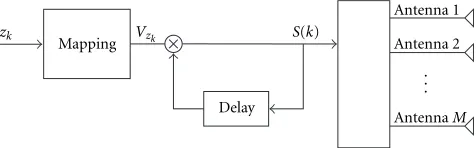
space-zk Vzk S(k)
Figure1: The transmission scheme of differential space-time mod-ulation with multiple antennas.
time modulation is briefly reviewed with the frequency-selective fading channel model in Section 2. The equalization scheme is presented under the LS criterion and the equalizer combined with the multiple symbol decision feedback detec-tion is presented in Secdetec-tion 3. In Secdetec-tion 4, the RLS algorithm is derived. Simulation results and conclusions are given in Sections 5 and 6, respectively.
2. DIFFERENTIAL SPACE-TIME MODULATION AND SIGNAL MODEL
Figure 1 shows the transmission scheme of differential space-time modulation. Suppose there areM transmit,N receive antennas in a frequency-selective fading environment. The transmission rate isRtbits per channel use.
An information sequence is grouped as zk and then
mapped toVzk,Vzk ∈ {Vl, l= 0,1, . . . , L−1}, a space-time
code, whereL = 2MRt andLis the signal constellation size.
Using the differential modulation technique (similar to the single antenna system), the transmit signal of thekth block is
sm,tis the transmitted signal on themth transmit antenna at
time tandS(0) is theM ×M identity matrix. SinceVzk is
a unitary matrix,S(k) is also unitary. Thus, the mean signal power at timetis always unit, that is,
E
On thenth receive antenna at timet, the received signal is
xn,t= ρ
tween themth transmit and thenth receive antennas at time
t,wn,tis the additive noise on thenth receive antenna at time t,Lhis the largest delay spread of all channels, andρis the
signal-to-noise ratio (SNR) on the receive antennas. For the energy normalization purpose, the channels are passive as in [9], that is,
Lh−1
d=0
hn,m(t, d)2
=1. (5)
It is assumed thatwn,tis complex Gaussian white noise with
zero mean and unit variance, that is,wn,t∼CN(0,1) andwn,t
is independent of each other with respect to bothnandt. As in [1, 2, 3, 4, 5, 6],hn,m(t, d) is assumed independent of each
other with respect tomand tonbut correlated with respect tot. When the fading is slow, the channel coefficients can be taken as constant over a period of time, coherence time. Thus hn,m(t, d) can be represented byhn,m(d) within the coherence
time. Therefore, (4) can be written in the following matrix form:
When channel matrix is approximately constant during the transmission of two blocks of data, (8) can be rewritten as
X(k)= ρHS(k−1)Vzk+W(k) (9)
=X(k−1)−W(k−1)Vzk+W(k) (10)
=X(k−1)Vzk+W(k), (11)
whereW(k)=W(k)−W(k−1)Vzk. AsVzkis unitary, the
ad-ditive noiseW(k) is still independent Gaussian. Therefore, the maximum-likelihood detector [1, 2] for (11) is
Vzk=arg min
l=0,1,...,L−1
whereAis the Frobenius norm ofA=(amn)M×N, defined
as
A=
TrAHA=
M
m=1
N
n=1
amn2 1/2
. (13)
3. EQUALIZATION OF DIFFERENTIAL SPACE-TIME MODULATED SYSTEM
In broadband multirate wireless communication links, the assumption of delay spread Lh = 1 does not always hold.
When multipaths exist, equalization techniques are needed to compensate the intersymbol interference (ISI). In the sin-gle antenna case, the linear equalizer works as a filter to sup-press the ISI term. The scalar coefficients of the equalizer are the parameters of the filter. In the multiple transmit antenna system, such coefficients are matrices. The input and the out-put are also matrices. The structure of the equalization is shown in Figure 2.
Therefore, the output of such equalizer is
Q(k)=
Le−1
ν=0
cνX(k−ν) (14)
=Gk0Sk−k0+
Lh+Le−2
ν=0,ν=k0
GνS(k−ν) +
Le−1
ν=0
cνW(k−ν),
(15)
wherecν,ν=0,1, . . . , Le−1, areN×Ncoefficient matrices
for equalization, andLeis the length of the equalizer,
Gν=
Le−1
µ=0
cµH(ν−µ) (16)
is the equivalent linear transform of the cascade of the chan-nel and the equalizer, andk0is the overall delay caused by the linear transformGν.
After equalization, the ISI item, that is, the second item in (15), is compensated. So
Q(k)=Gk0Sk−k0+
Le−1
ν=0
cνW(k−ν). (17)
Therefore, (12) can be applied to (17). That is,
ˆ
Vzk−k0=argl=0min,1,...,L−1Q(k)−Q(k−1)Vzl. (18)
As in the DPSK with single antenna [11, 12],Q(k−1) can be substituted by
Qref(k)= 1 Ln−1
Ln−1
j=1
Q(k−j) 1
i=j−1
ˆ
Vzk−k0−i, (19)
Qref(k)
cν Vˆ(k)
Σ
X(k) Q(k)
Decision
Figure2: Block diagram of receiver combining linear equalization with multiple symbol feedback detection for differential space-time modulation.
where feedback orderLn is the number of previous
equal-ization outputs used in the decision. If Ln = 2,Qref(k) = Q(k−1). In (19), each item in the summation is the esti-mation ofQ(k−1).Qref(k) is the average ofLn−1 estimated
values ofQ(k−1) and therefore less noisy. Therefore, when Ln>2, performance improvement can be obtained. Thus the
detector turns into
ˆ
Vzk−k0 =argl=0min,1,...,L−1Q(k)−Qref(k)Vzl. (20)
The equalizer is to minimize the error e(k) = Q(k)− Qref(k)Vzk. In the system, the cost function is defined as in
[13],
ψ(k)=
k
τ=1
λk−τe(τ)2, (21)
whereλis the forgetting factor. Under the LS criterion, the equalization coefficient matricescν,ν=0,1, . . . , Le−1 can be
obtained. With the obtained equalizer coefficients, the detec-tor (20) can be applied with the equalization outputQ(k−j),
j=0,1, . . . , Ln−1.
4. RLS ALGORITHM FOR DIFFERENTIAL SPACE-TIME MODULATED SYSTEM
In the forms of (14), (15), and (16) in Section 3, the chan-nels, the input and output signals are of matrix forms. Simi-lar to the existing equalization techniques for MIMO systems [7, 8, 14], we can derive the LS solution and the RLS solution for differential space-time modulated systems as follows.
Letcil
ν,xil(k) denotei, jth element of matrixcνandX(k),
respectively, then
cil=cil
0 c1il · · · cilLe−1
H ,
xil(k)=xil(k) xil(k−1) · · · xl jk−L
e+ 1T,
(22)
where the superscript H denotes the complex conjugate transpose, andT denotes the transpose. Equation (14) can be written in matrix form
where
ThereforeC, which minimizesψ(k), can be obtained by differentiatingψ(k) in (21) and setting the result to be the zero matrix, that is,
φ(k)C=ϕ(k), (26) conventional normal equation [13]. Using thematrix inver-sion lemma[13], an iterative algorithm for (26) can be ob-tained. Hence, the RLS algorithm for the space-time modu-lation with multiple antennas is as follows:
P(0)=σ−1ILe×N, σ=0.004, (28) RLS algorithm in [13]. From (25), (23), (19), (31), and (32), C(0) should have a nonzero value. In the following simula-tions, all the elements ofck0are set to 0.1, that is,c
i j
k0 =0.1,
i, j = 1,2, . . . , N. For fixed channels,λcan be set to 1 and ˆ
Vzk−k0 are assumed known in the training. After the training,
the detector in (20) is applied. ˆVzk−k0is the previous detection
result, to which the multiple symbol decision feedback de-tection refers. For the fading channels,λcan be set to a value less than 1. Thus, the receiver can track the variation of the channels.
5. SIMULATION RESULTS
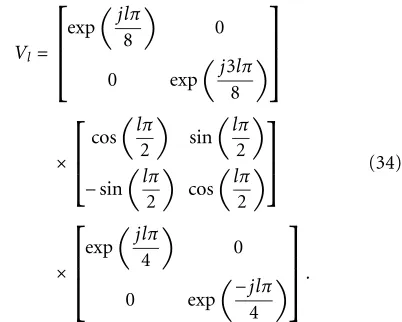
In this section, the performance of the equalization scheme for differential space-time modulated system is shown with simulations. In the following simulations, parametric space-time code of size 16 in [6] is adopted. For l = 0,1, . . . ,15,
This code has the best known product diversity in the lit-erature of the same size, which is 21/4/2 following the nota-tion in [1]. Although this code itself is not a group, it is a subset of a group of size 32 [6]. Using this space-time code, the number of transmit antennas isM=2 and the transmis-sion data rate isRt=2. The number of receive antennas is set
as 2, that is,N =2. The channel delay spreadLh =2 is used
throughout the simulations.
The simulation results are given under two cases, fixed channels and fading channels. In the fixed channel case, the two taps of a channel have equal power as the channels stud-ied in [9]. Figure 3 shows the learning curve of the RLS al-gorithm for differential space-time modulation. The length of equalizerLe =3. An information sequence of about 300
symbols known to the receiver is used in the training.J(k)=
Ee(k)2. The curves are drawn from the average over 1000 training processes. The forgetting factorλ=1.0. The overall delayk0is set to zero. Though the convergence processes do not speed up remarkably, the errors under concern decrease as the increase ofLn, the feedback order.
The performances of different receivers are shown in Figure 4. Because the energy of first taps and that of the sec-ond taps are the same, the ratio of the desired signals to the interference part is 0 dB when no equalization techniques is used. In this case, the performance is not good (BLER is above 10−1) whatever SNR is. Thus, this case is not shown in Figure 4. From Figure 4 one can see that the increase of the feedback orderLnimproves the performance, especially
in the high SNR. However, the increase ofLnalso means the
increase of the computational complexity.
102
101
10−1
100
0 20 40 60 80 100 120 140 160 180 200 K
J
(
k
)
Ln=2 Ln=3
Ln=5 Ln=10
Figure 3: Learning curves of the RLS algorithm for space-time modulation with differentLn.
10−4
10−3
10−2
10−1
100
8 10 12 14 16 18 20 22
SNR
Blo
ck
er
ror
ra
te
Ln=2 Ln=3
Ln=5 Ln=10
Figure4: The block error rate of space-time modulated system un-der fixed ISI channels.
system, the carrier frequency is 900 MHz. If a basic GSM EDGE slot structure with symbol rate of 2.71×10⁵symbols/s is used and the speed of mobile station is 3 km/h (TU3), the fading rate fdTsis 10−5, which is assumed in the simulation.
The average energy for the first taps of the channels is 9/10 of the total energy. The length of the equalizerLe=3. Before
the fading applied, 800 symbols are used in training. After training,λis set as 0.98. The curve marked by◦in Figure 5 is the performance without equalization, which has an error floor around BLER of 10−1. It is shown that the receiver with Ln > 2 still has a better performance over the receiver with Ln=2. However, the receiver withLn=10 has approximately
the same BLER with the receiver withLn=5. The reason lies
10−4
10−3
10−2
10−1
100
12 14 16 18 20 22 24 26 28 30
SNR
Blo
ck
er
ror
ra
te
Without equalizer Ln=2
Ln=3
Ln=5 Ln=10
Figure 5: The block error rate of space-time modulation with equalization under frequency selective fading environment, fdTs= 10−5.
is that (18) does not give a better estimation ofQ(k−1) due to the fading of the channel.
6. CONCLUSIONS
In the paper, an equalizer combined with differential detec-tion was proposed for the differential space-time modulated system over frequency selective fading channels. By applying the LS criterion on the detection error, the RLS algorithm was derived. Also the multiple symbol decision feedback de-tection was incorporated to improve the performance of the combined equalizer and detector. The performance was illus-trated by simulations. After this paper was done, we found a related and independent work [16].
ACKNOWLEDGMENTS
This work was supported in part by the Air Force Office of Scientific Research (AFOSR) under Grant F49620-00-1-0086 and the National Science Foundation (NSF) Grants MIP-9703377 and CCR-0097240.
REFERENCES
[1] B. M. Hochwald and W. Sweldens, “Differential unitary space-time modulation,” IEEE Trans. Communications, vol. 48, no. 12, pp. 2041–2052, 2000.
[2] B. L. Hughes, “Differential space-time modulation,” IEEE Transactions on Information Theory, vol. 46, no. 7, pp. 2567– 2578, 2000.
[3] V. Tarokh and H. Jafarkhani, “A differential detection scheme for transmit diversity,”IEEE Journal on Selected Areas in Com-munications, vol. 18, no. 7, pp. 1169–1174, 2000.
[5] A. Shokrollahi, B. Hassibi, B. M. Hochwald, and W. Sweldens, “Representation theory for high-rate multiple-antenna code design,”IEEE Transactions on Information Theory, vol. 47, no. 6, pp. 2335–2367, 2000.
[6] X.-B. Liang and X.-G. Xia, “Unitary signal constellations for differential space-time modulation with two transmit anten-nas: Parametric codes, optimal designs, and bounds,” to ap-pear inIEEE Transactions on Information Theory.
[7] N. Al-Dhahir and A. H. Sayed, “The finite-length multi-input multi-output MMSE-DFE,”IEEE Trans. Signal Processing, vol. 48, no. 10, pp. 2921–2936, 2000.
[8] A. Duel-Hallen, “Equalizers for multiple input/output chan-nels and PAM systems with cyclostationary input sequences,” IEEE Journal on Selected Areas in Communications, vol. 10, no. 3, pp. 630–639, 1992.
[9] G. Bauch, A. F. Naguib, and N. Seshadri, “MAP equalization of space-time coded signals over frequency selective chan-nels,” inProc. Wireless Communications and Networking Con-ference, New Orleans, La, USA, September 1999.
[10] A. F. Naguib, “Equalization of transmit diversity space-time coded signals,” inIEEE Globecom 2000, pp. 1077–1082, San Francisco, Calif, USA, December 1999.
[11] R. Schober, W. H. Gerstacker, and J. B. Huber, “Adaptive linear equalization combined with noncoherent detection for MDPSK signals,”IEEE Trans. Communications, vol. 48, no. 5, pp. 733–738, 2000.
[12] F. Edbauer, “Bit error rate of binary and quaternary DPSK signals with multiple differential feedback detection,” IEEE Trans. Communications, vol. 40, no. 3, pp. 457–460, 1992. [13] S. Haykin, Adaptive Filter Theory, Prentice-Hall, Upper
Sad-dle River, NJ, USA, 3rd edition, 1996.
[14] T. Kailath, A. H. Sayed, and B. Hassibi, Linear Estimation, Prentice-Hall, Upper Saddle River, NJ, USA, 2000.
[15] G. L. Stuber, Principles of Mobile Communication, Kluwer Academic, Boston, Mass, USA, 2nd edition, 2001.
[16] Y. Liu and X. Wang, “Multiple-symbol decision-feedback space-time differential decoding in fading channels,” EURASIP Journal on Applied Signal Processing, vol. 2002, no. 3, pp. 297–304, 2002, Special Issue on Space-Time Coding and Its Applications—Part I.
Genyuan Wangreceived his B.S. and M.S. degrees in mathematics from Shaanxi Nor-mal University, Xi’an, China, in 1985 and 1988, respectively, and the Ph.D. degree in electrical engineering from Xidian Univer-sity, Xi’an China, in 1998. From July, 1988 to September 1994, he worked at Shaanxi Normal University as an Assistant Profes-sor and then an Associate ProfesProfes-sor. From September 1994 to May 1998, he worked at
Xidian University as a Research Assistant. Currently, he is Post-Doctoral Fellow at the Department of Electrical and Computer Engineering, University of Delaware, USA. His research interests include radar imaging and radar signal processing, adaptive filter, OFDM system, channel equalization, and coding theory.
Aijun Songreceived his B.S. and M.S. de-grees in electrical engineering in Xidian University, Xi’an, China, in 1997 and 2000, respectively. From 1997 to 2000, he was a Research Assistant with National Key Lab for Radar Signal Processing in Xidian Uni-versity, Xi’an, China. Since 2000, he has been a Research Assistant with the Depart-ment of Electrical and Computer Engineer-ing, University of Delaware, USA. His
gen-eral interests include space-time coding techniques and multicar-rier modulations in communications.
Xiang-Gen Xiareceived his B.S. degree in mathematics from Nanjing Normal Uni-versity, Nanjing, China, his M.S. degree in mathematics from Nankai University, Tian-jin, China, and his Ph.D. degree in electrical engineering from the University of South-ern California, Los Angeles, USA in 1983, 1986, and 1992, respectively. He was a Lec-turer at Nankai University, China during 1986–1988, a Teaching Assistant at