Abstract— This research shows the process and conversion of water vapour/ humid from the ambient air into a useable and safe drinking water. A custom built inline condenser and evaporator were connected to a filter, solar panel and a charging bay.
Water vapour is controlled to a dew point resulting in increased sensitivity. Through laboratory testing of the water collected , the optimal total coliform were determined to be less than 1.1, the fecal coliform and Heterotrophic Plate Count (HPC) is to be less than 1.1 and 0 respectfully. The Ultra Violet filter was installed after the first examination of water that attained its optimal result. The mean volume for the working period was 23 liters in 24 working hours and will be producing 22 – 23 liters of water in 24 intermittent working hours. The electric recharging point is accessible to the system, the Inverter and Panel is accustomed to be 1000 watts and 150 watts to suit the loads, the controller and battery to be 12 volts.
Index Terms— Vapour, Atmospheric Water Generator, Dehumidifier, Water Conservation, Solar Power System
I. INTRODUCTION
ater is a necessity and shortages can be devastating. However, its value is not appreciated by all those who consume it. People want to drink water that is safe, free of impurities, and that has an acceptable taste. It’s a natural part of our existence: ensuring we have accessible, safe drinking water.
Life, both animals and plants, is impossible without water. Without water men die of dehydration because about
Manuscript received April 4, 2016. We would like to express our gratitude to National University – Manila for their continued support in this research study. To the NU College of Engineering (Dean E. F. Alabastro) and Electrical Engineering Department. In addition, we would also like to acknowledge the generosity of the following government offices for their generosity towards Filipino Researchers: Department of Science and Technology – Philippine Council for Industry, Energy and Emerging Technology Research and Development (DOST-PCIEERD) and Commission on Higher Education – Research Division (CHED-RD).
D. S. Fainsan is with the College of Engineering, National University, Sampaloc, Manila, 1008 PHL (e-mail: [email protected]).
J. A. Exito is with the College of Engineering, National University, Sampaloc, Manila, 1008 PHL (mobile: +63 905-784-2544; phone: 712-1900; e-mail: [email protected]).
J. D. Tabi was with the College of Engineering, National University, Sampaloc, Manila, 1008 PHL (e-mail: [email protected]).
J. S. Fainsan, J. F. Pedralvez, J. H. Calaycay, J. K. W. Dimapilis, E. L. Amboy, L. P. Tercenio, J. A. Rosas, D. L. Daquioag are alumni of College of Engineering, National University, Sampaloc, Manila, 1008 PHL.
70% of the human body is water. Of the total surface of the earth, 75 % is water and just below the surface of the land in most areas there is a saturated layer known as the water table. If there is no water, there can be no life. The moon is a sterile desert because there is no water in it. It is to be remembered that it was water that determined the location of human settlements and without the Nile the Egyptian Civilization would not have developed The Nile provided the Egyptians facilities for irrigation and transport. As Herodotus said, Egypt is the "Gift of the Nile". (Herodotus)
In rural areas that depend on groundwater wells, people should be concerned about sanitary hazards from nearby septic tanks and animal wastes in close proximity to the well, especially to those people who have been struck by tragedies. It may be hard for them to get fresh water unless the government will procure them limited bottled water, like in the case of Tawi-Tawi in the Philippines. The archipelago orientation of the country geographical location of the province is hard to be reached by the main water supply so the government can only provide bottled water.
Lanao del Sur, tagged as having the least access to safe water in 2008, got an allocation of P25 million for water supply projects in the five years covered by the study. That’s a mere a 4 percent of the total pork barrel of the province received in those years. Like in Tawi-Tawi, Lanao del Sur’s top pork barrel item is the financial assistance for programs that were unspecified in the available data. (Soriano, 2012)
An average of 3, 748, 788 people were affected by the disasters that have occurred between 1980 and 2010 and an average of economic damage per year was 239, 263. With these results we can conclude that these people may have lost their homes and other necessities, especially water. One significant disaster that hit the Philippines was the typhoon “Yolanda” with an international name Haiyan. It was a powerful tropical cyclone that devastated portions of Southeast Asia, particularly the Philippines, on November 8, 2013 (BBC News, 2013).
In fact it was so devastating that the death toll from Super Typhoon "Yolanda" climbed to 6,166 after the counting hit lull in the previous days, the National Disaster Risk Reduction and Management Council (NDRRMC) said (Bacani, 2014). With many casualties, the problem of a source in palatable and potable drinking water in affected areas aroused. There were some health issues were needed
The Development of Solar-Powered
Atmospheric Drinking Generator
with Charging Bay
Delia S. Fainsan, Jerome A. Exito, Jose Niño D. Tabi, Jeremiah S. Fainsan, Joshua F. Pedralvez, Jellie H. Calaycay, Jan Kamille W. Dimapilis, Edsel L. Amboy, Leslie P. Tercenio, Joshua A. Rosas,
Digel L. Daquioag, Members, IAENG
be considered in this kind of areas and situations. Thus, the researchers came up to an idea of integrating a device that provided a safe drinking water gathered from ambient air only and had a system that was power efficient that it had the ability to utilize solar energy as its power.
II. RELATED WORK
In the 1990s, as climate change moved in the public consciousness from an esoteric theory to a scientific fact, interest in solar returned, notably in Europe and to a lesser extent in the United States. In the 21st century, growing worries about an energy shortage on a planet voracious for power have added to the demands for solar energy. As Greenpeace points out, ―the market has grown by more than 40% a year for almost a decade and the industry is investing large sums to increase production facilities. The above summary is a bit simplistic, as, technically, humans have used solar power throughout history, notably as a source of light and, in the long run, as a source of pretty much everything, including our very planet. Situating and constructing buildings to best use the light that nature gives us every day is called passive solar. Buildings have long been positioned to take advantage of light and heat, for instance by having large south facing windows to allow plenty of sunlight. (Ayon, 2013)
Solar cells, which convert sunlight into electrical current, had their beginnings more than a hundred years ago, though early solar cells were too inefficient to be of much use. In April, 1954, researchers at Bell Laboratories demonstrated the first practical silicon solar cell.
The story of solar cells goes back to an early observation of the photovoltaic effect in 1839. French physicist Alexandre-Edmond Becquerel, son of physicist Antoine Cesar Becquerel and father of physicist Henri Becquerel, was working with metal electrodes in an electrolyte solution when he noticed that small electric currents were produced when the metals were exposed to light, but he couldn’t explain the effect. Solar cells today are used in all sorts of devices, from handheld calculators to rooftop solar panels. Improved designs and advanced materials have made it possible to build solar cells that reach over 40 percent efficiency, and research and development continues with the goal of bringing the cost down and raising the efficiency to make solar power more competitive with fossil fuels. (publications:apsnews, 2009)
A. The Economics of Solar Power
Without government subsidy, solar is not yet a competitive form of energy. Numerous sources agreed that currently, in direct competition with electricity generated from fossil fuels, solar cells almost always lose. (Debyshire, n.d.)
For the expansion of solar energy to be successful, solar advocates believe that as technology and economies of scale improve, solar will far outstrip fossil fuels in economic competitiveness. Solar advocates also point out that fossil fuels have long received government subsidies that the oil and natural gas industries received substantial government aid during their early histories and continue to receive tax breaks for exploration, favorable terms for drilling leases on government land, and so forth.
Because solar provides advantages that the economic laws of supply and demand, in a vacuum, do not account for, many governments choose to subsidize solar as a clean and renewable energy source. Conventional fossil fuels generate costs that the users do not pay for–what economists term externalities–that are shared by the wider community and may occur at a future time. (Zweibel, n.d.)
B. The Growth of Solar Energy
The promise of solar power is seductive in being clean, virtually free once the technology is in place, and seemingly limitless. The initial investment for solar power may be high but after a few years you have virtually recovered the investment and there after pay nothing for the resource. (Samath, n.d.)
C. Drinking Water Out of a Billboard
In Lima, Peru’s University of Engineering and Technology got the student’s attention before the opening for application for that period. Researchers at Lima’s University teamed up with an ad agency to set up the billboard that would advertise their university and recruit prospective applicants in this novel way. The capital, and its surrounding villages such as Bujama are located in the coastal deserts of Peru. In these places, there were many people suffering from the lack of clean and potable water.
The rain in this region is almost zero, but its atmospheric humidity is about 98%. The UTEC is stimulated and built the first billboard that produces drinking water out of thin air for residents of the desert city. Residents can use a faucet at the foot of the billboard to take what they need.
The billboard has inimitable technology that captures air’s humidity and turns it into drinking water. It goes to a reverse osmosis system right after it enrapture air humidity from the atmosphere. Each of their tank stores about 5.28 gallons of water. They have five generators that purify the liquid and store it in one tank. Their prototype has already produced 2, 496 42 gallons of water for the range of 3 months, it can provide hundreds of families per month. They could put it in several places for it to generate water. Peru's University of Engineering and Technology (2013)
Lima has nearly 8.5 million residents, making it one of the largest capitals in the world. Some portions of the city receive less than an inch of rain annually, though humidity in the coastal city often tops 90 percent. (Quilca, 2013)
Trying to inspire young people to pursue careers in engineering, the university and ad teams decided to show how technology can be used to solve local problems. One such problem in Lima is the lack of running water. Due to the extremely dry climate with an annual precipitation of less than 1 inch, most people draw water from wells that are often polluted. On the other hand, the atmospheric humidity in Lima approximates 98%. Keeping the needs of their community in mind, and using the context to their advantage, the two teams combined creativity and know how to come up with the first billboard in the world that produces drinking water out of air.
D. Atmospheric Drinking Generator (Water from air) The goal of the senior design project is to design and prototype an atmospheric water generator which produces drinkable water from ambient air. Special emphasis is given to energy efficiency and compatibility with renewable energy sources. This project is the culmination of the engineering program at Calvin College. It is conducted within the context of a two-semester course which covers all aspects of project development and management. The following report explores the feasibility of the proposed design as well as specifying components of the design.
After careful research and testing, Team 5 has concluded that wet desiccation is not a practical process for atmospheric water generation. The prototype works and is capable of producing 0.72 liters of water per day with significant potential for improvement. However, one of the metrics used to compare this unit to comparable units is the water per unit energy. Water from Air can produce 72.1 mL of water per kW-hr; Ecoloblue, a leading competitor, can produce 1031 mL of water per kW-hr. Given this factor of 10 differences, Team 5 has concluded that this design is impractical for atmospheric water generation. (Niewenhuis, 2012)
Another design describes an atmospheric potable water generator apparatus and method of use powered entirely by renewable energy sources, which generates water from atmospheric air. It uses solar energy to heat atmospheric air in a condensing air chamber, uses wind to cool the air, condense water on a cooling surface thereby creating potable water from atmospheric air. (Nowak, 2012)
E. LifeStraw
LifeStraw is a water filter designed to be used by one person to filter water so that they may safely drink it. It filters a maximum of 1000 liters of water, enough for one person for one year. It removes all waterborne bacteria and parasites. The LifeStraw Family, a larger unit designed for family use, also filters out nearly all microbes.
The LifeStraw is a plastic tube 310 mm long and 30 mm in diameter. Water that is drawn up through the straw first passes through hollow fibres that filter water particles down to 0.2 μm (micrometer) across, using only physical filtration methods and no chemicals. The entire process is powered by suction, similar to using a conventional drinking straw, and filters up to 1000 litres of water. While the initial model of the filter did not remove Giardia lamblia, LifeStraw removes a minimum of 99.9% of waterborne protozoan parasites including giardia and cryptosporidium.
LifeStraw has been generally praised for its effective and instant method of bacteria and protozoa removal and consumer acceptability. Paul Hetherington, of the charity WaterAid, has criticized the LifeStraw for being too expensive for the target market. He also points to other important problems linked with accessing the water in developing countries, which wait to be solved, but are not addressed by the device itself. LifeStraw has been praised in the international media and won several awards including the 2008 Saatchi & Saatchi Award for World Changing Ideas, the ‘INDEX: 2005’ International Design Award and "Best Invention of 2005" by Time Magazine (Time Magazine, 2005)
III. SYSTEM DESIGN
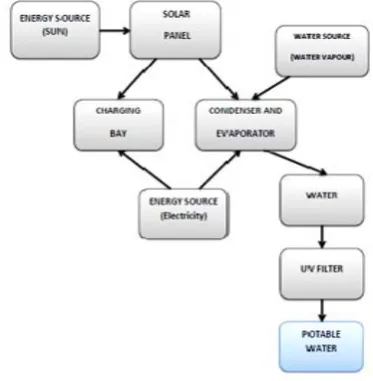
The conceptualize prototype consists of a condenser, evaporator and charging bay. They are regulated by an inverter which draws its power from either a power supply connected from an AC source or a 12 volt battery and a battery charger from which the Solar Panel is connected.
IV. IMPLEMENTATION
The design’s solar panel can only be aligned in 25 degrees and 45 degrees. Charging Bay can hold up to three phones. The rooms to be placed the prototype, ranges from 30 to 50 square meters. The condenser and evaporator would not operate as long as the reservoir is not properly intact or enough space to hold water. The system can be divided into two primary aspects: dehumidification and refrigeration, each of which is discussed below.
A. Dehumidification
When approaching the problem of atmospheric water generation it is clear that the heart of the system is dehumidification, which is the removal of water from a stream of air. In this application we seek to capture this water and utilize it for drinking purposes.
B. Refrigeration
The refrigeration cycle dehumidification is a prevalent method for generating water from atmospheric humidity. This method circulates air over cooling coils connected in a refrigeration cycle to bring the water in the air below its dew point. The dew point of the water is dependent on the vapor pressure and humidity and tends to be a relatively low temperature compared to the ambient conditions. To reach the dew point the air running through the unit will have to be cooled a considerable amount. This process requires a constant energy supply that is used as the maximum allowable energy demand for the system.
[image:3.595.334.521.133.324.2]The prototype can collect an average of 23.24 liters of water per day when powered by AC power supply and 23.30 liters of water per day when powered by solar power supply in Metro Manila. There is no significant difference to the collection of water if the system will be powered by solar source or by AC source.
The additional charging bay to the system can charged the gadget at the same time when using AC power system. The prototype was tested using different cellphones and level of charging. There is no significant difference to the time consumed in charging cellphone using AC power supply and using solar power supply.
Table 3 presents the result of the microbiological test of the sample water produced by the atmospheric drinking generator. The sample water is clear and directed from the reservoir. The UV Filter was connected to the system and the result shows that the total coliform is <1.1and the fecal coliform is also <1.1. The water therefore is safe for drinking purposes.
V. CONCLUSION
After testing in ideal conditions it was found that the design could produce an average of 23.30 liters of water in one day and the system operates at an average of 150 Watts. The result shows that the efficiency of collecting water using the prototype depends on the humidity in the ambient air where it is placed. After researching, designing, building, and testing the project design, the researchers have determined that it can be a practical method of water generation. Furthermore, the charging bay can charged the gadget similar to the required time of charging using AC power.
Determining the best location for the prototype will maximize the efficiency of the machine. Also, designing a new one for agricultural purposes will be encouraged.
ACKNOWLEDGMENT
We would like to thank all the people in the world for helping us to rise again after the typhoon Haiyan. We offer these all up to Him.
REFERENCES
[1] ASEAN Secretariat. (2005). Country Data Tables:State of Water Resources Management in the ASEAN. Thailand: ISBN: 0-643-09264-1. Retrieved March 20, 2014, from http://www.aseansec.org/awgwrm/State%20of%20Water%20Resou rces%20Man
[2] Ayon, M. (2013). Retrieved March 1, 2014, from http://www.studymode.com/profile/MahirAyon1-81920357/ [3] Bacani, L. (2014, January 3). Nation: Philstar. Retrieved from
Philstar Web site:
http://www.philstar.com/nation/2014/01/03/1274753/yolanda-death-toll-climbs-6166\
[4] BBC News. (2013, November 22). Asia: BBC News. Retrieved from A BBC News Web site:
http://www.bbc.com/news/world-asia-25051606
[5] Education&Training. (n.d.). Retrieved March 20, 2014, from United States Environmental
Protection Agency:
http://water.epa.gov/learn/kids/drinkingwater/watertreatmentproces s.cfm
[6] EMB. (2006). National Water Quality Status Report 2001 to 2005. Quezon City, Philippines.
Retrieved 20 March, 2014, from
http://www.emb.gov.ph/wqms/2001-2005%20NWQSR/NWQSR%20-%20%20%20Body.pdf
[7] Environmental Management Bureau. (2004). Philippine Country Assessment: Enforcement and Compliance Program. Quezon City, Philippines. Retrieved March 2014, 20, from http://www.inece.org/aecen/pdf/Assessment_Report_for_Philippine s_FINAL_7- 13-05.pdf
[8] Herodotus. (n.d.). An account of Egypt. Public Domain
[9] Kho, J., & Sano, E. A. (2005). Customary Water Laws & Practices TABLEI
ATMOSPHERIC DRINKING GENERATOR IN USING AC VS DC
Days of Observ
ation
Amount of Water Collected per Day Using AC Power Supply
Amount of Water Collected
per Day Using Solar Power
Supply
1 23.2 23.5
2 22.8 23.1
3 23.5 23
4 23.6 24
5 23.1 22.9
Mean 23.24 23.30
TABLEII
CHARGING A HANDSET USING AC VS USING DC
Cellphone Brand name
Level of Charging
Time Consumed in Charging Using AC Power
Supply
Time Consumed in Charging Using
Solar Power Supply
Samsung 20% 3 hrs 3 hrs
Nokia 10% 4 hrs 4 hrs
Sony 35% 2 hrs 2 hrs
TABLEIII
MICROBIOLOGICAL RESULT OF SAMPLE WATER FROM HUMIDIFIER
WITH UVFILTER
Manila Health Department Division of Public Health Laboratory 208 Quiricada St., Sta. Cruz, Quiapo, Manila, Philippines
Accreditation No. 065
Water from Dehumidifier with UV Filter
Official Receipt No. 2255615
Control Number 32
Laboratory Number 4282
Submitted by National University
Date of Collection December 17, 2014 Time of Collection 01:00 P.M.
Time Received 02:05 P.M
Physical Characteristics Clear
Results < 1.1 Total Coliform < 1.1 fecal Coliform None HPC
Passed
TABLEIV
MICROBIOLOGICAL RESULT OF SAMPLE WATER FROM HUMIDIFIER
WITHOUT UVFILTER
Manila Health Department Division of Public Health Laboratory 208 Quiricada St., Sta. Cruz, Quiapo, Manila, Philippines
Accreditation No. 065
Water from Dehumidifier with UV Filter
Official Receipt No. 2292590
Control Number 23
Laboratory Number 4080
Submitted by National University
Date of Collection November 27, 2014 Time of Collection 10:30 A.M.
Time Received 01:35 P.M.
Physical Characteristics Clear
Philippines. Retrieved March 20, 2014, from http://www.fao.org/legal/advserv/FAOIUCNcs/Philippines.pdf/en/ [10] National Water Sector Apex Body. (n.d.). Philippines Country
Paper. Retrieved March 20, 2014, from http://www.adb.org/Water/NWSAB/2004/Philippines_Country_Pap er.pdf
[11] Niewenhuis, B. S. (2012). Atmospheric Water Generator Water from air. Retrieved December 16, 2013from
http://www.calvin.edu/academic/engineering/2011-12-team5/downloads/Team_5_Design_Report.pdf
[12] Publications: apsnews. (2009, April). Retrieved March 20, 2014,
from APS Physics:
http://www.aps.org/publications/apsnews/200904/physicshistory.cf m
[13] Quilca. (2013). Miracles of Engineering in Peru: Drinking Water Out of a Billboard. Retrieved January 14, 2014, from Latin American Herald Tribune:
http://www.laht.com/article.asp?ArticleId
[14] Sabate, A. (2013, October 25). News. Retrieved from Fusion.net: http://fusion.net/abc_univision/news/story/billboard-turns-air-humidity-drinking-water-lima-peru-18230
[15] Soriano, J. (2012, July 27). Special Reports:In “waterless” Tawi-Tawi, water is nobody’s priority. Retrieved from GMA Network
Web site:
http://www.gmanetwork.com/news/story/267109/news/specialrepor ts/in-ldquo-waterless-rdquotawi-tawi-water-is-nobody-s-priority [16] World Health Organization. (2002). Philippines Environmental
Health Country. Philippines. Retrieved March 20, 2014, from http://www.wpro.who.int/NR/rdonlyres/368CD64E-E45D-47FDA5EC-881076EE143F/0/Philippines.pdf
[17] Wahlgren, R. V. (2014, October) Another Water Resource for Caribbean Countries: Water-from-Air. Paper presented at the
Caribbean
[18] Nowak, E. &Katz G. (2012) Renewable-Energy Based Atmospheric
Water Generator. From
http://www.freepatentsonline.com/y2014/0083120.html
ABOUT THE AUTHORS
DELIA S. FAINSAN is a registered
Electrical Engineer in the Philippines. She earned her Master of Science in Engineering Education and Doctor of Philosophy in Technology Education, both, at the Rizal Technological Institute. She is currently the Program Director for Electrical, Mechanical and
General Engineering at the College of Engineering, National University. She is also a Board of Director of the Mathematics Teacher Association of the Philippines and Academic Committee Member of the Institute of Integrated Electrical Engineers of the Philippines, Inc. (IIEE).
JEROME ASIA EXITO is a
registered Electrical Engineer in the Philippines. He is taking up Master of Engineering in Electrical Engineering (MEEE) major in Power Systems at the University of the Philippines – Diliman. His undergraduate degree, BSEE, was from National University –
Manila where he is currently a full-time Assistant Professor to the College of Engineering. Last 2014, he was awarded as the Most Outstanding Electrical Engineering Student of the Philippines by the Institute of Integrated Electrical Engineers of the Philippines, Inc. (IIEE). He is a member of the International Association of Engineers (IAENG).
JOSE NIŇO D. TABI is an Electronics and
Communications Engineer in the Philippines. He graduated in National University – Manila, earning his bachelor’s degree. He was the Program Director for Electronics and Computer Engineering Department of National University, and now, a professor at the FEU – Institute of Technology.
Jeremiah S. Fainsan is a Licensed Civil Engineer in the
Philippines. He took up his Bachelor in Science degree at National University – Manila.
Joshua Pedralvez finished Bachelor of Science in
Electrical Engineering at National University – Manila.
Jellie H. Calaycay is a Registered Electrical Engineer in
the Philippines. She took up her Bachelor in Science degree at National University – Manila.
Jan Kamille W. Dimapilis is a Registered Electrical
Engineer in the Philippines. She took up her Bachelor in Science degree at National University – Manila.
Edsel L. Amboy finished Bachelor of Science in Electrical
Engineering at National University – Manila.
Leslie Tercenio finished Bachelor of Science in Electrical
Engineering at National University – Manila.
Joshua Rosas finished Bachelor of Science in Electrical
Engineering at National University – Manila.
Digel Daquioag finished Bachelor of Science in Electrical