2011
Twente University Enschede
POSSIBLE UNDERLYING MECHANISMS OF CONTEXT EFFECTS IN
THE DSP TASK
Bachelor thesis of M. J. Welten (s0214396)
2 Table of Contents
Abstract...3
Samenvatting...4
1 Introduction...5
1.1 Sequence learning...5
1.2 Context dependent learning...6
1.3 Possible underlying mechanisms regarding context effects...7
1.3.1 Facilitating effect...7
1.3.2 Negative priming...8
1.4 The aim of the present study... 11
2 Method... 12
2.1 Participants... 12
2.3 Design... 13
2.4 Procedure... 14
2.5 Knowledge of sequences questionnaire... 15
3 Results... 15
3.1 Practice phase... 15
3.2 Test phase... 16
3.3 Explicit knowledge of sequences... 17
4 Discussion... 18
4.1 Familiarity and Mapping in the test phase... 19
4.2 The Key variable... 20
4.3 Practice and the Mapping variable further explored... 20
4.4 Limitations... 21
5 Conclusions... 22
3 Abstract
The aim of the current study was to investigate context effects and its underlying mechanisms in a discrete sequence production (DSP) task. In this task, participants responded to sequences of stimuli that were accompanied by irrelevant stimuli that had to be ignored. After a practice phase, participants responded to the previously ignored sequence in a familiar test block and to an unfamiliar sequence in another test block. The results showed that responses to previously ignored sequences were slower than responses to unfamiliar sequences. This suggests a negative priming effect. A negative priming effect is demonstrated when a
4 Samenvatting
5 1 Introduction
In cognitive psychology a lot of research addressed the issue of sequence learning (e.g. Cock, Berry, & Buchner, 2002; Deroost, Zeischka, & Soetens, 2008; Nissen & Bullemer, 1987; Verwey, 1996; Verwey, 1999; Verwey & Dronkert, 1996; Verwey, Lammens, & Van Honk, 2002). Sequence learning occurs when stimuli (e.g., visual or auditory) are presented after another in a fixed order over and over again and compared to the same task with stimuli in a random order performance and learning improves more (Stephan, Meier, Orosz, Cattapan-Ludewig, & Kealin-Lang, 2009).
Research on simple movements will eventually lead to an understanding of more complex skills. Complex motor skills are often performed by executing sequences of less complex motor skills (Willingham, 1998). Every movement that one makes consists of several other simpler movements. For example, when one is playing the piano, one is reading what next to play, pressing the key that has to be played by moving one’s arm, hand and one or more fingers and already is prepared for the next key etc. and altogether it is ‘playing the piano’. Playing the piano consists of numerous simple movements. The simple individual movements together form the complex skill of ‘playing the piano’.
1.1 Sequence learning
Sequence learning is an important concept in the field of cognitive psychology to study cognitive processing (Badgayan, Fischman, & Alpert, 2007). It is important to note that not all sequential learning studies are perceptual-motor function studies. Reading aloud series of verbs or letters can be a sequential task too, as used in a study by Tipper and Cranston (1985) in Cock et al. (2002). In the present paper when sequence learning is discussed, this will refer to perceptual-motor learning: it is perceptual because of the perception of a stimulus (e.g., a red square on a computer screen) and also has a motor component because a kind of motor behaviour is learned (e.g., pressing the corresponding keys). When reaction times (RTs) decrease this indicates that the participants have learned the sequence and thus sequence learning has been demonstrated (Remillard, 2009). The sequence learning task that was used in the present study is the discrete sequence production (DSP) task.
6
Page (2004). In comparison, sequences in the SRT task are composed of up to 12 digits. Another difference is the presentation of the sequence. In the DSP task, except for the first stimulus, all stimuli follow immediately after the correct response on the previous stimulus has been given (De Kleine & Verwey, 2009). In the SRT task a response stimulus interval (RSI) is used between each response and the next stimulus. For example, Deroost et al. (2008) used a RSI of 50ms and a RSI of 200ms was used in the original version (Rhodes et al., 2004). Another difference is the amount of repetition. In the DSP task the sequences are repeated more often than in the SRT task. Note that these are descriptions for the ‘typical’ SRT and DSP tasks and in different studies one can find the specific differences in the method sections of the studies that are of one’s interest. Because of these differences the SRT task is more suitable for implicit learning. Implicit learning occurs when participants are not aware or informed about the fact that the stimulus follows a sequential pattern. (Knee, Tomason, Ashe, & Willingham, 2007). The DSP task is more suitable for studying preparatory mechanisms, hierarchical control and sequence segmentation such as chunking (Rhodes et al., 2004; Verwey & Eikelboom, 2003).
1.2 Context dependent learning
The present study focuses on the underlying mechanism regarding context effects during sequentce learning. First, context effects and their influences on learning must be considered. Factors such as environment, mood, wall colour, music and semantic context have been investigated (Godden & Baddeley, 1975; Hockley, 2008). “The general view is that reinstating the original learning context at the time of retrieval produces optimal performance, and changes in context between study and test have deleterious effects on memory” (Hockley, 2008, p. 1412). This was confirmed in an analysis by Smith and Vela (2001). Though early studies on context-dependent learning concerned verbal memory, several studies have demonstrated context-dependent learning in the motor domain (Abrahamse & Verwey, 2008; Wright & Shea, 1991). This line of research is relevant for activities such as learning to type, playing tennis and driving a car or in case of verbal memory eye witness memory or learning for an exam. But context is not something the organism has no control over; humans actively select and ignore stimuli that are relevant or irrelevant to them. According to Cock et al. (2002), this active selection is a key concept of effective perceptual-motor functioning.
7
context effects. Further research showed that placeholder shape was the main cause of this impaired performance. In the current study a irrelevant stimulus is presented along with a relevant stimulus. The relevant stimulus is the stimulus that the participants had to respond to, the irrelevant stimulus is a stimulus that was presented at the same time as the relevant stimulus but the irrelevant stimulus had to be ignored. The irrelevant (to be ignored) stimulus was the contextual factor that was manipulated. In the method section the design and procedure of this study are further explained.
Stimuli in the context/environment can have influence on learning and motor performance. It can enhance learning or it can decrease performance. Although context effects for perceptual-motor learning have been demonstrated, the underlying concepts that cause these effects remain unclear. In the current literature two mechanisms can account for a facilitating effect and a decreased performance effect, respectively the facilitation view and the negative priming view. In the next paragraph these possible mechanisms will be considered.
1.3 Possible underlying mechanisms regarding context effects
1.3.1 Facilitating effect
When context influences performance positively, a facilitating effect has been demonstrated. Context factors are initially task irrelevant, but in some tasks it is possible that the environmental stimuli are used in attaining a certain skill or are used help remembering things (Wright & Shea, 1991). Wright and Shea (1991) illustrate how humans sometimes use the environment if they want to recollect something they once remembered with the following example:
“Almost everyone has stepped away from a desk in order to do something and before reaching the destination has forgotten what it was that he or she intended to do. The solution for many individuals is to return to the desk in the hope that the surroundings will assist in the reinstatement or retrieval of the memory.” (p.361)
The mechanism that is of importance here is that the context has been represented in the memory. This phenomenon was demonstrated by Wright and Shea (1991) and Abrahamse and Verwey (2008).
8
underestimated. The extra cues may become associated with the task and therefore are important for the training of a skill.
In a four key sequence motor learning task, Wright and Shea (1991) found that when in a test phase the irrelevant stimulus was changed, the performance decreased. These results support the notion that changing the original learning context is negative for performance. The manipulated context consisted of changed stimulus shape, position and colour and a different sound. The explanatory mechanism is according to Wright and Shea (1991) that during the acquisition of a motor skill, this process can become dependent of the context. An example of this notion is a study by Lintern (1985) in which a task of how to land an airplane in a simulator cockpit with more visual feedback enhanced the transfer of learning (Wright & Shea, 1991).
The fact that the relevant stimulus is presented with a concurrent irrelevant sequence might facilitate learning because of additional learning cues. However, Abrahamse and Verwey (2008) suggest that not context effects but associative learning is an alternative mechanism that is relevant when explaining the demonstrated reaction times.
In the current study the irrelevant stimulus in the test phase is the relevant stimulus in the practice phase and this design might provide a facilitating effect. So a facilitating learning effect might occur because of more cues to learn a sequence. Learning a dance in front of a mirror is an activity that is aided by additional cues. Not only the auditory cues and orally explained dance steps help to learn the steps, also additional visual information aids the learning process. Another facilitating effect might be produced by presentation of the previously learned relevant stimulus as the irrelevant stimulus in the test phase. Just the mere presence of an irrelevant stimulus in the practice phase can also serve as an additional learning cue.
1.3.2 Negative priming
9
an irrelevant stimulus, in this case a red square that appeared at the same time in one of the other of six positions. Both stimuli followed a pattern, a sequence of 10 elements. Colour was the discriminatory variable and was counterbalanced. In the test phase, the irrelevant stimulus that had been ignored in the practice phase, became the relevant stimulus. The fact that participants had previously ignored the sequence resulted in impaired performance.
Deroost et al. (2008) replicated the study of Cock et al. (2002) with second order conditional sequences (12 elements, each elements occurs as often as any other element) and by using an SRT task and also found negative priming results. They further found that negative priming only occurs when there was a concurrent learning task of a relevant sequence. Even though Deroost et al. (2008) used a SRT task, their results and discussions of possible underlying mechanisms of context effects are at least interesting when the data of the current DSP study will be analyzed and discussed.
According to Cock et al. (2002) the negative priming phenomenon is best explained by the inhibition view. According to the inhibition view negative priming effects occur because of the inhibitory attention processes. This is in line with the conclusion of Deroost et al. (2008) that negative priming reflects independent learning of the irrelevant stimulus. Even though the participant is not necessarily aware of the learning of the irrelevant sequence, this implicit learning does inhibit the responses and thereby decreases performance in the test phase, therefore a higher level of learning is thought to be activated.
The results found in the SRT task by Deroost et al. (2008) suggest that the negative priming effects can be interpreted as learning to inhibit the irrelevant sequence. In the present experiment there was an irrelevant stimulus that followed the order of a sequence, but in addition there was a condition where the irrelevant stimulus did not follow the order of a new sequencebut was paired to the location of the relevant stimulus. The configuration of these irrelevant stimuli to the relevant stimuli will be discussed under the concept of mapping.
10
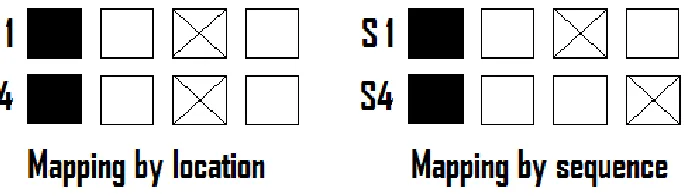
[image:10.612.130.475.333.431.2]stimulus, the cross is the irrelevant stimulus. This figure schematically shows how the stimuli were presented to the participants. The four squares were visible at the screen, the squares would turn blue or red according to the programmed relevant and irrelevant stimulus locations. The first column and the first row shows the first stimulus in the mapping by location condition (S1). The second row of the first column shows the fourth stimulus of the mapping by location condition (S4). Because relevant stimulus 4 is in the same position as in the first stimulus, irrelevant stimulus 4 also appears in the same position as in the first stimulus. Conversely, in the mapping by sequence condition this pairing is not always the same. The irrelevant sequence follows its own sequence pattern. Consequently, it possible that if relevant stimulus 4 appears in the same location as relevant sequence 1, irrelevant stimulus 4 appears in a different location as irrelevant stimulus 1. In short, the mapping concept discriminates between mapping by location and mapping by sequence and is schematically represented in Figure 1.
Figure 1. Schematic representation of the mapping concept. The first and fourth
element of a 7-key relevant sequence, accompanied by an irrelevant stimulus consisting
of a stimulus paired by location or by another sequence. The black square is the relevant
stimulus, the cross is the irrelevant stimulus. In the task as it was presented to the
participants the background was black, the lines of the squares were white and the
relevant and irrelevant stimuli were blue or red.
11
screen with a stimulus on the b position, while the second v (stimulus 5) will appear in the screen with a stimulus that appears in the c position. In a mapping by location condition this is not possible. If the first v is accompanied by a b, the other v will also be accompanied by a b.
Mapping is a concept that is used to discriminate between different configurations of the relevant stimulus in respect to the irrelevant stimulus. Mapping can be an addition in the negative priming theory. Mapping is not a mechanism, it is an extra variable that should be considered in the negative priming theory.
In the studies cited in the previous paragraphs, SRT or other key pressing tasks were used (e.g. Abrahamse & Verwey, 2008; Cock et al., 2002; Deroost et al., 2008; Wright & Shea, 1991). Results from SRT and other key pressing tasks should not be generalized without caution to the DSP setting. These results can however be a frame to place the current results in and can serve as comparison material. It is possible that these theoretical constructs on underlying mechanisms regarding context effects can also be used for the DSP task. This experiment seeks to contribute to the understanding of underlying mechanisms regarding context effects and more specifically how the mechanism works in the DSP task. The next paragraph will clarify to a further extent the aim of the present study.
1.4 The aim of the present study
The aim of the current study is to investigate underlying mechanisms regarding context effects in a DSP task. Also, the influence of a variable length of the practice phase on the possible mechanism is investigated. This research might contribute to the discussion about underlying processes that determine context effects in sequential learning tasks.
The questions that were investigated are: (1) What is the underlying mechanism to account for context dependent learning?, (2) Can either negative priming or the facilitating view account as a mechanism influencing context dependent learning?, (3) Does the length of the practice phase influence the mechanism of learning and ignoring relevant and irrelevant sequences on the context dependent sequential learning task? and (4) What kind of mapping occurs during negative priming to account for the negative influence on performance on the DSP task?
12
effect will occur because I expect that the irrelevant stimulus will not be used as an aiding cue. When the long and short practice condition were regarded, two things were presumed. First, that the participants in the long practice phase would score higher on the sequence knowledge questionnaire. Second, I expected that practice would serve as an amplifier for any effect that would be found. If negative priming effects would occur, I expected that with more practice the irrelevant stimulus would be better learned and thus would cause more impairment to test performance when the previously inhibited sequence had to be responded to in the test phase. Therefore I do expect to find a significant practice effect in the test phase. To sum up, the present study investigated context effects and its underlying concepts in a sequential learning task, the DSP task. Half of the participants had a short practice phase, the other half a long practice phase. Also, the group was divided in a mapping by sequence condition and a mapping by location condition. In the test phase every participant completed a block with a familiar (previously irrelevant) sequence and a block with an unfamiliar sequence. Colour, sequence and order of Familiarity in the test phase were counterbalanced for all groups. This experiment was conducted in order to contribute to the search for an underlying mechanism to explain context effects in a sequential learning task. I presumed that negative priming effects would occur, that is, that in the test phase impairment due to earlier presentation of the stimulus would be demonstrated. In addition, I assume that practice will amplify the context effect mechanism.
2 Method
2.1 Participants
Seventy-two students participated in the study in return for course credits. The participants could sign up for the long or the short version and received more course credits for the long version (not all participants wanted credits in return for their help, they participated voluntarily). Half of them were assigned to the mapping by sequence condition, the other half to the mapping by location condition. The mapping by sequence group consisted of 30 women and 6 men. Their age ranged from 19 to 28 (M = 21.58). The mapping by location group consisted of 25 women and 11 men. Their age ranged from 18 to 24 (M = 20.35).
2.2 Stimuli and apparatus
13
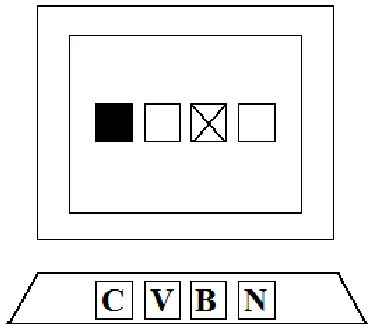
[image:13.612.117.301.207.373.2]the responses. The stimuli could appear in one of four places that were situated in the middle of the screen. Vertically it was the middle, horizontally the locations were situated next to each other with the same amount of space between them and the same amount of space left and right from them to the border of the screen. These four places were marked by four squares, made up out of white lines. These squares remained visible throughout the trials. Figure 2 is a schematic representation of the stimulus presentation.
Figure 2. A schematic representation of stimulus presentation in the DSP task. The black square is the relevant stimulus, the cross is the irrelevant stimulus. The correct response in case would therefore be ‘c’. The lines of the squares would remain visible the trials. If a stimulus would appear in a position blue or red colour would fill the square. In the task as it was presented to the participants the background was black, the lines of the squares were white and the relevant and irrelevant stimuli were blue or red.
2.3 Design
14
irrelevant sequences that were showed along with the relevant stimuli were respectively cbvnbnv, bcnvcvn, vnbcncb and nvcbvbc. Both the relevant and irrelevant sequences were counterbalanced for both of the conditions. The stimuli were either red or blue squares and sequence and colour were counterbalanced for both conditions. The practice phase, block 1-6 or block 1-2, was followed by a test phase, block 7-8 or block 3-4.
In this test phase, there were two conditions, a familiar test block and an unfamiliar test block. These test blocks were of equal length as the blocks in the practice phase. They differed in that in the familiar test blocks participants responded to the sequences they previously ignored as the irrelevant stimulus in the practice phase, and in the unfamiliar test block the participants responded to an unknown sequence. The irrelevant sequences in the familiar as well as the unfamiliar test block followed the order of the relevant sequence in the practice phase. The order of the test blocks was counterbalanced.
Thirty-six of the participants practiced a mapping by sequence condition in the practice phase. This condition entailed that the relevant stimuli, following the pattern of two 7-item sequences, were accompanied by irrelevant stimuli that followed the pattern of two other 7-item sequences. Thirty-six other participants were assigned to the mapping by location condition. In the mapping by location condition the relevant stimuli, that followed the pattern of two relevant 7-item sequences were not accompanied by two independent irrelevant sequences, but by stimuli that were paired to the specific location of the elements of the relevant sequence. Every irrelevant stimulus was always paired to a specific relevant location. This means that if stimuli 1 and 4 of a sequence in the mapping by sequence condition are both in the first position (c) of the screen they could be accompanied by irrelevant stimuli Y and Z. If in the mapping by location condition stimuli 1 and 4 would appear in the same place (in this case the first position in the screen, c), both stimuli 1 and 4 would be accompanied by the same irrelevant stimuli, in this case Y (see Fig. 1).
2.4 Procedure
15
left little-finger, left ring-finger, left middle-finger and left index-finger respectively. They further were instructed to respond as fast and as accurate as they could. After they ran through the practice blocks the experimenter started the test phase.
2.5 Knowledge of sequences questionnaire
After the participants finished the last block of the test phase, they filled in a sequence questionnaire. They were asked to reproduce the two sequences they had practiced in the
practice phase. The questionnaire consisted of two columns and 7 rows of 4 squares. In this way the participants could mark one sequence in the first column of 7 rows of 4 squares and the other sequence in the second column. They could fill out the square for the relevant stimulus and mark the square with a cross to mark the position of the irrelevant stimulus.
In summary, there were two conditions, a short and a long practice phase condition. In both conditions there was a familiar test phase group and an unfamiliar test phase group to test the negative priming effects. Also, there were two conditions of mapping, mapping by location and mapping by sequence. In every group colour, sequence and order of test condition were counterbalanced. After the experiment, all participants were requested to reproduce the learned sequences with a sequence knowledge questionnaire.
3 Results
3.1 Practice phase
We performed two repeated measures analysis of variance (ANOVA) on Reaction Times (RTs) with Block (2 or 6), Key (7) as within-subject variables and Practice (2; a short and long condition) and Mapping (2; a sequence and location condition) as between-subject variables. Significant effects were found in the short practice group for Block,
F(1,34)=249.56, p<.001, Key F(6,204)=15.13, p<.001 and a Block*Key interaction effect
16
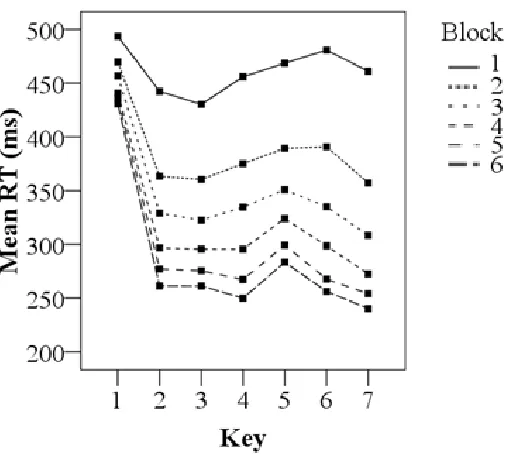
Figure 3. Mean RTs as a function of Key and Block for the long practice phase.
In the practice phase, the effect of Mapping in the short condition was significant,
F(1,34)= 7.19, p<.05, but in the long practice condition, F(1,34)=.51, p=.482, no significant results were found. When the first two blocks of all the participants of the long and the short practice condition are analyzed together, Mapping is, as it is in the short practice condition, significant, F(1,70)=4.63, p<.05. The responses of the participants in the mapping by location condition were faster than those in the mapping by sequence condition (453 ms vs. 499 ms for block 1 and 397 ms vs. 417 ms for block 2). There is one major limitation of this finding and that is that when the first two blocks of the long practice phase are considered alone, no significant Mapping results are found, F(1,34)=.10, p=.75.
3.2 Test phase
17
However, the interaction between Familiarity and Mapping was significant, F(1,68)=11.79,
p<.001 (see Figure 4). The mapping by location condition elicits responses that are faster compared to the mapping by sequence condition, a result that was also showed in the practice phase. Nonetheless, performance on the test block where a previously ignored sequence was shown elicited slower responses compared to the test block with a unfamiliar sequence only for the mapping by location condition. Concerning the test phase, this is the most noticeable result.
Figure 4. Mean RTs as a function of Familiarity and Mapping. The mapping by
location condition was disrupted in the Familiar test block.
Concerning the between subject effects, only Mapping was significant, F(1,68)=8.84,
p<.005. The mapping by location condition is significantly more disrupted than the mapping by sequence condition. Key was again a significant variable, F(6,408)=38.44, p<.001. In every block and condition, the first key always takes the longest response time. Key*Mapping*Familiarity was also significant, F(6,408)=5.99, p<.001. It is interesting that, against expectations, Practice is not significant, F(1,68)= 3.35, p=.07.
3.3 Explicit knowledge of sequences
18
sequences they had learned in the practice phase (relevant stimulus), as well as the two sequences that were presented as irrelevant sequences in the practice phase. These sequence questionnaires were scored as followed: for each fully correct sequence the participant scored one point. Participants had to write down the correct stimuli in the correct order. Participants got a score of 0, 1 or 2 if respectively 0, 1 or 2 sequences were written down correctly. In the short practice phase 78% reproduced not one sequence 100% correct. 22 % could reproduce all 7 elements of one sequence. 0% could reproduce two sequences. In the long practice phase 67% reproduced not one sequence 100% correct. 22 % could reproduce all 7 elements of one sequence. 11% could reproduce both sequences.
With an independent samples t-test the differences on the correct sequence score between the short and long practice phase were calculated. Scores for the short practice phase were M=.22, SD=.43 compared to M=.44, SD=.70 for the long practice phase. This difference was significant, F(34)=6.05, p<.05. These results confirm the assumption that in the long practice phase participants learned the sequences better that the short practice phase. It furthermore implies that learning the sequences in the DSP task was not completely implicit.
The participants also got a score (0-14 points) for each correct element -on the correct position- that they could reproduce. With an independent samples t-test on the count scores the differences on the correct element scores between the short and long practice phase were calculated. The results for relevant stimulus correct element scores were significant,
F(34)=5.11, p<.05. In the short practice phase the mean of the correct element score was
M=6.22, SD=3.21 and for the long practice phase M=8.39, SD=4.45.
The irrelevant sequences were not properly reproduced by any of the participants, giving a score of M=.00, SD=.00. The individual correct irrelevant elements for the short version was M=3.56, SD=1.82 and for the long version M=2.83, SD=2.71. An independent t -test on the count scores showed that these scores did not differ significantly, F(34)=2.4,
p>.10.
4 Discussion
19
4.1 Familiarity and Mapping in the test phase
The influence of context effects in this study were demonstrated with the Familiarity variable. The familiar condition is a condition in which the relevant sequence was previously ignored. The unfamiliar condition consisted of a relevant sequence that was new to the participant. If there would be a facilitating effect, a mechanism in which the context is used as an aiding cue, the reaction times in the familiar block were predicted to be faster than in the unfamiliar block. Reversely, if the reaction times would be slower this would indicate a negative priming effect. The latter was the result that was expected, but no significant results of Familiarity were found. However, in the test phase a Familiarity and Mapping interaction effect was significant. Mapping was the variable used to discriminate between certain configurations of relevant in relation to the irrelevant stimulus. In one condition the irrelevant sequence was paired independently ‘by sequence’ while the other was paired ‘by location’ and thus was consistently matched to the relevant stimulus (see Fig. 1 and introduction for an extended explanation of the mapping concept). This means that no negative priming effects occur unless the mapping is of a certain configuration. In this study a negative priming effect, an effect that performance is impaired because of a previously ignored sequence, only occurs when the irrelevant stimulus is consistently paired to the irrelevant stimulus. This means that (in the practice phase) the position of the irrelevant sequence depended on the position of the relevant stimulus. This implies that the negative priming effect does not occur as significant in this DSP task as that it does in the other sequence learning studies of Cock et al. (2002) and the Deroost et al. (2008). Only when Mapping was considered Familiarity played a significant role. In other words, only when there was a link by location between the relevant and the irrelevant stimulus, this impairs performance when participants have to respond to the previously ignored stimulus. This means that humans can learn to ignore certain positions but in the current DSP task only when the initial ‘learning to ignore the position’ takes place in a setting where the irrelevant stimuli are paired by location to the relevant sequences.
20
replicate the irrelevant sequence, under some conditions (the mapping by location condition) they showed impaired performance.
The differences between the results of this task and results of the tasks used by Cock et al. (2002) and Deroost et al. (2008) might be explained by the kind of learning that occurred. In the current study, most participants were aware of the fact that they were learning sequences and in addition were explicitly aware of the sequence itself. This might have influenced to what extend the ignoring of the irrelevant stimulus was also learned. By all means, when using the negative priming as an explanatory mechanism for context effects in the DSP task, the Mapping variable must be considered.
4.2 The Key variable
Key was in the test phase and in the practice phase a significant variable. Participants needed more time to respond to the first key then to the other 6 keys. What is also of interest for the Key variable is that the reaction times increase around key 5. This effect is most evident in block 6 of the practice phase (see Fig. 3). Presumably chunking, the learning of a sequence in parts in order to speed up performance, is the explanatory mechanism behind this phenomenon in the data. According to the chunking theory the loading of a chunk is responsible for the increase in reaction time but the following keys then, can be executed at a much higher pace and it is executed under the control of a mechanism that involves several brain structures (Hikosaka, Nakamura, Sakai & Nakahara, 2002; Verwey, 1996; Verwey & Dronkert, 1996; Verwey, Lammens, & Van Honk, 2002).
4.3 Practice and the Mapping variable further explored
21
In a pure perception based sequential learning task by Remillard (2009) one of the conclusions of that study was that when a sequence is accompanied by an attention capturing stimulus, learning is impaired but when a stimulus does not capture the attention learning, and thus task performance, will not be impaired. It is possible that for the participants a paired by sequence stimulus attracts more attention than a paired by location stimulus and therefore impairs performance. Learning the irrelevant sequence is established by the sixth block and by that block no Mapping results are significant anymore. The big influence of attention on the Mapping variable might be an alternative explanation for the slower responses in the mapping by sequence group compared to the mapping by location group. At least mathematically this seems valid because in the mapping by location condition the relevant stimulus can only be accompanied by a stimulus on one specific location while in the mapping by sequence condition each relevant stimulus can be accompanied by a stimulus in
three possible locations. The distraction that is caused by the more complex nature of the mapping by sequence task can explain why the responses in the mapping by sequence task are slower than responses in the mapping by location task. The mapping notion must be further explored in order to account for underlying mechanisms of this notion, cause attention and distraction the main influence of the mapping effect or does it reflect (implicit or explicit) learning?
4.4 Limitations
22 5 Conclusions
With the impaired performance in the mapping by location negative priming effects have been demonstrated. This answers our main research question. However, negative priming alone cannot account for the results. In this respect it is good to consider the Mapping notion. In the current data, the Mapping variable combined with the Familiarity variable can account for the found negative effects in the mapping by location condition and can account for the not significant data of the sequential mapping condition. The impairment due to earlier presentation effects can be explained by an inhibiting higher order learning mechanism. A perception view, where attention capturing impairs performance might provide an explanation for the slower responses of the mapping by sequence condition in both the practice and the test phase. Finally, Practice does not seem to have an influence on the negative priming mechanism, but based on the influence of practice on the Mapping variable in the practice phase, that with more practice less Mapping effects were significant, I recommend that the influence of Practice on Mapping will gain further attention.
In summary, this study shows that for the DSP task negative priming effects are not as outspoken as in the other sequence learning studies by Deroost et al. (2008) and Cock et al. (2002). Only when the relevant and the irrelevant stimulus were consistently paired within the sequence impaired performance was demonstrated on a task where responses were given on stimuli that occurred in the locations of the previously ignored stimulus. The position of the irrelevant sequence depended on the location of the relevant sequence and this position was consistently matched. In this study these configurations were discussed as the mapping notion. When this mapping notion is considered, the negative priming effect is a good frame to use to explain the outcomes of this study. However, the mapping notion must be further explored.
Acknowledgements The author wishes to thank M. F. L. Ruitenberg for her feedback and
structured way of working. I learned more than to write a thesis, I have learned to carry out an experiment. I would also like to thank W. B. Verwey for his feedback on earlier drafts of this thesis and many suggestions to improve it. Also a special thanks to I. W. Welten, for reviewing this thesis and sharing her knowledge concerning academic writing.
6 References
23
motor skills: Practical implications from the serial reaction time task. Revue européenne de psychologie appliquéel, 61, 65–76.
Abrahamse, E. L., & Verwey, W.B. (2008). Context dependent learning in the serial RT task. Psychological Research, 72, 397-404.
Badgayan, R.D., Fischman, A.J., & Alpert, N.M. (2007).Stratial dopamine release in sequential learning. Neuroimage, 38, 549-556.
Cock, J.J., Berry, D. C., & Buchner, A. (2002). Negative priming and sequence learning. European Journal of Cognitive Psychology, 14, 27–48.
Deroost, N., Zeischka, P., & Soetens, E. (2008). Negative priming in the SRT task: Learning
of irrelevant sequences is enhanced by concurrent learning of relevant sequences.
European journal of cognitive psychology,20, 47-68.
Godden, D. R., & Baddeley, A. D. (1975). Context-dependent memory in two natural environments: On land and underwater. British Journal of Psychology, 66,325–331. Hikosaka, O., Nakamura, K., Sakai, K., & Nakahara, H. (2002). Central mechanisms of
motor skill learning. Current Opinion in Neurobiology,12, 217-222.
Hockley, W. E. (2008). The effects of environmental context on recognition memory and claims of remembering. Journal of experimental psychology,34, 1412-1429.
Kleine, de, E., & Verwey, W.B. (2009). Representations underlying skill in the discrete sequence production task: effect of hand used and hand position. Psychological Research,73, 685–694.
Knee, R., Tomason, S., Ashe, J., & Willingham, D. T. (2007). The representation of explicit motor sequence knowledge. Memory & Cognition, 35,326-333.
Lintern, G. (1985). Context and dependency effects in skill acquisition. In R. Eberts & C. G. Eberts (Eds.), Trends in ergonomics/human factors II (pp. 249-256). Amsterdam: Elsevier Science
Nissen, M.J., & Bullemer, P. (1987). Attentional requirements of learning: Evidence from performance measures. Cognitive Psychology, 19, 1-32.
Remillard, G. (2009). Pure-perceptual based sequence learning: a role for visuospatial attention. Journal of Experimental Psychology: Learning, Memory, and Cognition, 35, 528–541.
Rhodes, B. J., Bullock, D., Verwey, W. B., Averbeck, B. B., & Page, M. P. A. (2004). Learning and production of movement sequences: Behavioural, neurophysiological, and modeling perspectives. Human Movement Science,23, 699–746.
24
meta-analysis. Psychonomic Bulletin & Review, 8, 203–22.
Stephan, M. A., Meier, B., Orosz, A., Cattapan-Ludewig, K., & Kealin-Lang, A. (2009). Interference during the implicit learning of two different motor sequences.
Experimental Brain Research, 196, 253-261.
Tipper, S.P., & Cranston, M. (1985). Selective attention and priming: Inhibitory and faciliatory effects of ignored primes. Quarterly Journal of Experimental Psychology,
37, 591–611.
Verwey, W.B. (1996). Buffer loading and chunking in sequential keypressing. Journal of experimental Psychology: Human Perception and Performance,22, 544-562.
Verwey, W. B. (1999). Evidence for a multi-stage model of practice in a sequential movement task. Journal of Experimental Psychology: Human Perception and Performance,25, 1693–1708.
Verwey, W.B., & Dronkert, Y. (1996). Practicing a structured continuous keypressing task: motor chunking or rhythm consolidation? Journal of Motor Behaviour,28, 71-79.
Verwey, W. B., & Eikelboom, T. (2003). Evidence for lasting sequence segmentation in the discrete sequence production task. Journal of Motor Behaviour,35, 171–181.
Verwey, W.B., Lammens, R., & Van Honk, J. (2002). On the role of the SMA in the discrete sequence production task: a TMS study. Neuropsychologia, 40, 1268-1276.
Willingham, D.B. (1998). A neuropsychological theory of motor skill learning. Psychological Review,105, 558-584.