
Design of Content Based Image Retrieval
Technique(S) Based on Gabor Color Correlation
Feature
Anjali1
1M. Tech Student
Abstract: The rapid growth in the internet and multimedia technology has produced a huge amount of data in the category of images, videos, and audio. This has issued the demand of systems which can store and retrieve multimedia data like images in an effective and efficient manner. Content Based Image Retrieval (CBIR) is the finding; navigation and retrieval of images depend on their visual content. In a way to access this very large image collection the new methods are verycrucial. Image mining system is the Content-Based Image Retrieval (CBIR) which executes retrieval depends on thesimilarity explained in terms of extracted features with more goodness. In this paper we study about the existing research work for content based image retrieval concept and release a conclusion on basis of problem statement.
Keywords: - Image pixel, CBIR, Feature extraction
I. INTRODUCTION
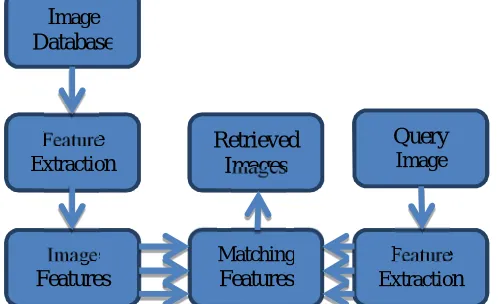
With the modern era in internet and multimedia technologies, a large amount of multimedia data in the category of audio, video and images has been implemented in many fields like medical treatment, satellite data, video and still images repositories, digital forensics and surveillance system. This has issued an ongoing demand of systems that can store and retrieve multimedia data in an effective way. Many multimedia data storage and retrieval systems have been generated till now for catering these needs. The most general retrieval systems are Text Based Image Retrieval (TBIR) systems, where the search is depends on automatic or manual annotation of images. A conventional TBIR finds the database for the common text surrounding the image as given in the query string. The generally used TBIR system is Google Images. The text dependent systems are fast as the string matching is computationally less time-consuming method. However, it is many times typical to express the whole visual content of images in words and TBIR may end up in generating irrelevant outputs. In combination annotation of images is not always correct and utilizes a lot of time. For searching the alternative method of finding and overcoming the drawbacks imposed by TBIR systems more intuitive and user friendly content based image retrieval systems (CBIR) were generated. A CBIR system uses visual contents of the images explained in the form of low level characteristics like color, texture, shape and spatial locations to display the images in the databases. The system access similar images when an example image or sketch is displayed as input to the system. Querying in this way stops the need of explaining the visual content of images in words and is close to human perception of visual data.
Some of the representative CBIR systems are Query by Image Content (QBIC).
Image
Database
Feature Extraction
Image
Features
Matching
Features Retrieved
Images
Feature Extraction
Query
[image:2.612.183.432.557.709.2]II. LITRETURE SURVEY
In this section we study about the research work done by researcher and scientists. The study of existing work moves us towards some issues.
In the year 2012 they proposed a content-based image retrieval methodwhich hybrid color and texture characteristics. To enhance thediscriminating power of color indexing method, they encode aminimal amount of spatial data in the color index. As itscolor features, an image is divided horizontally into three samenon-overlapping portions. From each portion in the image, they access the first three moments of the color spreading, fromeach color channel and store them in the index i.e., for a HSVcolor space, and they store 27 floating point numbers per image. As itstexture characteristics, Gabor texture descriptors are selected. Theyputweights to each feature respectively and measure the similaritywith hybrid features of color and texture using Canberradistance as similarity measure [1].
In May,2014 they presented that content based image retrieval technique is used retrieve query image from huge amount imagedatabase using three features such as color, shape, texture etc. The main purpose of this research is categorization of imageusing K-nearest neighbors Algorithm (KNN) [2].
In October, 2014 they performed various techniques available for Content basedimage retrieval System, they are RGB Color Histogram, Tamura Texture and Gabor Feature. The techniques areexecuted and tested depend on three parameters like Precision value, Recall value and Accuracy rate. TheExperimental outputs show that Gabor Feature technique is more efficient when comparing with other techniques. TheGabor Feature has 81.7%Accuracy in Content Based Image Retrieval system [3].
In February, 2015 they proposed a CBIRtechnique by extracting both color and texture feature vectors using the Discrete Wavelet Transform(DWT) and the Self Organizing Map (SOM) artificial neural networks. At access time texture vectorsare matched using a similarity measure which is the Euclidean distance and the most similarimage is accessed. In addition, other relevant images are also accessed using the neighborhood ofthe most similar image from the clustered data set via SOM. The proposed technique demonstratedpromising retrieval outputs on the Wang Database matched to the existing methods in literature [4].
In year 2015, they proposed system uses SIFT and SURF methods as local descriptors to generate image signatures that are invariant to rotation and scale. As well as, it uses K-Means as a clustering technique to build visual vocabulary for the features descriptors that obtained of local descriptors methods. To efficiently access much more images relevant to the query, SVM algorithm is implemented. The performance of the proposed system is measured by calculating both precision and recall. The experimental outputs reveal that this system executes well on two different standard datasets [5].
In January, 2016 they proposed a content-based image retrieval method that uses acombination of wavelet transform and color histogram. The Haar wavelet transform is used for texturefeature extraction, and for color feature extraction we use color histograms. Distance between the queryimage features and the database images features are computed using Euclidean distance. The assumed system has demonstrated a trusty and faster retrieval technique on a dataset performed for calculation ofexperimental results. The performance evaluated gives better result as in comparison to the existing systems [6].
In June, 2016 they proposed dynamic content-based image searchand retrieval is conferred, called Hybrid feature extraction method. The perceptible contents of an image such as shape, colorand texture are availed in content-Based Image Retrieval (CBIR).The Proposed algorithm which associate the advantages ofdistinct algorithms to improve the performance and accuracy of retrieval. The accuracy of color histogram depend matchingcan be marked up by using Color Coherence Vector for successive depuration. The Fourier Descriptors with Fast Fouriertransform and Extended Hough transform can strengthen the speed of shape based retrieval. The Gabor filter has beenbasicallyselected to access image features, peculiarly texture features. Feature Vector Normalization can be set to makesure that different feature vectors in the similarity measurement process. In this way the texture, color and shape features areunited to provide a prosperous feature set for retrieving image. In addition to this, relevance feedback (RF) scheme is refinedto progress the attainment of content-based image retrieval (CBIR) [7].
III. COMPARITIVE RESULT
Around 1000 images were used in the database, which consists of 12 different categories namely red rose, bird, sunflower, girl, aquarium, and car, girl in rain, starfish, baby, tiger, horse and oranges.Performance comparison of content-based image retrieval systems is a crucial and non-trivial task since it is very difficult to determine the relevant sets. The commonly used performance measurement parameters for the evaluation of retrieval performance are, precision and recall [8].
number of accessedrelatedimages to the total number of relevant images in the whole database.
Finally the average value of precision and recall were obtained for each category of images of the database for all techniques and results for both Euclidean distance and Canberra distance are shown below in table 1 and table 2. The percentages of accuracy of each method for all two similar measurement metrics are shown in table 3.
Table 1 Average percentage recall for all methods [9] Distance Metrics Color Based Search (HSV) Color Based Search (YCbCr) Color and wavelet Based Search (Symtel) Color and wavelet Based Search (Daubechies) Euclidean Distance
61 64.4 70.9 71.66
Canberra Distance
[image:4.612.139.476.140.567.2]56.58 59 63.58 66.25
Table 2 Average percentage precision for all methods [9] Distance Metrics Color Based Search (HSV) Color Based Search (YCbCr) Color and wavelet Based Search (Symtel) Color and wavelet Based Search (Daubechies) Euclidean distance
72.66 76.66 84 84.83
Canberra distance
70 74.25 75.83 78.41
Table 3 Average percentage of accuracy all methods [9] Distance Metrics Color Based Search (HSV) Color Based Search (YCbCr) Color and wavelet Based Search (Symtel) Color and wavelet Based Search (Daubechies) Euclidean distance
66.3 70.5 76.62 78.25
Canberra distance
64.5 68.37 69.93 71.2
IV. PERFORMANCE EVALUATION
The performance of a retrieval system is evaluated based on several criteria. Some of the general implemented outputs measures are average precision, average recall, average retrieval rate and Average Normalized modified Retrieval Rate (ANMRR). All these parameter are computed using precision and recall values computed for each query image. The precision of the retrieval is defined as the fraction of the retrieved images that are indeed relevant for the query:
=
ℎ
=
ℎ
A good retrieval system should have high values for precision and recall.
V. PROBLEM STATEMENT
Size of database is increasing day by day. Due to large size, it is very difficult for any user to access necessary information in less time. This problem arises in every type of database. So we choose database of images. Our basic motive is to access the image once and then the similar image does not take time for extract from large image database.
VI. MOTIVATION
In the last two decades, CBIR systems have been improved a lot. However, there still remain some problems which have not been answered satisfactorily. First and foremost isuue is of semantic gap, which lie between low level feature display of images and the actual visual perception of the image. Researchers all over the globe are working in the direction of narrowing down this semantic gap. Semantic gap is a bigissuewhich can be seen as a gathering of many small problems. In this work, we have identified such problems and tried to provide an effective solution to these problems.
VII. CONCLUSION
With study of content based image retrieval techniques it is described that recent work in CBIR is that used technique based on some features of image and some aspects for human visual system. Comparison of existing technique relates to color method have done on basis of some parameter like recall, accuracy and precision.The data set containsexactly 1000 randomly-selected images forexperiment. When the results are displayed, the usershave the opportunity to deliver feedback on everyimage by Relevance feedback. After all the study of recent techniques it found that we need to design a hybrid approach that can handle the issues.
REFERENCES
[1] S. Mangijao Singh , K. Hemachandran, “Content-Based Image Retrieval using Color Moment and Gabor Texture Feature”, IJCSI International Journal of Computer Science Issues, Vol. 9, Issue 5, No 1, September 2012
[2] Ms. Pragati Ashok Deole, Prof. RushiLongadge, “Content Based Image Retrieval using Color Feature Extraction with KNN Classification”, International Journal of Computer Science and Mobile Computing, Vol.3 Issue.5, May- 2014
[3] K. Haridas, Dr. Antony SelvadossThanamani, “Well-Organized Content based Image Retrieval System in RGB Color Histogram, Tamura Texture and Gabor Feature”, International Journal of Advanced Research in Computer and Communication Engineering Vol. 3, Issue 10, October 2014.
[4] AmmarHuneiti, MaisaDaoud, “Content-Based Image Retrieval Using SOM and DWT”, Journal of Software Engineering and Applications, 2015.
[5] Mohammed Alkhawlani, Mohammed Elmogy, HazemElbakry, “Content-Based Image Retrieval using Local Features Descriptors and Bag-of-Visual Words”, International Journal of Advanced Computer Science and Applications, Vol. 6, No. 9, 2015
[6] Mr. Niraj S. Fegade, Prof. Dinesh D. Patil, “Content Based Image Retrieval usingCombination of Wavelet Transform and Color Histogram”, International Journal of Computer Science and Mobile Computing, Vol.5 Issue.1, January- 2016
[7] D.Vetrithangam, Dr.N.Uma Maheswari, Dr.R.Venkatesh, “Dynamic Content-Based Image Search And Retrieval By Combining Low Level Features”, International Journal of Advanced Engineering Technology, Vol. VII, Issue II, April-June,2016.
[8] Sharma, N., Rawat P., and Singh, J., Efficient CBIR Using Color Histogram Processing, Signal & Image Processing: An International Journal (SIPIJ) Vol.2, No.1, March 2011.
![Table 2 Average percentage precision for all methods [9]](https://thumb-us.123doks.com/thumbv2/123dok_us/8572886.858511/4.612.139.476.140.567/table-average-percentage-precision-methods.webp)
