
Analysis and Comprehensive Study: Image
Segmentation Techniques
Navjot Kaur1, Jagdeep Singh2 Vikrant Sharma3,
Department of ECE, CT Institute of Technology
Abstract— Image Segmentation plays a vital role in extracting image information from dull and noisy images. Further,
image segmentation is the key step in processing images of different types. In last two decades, image segmentation has got a high boost and attention from the researches across the globe. In this paper, most dominating approaches have been discussed in detail. Image segmentation generally involves the cutting of a particular region of interest (ROI). Till date, many algorithms are available and each has its own advantage and purpose. This paper discusses the important techniques and their impacts on the segmented image.
Keywords— Image segmentation, Thresholding, contour, level set method, edge detection, histogram, ANN, ROI.
I. INTRODUCTION
An image (derived from Latin word imago) is an artifact that depicts or records visual perception. Images are considered as one of the most important medium of conveying information. An image is defined as a two dimensional function f(x,y), where x and y are spatial coordinates and amplitude of this function f at a given coordinate gives the intensity or gray level of the image [1]. Image processing involves improving the quality of images so as to retrieve lots of information from it. The major application areas include:
A. Medical Diagnosis: It includes disease identifications like malignant cells, tumours etc. from MR images.
B. Astronomical Image Evaluation: Satellite images of space indicated the existence of life on moon.
C. Sensitive and Noisy Image Processing: The images taken hundreds of years back are processed to collect important and rich data.
II. IMAGESEGMENTATION
Digital image processing is the use of computer algorithms to perform image processing on digital images. Image Segmentation is very important part of image processing. The aim of image segmentation is the partition of the image into a set of regions, which are visually distinct and uniform with respect to some property, such as grey level, texture or colour. This partitioning is domain independent [2]. It is to get more information in the region of interest in an image and clearly differentiate the object and the background in an image [1].
III.IMAGESEGMENTATIONTECHNIQUES
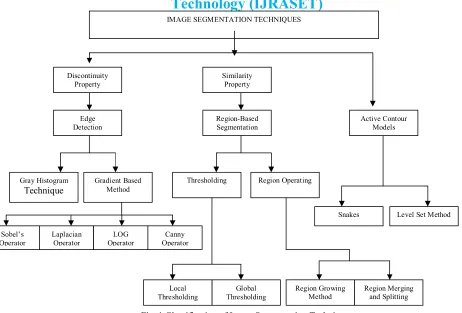
A lot of research has been carried out in the field of image segmentation process in past few years. There are number of algorithms proposed for the same. All of these algorithms are doing well with different categories of images. But still there is no single algorithm working with all types of images. The algorithm developed for a group of images may not always apply to images of another class [3]. Thus, in spite of several decades of research, there is no universally supported method for image segmentation for all categories of images and therefore it remains a challenge in image processing and computer vision [4]. In general, segmentation methods are based on two basic properties of the pixels: discontinuity and similarity. Methods that are based on some discontinuity property of the pixels are called boundary-based methods, whereas methods based on some similarity property are called region-based methods [2]. The various algorithms for the above mentioned approaches are shown in the figure 1.
A. Segmentation Based on Edge Detection
Edge detection is very important step in digital image processing. An edge represent object boundaries and therefore it helps us in detection and segmentation of objects in an image [5] [6]. The algorithms proposed will identify the points in a digital image where there is an abrupt change in image brightness or there is a difference in intensities. The edges are identified first, and then they are linked together to form required boundaries. These are extracted and linked together to form closed object boundaries and the result is binary image [7].
Fig. 1 Classification of Image Segmentation Techniques
1) Gray Histogram Technique: The result of edge detection technique depends mainly on selection of threshold level T [8].The technique depends upon separation of foreground from background. The challenge here is selection of threshold value because gray histogram is uneven for the impact of noise. Thus we approximately substitute the curves of object and background with two conic Gaussian curves [9], whose intersection point is chosen as the value of threshold T.
2) Gradient Based Method: Gradient is the first derivative for image f(x, y), when there is abrupt change in intensity near edge. There is a little image noise, therefore gradient based method works well [9].This method involves convolving gradient operators with the image. Commonly used operators in gradient based edge detection method are sobel’s operator, canny operator, Laplace operator, Laplacian of Gaussian (LOG) operator. These operators work well for images with sharp edges and low amounts of noise. The detected boundaries using these operators may not necessarily form a set of closed connected curves, so some edge linking (step edge, line edge, ramp edge, roof edge) may be required [10].
a) Sobel’s Operator: This can be thought as 3×3 approximations to first derivatives of Gaussian Kernels. The noise suppression characteristics of Sobel’s operator are better. The operator in matrix form are given by [1][10]
-1 -2 -1
0 0 0
1 2 1
Fig. 2 Sobel’s Operator [10]
b) Laplacian Operator: It is based on second derivative method of detecting edges in an image. Being approximation to the second derivative, it enhances noise in the image. The 3×3 Laplacian operator is gives by[10]
-1 -1 -1
-1 8 -1
[image:3.612.273.339.660.703.2]1- -1 -1
Fig. 3 Laplacian Operator [10]
-1 0 1
-2 0 2
-1 0 1
Edge Detection Region-Based Segmentation Gray Histogram Technique Gradient Based Method Thresholding Similarity Property Property Region Operating Discontinuity Property Sobel’s Operator Laplacian Operator LOG Operator Canny Operator Region Merging and Splitting Region Growing Method Global Thresholding Local Thresholding
IMAGE SEGMENTATION TECHNIQUES
Level Set Method Snakes
c) Laplacian of Gaussian (LOG) Operator: The noise effects in Laplacian operator can be minimized by smoothing the image. The LOG operator smooths the image by convoluting it with Gaussian operator. But the noise, still is present [10].
d) Canny Operator: This operator defines edges as zero-crossings of second derivatives in the direction of the greatest first derivative. This is most promising one, but takes more time as compared to sobel’s operator.
[image:4.612.130.486.133.246.2]Original Image Sobel’s Edge LOG Edge Canny Operator
Fig. 4 Results of different operators [1]
Always a balance is required between accuracy and noise immunity. Practically if the accuracy is too high, noise may create fake edges making the outline of images unreasonable. And if the degree of noise immunity is high [9], the edges may not be detected accurately. Thus, we can say that these algorithms are suitable for simple and noise-free images [11].
B. Segmentation Based on Thresholding
Image segmentation by thresholding is a simple but powerful approach. Thresholding technique is based on image space regions i.e. on characteristics of image [9]. It provides segments having pixels with similar intensities and useful for extracting boundaries in images that contain solid objects on contrasting backgrounds. The algorithm converts a multilevel image into a gray channel image by choosing a proper threshold T. Then we divide the pixels of image into several different regions so as to separate the light and more useful objects from background. Any pixel (x, y) is considered as a part of object if its intensity exceed or is in the range of the threshold value i.e. f(x, y) ≥T, otherwise the pixel belong to background [12][13].
We have two classes of Thresholding methods.
1) Global Thresholding: When T is kept fixed, the approach is called global Thresholding. The value of T depends on the properties of the pixels [3]. This approach is used when the difference between background and foreground objects is very distinct and single value of T is sufficient to differentiate between both the objects. The commonly used methods for the same are optimal thresholding, Otsu method, entropy based thresholding etc.[14].
2) Local Thresholding: When T is not kept fixed, the approach is called local Thresholding. Multiple thresholds are used to manage uneven illuminations [15] in this approach.The image is divided into segments and different threshold levels are defined for each segment. Threshold selection is typically done interactively however; it is possible to derive automatic threshold selection algorithms [7].Undoubtedly threshold based methods arecomputationally inexpensive, fast and simpler to implement and can work in real time applications [16].The main drawback of this approach is that it is not applicable to multichannel images and moreover the spatial characteristics of an image are not taken into the account. Therefore sensitive to noise is high [17].
C. Region based Segmentation
A region in any image (R) is basically a subset of the image with respect to some criterion. More precisely, the pixels with similar properties are grouped together in a region [7]. The similarity check may be for color, texture, gray level or shape [18]. As compared to segmentation methods mentioned above, regions are quite simple and immunity to noise is more [9][19]. The edge based methods partition an image where there is rapid changes in intensity near edges whereas region based methods, partition an image into regions that are same according to a set of predefined criteria [20][21]. Region based segmentation algorithms mainly includes the following methods [4]:
from initially placed points called seeds by aggregating neighboring pixels or regions according to some similarity criterion. The region growing is a widely used segmentation method due to its computational simplicity and stability to noise [24].
[image:5.612.193.467.177.285.2]2) Region Merging and Splitting: This method is based on the concept of quad trees to distinguish the homogeneity of the image [25]. The whole image is treated as single region and then divides it into four quadrants based on certain predefined criteria. Further divide the quadrant into other four quadrants for the same criteria. The process continues till further division is possible.No doubt, manually interaction will not be required in this technique but it requires the input to be organized into a pyramidal grid structure which could be difficult [26].
Fig. 5 Quad tree [27]
D. Segmentation Based on Contour Models
In computer vision, contour models describe the boundaries of shapes in an image. Particularly the models are designed to solve problems where the approximate shape of the boundary is known. The well known models used for image segmentation are:
1) Snakes: The basic idea in active contour models or snakes is to evolve a curve, subject to constraints from a given image in order to detect objects in that image [28].These are computer generated curves [29][30] used to find object boundaries under the influence of internal and external forces while moving within the image. As compared to classical feature attraction techniques, snakes have multiple advantages. They autonomously and adaptively search for the minimum state and can be used to track dynamic objects. But the snake algorithm is sensitive to noise. The computational complexity of the algorithm is high. Although improvements have been made, but still shortcomings are there [30].
2) Level Set Model: Level set methods are a conceptual framework for numerical analysis of surfaces and shapes. We can perform numerical computations involving curves and surfaces on a fixed Cartesian grid without having to parameterize these objects [31]. Also, the level set method makes it very easy to follow shapes that change topology, for example when a shape splits in two, develops holes, or the reverse of these operations. All these make the level set method a great tool for modelling time-varying objects [31].The level set method was developed by Osher and Sethian [29]. The disadvantage is that, the edge-stopping function is never exactly zero at the edges, and so the curve may eventually pass through object boundaries [8].
E. Segmentation Based on Clustering
Clustering a process of organizing the groups based on its attributes. It is basically bunching the data [1]. The pixels having same attributes are grouped together to form clusters. Same attributes here refers similarity in colour, size, texture etc. There is no training provided rather train themselves using available data. The effectiveness of this approach depends similarity criteria used and definitely on the implementation. A good clustering method [32] will produce high quality clusters with high intra-class similarity.
[image:5.612.162.446.591.705.2]The clustering algorithms used are hard clustering, k-means clustering, fuzzy clustering etc. In hard clustering, pixel will belong to a single cluster [3]. K-means algorithm clusters the point that is nearest to the centroid. In fuzzy algorithm, the test pixel is allowed to be member of two or more clusters with different membership coefficient [1].
F. Segmentation Based on Artificial Neural Network
A neural network is an artificial representation of human brain that trains through learning process [34][35]. In past few years, artificial neural networks have been widely used to solve the problem of medical image segmentation. Neural network constitutes a large number of parallel nodes to perform some basic computing. It also reduces the requirements of expert intervention during the image segmentation process [7]. An image is firstly mapped into a neural network where every neuron represents a pixel [36]. The neural network is trained with training sample set in order to determine the connection and weights between nodes. Once the neural network is trained, new images can be segmented. This approach includes two steps. Firstly, the important features are extracted from the image and secondly the image is segmented based on the features extracted. This algorithm is highly suited for real time applications because of fast and parallel computing. Also the noise immunity is high [3].
IV.CONCLUSION
In this review paper, we have discussed all the major image segmentation techniques and algorithms. The detection of pattern and recognition using edges and points is all possible by these methods. Since number of parameters like colour, intensity, noise etc. affect these algorithms, there is a challenging task to select an appropriate algorithm for a image. This remains a problem in the field of image processing and computer vision. Still research is going on and more algorithms are being proposed. We are hoping for an algorithm best suited for all types of images.
REFERENCES
[1] A. M. Khan, Ravi. S, “Image Segmentation Methods: A Comparative Study,” International Journal of Soft Computing and Engineering (IJSCE) ISSN: 2231-2307, Volume-3, Issue-4, September 2013.
[2] X.Cufi, X.Munoz, J.Freixenet and J.Marti, “A Review on Image Segmentation Techniques Integrating Region and Boundary Information,” October 31, 2001.
[3] Rohan Kandwal, Ashok Kumar, Sanjay Bhargava, “International Journal of Advanced Research in Computer Science and Software Engineering,” Volume 4, Issue 4, April 2014 ISSN: 2277 128X
[4] Savita Agrawal, Deepak Kumar Xaxa, “Survey on Image Segmentation Techniques and Color Models,” International Journal of Computer Science and Information Technologies, ISSN: 0975-9640, Vol. 5 (3) , 2014.
[5] “Edge Detection Techniques Evaluations and Comparisons,” Ehsan Applied Mathematical Sciences, Vol. 2, 2008, no. 31, 1507 - 1520. [6] Ahmed R. Khalifa , “Evaluating The Effectiveness Of Region Growing And Edge Detection Segmentation Algorithms,” 2010.
[7] H.P. Narkhede, “Review of Image Segmentation Techniques,” International Journal of Science and Modern Engineering (IJISME) ISSN: 2319-6386, Volume-1, Issue-8, July 2013.
[8] Rajeshwar Dass, Priyanka, Swapna Devi, “Image Segmentation Techniques,” IJECT Vo1-3, Issue -1, Jan-March 2012.
[9] W. X. Kang, Q. Q. Yang, R. R. Liang, “The Comparative Research on Image Segmentation Algorithms,” IEEE Conference on ETCS, pp. 703-707, 2009. [10] S Jayaraman, S Esakkirajan, T Veerakumar, “Digital Image Processing” Third reprint, TMH, 2010.
[11] S. S. Varshney, N. Rajpal, R. Purwar, “Comparative Study of Image Segmentation Techniques and Object Matching using Segmentation,” Proceeding of International Conference on Methods and Models in Computer Science, pp. 1-6, 2009.
[12] Wahba Marian, “An Automated Modified Region Growing Technique for Prostate Segmentation in Trans- Rectal Ultrasound Images,”Master's Thesis, Department of Electrical and Computer Engineering, University of Waterloo, Waterloo, Ontario, Canada, 2008.
[13] L. Aurdal, "Image Segmentation beyond thresholding,” Norsk Regnescentral, 2006.
[14] “Segmentation Techniques For Image Analysis,” IJAERS,Vol. I, Issue II, January-March, 2012.
[15] T. Lindeberg and M.-X. Li, "Segmentation and classification of edges using minimum description length approximation and Complementary junction cues,” Computer Vision and Image Understanding, vol. 67, no.1, pp. 88-98, 1997.
[16] S. Nagabhushana, “Computer Vision and Image Processing,” New Age International Publishers, 2005.
[17] Tranos Zuva, Oludayo O. Olugbara, Sunday O. Ojo and Seleman M. Ngwira, “Image Segmentation, Available Techniques, Developments and Open Issues,” Canadian Journal on Image Processing and Computer Vision, Vol. 2, No. 3, March 2011.
[18] H.S.Prasantha, Dr.Shashidhara.H.L, Dr.K.N.B.Murthy and Madhavi Lata.G, “MEDICAL IMAGE SEGMENTATION,” (IJCSE) International Journal on Computer Science and Engineering Vol. 02, No. 04, 2010.
[19] H. Zhang, J. E. Fritts, S. A. Goldman, “Tmage Segmentation Evaluation: A Survey of unsupervised methods,” computer vision and image understanding, pp. 260-280, 2008.
[20] Rastgarpour M. and Shanbehzadeh J., “ Application of AI Techniques in Medical Image Segmentation and Novel Categorization of Available Methods and Tools,” Proceedings of the International MultiConference of Engineers and Computer Scientists 2011, Vol I, IMECS 2011, March 16-18, 2011, Hong Kong.
[21] H. G. Kaganami, Z. Beij, "Region Based Detection versus Edge Detection,” IEEE Transactions on Intelligent information hiding and multimedia signal processing, pp. 1217-1221, 2009.
[22] Zheng Lin, Jesse Jin and Hugues Talbot, “Unseeded region growing for 3D image segmentation”.
1663-618X, 2012.
[25] Bo Peng, Lei Zhang, and David Zhang, “A Survey of Graph Theoretical Approaches to Image Segmentation,”.
[26] S.Lakare and A.Kaufman, “3D Segmenatation techniques For Medical Volumes,” Center For Visual Computing, department Of Computer Science, State University Of New York, dec.2000.
[27] Rafael C. Gonzalez & Richard E. Woods, “ Digital Image Processing,” Second Edition 2002, Prentice Hall.
[28] Tony F. Chan and Luminita A. Vese, “Active Contours Without Edges,” IEEE Transactions on Image Processing, VOL. 10, No. 2, Feb. 2001. [29] X. Jiang, R. Zhang, S. Nie, “Image Segmentation Based on PDEs Model: a Survey,” IEEE conference, pp. 1-4, 2009.
[30] C. Zhu, J. Ni, Y. Li, G. Gu, “General Tendencies in Segmentation of Medical Ultrasound Images,” International Conference on ICICSE, pp. 113-117, 2009.
[31] www.wikipedia.org.
[32] R.Xu, D.Wunsch A, Jain, M.Murty, P.Flynn, “Data Clustering: A Review,” ACm Computing Surveys, 31, 1999, pp-264.
[33] V. K. Dehariya, S. K. Shrivastava, R. C. Jain, “Clustering of Image Data Set Using K-Means and Fuzzy K-Means Algorithms,” International conference on CICN, pp. 386-391, 2010.
[34] T.F. Wang, D.Y. Li et al. “Automatic segmentation of medical ultrasound image using self-creating and organizing neural network,” Journal of electronics 1999, 21(1), pp.124-127.
![Fig. 4 Results of different operators [1]](https://thumb-us.123doks.com/thumbv2/123dok_us/8586175.862475/4.612.130.486.133.246/fig-results-of-different-operators.webp)
![Fig. 5 Quad tree [27]](https://thumb-us.123doks.com/thumbv2/123dok_us/8586175.862475/5.612.162.446.591.705/fig-quad-tree.webp)
