Swarm Robotics: Theoretical View on Task
Allocation Material Handling Approach
Akash Kadiya1, Saurin Sheth, 3Rajesh Sanghvi2 1, 2
Mechatronics Department, 3Applied Science & Humanities dept.
1, 2, 3
G. H. Patel College of Engineering & Technology, Vallabh Vidhyanagar, Gujarat, India
Abstract - Nowadays, industrial world is becoming fully or semi-automatic. So, many organizations implement automation to increase production rate and reduce lead time. Bigger organizations can easily implement conveyor belt system for material handling system but small or lower level organizations can’t afford that automation due to economic break even. A special man is allotted for material handing purpose and it is tedious and time consuming task. The solution is Swarm Robotic (SR) system for material handling purpose which can complete small individual tasks to achieve global organization goal. So an attempt is made here to propose a Swarm Robotic (SR) system for material handling. In the proposed SR system 3 robots are used, one of them is foraging robot and remaining are worker robots. This material handling SR system is working with ant inspired strategy.
Keywords - Swarm robotic (SR) system, Foraging, Material handling system, Task allocation, Ant Colony Optimization (ACO), Multi Robot Task Allocation (MRTA), Swarm Intelligence (SI)
I. INTRODUCTION
Swarm robotics is a modern thought in this recent technology era. The swarm robotics technology brings a new dimension of thoughts with greater advantage and ease over the several conventional processes of engineering world. The whole SR system is inspired from the social insects or animals’ behavior. Some important features of social animals are robustness, scalability and flexibility.Robustness means to operate in same condition even change in both individuals and environmental conditions [3, 4]. Scalability is the ability to perform well with different group sizes. The introduction or removal of individuals does not result in a drastic change in the performance of a swarm[3]. The term flexibility is used to refer to the ability of the robotic system to work under different environmental conditions with flexibility of work [3, 4]. In a swarm robotic system, the group of the robots perform the task by applying local rules and accomplish the task [17]. SR system mimics from social world and try to behave like them to achieve desire goals successfully[5]. These mimicries include flying robots, ground moving robots and under water movement robots [1] using Swarm Intelligence (SI).
A. Biological inspiration
A swarm robotic system is inspired from the natural animals and insects like ants, bees, termites, fishes, bacteria, cockroaches and human beings [2]. The approach in this paper is inspired from ant’s behavior. Ants and bee have same concept of work like foraging, types of workers and their duties. The ant colony shows a higher degree of the social behavior by creating a collective intelligent behavior [9]. An ant chooses its path based on the level of pheromone concentration. Ants have to perform work like foraging, brood feeding, cleaning nest and transportation of material.
[image:2.612.228.381.567.696.2]B. Classification of SR
Figure 1.2 Collective Methods [3]
The SR system is classified in two ways: on the basis of applied methods and on the basis of collective behaviors shown. Figure 1.1 and Figure 1.2 shows the complete classification. As shown in Figure 1.1, the methods contain design and analysis methods. In design methods, the user plans the requirement and specification as per the application [3]. The proposed approach is behavior based design method. So this approach is based on mimicry of the collective behavior of the social insect or animal and implement in SR system [3]. The collective behavior category is further explored, as shown in Figure 1.2, into spatial organizing, navigation, decision making and other collective behaviors. Our SR system is focused on Task Allocation (TA) in decision making behavior. In task allocation, different tasks are allocated to the workers as per the previous experience and size of the body. The work of each individual aggregates at last to give a quick and sophisticated desired output. It is inspired from ants, bees and other social insects [3].The crucial challenges in SR system are design of algorithms, implementation and test, analysis and modeling [6].
C. Source of inspiration and MRTA
An ant colony’s sophisticated collective behavior uses this task allocation strategy for solving current complex problems [17] with intelligent behavior [8]. Ants communicate with each other using touch, pheromone and sound and an ant with a successful attempt leaves a trail marking the shortest route on its return [2]. In ant colony, the task is distributed as per the previous work experience and size of the body [9]. Ants work together to find new food sources by sending out foragers ants randomly and ants use pheromone based route deciding food trail that other ants can follow [17]. Foraging scenario is best for selecting or dividing whole task into small subtasks [7]. According to researchers the ACO algorithm has good capability to solve a
computational problem as SI [17]. Here MRTA (Multi Robot Task Allocation) is a good strategy to solve global goal problems.
In MRTA system, the TA algorithm used to optimize the goal towards current complex problem faces several problems. As an example, as the number of swarm robots increase, the problem of communication between robots also increases [18]. The MRTA system optimizes the global cost of project having communication capability which leads higher flexibility, quicker decision taking and conformism [16, 18]. In case of unknown and open area project, Artificial Potential Field technique using wavefront algorithm can be used [15].
II. PROBLEMDEFINITIONANDCURRENTVIEW
For defined problem, the main focus is on small shops or warehouses which are not capable to buy/hire the automation machineries due to compact size of building construction or money problem. Such industries use trolley for material handling purpose. Let’s take a case of bearing manufacturing industry in which a trolley moves one place to another for completion of other process or assembly task. After completion of one process, the bearings are transported for other process by a trolley. This is time consuming, tedious task and one of the important thing is that if company does mass production then one special labor has to be allotted for that work. So for that kind of problem, companies have to think the other way to get production rate fast with efficient manner. One of the ways is to design a SR system for material handling purpose. There are two types of tasks available in task taxonomy: static task and dynamic task. In static task condition, task does not change with time whereas in dynamic task, the task conditions change with time [11]. In SR, task partitioning from whole common global goal to smaller and manageable subtasks is a good and effective adaptive methods for selection of the material handling strategy [10].
productivity [22], reduce human errors, better accuracy and safety [21] using machine vision in object sorting but due to map errors (misplacing of objects) task rearrangement is a good idea for SR system [13] or use chemical based model in which only telecommunication gives better efficiency [14]. For that the task is distributed in the robots. All robots find their objective related objects and place at the cache point and after sorting all objects they can lead all objects into the nest [12]. For gathering information from SR environment wireless data acquisition play crucial role [19]. Color guided vehicle use for color identification which contains pneumatic actuator, ZigBee module and MATLAB GUI for material handling, wireless communication and human-machine interface respectively [20].
III. PROPOSEDMODEL
The proposed model contains specification of the industrial problem, prototype design, specification of SR system, terminology of SR system, proposed organization model and working flow chart of proposed SR system.
A. Industrial problem & Prototype specifications
1) Man is prohibited until the completion of work and if some problem occurs then shut down the system and then entry is allowed.
2) This model is only for task allocation and object sorting through color or shape or size from one station to another station.
3) There is static environmental condition with no obstacle except objects with flat floor.
4) Here small robots are designed which pick up a size of 50×50×50 mm3 with less than 1 Kg weight of payload lifting object grasping capacity.
5) Transport one object at a time (Single task TA)
B. Proposed SR model terminology
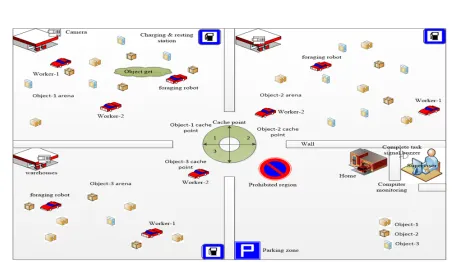
This inspired model comes from the foraging behavioral concept of the ant colony. In this model there are 3 robots. One is foraging robot and other two are workers. The whole process occurs in one rectangular region as shown in Figure 1.3. Certain terminology about this model is describe below:
1) Nest or Home: A place in rectangle region in which robots take a rest and place their objects.
2) Foraging robot: A robot which tries to find the objects in region in certain predefined time limit. If it finds an object then it calls worker-1.
C. Proposed Organization Model
[image:4.612.74.526.442.704.2]
3) Cache point: It is a point or a small region at where worker-1 places the object and worker-2 picks it from that place and place it at appropriate location. .
4) Boundary region:It is a region in which robots are do their task and do not go outside of that. Sometimes boundary of the region decided as per the communication or sensor network range.
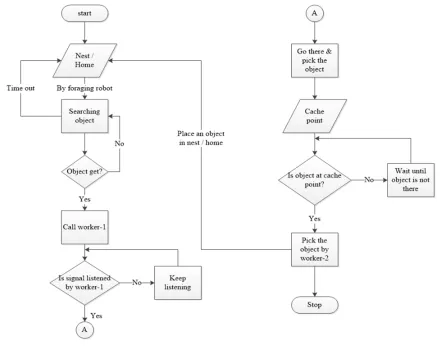
5) Time out concept: in foraging robot this parameter is added. This robot start to foraging in that if it find object then ok otherwise take rest for some time. But here there is small arena so not compulsory of that. It is only required for open, wide and hazardous environment.
D. Working Flow chart of SR system
In explanation of this flow diagram it starts from start button. All 3 robots are come out from nest. Among from 3 robots, robot-1 a forager robot tries to find out the targets which is not targeted objected of that arena means it is find the objects except of respective arena. This work should be completed in certain time limits otherwise it will take rest for some time. When it will find the target at that time it will give a signal to worker-1. Worker-1 pick that object from that place and now foraging robot free from this object duty so it will try to find another object. At the same time the worker-1 place the object at cache point. The respective arena’s worker-2 check each moment at respective cache point zone whether the object is place at cache point or not. If not place the then wait until it is not placed. After placing object at respective zone of cache point by worker-1 it will free and try to get or receiving signal from foraging robot. Now worker-2 places the object in the nest. And then it will go to near to cache point (figure 1.3).
[image:5.612.83.528.329.682.2]If we increase the working region then more number of robots or agents are required which are cover the whole region and complete the whole task as fast as possible. So this cache point play very important role as an intermediate station of an object
placement. One thing is remember is that the strength of robots is less than the object in the working region. Denoting the strength of the robot as N and the object strength as M, assume that M > N, where M and N are positive integers.
IV. SIMULATIONRESULT
In real environment, the working condition is dynamic. When ants go for foraging purpose, they try to find food by first sending their agents in each direction. After finding out food destination they try to find out shortest path to gathering that food. This strategy is acceptable only in task allocation problem for material handling purpose. Below software simulation of ants foraging behavior in dynamic environment is shown. Initially, ants choose various paths to get food at hills of mountains or apex of hills (Figure 1.5) and finally they collect food at the peak of the hills (Figure 1.6).
Figure 1.6 Final condition of Foraging Ants
V. CONCLUSION
The small scale material handling industries are the potential systems where one can use the said approach. The approach uses design of algorithms, implementation and test, modeling and analysis. The SR system comprised with sensors, actuators and wireless media may lead swarm intelligence to solve the complex problem with ease of operation and in efficient manner. The SR system brings better efficiency, cost optimized solution, increased material handling rate and so on. Instead of using singular system or labor for material handling TA system, the implemented SR system is advantageous and solves the problems faced by the MSME organizations, warehouses and small shops.
REFERENCES
[1] Jan Carlo Barca and Y. Ahmet Sekercioglu,’ Swarm robotics reviewed’, © Cambridge University Press, Robotica (2013) volume 31, pp. 345–359. [2] Ying Tan and Zhong-yang Zheng,’Research, ‘Advance in Swarm Robotics’, Science Direct, Defense Technology 9 (2013) 18-39.
[3] Manuele Brambilla, Eliseo Ferrante, Mauro Birattari and Marco Dorigo,’Swarm robotics: a review from the swarm engineering perspective’, © Springer Science + Business Media New York 2013, Swarm Intell (2013) 7:1–41.
[4] Erol Sahin,’ Swarm Robotics: From Sources of Inspiration to Domains of Application’, Middle East Technical University. January 2005.
[5] Eric Bonabeau, David Corne and Riccardo Poli,’ Swarm intelligence: the state of the art special issue of natural computing’, Springer Science+Business Media B.V. 2010, Nat Comput (2010) 9:655–657.
[6] Erol ¸Sahin and Alan Winfield,’ Special issue on swarm robotics’, © Springer Science + Business Media, LLC 2008, Swarm Intell (2008) 2: 69–72. [7] Marco Dorigo, Mauro Birattari , Christian Blum, Anders Lyhne Christensen, Andries Engelbrecht, Roderich Groß and Thomas Stützle, ‘Ants 2012 special
issue’, © Springer Science+Business Media New York 2013, Swarm Intell (2013) 7:79–81.
[8] K.Escherich,’Ants and her ways’, Scientific American supplement No. 1747, © 1909, Scientific American, Inc, (1909):404-406.
[9] Sifat Momen, ‘Ant inspired decentralized task allocation strategy in group of mobile robots’, Science Direct Elsevier publication, Procedia Computer Science 20 (2013) 169 – 176.
[10]Giovanni Pini, Arne Brutschy, Marco Frison, Andrea Roli, Marco Dorigo, and Mauro Birattari,’ Task partitioning in swarms of robots: An adaptive method for strategy selection’, IRIDIA- Institut de Recherches Inter disciplinaires et de Developements en Intelligence Artificielle,2011.
[11]Guanghui Li, Yusuke Tamura and Hajime Asama,’ Dynamical Task Allocation and Reallocation Based on Body Expansion Behavior for Multi-robot Coordination System’ IEEE- international conference of mechatronics and automation, 2011.
[12]Andrew Vardy, Gregory Vorobyev and Wolfgang Banzhaf, ‘Cache consensus: rapid object sorting by a robotic swarm’, © Springer Science+Business Media New York 2014, Swarm Intell (2014) 8:61–87.
©IJRASET 2015: All Rights are Reserved
652
[13]Norisuke Fujii, Taiki Ogata, Tatsunori Hara and Jun Ota,’ Realization method for a re- arrangement task by multiple mobile robots inconsideration of map errors’, Springer Robomech Journal 2014, 1:16.
[14]Ryusuke Fujisawa, Shigeto Dobata, Ken Sugawara and Fumitoshi Matsuno,’ Designing pheromone communication in swarm robotics: Group foraging behavior mediated by chemical substance’, © Springer Science+Business Media New York 2014, Swarm Intell (2014) 8:227–246.
[15]Olivier Simonin, François Charpillet and Eric Thierry,’ revisiting wavefront construction with collective agents: an approach to foraging’,© Springer Science+Business Media New York 2014, Swarm Intell (2014) 8:113–138.
[16]Giovanni Pini, Matteo Gagliolo, Arne Brutschy, Marco Dorigo and Mauro Birattari,’ Task partitioning in a robot swarm: a study on the effect of communication’, © Springer Science+Business Media New York 2013, Swarm Intell (2013) 7:173–199.
[17]www.nature.com/news/2000/000706/full/news000706-11.%5b11/12/2014%2010:11PM
[18]Shuhua Liu, Tieli Sun, Chih-Cheng Hung, ‘Multi-Robot Systems, Trends and Development’, In Tech publication 2011.
[19]Priyam A. Parikh, Hitesh B. Shah, Saurin Sheth,’ Development of a multi-channel wireless data acquisition system for swarm robots’, International Journal of Engineering Development and Research, Volume 2 (2014) 717-725, Issue 1 | ISSN: 2321 -9939.
[20]Priyam A. Parikh, Keyur D. Joshi, Saurin Sheth,’ Color Guided Vehicle – An Intelligent Material Handling Mechatronic System’, 1st International and 16th National Conference on Machines and Mechanisms (iNaCoMM2013), IIT Roorkee, India, page no: 628-635 [15/3/2015 07:00 PM]
[21] Vedang Chauhan , Saurin Sheth , Bhavesh R. Hindocha ,Rushabh Shah , Parth Dudhat , Pratyush Jani ,’Design and Development of a Machine Vision System for Part Color Detection and Sorting’, ICSSA-11, DOI:10.13140/2.1.1628.7526
[22]Saurin Sheth,Rahul Kher, Rushabh Shah, Parth Dudhat, Pratyush Jani, ‘Automatic Sorting System Using Machine vision’,ISCAR volume 1, DOI: 10.13140/2.1.1432.1448
![Figure 1.1 Methods of Swarm Robotics System [3]](https://thumb-us.123doks.com/thumbv2/123dok_us/8583933.861775/2.612.228.381.567.696/figure-methods-swarm-robotics.webp)
![Figure 1.2 Collective Methods [3]](https://thumb-us.123doks.com/thumbv2/123dok_us/8583933.861775/3.612.168.441.78.241/figure-collective-methods.webp)