S T U D Y P R O T O C O L
Open Access
Acupuncture at local and distant points for
tinnitus: study protocol for a randomized
controlled trial
Guang-Xia Shi, Li-Li Han, Li-Ying Liu, Qian-Qian Li, Cun-Zhi Liu
*and Lin-Peng Wang
*Abstract
Background:Tinnitus is the perception of a sound in the absence of an objective physical source. Up to now, there is no generally accepted view how these phantom sounds come about, and also no efficient treatment. Patients are turning to complementary or alternative medical therapies, such as acupuncture. Based on the theory of traditional Chinese medicine, acupoints located on both the adjacent and distal area of the disease can be needled to treat disease. Furthermore, the way of combining acupoints is for strengthening the curative effect. We aim to evaluate the efficacy of acupuncture at local points in combination with distal points in subjective tinnitus patients.
Method:This trial is a randomized, single-blind, controlled study. A total of 112 participants will be randomly assigned to one of four treatment groups receiving acupuncture treatment for 4 weeks. The primary outcome measure is subjective tinnitus loudness and annoyance perception, which is graded using the Visual Analogue Scale (VAS). The assessment is at baseline (before treatment initiation), 4 weeks after the first acupuncture session, and 8 weeks after the first acupuncture session.
Discussion:Completion of this trial will help to identify whether acupuncture at local acupoints in combination with distal acupoints may be more effective than needling points separately.
Trial registration:International Standard Randomized Controlled Trial Number Register: ISRCTN29230777
Background
Tinnitus
Subjective tinnitus is a frequent auditory sensation (for example, a tone, hissing, or buzzing sound, and some-times combinations of such perceptions) experienced in the absence of an external or internal acoustic stimulus. An estimated prevalence in the adult population across studies is about 10% to 15% [1-3], where 1% to 3% of the population has severe, distressing tinnitus. Among se-vere sufferers, tinnitus causes disability associated with concentration deficits, hypersensitivity to sounds, anx-iety, depression, irritability, agitation, and insomnia. Often a combination of several complaints could disrupt daily activities and has a negative impact on quality of life. It represents a worldwide major healthcare problem
with an enormous social and economic demand for therapeutic treatment [4,5]. Pharmacotherapy (antide-pressants, benzodiazepines), cognitive therapies, or elec-tronic devices that try to cancel the tinnitus have all been tried either separately or in combination but the success rate is not high. Attempts to develop evidence-based therapies have been thwarted by a poor under-standing of the pathophysiology [6,7]. Increasingly, patients are turning to complementary and alternative medical therapies. Acupuncture is among the most popular.
Acupuncture
Acupuncture has been used to treat tinnitus for a long time. Neuroscience studies related the effects of acu-puncture to neuronal stimulus, activation of endogenous opioid mechanisms and neuropeptides which stimulate specific brain structures [8]. It has been reported that acupuncture can yield immediate relief, both from the * Correspondence:[email protected];[email protected]
Acupuncture and Moxibustion Department, Beijing Hospital of Traditional Chinese Medicine affiliated to Capital Medical University, 23 Meishuguanhou Street, Dongcheng District, Beijing 100010, China
loudness and the disturbing quality of tinnitus, signifi-cant improvement in quality of life, less tension, and bet-ter sleep [9-12]. In contrast, an analysis of six randomized clinical trials of acupuncture for tinnitus failed to demonstrate any efficacy [13]. Based on the theory of traditional Chinese medicine (TCM), acu-points located on both the adjacent and distal area of the disease can be needled to treat disease. Further-more, the way of combining these acupoints is often used for strengthening the curative effect.
Aims
The aim of our study is to evaluate the efficacy of acu-puncture at local points in combination with distal points in subjective tinnitus patients.
Methods
We perform the study according to common guidelines for clinical trials (Declaration of Helsinki, International Conference on Harmonisation (ICH)/WHO Good Clin-ical Practice standards (GCP) including certification by an external audit). The trial protocol has been approved by the Research Ethical Committee of Beijing Hospital of Traditional Chinese Medicine Affiliated to Capital Medical University. This trial was registered with ISR CTN at Current Controlled Trials (ISRCTN29230777).
Population
Patients will be recruited in acupuncture clinic, Beijing Hospital of Traditional Chinese Medicine affiliated to Capital Medical University with a target sample size of 112 subjects. The trial is executed from February 2012 to December 2014.
Inclusion criteria
Patients who require for all of the following conditions will be considered for enrollment:
1. Diagnosis of subjective tinnitus, unilateral or bilateral 2. Age 18 to 65 years, either sex
3. Tinnitus duration of at least 3 months
4. Not to receive another treatment during the clinical trial period
5. Written and informed consent
Exclusion criteria
1. Objective tinnitus (objective tinnitus is audible to the examining/auscultating physician, whereas subjective tinnitus can only be perceived by the patient) 2. Underlying disease or history:
2.1. Cerebral vascular events 2.2. Neurodegenerative disorders
2.3. Otitis media 2.4. Acoustic tumor 2.5. Prior brain surgery 2.6. Inner ear malformation 2.7. Head trauma
2.8. Ototoxic drug medication
3. Women in pregnancy and lactation or without contraception
4. Inability to correct use of test equipment: unable to cooperate during audiologic examination
5. Patients who cannot communicate reliably with the investigator or who are not likely to cope with the requirements of the trial
Interventions
This trial is a randomized, single-blind, controlled study. Participants will receive acupuncture for 4 weeks. All candi-dates go through a standardized interview and receive more information about the study and the treatments. They also undergo audiological testing of hearing thresholds, minimal masking levels, and loudness discomfort levels carried out by an audiologist in Tongren Hospital affiliated to Capital Medical University.
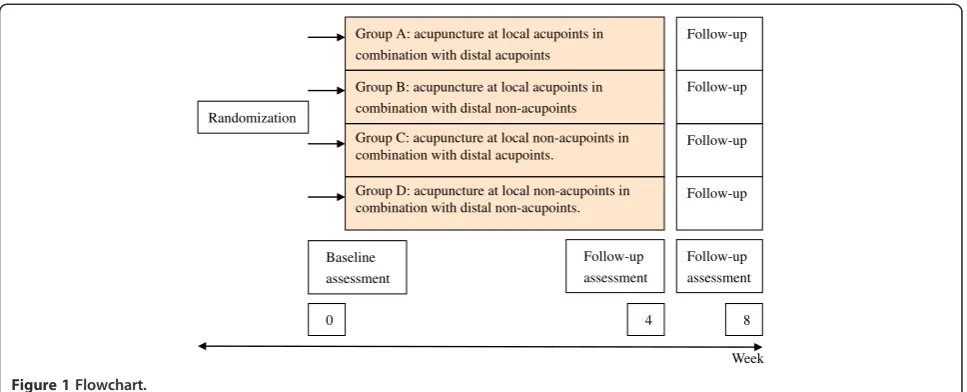
Time points are as follows (Figure 1):
Visit 1: screening
Visit 2: treatment initiation, participants will receive acupuncture for 4 weeks
Visit 3: 4 weeks after first acupuncture, follow-up and treatment finish
Visit 4: 8 weeks after first acupuncture, follow-up
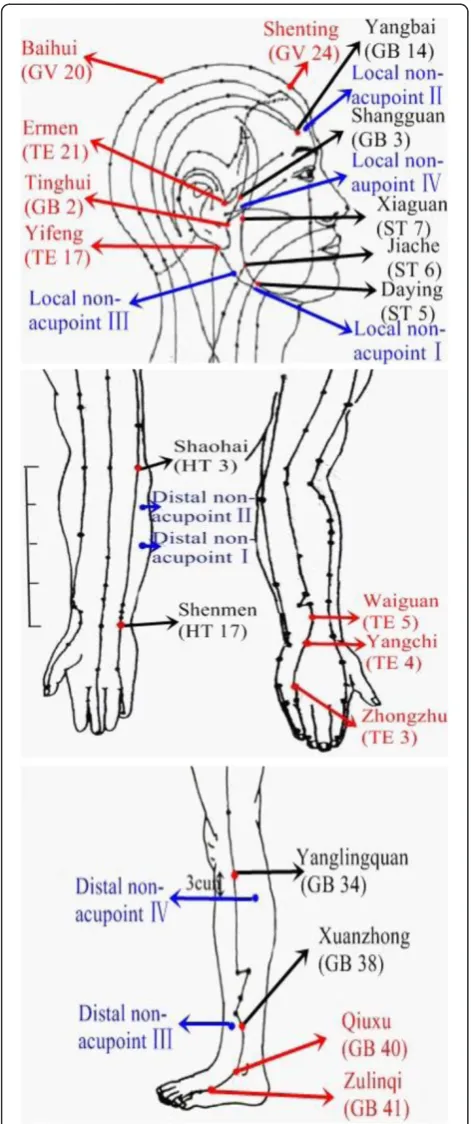
Patients who meet the inclusion criteria and none of the exclusion criteria are randomized to one of four treatment groups: group A will receive acupuncture at local acupoints in combination with distal acupoints; group B will receive acupuncture at local acupoints in combination with distal non-acupoints; group C will receive acupuncture at local non-acupoints in combination with distal acupoints; group D will receive acupuncture at local non-acupoints in com-bination with distal non-acupoints. Acupuncture points selected as follows (Figure 2):
Local acupoints: Baihui (GV 20), Shenting (GV 24), Yifeng (TE 17), Tinghui(GB 2), Ermen (TE 21)
Distal acupoints: Waiguan (TE 5), Zhongzhu (TE 3), Qiuxu (GB 40), Zulinqi (GB 41)
Distal non-acupoints
shaoyin and small intestine meridian of hand-taiyang
Distal non-acupoint II: the radial side of forearm, the junction of the upper 1/4 and lower 3/4 of the line joining HT 3 and HT 7, between heart meridian of hand-shaoyin and small intestine meridian of hand-taiyang Distal non-acupoint III: lateral side of lower leg, 3 cun above the tip of external malleolus, 1.5 cun behind anterior crest of the tibia, between the stomach meridian of foot-yangming and gall bladder meridian of foot-shaoyang
Distal non-acupoint IV: lateral to the shank, 3 cun below Yanglingquan (GB34), the midway between gall bladder meridian of foot-shaoyang and bladder meridian of foot-taiyang
Local non-acupoints
Local non-acupoint I: one finger-breadth (middle finger) inferior to Daying (ST5) in the body of mandible
Local non-acupoint II: midpoint between Yangbai (GB14) and the midline of the head, between governor meridian and gall bladder meridian of foot-shaoyang Local non-acupoint III: high spot of the angle of mandible Local non-aupoint IV: on zygomatic arch, the midway between ST 7 and GB 3
Acupuncture will be performed with sterile needles by one therapist with more than 22 years of experience and an acupuncture license from the Chinese medicine prac-titioner license from the Ministry of Health of the Peo-ple’s Republic of China. Treatment will be conducted over a period of 4 weeks, at a frequency of two sessions per week. No additional treatment is allowed.
Randomization and blinding
A research coordinator screen and enroll participants at clinic. After participants completed a baseline evalu-ation, another research coordinator who is uninvolved with data collection randomly assigns them to one of four treatment groups by using a computer-generated, blocked random-allocation sequence. The random list is generated with SAS software (SAS Institute, Inc., Cary, NC, USA). This research coordinator informs the acu-puncturist of the treatment assignment.
The patients, data collection staff, and data analysts are blinded during the study period. The acupuncturist is not blinded to the treatments they delivered because acupuncture manipulation makes it impossible. During the intervention, acupuncturist and the personnel who collect data are segregated immediately after the treat-ment start and are instructed not to exchange informa-tion with each other.
Primary outcome measures
Subjective tinnitus loudness and annoyance perception is graded using the VAS. The assessment is at baseline (before treatment initiation), 4 weeks after the first acu-puncture session, and 8 weeks after the first acuacu-puncture session.
Secondary outcome measures
Change of tinnitus severity according to the tinnitus questionnaire of Tinnitus Handicap Inventory (THI):
1.1. F: Functional subscale (11 factors) 1.2. E: Emotional subscale (9 factors) 1.3. C: Catastrophic subscale (5 factors)
Week Randomization
Group A: acupuncture at local acupoints in combination with distal acupoints
Group B: acupuncture at local acupoints in combination with distal non-acupoints
Group C: acupuncture at local non-acupoints in combination with distal acupoints.
Group D: acupuncture at local non-acupoints in combination with distal non-acupoints.
Follow-up
Follow-up
Follow-up
Follow-up
Baseline assessment
Follow-up assessment Follow-up
assessment
[image:3.595.57.541.88.284.2]0 4 8
Changes of tone and noise parameters of tinnitus are assessed by tinnitus matching (screeningversus week 8).
Perceived credibility of acupuncture would be evaluated by the Treatment Credibility Scale (TCS) after a 4-week acupuncture session. It is a five-item questionnaire ranging from 1 (not at all) to 5 (very confident); items are averaged to provide a single treatment credibility score, with high scores reflecting high treatment credibility.
To evaluate the adequacy of blinding, we will ask participants to rate how certain they are that they have received traditional acupuncture or new method of acupuncture on a seven-point scale (1 very sure, 7 very uncertain) after 4 weeks of treatment.
Each question of the THI can be answered by the pa-tient with either‘often’(4 points),‘sometimes’(2 points), or ‘never’(0 points) with a maximum total score of 100 points indicating most severe suffering from tinnitus. The assessment is at baseline (before treatment initi-ation), 4 weeks after the first acupuncture, and 8 weeks after the first acupuncture.
Participants should report the adverse events they experienced, including discomfort or bruising at the sites of needle insertion, nausea, or feeling faint after each treatment.
Statistical methods
The trial aims to detect a difference in loudness and an-noyance perception of tinnitus between the four study groups. This is deemed a clinically significant difference of average 20-point reduction on the VAS scores of loudness in acupuncture group when comparing with the sham-control group based on previously published studies [14]. The standard deviation is 25.9 in acupunc-ture group and 23.8 in the sham-control group, respect-ively, as previous studies have suggested [15].
The following formula was used for a four-group trial [16]:
n1¼n2¼2 ðuαþuβÞs δ
2
Calculations are performed using 80% power, a 5% sig-nificance level (two-side). The required sample size is approximately 24 participants for each group. We plan to enroll a total of 112 participants with 28 in each group, allowing for a 25% withdrawal rate.
Data analysis
[image:4.595.56.292.88.651.2]Data will be analyzed according to the 2×2 randomized factorial study designs. The statistical model includes two fixed factors (both local acupoints and distal acu-points). Interaction is evaluated using the interaction term in the ANOVA model and by visual assessment of
profile plots. As no interaction between local acupoints and distal acupoints is detected, results are presented as a factorial design (for example, all patients receiving acupuncture at local acupoints in combination with distal non-acupoints; and all patients receiving acupunc-ture at local non-acupoints in combination with distal acupoints).
Data analysis will be conducted by statisticians who are independent from the research team. Every analysis is conducted using the SPSS software (SPSS 12.0 KO for Windows ©).
Discussion
We have presented the design and the protocol for the randomized controlled trial of acupuncture at local and distant points for subjective tinnitus. Completion of this trial will help to identify whether acupuncture at local acupoints in combination with distal acupoints may be more effective than needling points separately.
It is hoped that this study will encourage renewed interest in acupuncture’s potential for treating people with tinnitus. Recent researches have created a climate where acupuncture might be assumed to be ineffective [17]. However, there is as yet inadequate evidence on which to base a judgment on acupuncture’s effectiveness for tinnitus. Well-designed randomized controlled trials where patients are representative of people with tinnitus in the general population are needed.
In this study, the side-effects of acupuncture will be reported by patients. Several large surveys have also pro-vided evidence that acupuncture is a relatively safe treat-ment [18]. The results could also provide consumers with information about viable choices. If acupuncture is demonstrated to be effective and safety in tinnitus, there may be a number of patients with these conditions who seek out acupuncture rather than pharmacotherapy.
Patients are informed in a manner suggesting that two different types of acupuncture treatment were compared. One type is traditional, another is new, and the effect of both is uncertain, not mentioning terms such as ‘ pla-cebo’ or ‘sham’. Similar strategies of informed consent have been used in most previous acupuncture trials [19]. However, our study has several limitations. Deciding on an appropriate control procedure for clinical studies on acupuncture is a particular challenge [20]. Previous randomized, controlled trials of acupuncture suggest that needling of acupoints is as effective as non-points, in particular for pain releif, although both interventions were more effective than a waiting list control [21-23]. Few guidelines exist, however, for identifying appropriate sham point locations; the depth, direction, and duration of needle insertion; or the need for needle stimulation. In the present study, physicians were instructed to avoid manual stimulation of the needles and provocation of
Deqi at non-acupuncture points. However, we cannot rule out that this intervention may have some physio-logical effects.
One limitation concerns the fact that this is a single-center study. It does not lend the results to great generalizability to more diverse sets of patients in more diverse settings. Our directed acupuncture treatment is uniformly applied, and adjunctive therapies are not used. In addition, acupuncturists in diverse settings with dif-ferent philosophies, backgrounds, training, and clinical experiences might have chosen different technique for the directed acupuncture intervention. Therefore, the external validity can be somewhat hard to achieve. But we ensure that the risk of contamination between groups will be minimized, while maintaining the integrity of the experimental group comparison. As a result, whether the findings can be generalized to the clinical setting is unclear and more work is needed.
Another limitation is that the therapist is not blinded in the present trial. A blinded study of acupuncture is challenging to conduct because it is almost impossible to blind acupuncturists to the treatments they are deli-vering. This study does not allow us to determine whether the observed effectiveness is due to placebo effects, intensity of provider contact, or a physiologic ef-fect of needling. Therefore, a bias due to unblinding can-not be ruled out. In addition, the sample size in the present study is relatively small.
Trial status
The trial is currently in recruitment phase.
Competing interests
The authors declare that they have no competing interests.
Authors’contributions
CZL conceived of the study and prepared the initial protocol. LPW made amendments and participated in design of the trial protocol. GXS drafted the manuscript and participated in design of the study. LLH participated in the development of the acupuncture point protocol. QQL and LYL participated in the design of the study. All authors read and approved the final manuscript.
Acknowledgements
The study was supported by Beijing Health System (China) - High Level Health Technology Talent Cultivation Plan ref: 2011-3-055.
Received: 3 June 2012 Accepted: 18 October 2012 Published: 23 November 2012
References
1. Møller AR:Tinnitus: presence and future.Prog Brain Res2007,166:3–16. 2. Chan Y:Tinnitus: etiology, classification, characteristics, and treatment.
Discov Med2009,8:133–136.
3. Heller AJ:Classification and epidemiology of tinnitus.Otolaryngol Clin North Am2003,36:239–248.
4. Bauch CD, Lynn SG, Williams DE, Mellon MW, Weaver AL:Tinnitus impact: three different measurement tools.J Am Acad Audiol2003,14:181–187. 5. Erlandsson SI, Hallberg LR:Prediction of quality of life in patients with
6. Schaaf H, Eichenberg C, Kastellis G, Hesse G:Treatment of tinnitus needs a combined neurootological and psychosomatic approach.Otolaryngol Pol
2010,64:78–82.
7. Lockwood AH, Salvi RJ, Burkard RF:Tinnitus.N Engl J Med2002, 347:904–910.
8. Okada DM, Onishi ET, Chami FI, Borin A, Cassola N, Guerreiro VM: Acupuncture for tinnitus immediate relief.Braz J Otorhinolaryngol2006, 72:182–186.
9. Axelsson A, Andersson S, Gu LD:Acupuncture in the management of tinnitus: a placebo-controlled study.Audiology1994,33:351–360. 10. Jackson A, MacPherson H, Hahn S:Acupuncture for tinnitus: a series of six
n= 1 controlled trials.Complement Ther Med2006,14:39–46. 11. Hansen PE, Hansen JH, Bentzen O:Acupuncture treatment of chronic
unilateral tinnitus–a double-blind cross-over trial.Clin Otolaryngol Allied Sci1982,7:325–329.
12. Marks NJ, Emery P, Onisiphorou C:A controlled trial of acupuncture in tinnitus.J Laryngol Otol1984,98:1103–1109.
13. Park J, White AR, Ernst E:Efficacy of acupuncture as a treatment for tinnitus: a systematic review.Arch Otolaryngol Head Neck Surg2000, 126:489–492.
14. Nilsson S, Axelsson A, De Li G:Acupuncture for tinnitus management. Scand Audio1992,21:245–251.
15. Vilholm OJ, Møller K, Jørgensen K:Effect of traditional Chinese acupuncture on severe tinnitus: a double-blind, placebo-controlled, clinical investigation with open therapeutic control.Br J Audio1998, 32:197–204.
16. JiaLiang W, Binyou W:Clinical epidemiology. 3rd edition. Beijing: People’s Medical Publishing House; 2008.
17. Witt CM, Jena S, Selim D, Brinkhaus B, Reinhold T, Wruck K, Liecker B, Linde K, Wegscheider K, Willich SN:Pragmatic randomized trial evaluating the clinical and economic effectiveness of acupuncture for chronic low back pain.Am J Epidemiol2006,164:487–496.
18. Brinkhaus B, Witt CM, Jena S, Linde K, Streng A, Hummelsberger J, Irnich D, Hammes M, Pach D, Melchart D, Willich SN:Physician and treatment characteristics a randomized multicentre trial of acupuncture inpatients with osteoarthritis of the knee.Complement Ther Med2007,15:180–189. 19. Linde K, Dincer F:How informed is consent in sham-controlled trials of
acupuncture?J Altern Complement Med2004,10:379–385.
20. Birch S:Clinical research on acupuncture. Part 2. Controlled clinical trials, an overview of their methods.J Altern Complement Med2004,10:481–498. 21. Linde K, Streng A, Jürgens S, Hoppe A, Brinkhaus B, Witt C, Wagenpfeil S,
Pfaffenrath V, Hammes MG, Weidenhammer W, Willich SN, Melchart D: Acupuncture for patients with migraine: a randomized controlled trial. JAMA2005,293:2118–2125.
22. Suarez-Almazor ME, Looney C, Liu Y, Cox V, Pietz K, Marcus DM, Street RL Jr: A randomized controlled trial of acupuncture for osteoarthritis of the knee: effects of patient-provider communication.Arthritis Care Res (Hoboken)2010,62:1229–1236.
23. Haake M, Müller HH, Schade-Brittinger C, Basler HD, Schäfer H, Maier C, Endres HG, Trampisch HJ, Molsberger A:German Acupuncture Trials (GERAC) for chronic low back pain: randomized, multicenter, blinded, parallel-group trial with 3 groups.Arch Intern Med2007,167:1892–1898. doi:10.1186/1745-6215-13-224
Cite this article as:Shiet al.:Acupuncture at local and distant points for tinnitus: study protocol for a randomized controlled trial.Trials2012
13:224.
Submit your next manuscript to BioMed Central and take full advantage of:
• Convenient online submission
• Thorough peer review
• No space constraints or color figure charges
• Immediate publication on acceptance
• Inclusion in PubMed, CAS, Scopus and Google Scholar
• Research which is freely available for redistribution