ISSN: 1992-8645 www.jatit.org E-ISSN: 1817-3195
MATCHED FILTER BASED SPECTRUM SENSING FOR
COGNITIVE RADIO AT LOW SIGNAL TO NOISE RATIO
1R. VADIVELU, 2K. SANKARANARAYANAN, 3V. VIJAYAKUMARI
1Assistant Professor, Department of Electronics and Communication Engineering, Sri Krishna College of Technology, Coimbatore, India
2Dean, PG Studies, Department of Computer Science and Engineering
Sri Ramakrishna Institute of Technology, Coimbatore, India
3Associate Professor, Department of Electronics and Communication Engineering
Sri Krishna College of Technology, Coimbatore, India
E-mail: [email protected], [email protected], [email protected]
ABSTRACT
Custom usage of a Cognitive Radio is administrated by the essential utilization aspect of the radio spectrum the natural resource. Cognitive radio trying to resourcefully share the radio spectrum along with potential primary users in the spectrum that must be identified in order to evade causing harmful interference with other users on the spectrum. The vibrant usage of spectrum belongs to the white space assessment and how accurately it can be utilized. In this paper we put forward an open situation of channel estimation at low signal to noise ratio. A Matched Filter based system is well-thought-out to make the spectrum sensing reso-lution based on the observed signal to noise ratio from the Cognitive Users. With the existing knowledge of the regulated system parameters, the fusion Centre can make a global sensing decision consistently without any additional requirements such as channel state information, prior information and prior prospects about the primary user's signal. Numerical results in terms of receiver operating characteristics show that the sensing performance of the proposed Matched filter based system outperforms the performance of the adap-tive Takagi and Sugeno’s fuzzy energy based system model at low Signal to Noise Ratio and one order Cyclostationary detection based on estimated signal to noise ratio.
Keywords: Cognitive Radio, Spectrum Hole, Signal to Noise Ratio, Matched Filter, Spectrum Sensing,
Channel State Information, Receiver Operating Characteristics
1. INTRODUCTION
Current and Innovative wireless communication devices are proficient to offer higher data rates and innovative services to end users, extensive radio spectrum is available for several wireless communi-cation services. On the other hand with the expo-nential growth in wireless communication devices and their usage, the radio spectrum is becoming a scarce resource [1][2]. Cognitive Radio (CR) has been identified as a new design technique wishes to enrich the proficient utilization of electromagnetic radio spectrum by empowering dynamic spectrum access (DSA) for the current and next-generation wireless communication technology. The stimulus for the design of CR communication system arises from the fact that the ample portions of the author-ized or licensed radio spectrum are underutilauthor-ized by the primary users or licensed users. As per Federal Communications Committee (FCC) about 15 - 85 % of the spectrum is assessed to be underutilized [3]. This lays the strong foundation for the second-ary user or CR user (CU) permitted to access a
spectrum band that is unoccupied by the primary user at a specific time and geographic location [4]. The spectrum hole or white space is the frequency band that has been allocated to a PU who is not using the spectrum at the specified allotted time. Opportunistic Spectrum Access (OSA) by the CU depends on how efficiently and reliably the spec-trum is sensed and utilized by the CU. Moreover, a periodic spectrum sensing is the basic requirement that a CU to transmit data over the spectrum, to overcome the interference with the PU [5].
sens-ing algorithm was proposed to improve the band-width problem of reporting channels, only the cog-nitive users with reliable information are allowed to report their sensing results. Under user less reliabil-ity condition, the cognitive user with highest reputa-tion will report its sensing result to the fusion cen-ter. In Data throughput optimization scenario, the throughput of the CU’s network is maximized sub-ject to a constraint on the global probability of de-tection (PD) in order to determine the optimal num-ber of CU’s dealt in [8]. To avoid interference to the licensed user by the CU, spectrum sensing pro-cess or algorithms must be more accurate and should be highly reliable.
The firmness on whether the signal is present or absent on the channel can be expedited if we pass the signal through a filter that will accentuate the useful signal and suppress the noise signal. A Matched Filter will peak out the signal component at some instant of time and suppress the noise am-plitude at the same time. If Signal is present on the channel, a large peak at this instant will occur and if the signal is absent, no such peak will appear. This prearrangement will make it possible to decide whether the signal is present or not in the channel. A matched filter detection technique is the optimal linear filter used to maximize the signal to noise ratio (SNR) in the presence of additive white Gaussian noise. Cooperation among CUs are estab-lished to estimate the PU’s presence or absence, fusion Centre (FC) is used to take the overall reso-lution about the PU’s.
In [9], Quan et al. projected an optimal linear col-laboration framework for sensing the spectrum in order to exactly detect the weak primary user signal in the spectrum band or sub band. However, the weakness of algorithm implementation in [9] is the overall knowledge of signal to noise ratio (SNR) and the noise variance of the PU signal should be known at the FC during the spectrum sensing pro-cess. In [10] a fuzzy inference system was proposed by Kieu-Xuan et al., assuming the SNR of the PU is known to the CU which provides an advantage of local soft spectrum sensing decision made at CUs terminal. Results in [10] shows that the sensing performance of the proposed scheme is comparable with the sensing performance of the maximal-ratio combination (MRC) based scheme which does not require SNR of the PU signal from CUs to the FC.
In real time it is very challenging for a CU to precisely estimate SNR of the PU in a given spec-trum band or sub band in a non-cooperative envi-ronment. It is apparent that most of the contempo-rary cooperative spectrum sensing schemes makes a
speculation that the SNR of the PU signal at the CU is perfectly known. Moreover, the CUs can estimate these parameters well but it is very difficult to communicate them along with local observations to the FC. In [11] Kieu-Xuan et al. assumed each CU in the CR network estimated the energy of the re-ceived signal in the given band or sub band of inter-est and then transmitted the experimental parame-ters to the FC. Data fusion at the FC is accom-plished by using an adaptive Takagi and Sugeno’s fuzzy system where fuzzification parameters are adapted from received data through a Kalman filter. In this paper we first estimated the SNR of each CU in the CR network and then it is transmitted along with the parameters of the received signal in the given band or sub band of interest to the FC. Data fusion is performed at the FC by an adaptive Bayes-ian system where SNR are adapted from received data through a Kalman filter. It means that the de-tection problem and the estimation problem are solved at the FC concurrently and cooperatively. Therefore, the FC can make a global decision based on local observed SNR in an additive white Gaussi-an noise environment of PU signal at CUs. In [12] Waleed Ejaz et.al proposed one order Cyclostation-ary detection with estimated SNR in terms of re-duced detection time.
The rest of the paper is organized as: Section 2 describes the system model for adaptive cooperative spectrum sensing problem. A matched filter detec-tion overview is dealt in Secdetec-tion 3. Secdetec-tion 4 de-rives Detection of primary user signal in additive white Gaussian channel. Numerical result analysis is presented in Section 5. Finally Section 6 con-cludes the paper.
2. SYSTEM MODEL FOR COOPERATIVE SPECTRUM SENSING
The basic problem of existence based spectrum sensing is to differentiate between two postulates i.e., based on presence or absence of the primary user: that the possibly faded primary user signal is present at a sufficiently high power level or it is absent. The detector that it can reliably de-tect the weakest signal present over the channel is its sensitivity. The spectrum sensing problem can be formulated based upon the appearance or non-appearance of PU in the concerned band or sub band based on binary hypothesis testing model [13] as
0 1
H Pr imaryUserAbsent
H Pr imaryUser Pr esent (1)
Any detection scheme can be written as a possibly
ISSN: 1992-8645 www.jatit.org E-ISSN: 1817-3195
the N dimensional received vector y = (y[1], y[2],y[3],• • •, y[N]) onto the set {0, 1}. Here ‘0’ stands for the decision that the received signal is only noise and ‘1’ stands for the decision that the received signal is signal plus noise. Considering a single FC with N number of CUs scattered across a given CR network. The received signal at each CU based on the appearance or non-appearance of PU is given by
i 0 i
i 1 i i i
y (t) H : n (t)
y (t) H : h (t)x (t) n (t)
=
= + (2)
Where the received signal at the ith CU is
repre-sented by yi(t) and gain of the channel between the
PU and the ith CU represented by hi(t). The signal
transferred by the PU is represented by xi(t) and the
additive white Gaussian noise (AWGN) at the ith
[image:3.612.91.290.365.516.2]CU represented by ni(t). In addition to above con-siderations we assume that the channels corre-sponding to different CUs are assumed to be inde-pendent and identically distributed, and the CUs and the PU share a common spectrum of concerned band or sub band.
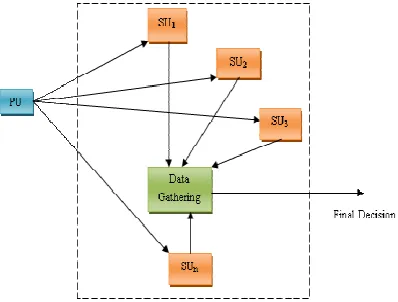
Figure 1: Sensing in Cooperative Environment
Cooperative spectrum sensing environment is shown in Figure 1. For a given sequence of sensing, the CU estimates the SNR of its received signal in the AWGN channel. The SNR observed from the CUs are then communicated to the overall FC through the control channel for final decision. Fi-nally, the FC coordinates with the observations of all the CUs and their observed SNR to make a final decision about the appearance or non-appearance of the PU signal.
Our primary goal is to detect the PU signal in the given AWGN channel and that is never seam-lessly known in the real time spectrum sensing, hence we assumed that the PU signal is present in the AWGN channel and by maximizing the SNR
we detect the presence or absence of PU signal us-ing optimal filter based on fixed threshold [14].
3. MATCHED FILTER DETECTION
To enrich the SNR a matched filter is often used at the receiver front end. Matched filter coefficients are basically given by the complex conjugated re-versed signal samples in terms of discrete signals. Two types of coherent or non-coherent receivers are used based on signal analysis either as complex signals or noises. If the amplitude and phase of the received signal are known coherent receivers are used results in a perfect match between the matched filter coefficients and the signals. In case of a noncoherent receiver, the received signal is mod-eled as a replica of the original signal with a ran-dom phase error. With a noncoherent receiver the detection after the matched filter is generally based on the power or magnitude of the signal since we need both real and imaginary parts to define the signal entirely [15].
Power Spectral Density (PSD) of the AWGN signals is given
0 AWGN
N
PSD (f )
2
= (3)
Where N0 is the noise signal and AWGN
chan-nel Signal to Noise Power measured at the output of
the matched filter is given by
2
2
S(t) SNR
N(t)
= (4)
The output noise power Pn calculated of the nth primary user is found to be [16]
2 0
n n
N
P H (f ) df
2 +∝
−∝
=
∫
(5)The output signal power Ps calculated of the nth
primary user is found to be
2 ej2 ft
s n i
P H (f )S (f ) df
+∝
π
−∝
=
∫
(6)Output signal power Ps is decomposed in terms
of input signal power Si using Schwartz inequality
2
s n is
P H (f )df P
+∝
−∝
=
∫
(7)Now the SNR of the primary user is simplified
to SNRo
is o
0
2P SNR
N
= (8)
4. DETECTION OF PRIMARY USER SIG-NAL IN ADDITIVE WHITE GAUSSIAN NOISE CHANNEL
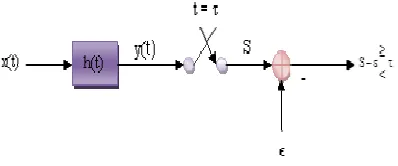
[image:4.612.95.294.261.344.2]The reason behind introducing Matched Filter implementation is to model the evolution of PU signal in the spectrum band considered over time by measurements using CR. In this section, we con-sider the basic functional model of linear matched filter. Primarily matched filter implementation is best suitable for radar, sonar, wireless communica-tion systems, Intelligent Radio Systems and binary detection of AWGN channel as shown in Figure 2.
Figure 2: Implementation of Matched Filter
Binary detection problem is used to identify the state of PU signal presence or absence in AWGN
channel in the time interval of 0 ≤ t ≤ T. The binary
hypothesis specified by H1 and H0 indicates the
presence and absence of PU signal [17] in the channel considered.
0 1
H : Y(t) N(t)
H : Y(t) s(t) N(t)
=
= + (9)
Here N(t) is the AWGN with zero mean and
co-variance of σ2δ(t-s), where σ2 is the power density
of intensity of the AWGN signal. In order to detect the PU signal an orthonormal basis function in sig-nal space {Φi (t), i ϵ I} of space S2 [0,T] integrable over the function [0,T]. As the first element of the basis, we select the function as
1 1
2
s(t) (t)=
E
Φ (10)
Where
T
2 2
0
E= s =
∫
s dt (11)If we identified orthonormal basis {Φi (t), i ϵ I}, using Karhunen-Loeve decomposition [18] AWGN noise N(t) decomposed to
T
i i
0
N =
∫
N(t)Φ (t)dt (12)Similarly the received signal Y(t) can be de-composed to
T
i i
0
Y =
∫
Y(t)Φ (t)dt (13)Under signal space domain, the detection prob-lem reduces to one dimensional probprob-lem as
0 1 1
1 2
1 1 1
H : Y N
H : Y E N
=
= + (14)
Now the Binary Hypothesis theory in terms of Generalized Likelihood Ratio Test (GLRT) [19] statistics established as
1 1 2 2 1 2 1
2 1 2
0
H 1
exp( (y E ) )
2 L(y )
1
exp( y )
2 H
− − ≥
σ
= τ
< −
σ
(15)
Where τ denotes the threshold and taking
loga-rithms and reorganizing the resulting identity gives
1 1
2 2
1 1
2 0
H
E
Y ln( )
2 E H
≥ Ω +σ τ
< (16)
Hence the optimum filter expressed in terms of sufficient statistics S as
T 1
0 2
1
S Y(t)s(t)dt
E
=
∫
(17)Under binary hypothesis it is observed that
Y1~N(0, σ2) based on H0 and Y1~N(E1/2, σ2)
based on H1. If r denotes the distance between the two hypotheses measured in terms of noise standard deviation.
ISSN: 1992-8645 www.jatit.org E-ISSN: 1817-3195
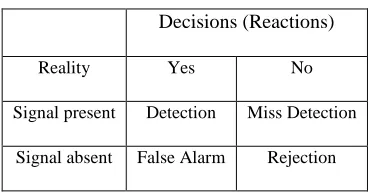
Table 1: The four possible types of reaction
Decisions (Reactions)
Reality Yes No
Signal present Detection Miss Detection
Signal absent False Alarm Rejection
It is shown that the probability of detection PD and Probability of false alarm PF for the test are given by
D
ln( ) r
P 1 Q( )
2 r
τ
= − − (18)
F
ln( ) r
P Q( )
2 r
τ
= − (19)
By using Neyman-Pearson (NP) test and
elimi-nating the threshold τ from the above identities we
achieve
1
D F
P = −1 Q(r−Q (P ))− (20)
Using unnormalised statics we obtain the suffi-cient static S as
1
2
0
H
E
S ln( )
2
H
≥
γ + σ τ
< (21)
5. RESULT AND DISCUSSION
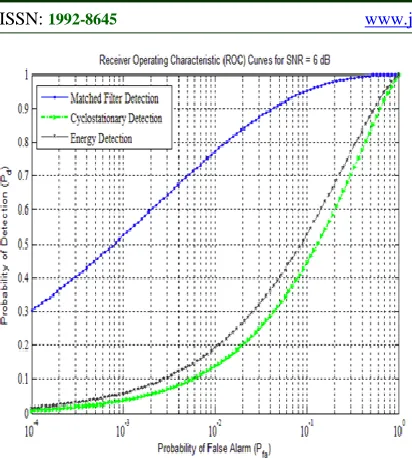
In order to increase the performance of spec-trum sensing, we allow various SU to cooperate by sharing their information and to reduce the commu-nication overheads, users share their decision statis-tics based on the binary hypothesis testing. In signal estimation theory, a receiver operating characteris-tic (ROC) curve is a graphical plot which demon-strates the performance of a binary classifier system as with threshold variation. It is created by plotting the probability of detection (PD) vs. Probability of False alarm (PF), at various threshold values. In general, if both of the probability distributions for detection and false alarm are known, the ROC curve can be generated by plotting the Cumulative Distribution Function of the detection probability in the y-axis versus the Cumulative Distribution Func-tion of the false alarm probability in x-axis. The sensing performance of the proposed scheme, in
terms of its ROC curve is evaluated using Monte-Carlo simulations.
It is assumed that the PU signal is likely-equally Binary Phase Shift Keying (BPSK) signal [19] with prior probabilities Pr {H0} = Pr {H1} = 0.5 and the noises at CUs are AWGN with zero mean and unit variance.
Figure 3: Receiver Operating Characteristics Curve For 3 Db SNR
[image:5.612.315.518.190.383.2]Figure 4: Receiver Operating Characteristics Curve For 6 Db SNR
6. CONCLUSSION
In order to sense the spectrum holes consistently and resourcefully, in this paper we propose a matched filter based cooperative spectrum sensing in CR networks. The advantage of the proposed scheme comes from the fact that it can work with very low SNR with the knowledge of the PU signal, the prior probability of the PU activity, and SNRs of the PU signal at cognitive radio terminals. Mon-te-Carlo simulation results based on ROC curve show that the sensing performance of the proposed scheme outperforms the performance of Kalman filter based adaptive fuzzy system scheme and one order Cyclostationary detection scheme.
The only limitation of the proposed scheme is we should have the prior knowledge about the PU signal before sensing the channel. The choice of matched filter detection technique proposed here to estimate the channel in the lower SNR regime.
Consequently, finding lower bound of min τ
(Threshold) and upper bound of max τ is still an
open issue. Future work is in progress in this direc-tion.
REFRENCES:
[1] S. Haykin, "Cognitive Radio: Brain-Empowered Wireless Communications", IEEE Journal on
Selected Areas in Communications, vol. 23,
2005, pp. 201-220.
[2] K. Yau, P. Komisarczuk and P.D. Teal, "Cogni-tive Radio-based Wireless Sensor Networks: Conceptual Design and Open Issues", IEEE
34th Conference on Local Computer Network,
2009, pp. 955-962.
[3] Federal Communications Commission (FCC),
Spectrum Policy Task Force, ET Docket no.2,
2002, pp. 1-135.
[4] R.W. Broderson, A. Wolisz, D. Cabric, S.M. Mishra and D. Willkomm, "CORVUS: A Cog-nitive Radio Approach for Usage of Virtual Un-licensed Spectrum", White Paper, University of
California, Berkeley, Technical Report, 2004.
[5] A. Ghasemi and E.S. Sousa, "Collaborative Spectrum Sensing for Opportunistic Access in
Fading Environments", Ist IEEE Symposium on
New Frontiers in Dynamic Spectrum Access Network, 2005, pp. 131-136.
[6] F. F. Digham, M.S. Alouini and M.K. Simon, "On the Energy Detection of Unknown Signals Over Fading Channels", IEEE International
Conference on Communications, vol. 5, 2003,
pp. 3575-3579.
[7] Lei Zhang and Shuquan Xia, "A New Coopera-tive Spectrum Sensing Algorithm for CogniCoopera-tive Radio Networks", Proceedings of ISECS
Inter-national Colloquium on Computing, Communi-cation, Control, and Management, vol. 1, 2009,
pp. 107-110.
[8] Sina Maleki, Sundeep Prabhakar Chepuri and Geert Leus, "Energy and Throughput Efficient Strategies for Cooperative Spectrum Sensing in Cognitive Radios", IEEE 12th International
Workshop on Signal Processing Advances in Wireless Communications, 2011, pp. 71-75.
[9] Z. Quan, S. Cui and A.H. Sayed, "Optimal Linear Cooperation for Spectrum Sensing in Cognitive Radio Networks", IEEE Journal of
Selected Topics in Signal Processing, vol. 2,
2008, pp. 28-45.
[10] T. Kieu-Xuan and I. Koo, "A Cooperative Spec-trum Sensing Using Fuzzy Logic for Cognitive Radio Networks", KSII Transactions on Internet
and Information Systems, vol. 4, 2010, pp.
289-304.
[11] T. Kieu-Xuan and I. Koo, "Cooperative Spec-trum Sensing using Kalman Filter based Adap-tive Fuzzy System for CogniAdap-tive Radio Net-works", KSII Transactions on Internet and
In-formation Systems, vol. 6, 2012, pp. 287-304.
[12] Waleed Ejaz, Najam Ul Hasan and Hyung Seok Kim, "SNR Based Adaptive Spectrum Sensing for Cognitive Radio Networks", International
ISSN: 1992-8645 www.jatit.org E-ISSN: 1817-3195
[13] Rahul Tandra and Anant Sahai, "SNR Walls for Signal Detection", IEEE Journal of Selected
Topics in Signal Processing, vol. 2, 2008, pp.
4-17.
[14] Pu Wang, Hongbin Li and Braham Himed, "Bayesian Parametric Approach for Multichan-nel Adaptive Signal Detection", IEEE Radar
Conference, Washington DC, 2010, pp.
838-841.
[15] A. Eftekhari, A. J. Romberg and M.B. Wakin, "Matched Filtering from Limited Frequency Samples", IEEE Transactions on Information
Theory, vol. 59, 2013, pp. 3475-3496.
[16] F. Chaillan, C. Fraschini and P. Courmontagne, "Stochastic Matched Filtering Method Applied to SAS Imagery", Proceedings of OCEANS’05, vol. 1, 2005, pp. 233-238.
[17] Rongfei Fan and Hai Jiang, "Optimal Multi Channel Cooperative Sensing in Cognitive Ra-dio Networks", IEEE Transactions on Wireless
Communications, vol. 9, 2010, pp. 1128-1138.
[18] P. A. Regalia, "An Adaptive Unit Norm Filter with Applications to Signal Analysis and
Karhunen-Loeve Transformations", IEEE
Transactions on Circuits and Systems, vol. 37,
1990, pp. 646-649.
[19] John Proakis and Masoud Salehi, Digital
Com-munications, McGraw-Hill, 2007.
[20] Peter J. Schreier, Louis L. Scharf and Alfred Hanssen, "A Generalized Likelihood Ratio Test for Impropriety of Complex Signals", IEEE
Signal Processing Letters, vol. 13, 2006, pp.
433-436.