A FULLY ASSOCIATIVE CACHE ALGORITHM WITH
IMPROVED PERFORMANCE
S.SUBHA
SITE, Vellore Institute of Technology , Vellore, India
E-mail: [email protected]
ABSTRACT
Fully associative caches enable all blocks to map address. This paper proposes an algorithm to enable one fully associative block. The address a is right shifted by certain prefixed number of bits. The result is XOR’ed with n-1, n being the number of fully associative cache blocks. The bit selection of the result to map to one of the n blocks in fully associative cache is performed. The chosen block is enabled to access a line or place cache line. The proposed algorithm is simulated with SPEC2K benchmarks. The average memory access time is improved by 16% with energy savings of 9%. The proposed model shows 30% degradation in average memory access time with no change in energy consumption over direct mapped cache of same size.
Keywords: Average Memory Access Time, Cache Algorithm, Cache Performance, Energy Saving, Fully
Associative Cache
1. INTRODUCTION
Caches are denoted by (C,k,L) for capacity C with associativity k and line size L bytes. Caches are of three kinds –direct mapped, set associative and fully associative [1,3] A line is placed in fixed position in direct mapped cache. It can occupy any of the k-ways in k-way set associative cache in the mapped set. It can occupy any of the n blocks in fully associative cache of n blocks. In fully associative cache, the address and data are placed in block. The address match is performed, the block accessed on hit. In case of miss, the least recently used block is replaced. This operation involves performing address match with all blocks. Hence all blocks are enabled during address mapping. Ideally, it is desirable if only one block is enabled during address mapping. The author in [4, 5] proposes algorithm to enable subset of the fully associative cache. In [7] only one block is enabled. However there is increase in average memory access time. A method to save energy in fully associative cache is presented in [6]. The use of XOR functions improves the performance of set associative caches is shown in [2].
This paper proposes algorithm with improved AMAT and energy saving in fully associative cache. The address is shifted right by prefixed number of bits. The result is XOR’ed with n-1, n number of fully associative cache blocks. Bit selection is done to map to block. The mapped block is accessed. The line is accessed if present (hit) or placed in the mapped block (miss). The proposed model is simulated with SPEC2K benchmarks. The average memory access time is improved by 16% with energy savings of 9%. The proposed model shows 30% degradation in average memory access time with no change in energy saving over direct mapped cache of same size. The rest of the paper is organized as follows. Section 2 gives motivation, section 3 the proposed model, section 4 mathematical analysis of proposed model, section 5 simulations, section 6 conclusion followed by acknowledgments and references.
2. MOTIVATION
1. Right shift 100 one position. This gives 50 2. Perform XOR with (4-1). This gives 49. 3. Extract 2 bits from 49 i.e. perform 49%4.
This gives 1. Address 100 is mapped to block 1.
4. Stop.
Repeating the above algorithm for addresses 101, 104, 123, 140 maps to blocks 1, 3, 2, 1. In this mapping only one block is accessed. If the cache consumes 10J per block during operation, the total energy consumed during operation in traditional cache is 4*5*10J=200J. Assume the cache operates in two modes viz. high power mode and low power mode in the proposed model. A block is in low power mode during non-operation. Assume the cache consumes 5J per block during non-operation. The energy consumed in this model is 5*4*5J+5*5J = 125J. An improvement of 37.5% in energy consumption is observed. This is the motivation of this paper.
3. PROPOSED MODEL
Consider a cache system. The performance of the cache system is measured in terms of average memory access time. The energy consumed by the cache system depends on the number of active components. The aim of cache operation is
Min Energy consumed Subject to
Min average memory access time. (1)
The following algorithm aims at achieving (1) Consider fully associative cache of n blocks. Consider address a. The following algorithm maps the address to block b.
1. computer a>>line size to get the address 2. compute a>>x for some x
3. Compute a XOR (n-1).
4. choose the block b=a%n
5. If the address and data are present in b, increment number of hits, access the block and stop.
6. Place the block in b , increment number of misses, access the block and stop.
The number of bits used for right shift in step 2 of the above algorithm can be varied.
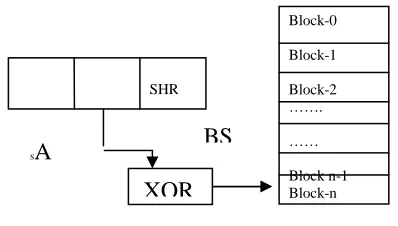
The architecture of the proposed model is shown in Figure 1. Only one block is accessed in the proposed model.
Figure 1 Architecture of proposed model. Address A is right shifted SHR bits. The result is XOR’d wih n-1, and bit selection BS is done to map to block in fully associative cache of n blocks.
4. MATHEMATICAL ANALYSIS OF
PROPOSED MODEL
Consider two level inclusive cache system . Let level one be fully associative cache of n blocks. Let level two be
w
1-way set associative cache of S sets. Denote this system asprop
C
.Consider address trace with R references. Consider the algorithm proposed in section 3. Let k be the time taken to perform the address mapping. Leth
1, h
2 be the hits in level one and level two cache respectively. Lett
1,
t
2,
t
12,
M
be level one hit time, level two hit time, time to transfer block of data between level one and level two and miss penalty respectively. The average memory access
SHR
Block-0
Block-1
Block-2 …….
……
Block n-1 Block-n s
A
Fully associative cache
[image:2.612.333.532.327.440.2]time is given by
( )
(
)
(
)
−
−
+
+
+
+
+
=
M
h
h
R
t
t
t
h
t
h
Rk
R
C
AMAT
prop 2 1 12 2 1 2 1 11
(2) The first term in (2) is the time taken to perform address mapping. The second term is the time taken to access level one hits. The third term is the time taken to access level two hits. The fourth term is the time taken to access the misses in the cache system.Consider the traditional cache system. Let level one be fully associative cache and level two be set associative cache with same capacity as
prop
C
. Denote this system asC
trad. The address mapping in this system is done as usual. LetH
1, H
2be the number of hits in level one and level two respectively. Letm
T
T
T
1,
2,
12,
be level one hit time, level two hit time, transfer time between level one and level two, and miss penalty respectively. The average memory access time is given by(
)
(
)
(
)
−
−
+
+
+
+
=
m
H
H
R
T
T
T
H
T
H
R
C
AMAT
trad 2 1 12 2 1 2 1 11
(3) The first term in (3) is the level one hit time, second term is the level one miss and level two hit, third term is the time to service miss in level one and level two caches. An improvement in AMAT is observed if(
)
(
)
−
−
+
+
+
+
+
M
h
h
R
t
t
t
h
t
h
Rk
R
1 212 2 1 2 1 1
1
<=(
)
(
)
−
−
+
+
+
+
m
H
H
R
T
T
T
H
T
H
R
1 212 2 1 2 1 1
1
(4)Consider direct mapped cache of same size. Let the number of sets be
S
d. Leth
1d,
h
2dbe level one and level two cache hits. Letd d d
d
t
t
m
t
1,
2,
12,
be level one access time, level two access time, transfer time between level one and level two and miss penalty in direct mapped cache. The average memory access time is given by(
)
(
)
(
)
−
−
+
+
+
+
=
d d d d d d d d d directh
h
R
m
t
t
t
h
t
h
R
C
AMAT
2 1 12 2 1 2 1 11
(5)A performance improvement in AMAT with direct mapped cache is observed if
(
)
(
)
− − + + + + + M h h R t t t h t h RkR 1 2
12 2 1 2 1 1 1 <=
(
)
(
)
−
−
+
+
+
+
d d d d d d d d dh
h
R
m
t
t
t
h
t
h
R
2 1 12 2 1 2 1 11
(6) Consider the energy consumption. In the proposed model only one block in level one is accessed. The entire cache set is accessed in level two access. Assume the cache system operates in two energy modes – high energy mode and low energy mode. The cache system is in low energy mode during non-operation. Let the energy consumed per cache block during operational and non-operational mode beE
high,E
low respectively. In the proposed model the following happens.2. For
h
2references, one fully associative block and one set in level two is enabled in high energy mode.3. For
R
−
h
1−
h
2 references, one block in level one and one set in level two is enabled in high energy mode.The total energy consumed in the proposed model is given by
( )
(
)
(
)
(
) (
)
(
)
(
1 2)
(
)
(
1)
1 2 1 1
1 w
E
E
h
h
R
E
E
w
E
E
h
E
E
h
S
w
n
RE
C
E
low high low high low high low high low prop+
−
−
−
+
−
+
−
+
−
+
+
=
(7) The first term in (7) is the energy consumed by cache system during non-operation. The second term is the energy consumed during level one hits. The third term is the energy consumed in level two hits. The fourth term is the energy consumed during miss. In the traditional cache the following happens. 1. The entire fully associative cache is inhigh energy mode during operation. 2. The level two set associative cache is in
non-operational mode. During access one set is in operational mode.
The energy consumed in the traditional cache is given by
(
)
(
)
(
)
(
)
(
high low)
low high high low trad
E
E
w
h
h
R
E
E
w
h
RnE
S
w
RE
C
E
−
−
−
+
−
+
+
=
1 2 1 1 2 1(8)
The first term in (8) is the energy consumed by level two cache during non-operation. The second term is the energy consumed by fully associative cache in level one. The third term is the energy consumed during level two hits. The fourth term is the energy consumed during miss. An improvement in energy consumption is observed if
(
)
(
)
(
) (
)
(
)
(
1 2)
(
)
(
1)
1 2 1 1
1
w
E
E
h
h
R
E
E
w
E
E
h
E
E
h
S
w
n
RE
low high low high low high low high low+
−
−
−
+
−
+
−
+
−
+
+
<=
(
(
)
)
(
)
(
high low)
low high high low
E
E
w
h
h
R
E
E
w
h
RnE
S
w
RE
−
−
−
+
−
+
+
1 2 1 1 2 1(9)
Consider the direct mapped system. The following happens.
1. The direct mapped cache is in low power mode during non-operation. The accessed set is in high power mode during operation.
2. The level two set associative cache is in low power mode during non-operation. The accessed set is in high power mode during operation.
The energy consumed in the direct mapped cache is given by
(
)
(
)
(
)
(
)
(
)
(
d d)(
)
(
high low)
low high d low high d d low direct E E w h h R E E w h E E h S w S RE C E − + − − + − + + − + + = 1 2 1 1 2 1 1 1 1(10)
The first term in (10) is the energy consumed by the cache system during non-operation. The second term is the energy consumed during direct mapped cache hits. The third term is the energy consumed during level one miss, level two hits. The fourth term is the energy consumed during miss. An improvement in energy consumption is observed if
( )
(
)
(
)
(
)
(
)
( 1 2)
(
)
( 1)1 2 1 1 1 w E E h h R E E w E E h E E h S w n RE low high low high low high low high low + − − − + − + − + − + +
<=
(
)
(
)
(
)
(
)
5. SIMULATIONS
The proposed model is simulated with SPEC2K benchmarks. The simplescalar Toolset was used to gather addresses from SPEC2K benchmarks. The program was run on a Linux system with uniprogram environment. Routines in C program were written to simulate the proposed model. A two level data cache model was simulated with the parameters shown in Table 1. The addresses were shifted by fourteen bits in this simulation. The simulations resulted in same performance increasing the number of bits used for right shift in the proposed model. The number of hits and misses were collected.
Table 1 Simulation Parameters
Parameter Value
L1 size in blocks 32768
Block size 32 bytes
L2 size in sets 65536
L2 associativity 4
L1 access time in fully associative cache in proposed model
1 cycle
L1 access time in traditional fully associative cache
6 cycles
L2 access time 12
cycles
Miss penalty 65
cycles
XOR calculation 1cycle
L1 to L2 transfer time 10 cycles
L1 access time in direct mapped cache 1 cycles
The AMAT is shown in Figure 2. As seen from the Fig.2 there is an improvement in AMAT by 16% over traditional fully associative cache and degradation of 30% over direct mapped cache of
same size.
Figure 2 AMAT comparison
The energy consumed with respect to traditional cache system is shown in Table 2. The cache is assumed to consume 5J during non-operation and 10J during operation per cache way. As seen from Table 2 there is improvement of 9% in energy consumed.
Table 2 Energy comparison with traditional cache system
name
Energy(p)
Energy(t)
%improve
256.bzip2
6.89E+11
7.66E+11
9.999776
181.mcf
5.84E+09
6.49E+09
9.999603
197.parser
4.78E+10
5.32E+10
9.99966
300.twolf
6.65E+09
7.39E+09
9.999616
255.vortex
1.78E+10
1.97E+10
9.999465
175.vpr
1.29E+10
1.43E+10
9.999552
average
9.999612
There is no change in energy consumption of the proposed model with respect to direct mapped cache.6. CONCLUSION
9%. The proposed model shows 30% degradation in average memory access time with no change in energy consumption over direct mapped cache of same size.
ACKNOWLEDGMENTS
The authors expresses thanks to Santa Clara University, Santa Clara, CA, USA for providing Simplescalar Toolkit and SPEC2K benchmarks.
REFERENCES
[1] Alan Jay Smith, “Cache memories”, Computing Surveys, Vol. 14, No.3, pp. 473-530, September 1982
[2] Antonio Gonzalez, Mateo Valero, Nigel Topham, Joan M Parciresa, “Eliminating Cache Conflict Misses Through XOR-Based Placement Function”, Proceedings of ICS, 1997
[3] David A.Patterson, John L.Hennessey, Computer System Architecture, 3rd ed., Morgan Kaufmann Inc., 2003
[4] S.Subha, “An Algorithm for Fully Associative Cache Memory, Proceedings of Second Bihar Science Conference, 2009
[5] S.Subha, “Performance analysis of variable number of sets in fully associative cache”, Proceedings of International Conference on Computing, Engineering and Information, pp. 295-298 , 2009
[6] S.Subha, “An Energy Saving Model for Fully Associative Cache”, Proceedings of TISC, 2011
[7] S.Subha, “Energy efficient fully associative cache model”, International Journal of Computing Applications, Vol. 47, No.6, pp. 16-18, June 2012