ON THE APPLICATION OF WAVELTE ANALYSIS AND
APPROXIMATE ENTROPY IN PILE FOUNDATION
INSPECTION
1XIE HONGYANG, 2LIAO YICHEN 1
Assoc. Prof., College of Civil Engineering and Architecture, Nanchang Hangkong University, CHINA
2Asstt Prof., College of Civil Engineering and Architecture, Nanchang Hangkong University, CHINA
E-mail: [email protected], [email protected]
ABSTRACT
The concrete quality rating of pile foundation often adopts the PSD multi-parameter synthesis method, but due to the discontinuous characteristics and random disturbance of concrete material itself, mistakes will be resulted from in the pile foundation inspection process, during which the singular signal will interfuse. This paper uses the wavelet transform to decompose the suspected defect signals of the pile foundation, and introduces the disordered degree of approximate entropy quantitative characterization. The results show that the signal amplitude of defect signals in high frequency band attenuates, the waveforms are mixed and disordered, and the approximate entropy value is big. Thus, the suspected defects can be judged. The engineering example has proved the effectiveness of this method in the pile foundation inspection.
Keywords: Wavelet Analysis; Approximate Entropy; Pile Foundation Inspection
1. INTRODUCTION
Bored cast-in-place pile is the commonly used foundation form in bridge engineering. But because of the uncertain factors in construction processes, broken piles, clamp mud, necking, holes and other internal defects can directly affect the bearing capacity of the pile foundation. Thus it is necessary to test homogeneity and integrity of the pile foundation. The ultrasonic testing is a normal NDT method, which is simple, rapid, and can be directly used for the repeated engineering component detection. At present, this ultrasonic transmission method is used in the integrity testing of bored cast-in-place piles. According to the acoustic parameters and variations of one side concrete base pile, the defect position and range can be determined. Then, by using the PSD - V - A multi-parameter comprehensive evaluation methods, this paper evaluates the quality level of the pile foundation concrete.
But due to the discontinuous characteristics and random disturbance of concrete material itself, in the pile foundation inspection process, the singular signal will interfuse, thus the PSD-V-A[1] method can lead to mistakes. The wavelet transform [2]- [3] is a kind of multi-resolute time-frequency domain
analysis method, which breaks through the resolution limit of Fourier analysis, and it can focus on any frequency bands of signals. It has the good localization characteristic, especially be suitable in processing time-varying spectrum of non-stable signals. Based on the wavelet theory, this paper adopts the wavelet decomposition and procession on the ultrasonic transmission signal, does the quantitative analysis on the complexity of transmission signals, and proposes the using of approximate entropy [4] - [9] to characterize the degree of uniformity of the base pile concrete.
2. THEORETICAL ANALYSIS
The basic idea of wavelet transform is to decompose the original signal into simple functions which are in the gens of a same space and has the time-frequency localization characteristics. That is the wavelet function system, and it is formed through the different scale translation and compression of the mother wavelet function or basic wavelet function. Set
) ( ) (x L2 R
f ∈ the square integrable function, the scaling function and wavelet function are
ϕ
(
x
)
) ( ) ( ) ( ) ( )
( 0 0, ,
0 x k d x k c x
f jk
j j k j k j k
j ϕ
∑∑
ψ∑
∞= +
= The
cj0 is the approximation or scale coefficient of the
j0 layer, which on behalf of the average part or low frequency component of the signal; dj is the
detail or wavelet coefficient of the j0 layer, which on behalf of the changes of signal or the high frequency component. So the original signal can be decomposed into the sum of approximate c and wavelet details d. Take the hole or crack defects of pile foundation concrete as the effects of singular signal on the original signal effects, which often make the original signal, especially high frequency band signal to attenuate.
As for the ultrasonic detection signals that contain singular point or different singular degree, the wavelet transform can decompose them into a series of the independent low frequency and high frequency components. And compared with the PSD - V - A method, it can capture the singular point position more quick, and more effectively to analyze the signal singularity degree. In order to quantitatively evaluate the singular degree of the wave signals, the approximate entropy is introduced. Thus, it can reflect the complexity or disorder of a time series signal from the point view of statistics. Its advantage is to avoid the rebuilding of the outline of the singular attractor, so the needed data is less, and approximate entropy estimation is effective to the stochastic process and deterministic process.
Set the collected original data is x(i), (I = 1, 2, 3... N), the mode embedding dimension is
m
and similar tolerance value isr
, then, the approximate entropy can be calculated through the following steps:1. let the series
{
x
(
i
)}
compose them
dimension vector{
o
(
i
)}
(i=1N-m+1);] ) 1 ( ) 2 ( ) 1 ( ) ( [ )
(i = xi xi+ xi+ xi+m−
o
2. Calculate the distance between
o
(
i
)
and othervectors of
o
(
j
)
;|
)
(
)
(
|
max
)]
(
),
(
[
10
x
i
k
x
j
k
j
o
i
o
d
mk
+
−
+
=
+ =
3. Based on the similar tolerance value of
r
, calculate the similarity betweeno
(
i
)
ando
(
j
)
,written as Cm(r)
i ;
∑
≠ + − < = j i mi r d o i o j r N m
C ( ) { [ ( ), ( )] }/( 1)
4. Take the logarithm of
C
im(
r
)
, and get theaverage value of all
i
, written asφ
rm;∑
− + = + − = 1 1 ) 1 /( ) ( ln m N i m i mr C r N m
φ
5. Repeat the above steps to get the
φ
rm+1;6. Theoretically the sequence of approximate entropy is:
1 )
, ,
(m r N = rm− rm+
ApEn
φ
φ
The approximate entropy is closely related to the values of
m
andr
. Based on Pincus's experience [6, 7], choosem
=2,r
=
ad
ST( )
x
,( )
ST
d
x
is the standard deviation,a
is the Weight parameters ofr
and the range is 0.1~0.25. The approximate entropy is the similar degree on mode of the time series. Combine with the wavelet discomposition, the time series can be evaluated by getting the approximate entropy of wavelet coefficient and approximation coefficient.3. TEST ANALYSIS
Take the bored perfusion pile foundation in
Nanchang County Fushan rural bridge
[image:2.612.317.519.596.700.2]engineering as an example, the designed pile diameter is 1200 mm, the length is of 19.0 m, the measured pile length is17.5 m, the strength grade of the concrete is C25. Three root sound tubes will be embedded with the tube distance AB, BC, CA are 840 mm, 820 mm and 680 mm respectively. The pile foundations will be tested after 27 days. The test instrument is the RS - ST01C nonmetal ultrasonic detector.
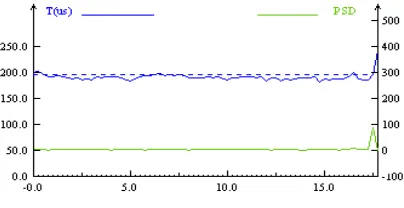
According to the acoustic - PSD curve, the suspected defects in 17.5 m at AB profile’s pile foundation can be found, as shown in figure 1. By the wavelet decomposition of the ultrasonic transmission signal, the discontinuity of the profile can be clearly observed; especially the singular perturbation in detail wave (high frequency) can be detected.
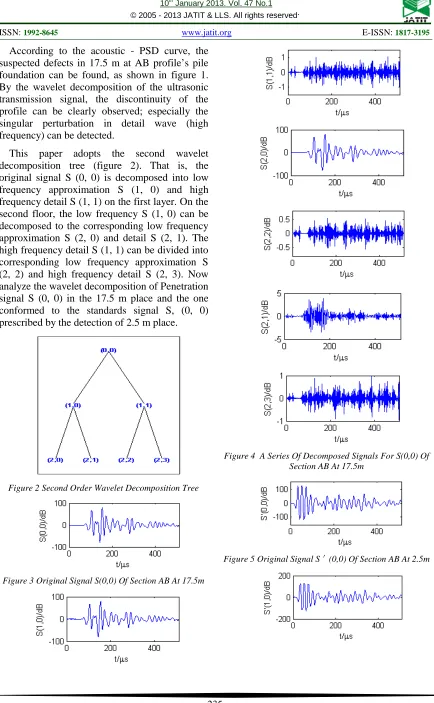
[image:3.612.91.525.49.752.2]This paper adopts the second wavelet decomposition tree (figure 2). That is, the original signal S (0, 0) is decomposed into low frequency approximation S (1, 0) and high frequency detail S (1, 1) on the first layer. On the second floor, the low frequency S (1, 0) can be decomposed to the corresponding low frequency approximation S (2, 0) and detail S (2, 1). The high frequency detail S (1, 1) can be divided into corresponding low frequency approximation S (2, 2) and high frequency detail S (2, 3). Now analyze the wavelet decomposition of Penetration signal S (0, 0) in the 17.5 m place and the one conformed to the standards signal S, (0, 0) prescribed by the detection of 2.5 m place.
Figure 2 Second Order Wavelet Decomposition Tree
Figure 3 Original Signal S(0,0) Of Section AB At 17.5m
Figure 4 A Series Of Decomposed Signals For S(0,0) Of Section AB At 17.5m
[image:3.612.129.273.386.518.2]Figure 6 A Series Of Decomposed Signals For S(0,0) Of Section AB At 2.5m
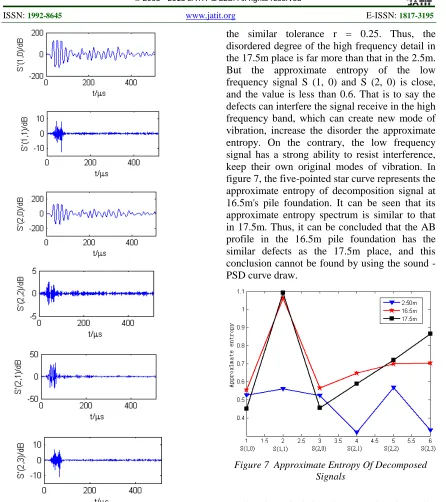
Compare figure 5 and 6, it is easy to find that the amplitude high frequency signal in the 17.5m is far less than that of in the 2.5m. The waveform is mixed and disordered, and no prominent singular point can be found. It indicates that the concrete in the 17.5m AB section exists even discontinuous. It can be dispersed mud pie, honeycomb defect or pile bottom sediment.
[image:4.612.99.263.86.572.2]the similar tolerance r = 0.25. Thus, the disordered degree of the high frequency detail in the 17.5m place is far more than that in the 2.5m. But the approximate entropy of the low frequency signal S (1, 0) and S (2, 0) is close, and the value is less than 0.6. That is to say the defects can interfere the signal receive in the high frequency band, which can create new mode of vibration, increase the disorder the approximate entropy. On the contrary, the low frequency signal has a strong ability to resist interference, keep their own original modes of vibration. In figure 7, the five-pointed star curve represents the approximate entropy of decomposition signal at 16.5m's pile foundation. It can be seen that its approximate entropy spectrum is similar to that in 17.5m. Thus, it can be concluded that the AB profile in the 16.5m pile foundation has the similar defects as the 17.5m place, and this conclusion cannot be found by using the sound - PSD curve draw.
Figure 7 Approximate Entropy Of Decomposed Signals
Thus, by calculating the approximation value of ultrasonic signal and the approximate entropy of wavelet details in the section, it can easily and reliable assess the pile foundation concrete's homogeneity in different depths and profiles.
4. CONCLUSION
[image:4.612.315.521.356.520.2]concrete defects can make the signal amplitude attenuate in high frequency band, and the waveforms are mixed and disordered. To quantitatively evaluate the signal disorder degree, the approximate entropy is introduced to measure the probability of signals' generating of new vibration model, the results prove that it can easily and reliable assess the pile foundation concrete's homogeneity in different depths and profiles.
REFRENCES:
[1] Xinxuan Wu, “Concrete Nondestructive Testing Technology Handbook”, Beijing: China Communications Press, 2003.
[2] I. Daubechies, “The wavelet transform, time frequency localization and signal analysis”,
IEEE transactions on Information Theory, Vol. 36, No. 5, 1990, pp. 961-1005.
[3] Xinmin Tao, Jing Xu, and Baoxiang Du, “Bearing Fault Diagnosis Based on Wavelet-domain Generalized Gaussian Distribution”,
Chinese Journal of Mechanical Engingeering,
Vol. 45, No. 10, 2009, pp. 62-67.
[4] Hongmei Jin, Wenping He, and Wei Hou, “Effects of different trends on moving cut data-approximate entropy”, Acta Physica Sinica, Vol. 61, No. 6, 2012, pp. 1-9.
[5] Guohua Liu and Zhigen Wu, “New thought on dynamic identification technology for damage detection of RC structures by introducing information entropy theory”, Journal of vibration and shock, Vol. 30, No. 6, 2011, pp. 162-171.
[6] Qiang Li and Taiyong Wang, “Research of adaptive stochastic resonance based on approximate entropy”, Acta Physica Sinica,
Vol. 56, No. 12, 2007, pp. 6803-6806.
[7] Yonggang Xu, Lingjun Li, and zhengjia He, “Appromimate entropy and its applications in fault diagnosis”,Information and Control, Vol. 31, No. 6, 2002, pp. 547-549.
[8] S. M. Pincus, “Approximate entropy as a measure of system complexity”, Proceedings of National Academy of Sciences of USA, Vol. 88, No. 6, 1991, pp. 2297-2301.