http://dx.doi.org/10.4236/cs.2015.63008
Implementation & Comparative Analysis of
10, 18 & 24 Level Diode Clamped Inverters
Using “Trust Region Dog Leg” Method
Haider Ali
1, Mohamed Z. H. Qawaqzeh
2, Muhammad Abbas
1, Takialddin Al Smadi
31CIIT, Abbottabad, Pakistan
2Faculty of Engineering, Al-Balqa’ Applied University, Amman, Jordan
3Department of Communications and Electronics Engineering, College of Engineering, Jerash University, Jerash,
Jordan
Email: [email protected], [email protected]
Received 5 December 2014; revised 23 March 2015; published 25 March 2015
Copyright © 2015 by authors and Scientific Research Publishing Inc.
This work is licensed under the Creative Commons Attribution International License (CC BY). http://creativecommons.org/licenses/by/4.0/
Abstract
Multilevel inverters are used in many industrial applications because of good power quality, minimum losses and less harmonics contents. Multilevel inverters require no series connected synchronized switching devices, transformer and complex filters. In this paper 10, 18, 24 diode clamped multi-level inverters (DCMLI) are implemented using trust region dog leg optimization
method to find the optimized values of switching angles (θ). It decreases the total harmonic
dis-tortion (THD) of the output voltages and to reduce the complexity of external filter required. The multi-level inverters are implemented in MATLAB Simulation and results are compared in terms of harmonics, system complexity and efficiency.
Keywords
DCMLI, THD, Switching Angles, IGBTs, Trust Region Dog Leg
1. Introduction
ma-chines, working at high speed with the power of twelve [5]. 3-level diode clamped inverter with active neutral points and zero current transition (3 tests such as pre-employment) use it for sustainable energy [6].
Comparison between two diodes clamped inverter nerve point of converter (DNPC-3 l tests such as pre- employment) and (ANPC-3 l tests such as pre-employment) discussed options for switching energy volume [7]. Using capacitors and one DC source to build multilevel inverter cascaded (H-bridge) [8].
H-bridge multilevel inverter flying capacitor using two different schemes of voltage balancing and equations used [9]. The closed method based on carrier to minimize losses of switches for a half cycle of the basic wave is used for analyzing each half-cycle of the switch area [10]. Two SVM methods are executed that explosive for the purpose of controlling the DVR in order to reduce the losses in the circuit breakers and less harmonic DIS [11]. Particle Swarm Optimization used in cascade inverter to reduce harmonics improve output quality [12]. Cascade multilevel inverter is implemented by using the theory of vector space to switch strategies in the topol-ogy. The proposed topology reduces harmonic distortion and switching frequency employed switches [13].
This proposed converter, diodes clamped multilevel inverters (DCMLI) for different levels of switching an-gles are calculated using the dog leg in order to minimize the total harmonic distortion (THD), improve the quality of the electricity voltage wave form, the overall efficiency of the inverter, as well as to study the rela-tions of levels with THD.
2. Methodology
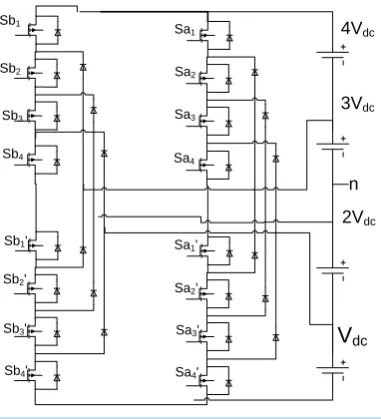
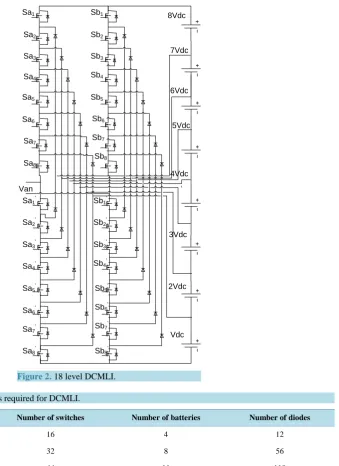
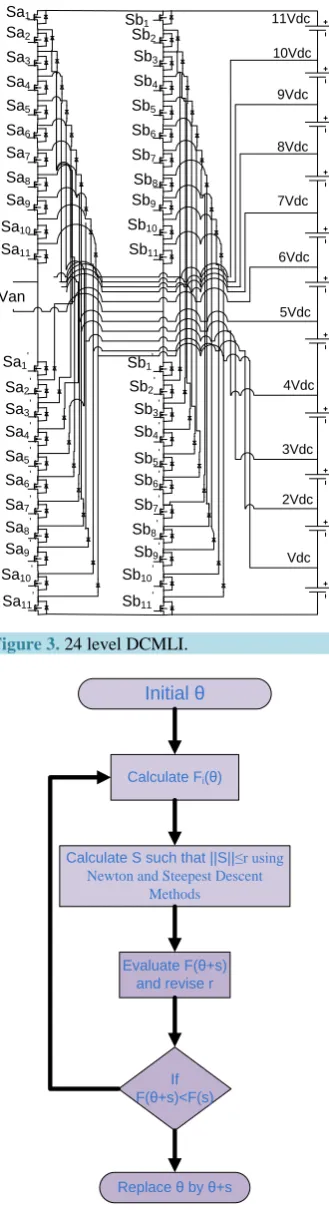
Circuit diagrams of diode clamped multilevel inverters (DCMLI) 10, 18, 24 levels are shown in the Figures 1-3
respectively. DCMLI consists of two legs and each leg consists of two sub-systems connected in series. Each subsystem comprises
(
m 2 1−)
switches. Every level of multilevel inverter has its own requirement of num-bers of switches (IGBTs), batteries and clamping diodes. The components are calculated using Equations (1), (2) and (3) and shown in Table 1.(
)
(
)
No. of switches IGBTs =4 m2 1− (1)
(
)( )
No. of batteries= m2 1 2− (2)
(
)(
)
No. of diodes= m 2 1− m 2−2 (3)
Switches of subsystem 1 are connected in series with subsystem 2 in one leg and similarly subsystem 3 with subsystem 4 in other leg. The output of the DCMLI is stepped stair case voltage levels as shown in Figure 5 for 10 levels DCMLI. To obtain different voltage levels and to eliminate lower order harmonics such as 3rd, 5th, 7th, 11th and 13th, selective harmonic elimination technique is implemented using Trust Region Dog Leg, the flow diagram is shown in Figure 4. Dogleg utilizes Newton and steepest descent methods. The combination of these
Sb1
Sb2
Sb3
Sb4
Sb2'
Sb3'
Sb4'
Sa1
Sa2
Sa3
Sa4
Sa1'
Sa2'
Sa3'
Sa4'
V
dc2Vdc 3Vdc 4Vdc
n
[image:2.595.218.409.500.710.2]Sb1'
Sa1 Sa2 Sa3 Sa4 Sa5 Sa8 Sa7 Sa6
Sa1'
Sa2 '
Sa3'
Sa4'
Sa5 '
Sa6'
Sa7'
Sa8 ' Sb1 Sb2 Sb3 Sb4 Sb5 Sb6 Sb7 Sb8
Sb1'
Sb2 '
Sb3'
Sb4'
Sb5 '
Sb6'
Sb7'
[image:3.595.203.543.85.552.2]Sb8 ' Vdc 2Vdc 3Vdc 4Vdc 5Vdc 6Vdc 7Vdc 8Vdc Van
Figure 2. 18 level DCMLI.
Table 1. Number of components required for DCMLI.
DCMLI Number of switches Number of batteries Number of diodes
10 level 16 4 12
18 level 32 8 56
24 level 44 11 110
two methods ensures a fast convergence and a solution of function in the steepest descent direction. The second step involves finding the value of trust region radius to estimate length of step for the current iteration such that the following condition is obeyed. Trust region dog leg optimization technique is utilized to find out the opti-mized switching angles using a set of non-linear equations derived to selectively eliminate specific harmonics (Selective Harmonic Elimination). The set of non-linear equations are shown in Equations (14), (15) and (16) and trust region dog leg method determines the optimized switching angles to result a wave form with minimum Total Harmonic Distortion (THD).
For particular switching angle different switches are turned on, for 10 levels four switches and 8 for 18 levels and 11 for 24 levels are on in one leg and 4, 8 and 11 in another leg. Every switch is turned on and off only once in half cycle therefore the switching losses are low. Table 2 is showing the switching states for one leg 10 levels DCMLI.
[image:3.595.88.537.494.562.2]Sa1
Sa1' Sa10 Sa9 Sa8 Sa7 Sa6 Sa5 Sa4 Sa3 Sa2
Sa11
Sa2 '
Sa3'
Sa6' Sa7' Sa4'
Sa5'
Sa9' Sa8'
Sa10'
Sa11'
Sb1 Sb2
Sb10 Sb11 Sb9 Sb8 Sb3
Sb6 Sb7 Sb5 Sb4
Sb1' Sb2'
Sb6' Sb5' Sb4' Sb3'
Sb7'
Sb8' Sb9' Sb10'
Sb11' Van
Vdc 7Vdc
6Vdc
5Vdc 8Vdc
4Vdc
3Vdc
2Vdc 10Vdc
[image:4.595.231.396.87.695.2]9Vdc 11Vdc
Figure 3. 24 level DCMLI.
Initial θ
Calculate Fi(θ)
Calculate S such that ||S||≤r using
Newton and Steepest Descent Methods
Evaluate F(θ+s) and revise r
If F(θ+s)<F(s)
Replace θ by θ+s
Figure 5. Output of 10 levels DCMLI.
Table 2. On-off switching pattern for 10 Level DCMLI.
Output
out v
Switches state of first leg for positive half cycle of 10 levels DCMLI
1 a
s sa2 sa3 sa4 sa′ sa′2 sa′3 sa′4
4 4 dc
v = v 1 1 1 1 0 0 0 0
3 3dc
v = v 0 1 1 1 1 0 0 0
2 2 dc
v = v 0 0 1 1 1 1 0 0
1 dc
v =v 0 0 0 1 1 1 1 0
0 0
V = 0 0 0 0 1 1 1 1
of subsystem 3 and subsystem 4 are ON and OFF in the similar way and all switches of sub system 1 are OFF and subsystem’s 2 are ON. Similarly switching states of 18 and 24 levels are shown in Table 3, Table 4.
As shown in Figure 5 each half cycle of the output voltage is divided into multi-levels for optimized switch-ing angles
( )
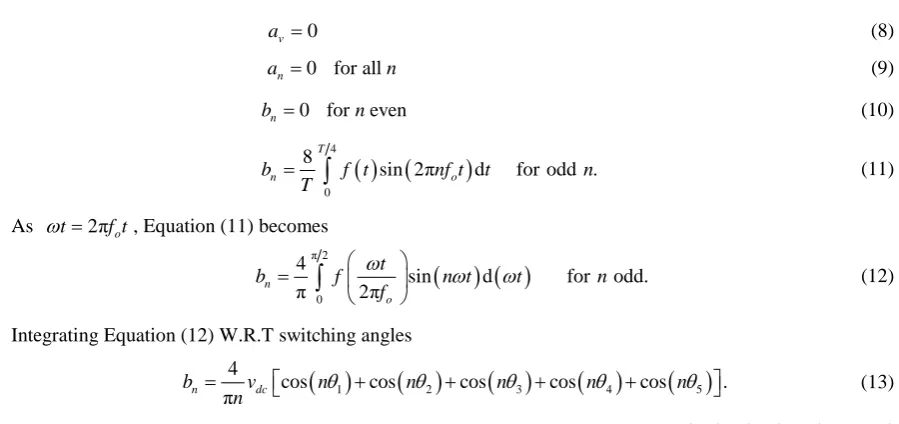
θ . The switching angles are determined using Fourier series to find system of non-linear equations and further “trust region dogleg” method is applied. Fourier series is applied first to find out a set of non-linear equations.From Fourier series the periodic function can be expressed as following
(
)
(
)
1
cos 2π sin 2π 1, 2, 3, ,
t v n o n o
n
f a a nf t b nf t n
∞
=
= +
∑
+ = ∞ (4)v
a , an and bn are Fourier coefficient and can be determined from following equations
( )
1 d o o t T v ta f t t
T
+
=
∫
(5)( )
(
)
2
cos 2π d
o
o t T
n o
t
a f t nf t t
T
+
=
∫
(6)( )
(
)
2 sin 2π
d . o o t T n o t
b f t nf t t
T
+
=
∫
(7)Here T is the fundamental period and to is arbitrary reference time.
Table 3. Switching states of 18 levels DCMLI.
Output
out v
Switches state of first leg for positive half cycle of 18 level DCMLI
1
s s2 s3 s4 s5 s6 s7 s8 s1′ s′2 s3′ s4′ s′5 s6′ s7′ s8′
8vdc 1 1 1 1 1 1 1 1 0 0 0 0 0 0 0 0
7vdc 0 1 1 1 1 1 1 1 1 0 0 0 0 0 0 0
6vdc 0 0 1 1 1 1 1 1 1 1 0 0 0 0 0 0
5vdc 0 0 0 1 1 1 1 1 1 1 1 0 0 0 0 0
4vdc 0 0 0 0 1 1 1 1 1 1 1 1 0 0 0 0
3vdc 0 0 0 0 0 1 1 1 1 1 1 1 1 0 0 0
2vdc 0 0 0 0 0 0 1 1 1 1 1 1 1 1 0 0
dc
v 0 0 0 0 0 0 0 1 1 1 1 1 1 1 1 0
0 0 0 0 0 0 0 0 0 1 1 1 1 1 1 1 1
Table 4. Switches state of both legs of 24 levels DCMLI.
Switches state of 24 level DCMLI in both legs
Conducting switches Non conducting switches
11v dc s s s1, , ,2 3,s s11, 34,s35,s36,,s44 s12,s s13, 14,,s33
10v dc s s s2, , ,3 4,s12,s34,s35,s36,,s44 s s1, 13,s s14 15,,s33
. . . . . . dc
v s s11, 12,s13,,s21,s34,s35,s36,,s44 s s s1, , ,2 3,s10,s22,s23,s24,,s33
0 s12,s13,s14,,s22,s34,s35,s36,,s44 s s s1, , ,2 3,s s11, 23,s24,s25,,s33
1, , ,2 3 , 11
s s s s = subsystem 1 switches; s12,s13,s14,,s22 = subsystem 2 switches; s23,s24,s25,,s33 = subsystem 3 switches; s34,s35,s36,,s44 =
subsystem 4 switches.
0
v
a = (8)
0 for all
n
a = n (9)
0 for even
n
b = n (10)
( ) (
)
4
0
8 sin 2π
d for odd . T
n o
b f t nf t t n
T
=
∫
(11)As ω =t 2πf to , Equation (11) becomes
(
) ( )
π 2
0
4
sin d for odd.
π 2π
n
o
t
b f n t t n
f
ω ω ω
=
∫
(12)Integrating Equation (12) W.R.T switching angles
( )
1( )
2( )
3( )
4( )
54
cos cos cos cos cos .
π
n dc
b v n n n n n
n
θ
θ
θ
θ
θ
= + + + + (13)
[image:6.595.91.541.485.697.2]( )
1( )
2( )
3( )
44
cos cos cos cos
π vdc v
n
θ
+θ
+θ
+θ
= (14)( )
1( )
2( )
3( )
4cos 5
θ
cos 5θ
cos 5θ
cos 5θ
0 + + + =
(15)
( )
1( )
2( )
3( )
4cos 7
θ
cos 7θ
cos 7θ
cos 7θ
0. + + + =
(16)
The values of switching angles can be calculated from these set of non-linear equations using iterative me-thod.
Equation (14) can also be written as
( )
1( )
2( )
3( )
4cos θ +cos θ +cos θ +cos θ =m (17)
where . 4 π dc v m v
= (18)
Modulation index ma is given by
. 4 π a dc m v m s sv
= = (19)
s = No. of DC sources.
The total harmonic distortion is calculated from the following equation
2 2 2 2
2 3 4 1
THD v v v vn
v
+ + + +
= (20)
2
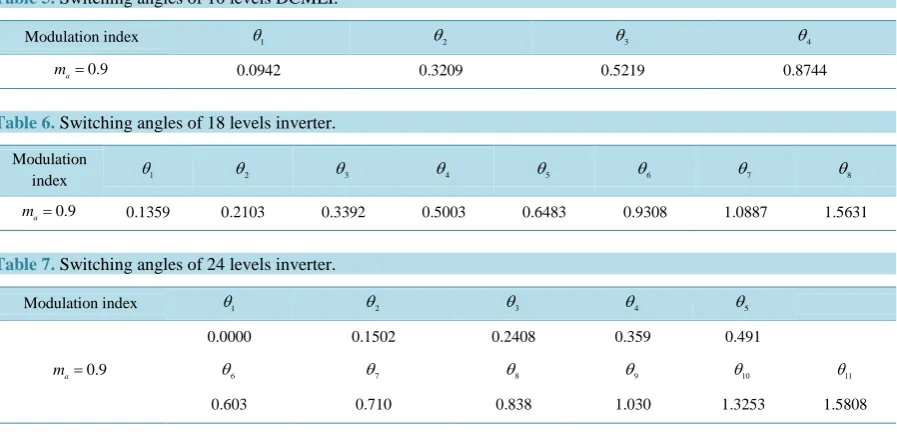
v , v3, vn are the RMS voltage value of 2nd, 3rd and nth harmonics and v1 is the fundamental output voltage. Computed values of switching angles in radians of 10, 18 and 24 levels DCMLI when dog leg method is ap-plied are Tables 5-7.
3. Results
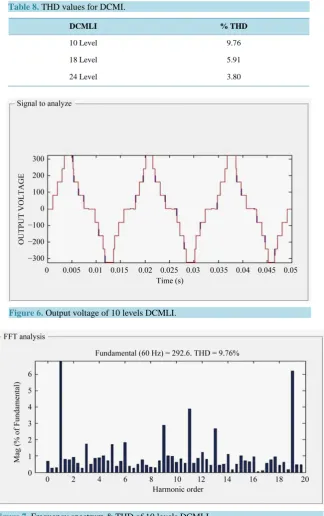
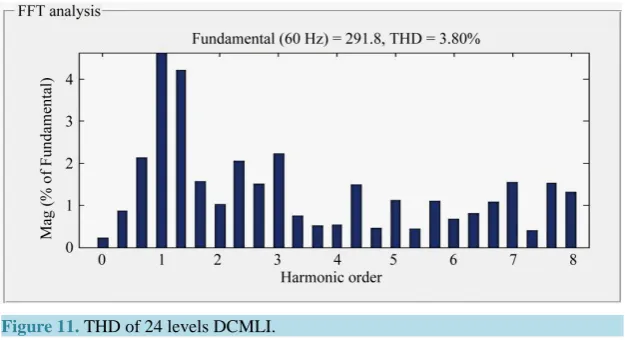
[image:7.595.90.539.510.726.2]Total harmonic distortion values and output voltage wave forms are observed for m = 0.9 and the variation in harmonics and the quality of output waveforms. The value of m is kept constant while total numbers of voltage levels in half cycle (0 - π) of output waveforms are increased gradually, when Voltage levels are increased the
Table 5. Switching angles of 10 levels DCMLI.
Modulation index θ1 θ2 θ3 θ4
0.9 a
m = 0.0942 0.3209 0.5219 0.8744
Table 6. Switching angles of 18 levels inverter.
Modulation
index θ1 θ2 θ3 θ4 θ5 θ6 θ7 θ8
0.9 a
m = 0.1359 0.2103 0.3392 0.5003 0.6483 0.9308 1.0887 1.5631
Table 7. Switching angles of 24 levels inverter.
Modulation index θ1 θ2 θ3 θ4 θ5
0.9 a m =
0.0000 0.1502 0.2408 0.359 0.491
6
θ θ7 θ8 θ9 θ10 θ11
wave form gets closer to pure sinusoidal wave form and consequently the percent total harmonic distortion de-creases. Total harmonic distortion (THD) depends on the 3rd, 5th, 7th, 9th, 11th, and 13th (in the proposed case) lower harmonics when levels are increased the harmonics results smaller peak values which decreases the THD value as shown in Table 8 and Figures 6-11 for various levels.
4. Conclusion
Trust region dog leg method employing optimized switching angles has reduced total harmonic distortion in multilevel inverters compared to when non-optimized switching angles are considered. It is evident from the
Table 8. THD values for DCMI.
DCMLI % THD
10 Level 9.76
18 Level 5.91
24 Level 3.80
[image:8.595.154.479.197.714.2]Figure 6. Output voltage of 10 levels DCMLI.
Figure 8. Output voltage of 18 levels DCMLI.
[image:9.595.155.481.81.715.2]Figure 9.THD of 18 levels DCMLI.
Figure 11. THD of 24 levels DCMLI.
results that an increasing number of voltage levels in the output waveforms decrease the total harmonic distor-tion (THD) and the output wave form gets closer to pure sinusoidal voltage plus overall efficiency of the system rises. Moreover, the number of battery sources, IGBTs and diodes required makes the system bulkier and ex-pensive as the number of levels is increased but ensures a sooth input to the industrial load (e.g. AC Motor Drive runs with maximum torque, less noise and maximum efficiency when the higher level of multi-level inverter output is fed to it).
References
[1] Peddapeli, S.K. (2014) Recent Advances in Pulse Width Modulation Techniques and Multilevel Inverters.
Internation-al JournInternation-al of ElectricInternation-al, Electronic Science and Engineering, 8, 568-576.
[2] Hussein, H. (2014) Harmonics Elimination PWM (HEPWM). International Journal of Engineering Research and
General Science, 2, 172-181.
[3] Satyanarayana, G.V.R. and Ganesh, S.N.V. (2010) Cascaded 5-Level Inverter Type DSTATCOM for Power Quality Improvement. 2010 IEEE Students’ Technology Symposium (TechSym), Kharagpur, 3-4 April 2010, 166-170.
http://dx.doi.org/10.1109/TECHSYM.2010.5469168
[4] Shukla, A., Ghosh, A. and Joshi, A. (2010) Flying-Capacitor-Based Chopper Circuit for DC Capacitor Voltage Ba-lancing in Diode-Clamped Multilevel Inverter. IEEE Transactions on Industrial Electronics, 57, 2249-2261.
http://dx.doi.org/10.1109/TIE.2009.2029527
[5] Boora, A.A., Nami, A., Zare, F., Ghosh, A. and Blaabjerg, F. (2010) Voltage-Sharing Converter to Supply Single- Phase Asymmetrical Four-Level Diode-Clamped Inverter with High Power Factor Loads. IEEE Transactions on Power
Electronics, 25, 2507-2520. http://dx.doi.org/10.1109/TPEL.2010.2046651
[6] Cavalcanti, M.C., Farias, A.M., Oliveira, K.C., Neves, F.A. and Afonso, J.L. (2012) Eliminating Leakage Currents in Neutral Point Clamped Inverters for Photovoltaic Systems. IEEE Transactions on Industrial Electronics, 59, 435-443. http://dx.doi.org/10.1109/TIE.2011.2138671
[7] Li, J., Liu, J., Boroyevich, D., Mattavelli, P. and Xue, Y. (2011) Comparative Analysis of Three-Level Diode Neural- Point-Clamped and Active Neural-Point-Clamped Zero-Current-Transition Inverters. 2011 IEEE 8th International
Conference onPower Electronics and ECCE Asia (ICPE & ECCE), Jeju, 30 May-3 June 2011, 2290-2295.
http://dx.doi.org/10.1109/ICPE.2011.5944469
[8] Du, Z., Tolbert, L.M., Ozpineci, B. and Chiasson, J.N. (2009) Fundamental Frequency Switching Strategies of a Sev-en-Level Hybrid Cascaded H-Bridge Multilevel Inverter. IEEE Transactions on Power Electronics, 24, 25-33. http://dx.doi.org/10.1109/TPEL.2008.2006678
[9] Khazraei, M., Sepahvand, H., Corzine, K.A. and Ferdowsi, M. (2012) Active Capacitor Voltage Balancing in Single- Phase Flying-Capacitor Multilevel Power Converters. IEEE Transactions on Industrial Electronics, 59, 769-778. http://dx.doi.org/10.1109/TIE.2011.2157290
[10] Chaturvedi, P.K., Jain, S. and Agarwal, P. (2011) Reduced Switching Loss Pulse Width Modulation Technique for Three-Level Diode Clamped Inverter. IET Power Electronics, 4, 393-399. http://dx.doi.org/10.1049/iet-pel.2010.0311
[11] Massoud, A.M., Ahmed, S., Enjeti, P.N. and Williams, B.W. (2010) Evaluation of a Multilevel Cascaded-Type Dy-namic Voltage Restorer Employing Discontinuous Space Vector Modulation. IEEE Transactions on Industrial
[12] Taghizadeh, H. and Hagh, M.T. (2010) Harmonic Elimination of Cascade Multilevel Inverters with Nonequal DC Sources Using Particle Swarm Optimization. IEEE Transactions on Industrial Electronics, 57, 3678-3684.
http://dx.doi.org/10.1109/TIE.2010.2041736
[13] Al Smadi, T.A. (2013) Design and Implementation of Double Base Integer Encoder of Term Metrical to Direct Binary.
Journal of Signal and Information Processing, 4, 370.