4147
GRAPHIC DIGITAL TECHNIQUES IN THE FINE
ARTS DESIGN AND PROCESSING
KHALID FAKHIR ABDULLAH DARRAJI
Directorate of Education in Baghdad/ Third Al-karkh, Ministry of Education, Baghdad, Iraq Email: [email protected]
ABSTRACT
Computerized graphics processing techniques cannot just resolve the difficulty of customary painting simulation in the art, but have more gains in the teaching of art features and task to the art stylishness and morphology of the massive modifications and save monetary, manpower and substantial resources and time. Image processing tools may attract new expertise of contemporary art in the most significant manner. Consequently, computerized techniques are customary art conception of computerized design tool for the expansion tendency of fine art images. This paper at first surveys the used techniques regarding graphic fine art image processing including design, manipulation and artist photo detection . Then, a practical face recognition based on eigenface, LABP and database for artist photo has been suggested to record all well-known artist information in museums and art centers. The suggested face detection has been compared with other testified researches in the literature.
Keywords: Computerized graphic Processing, Fine Arts, Artist face recognition
1. INTRODUCTION
With the growing digital IT application with the Internet expansion , the painting formation in numerous from time to time predictably produced a substantial influence to the customary art conception. From the perception of computer application expansion, the use of computerized techniques from the primary computer research development in the sturcturing and production to digital information technology application is growing. Computerized tools are regularly used into communal life, therefore progressively recognized and extensively employed by graphic designer to produce a more customary design stylishness. The use of computerized image processing methods are practically substituted the old-style design approaches [1].
Employing computerized techniques for art formation should depend on computer aided design software tools and innovative theory. In computerized art and inventive thoughts simulation of interior relationships, there are several complications praiseworthy to be deliberated involving scopes of art and formation, method of appearance and cognitive philosophy in addition to computer simulation and modeling. Computeri z e d art technique stands for the artifact of methodical and imaginative harmony, and exemplifies the
accord of the most significant features in computer use in the graphics field. Recently, the research on art formation and design by computer is constantly developed.
Biometrics is proof of identity of humans by their features. They are adopted computerized recognition tool as a form of documentation and right of entry management[2]. It can be as well exploited to recognize person in individuals crowd that are under investigation.
Their identifiers are the specific, computable characteristics employed to tag and refer to persons [3]. They are over and over again regarded as physical as opposed to interactive characteristics [4]. Physical characteristics are associated with the figure of the body as in face detection [5,6].
4148 than likewise reported works in the literature using same number of tested images and database kind.
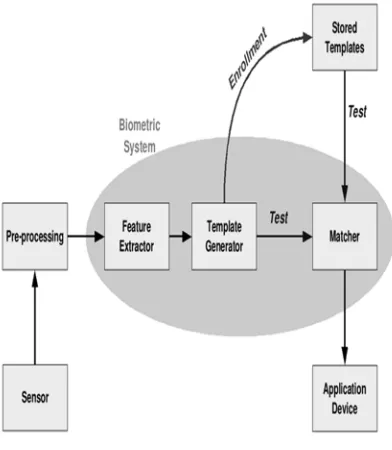
Figure 1. Biometric System Illustration
2. COMPUTERIZED IMAGE PROCESSING
TOOLS
In conjunction with progressively developed computer art, skilled use of computerized image processing tools in the graphics formation comes to be a new practice [7]. This study through art formation concretely deliberates the applied computerized graphics editing techniques in the fine arts formation, drawing interpretation stage, and the use of innovative expertise stimulated art formation notion of problem. Promoters the formation of a reasonable knowledge is based on sensible use of technological, original materials, innovative designs as in media facilities for formation of graphics. Graphics processing stands for a class of creative formation tools in the points of view of the artist in his distinctive nature and meaningful outlooks to create the knowledge and art of absolute synthesis.
2.1. Photoshop application
It is the global well-known software produced by Adobe Photoshop Company. It is one of the most outstanding broadly applied image processing software. It joins image change as well as artistic creation. Images visualizing is
equivalent to an natural whole that can carry out countless contribution and function setups and support numerous color styles simultaneously. Also, it is expedient and speedy for the choice of image of completely categories of function as in color adjustment and editing that are widespread with most pictorial engineers. Particular applications based on Photoshop are displayed in Figure2.
Figure 2. Photoshop application Instance
Photoshop has huge abilities of influential tone color. It has straightforward adjustment to correct image color of lighting and shading, regulate the deviancy of color and can suit dissimilar color images in whole application features . Image creation can be applied to any image throughout layer process and finally be joint into an entire new image [8]. It stands for remarkable drawing tool and can have considerations to choose exterior image fusion for the image designer requirement. Exceptional properties production depends principally on the channel, mask, filters and other all-inclusive methods to fulfil.
2.2. CorelDraw Application
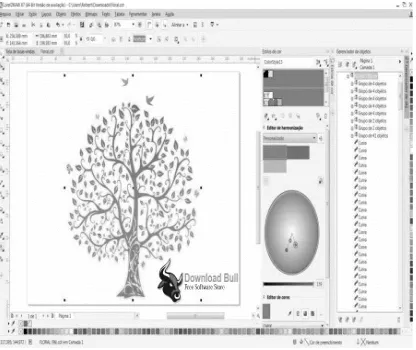
[image:2.612.311.522.223.384.2]4149 image preparation, illustrative marketing design, model sketch, product wrapping design, interior and exterior beautification design, web design, etc. Altogether, the word processing purpose of CorelDraw don't break down, that causes it extensively applied in brochures, choreography, magazines, newspapers, and other fields of word processing. Several CorelDraw applications are presented in Figure 3.
Figure 3. CorelDraw application Instance
Dual uses in CorelDraw graphics are employed for image overseeing and vector outline, page design. The absolute arrangement of the dual applications for the overall user computerized graphic structuring produced an appropriate technique to operate. The designer is possibly been expedient by the easy operation of creating an assortment of instantaneous effect and distinct consequence on the subject of bitmap images. Manipulators of CorelDraw software can realize the whole function of integrated presented design to make the graphic design more artistic and flexible.
2.3. Illustrator application
It is the Adobe product weight vector drawing simulation package. It can manage graphic, blueprint, and drawing tools that are far and wide adopted in CI design, advertising, web scheme, illustration, logo design, etc. With partial indicators, ninety seven percent of universal designers to graphics enterprise is found in using Illustrator program. Adobe Illustrator stands for developed version of CorelDraw, pattern pamphlets, online image as well as multimedia industry software, and is extensively
utilized, artless and straightforward to control one of the plane designing software [10]. Several concentrations using Illustrator are displayed in Figure 4.
Figure 4. Illustrator application Instance
For the reason of its ease of operation, generating colors, dynamic and forming diversity, it has the physical feature of resilient graphic influence. Consequently, the uses of the Illustrator is extensively applied in the conception of animatronics exemplar, or prepared into entirely varieties of unique vector illustration as well as graphic design.
3. COMPUTERIZED PROCESSING TOOLS
IN THE GRAPHICS FORMATION
4150 procedure as completely documented and straightforward to be modified. By using Photoshop program formerly, countless design concepts persistently come to be more faultless, and create the designer more thoughtful sympathetic of the imaginative subject and implication. This depiction is not old-style sketch version. Besides, material that is previously accessible in the computer graphic arrangement over recurrent analysis, take as a final point the finest structure variations and effectively finalized work. This technique of script significantly reduces the investigation on the painting, saving loads of timetable and power. Art is summary drawing development in which an creative formation is correspondingly a labor-intensive, and the depiction of contextual procedure is an iterative practice. For that reason, the rational formation of using particular graphic processing methods for producing amenities and new experimentation lead to the development of art design in appealing rich form.
4. ARTIST FACE RECOGNITION
Face identification has been utilized for an extensive range image and graphic processing as well as human-computer interface .This stirred scholars to initiate mathematical prototypes to recognize the faces, that are comparatively straightforward and undemanding for appliance. The mathematical prototype presented in [1] is uncomplicated, speedy and exact in restricted situations. The intention of this research article is to execute the face detection prototype for a specific graphic face and discriminate it from an enormous numerous accumulated faces with particular real-time variants.
The model uses IT methodology that rots face images into a lesser group of typical feature images termed ‘eigenfaces’, that are in point of fact the foremost constituents of the preliminary training group of face graphics. Face detection can be accomplished by projecting a newfangled graphic face into the subspace traversed using eigenfaces(‘face space’) and at that point categorizing the face by relating its locus in the graphic face space with the locus of the identified artists.Graphic face detection under extensively changeable settings as in front outlook, a 45° view, scaled front outlook and other issues of face situations.
4.1. LBP AND LABP OPERATORS
Local Binary Pattern (LBP) method is extensively adopted in numerous appliances recently. Using essential characteristics like invariance in monotonic deviations of gray level and computational efficiency creates this technique as highly advantageous approach for face image investigation. As a general rule, the face image has mixture of numerous minor models required for appearance analysis [11].
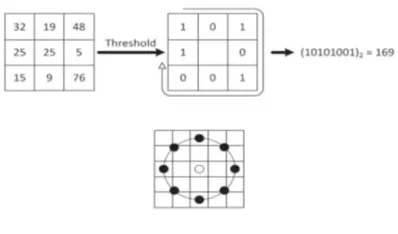
[image:4.612.319.518.379.496.2]Originally, LBP was proposed as square operator 3×3 as reported by [11]. The process of this technique can be organized through eight neighbouring positions compared with the central pixel. In the case of one of the eight adjacent pixels is bigger or equivalent to the middle pixel amount, it will be swapped by 1. Else, its value will be 0. As a final point, the middle pixel is substituted by the summation of weighted binary adjoining pixels and 3×3 window will transfer the subsequent pixel. By finding histogram of these amounts, an appearance texture descriptor can be achieved. Figure 5 shows the LBP operator.
Figure 5. LBP procedural steps
The Local Average Binary Pattern (LABP) denotes a different augmentation of the LBP technique [8, 23]. The LABP patterns have homogeneous outlines since they cover at most two bitwise shifts if the bit sequence is considered to be circular. E.g., 2 transitions are perceivable from (11001111) and (01110000) arrangements that are harmonized, whereas the transitions in (11001001) and (01010011) arrangements are 4 and 6 correspondingly that are not. The LABP operation can be defined by:
, ( , ) 10 ( )2
P
P
P R x y p c
P
LABP S g g
4151 In Eq.(1), S represents the sign function, and gp
and
g
c symbolize the gray levels amount of adjacent and middle pixels. Correspondingly, 2Prepresents a necessary element for all neighbouring points in the LABP technique. The S(x) value is
possibly calculated by:
( )
1,
0
0,
if x
s x
otherwise
(2) [image:5.612.325.504.241.385.2]Subsequently, this technique has been extended to employ neighbouring localities of different sizes [8, 22]. In these regions, the (P, R) term indicates sampling points (P) on a circle radius (R. The pixel amounts have bilinear disruption if the sampling point is not within the central pixel. Figure 6 shows an exemplar of the circular (8, 2) neighbourhood.
Figure 6. Labp Example
2 , u P R
LABP representative term of the LABP operator
can be used. The foremost script signifies the operator in a (P, R) region. The sub-script u2 symbolizes the points for using solitary equivalent arrangements and assembling all remaining arrangements with a solitary tag. To calculate LABP tags, uniform arrangements should be positioned with the intention of finding a disjointed tag for each uniform arrangement and each non uniform arrangement is given just single tag. E.g, with eight sampling points, about 256 outlines can be created with 58 uniform outlines that causes 59 miscellaneous tags or labels.
This histogram has particulars about the resident micro outline allocation like adverts, plane areas and edges of the image. For efficacious face style, longitudinal information must be preserved. Consequently, the image can be partitioned into
1 1
0
,
R
,
...,
R
mR
areas. The feature vector length (B) is equivalent to mBr, where m is the areasnumber and Br is the LABP histogram size. An
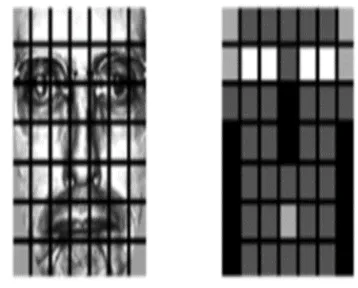
enormous small areas number produces extensive feature vectors, making giant memory ingestion and sluggish ordering, but employing widespread areas stimulates extra latitudinal data to be made available. Figure 7 exemplifies a preprocessed face mask image split into 49 windows.
Figure 7. A Preprocessing Of Face Mask Image Sample Split Into 49 Windows
4.2 Eigenface Approach
IT method of encoding and decoding face graphics roots out the important info in a face image, encode it as proficiently as feasible and relate it with database of likewise encoded faces.The encoding is completed by means of features that can be dissimilar or autonomous than the noticeably apparent features as in ears, eyes, lips, nose and hair.Arithmetically, PCA method will give each graphic face of the recognition experimental collection as a vector in extreme dimensional space. The eigenvectors of the covariance matrix can include the deviation amid the graphic face. At this point, every image in the training group can possess its involvement to the eigenvectors as an ‘eigenface’ on behalf of its
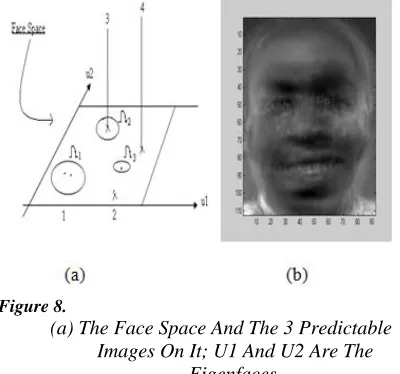
influence in the discrepancy amongst the images. These eigenfaces are similar to ghostlike images as explained in Figure 8.Every eigenface has understood category of facial disparity that differs from the fundamental image [12].
[image:5.612.107.297.321.493.2]4152 linear mixture of the eigenfaces. The quantity of total variance for one eigenface is essentially identified using eigenvalue related with the resultant eigenvector. In the case of the eigenface with minor eigenvalues are overlooked, at that point an image is possibly be a linear mixture of reduced number of these eigenfaces. E.g., if there are M images in the experimental set, M eigenfaces can be gotten. Beyond these, just M’ eigenfaces can be designated to associate them with the leading eigenvalues. These will span the M’-dimensional subspace ‘face space’ outside entirely potential image spaces.
[image:6.612.91.291.413.600.2]If the face image to be documented as identified or unidentified, is projected on this face space as in Figure 8, the weights linked with the eigenfaces can be acquired, that linearly come near to the face or can be empoyed to restructure the face. In this point, these weights are matched with the weights of the known face images to recognize them as an identified face in the experimental image set. Explicitly, the Euclidean distance amid the image projection and identified projections is considered. So, the face image is categorized as one of the faces with smallest Euclidean distance.
Figure 8.
(a)The Face Space And The 3 Predictable Images On It; U1 And U2 Are The
Eigenfaces.
(b)The Predictable Face From The Experimental Database.
Suppose a face image I(x,y) is a 2D N by N matrix
of (8-bit) intensity standards. Image can also be deemed as dimensionality vector N2, with the
intention of a distinctive image of size 256 by 256 is a vector of dimension 65,536 or regularly a point in a 65,536- dimensionality space. Collaborative images at that point represent a group of points in this huge space. PCA can catch the vectors that best
version for the sharing of the face images contained by this all-inclusive space.
Assume the experimental set of face graphics be T1,T2,T3,….TM. Experimental set has to be mean
accustomed in advance to computing the covariance matrix or eigenvectors.The regular face can be evaluated by Ψ = (1/M) Σ1MTi Every
graphic face in the data collection fluctuates from the typical face by the vector Ф = Ti – Ψ.This is
essentially mean accustomed data. The covariance matrix is
C = (1/M) Σ 1M Φi ΦiT (3)
= AAT
where A = [ Φ1, Φ2, …. ΦM]. The matrix C is a N2
by N2 format and can produce N2 eigenvectors and
eigenvalues. If image sizes is 256 by 256, or less than that, this computation will be unfeasible to carry out.
A mathematically practicable technique has been given to realize the eigenvectors. If images number in the experimental graphic face set is lower than the pixels number in an image, for instance M < N2, in that case an M by M matrix can be can
solved in place of resolving a N2 by N2 matrix.
Assume the covariance matrix as ATA in place of
AAT. At this point, the eigenvector v
i is feasibly
computed by:
ATAvi = μivi (4)
μi stands for the eigenvalue. At this time,
covariance matrix size has M by M dimensions. In consequence, m eigenvectors can be taken into consideration as opposed to N2. By multiplying
Eq. 2 by A,
AATAv
i = μi Avi (5)
The rightward provides us the M eigenfaces of the order N2 by 1.Altogether of these vectors will
create the image space of M dimensionality. If precise reform of the graphic face is unnecessary, the dimensionality to M’ instead of M can be condensed. This can be prepared by choosing the M’ eigenfaces that require the biggest related eigenvalues. These eigenfaces at this point span a M’-dimensional subspace rather than N2.
Regarding Recognition stage, new graphic face T is converted into its eigenface constituents ; projected into ‘face space’ through a unsophisticated process,
4153 At this point, k = 1,2,….M’. The weights attained form a vector ΩT = [w1, w2, w3,…. wM’] that
delineates the input of every eigenface in signifying the involvement of graphic face image. The vector is possibly at that moment adopted in a typical face detection procedure to realize which face class number, if any, finest labels the face.The face class is considered by being an average of the weight vectors for one person images. The made face classes rely on the arrangement to be completed like a face class can be prepared of each image if the image theme has satisfactory sights. Accordingly, classification can be prepared whether the subject has spectacles or not. The Euclidean distance of the weight vector of the newfangled image from the face class weight vector is computed by:
εk = || Ω – Ωk|| (7)
Ωk is a vector labeling the kth face class.Euclidean
distance formulation is stated in details in [2]. The face is categorized based on class k if the distance εk is less than the threshold θε. Else, the face is
categorized as anonymous. Correspondingly, it can be located if an image is a face image or not just by obtaining the squared distance amid the mean adjusted entered image and its prediction onto the face space.
ε2 = || Ф - Фf || (8)
Фf stands for the face space and Ф = Ti – Ψis the
mean adjusted input.
Based on above, the image can be classified as detected face image, anonymous face image and not valid image.
5.
RESULTS AND DISCUSSION
Graphic
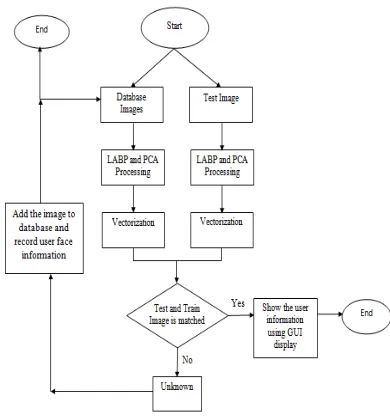
face image is a complex multidimensional model and intensifying a computational exemplary for face detection is complicated. An extra challenging condition is the detection at a distance, at what time the subject matter is recognized in unsystematic conditions. In this situation, individuals can be far away from the camera or unaware of the sensors. Accordingly, this experiment originates from these categories of problematic users. If the subject pattern is gotten with an unbiased expression, it is easy for a individual who tries to hold off from being detected to regulate parts of his/her facial surface by a smiling or open-mouthed appearance. Similarly, on the moustache growing or a beard, or using [image:7.612.322.517.307.515.2]glasses can create a trouble in the practice of detecting the person. A promising solution to this trouble is by exploiting impartial rigid partitions of the face, predominantly the nose area, for detection. Nonetheless, regulating the input data to such a small area points to considerable useful information may be misplaced, and the huge precision can be lessened. LABP and PCA incorporation technique decrease these special effects. An approach for graphic face detection is implemented in this section. The foremost objective of this paper is to put into operation the system detection for any itemized face and distinguish it from enormous provided faces with a number of instantaneous deviances along with his/her individual information as in flowchart described in Figure 9.
Figure 9. The flowchart of the projected face detection
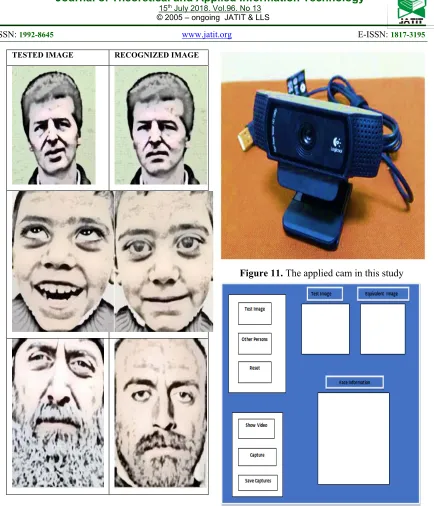
4154 TESTED IMAGE RECOGNIZED IMAGE
Figure 10. Graphic Face recognitions for different poses and situations
[image:8.612.96.530.44.550.2]The investigative graphic face Image for any individual is feasibly taken via a special camera as in Figure 11. This camera is practicably attuned by means of GUI display as in Figure 12.The adopted camera in this study is HD Pro C920 that has satisfactory capture and video resolutions. Also, it has substantially influential and sharp topographies.
Figure 11. The applied cam in this study
Figure 12. The designated GUI show
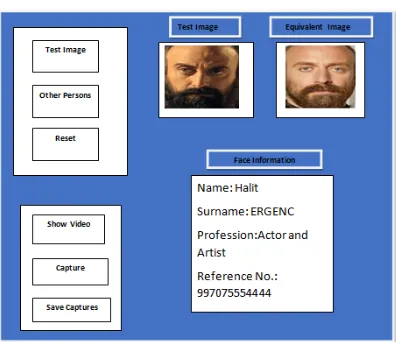
4155 the anticipated system of this paper. Other Persons switch in the GUI model is to compare any graphic face from internal or external hard disk with the stored images in the database. The projected method can be employed to detect and check the face details if his/her face details had been documented in the applied database.
[image:9.612.94.291.190.363.2]Figure 13. Non-Recognition Circumstance With Graphic Face Details Using GUI Display
Figure 14. Recognition Circumstance With Graphic Face Details Using GUI Display
[image:9.612.92.295.241.555.2]As a final point, the anticipated face detection was investigated with another testified studies in the literature using varied approaches and databanks. The used databases are AR, Yale B, ORL and FERET for this evaluation. The tester faces for every used database have presented in Figure 15 . It is concluded that the face detection method using hybrid of LABP and PCA approaches is better than testified face detection schemes in [13-15] correspondingly as it is explained by Table 1 using the equivalent databank and no. of training images in these reported works.
[image:9.612.94.292.391.562.2]Figure 15. The Applied Databases In This Study: (A) ORL; (B) Yale; (C) AR; (D) FERET.
Table 1 Comparis N Of The Proposed Face Recognition With [13-15] Employing Equivalent Used Database And
Testified Images Number
6. CONCLUSION
Currently, the commercialization of the practiced computerized processing tools in the drawing or painting formation and develop graphic fine arts to highest extents.Accordingly, fine arts formation notion and sketch version period, the realistic use of image processing tools to handle original mechanisms, motivate the designer bold resourcefulness, and effectively finalize sketch map. Graphic designers to investigate newfangled methods of functioning to develop the art usage are really nice. Nevertheless, the worth of art is based on the formation of computer image processing tools. Graphics design is arty novelty under the different times of consideration and investigation. The imaginative formation of graphics or any
Parameter/Refrence [13] [14] [15]
Database AR ORL ORL,
Yale B, FERET
Technique LBP+SRC Eigen
Faces Common Eigen values
Tested image No. 700 190 400
Detection Rate (%)
96 97.5 99.4,
97.5, 98 Detection Rate of
Our Work (%)
99.3 99.5 99.8,
[image:9.612.330.529.399.536.2]4156 image under the dominance is not merely digital tool, graphics processing tool supported the creativity of designer only means and tools to increase the intended innovations and scopes. Also, an applied face recognition based on PCA, LABP and database for artist photo has been suggested to record all well-known artist information in museums and art centers. After that, applied face detection based on eigenface (PCA), LABP and database for artist photo has been put forward to record all familiar artist information in museums and art centers.This face detection system has recognition rate superior than 99 % and better than face detection methods in [13-15]. Further future work is to enhance the performance graphic face detection by using Genetics Algorithms (GAs) [16]. GAs are powerful procedures that have possibilities of optimization in all branches of engineering and applied sciences. They can be used crypt or decipher graphics of artist information with high performance for security issues [17, 18].
ACKNOLEDGMENTS
The corresponding author appreciates Directorate of Education in Baghdad/ Third Al-karkh, Ministry of Education in Baghdad in Iraq for their sponsorship for this study.
REFRENCES:
[1] D. Zhu, “The application of computer image processing technology in the fine arts creation”, IEEE Workshop on Advanced Research and Technology in Industry Applications (WARTIA), 2014.
[2]
“Biometrics: Overview”.Biometrics.cse.msu.edu. 6 September 2007. Retrieved 2012-06-10.
[3] A. Jain, L. Hong, and S. Pankanti, “Biometric Identification".Communications of the ACM,
43(2), 2000, p. 91-98. DOI
10.1145/328236.328110.
[4] A. K. Jain, A. Ross, “Introduction to Biometrics”. In Jain, AK; Flynn; Ross, A. Handbook of Biometrics. Springer. pp. 1– 22, 2008. ISBN 978-0-387-71040-2.
[5] W. Y. Zhao, R. Chellappa, P. J. Phillips, and A. Rosenfeld, “ Face Recognition: A Literature Survey,” ACM Computing Surveys,
vol.34, no. 4, pp. 399–485, 2003.
[6] A.C. Weaver,
“Biometric Authentication,
Computer”, 39 (2), p. 96-97, 2006. DOI 10.1109/MC.2006.47.[7] H. Fang, and J. Liu,
“Computer-Aided
Industrial Design & Conceptual Design” , (Yiwu, China, November 17-19, 2010), Vol.1, p.733[8]K. Tallon,
“Digital fashion illustration with
Photoshop and Illustrator”, Anova Books, 2008.[9]Z.Y. Mei, and C.J. Jie,
“Advanced Computer
Theory and Engineering”, Chengdu, China, Vol.3, p.75, 2010.[10] M.B. Codur, “Graphic design applications in
establishing visual images for indoor design” Procedia-Social and Behavioral Sciences, Vol. 1,No.1, p. 2879, 2009.
[11] Y. S. Mezaal,
“Face Recognition Approach
Based on The Integration of Image Preprocessing, CMLABP and PCA Methods”, Iraqi journal of electrical and electronic engineering, 2017.[12] H. Abdi, and L.J. Williams,
“Principal
component analysis”, Wiley Interdisciplinary Reviews: Computational Statistics, 2: 433– 459, 2010.doi:10.1002/wics.101.[13] R. Min, and J.-L. Dugelay, “Improved Combination of LBP and Sparse Representation Based Classification (SRC) for Face Recognition, ” Proceedings of IEEE International Conference on Multimedia and Expo (ICME), Barcelona, pp.1-6, 2011. [14] M. Slavkovic, and D. Jevtic, “ Face
Recognition Using Eigenface Approach, ” Serbian Journal of Electrical Engineering, vol.9, no.1, pp. 121-130, 2012.
[15] V. H. Gaidhane, Y. V. Hote, and V. Singh, “ An Efficient Approach for Face Recognition Based on Common Eigenvalues, ” Pattern Recognition, vol.47, no.5, pp. 1869-1879, 2014.
[16] R. L. Haupt, S E Haupt, “Practical Genetic Algorithms”, 2nd Edition: John wiley& Sons, 2004.
[17] Y. S. Mezaal, et al., “ OTP Encryption Enhancement Based on Logical Operations”, 6th International Conference on Digital Information Processing and Communications (ICDIPC), Beirut, 2016.