IJPSR (2013), Vol. 4, Issue 3 (Research Article)
Received on 02 December, 2012; received in revised form, 12 January, 2013; accepted, 27 February, 2013
DEVELOPMENT AND VALIDATION OF STABILITY-INDICATING RP-HPLC ASSAY METHOD FOR ENTACAPONE IN ENTACAPONE TABLETS
Raj Kumar Dhawan*1, S. Ravi 1, T. Subburaju 1, H. Revathi 1, C. Arul 2 and N. Ganapathi Rao 2
Karpagam University, Coimbatore - 641021, Tamilnadu, India
Hetero Labs Ltd, 22-110, IDA, Jeedimetla, Hyderabad - 500055, Andhrapradesh, India
ABSTRACT: A new, simple, precise, rapid, accurate and stability-indicating RP-HPLC method has been developed for the determination of Entacapone in presence of its degradation products or other pharmaceutical excipients. Stress studies were performed on Entacapone tablets and it was found that it degrades sufficiently in acidic, alkaline and oxidation conditions, while negligible degradation was observed in thermal, photolytic and humidity conditions. The peaks of the degradation products were not observed in the chromatogram due to the nonchromophoric nature of the degradation
moiety formed. The separations were carried out on a Hypersil BDS C8, 150
mm x 4.6 mm 5µm particle size column with a mobile phase consisting of Acetonitrile: 0.01% Orthophosphoric acid pH 2.5 at a flow rate of 1.0 ml/min. Detection wavelength was 210nm. The retention time of Entacapone was 7.0minutes. The developed method was validated in terms of specificity, forced degradation, linearity, precision, intermediate precision (ruggedness), accuracy, range and robustness. The calibration curve for Entacapone was linear (correlation coefficient 0.99995) from range of 50µg/ml to 150µg/ml. Relative standard deviation values for all the key parameters was less than 2.0%. The recovery of the Entacapone was found to be 100.3%. Thus, the developed RP-HPLC method was found to be suitable for the determination of Entacapone in bulk as well as stability samples of the pharmaceutical dosage forms containing various excipients.
INTRODUCTION: Entacapone is a selective, reversible catechol-O-methyl transferase (COMT) inhibitor for the treatment of Parkinson’s disease. It is a member of the
class of nitrocatechols. When administered
concomitantly with levodopa and a decarboxylase inhibitor (e.g., carbidopa), increased and more sustained plasma levodopa concentrations are reached as compared to the administration of levodopa and a decarboxylase inhibitor 1, 2, 3.
Chemically it is
(2E)-2-cyano-3-(3,4-dihydroxy-5-nitrophenyl)-N,N-diethyl prop-2-enamide.
Greenish yellow to yellow powder, sparingly soluble in acetone and in methanol, slightly soluble in ethanol, very slightly soluble toluene, practically insoluble in water 4, 5, 6.
Stability screening of drug candidates constitutes an inevitable part of drug discovery. The need for the stability studies on a drug candidate arises from the fact that the chemical integrity of the drug substance should be maintained until the compound is delivered to the intended site of action.
Keywords:
Entacapone, Excipients, Formulation, HPLC, Stress studies, Validation Correspondence to Author:
Raj Kumar Dhawan
(Research scholar – Karpagam University), Plot No.1054, behind ICICI ATM, Pragathi Nagar, Kukatpally, Hyderabad – 500072, Andhra Pradesh, India
Any form of chemical instability of the drug candidate may invariably affect the bioavailability and can further lead to toxic effects. Long term storage of the drug under various temperature and humidity conditions can affect its stability and this requires accurate methods to verify the appropriate storage conditions for the drug candidate. International Conference on Harmonization (ICH) has made the need of a stability-indicating assay method for every drug candidate mandatory.
A stability-indicating assay method helps in
establishing the inherent stability of the drug which in turn provides assurance on detection changes in identity, purity and potency of the product on exposure to various conditions. In this study, the drug candidate is exposed to a variety of stress conditions like acidic, alkaline, oxidative, thermal, photolytic and humidity stress. As per the ICH guidelines, stress testing of the drug substance aids in identifying the likely degradation products, which in turn can help in establishing the degradation pathways and the intrinsic stability of the molecule and validate the stability indicating power of the analytical procedures used 7.
Several analytical techniques are available for estimation of Entacapone in bulk dosage form by
HPTLC, HPLC and UV spectrophotometeric method 8, 9,
10, 11
. Keeping this objective in mind an attempt has been made to develop and validate the HPLC method for the analysis of Entacapone which would be highly sensitive, good resolution and reproducible. Various validation parameters of the analysis, specificity, precision, linearity and accuracy have been measured as per ICH guidelines 12, 13, 14.
MATERIALS AND METHODS
Materials: The liquid chromatographic system were of Waters Alliance 2695 separation module with 2996
PDA Detector, which consisted of following
components: a gradient pump, variable wavelength programmable UV/Vis detector, auto injector and column oven. The chromatographic analysis was performed using Empower-2 software (Waters, Milford, USA) on a Hypersil BDS C8, 150 mm x 4.6 mm 5 µm column. Analytically pure Entacapone and impurities was procured as gift samples from Hetero labs Ltd, Hyderabad, Andhrapradesh, India.
All other chemicals and reagents used were analytical grade and HPLC grade and purchased from Merck Chemicals, India. Tablets were procured from local market.
Methods:
a. Preparation of Diluent: Diluted 1ml of Orthophosphoric acid in to 1000ml with water and pH 2.5 adjusted using triethylamine (buffer). The buffer was mixed with the Acetonitrile in the ratio of (70:30) v/v.
b. Preparation of Standard solution: Standard solution of Entacapone was prepared by dissolving 50mg of Entacapone in to a 50ml volumetric flask and dissolved with diluent. The solutions were further diluted to obtain final concentrations of 100 μg/ml of Entacapone.
c. Chromatographic conditions: Chromatographic determination was performed by using Hypersil BDS C8 column 150mm x 4.6mm, 5µm particle size, mobile phase consisting of buffer and acetonitrile in the ratio of 70:30v/v. Buffer was 1ml of Orthophosphoric acid in to 1000ml with water and pH 2.5 adjusted using triethylamine, flow rate was 1.0ml/minute, column oven temperature was 50°C, injection volume was 20µl and run time was 15minutes.
d. Preparation of sample solution: Twenty tablets (each containing 200mg of Entacapone) was weighed and powdered. The powder equivalent to 200mg of Entacapone was transferred to 200ml volumetric flask and treated with 80ml of methanol and sonicated using ultra sonicator. This solution was filtered through 0.45µm membrane filter. This filtered solution was diluted with diluent to get the final concentration of 100µg/ml of Entacapone.
f. Stress degradation studies: Stress degradation studies were carried under the condition of acid, base, peroxide, dry heat, humidity and photolysis. The peak purity was determined on Empower software.
Degradation under alkali catalyzed hydrolytic condition: Sample treated with 5ml of 10N sodium hydroxide solution and kept for about 45minutes at room temperature, neutralized with 5ml of 10N hydrochloric acid. Treated sample solution was prepared and injected.
Degradation under acid catalyzed hydrolytic condition: Sample treated with 2ml of 10N hydrochloric acid solution and kept for about 5minutes at room temperature, neutralized with 2ml of 10N sodium hydroxide solution. Treated sample solution was prepared and injected.
Degradation under Oxidation condition: Sample treated with 5ml of 30% w/v solution of hydrogen peroxide and kept for about 45 minutes at room temperature. Treated sample solution was prepared and injected.
Degradation under Dry heat: Sample was exposed to heat at 70°C for about 24 hours. Treated sample solution was prepared and injected.
Photo-Degradation condition: Sample was exposed to UV light up to 200watt hour/square meter and subsequently to cool fluorescent light to achieve an illumination of 1.2 million lux hours. Treated sample solution was prepared and injected.
Humidity Degradation condition: Sample was exposed to humidity at 40°C/75%RH for about 96hours. Treated sample solutions was prepared and injected.
g. Specificity: In the specificity study the blank, placebo and sample solution spiked with known impurities at 1% level of sample concentration in triplicate were prepared and injected.
h. Precision: The system precision was evaluated by six replicate injections of standard solution and % RSD value was calculated. In the method precision six sample solutions were prepared, injected and the percentage assay of Entacapone for six samples was calculated. The Ruggedness of the
method was verified by analyzing six samples by different analyst, using different instrument and different column on different day. The percentage assay of Entacapone and overall % RSD for both method precision and intermediate precision were calculated.
i. Accuracy: To check the Accuracy of the method, known amount of Entacapone (WS) spiked with placebo at 50%, 100% and 150% of test concentration were prepared in triplicate at each level. Mean %recovery was calculated.
j. Robustness: To evaluate the robustness, small deliberate variations were made in the method and samples were analyzed in triplicate.
RESULT AND DISCUSSION:
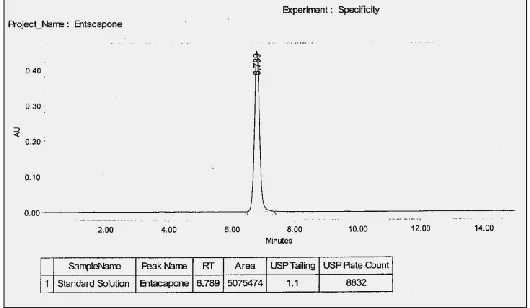
[image:3.612.317.582.462.616.2]Development and optimization of Chromatographic conditions: HPLC separation studies were carried out on the working standard solution of Entacapone (100 μg/ml). Several mobile phases were prepared using Acetonitrile and water by adjusting various pH. After several trials, Acetonitrile: 0.01% Orthophosphoric acid pH 2.5 (70:30 % v/v) was chosen as the mobile phase and column temperature was maintained at 50°C. This resulted in good resolution and acceptable peak parameters. RT was found as 7.0 minutes [Fig. 1].
FIG. 1: STANDARD CHROMATOGRAM
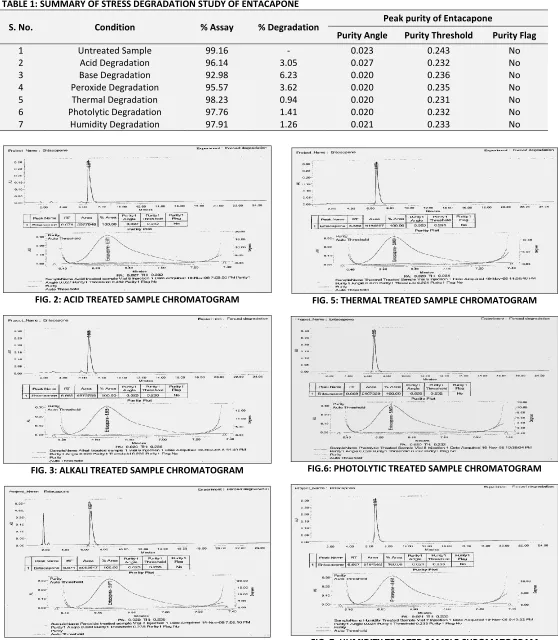
After exposing drug to heat condition no degradation peaks were found, but some amount of degradation was observed [Fig. 5]. After photo degradation study for UV light and fluorescence light, Entacapone showed
[image:4.612.25.583.106.746.2]1.41% degradation [Fig. 6]. Under humidity condition no degradation peaks were obtained, but some amount of degradation was observed [Fig. 7].
TABLE 1: SUMMARY OF STRESS DEGRADATION STUDY OF ENTACAPONE
S. No. Condition % Assay % Degradation Peak purity of Entacapone
Purity Angle Purity Threshold Purity Flag
1 Untreated Sample 99.16 - 0.023 0.243 No
2 Acid Degradation 96.14 3.05 0.027 0.232 No
3 Base Degradation 92.98 6.23 0.020 0.236 No
4 Peroxide Degradation 95.57 3.62 0.020 0.235 No
5 Thermal Degradation 98.23 0.94 0.020 0.231 No
6 Photolytic Degradation 97.76 1.41 0.020 0.232 No
7 Humidity Degradation 97.91 1.26 0.021 0.233 No
FIG. 2: ACID TREATED SAMPLE CHROMATOGRAM
FIG. 3: ALKALI TREATED SAMPLE CHROMATOGRAM
FIG. 4: PEROXIDE TREATED SAMPLE CHROMATOGRAM
FIG. 5: THERMAL TREATED SAMPLE CHROMATOGRAM
FIG.6: PHOTOLYTIC TREATED SAMPLE CHROMATOGRAM
Validation of the developed stability indicating method [Table 2]:
TABLE 2: VALIDATION RESULTS
S. No. Validation Parameters Results
1. Specificity Specific
2. System precision (%RSD) 0.17 3. Method precision (%RSD) 1.26 4. Intermediate precision (%RSD) 1.30 5. Accuracy-50% (%Recovery) 99.48% 6. Accuracy-100% (%Recovery) 100.07% 7. Accuracy-150% (%Recovery) 101.23% 8. Linearity- Correlation coefficient 0.99995
[image:5.612.29.298.303.448.2]Specificity [Fig. 8]: The Specificity of the method was determined by %assay difference between mean of spiked sample result and mean of method precision results. No interfering peak was eluted at the retention time of Entacapone peak from blank and placebo.
FIG. 8: SPIKED SAMPLE CHROMATOGRAM
For the Peak purity, purity angle of Entacapone was checked which was 0.020 which was less than peak threshold 0.244 and in purity flag there was no tick mark.
Linearity: The data obtained in the linearity experiment was subjected to linear-regression analysis. A linear relationship between peak response and concentrations was obtained in the range of 50µg/ml to 150μg/ml of Entacapone with correlation coefficient (r) 0.99995.
Precision: The developed method was found precise as the overall %RSD for % assay of Entacapone in both method precision and intermediate precision were less than 2.0.
Accuracy: Excellent recoveries were obtained at each level of spiked concentration. The result obtained (n = 3 for each level) indicated the mean recovery between 98% to 102% for Entacapone.
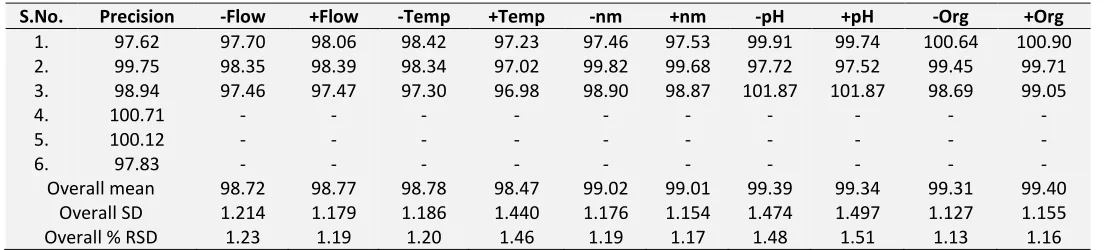
Robustness [Table 3]: The overall % RSD for % assay of method precision and Robustness variations for change in flow rate, change in wavelength, change in column oven temperature, change in pH of buffer and change in organic content in mobile phase was found to be less than 2.0.
TABLE 3: ROBUSTNESS RESULTS
S.No. Precision -Flow +Flow -Temp +Temp -nm +nm -pH +pH -Org +Org
1. 97.62 97.70 98.06 98.42 97.23 97.46 97.53 99.91 99.74 100.64 100.90 2. 99.75 98.35 98.39 98.34 97.02 99.82 99.68 97.72 97.52 99.45 99.71 3. 98.94 97.46 97.47 97.30 96.98 98.90 98.87 101.87 101.87 98.69 99.05
4. 100.71 - - - -
5. 100.12 - - - -
6. 97.83 - - - -
Overall mean 98.72 98.77 98.78 98.47 99.02 99.01 99.39 99.34 99.31 99.40 Overall SD 1.214 1.179 1.186 1.440 1.176 1.154 1.474 1.497 1.127 1.155 Overall % RSD 1.23 1.19 1.20 1.46 1.19 1.17 1.48 1.51 1.13 1.16
DISCUSSION: The degradation conditions mentioned above were arrived after number of initial trials for optimization of extent of degradation.
CONCLUSION: This study indicates a simple, rapid and validated stability-indicating HPLC method for determination of Entacapone in the presence of degradation products. All the degradation products formed during forced degradation studies were well
separated from the analyte demonstrating that the developed method was specific and stability indicating.
[image:5.612.32.584.482.607.2]ACKNOWELEDGEMENT: The authors are thankful to Hetero labs Ltd, Hyderabad, Andhrapradesh, India for providing working standard of Entacapone and impurities. The authors are also thankful to the Vice chancellor, Karpagam University for providing necessary facilities and constant encouragement.
REFERENCES:
1. Lyons KE and Pahwa R: Conversion from sustained release
carbidopa/levodopa to carbidopa/levodopa/entacapone
(Stalevo) in Parkinson disease patients. Clinical
Neuropharmacology. 2006; 29(2): 73-76.
2. Brooks DJ, Agid Y, Eggert K, Widner H, Ostergarrd K and Holopainem A: TC-INIT Study Group. Treatment of end-of-dose wearing-off in Parkinsons’s disease. Eur Neurol. 2005; 53(4): 197-202.
3. http://www.medindia.net/doctors/drug_information/entacapo
ne.htm. Accessed 5 April 2011.
4. O’Neil MJ, The Merck Index, Merck and Co., Inc., White House Station, NJ., 13th Ed, 2001:3630.
5. Sweetman SC, (Ed.) Martindale: The Complete Drug Reference, Pharmaceutical Press London, UK, 33rd Ed, 2002:1168.
6. United States of Pharmacopoeia Vol. 1, General Chapters Description and Solubility / Reference Tables. 2012; 1:1116. 7. ICH, Q1A (R2): Stability Testing of New Drug Substances and
Products, International Conference on Harmonization, Geneva. February 2003.
8. Deesha B Gandhi and Priti J Mehta: A Simultaneous RP-HPTLC method for determination of levodopa, carbidopa and entacapone in combined tablet dosage form. Journal of Planar Chromatography. 2011; 24: 236-241.
9. Goncalves D, Alves G, Soares-da-Silva P and Falcao A: Bioanalytical chromatographic methods for the determination of catechol-O-methyltransferase inhibitors in rodents and human samples. Journal of Analytica Chimica Acta. 2012;13:17-32.
10. Ramakrishna NVS, Vishwottam KN, Wishu S, Koteshwara M and Chidambara J: High-performance liquid chromatography for the quatification of Entacapone in human plasma. Journal of Chromatography.B. 2005; 823(2):189-194.
11. Koradia SK, Jivani NP, Malaviya SV, Chauhan SP: Development and validation of spectrophotometric method for the estimation of Entacapone in pharmaceutical formulations. International journal of Chromatographic science. 2009, 7 (1):349-352.
12. ICH, Q1A (R2): Validation of Analytical procedure, International Conference on Harmonization, Geneva. February 2003. 13. Shailesh K, Koradia, Ashwin S Agola, Nurudin P Jivani, Ravi A.
Manek and Shivanand Pandey. Development and Validation of Derivative Spectrophotometric Method for Determination of Entacapone in Pharmaceutical Formulation. International Journal of Pharmaceutical Research and Development. 2009; 9:1-10.
14. Maitreyi Zaveri, Bhavita Dhru and Amit Khandhar: Simultaneous Estimation of Levodopa, Carbidopa and Entacapone in Pharmaceutical Dosage by Validated Reverse phase High performance liquid chromatography. International Journal of Institutional Pharmacy and Life sciences. 2012; 2: 10-19.
How to cite this article: