787
ORGANIZATIONAL GREEN INFORMATION TECHNOLOGY
(IT) ADOPTION THEORETICAL FRAMEWORKS: A
SYSTEMATIC LITERATURE REVIEW
1*ABUBAKAR ATIKU MUSLIM, 2ALEX TZE HIANG SIM, 3JEE MEI HEE
1*,2 Faculty of Computing, Universiti Teknologi Malaysia (UTM), Johor Bahru, Malaysia.
3 Faculty of Education, Universiti Teknologi Malaysia (UTM), Johor Bahru, Malaysia.
1*[email protected], 2[email protected], 3[email protected]
ABSTRACT
Although, organisational Green Information Technology (Green IT) adoptions have been on the increase, yet many organisations face difficulty in identifying and adopting relevant Green IT strategy. Green IT adoption studies at the organisational level are primarily based on theoretical frameworks. However, these underlying theories are understudied. This paper review 103 published research articles from leading information systems’ literature sources on organisational Green IT adoption from 2007 – 2018 to guide future research. The review focuses on the theoretical frameworks used in organisational Green IT adoption studies and provides analysis by purpose, by country, by year of publication and the frequency of use with insights and recommendations for future research.
Keywords: Green Information Technology (It), Green Information Systems (Is), Sustainable It, Adoption,
Is Theory
1. INTRODUCTION
For the last century, the planet earth experienced an environmental decline due to human activities such as exploration and use of resources, manufacturing and electricity generation[2-4]. Information Technology (IT) contribute to the environmental decline as much as the aviation industry [5]. IT is a major contributor of e-waste, consumer of energy and emitter of greenhouse gases (such as CO2). IT
lifecycle from production, use and disposal has a negative impact on the environment. For instance, in the United States alone, IT accounts for estimated energy consumption of 20 Million Gigajoules and 4 Million tons of greenhouse gases is released to the environment as a result [6]. 50 million tons of electronic waste is dumped into the land fields annually which significantly pollute the environment[7]. Ironically, IT as part of the environmental problem is also part of the solution. IT assists in addressing the environmental problem in practices referred to as Green or Sustainable IT. Green IT is defined as a practice or use of IT resources and systems efficiently in an environmentally friendly way while maintaining or increasing the performance and productivity [8]. Although, some researchers [9-11] attempted to distinguish between Green IT and Green IS, majority researchers in this area [12-14] regard
them as the same. Thus, this paper considers both terms as the same and are used interchangeably. Green IT particularly at organisational level can take several shapes and forms. For instance, using energy efficient computers and IT systems can minimise energy consumption[8]. An optimised software is faster and microprocessor friendly resulting in a reduction in energy consumption[8, 15]. Green data centre save energy in virtualisation, cooling and lighting, translating into less CO2
emission[14, 16]. Automation in the form of hardware and software can minimise energy consumption[17, 18]. Improved mapping and GPS technology have been used to improve routing to optimise transportation and delivery which curtail CO2 emission. Companies such United Airlines
788 organisations. CIO magazine survey also found that CIOs are looking at best ways to implement Green IT practices[21]. The magazine further reported cost savings and corporate social responsibility are the main motives behind the Green IT initiatives[21]. In 2010, the United Nations (UN) global pact, ISO 26000 standard, released a comprehensive direction and recommendations to corporate executives on corporate social responsibility. In this standard, organisations are required to take precautionary measures to protect the planet and encourage greater environmental responsibility through organisation activities and implementation of IT systems and practices [22-24]. Although, organisational Green IT adoptions have been on the rise but identifying and adopting environmentally efficient IT systems and practices is a challenge for many organisations. Green IT adoption studies at the organisational level are primarily based on theoretical frameworks. Theories help to structure a concept and idea on the phenomenon to facilitate extensive study. Theories are also useful in designing and shaping empirical studies and analysis.
According to Gregor (2006), theories are the backbone of information systems (IS) research and thus, the study of the IS theories and their use in IS research are important. However, there are limited studies on the theories and their use in organisational Green IT adoption studies.
2. OBJECTIVES
Green IT as an area of research has evolved and attracted significant interest from researchers. In the last decades, information systems conferences have experienced an upsurge in Green IT research. Despite the evolution of Green IT, few organisational Green IT adoption systematic literature review have been published. Organisational Green IT adoption theories are partially covered in previous studies. Furthermore, most studies are not specific to organisational Green IT adoption theories. We hope that this article addresses these limitations.
The objective of the review is to answer the following research questions:
1. What are the theories used in organisational Green IT adoption studies?
2. How has the use of theories in Green IS research evolved over the last decade?
3. What are the dominant theories used in organisational Green IT research?
3. METHODOLOGY
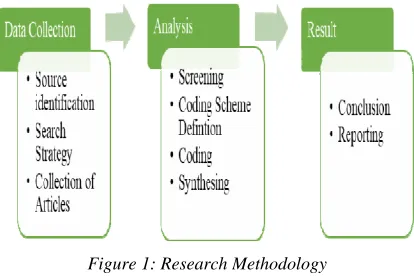
We developed our systematic review protocol based on the guidelines and procedures proposed by the Cochrane Handbook for Systematic Reviews of Interventions[26], Levy & Ellis[27], and Bandara et al. [28]. The review protocol is in three distinct phases: data collection, analysis and result as presented figure 1. The first phase involved defining a search strategy, identification and collection of relevant articles based on the inclusion and exclusion criteria. The second phase involved the screening of the articles based on quality criteria, coding and analysis based on the objectives of the study. The final phase involved synthesizing, concluding and reporting the result. We describe the details of these stages and the method used in the rest of this section.
3.1 Inclusion and Exclusion Criteria
[image:2.612.314.521.542.680.2]We defined the inclusion and exclusion criteria to guide the data collection. The criteria are as follows: papers were considered for inclusion in the review process if they are organisational Green IT/IS adoption empirical research. Studies from both academic and practitioners’ literature were included. Studies included in the review were not restricted to a specific type of outcome. The review included both quantitative and qualitative studies published from 2007 to 2018. Only studies published in the English language were included. Studies were excluded if their main focus was not Green IT/IS adoption. Given that our focus was on empirical research, papers without a research design, not grounded in theory were excluded. Finally, papers based on only the opinion of experts were also excluded.
Figure 1: Research Methodology
3.2 Source Identification and Search Strategy
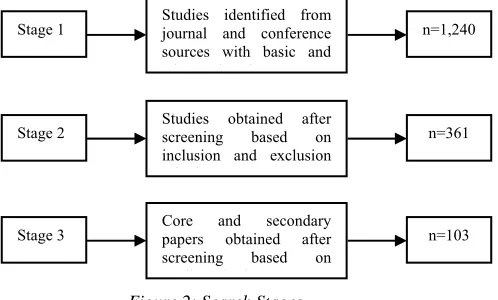
789 sources. Figure 2 shows the search process and papers identified at each stage.
Figure 2: Search Stages
The following keywords were used:
1. “Green Information Technology OR IT Adoption”
2. Green AND ICT 3. Sustainable AND IT 4. Green AND Computing 5. Green AND IS
6. Green AND Procurement
7. Green OR Sustainable IT AND Adoption 8. “Energy Efficient Computing”
9. “Energy Efficient IT” 10. “Green IS Adoption” 11. Eco AND Computing
12. Environmental AND Protection
All the search terms for Green IT articles were searched in combination using basic and advanced search settings. We began with a basic search to obtain search results sorted by relevance. The basic-settings were necessary at the beginning so as not filter the best and most relevant papers. Advanced settings such as year, database and author were later applied to filter the search results. For instance, year of publication was specified to obtain recent articles and also limit search results for certain publication year. In Green IT, authors such as Alemayehu Molla of RMIT, Australia, are leading authors in Green IT/IS, and we used author-setting to obtain his specific and recent publications. Database-setting was used to search leading IS journal and conference sources. We also applied Boolean operators and special characters to define search rules. Only articles which conform to the rules were retrieved. Some search engines such as Google Scholar apply AND operator when searching for two or more keywords.
The purpose of AND operator was to obtain search results that contained all keywords. OR operator is normally used in the case where synonymous words are used interchangeably. By using OR operator, an article had to include one keyword or the other (such as Green IT or IS) to be retrieved. Quotes were used between keywords to perform a phrase search. The phrase-search is search used to obtain search results in the exact order of the keywords used in a particular search. We began data collection phase with the search for the relevant literature using a leading search engine, Google Scholar, due to a limited number of Green IT papers on leading IS journals sources. The timeframe for the search is from 2007, the year, the term Green IT first appeared on CIO magazine, to 2018. The search process continued with advanced settings, and specific leading IS databases. The database sources include MIS Quarterly, ACM Digital Library, Elsevier, EBSCOhost, Emerald Management eJournals and Science Direct journals [29]. Leading IS conferences were later searched with the same keywords. These include International Conference on Information Systems (ICIS), Americas Conference on Information Systems (AMCIS), European Conference on Information Systems (ECIS) and Pacific Asia Conference on Information Systems (PACIS). The search was extended to the practitioner’s literature sources using similar keywords. The result of the search with basic and the specific parameters from all sources returned 1,240 results. The references were exported to Endnote for analysis.
3.3 Citation Management
Citations from search results in stage 1 (n = 1,240) were imported to Endnote where eligibility and retrieval decisions were taken. Endnote is an industry standard software used for managing references and citations on multiple platforms such as Windows and Macintosh. Endnote libraries were created for each subsequent stage. At this stage, individual paper titles were analysed for download eligibility. Studies that were not Green IT/IS studies were removed regardless of their empirical status. For instance, our search includes Green information Technology or IT other Green technology such Green Building and Green Manufacturing related articles were retrieved. Also, because our search strategy includes IT which stands for Information Technology in our case studies from other research areas with IT in their titled were retrieved. Duplicate references were also removed as some papers in the basic search
Studies identified from journal and conference sources with basic and
d d i
Stage 1 n=1,240
Studies obtained after screening based on inclusion and exclusion
i i
Stage 2 n=361
Core and secondary papers obtained after screening based on
li i i
790 results were duplicated in the advanced search results.
Moreover, papers that were outside the scope of the review process were removed. For instance, studies that studied individual (not organisation level) Green IT adoption were excluded. However, the scope and relevance of some articles were not obvious from the title. In such a case, the references were included for further analysis. After all the irrelevant references were excluded, 901 references were removed from our library, and only 361 articles were downloaded for further analysis.
3.4 Quality Criteria
Quality criteria were used to assess the quality and fitness of the articles to be included in the review. The 361 remaining papers that scaled the previous stages were assessed in detail and individually according to the criteria as follows. The criteria was based on the Critical Appraisal Skills Programme (CASP) 4 (in particular, those used in assessing the quality of studies. The criteria covered in three main aspects of research quality: credibility, rigour and relevance. The criteria are summarised as follows:
1. Was the paper based on empirical research?
2. Was the research grounded in theory? 3. Was the aim of the research clearly stated? 4. Was the research context adequately
described?
5. Has the data collection addressed the research objectives?
6. Was the data analysis sufficient to provide a reasonable conclusion?
7. Was the finding clear stated?
The seven criteria highlighted were used to assess the quality and contribution of each study to the review process. Each of the seven criteria was assessed on a logical “yes” or “no” scale. Of the 361 studies analysed in detail at this stage, 259 have not satisfied the minimum criteria and thereby removed. Out of the remaining 103, 61 papers constitute the core or primary papers, and 42 constitute the secondary references. The 103 papers were thus, used for the review process.
3.5 Data Extraction and Coding
All the screened articles were copied to Nvivo for extraction and synthesis. Nvivo is a software used for qualitative data analysis and management. In the extraction process, data was extracted from 61 main articles and 42 secondary articles for this
791 • Reciprocal translation or direct comparison.
• Rotational comparison or opposition to one another.
• Complementary translation or present same proposition.
The synthesis was performed in three steps. The first step was to identify the definition and background, objective, theory, methodology and conclusion. The second step was organizing the relevant information in a predefined coding scheme to facilitate comparison and research results based on the research questions. Finally, the result was analyzed to identify gaps to in organizational Green IT adoption studies.
4. RESULT
We reviewed 61 core studies on organisational Green IT adoption; we identified 33 theories and underlying objectives of the studies and relevant references as presented in table 1. We further analyzed theoretical frameworks based its purpose of the application, the spread of organizational Green IT adoption by-year over the last decade. Finally, we highlight the spread or geographical distribution of the organizational Green IT adoption studies.
4.1 Classification of Theories by Purpose
Green IT adoption studies at the organisational level are primarily based on theoretical frameworks, and 33 theories have been reviewed in this study. These frameworks are classified based on their intent or purpose of use as taxonomy, general purpose and special purpose [35].
4.1.1 Taxonomy
Taxonomy category serves as classification frameworks. These include among others, Natural Resource-Based View (NRBV), Diffusion of Innovation (DoI), Organizational Motivation (OM), and Technology Organization Environment (TOE) theories. NRBV often used in Green IT adoption research to classify Green IT initiatives. For instance, Rahim et al., 2013 used NRBV to study Green IT capability[36]. TOE is used in Green IT adoption for classification of antecedents into Technology Organization and Environment contexts. For instance, (Hernandez & Ona, 2018) used the TOE to investigate Green IT adoption in the business processes outsourcing industry in the Philippines[37]. While DoI is used in Green IT adoption studies to describe stages of Green IT
implementations such as initiation, adoption, and reutilization. For instance, (Bose & Luo, 2011) used DoI to develop Green IT adoption integrative framework to study different stages of implementation of Green IT adoption at the organisational level[38].
4.1.2 Green IT General Initiatives
This category of theoretical frameworks focused on the factors driving adoption of Green IT at the organisational level. This category includes but not limited to Institutional Theory (IT), DoI and Belief–Action–Outcome (BAO) theories. Green IT General Initiative’s theories such as IT have frequently been used in Green IT adoption studies[39]. The IT’s main argument is predicated on the proposition that the desire of an organisation to acquire political power and legitimacy to drive its initiation[35]. The theory argues that the actions of an organisation are due to external or environmental pressure but not from organisational initiatives. There are three types of institutional pressure according to the theory from perspective Green IT literature. These are normative, mimetic and coercive, pressure (Chen et al., 2009).
4.1.3 Specific Type of Initiatives
This category of theoretical frameworks are used in organizational Green IT adoption studies to address specific sustainable initiatives of several characteristics of focal Green IT implementations. Thus, this category of theoretical frameworks may not be able to explain other Green IT initiatives[35]. PVT is a theory used to investigate process virtualization by analyzing related characteristics [14]. For instance, Bose and Luo (2011) use PVT to study IT-enabled virtualization which is a special organizational Green IT initiative.
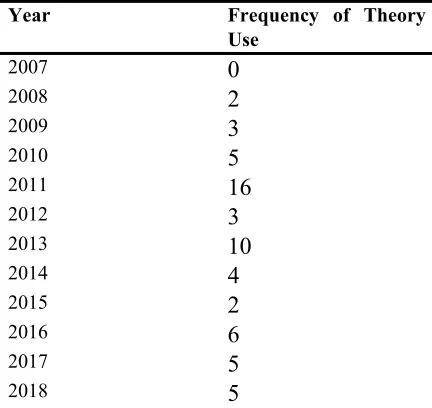
4.2 Use of Theory by Year of Publication
792 increase in publications from 2008 to 2011. This increase reached its peak in 2011 and began to decline till 2013 which mark a relative surge with 10 published papers. 2015 like 2008, has the least with 2 published papers found by the authors. The review of this paper was completed in the third quarter of 2018 with the potential of more published studies before the end of 2018.
Table 1: Frequency of Use Theory
Year Frequency of Theory
Use
2007
0
2008
2
2009
3
2010
5
2011
16
2012
3
2013
10
2014
4
2015
2
2016
6
2017
5
2018
5
4.3 Use of Theory by Country
This section presents the geographical distribution of the studies by countries where the studies were conducted. Although, the negative impact of IT affects both developed and developing nations, however, most studies focused on the developed countries. Our review of the published journals and conference papers reveals that the majority of the studies focused on developed nations such as Australia[13, 40-42], USA[43-45], UK[46, 47], Fewer studies gave consideration to leading developing nations such as India[48], China[49, 50]. Only one studies focused on Africa[51].
4.4 Frequency of Use of Theory
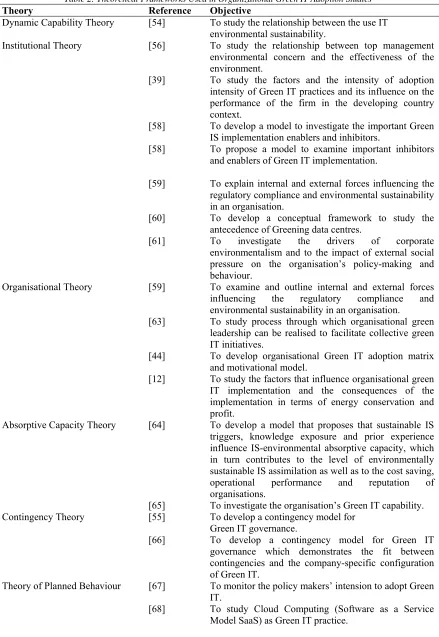
Green IT studies are normally based on underlying theatrical frameworks. Table 2 shows theories used in green it researches from 2007 to 2018. Thirty-three theories were identified and reviewed in this study. These include Dynamic Capability Theory (DCT), Institutional Theory (IT), Organisational Theory (OT), Absorptive Capacity Theory (ACT), Contingency Theory (CT), Theory of Planned Behaviour (TPB), Theory Reasoned Action (TRA), Technology Acceptance Model (TAM), Ecological Theory (ET), Complementarity Theory (CT),
Technology-Organization-Environment (TOE), Resource-Based View Theory (RBV), Natural Resource-Based View Theory (NRBV), Diffusion of Innovation Theory (DoI), Information Processing Theory (IPT), Expectation Disconfirmation Theory (EDT), Motivational Theory (MT), Performance-Expectancy Theory (PET), Actor-Network Theory (ANT), U- commerce Theory (UT), Social Capital Theory (SCT), Process-Virtualization Theory (PVT), Socio-Technical System Theory (STS), Transaction Cost Theory TCT), Stakeholder Theory (ST), Norm Activation Theory (NAT), Belief-Action-Outcome (BAO) framework, Reference Group Theory (RGT), Theory of Practice (ToP), Resource Dependence Theory (RDT), Upper Echelon Theory (UET), Refined Theory of Basic (RTB) and Unified Theory of Acceptance and Use of Technology (UTAT).
All theories identified in this study were used once or twice except, IT (used 7 times), TOE (used 12 times) and NRBV (used 5 times). Theories used 3 times include RBV, MT and DoI. OT, NAT, TAM and UTAT are also used 4 times.
Some researchers used multiple theories to study organisational green it adoption. for instance, [38] used three theories, DoI, PVT and TOE to develop green it adoption integrative framework and the stages of implementation at the organisational level. While others used single theory to study green it adoption at the organisational level. For instance, (aoun et al., 2011) used ANT to study the use of collaborative technologies for eco-mobilisation among environmental non-governmental organisations (NGOs) to achieve shared environmental goals. The number of theories used in a particular study depends on the context and purpose of the study.
5. DISCUSSION AND FUTURE RESEARCH IMPLICATION
793 investigating higher educational institutions is lacking, to the knowledge of the authors, as there is a large concentration of IT devices in higher education communities resulting in the high use of energy, a large volume of e-waste and high greenhouse gas emission. Also, most studies focused on developed countries in Europe and America, few from leading from leading developed nations such as China and Hong Kong and least from Africa. Future research can field this gap by investigating antecedents of IT policymakers to Green IT in specific industries such as education, SMEs, health and hospitality industries. Green IT adoption studies are needed in developing nations, particularly in Africa. African countries like Nigeria with large young population are moving towards knowledge-based economy and industrialization which will have accompanied global environmental footprint. Furthermore, more focus also on address gap in development organizational Green IT adoption theoretical frameworks.
6. CONCLUSION
Green IT as an area of research has relatively evolved in the last decade based on the number of published studies identified in this review. However, studies are likely to increase due increased attention to the environment from all human endeavor. Among the questions still asked, “how do organisations identify and adopt Green IT strategy?” This paper contributes to Green IT literature by providing a comprehensive review of organisational Green IT adoption theoretical frameworks from 2007 – 2018. 103 published research articles were reviewed, thirty-three theoretical frameworks, objectives of the studies and relevant references were identified and discussed in this review as summarized in table 2. The theories were further analyzed by year of publication, geographical distribution, by purpose and frequency of use. From our findings, most organisational Green IT studies were conducted in developed countries, and year 2011 has the highest number of published papers. Our findings further revealed the TOE framework to be the dominant theory used in organisational Green IT research. Insights and recommendations were also provided which future research could address. This paper is limited to organisational level research, hence, adoption studies that were conducted at the individual level were excluded.
ACKNOWLEDGEMENT
This research is supported by research grants (vot no: 4F441, 13H89). Authors also acknowledge the support provided by the Ministry of Higher Education (MOHE), Research Management Centre (RMC) and Universiti Teknologi Malaysia.
REFERENCES
[1] C. Koo, N. Chung, and Y.-C. Lee, "The Influential Motivations of Green IT Device Use and the Role of Reference Group Perspective," in PACIS, 2013, p. 90.
[2] B. Walsh, "The gas dilemma," Time, vol. 177, no. 14, pp. 40-48, 2011.
[3] J. Harris and A. McCartor, "The world's worst toxic pollution problems: The top ten of the toxic twenty. Blacksmith Institute," ed, 2011.
[4] H. Salehfar and S. Benson, "Electric utility coal quality analysis using artificial neural network techniques," Neurocomputing, vol. 23, no. 1, pp. 195-206, 1998.
[5] S. Heng, "Green-IT: IT is not green and never ever will be," ed, 2009.
[6] P. Ranganathan, "Recipe for efficiency: principles of power-aware computing,"
Communications of the ACM, vol. 53, no.
4, pp. 60-67, 2010.
[7] B. Karin, "Scavenging Hazardous' E-Waste'for a Few Redeemables," The Washington Post, 2009.
[8] S. Murugesan, "Making IT green," IT professional, vol. 12, no. 2, pp. 4-5, 2010. [9] J. Dedrick, "Green IS: concepts and issues
for information systems research," Communications of the Association for Information Systems, vol. 27, no. 1, pp. 11-18, 2010.
[10] S. Brooks, X. Wang, and S. Sarker, "Unpacking Green IT: A review of the existing literature," 2010.
[11] S. Brooks, X. Wang, and S. Sarker, "Unpacking green IS: a review of the existing literature and directions for the future," in Green business process management: Springer, 2012, pp. 15-37. [12] S. Mithas, J. Khuntia, and P. K. Roy,
794 [13] H. Huang, "A sustainable systems
development lifecycle," PACIS 2008 Proceedings, p. 81, 2008.
[14] E. Overby, "Process virtualization theory and the impact of information technology," Organization science, vol. 19, no. 2, pp. 277-291, 2008.
[15] R. T. Watson, M.-C. Boudreau, and A. J. Chen, "Information systems and environmentally sustainable development: energy informatics and new directions for the IS community," MIS quarterly, pp. 23-38, 2010.
[16] K. Bilal et al., "A taxonomy and survey on green data center networks," Future Generation Computer Systems, vol. 36, pp. 189-208, 2014.
[17] D. Gilstrap, "Method and apparatus for home automation and energy conservation," ed: Google Patents, 2011. [18] E. J. Bartone, E. L. Mendenhall Jr, J. H.
McClutchy Jr, and D. N. Patel, "System and method for monitoring and controlling energy usage," ed: Google Patents, 2003. [19] R. T. Watson, M.-C. Boudreau, S. Li, and
J. Levis, "Telematics at UPS: En Route to Energy Informatics," MIS Quarterly Executive, vol. 9, no. 1, 2010.
[20] J. P. Fuhr and S. Pociask, "Broadband and telecommuting: Helping the US environment and the economy," Low Carbon Economy, vol. 2, no. 01, p. 41, 2011.
[21] C. Staff, "CIO's Green IT Survey: Cost Cutting, Social Responsibility Drive Environmental Moves," Retrieved, vol. 3, no. 17, p. 2009, 2008.
[22] A. Burton-Jones and M. J. Gallivan, "Toward a deeper understanding of system usage in organizations: a multilevel perspective," MIS quarterly, pp. 657-679, 2007.
[23] J. L. Murillo-Luna, C. Garcés-Ayerbe, and P. Rivera-Torres, "What prevents firms from advancing in their environmental strategy?," International Advances in Economic Research, vol. 13, no. 1, pp. 35-46, 2007.
[24] C. Dascalu, C. Caraiani, C. Iuliana Lungu, F. Colceag, and G. Raluca Guse, "The externalities in social environmental accounting," International Journal of Accounting & Information Management, vol. 18, no. 1, pp. 19-30, 2010.
[25] L. G. Tornatzky, M. Fleischer, and A. K. Chakrabarti, Processes of technological innovation. Lexington Books, 1990. [26] J. P. Higgins and S. Green, "Cochrane
handbook for systematic reviews of interventions," ed: version, 2005.
[27] Y. Levy and T. J. Ellis, "A systems approach to conduct an effective literature review in support of information systems research," Informing Science, vol. 9, 2006. [28] W. Bandara, S. Miskon, and E. Fielt, "A
systematic, tool-supported method for conducting literature reviews in information systems," in Proceedings of the19th European Conference on Information Systems (ECIS 2011), 2011. [29] M. S. Matell and J. Jacoby, "Is There an
Optimal Number of Alternatives for Likert Scale Items? Study," Educational and psychological measurement, vol. 31, pp. 657-674, 1971.
[30] W. J. Orlikowski and J. J. Baroudi, "Studying information technology in organizations: Research approaches and assumptions," Information systems research, vol. 2, no. 1, pp. 1-28, 1991.
[31] T. A. Scandura and E. A. Williams, "Research methodology in management: Current practices, trends, and implications for future research," Academy of Management journal, vol. 43, no. 6, pp. 1248-1264, 2000.
[32] A. Rahim, R. Eladwiah, and A. Abdul Rahman, "Resource-based Framework of Green IT Capability Toward Firms’ Competitive Advantage," Resource, vol. 6, pp. 18-2013, 2013.
[33] M. B. Miles and A. M. Huberman, Qualitative data analysis: An expanded sourcebook. sage, 1994.
[34] R. Campbell et al., "Using meta-ethnography to synthesise qualitative research," Moving beyond effectiveness in evidence synthesis, pp. 75-82, 2006. [35] C. F. Lei and E. W. T. Ngai, "Green IT
Adoption: An Academic Review of Literature," in PACIS, 2013, p. 95.
[36] R. E. A. Rahim and A. A. Rahman, "Green It Capability and Sustainable Development," in The First International Conference on Green Computing, Technology and Innovation
(ICGCTI2013), 2013, pp. 80-88: The
795 [37] A. A. Hernandez and S. Ona, "A
Qualitative Study of Green IT Adoption Within the Philippines Business Process Outsourcing Industry," Technology Adoption and Social Issues: Concepts, Methodologies, Tools, and Applications: Concepts, Methodologies, Tools, and Applications, p. 408, 2018.
[38] R. Bose and X. Luo, "Integrative framework for assessing firms’ potential to undertake Green IT initiatives via virtualization–A theoretical perspective," The Journal of Strategic Information Systems, vol. 20, no. 1, pp. 38-54, 2011. [39] S. Ainin, M. M. Naqshbandi, and S.
Dezdar, "Impact of adoption of Green IT practices on organizational performance," Quality & Quantity, vol. 50, no. 5, pp. 1929-1948, 2016.
[40] A. Cater-Steel and W.-G. Tan, "The role of IT service management in Green IT," Australasian Journal of Information Systems, vol. 17, no. 1, 2011.
[41] H. Hasan, A. Ghose, and T. Spedding, "IS solution for the global environmental challenge: An Australian initiative,"
AMCIS 2009 Proceedings, p. 122, 2009.
[42] A. Molla and A. Abareshi, "Green IT Adoption: A Motivational Perspective," in PACIS, 2011, p. 137.
[43] M. Chetty, A. Brush, B. R. Meyers, and P. Johns, "It's not easy being green: understanding home computer power management," in Proceedings of the SIGCHI Conference on Human Factors in
Computing Systems, 2009, pp. 1033-1042:
ACM.
[44] A. Molla, S. Pittayachawan, B. Corbitt, and H. Deng, "An international comparison of Green IT diffusion," International Journal of e-Business Management, vol. 3, no. 2, p. 3, 2009. [45] K. Marett, R. F. Otondo, and G. S. Taylor,
"Assessing the effects of benefits and institutional influences on the continued use of environmentally munificent bypass systems in long-haul trucking," Mis Quarterly, vol. 37, no. 4, pp. 1301-1312, 2013.
[46] S. Chai-Arayalert and K. Nakata, "The Evolution of Green ICT Practice: UK Higher Education Institutions Case Study,"
in Proceedings of the 2011 IEEE/ACM
International Conference on Green
Computing and Communications, 2011,
pp. 220-225: IEEE Computer Society. [47] R. Bhamra, "Sustainable outsourcing: a
practice survey and research opportunities," International Journal of Sustainable Engineering, vol. 5, no. 4, pp. 304-311, 2012.
[48] A. Datta, S. Roy, and M. Tarafdar, "Adoption of Sustainability in IT Services: Role of IT Service Providers," in AMCIS, 2010, p. 41: Citeseer.
[49] Z. Xu, "Measuring Green IT in Society," Computer, vol. 5, no. 45, pp. 83-85, 2012. [50] S. Cai, X. Chen, and I. Bose, "Exploring
the role of IT for environmental sustainability in China: An empirical analysis," International Journal of Production Economics, vol. 146, no. 2, pp. 491-500, 2013.
[51] J. Corbett, "Unearthing the Value of Green IT," in ICIS, 2010, vol. 198.
[52] K. Nanath and R. R. Pillai, "A sustainability model of green IT initiatives," 2012.
[53] G. B. Grant, T. P. Seager, G. Massard, and L. Nies, "Information and communication technology for industrial symbiosis," Journal of Industrial Ecology, vol. 14, no. 5, pp. 740-753, 2010.
[54] L. Sayeed and S. Gill, "An exploratory study on environmental sustainability and IT use," AMCIS 2008 Proceedings, p. 55, 2008.
[55] N.-H. Schmidt and L. M. Kolbe, "Towards a contingency model for green IT governance," in ECIS, 2011, p. 105. [56] M. M. Maymand and S. Golkarihagh,
"The effect of green IT adoption on the relationship between environmental orientation of CEO’s and environmental performance," International Journal of Humanities and Cultural Studies (IJHCS) ISSN 2356-5926, vol. 1, no. 1, pp. 812-838, 2016.
[57] C. F. Lei and E. Wai Ting Ngai, "Green IS assimilation: A theoretical framework and research agenda," 2012.
[58] N. Grant and D. Marshburn, "Understanding the Enablers and Inhibitors of Decision to Implement Green Information Systems: A Theoretical Triangulation Approach," 2014.
796 of Green IS," The Journal of Strategic Information Systems, vol. 20, no. 1, pp. 6-26, 2011.
[60] S. Karanasios, V. Cooper, H. Deng, A. Molla, and S. Pittayachawan, "Antecedents to greening data centres: A conceptual framework and exploratory case study," in Proceedings of the 21st Australasian Conference on Information Systems (ACIS 2010), 2010.
[61] P. Sarkar and L. Young, "Managerial attitudes towards Green IT: an explorative study of policy drivers," PACIS 2009 Proceedings, p. 95, 2009.
[62] A. Molla, "Organizational motivations for Green IT: Exploring Green IT matrix and motivation models," PACIS 2009 Proceedings, p. 13, 2009.
[63] B. Tan, S. Ling Pan, and M. Zuo, "Attaining and enacting green leadership: Insights from the green IT initiatives of China Mobile," 2011.
[64] V. Cooper and A. Molla, "Information systems absorptive capacity for environmentally driven IS‐enabled transformation," Information Systems Journal, vol. 27, no. 4, pp. 379-425, 2017. [65] V. A. Cooper and A. Molla, "Developing
Green It Capability: An Absorptive Capacity Perspective," in PACIS, 2012, p. 46.
[66] N. Opitz, H. Krüp, and L. M. Kolbe, "How to Govern your Green IT?-Validating a Contingency Theory Based Governance Model," in PACIS, 2014, p. 333.
[67] S. Asadi, A. R. C. Hussin, and H. M. Dahlan, "Toward Green IT adoption: from managerial perspective," International Journal of Business Information Systems, vol. 29, no. 1, pp. 106-125, 2018.
[68] G. A.-M. Taufiq-Hail, H. Ibrahim, and S. A. M. Yusof, "SAAS CLOUD COMPUTING AS A MEANS OF GREEN IT ACCEPTANCE MODEL: A THEORY OF PLANNED BEHAVIOR MODEL AT MALAYSIAN PUBLIC UNIVERSITIES’CONTEXT," Journal of Information, vol. 2, no. 4, pp. 01-17, 2017. [69] S. Asadi and A. Saedi, "Decision makers intention for adoption of Green Information Technology," in Computer and Information Sciences (ICCOINS),
2016 3rd International Conference on,
2016, pp. 91-96: IEEE.
[70] C. Yoon, "Extending the TAM for Green IT: A normative perspective," Computers
in Human Behavior, vol. 83, pp. 129-139,
2018.
[71] I. Akman and A. Mishra, "Sector diversity in green information technology practices: technology acceptance model perspective," Computers in human behavior, vol. 49, pp. 477-486, 2015.
[72] N.-H. Schmidt, K. Erek, L. M. Kolbe, and R. Zarnekow, "Predictors of Green IT Adoption: Implications from an Empirical Investigation," in AMCIS, 2010, p. 367: Citeseer.
[73] S. Ryoo, C. Koo, and Y. Wati, "Why Go Green: The Influence of Green Practices Coordination on Firm Performance," in
AMCIS, 2011.
[74] J. L. Chong and K. Olesen, "A Technology-Organization-Environment perspective on eco-effectiveness: A Meta-analysis," Australasian Journal of Information Systems, vol. 21, 2017.
[75] B.-N. Hwang, C.-Y. Huang, and C.-H. Wu, "A TOE approach to establish a green supply chain adoption decision model in the semiconductor industry," Sustainability, vol. 8, no. 2, p. 168, 2016. [76] M. Thomas, D. Costa, and T. Oliveira,
"Assessing the role of IT-enabled process virtualization on green IT adoption," Information Systems Frontiers, vol. 18, no. 4, pp. 693-710, 2016.
[77] A. A. Hernandez and S. E. Ona, "A Qualitative Study of Green IT Adoption within the Philippines Business Process Outsourcing Industry: A Multi-Theory Perspective," International Journal of Enterprise Information Systems (IJEIS), vol. 11, no. 4, pp. 28-62, 2015.
[78] S. Yunus, S. F. A. K. Jailani, H. Hairuddin, and E. S. Kassim, "Green IT adoption towards environmental sustainability: The moderating role of top management enforcement," in Research and Innovation in Information Systems (ICRIIS), 2013 International Conference on, 2013, pp. 241-244: IEEE.
797 [80] C.-Y. Lin and Y.-H. Ho, "Determinants of
green practice adoption for logistics companies in China," Journal of business ethics, vol. 98, no. 1, pp. 67-83, 2011. [81] D. Nedbal, W. Wetzlinger, A. Auinger,
and G. Wagner, "Sustainable IS Initialization Through Outsourcing: A Theory-Based Approach," in AMCIS, 2011.
[82] A. Molla, "GITAM: A Model for the Adoption of Green IT," ACIS 2008 Proceedings, p. 64, 2008.
[83] D. Simmonds and A. Bhattacherjee, "Green IT adoption and sustainable value creation," 2014.
[84] J. Benitez-Amado and R. M. Walczuch, "Information technology, the organizational capability of proactive corporate environmental strategy and firm performance: a resource-based analysis," European Journal of Information Systems, vol. 21, no. 6, pp. 664-679, 2012.
[85] A. J. Chen, R. T. Watson, M.-C. Boudreau, and E. Karahanna, "Organizational adoption of Green IS & IT: An institutional perspective," ICIS 2009 Proceedings, p. 142, 2009.
[86] R. E. A. Rahim and A. Rahman, "Resource-based framework of green it capability toward firms’ competitive advantage," in Proceedings of the 17th Pacific Asia Conference on Information System, Jeju Island, Korea, 2013, pp. 18-22.
[87] V. Dao, I. Langella, and J. Carbo, "From green to sustainability: Information Technology and an integrated sustainability framework," The Journal of Strategic Information Systems, vol. 20, no. 1, pp. 63-79, 2011.
[88] S. Ham and H. Han, "Role of Perceived Fit With Hotels' Green Practices in the Formation of Customer Loyalty: Impact of Environmental Concerns," Asia Pacific Journal of Tourism Research, vol. 18, no. 7, pp. 731-748, Oct 2013.
[89] L.-H. Yu and W.-T. Wang, "Examination of Green IT Adoption in Organizations: Based on the Expectation Disconfirmation Theory," 2017.
[90] A. Molla and A. Abareshi, "Organizational green motivations for information technology: empirical study," Journal of
Computer Information Systems, vol. 52,
no. 3, pp. 92-102, 2012.
[91] C. Aoun, S. Vatanasakdakul, and D. Cecez-Kecmanovic, "Can IS Save the World? Collaborative Technologies for Eco-Mobilisation," in Proceedings of the Australasian Conference on Information System, 2011.
[92] F. Bengtsson and P. J. Ågerfalk, "Information technology as a change actant in sustainability innovation: Insights from Uppsala," The Journal of Strategic Information Systems, vol. 20, no. 1, pp. 96-112, 2011.
[93] L. F. Pitt, M. Parent, I. Junglas, A. Chan, and S. Spyropoulou, "Integrating the smartphone into a sound environmental information systems strategy: Principles, practices and a research agenda," The Journal of Strategic Information Systems, vol. 20, no. 1, pp. 27-37, 2011.
[94] R. T. Watson, M.-C. Boudreau, A. J. Chen, and H. H. Sepúlveda, "Green projects: An information drives analysis of four cases," The Journal of Strategic Information Systems, vol. 20, no. 1, pp. 55-62, 2011.
[95] J. van Reijsen and R. Helms, "Social Capital as an Enabler for Sustainable
Knowledge Management in
Organizations," ECIS 2011 Proceedings, 2011.
[96] S. Seidel, J. C. Recker, and J. Vom Brocke, "Sensemaking and sustainable practicing: functional affordances of information systems in green transformations," Management
Information Systems Quarterly, vol. 37,
no. 4, pp. 1275-1299, 2013.
[97] M. Dalvi-Esfahani and A. A. Rahman, "AN INTEGRATIVE FRAMEWORK TO UNDERSTAND THE INFLUENCE OF
MORALITY ON GREEN IS
ADOPTION: A THEORETICAL
PERSPECTIVE," Journal of Theoretical & Applied Information Technology, vol. 88, no. 2, 2016.
[98] C. Lei and E. Ngai, "A RESEARCH
AGENDA ON MANAGERIAL
INTENTION TO GREEN IT
ADOPTION: FROM NORM
ACTIVATION PERSPECTIVE Paper presented at the Pacific Asia Conference on Information Systems (PACIS)," ed: China, 2014.
798 for Sustainability: A Case Study in China," Sustainability, vol. 10, no. 7, p. 2160, 2018.
[100] R. Gholami, A. B. Sulaiman, T. Ramayah, and A. Molla, "Senior managers’ perception on green information systems (IS) adoption and environmental performance: Results from a field survey," Information & Management, vol. 50, no. 7, pp. 431-438, 2013.
[101] M. T. Ijab, A. Molla, and V. A. Cooper, "A theory of practice-based analysis of Green Information Systems (Green IS) use," Proc of ACIS, 2011.
[102] M. Dalvi-Esfahani, T. Ramayah, and M. Nilashi, "Modelling upper echelons’ behavioural drivers of Green IT/IS adoption using an integrated Interpretive Structural Modelling–Analytic Network Process approach," Telematics and Informatics, vol. 34, no. 2, pp. 583-603, 2017.
799
Table 2: Theoretical Frameworks Used in Organizational Green IT Adoption Studies
Theory Reference Objective
Dynamic Capability Theory [54] To study the relationship between the use IT environmental sustainability.
Institutional Theory [56] To study the relationship between top management environmental concern and the effectiveness of the environment.
[39] To study the factors and the intensity of adoption intensity of Green IT practices and its influence on the performance of the firm in the developing country context.
[58] To develop a model to investigate the important Green IS implementation enablers and inhibitors.
[58] To propose a model to examine important inhibitors and enablers of Green IT implementation.
[59] To explain internal and external forces influencing the regulatory compliance and environmental sustainability in an organisation.
[60] To develop a conceptual framework to study the antecedence of Greening data centres.
[61] To investigate the drivers of corporate environmentalism and to the impact of external social pressure on the organisation’s policy-making and behaviour.
Organisational Theory [59] To examine and outline internal and external forces influencing the regulatory compliance and environmental sustainability in an organisation.
[63] To study process through which organisational green leadership can be realised to facilitate collective green IT initiatives.
[44] To develop organisational Green IT adoption matrix and motivational model.
[12] To study the factors that influence organisational green IT implementation and the consequences of the implementation in terms of energy conservation and profit.
Absorptive Capacity Theory [64] To develop a model that proposes that sustainable IS triggers, knowledge exposure and prior experience influence IS-environmental absorptive capacity, which in turn contributes to the level of environmentally sustainable IS assimilation as well as to the cost saving, operational performance and reputation of organisations.
[65] To investigate the organisation’s Green IT capability. Contingency Theory [55] To develop a contingency model for
Green IT governance.
[66] To develop a contingency model for Green IT governance which demonstrates the fit between contingencies and the company-specific configuration of Green IT.
Theory of Planned Behaviour [67] To monitor the policy makers’ intension to adopt Green IT.
800
[69] To study policy maker’s intention for the adoption of Green IT.
Theory Reasoned Action [61] To study how managerial attitudes and subjective norms influence the strategic initiatives of an organisation.
Technology Acceptance Model [70] To investigate empirically Green IT based on the extended TAM.
[71] To investigate diversity in Green IT adoption between private and public organizations.
[55] To develop a contingency model for Green IT governance.
[72]
Ecological Theory [73] To investigate the Influence of Green practices’ coordination on firm performance.
Complementarity Theory [73] To investigate the Influence of Green practices’ coordination on firm performance.
Technology-Organization-Environment [37] To investigate Green IT adoption in the business processes outsourcing industry in the Philippines. [74] To use meta-analysis to examine organizational Green
IT adoption based technology enforcement.
[75] To develop a framework for decision making and analyse based on a survey conducted on expected selected from the semiconductor industry.
[76] To assess the impact of IT-enabled process virtualisation capabilities on Green IT initiatives at the organizational level.
[77] To study Green IT from the perspective of business process outsourcing industry in the Philippines,
[78] To study Green IT adoption from technology, organisational and environmental (TOE) perspective, and also examine the impact of the practice, attitude, policy and governance in Green IT adoption.
[35] To discuss Green IT adoption based on TOE framework.
[79] To investigate the influential factors in Green IT adoption in data centres design and operation in Sri Lanka.
[80] To study determinants of Green IT adoption for logistics companies in China.
[38] To develop Green IT adoption integrative framework and the stages of implementation at the organisational level.
[81] To integrate outsourcing with sustainable IS to examine the possibilities of organisations engaging in green and sustainable initiatives.
[82] To propose Green IT Adoption Model (GITAM) based technological, organisational and environmental perspectives.
Resource-Based View Theory [83] To develop a to investigate the creation of sustainable value using green IT.
[84] To study organizational capability of proactive corporate environmental strategy.
[85] To examine how institutional pressure, affect the adoption of green IS&IT across
801 Natural Resource-Based View
Theory [56] To study the relationship between top management environmental concern and the effectiveness of the environment.
[32] To study the relationship between Natural Resource-Based View
(NRBV) and Green IT capability.
[86] To develop a framework to study Green IT capability at a higher order.
[87] To integrate IT resources with HRM and SCM resources, which influences the firms to develop sustainability capabilities.
[51] To examine and outline organisations’ justification and choice of Green IT and how they realise value from these investments.
Diffusion of Innovation Theory [88] To study Green IT adoption in the business processes outsourcing industry in the Philippines.
[76] To assess the impact of IT-enabled process virtualisation capabilities on Green IT initiatives at the organisational level.
[38] To develop Green IT adoption integrative framework to investigate the stages of implementation at the organisational level.
[81] To integrate outsourcing with sustainable IS to examine the possibilities of organisations engaging in green and sustainable initiatives.
Information Processing Theory [57] To develop a framework for Green IS assimilation. Expectation Disconfirmation
Theory
[89] To examine continuance intention to adopt Green IT.
Motivational Theory [1] To study the relationship between motivation aspects and perceived usefulness and analyse how the reference group moderates the relationship.
[90] To investigate the motivational factors to influence Green IT adoption by organisations.
[42] To identify the influential factors of motivations to adopt Green IT in organisations and analyses organisational eco-sustainability influence the adoption of Green IT.
Performance-Expectancy Theory [89] To examine the organisations’ intention to adopt Green IT from the perspective performance-expectancy theory.
[60] To develop a conceptual framework to study the antecedence of Greening data centres.
Actor-Network Theory [91] To study the use of collaborative technologies for eco-mobilisation among non-governmental organisations (ENGOs) to achieve shared environmental goals. [92] To examine the effects of a sustainability initiative in
the
the municipality of Uppsala, Sweden and to understand the driving forces for sustainability initiative and the roles of human and nonhuman actants in that process of the initiative.
802
[93] To integrate the smartphone into sound environmental information.
Social Capital Theory [95] To examine social capital as an enabler for sustainable knowledge management in organisations.
Process-Virtualization Theory [38] To assist business managers to adopt Green IT.
[76] To assess the impact of IT-enabled process virtualisation capabilities on Green IT initiatives at the organisational level.
Socio-Technical System Theory [96] To investigate how an organisational work system can be transformed to attain environmental sustainability targets.
Transaction Cost Theory [81] To integrate outsourcing with sustainable IS to examine the possibilities of organisations engaging in green and sustainable initiatives.
Stakeholder Theory [50] To study the political factors (public concerns and regulatory forces) and economic factors (cost reduction and differentiation) for the adoption of Green IT. Norm Activation Theory [67] To monitor the policymakers’ intention to adopt Green
IT.
[69] To study policy maker’s intention for the adoption of Green IT.
[97] To assess the managers’ moral behaviour toward the adoption of Green practices.
[98] To examine managerial intention to adopt Green IT.[98]
Belief-Action-Outcome Framework
[99] To study Green IT Transformation based on extended Belief-Action-Outcome Framework.
[100] To develop a model to shows senior managers’ perception of both the antecedents to and the consequences of Green IS adoption by a firm.
Reference Group Theory [1] To outline the relationship between motivation aspects and perceived usefulness and analyse how the reference group moderates the relationship.
Theory of Practice [101] To study how Green IS as a practice emerged in the organisation.
Resource Dependence Theory [48] To examine the nature of the exchange relationship between IT services provider and client organisations. Upper Echelon Theory [102] To investigate managers’ psychological motivations in
their organisational Green IT adoption.
[97] To assess the managers’ moral behaviour toward the adoption of Green practices.
Refined Theory of Basic [97] To assess the managers’ moral behaviour to the adoption of Green practices.
Unified Theory of Acceptance and Use of Technology [103]