2016 Joint International Conference on Artificial Intelligence and Computer Engineering (AICE 2016) and International Conference on Network and Communication Security (NCS 2016)
ISBN: 978-1-60595-362-5
Research on Virtual Storage System in Cloud Computing
Fu-Jun FENG
a,*, Xin-She LI
b, Jun-Ping YAO
cRocket Force University of Engineering, Xi'an, China
a[email protected], b[email protected], c[email protected]
*Corresponding author
Keywords: Cloud Computing, Virtual Storage, NAS.
Abstract. Data storage is important for cloud computing, the virtual storage system is a new method
for cloud storage which combines virtualization technology and network storage. A virtual storage system based on NAS is proposed, requirement analysis and design objects are discussed, and system structure and resource management processing are presented. At last a virtual storage system based on SAN and NAS is provided which is more efficient, flexible and realizes the real integration for storage information.
Introduction
Cloud computing is a kind of new technology including distributed processing, parallel processing and grid computing, through reliable computing platform it provides users customizable virtual environment, simplifies computing resources, descends cost of constructing computing environment, and it makes accessing network, storage and computing resources in real time[1]. In cloud computing dynamic resource pools are provided by virtual technology, which makes the usability of resource more efficient. Users may manage increasing information applying least resources and most economic methods, and simplify complexity of managing heterogeneous environment by virtual storage technology [2,3], which supplies a new kind of storage pattern and makes storage management more efficient and simple.
Data storage in cloud computing is becoming an important problem need to be resolved [4-8], which includes how to realize information processing more efficiently and how to manage all kinds of information resources more flexibly and securely. Researching on virtual storage technology in cloud computing is significant for cloud storage.
[image:1.612.97.513.563.695.2]Virtual Storage
Table 1. Comparison of virtual storage and traditional storage.
management efficiency scalability method
Traditional
storage manual, complicated configurations
large storage
space wasted incompatible, no scalability direct connection (tape, disc)
Virtual
storage Simple, intelligent, transparent for users
high usability
dynamical
scalability based on host, storage devices and storage network(NAS, SAN)
virtualization and server virtualization can be realized in data center of cloud computing by virtualization technology, which resolves series problems including enhance usability of hardware devices, reducing operation cost-effective, and keeping normal, reliable and continuous operations of the network and servers .
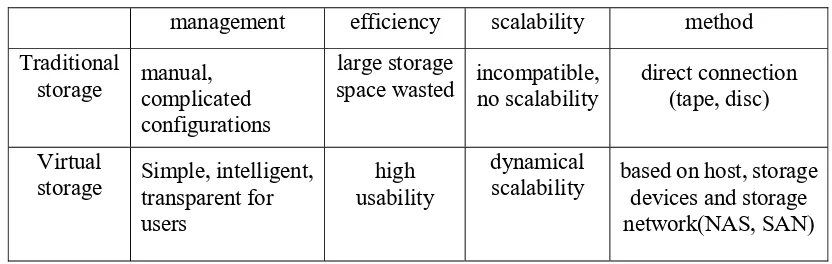
To resolve unforeseeably continuous and expansive increasing of storage requirements in cloud computing, network storage systems are enormous and complex more and more, so how to manage and use numerous heterogeneous storage devices is an important problem to resolve. Storage system becomes a single resource independent from server architecture, which is in the bottom of cloud computing architecture and provides services with infrastructure cloud. It has more advantages than the traditional storage which is listed in Table 1.
Design of Virtual Storage System Based on NAS
Requirement Analysis
A virtual storage system based on NAS called VSSN is presented. The file system is established in block devices provided by Logic Volumes Management (LVM), and mapped to the client operational system. The requirements of virtual storage system are listed below:
(1) Creating resource: creates usable logic volumes on the appointed virtual disc, and assigns the type of corresponding file system. The permission of read/write is allocated when loading.
(2)Information checking: reads resource information of NAS and outputs attributes of information. (3)Expansion of resource spaces: it demands dynamically expanding the spaces of logic volumes through LVM.
(4)Formatting resource: the file systems should be updated if user’s requirements can’t be satisfied by current file system. All data will be covered by formatting operation.
(5) Deleting resource: resource will be deleted when data and logic volumes are not needed for users, then data stored by users will be deleted when NAS resources are deleted.
(6) Loading NAS resource: it can be accessed by users when NAS resources are loaded to the corresponding director. On the contrary, unloading NAS resource makes data not accessed.
(7) Consistency checking on file system: the environments of network storage device are very complex, and the file system will be destroyed by some abnormal factors, such as repeatedly loading/unloading of disc, unexpected power breakdown or system hanging long time, those can make some important data losing and bring unavoidable losses for users. The consistency of file system should be checked by invoking system interface when the number of loading times reaches to some degree or unexpected system breakdown happens. Meanwhile the file system should be checked at regular time according to the demands of users.
Design Target
According to the characteristics of network storage service, the design targes for VSSN are listed below:
(1)Continuous resource sharing service: the integrity of resource sharing should be ensured when expanding system resources.
(2)Scalability: the storage capacity is expanded according to requirements of users when storage increasing continuously.
(3)Keeping data’s consistency: in order to assure security and validity for data storage, the consistency of file system is checked under accidental circumstance.
(4)Good read/write performance: it chooses rational file system, provides high throughput and good read/write performance.
Design Scheme
Figure 1. Architecture of VSSN.
(1)The storage system proposed manages NAS resources through interface provided by LVM, including creation, deletion and expansion of logic volumes. It manages file system through interface provided by operation system, including formation, expansion and consistency checking of file system.
(2)In sharing service system, it controls permissions of common NFS users and Kerberos users to access sharing files according to the configuration files of NFS service; it maintains authentication environment in region of Kerberos according to configuration files of Kerberos service; it restricts permissions of FTP users to access sharing files according to the configuration files of FTP service.
(3) It adds NAS server to the region according to the commands provided by Windows region service system, and obtains related information of users and user groups.
(4)It operates configuration data of management module through interface provided by database system, including query, insertion, deletion, updating, transaction processing and rollback; it sends warning email to system administrator and relevant users through interface provided by Email server; it records some important and abnormal information of NAS through interface provided by log server.
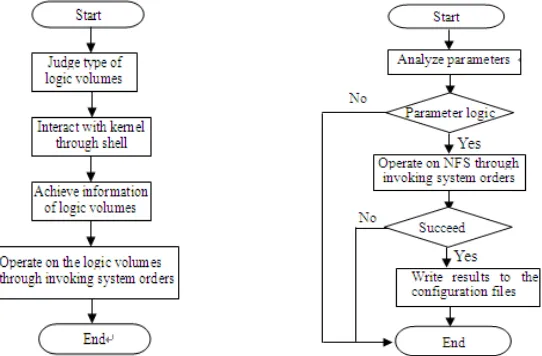
Resource storage and management are two important functions of NAS, and the key technology of those is how to obtain information of logic volumes. The operations on NAS resources are realized by function invoking according to system commands of NAS. The algorithm flowchart of VSSN is listed in Fig.2.
For VSSN, It meets requirements of resource storage for daily data in cloud computing, but for large amounts of storage, such as resource storage in large-scale database, it may lead to network congestion because of concentrate occupation of network resources. An improvement VSSN is presented which integrates SAN technology.
[image:3.612.193.464.519.697.2]
An Improvement VSSN
Design Scheme and Data Access
Table 2. Comparison of NAS and SAN. Physics
architecture level Data Advantage Disadvantage environment Applying
NAS Ethernet;
TCP/IP file low cost; easy
implementing ; supporting web
client
low security; network congestion;
bad scalability
Daily office work (webpage)
SAN optical fiber
network; optical fiber communication
protocol
block high security;
flexible architecture; good scalability;
not occupying network resources
bad operation;
high maintaining
cost limited file
sharing
key applying (database,
backup)
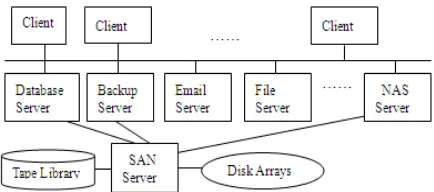
NAS and SAN are network storage systems applied extensively at present, and comparison of both is listed in Table 2. For expressing each advantages and offsetting disadvantages of NAS and SAN, the improvement NSSN integrates NAS and SAN, satisfies storage demands for daily data and large-scale data access. It provides an integrate and flexible solution of data storage and backup for storage systems, which uses resources more rationally and flexibly, expands file storage devices and tape backup devices more easily, and greatly reduces cost of whole system. The architecture of improvement VSSN is in Fig.3.
[image:4.612.204.421.486.582.2]The improvement VSSN is under the architecture of SAN, the storage resources of SAN are shared with NAS server and other systems. On the one hand, it satisfies the data access demands for large-scale storage, such as database and backup system, data access of which are processed by SAN server; on the other hand, it considers the frequent storage demands for daily data, such as email service and file service, data access of which are processed by NAS server.
Figure 3. An Improvement VSSN.
The procession of data access is in Fig.4. Client sends a requirement of data access to applying server, if accessed resources are belong to heterogeneous system, the requirement is processed by NAS server, otherwise by corresponding server. Data blocks are integrated by NAS according to relevant file format, and then transferred to the client by SAN, which realizes data sharing for heterogeneous system in NAS.
In the improvement VSSN, high speed transmission is realized by SAN, cooperation of file procession is provide by NAS, combination of both balances data outputs of storage system, enhances the storage efficiency, and provides a good solution of data storage.
Security Analysis
Information leakage happens frequently in recent years, which brings great challenges to data security. Traditional network threats affects cloud storage system, such as data damage, stealing, forgery, denial of service etc. , so it pays more attention to researches on security of cloud storage. The virtual storage system in cloud computing just resolves questions in data storage level which is at the bottom of cloud architecture. It needs to resolve two kinds of questions if realizing data security in the whole architecture of cloud computing:
Storage Security
If cloud storage system has no ability of self-protection, self-defense and self-prewarning, some important information of users may be malevolently stealed, forged and damaged under circumstance of illegal intruding. The storage security includes not only data security but also transmission security. The technologies of encryption, backup and disaster tolerance are applied to realize data security, which ensure integrality, confidentiality, and restorability. The technologies of high strength encryption algorithms and security protocols are applied to realize transmission security, which prevent information from interception.
Access Security
Data in cloud storage system may be damaged if user accounts are forged or data is accessed illegally, so access security includes account security and authorization security. The technologies of identification, signature, and dynamic password are applied to realize account security, which ensure legal identity of users and prevent forging. The technologies of access control, log audit, and intrusion detection are applied to realize authorization security, which ensure legal authorization of users to access data.
Summary
With continuous development of cloud computing, virtualization and network storage become key technologies of cloud computing, which provide effective protection for cloud storage. We analyze the requirements of virtual storage system, discuss the design targets, and propose a virtual storage system based on NAS called VSSN. For offsetting disadvantages of VSSN, an improvement VSSN is presented, which realizes information integration through SAN and NAS. Security analysis of data storage is discussed at last.
References
[1]U.S. Department of Commerce, The NIST definition of cloud computing, National Institute of Standards and Technology, 2011.
[2]Wang Qingbo, Virtualization and cloud computing, Publishing House of Electronic Industry, Beijing, 2010.
[4]Zhang Yaoxiang, Cloud computing and Virtualization, Computer Security, 2011, 80-82.
[5]Liu Fei, Yi Letian, Liu Qingkun, Shu Jiwu, The SAN-based Storage Virtualization System in Windows System, Journal of Chinese Computer Systems, 2012, 33(3): 598-602.
[6]Tan Shenglong, The Study of Storage Virtualization Technology, Microcomputer Application, 2010, 31(1): 33-38.
[7]Sun Zhixin, Huang Hanxia, Study of Storage Technology based on Cloud Computing, Journal of Nanjing University of Post and Telecommunication, 2014, 34(4): 13-19.