ScholarWorks @ Georgia State University
Business Administration Dissertations Programs in Business Administration
Spring 4-29-2019
Real-Time Push Mobile Marketing Strategy: To
What Extent Do Time and Relevance Matter?
Alvin GlayFollow this and additional works at:https://scholarworks.gsu.edu/bus_admin_diss
This Dissertation is brought to you for free and open access by the Programs in Business Administration at ScholarWorks @ Georgia State University. It has been accepted for inclusion in Business Administration Dissertations by an authorized administrator of ScholarWorks @ Georgia State University. For more information, please [email protected].
Recommended Citation
Glay, Alvin, "Real-Time Push Mobile Marketing Strategy: To What Extent Do Time and Relevance Matter?." Dissertation, Georgia State University, 2019.
PERMISSION TO BORROW
In presenting this dissertation as a partial fulfillment of the requirements for an advanced degree from Georgia State University, I agree that the Library of the University shall make it available for inspection and circulation in accordance with its regulations governing materials of this type. I agree that permission to quote from, copy from, or publish this dissertation may be granted by the author or, in her absence, the professor under whose direction it was written or, in his absence, by the Dean of the Robinson College of Business. Such quoting, copying, or
publishing must be solely for scholarly purposes and must not involve potential financial gain. It is understood that any copying from or publication of this dissertation that involves potential gain will not be allowed without written permission of the author.
NOTICE TO BORROWERS
All dissertations deposited in the Georgia State University Library must be used only in accordance with the stipulations prescribed by the author in the preceding statement.
The author of this dissertation is: Alvin Nyah Glay
J. Mack Robinson College of Business Georgia State University
Atlanta, GA 30302-4015
The director of this dissertation is: Denish Shah
J. Mack Robinson College of Business Georgia State University
Real-Time Push Mobile Marketing Strategy: To What Extent Do Time and Relevance Matter?
by
Alvin Nyah Glay
A Dissertation Submitted in Partial Fulfillment of the Requirements for the Degree
Of
Executive Doctorate in Business In the Robinson College of Business
Of
Georgia State University
GEORGIA STATE UNIVERSITY ROBINSON COLLEGE OF BUSINESS
Copyright by Alvin Nyah Glay
ACCEPTANCE
This dissertation was prepared under the direction of the ALVIN NYAH GLAY
Dissertation Committee. It has been approved and accepted by all members of that committee,
and it has been accepted in partial fulfillment of the requirements for the degree of Doctor of Philosophy in Business Administration in the J. Mack Robinson College of Business of Georgia State University.
Richard Phillips, Dean
DISSERTATION COMMITTEE
Dr. Denish Shah (Chair)
Dr. Naveen Donthu
DEDICATION
We have all heard the maxim that nothing good in life comes easily. My journey to earn this degree supports this statement. I became a refugee at the age of 7, when I had to flee my
home with my family. For 7 years, my family and I lived in exile, where every day was a matter of life and death. During this period, I had no chance to obtain a formal education because staying alive was a priority. Many days, we did not eat, and we had no clothes or shoes; we
would often walk for weeks at a time, in search of a better home. This led us to the Ivory Coast, where my family and I lived in exile for 5 years. In 1997, we were granted a resettlement visa to
come to the United States, and thus began the pivotal moment in my life. Migrating to the U.S., did not significantly change my circumstances; we were still poor and required assistance for
food, clothes, and everyday essentials. However, for the first time, I had access to a real education.
This experience taught me three simple lessons. The first is perseverance is critical—your past doesn’t define your future. You must remain positive and stay committed. It is much easier
to give up when circumstances are not in your favor; however, positive thinking and
commitment can make the impossible possible. Second, willingness to be uncomfortable is essential to success. Being uncomfortable drives creativity and openness to learning. When you are uncomfortable, you often doubt yourself, which makes it much easier to give up. However, people often don’t know how strong they are. Truly, when you are committed to a cause, no
obstacle is too significant to overcome. It is valuable to remember that when you are in an
would like to pursue. Being around people who are smarter and more driven encourages you to
keep progressing, even when things are not going well.
The purpose of my story is not to demonstrate my resilient However, I share my story
here, because I know there that many others like me, facing similar or worse situations. I share my story to let them know that there is hope and that they have more control of it. The
impossible can be possible, but one must work hard, remain positive and stay committed. I
ACKNOWLEDGEMENTS
Where shall I begin? Many individuals were influential throughout this journey. My
name is listed as the author of this dissertation; however, it would be selfish of me not to acknowledge everyone who has supported me on this journey. To begin, I would like to extend
my gratitude to my data access partner and all the stakeholders at the firm for allowing me to execute this research.
Second I would like to thank all the faculty and staff members at Georgia State Robinson
College of Business for their continued guidance and support. There was not a single moment during the program when I needed advice that I felt unsupported. They provided me with the
foundation and confidence to progress. Specifically, I would like to thank Shalini
Gopalakrishnan for all of her support. Shalini was always available and responsive whenever I needed her.
Next, I would like to acknowledge my committee members for their counsel and support. Specifically, I would like to recognize my academic advisor, Dr. Denish Shah. From the moment
we met, I realized that he would have a profound impact on my journey and beyond. He was available whenever and wherever I needed him. Dr. Shah is truly a selfless and fantastic mentor,
and I am grateful to have met him. Without his support, completing this program would not be possible. I am forever thankful.
Next, I would like to than my cohort, specifically: Esther Chance, Irina Kogan, Yves
Belmont, and Jennoa Graham. We were total strangers when we met on the first day of this program but are now family for life. We supported each other, and, without their support, the
them. Strangely enough, as much as I am not going to miss the long nights and weekends, I will
truly miss seeing them every month.
Next, I would like to thank my wife, Liduvina Glay, and my two children, Camila and
Jayce Glay. They sacrificed everything to allow me to achieve my dreams. Often, we do not realize the impact a program as such has on our loved ones. The countless hours of missed weekend activities and time away from my family was hard, but they were supportive. Words
alone cannot express how grateful I am for a supportive wife and children.
Finally, I wanted to save the last acknowledgment for the most influential person in my
life, my mother, Betty Johnson. She sacrificed everything, including her happiness, for my siblings and me. All I have ever wanted to do is make her proud and let her know that her
sacrifices were not wasted. This degree is not just for me, but for the both of us. You are my honorary Dr. Thank you for loving me and instilling in me faith that the impossible is possible, with hard work and positivity.
Thank you,
TABLE OF CONTENTS
ACKNOWLEDGEMENTS ... vi
LIST OF TABLES ... x
LIST OF FIGURES ... xi
I CHAPTER 1: INTRODUCTION ... 1
I.1 Research Motivation ... 1
I.2 Smartphone Penetration ... 2
I.3 Consumer Adoption ... 4
I.4 Advertising Trends ... 6
I.5 Summary ... 7
II CHAPTER 2: LITERATURE REVIEW AND THEORY ... 11
II.1Literature Review ... 11
II.2Thematic Categorizations Process... 12
II.3Publication Trends ... 13
II.4Mobile Promotion, Marketing, and Advertising ... 17
II.5Mobile Marketing Research Characteristics ... 19
II.6Trends in Mobile Marketing ... 21
II.7Considering the Contextual Factors... 23
II.8Interactive Effectiveness in Mobile Marketing ... 24
II.9Permission Marketing ... 25
II.9.1 Mobile-Permission Marketing ... 27
II.10 Proximity ... 28
II.10.1 Real-Time Mobile Marketing ... 29
II.11.1 Customer Experience ... 33
II.12 Utility ... 34
II.13 Theoretical Framework ... 35
II.14 Conceptual Model Specification ... 36
II.15 Push Mobile Communication ... 37
II.16 Messaging Timing ... 38
II.17 Message Relevance ... 38
II.18 Consumer Engagement Rate ... 39
II.19 Hypotheses ... 40
III CHAPTER 3: RESEARCH DESIGN AND METHODOLOGY ... 42
III.1 Research Design ... 42
III.2 Data Collection Method ... 43
III.2.1 Research Data Management ... 44
III.3 Sample Selection ... 45
III.4 Control Variable ... 46
IV CHAPTER 4: DATA ANALYSIS AND RESULTS ... 48
V CHAPTER 5: DISCUSSION ... 58
VI CHAPTER 6: RESEARCH LIMITATIONS AND FUTURE IMPLICATIONS ... 63
VI.1 Research Limitations ... 63
VI.2 Future Research Implications ... 64
VIICHAPTER 7: CONCLUSION ... 65
REFERENCES ... 66
LIST OF TABLES
Table 1:Themes Definition ... 13
Table 2: Frequency of Papers Published by Journals ... 14
Table 3:Distribution of Topic Focus by Year ... 16
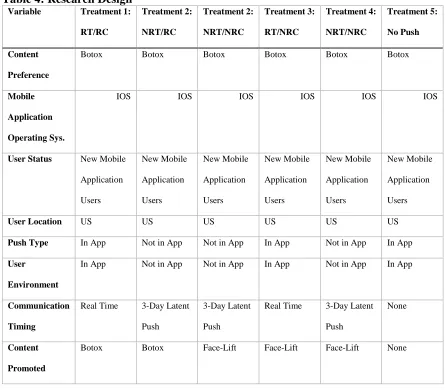
Table 4: Research Design ... 42
LIST OF FIGURES
Figure 1:Number of Publications by Year... 15
Figure 2: Research Categorization ... 16
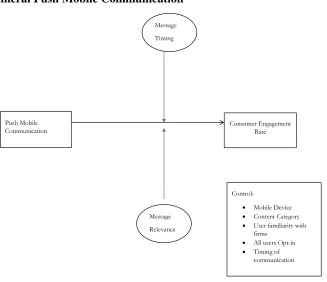
Figure 3:Ephemeral Push Mobile Communication ... 36
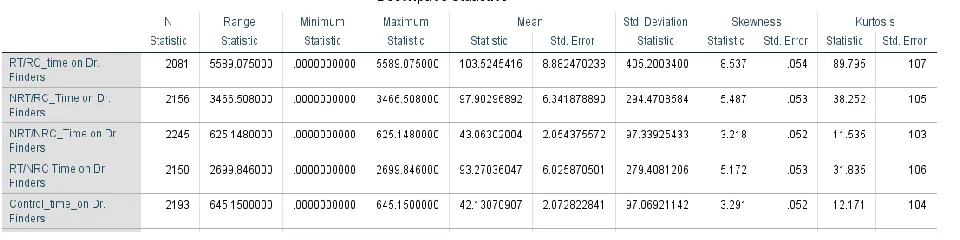
Figure 4: Descriptive Statistics: Time Spent on the Doctor Finder Page (Seconds) ... 48
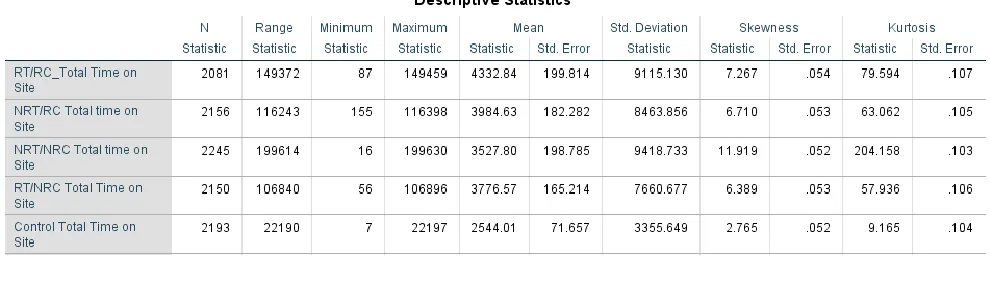
Figure 5: Descriptive Statistics: Total Time on Site (Seconds) ... 49
Figure 6: Descriptive Statistics: Total Contacts ... 49
Figure 7: Time Spent on Doctor Finders T-test results: NRT/RC vs. NRT/NRC ... 50
Figure 8: Time Spent on Dr. Finder T-test results: NRT/RC vs. Control ... 51
Figure 9: Total Contacts T-test Results: NRT/RC vs. NRT/NRC ... 51
Figure 10: Time Spent on Dr. Finder T-test results: RT/RC vs. NRT/NRC ... 53
Figure 11: Time spent on Dr. Finder T-test results: RT/RC vs. Control ... 53
Figure 12:Total contact T-test Results: RT/RC vs. NRT/RC ... 54
Figure 13: Time spent on Dr. Finder T-test Results: RT/RC vs. NRT/RC ... 55
Figure 14: Total Time spent on Site T-test Results: RT/RC vs. NRT/RC ... 55
Figure 15: Total Contacts T-test Results: RT/RC vs. NRT/RC ... 56
Figure 16: Time spent on Dr. Finder T-test Results: RT/RC vs. NRT/RC ... 57
Figure 17: Total time on site T-test Result: RT/RC vs. NRT/RC ... 57
ABSTRACT
Real-Time Push Mobile Marketing Strategy: To What Extent Do Time and Relevance Matter? by
Alvin Nyah Glay May 2019 Chair: Denish Shah
Major Academic Unit: Executive Doctorate in Business
The ubiquity of the smartphone has proven disruptive. The relevance of this medium can
be observed through time spent on mobile media, google mobile search numbers, and direct and indirect sales generated by mobile devices. Consumer expectations of firms have likewise
increased, and there is now an anticipation of readily reliable, responsive, and personalized services to support consumers’ everyday activities whenever they need it. Prior research focused
on the following themes: mobile marketing strategy, permission marketing, proximity marketing,
topicality, and utility. Empirical gaps were identified in the real-time mobile and push mobile marketing domain. A quantitative engaged scholarship research method was utilized to
empirically investigate this phenomenon. In partnership with an online information marketplace, an empirical investigation was undertaken via an experiment that used real mobile application users. The empirical findings from the study have several possible implications. First, prior
research suggests that mobile marketing is time-sensitive, but consumers require some lead time to respond to the communication. However, this study provides evidence that push mobile
communication is different. Unlike traditional mobile marketing, real-time communication and content topicality work together to increase consumer engagement in push mobile
relevant and in real-time. Failing to engage users with any communication or provide a guided
experience on the mobile application is as counterproductive as sending users a push communication that is neither relevant nor in real-time. Third, in certain business contexts,
typicality takes priority over the timing of the communication. When the business context is ephemeral in nature, timing and topicality are of equal importance. The study contributes to the research by plugging the real-time and push mobile communication literature gap. The study
contributes to practice by providing a push mobile marketing framework for firms seeking to orchestrate a sound push mobile communication strategy. Finally, the study acts as a catalyst to a
call for research on the scarcely explored areas of real-time and push mobile marketing to move the field forward.
I CHAPTER 1: INTRODUCTION
Research Motivation
The global adoption of mobile commerce, marketing, and advertising in the marketplace requires in-depth knowledge of all the areas relating to consumer behavior. Both academic and industry research has yet to thoroughly explore the impact of mobile marketing techniques and
strategies. Hence, a comprehensive review of the mobile marketing literature, from 2000 to 2018, was conducted; the time frame was determined by the evolution of Apple’s iPhone, the
archetype for today’s smartphones. The literature review focused on the mobile advertising
literature, with the objective of understanding current research in the mobile marketing domain. The investigation covered an overview of market opportunities, marketing applications like the
traditional short message service (SMS), the contextual relevance of advertisements, mobile advertising displays, and consumer behavior. There was a focus on the related academic journals,
practitioner journals, and industry research, narrowing down these fields to mobile marketing strategy and application, thereby yielding an identifiable gap in push mobile marketing studies. Based on a survey of the mobile marketing literature from this time frame, gaps existed in the
real-time and push mobile marketing literature. Push mobile marketing represents approximately 25% of firms’ marketing programs (Rowe, 2017). Push mobile notification is an area where few
studies have been conducted, which presents an opportunity to contribute to push mobile
marketing literature in a way that may be useful to practitioners. Push mobile’s ephemeral nature demands further, yet up-to-date, research among marketing specialists. The lack of adequate
identification of issues within mobile advertising is paramount to effecting change within the
industry.
This objective of this research is to address this gap. The investigation explored the
extent to which timing and topicality impact the consumer engagement rate in push mobile marketing. The phenomenon was explored empirically, through a quantitative engaged scholarship method (Mathiassen & Nielsen, 2008; Van de Ven, 2007). In partnership with an online information portal, data were collected using real mobile users on the firm’s mobile
application. The research question explore is the following: To what extent does real-time
context and content topicality through push mobile communication impact customer engagement rate?
The investigation was undertaken through the lens of the theory of being present (Kivetz & He, 2017). The theory of being present posits that consumers are more engaged when
communication is transient in nature. Ephemeral messages foster greater interpersonal closeness
by causing consumers to ruminate less and engage more or be in the moment. By being in the moment, people are more inclined to be open and creative. Push mobile marketing is a form of
ephemeral messaging, and as such, it is appropriate to investigate this research stream by utilizing the theory of being present.
Smartphone Penetration
The emergence of Apple’s iPhone, which launched in 2007, precipitated mobile web use
at a magnitude that is yet to be fully understood. The iPhone combines three products—a revolutionary mobile phone, a widescreen iPod® with touch controls, and a groundbreaking
qualities, the iPhone did not become mainstream immediately. The iPhone, however, positioned
itself among other technological advancements as a mobile contender and was a catalyst for the demand and subsequent supply of “smartphones,” as we know them today. Manufacturers such
as Samsung, HTC, and Alcatel, among others, began to adopt this new technology, increasing the penetration of smartphones in the mainstream market. The ubiquity of smartphone innovation has provided firms with unprecedented access to consumers without the restrictions of time and
space (Smutkupt, Krairit, & Esichaikul, 2010). Prior to mobile innovation, firms were restricted by the space and time in which they could reach their target consumers.
The Internet of Things (IoT) is another phenomenon that has further accelerated the utility of consumers’ content consumption. Here, IoT is defined as the shift from an Internet used
for interconnecting end-user devices to an Internet used for interconnecting physical objects, such as everyday devices like cars (Miorandi, Sicari, De Pellegrini, & Chlamtac, 2012). These everyday items include things like refrigerators, clothing, and many other items. By 2020, there are expected to be 50 billion connected devices, which is more than seven times the world’s
population (Gao & Bai, 2014; Swan, 2012). The mobile phone will serve as a communication
hub for the interaction of consumers and their connected devices. The high level of the mobile penetration has resulted in heightened consumer expectation for real-time information. The need for immediacy has resulted in consumers’ expectations increasing mobile dependence.
Consumers’ mobile activities no include activities once performed on outpaced desktop
computers, with more than 51% of browsing activities currently occurring on mobile versus 48%
(Miorandi et al., 2012). Consumers generally respond positively to firms that use personalized
content (Wu, Chen, & Dou, 2016). Mort et al. (2002) coined this phenomenon the “roam and receive” environment; indeed, the heightened demand for personalized experience is referred to
as Uber-commerce (Richard T. Watson, 2002). Consequently, consumer loyalty to a given firm or product has been declining, because of an increase in online options at the customer’s
disposal (Bardhi & Eckhardt, 2017). It is much easier to find a substitute for a product, using a
single Google search on a mobile phone. Any friction within this interaction between a given firm and consumer culminates in the risk of that firm losing the consumer to a competitor.
Consumers like this are referred to as liquid consumers (Bardhi & Eckhardt, 2017. Liquid consumers are ephemeral, through mobility, flexibility, and experience, as required to navigate
an online marketplace. The need for companies to interact in real time with relevant information without any friction with their consumers is crucial.
Consumer Adoption
Mobile technological advancements have revolutionized the interaction between firms
and consumers. Smartphones are increasingly becoming the primary medium of a consumer’s content consumption, and this has been changing the way people shop. A consideration of this
changing trend of how people shop reveals that more than 3 billion people, globally, own a smartphone device; this rate is expected to increase by 90% by 2020 (Rohm, 2012). Consumers use their devices as the starting point of their shopping journey, sometimes even while they are in a retailer’s physical location (Fulgoni, 2014). As such, offline and retail shopping behaviors
are significantly affected by mobile phone usage. The ability of consumers to easily and quickly navigate the world of retail has proven to be widely beneficial, in terms of a firm’s use of time,
resulted in a constant consumer connection, leading some people to become addicted to their
mobile phones.
A recent study by the Physiological Society revealed that the idea of losing a smartphone
is more closely associated with stress and a terror attack with fear (Knapton, 2017). The average consumer’s attention span is less than eight seconds (Faro & Grimes, 2018). The number of
connected devices per person has increased exponentially from 3.45 in 2015 and to an estimated
6.5 in 2020.1 Individuals now have access to more screens than before; as such, more than half of consumers today are, on average, engaged in cross-screen activities and 70% are engaged with a
second device while watching TV (Marvin, 2013). As a result, people are less focused on traditional business practices, products, and services, which makes them more reliant on their
mobile devices than before, so much so that the average person picks up his or her phone over 100 times a day, spending 26% of his or her time staring at the home screen because of the fear of missing out (Clor-Proell, Guggenmos, & Rennekamp, 2018). Research from Pew states that
67% of mobile phone users check their phones for messages, alerts, or missed phone calls even when the phone is turned off or not ringing, and 44% of users sleep with their mobile phones
next to their beds (Smith, 2012). People engaging in an ad-free environment continue to rise with the increase of ad-blocking technology, going from 15.7% in 2014 to 27.5% in 2015 (Statista, 2019), which many see as making mobile use a more pleasant experience. Consumer adoption
involves the how (pattern/s), why (reason/s), what (influence/s), where (proximity), and when (timing) questions associated with the way customers are most likely to engage. A study
conducted on the cross-market acceptance of mobile marketing found that in the three most influential regions, the United States, China, and Europe, customers perceived usefulness,
consumer innovativeness, and personal attachment as directly influencing attitudes toward
mobile marketing (Rohm, 2012). In modern, multifaceted, and omnichannel environments, consumers are bombarded with information about goods and services (Grewal, Roggeveen, &
Nordfält, 2017). Nonetheless, Rohm et al.’s (2012) study emphasized the importance of a customer-centered approach in mobile marketing, which is the hallmark of any successful advertising strategy. The emotional attachment people have to their mobile devices plays a role
in the user perceptions of mobile advertising and receptiveness (Kolsaker & Drakatos, 2009).
Advertising Trends
The combination of mobile web access and online retail has also spurred the growth of
many technology companies, such as Uber, Airbnb, Netflix, and Facebook. For example, Facebook, the largest social media network in the world, generated $55 billion revenue in 2018, compared with the $7.8 billion it generated in 2013. Facebook is ranked fourth, in terms of
market cap, on the S&P 500 and has over 2.1 billion users on its platforms (Facebook, 2018; Yahoo, 2019). A significant amount of Facebook’s social media activity, over 95%, is through
smartphones (Facebook, 2018). Also, nearly 60% of all Google searches are done via mobile devices (Sterling, 2016). Because of the increased utilization of consumer content consumption
and time spent on mobile devices, firms are spending billions of dollars on mobile advertising. The average person is exposed to over 11,000 ads in any given month (Elliott, 2017), trying to divert consumers’ attention to ads but not directly engaging consumers with these ads.
Subsequently, firms are exploring other options that are scalable, cost-efficient, and less intrusive to trigger customer engagement
optimizes the visibility and reach that these companies have with customers and does so in real
time; however, real-time mobile marketing must be anchored to right-time interactions. Both real-time and right-time customer interactions ensure the relevance of all communication
between firms and customers. Companies have further recognized the shift in content
consumption proficiency, primarily in advertising, which has led to an increase in revenue being invested in mobile marketing. In 2017, mobile advertising accounted for 69.9% of the total U.S.
digital advertising expenditure. Mobile advertising expenditures are expected to surpass $65 billion by 2019 in the United States alone (Grewal, Bart, Spann, & Zubcsek, 2016). According to
eMarketer, mobile advertising is projected to surpass TV as the leading advertising medium, with a projected growth rate of 47.9%, by the year 2022 (Grewal et al., 2016). In the Asian
Pacific region and in China, 50% of total online transactions are conducted through mobile devices.2 Globally, the total mobile share of online commerce is expected to double, reaching three-quarters by 2021.3 Given the rapid increase in mobile device penetration, alongside the
continuous advancement of services provided via mobile technology, it is essential that the literature accurately reflects the time, space, and audiences. It is imperative that firms be
grounded in the right moment and context to capture the attention of mobile users.
Summary
This research paper is organized as follows:
Chapter 1: Introduction: This chapter presents the magnitude of smartphone technology’s impact on both consumers and businesses. It begins with a brief history of the emergence of Apple’s
iPhone, the archetype of the modern smartphone, which creates the trajectory of the paper. In
2 Global M-Commerce 2018-2021 - M-Commerce Accounts for Over Half of Global Online Retail -
ResearchAndMarkets.com," 2018
3 Global M-Commerce 2018-2021 - M-Commerce Accounts for Over Half of Global Online Retail -
addition, there is a discussion of the importance of smartphone ubiquity and how it influences the
interaction between firms and consumers. The research gap in the real-time mobile and push mobile marketing domain receives consideration. The chapter then concludes with the research
question and hypothesis explored, due to the literature gap.
Chapter 2: Literature Review: The literature review focuses on the mobile marketing literature, as well as specific areas, namely: permission marketing, proximity marketing, topicality, and
utility, as well as the impact of each on mobile advertising aimed at promoting goods and services. The discussion concentrates on scholarly research produced between 2000 and 2018
and material produced within the business arena. The chapter also focuses on those journals with accessible articles on mobile marketing. There are analytical tables, denoting each journal and
the number of articles found within each journal used in the review. The literature review aims to understand the existing literature landscape on mobile marketing, as well as the literature on push mobile marketing to identify the gaps within the literature collection.
Chapter 3: Research Design and Methodology: This chapter outlines the methodological
approach and theoretical framework that guided the study. This section provides justification for
the use of a quantitative experimental engaged scholarship method that tests a total of five groups, including a control group. All participants were randomly selected, and the criteria for participation required first-time users of an online aesthetic marketplace application downloaded
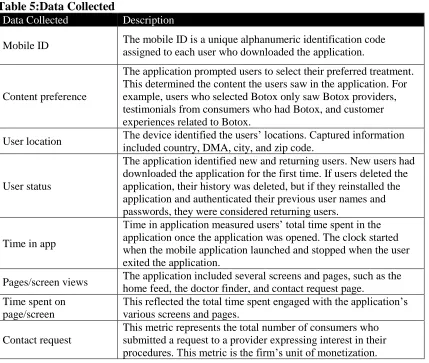
on their Apple iPhones. The data collected and measured are as follows: mobile ID, content preference, user location, user status, time in application, pages/screens views, time spent on
impact of a real-time push mobile marketing strategy and the extent to which time and relevance
impact the customer engagement rate.
Chapter 4: Data Analysis and Results: This chapter provides insight into the data analysis
process and results. A variance ephemeral push mobile communication conceptual model was developed. The outcome of the model is to predict the extent of the impact of timing and
topicality on the consumer engagement rate in push mobile communication. The statistical tools
used for analysis were IBM SPSS for quantitative research and Microsoft Excel for the
compilation of the literature that also aided in the literature synthesis. The conceptual model and
hypotheses were tested against a sample of 11,828 real mobile users.
The results reveal that an ephemeral push mobile communication grounded in real-time
communication and that possesses information relevant to consumers has an impact on consumer engagement. Also, the results empirically showed that no communication to users on a mobile application is as ineffective as a push communication that is neither relevant nor timely, sent to
consumers by a firm.
Chapter 5: Discussion: This chapter discusses the results of the research in ways supported by
the literature review findings, as well as the nuances the current study brings to mobile marketing research literature. Specifically, the discussion looks at the primary motivation of the research and the extent to which the smartphone phenomenon has reshaped the mobile marketing
industry. This section highlights the contributions that the current paper makes to the literature.
Chapter 6: Research Limitations and Future Implications: This chapter presents the limitations
elaborates on the future implications of the study and highlights the triggering effect it may have
on market researchers to explore push mobile communication strategy.
Chapter 7: Conclusion: Finally, the conclusion describes the culmination of the motivation
behind the research and calls for more research to address the existing literature gap in push mobile communication in real time. The chapter also suggests that the framework developed by the current study may be used to orchestrate push mobile communication strategy by firms to
II CHAPTER 2: LITERATURE REVIEW AND THEORY
Literature Review
This literature review began with a thorough exploration of mobile marketing literature published from 2000 to 2018. The time frame is consistent with the technological development of the first Apple iPhone, which was launched in 2007. The literature search employed a
two-step process to identify pertinent contributions to the mobile marketing discourse. In the first step, the goal was to identify the overall coverage of the mobile marketing literature via a
snowballing technique (Borrego, Foster, & Froyd, 2014). The following keywords were used to discover relevant papers: mobile marketing, proximity to mobile marketing, real-time
marketing, smartphone marketing, mobile advertising, smartphone advertising, and consumer
adoption to mobile marketing. The keywords were derived by using a Google Keywords4 planner tool to identify the most popular and relevant keywords in the domain. The search scope
was bounded to mobile marketing strategy and applications. The primary sources of investigation were journals related to peer-reviewed marketing and practitioner marketing outlets, such as the Journal of Marketing, the Journal of Interactive Marketing, the Journal of
Marketing Communication, the Journal of Marketing Research, the Journal of Advertising Research, the International Journal of Mobile Marketing, Management Science, the Journal of
Retailing and Consumer Science, eMarketer, and the Journal of Marketing, which were accessed through databases such as ProQuest ABI/INFORM, EBSCOhost, Business Source Ultimate, and Google Scholar. Topics such as privacy, technology, and measurement were beyond the breadth
of the current study because the focus was on mobile marketing trends and applications, not the operating mechanization. Abstracts and introductions were reviewed to eliminate all papers
outside the scope of the research. The literature search returned a total of 245 publications that
were deemed relevant for the second phase. In step two, the full text of each article was reviewed to eliminate papers that were not directly relevant to the research questions. Articles
were eliminated based on the following additional criteria: not a mobile marketing focus, engineering and technical aspect of mobile marketing, mobile marketing privacy, mobile marketing measurement, and business-to-business mobile marketing. The final review process
yielded a total of 47 articles. This process encompassed thorough reviews of the literature with over 33 source consultations, and it ended with 47 papers being accepted.
Thematic Categorizations Process
To synthesize the selected articles, a classification exercise was developed to group the research by topic areas and extrapolate key themes from the mobile marketing literature. The selected papers were categorized into the key themes to form a macroview of the mobile
marketing literature. A macrolevel analysis utilizing an article-coding scheme was developed to establish a topical view of the coverage of key conversations in the literature. The coding scheme
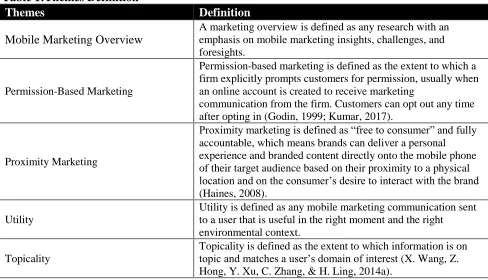
for the themes was based on the frequency of keyword mentions, the research agenda, and a summary of findings. The following themes (see Table 1) were identified: (a) mobile marketing
Table 1:Themes Definition
Themes Definition
Mobile Marketing Overview
A marketing overview is defined as any research with an emphasis on mobile marketing insights, challenges, and foresights.
Permission-Based Marketing
Permission-based marketing is defined as the extent to which a firm explicitly prompts customers for permission, usually when an online account is created to receive marketing
communication from the firm. Customers can opt out any time after opting in (Godin, 1999; Kumar, 2017).
Proximity Marketing
Proximity marketing is defined as “free to consumer” and fully accountable, which means brands can deliver a personal experience and branded content directly onto the mobile phone of their target audience based on their proximity to a physical location and on the consumer’s desire to interact with the brand (Haines, 2008).
Utility
Utility is defined as any mobile marketing communication sent to a user that is useful in the right moment and the right environmental context.
Topicality
Topicality is defined as the extent to which information is on topic and matches a user’s domain of interest (X. Wang, Z. Hong, Y. Xu, C. Zhang, & H. Ling, 2014a).
Publication Trends
[image:29.612.73.561.82.362.2]In assessing the various available literature on mobile marketing and publication trends,
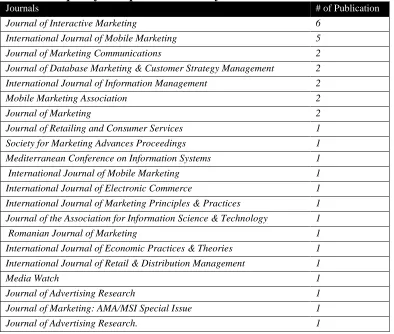
Table 2 represents the frequency of papers published by journals, Table 3 represents the publications by year and the distribution of topic focus by year, and Figure 2 represents the research category publication by year. A total of 47 papers were selected because they fell within
the scope of the research. The 47 papers were distributed across 33 literature outlets, as listed in Table 1. Out of the 33 sources, the Journal of Interactive Marketing and the International
Journal of Mobile Marketing produced six papers and five papers, respectively. The remaining journals published no more than two papers, as seen in Table 2. The coverage theme was distributed across the journals, except for the Journal of Marketing Communication, which
Marketing overview is the main topic covered during this time frame, with a total of 13 papers. Topicality and utility combined have a total of 22 papers published during this time
frame. Surprisingly, there has been no current research since 2015 on the themes of utility and the permission-based mobile marketing domain. Only 20 out of the 47 selected articles were categorized as empirical studies, with only two publications over the last 4 years. The remaining
27 papers were conceptual studies (5) and strategy-focused (22). The publication trends align with Apple’s iPhone launch in 2007 (Kerris & Dowling, 2007). Thus, the years 2009 (5), 2014
(7), and 2016 (8) produced the most publications. Earlier in this period, scholars focused heavily on mobile strategy, which made sense because the topic was new at the time. In 2014, there was
[image:30.612.72.466.388.722.2]a surge of empirical studies.
Table 2: Frequency of Papers Published by Journals
Journals # of Publication
Journal of Interactive Marketing 6
International Journal of Mobile Marketing 5
Journal of Marketing Communications 2
Journal of Database Marketing & Customer Strategy Management 2 International Journal of Information Management 2
Mobile Marketing Association 2
Journal of Marketing 2
Journal of Retailing and Consumer Services 1 Society for Marketing Advances Proceedings 1
Mediterranean Conference on Information Systems 1 International Journal of Mobile Marketing 1
International Journal of Electronic Commerce 1 International Journal of Marketing Principles & Practices 1
Journal of the Association for Information Science & Technology 1
Romanian Journal of Marketing 1
International Journal of Economic Practices & Theories 1 International Journal of Retail & Distribution Management 1
Media Watch 1
Journal of Advertising Research 1
Journal of Marketing: AMA/MSI Special Issue 1
Journal of Sponsorship 1
Journal of Business Horizons 1
Management Science 1
European Journal of Marketing 1
MIR - Marketing Intelligence Review 1
GfK-Marketing Intelligence Review 1
Psychology & Marketing 1
Annals of the University of Oradea, Economic Science Series 1
International Journal of Business Information Systems 1 IEEE Advancing Technology for Humanity 1
Journal of Marketing Research. 1
[image:31.612.158.455.321.538.2]Journal of Marketing Science 1
Figure 1:Number of Publications by Year
0 1 2 3 4 5 6 7 8 1 1 2 1 3 5 3 3 1 3 7 4 8 5
Table 3:Distribution of Topic Focus by Year
Themes 2003 2004 2005 2007 2008 2009 2010 2011 2012 2013 2014 2015 2016 2017 Grand Total
Mobile Overview 1 1 3 1 1 4 2 13
Permission (Opt-in/out) 1 1 1 1 4
Proximity 1 1 4 1 1 8
topicality 1 2 1 3 3 2 12
Utility 1 2 1 2 1 1 2 10
Grand Total 1 1 2 1 3 5 3 3 1 3 7 4 8 5 47
Figure 2: Research Categorization
2003 2004 2005 2007 2008 2009 2010 2011 2012 2013 2014 2015 2016 2017
4
1
1 1 1
2
1 2
5
3
1 1
1
2
1 3
4
1 1
2
1 3
2
Research Type by year
[image:32.792.197.604.238.432.2]Mobile Promotion, Marketing, and Advertising
The demand for mobile research is growing as the adoption of mobile commerce,
marketing, and advertising in the marketplace grows (Hairong & Townsend, 2008). The research on mobile marketing contains numerous gaps. The impact of mobile marketing techniques and
strategies has yet to be explored thoroughly by academic and industry studies. Given the rapid increase in mobile device prevalence alongside the continuous upgrading of services provided by mobile technology, it is essential that research in this area reflect the relevant themes of time,
space, and audience. A lack of research can become taxing on industry players, especially those who provide online retail services. Identifying and filling missing critical areas of focus in
existing mobile marketing research is paramount to effect change.
A keen understanding of mobile advertising context can help advertisers maximize their consumer engagement by providing information on the location of potential mobile message
recipients, who they are with, their surrounding activities, and how much time they would need to consider a mobile promotion. A campaign’s success depends on understanding all the
above-mentioned environmental considerations, the consumer, and the technological contextual variables. It also requires a strong focus on advertising goals, a consideration of market factors
related to the stakeholders and the market environment, and the use of appropriate mobile ad elements to improve the relevant outcome metrics (Andrews, 2017b; Ghemawat, 2001). In this context, customers’ acceptance of the marketing technique guides their purchasing decisions.
• Distance: Geographically, consumers have been shown to be more responsive to
promotional offers from nearby shops or events (Ghemawat, 2001).
• Time: Temporal targeting on the same day with less promotional lead time is considered
an effective strategy to generate mobile sales (Andrews, 2017a; Andrews, Luo, Fang, &
Ghose, 2016).
• Environment: People’s responses to mobile ads depends on the environment, or what is
going on around them (Andrews, 2017b).
In the early era of mobile marketing, text messages served as the primary communication
and were referred to as SMS technology. The success rate of SMS communication with customers proved beneficial to businesses because of its ease. Gokhan Karaatli (2010) defined mobile marketing as the delivery of any services via mobile devices; the author also defined
mobile marketing as the process of delivering marketing messages from businesses to consumers using permission-based and interactive communication services via mobile communication. As a
new wave within advertising, mobile marketing has become necessary to quickly reach a
significant number of customers; it also allows retailers, service providers, and manufacturers to offer consumers relevant goods and services through various campaigns.
Previous studies on mobile marketing examined this technology’s framework. Varnali
(2014) investigated the relevance of SMS messages and their impact on consumers’ developed
attitude toward brands (Varnali, 2014). The study found that, although SMS advertising is the most primitive yet widely used version of mobile marketing, the area of how SMS ads influence consumer attitudes and how this influence is generated still lacks studies (Varnali, 2014). In
attitudes toward messages and toward the brand, which is an indicator of the messages’
perceived usefulness. Establishing message relevance lowers perceived intrusiveness, which fosters positive attitudinal responses toward the message (Varnali, 2014). However, the SMS
approach has serious limitations because consumers often view text messages from businesses as irritating (Muk, 2007, 2008; Samanta, Woods, & Ghanbari, 2009), an invasion of privacy
(Basheer & Ibrahim, 2010; Windham & Orton, 2000), and brand intrusion (Monk, Carroll,
Parker, & Blythe, 2004). People value freedom of choice in all areas of life, so people are prone to reject anything forced upon them, even if some deem it beneficial (Friedrich, Gröne, Hölbling,
& Peterson, 2009).
Mobile Marketing Research Characteristics
Mobile phones inherently include many distinct features, such as intimacy, accessibility, personalization, interactivity, multimodality, and location awareness (Hairong & Townsend,
2008). Real-time communication hinges on knowledge of the customers’ whereabouts. In studying participants’ location-based marketing responses at, for example, sporting events, road
shows, and trade exhibits, all responses showed a central area of customer concentration;
otherwise, information extraction is a bit more challenging (Hairong, 2008). Integrating
location-based information provides the tremendous ability to seamlessly integrate additional contextual information. Here, multimodality speaks to the ability to collect visual and audial data about research participants’ behavior and surroundings, such as by gathering pictures and video clips
(Hairong, 2008). The character insights derived from this data give marketers a precise understanding of what causes consumers to act. However, many components of mobile
expenses (Marriott, 2007). Despite significant developments in mobile technology and the
establishment of privacy laws, mobile users still hesitate to share personal information online. Mobile marketing’s impact on the global consumer landscape and their engagement with
firms have led to a broad cross-section of studies aimed at understanding this form of marketing and its subsequent successes. Many studies investigated the collective and individual elements that boost profitability for consumers and firms. (Matti Leppäniemi, 2006) studied the mobile
marketing literature in detail and found 21 distinct definitions or meanings of mobile marketing. According to their analysis, the definitions in the literature represent four major approaches to
marketing via mobile channels. They also found that marketing through mobile channels have been implicitly or explicitly been conceptualized as (a) mobile marketing, (b) mobile advertising,
(c) wireless marketing, or (d) wireless advertising. It is crucial here to distinguish the terms “wireless” and “mobile.” Wireless does not necessarily mean mobile. In acknowledging this
distinction for the purpose of the current research, mobile is considered a portable device,
specifically a smartphone. Mobile promotion, marketing, and advertising have been categorized as separate entities in multiway communication between a retailer and its customers on a
smartphone device (Shankar & Balasubramanian, 2009). However, each has a similar overtone; as such, they are considered to have the same meaning in my research.
Mobile technology has become the ultimate marketing vehicle, enabling businesses to
establish a prevalent electronic presence that grants access to customers at any time and any place and, most importantly, access to new market avenues. Mobile marketing has opened up
triggers. Each method has advantages that allow customers to receive relevant information in real
time. In this context, (Friedrich et al., 2009) interviewed 30 senior executives of mobile virtual network operators and major media and consumer companies between 2006 and 2008. The
following factors were identified as the key components in which mobile marketing outperformed other marketing platforms:
• Customer access: Mobile marketing is exclusively available to primary users wherever they
go—not only in fixed locations.
• Customer insight: Once mobile commerce gains traction, businesses can add shopping
history, online store preferences, and spending patterns to the list.
• Customer dialog: The mobile phone is a distinctly personal device that reflects its primary user’s use and interests.
• Customer emotions: A consumer’s choice of mobile device is often a definite lifestyle
statement.
• Customer transaction: Few physical boundaries exist for mobile devices.
Trends in Mobile Marketing
A 2007 study called “The State of Internet Marketing Research” found that the quantity
of literature was a significant factor (Schibrowsky, Peltier, & Nill, 2007). The authors found that the three most-researched Internet marketing areas were consumer behavior, Internet strategy, and Internet communications (Schibrowsky et al., 2007). These areas were considered important
topics of Internet marketing research at the time, which explains the heavy concentration of research in those areas. Gaps remained in other significant areas. A review of the existing
body of work on mobile marketing and summarized the progress and recommended a direction
for future studies based on journals and research databases. They concluded the following: 1) Mobile marketing articles appear in various journals across many disciplines, such as
management, marketing, business, engineering, information technology, information systems, finance, and operations research.
2) The key themes discovered were conceptualizations of mobile marketing and mobile
commerce. Mobile commerce is also referred to as m-commerce, and the feature distinguishing it from e-commerce is the buying and selling of goods and services through a wireless and mobile
handheld device.
3) Researchers have not accepted a common classification framework for mobile
marketing.
4) Gaps in mobile marketing research appeared in the domains of trust, satisfaction, m-loyalty (m-mobile), and public policy; in addition, cross-cultural studies in the domain of mobile
marketing were still scarce.
Many scholarly works exist in mobile promotion, marketing, and advertising. A study
conducted in a crowded subway station found that consumers are more receptive to mobile advertisements in a crowded location and are more likely to engage with a retailer in these areas (Andrews, Xueming, Zheng, & Ghose, 2016). The study concluded that crowding makes people
turn inward, immersing themselves in their smartphones. Mobile coupon promotions present one way that marketing to new customers could drive brand awareness and store traffic. With mobile
advertisements can increase loyalty. (Danaher, Smith, Ranasinghe, & Danaher, 2015) showcased
that mobile coupon promotion can be most effective when potential customers are targeted closer to a retailer’s location. (Shankar et al., 2016) supported this argument by stating that the viability of offering a mobile coupon near a consumer’s location could directly intervene and increase the
purchase rate. Another study (Sam K. Hui, March 2013) concluded that mobile promotion with a coupon increased unplanned product category purchases.
Considering the Contextual Factors
Contextual consideration is critical when implementing a mobile advertising strategy. To implement an effective mobile advertising campaign, context plays a central role (Grewal et al.,
2016). Mobile advertising can be perceived as intrusive (Luo, Andrews, Fang, & Phang, 2014) because people view their smartphone devices as a personal communication medium and want to have control over external communications (Watson, McCarthy, & Rowley, 2013). It is a
welcome experience if, and only if, consumers consider it relevant and useful. Of consumers, 47% say they would provide smartphone location data to receive relevant advertising offers
(Andrews, Goehring, Hui, Pancras, & Thornswood, 2016; Andrews, Xueming, et al., 2016). Here, location data can accelerate purchase behavior and increase customer loyalty. Consumers
welcome a push mobile advertisement if they consider the communication useful, and it simplifies a transaction experience (T. A. Awad & El-Shihy, 2014). To build on this notion,
(Shankar et al., 2016) stated that convenience and savings drive consumers’ mobile shopping.
(Fong et al., 2015) showed that competitive location targeting with reasonable discounts can increase customer purchase. In line with these studies, (Luo et al., 2014) concluded that
time and location of the promoted event. Optimizing locational targeting can increase purchasing
response.
Interactive Effectiveness in Mobile Marketing
One study showed that mobile marketing effectiveness can be improved via metrics such
as bounce rates, add-to-cart rates, shopping cart abandonment, and average order size (Berman, 2016). The study looked at the current state of mobile marketing and highlighted some main areas for improving the effectiveness of mobile marketing, such as omnichannel and the lack of
settling on a correct mobile strategy. Capitalizing on the strategic advantages of mobile marketing requires marketers to consider various advantages, including (a) mobile marketing devices always being on, connected, and with the consumer; (b) mobile marketing’s ability to
generate location-sensitive offers; and (c) the ability to offer highly personalized mobile
marketing messages (Berman, 2016). Mobile marketing devices are primarily used for personal communication, which is companies’ biggest gain from smartphones due to customization and
emotional attachments. Most customers almost always have service via Wi-Fi and Internet
providers; through this connectivity, marketers can generate prices that quickly match
competitors’ prices while immediately evaluating the effectiveness of these campaigns; all this is
done in real time. Marketers’ ability to generate location-sensitive offers has further developed the ability to provide consumers with special offers within a given distance to the company’s
retail location and to their competitors. Offering highly personalized mobile marketing messages
is of great importance to marketers. Ads that appeal to consumers are promoted and tailored to their buying history, social media use, demographic data, and usage data. Essentially, mobile
enough time to respond to these promotions given their distance from the promoted venue, but
too much time may reduce their response rates (Andrews, Xueming, et al., 2016).
Understanding consumer behavior is vital to success, regardless of the industry and the
position within a company. Market research provides insights into consumer behavior by
learning about individual and group lifestyle practices that reveal the needs and wants that guide consumption patterns. With this kind of information, firms can effectively strategize to meet
market demands and compete within their respective industries. However, understanding consumer behavior toward mobile advertising is challenging because mobile device penetration
and services have increased rapidly over the past decade. Mobile marketing growth depends heavily on consumer acceptance and improvements in technology. Companies must keep abreast
of market changes that will allow effective responses to mobile audiences, which may have unlimited access when observing users’ personal relationship with their mobile device. As such,
to gain a fundamental understanding of consumer behavior, it is imperative to explore topics
such as permission marketing, proximity, topicality, and usefulness in mobile marketing.
Permission Marketing
In 1999, Seth Godin, the groundbreaking marketer and author of Permission Marketing,
wrote that the emergence of the Internet and e-mail —and the interactivity they enable—changed all the rules (Godin, 1999). Godin correctly prophesized the ineffectiveness of one-size-fits-all advertising and warned that brands’ freedom to invade our living rooms with commercials that
interrupt TV viewing, to command attention with unannounced telemarketing calls, or to fill mailboxes with unsolicited offers had been replaced by a new paradigm (Vlad, 2011): mobile
Earlier studies indicated that permission-based mobile advertising is more acceptable
than others, suggesting that users like to feel in control of the communication (Barwise & Strong, 2002). Mobile phones are more personal than any other medium (Barwise & Strong, 2002; Salo
& Tähtinen., 2005), so mobile marketing offers a potentially more accurate and wider audience. People customize their mobile devices and regard them as an extension of their personal
identities (Vlad, 2011). Hence, the permission-based approach can develop trust between
companies and consumers by giving consumers some control over the messages with options to opt in or opt out (Godin, 1999). This approach gives consumers a sense of inclusion in the
marketing process because they feel their opinions are valued and that products are not forced upon them.
There are two types of permission marketing, namely opt-in and opt-out marketing. Opt-in marketOpt-ing refers to firms explicitly askOpt-ing customers for permission, usually when creatOpt-ing an online account. Customers can opt out at any time after they opt in (Kumar, 2017). Most
subscriptions provide this option, which is generally located at the bottom of all e-mails sent from the vendor site. Permission marketing’s three main characteristics are “anticipated,
personal, and relevant” (Godin, 1999, p. 40; (Kumar, 2017). Firms can personalize the marketing messages according to customers’ specific interests and tailor the promotional information
included in the message based on the customer’s past purchase behavior (Kumar, 2017).
Research on permission marketing in this area has explored several factors that influence a customer’s willingness to give permission to marketers, including brand equity, a previous
Mobile-Permission Marketing
Mobile marketing testing began in Europe in the early 2000s; it was considered a
phenomenon of youth and was explored via SMS messaging. Worldwide mobile marketing test drives have proliferated connectivity between firms and consumers, with the UK as the
innovation laboratory (Petros et al., 2003). The study noted the advantage of mobile marketing by citing Forrester Research’s previous studies, where three marketers agreed that SMS
marketing had interesting features: high-speed message delivery, interactivity, high customer
reach, and a response rate five times higher than direct mail. However, the authors were mindful of the personal nature of the mobile phone and urged firms to recognize permission-based
marketing as the appropriate context for mobile marketing (Petros et al., 2003), writing that mobile marketing must deliver relevant, requested, and interactive content to customers to be an effective and lucrative industry. End-user privacy must be respected. Therefore, permission marketing’s opt-in option with clear opt-out instructions is the most efficient way to proceed.
Another important factor in permission marketing is approach’s creation of trust in
customers for a specific brand. This trust does not necessarily increase brand loyalty, thanks partly to steep competition, but it is especially crucial for more experienced users. Chhateja and
Jain (2014) discussed Generation Y as people born between 1978 and 1992 who are technology savvy, well-educated, and more ethnically diverse than any previous generations. This generation is loyal to digital media and flexible to new technology (Chhateja & Jain, 2014). Generation Y
perceives mobile devices as a symbol of individuality (Chhateja & Jain, 2014; Taylor & Harper, 2001)). Hence, the information’s relevance is key to obtaining permission for engagement. Here,
permission marketing emphasizes building an ongoing relationship of increasing depth with customers by obtaining customers’ consent to receive information from companies (Carroll &
anticipated (people look forward to hearing from you), personal (the messages are directly
related to the individual), and relevant (the marketing is about something the consumers is interested in (Suher & İspir, 2011). In permission marketing, people give their permission for
marketers to educate them on their products. Permission marketing, Godin (1999) argued,
encourages consumers to participate in long-term, interactive marketing campaigns in which they are rewarded for paying attention to increasingly relevant messages (Petros et al., 2003).
Proximity
Mobile marketing is time sensitive. The proximity to an event is critical in delivery performance (Andrews, Xueming, et al., 2016; Grewal et al., 2016; Hui, Inman, Yanliu, & Suher,
2013). Proximity in relation to marketing is especially important in reaching consumers within their locality. In brief, proximity mobile is free to the consumer and a fully accountable way brands can deliver a personal experience and branded content directly to their target audience’s mobile phones based on the consumers’ proximity to a physical location and the consumers’
desire to interact with the brand (Haines, 2008). Firms and service agencies have found value in
this form of advertising, which uses Bluetooth and Wi-Fi technology to transmit myriad
marketing campaigns. Proximity-based marketing grants the ability to customize content based on the user’s location, bridging the physical and digital context to provide actionable content at a
relevant time. The more time the customer spends on his or her mobile device, the more firms will be willing to spend millions on targeted mobile ads. Ultimately, the gathered data aim to
inform what, when, where, and why people shop, all while providing firms with prime opportunities to mobilize their products using customers’ insights. As consumers spend an
targeted approach particularly challenging due to the volume of competition within their
respective markets, all of which are competing for consumer attention within a certain proximity. Another deterrent to investing in such mobile technology is the lack of reliable data that support
the effectiveness of proximity-based marketing. Prior research has not adequately quantified the efficacy of competitive locational targeting (Fong et al., 2015). Also, empirical evidence on competitively targeted promotions is surprisingly limited. Substantial data is key to location-based marketing. Without reliable data to guide retailers’ capitalization on location-location-based
marketing and to provide investment incentives in mobile technology, companies may see such
technological advancements and widespread customer engagement and maintenance as unattainable.
(Hui et al., 2013) examined proximity’s importance by focusing on the lack of literature on in-store unplanned spending, despite its frequency. Empirical analyses and previous
simulations would lead one to believe that “shoppers in the far condition would, on average, spend more on unplanned purchases than shoppers in the near condition” (Hui et al., 2013). In
other words, the more distance there is, the more likely a person is to engage in unplanned
spending. Hence, the success of online shopping as persons deem these items scarce commodities.
Real-Time Mobile Marketing
Real-time mobile marketing is an instant promotion that reaches consumers via the
advertised material and factors that influence their shopping decisions. Traditionally, marketing requires planned execution according to immobile scheduling, which often allows ideas to be
advertising as the primary form of marketing. For example, when the power went out at the
Superdome in 2013 during the Super Bowl, Oreo tweeted an image of one of its cookies with the caption, “You can still dunk in the dark.” All eyes focused on Twitter during the blackout, so the
brand saw an opportunity to reach a massive audience, and the free ad has since been retweeted more than 15,000 times. Real-time marketing also operates on the accurate premise that the web destroys yesterday’s content and demolishes loyalties (REID, 2014). Analytics-based marketing
and advertising is approximate, but it feels well-reasoned and sits comfortably in boardroom presentations; real time is unfathomable, quirky, and a little bit out of control. Critics of real-time
marketing say one big problem is losing control of the brand. Advertisers may lose control over where their ads are placed, which could compromise brand safety (Reid, 2014). However, many
customers use their smartphones to shop; thus, wise marketers should understand consumer traffic flow to concentrate their mobile marketing efforts. Nonetheless, the specific overall goals and terms now permeate the ecosystem of data-driven, agile, and real-time marketing.
Topicality
All forms of marketing communication depend on topical content. However, in the mobile environment, users also require relevant communication because the mobile environment
is personal (Grewal et al., 2016). Here, I define relevance as the subjective and contextual judgment of information. When targeting an audience through mobile channels, communication relevance must be considered. A significant component of relevance judgment is
contemporaneity, in which users’ subjective perception of information reception and the current application depends upon their interests rather than the satisfaction of mechanical criteria, such
and most ads successfully trigger consumer engagement through relevance-based advertising.
(X. Wang, Z. Hong, Y. C. Xu, C. Zhang, & H. Ling, 2014b) examined the relevance of mobile commercial information by investigating how users judge the relevance of commercial
information. What are their privacy concerns when receiving commercial information? How do message content and contextual factors, such as location and time, affect relevance judgment and privacy? The results indicated that topicality, reliability, economic value, and location are the
significant direct antecedents of mobile commercial information (MCI) relevance. Topicality and economic value have a synergetic effect on MCI relevance, which indicates that marketing
messages should integrate content individualization and promotion for increased effectiveness. However, the study found that message timing was not significant to the message’s perceived
relevance, possibly because of important factors related to product or service need.
An effective mobile marketing strategy requires reliable information about consumer responses to mobile advertising. Mobile ads inform customers of available goods and services,
but most users find ads bothersome because they often pop up at inconvenient times and are sometimes irrelevant to the current mobile activity. As such, focusing on the precise extent to which users’ attachment to their mobile device influences receptiveness to mobile advertising is
crucial to the exploration of the improved advertising methods. (Kolsaker & Drakatos, 2009) focused on users’ emotional attachment to their mobile devices. The researcher proposed three
hypotheses, two of which are relevant to this study:
1. H2: There is a relationship between the strength of one’s emotional attachment to
2. H3: There is a relationship between the strength of emotional attachment to the mobile device and one’s receptiveness to mobile advertising (Kolsaker &
Drakatos, 2009).
The study indicated that emotional attachment influences user perceptions of mobile advertising and receptiveness to mobile ads. However, the results indicated only a moderate appreciation of such benefits and rather lukewarm receptiveness overall. Nonetheless,
receptiveness is marginal because attachment to a mobile device does not guarantee
advertisement acceptance. The research shows that users who are emotionally attached to their
mobile devices react positively to such initiatives, provided they feel they are contributing rather than merely receiving communication intended to trigger a buying response. (Watson et al.,
2013) showed that the usefulness of mobile advertisements facilitates acceptance because smartphone users employ their devices for a range of activities, including Internet access, e-mail access, and social networking. The data analysis provided clear evidence that consumers rely on
their phones for a range of communication, information, and entertainment purposes, and the study emphasized that user consider unsolicited information is intrusive. The respondents
indicated that they use their smartphones primarily for personal purposes and that mobile contact from companies is annoying and intrusive. In all, 97.4% of respondents strongly preferred or tended to prefer mobile contact from friends rather than companies. The study found that
incentives, such as competitions, discounts, and gifts, did not make mobile advertisements more acceptable. However, the respondents had more positive responses to ticketing, appointments,