D
OROTAD
IAKOWSKA1, W
ITOLDD
IAKOWSKI2, W
ITOLDK
NAST1, K
RZYSZTOFG
RABOWSKI1,
M
ARTAS
TRUTYŃSKA−K
ARPIŃSKA1, K
RYSTYNAM
ARKOCKA−M
ĄCZKA1Abnormal Metabolism of Cholesterol Fractions
in Chronic Pancreatitis and Results
After Surgical Treatment
Zaburzenia metabolizmu frakcji cholesterolowych obserwowane
w przewlekłym zapaleniu trzustki i wyniki po operacyjnym leczeniu
1Department of Gastrointestinal and General Surgery, Silesian Piasts University of Medicine in Wrocław, Poland 2Department of Cytobiochemistry, Institute of Biochemistry and Molecular Biology, Wrocław University,
Wrocław, Poland
Adv Clin Exp Med 2006, 15, 4, 631–636 ISSN 1230−025X
ORIGINAL PAPERS
© Copyright by Silesian Piasts University of Medicine in Wrocław
Abstract
Background.The consequence of the progressive inflammatory processes in chronic pancreatitis (CP) is exocrine pancreatic insufficiency. Patients have increased fat excretion in stool and changes in lipid fraction levels in serum.
Objectives.Measuring and evaluating the results of stool and serum fat concentrations, especially the cholesterol fraction, in patients with CP before and after surgical treatment and substitution therapy.
Material and Methods.Thirty−eight patients with CP and 15 healthy subjects were studied. The concentrations of the lipid fractions in stool and serum were determined using thin−layer chromatography (TLC), chemical tests, and elec− trophoresis of serum lipoproteins. The data were statistically analyzed using the Kruskal−Wallis and Spearman tests.
Results.The CP patients showed statistically significantly higher lipid concentrations in serum and stool than the control group (p< 0.001). After surgery and substitution therapy, normalization of the lipid fractions levels was observed, but the concentrations of LDL−CH and HDL−CH were irregular.
Conclusions. In CP patients, improvement of digestion and absorption function after surgery and substitution ther− apy is visible earlier in the normalization of lipid classes in feces than in serum. It is hoped that TLC and lipopro− tein electrophoresis may be useful methods in recognizing CP and monitoring the results of its surgical treatment (Adv Clin Exp Med. 2006, 15, 4, 631–636).
Key words: chronic pancreatitis, serum and stool lipids, thin−layer chromatography, electrophoresis of serum lipoproteins.
Streszczenie
Wprowadzenie.Konsekwencją procesu zapalnego w przewlekłym zapaleniu trzustki (p.z.t.) jest zaburzenie funk− cji wydzielniczej tego narządu. U chorych obserwuje się zakłócenia trawienia i wchłaniania pokarmów, co w pierwszej kolejności ujawnia się uszkodzeniem metabolizmu lipidów.
Cel pracy. Ocena wyników stężenia lipidów całkowitych i frakcji cholesterolowych w kale i surowicy pacjentów z p.z.t. przed i po leczeniu operacyjnym i substytucyjnym.
Materiał i metody.Badaniami objęto grupę 38 pacjentów z p.z.t. i 15 osób zdrowych. Stężenia frakcji lipidowych kału i surowicy oznaczono za pomocą chromatografii cienkowarstwowej (TLC), testów chemicznych i elektrofo− rezy lipoprotein surowicy. Dane analizowano statystycznie z użyciem testu Kruskala−Wallisa i testu Spearmana.
Wyniki.U pacjentów z p.z.t. stwierdzono statystycznie istotne duże stężenia frakcji lipidów złożonych w kale i suro− wicy w porównaniu z grupą kontrolną (p < 0,001). Po leczeniu operacyjnym i substytucyjnym stężenia frakcji lipido− wych uległy normalizacji, ale stężenia frakcji HDL−CH i LDL−CH były nieprawidłowe przez cały cykl leczenia.
Wnioski.W analizach frakcji lipidowych kału, a szczególnie frakcji cholesterolowych szybciej uwidaczniają się zmiany zachodzące po zastosowaniu leczenia operacyjnego i substytucyjnego p.z.t. w porównaniu z badaniami frakcji lipidów surowicy. Uzyskane wyniki mogą sugerować wykorzystanie technik chromatografii cienkowar− stwowej i elektroforezy lipoprotein surowicy w diagnostyce i naukowych analizach etiologii zapalenia trzustki (Adv Clin Exp Med. 2006, 15, 4, 631–636).
The consequence of the progressive inflamma− tory processes in chronic pancreatitis (CP) is exocrine pancreatic insufficiency [1–3]. Patients with pancreatic maldigestion and malabsorption secondary to chronic panceatitis experience lipid malabsorption first. Increased fat excretion in stool [4, 5] and changes in lipid fraction levels in serum are observed in such patients [6]. CP patients display decreased nutritive cholesterol absorption, a reduction in endogenous cholesterol synthesis and, consequently, hypochlesterolemia [5, 7]. Malabsorption of bile acids has been noted in patients with prancreatic insufficiency [4, 7, 8]. Episodic or intractable abdominal pain and the presence of complications such as pseudocyst for− mation or biliary obstruction are the natural histo− ry of CP. Patients with chronic persistent pain undergo surgery for resection or ductal drainage procedures. Patients with pancreatic insufficiency have secretory disturbances in all pancreatic enzymes and have to take pancreatic enzyme sup− plements.
The aim of the present study was to measure and evaluate the results of stool and serum fat con− centrations, especially cholesterol fractions, in patients with CP before and after surgical treat− ment and substitution therapy.
Material and Methods
The CP group consisted of 38 patients (5 women and 33 men, mean age: 46.0 years). Chronic pancreatitis was diagnosed on the basis of clinical history and the presence of morphological pancreatic abnormalities, especially calcification detected by X−ray and confirmed by abdominal ultrasonography and computerized tomography. In all patients the main reason for the operation was severe abdominal pain. The clinical pictures showed low body mass index (BMI < 27 kg/m2) in
32 patients (84%) and steatorrhea in 17 subjects (45%). The etiology of CP was thought to be alco− holic excess in 20 cases (58%). Half of the patients had had surgical treatment in the past (bile ducts diseases, cholecystitis, stomach and duodenal ulcers). Fourteen of the patients (37%) were dia− betic, 19 (50%) had higher levels of serum amy− lase, and 36 (98%) had increased levels of serum lipase.
The control group consisted of 15 healthy sub− jects (3 women and 12 men, mean age: 46.2 years) who suffered from no intestinal or metabolic dis− ease as determined by their medical history and fasting blood glucose levels.
The study was approved by the Ethics Committee of the Silesian Piasts University of
Medicine in Wrocław and all subjects gave their written informed consent.
Stool and serum samples were collected from the study group in two series: series I before the operation and series II after the operation and sub− stitution therapy. For the control group, the sam− ples were taken once. The concentrations of total lipids (TL) in stool and serum were measured by the sulfovanillin test [9]. Normal levels of TL in stool are ≤70 mg/g of stool and 400–1000 mg/dl of serum. The procedure used for lipid extraction from stool was described by Bohle and Starck [10]. The Bloor procedure [11] was followed for blood samples. Lipid extracts were dissolved in chloroform−methanol (2 : 1) and stored at –20ºC. The separation and identification of lipid classes in stool and serum were performed by thin−layer chromatography (TLC) according to Yao and Rastetter [12]. Chromatography was developed in the solvent system: hexane−diethyl ether−acetic acid (50 : 48 : 2). The fractions of lipid classes were called in iodine mistes for 30 minutes and dried at 25ºC for 10 minutes. Then the lipid frac-tions were isolated from the silica gel plates and determined by the sulfovanillin method. The cor-rect values for the lipid classes were defined according to the control group.
The normal level of total serum cholesterol (CH) was ≤220 mg/dl and for serum triglycerides (TG) ≤ 150 mg/dl. HDL cholesterol (HDL−CH) was determined by assaying the cholesterol con− centration in the supernatant obtained after precip− itating lipoproteins with densities lower than HDL using a mixture of phosphotungstic acid and mag− nesium chloride [13]. The LDL cholesterol (LDL− CH) concentration was calculated using Friedewald’s equation [14]. The correct LDL−CH concentration in serum was ≤130 mg/dl and HDL− CH values > 50 mg/dl.
Separation of the serum lipoprotein fractions was analyzed by SDS−polyacrylamide gel elec− trophoresis performed an a nonlinear gradient gel [15]. The lipid fractions were colored, elucidated, and measured colorimetrically. Absorbance of all fractions was defined as 100% and the percentage of each lipoprotein fraction was calculated.
Data were expressed as mean and standard deviation (SD). The χ2test was used for categori−
cal variables and the Kruskal−Wallis test to verify the absence of statistical differences. pvalues < 0.05 were considered statistically significant.
Results
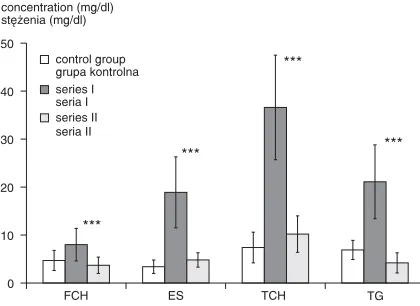
chromatography. The concentration of total lipids (TL) in stool was significantly higher in the patients with CP than in the control group (114.9 ± ± 58.9 vs. 38.7 ± 9.34 mg/g of stool, respectively). After surgical and pharmacological therapy, the values for total lipids in the patients with CP nor− malized (43.8 ± 22.9 mg/g). The levels of FCH, ES, CH, and TG in the CP patients were signifi− cantly higher than in the control group. After surgi− cal and supplementation therapy the concentrations of these lipid fractions also normalized (Fig. 1).
Total serum concentrations of lipids in all the tested groups were correct and varied from 620.11 ± ± 94.4 mg/dl to 655.8 ± 105.9 mg/dl. The FCH and TG concentrations in the serum of CP patients dif− fered significantly from the values obtained in the control group. Surgery and substitution therapy led to normalization of TG levels in serum, but FCH concentrations were significantly lower. Sterol esters (ES) and total cholesterol (CH) concentra− tions in serum were normal during the whole time of the treatment (Fig. 2). The LDL−CH level was significantly higher and the HDL−CH level signif− icantly lower in the patients with CP than in the control group (Fig. 3).
Statistically significant correlations between TL concentration and the levels of the lipid frac− tions from stool and serum in the tested groups were observed (Table 1). Changes in the serum lipid fraction levels were confirmed by elec− trophoresis of the lipoproteins (Table 2).
Discussion
It has been reported that patients with pancre− atic maldigestion and malabsorption secondary to chronic pancreatitis experience malabsorption of lipids (sterol esters and bile acids) in addition to maldigestion and malabsorption of fats [16].
TG 0 10 20 30 40 50 *** *** *** *** control group grupa kontrolna series I seria I series II seria II TCH ES FCH concentration (mg/dl) stężenia (mg/dl)
Fig. 1. Cholesterol fraction (FCH, ES, TCH) and triglyceride (TG) concentrations in the stool of CP patients and of the control group (mean ±SD). Series I: patients before surgery, series II: patients after surgery and substitution therapy, *** p< 0.001 vs. the control group
Ryc. 1. Stężenia frakcji cholesterolowych (CH w., ES, CH całk.) i triglicerydów (TG) w kale pacjentów z p.z.t. i w grupie kontrolnej (średnie ± SD). Seria I – pacjenci przed operacją, seria II – pacjenci po operacji i leczeniu substytucyjnym, *** p < 0,001 vs.grupa kontrolna 0 50 100 150 200 250 300 4 *** * * TG control group grupa kontrolna series I seria I series II seria II TCH ES FCH concentration (mg/dl) stężenia (mg/dl)
Fig. 2.Cholesterol fraction (FCH, ES, TCH) and triglyceride (TG) concentrations in the serum of CP patients and of the control group (mean ± SD). Series I: patients before surgery, series II: patients after surgery and substitution therapy, * p< 0.05 vs. the control group, *** p< 0.001 vs. the control group
Ryc. 2.Stężenia frakcji cholesterolowych (CH w., ES, CH całk.) i triglicerydów (TG) w surowicy pacjentów z p.z.t. i w grupie kontrolnej (średnie ± SD). Seria I – pacjenci przed operacją, seria II – pacjenci po operacji i leczeniu substytucyjnym, * p < 0,05 vs.grupa kon− trolna, *** p < 0,001 vs.grupa kontrolna
0 40 80 120 160 200 1 2 LDL−CH ** ** ** ** HDL−CH control group grupa kontrolna series I seria I series II seria II concentration (mg/dl) stężenia (mg/dl)
Fig. 3.HDL−CH and LDL−CH concentrations in the serum of CP patients and of the control group (mean ± ± SD). Series I: patients before surgery, series II: patients after surgery and substitution therapy, ** p< ± 0.01 vs. the control group
These patients had concentrations of sterol esters twice that of healthy people, although they were on low−cholesterol diets. In the present study, sig− nificantly higher concentrations of cholesterol fractions (CH and ES) in the stool of the patients with CP were observed (Fig. 1). The level of fecal ES was three times higher than the FCH concen− tration in stool. These results give evidence of abnormalities in lipolytic enzyme secretion by the pancreas, especially in the secretion of cholesterol esterases, which stimulate sterol ester hydrolysis.
Several studies report that in chronic pancre− atitis, reduced pancreatic secretion of bicarbonate and the resulting acidity of the duodenal contents might contribute to maldigestion and malabsorp− tion, both by inactivating either endogenously secreted or ingested intraduodenal pancreatic
enzymes and by causing precipitation of bile salts [17–19]. An unabsorbable large−intestinal oil phase solubilizes and traps cholesterol, which results in cholesterol malabsorption. Patients with exocrine pancreatic insufficiency have a bulky intestinal oil phase due to decreased lipolytic activity. A large oil phase contributes to the large fecal sterol esters, CH, and precipitated bile salt excretion [7, 8, 18–20].
After surgery and substitution therapy, the lev− els of the cholesterol fractions were significantly lower than before the treatment (Fig. 1). This is in agreement with the results of other investigations [8, 16, 19, 21]. An improvement in the micellar phase formation and intestinal absorption of CH was observed. Substitution therapy significantly corrects sterol metabolism [6, 22, 23]. The results of the present study confirm that surgery and then replacement therapy have a positive influence on lipid digestion processes.
Significant correlations between TL concen− tration and the levels of FCH, ES TCH, and TG in stool were observed in CP patients (Table 1). One must pay attention to the correlation between the levels of fecal CH and TG. Cholesterol is not absorbed as effectively as other lipids. Products of TG hydrolysis have the greatest effect on CH absorption. Mono− and triglycerides stabilize the micellar phase and free fatty acids help in the intestinal absorption of CH [3].
Decreasing cholesterol intake in the diet and cholesterol malabsorption leads to a low serum cholesterol concentration in most CP patients. This is the result of catabolism from CH to bile acids and subsequent bile acid malabsorption [5]. The
Table 1.Correlations between the lipid fraction concentrations in the stool and serum of CP patients and of the control group, * p< 0.05 vs. the control group
Tabela 1. Korelacje dla stężeń frakcji lipidowych w kale i surowicy chorych na p.z.t. i w grupie kontrolnej, * p < 0,05 vs.grupa kontrolna
Parameters Stool Serum
(Wskaźniki) (Kał) (Surowica)
Group of patients control group study group control group study group (Grupa pacjentów) (n = 15) (n = 38) (n = 15) (n = 38) Statistical test Spearman test Spearman test
(Test statystyczny)
LC : FCH 0.48 0.59 –0.30 –0.24
p = 0.061 p = 0.000* p = 0.23 p = 0.14
LC : ES 0.78 0.67 0.49 0.31
p = 0.017* p = 0.000* p = 0.05* p = 0.05*
LC : TCH 0.52 0.90 –0.64 –0.57
p = 0.031* p = 0.000* p = 0.048* p = 0.000*
LC : TG 0.83 0.66 0.39 0.37
p = 0.009* p = 0.000* p = 0.14 p = 0.060
TG : TCH 0.26 0.74 –0.22 –0.04
p = 0.470 p = 0.000* p = 0.540 p = 0.770
Table 2. Percent changes in serum lipoprotein levels of CP patients and of the control group. Series I: patients before surgery, series II: patients after surgery and substi− tution therapy
Tabela 2. Procentowe zestawienie zmian ilości lipoprote− in surowicy u pacjentów z p.z.t. i w grupie kontrolnej. Seria I – pacjenci przed operacją, seria II – pacjenci po operacji i leczeniu substytucyjnym
Group CHM VLDL LDL HDL
(Grupa pacjentów) Control group
(Grupa kontrolna) 6.0 14.6 36.4 43.0 Study group
(Grupa badana)
series I 19.3 31.4 35.7 13.6
chromatographic investigation of the present study showed that the concentration of serum FCH was lower than normal, but the levels of ES and total CH were normal. In CP patients the concentration of ES was four times higher than the concentration of FCH. These results show that in the serum of CP patients, a low level of free CH is observed, as sug− gested in other studies [24]. It was reported that in pancreatitis, the elimination of cholesterol into the feces was a factor contributing to hypocholes− terolemia. In addition, malabsorption of bile salts and their high levels in the intestine inhibited the endogenous synthesis of cholesterol [4]. The TLC and chemical study showed significant correlations of TL level with ES and TCH levels (Table 1).
Saviana et al. [18] found that CP patients had low plasma LDL−CH levels and it could be argued that hypocholesterolemia was a simpler marker of impaired fat absorption. The results of the present study showed that the concentrations of total CH and ES were normal, but high−density lipoprotein (HDL−CH) levels were lower and low−density lipoprotein (LDL−CH) levels higher than the respective concentrations in the control group (Fig. 3). These values remained at the same level during the whole time of the treatment, before and after surgery and substitutive therapy. Yadav et al. [6] suggested that patients with pancreatitis usual− ly had abnormalities in lipoprotein metabolism. High levels of LDL−CH were observed in the sera of CP patients in other reports [25, 26].
Significantly higher concentration of serum TG were observed in this study. This is in agree− ment with results obtained by others [6, 27]. They
suggest that hypertriglyceridemia is responsible for initiating pancreatitis. Triglycerides occurring in high concentrations in and around the pancreas might be hydrolyzed by pancreatic lipase, result− ing in the release of large quantities of FFA. Unbound by albumin, FFAs are toxic to tissues and could lead to acinar cell or small−vessel injury and pancreatitis [6, 27, 28]. Patients with signifi− cant hypertriglyceridemia usually have abnormali− ties in lipoprotein metabolism (high levels of CHM, VLDL, and LDL) [18, 26]. The results of the present study showed that the high concentra− tion TG in the sera of CP patients was connected with a high level of VLDL and a low level of HDL−CH (Table 2). Over 50% of the patients in the present study abused alcohol. In the majority of alcoholic patients an increase of TG level in plasma and abnormal lipoprotein metabolism were observed. Alcohol induces hypertriglyceridemia by competing with FFAs for oxidation processes, leading to increased availability of FFA for endogenous TG synthesis [6].
The results of this study showed improvement in CP patients with regard to lipid digestion after surgery and substitution therapy. This is connected with improvement in the flow of pancreatic juice to the gastrointestinal tract and exocrine activity of the pancreatic fragment after resection. The TLC chromatography in this study represents the first accurate analyses of lipid fraction concentrations in the stool and serum of CP patients. The results show that TLC study can be used as a clinical and research method in recognizing and monitoring inflammatory processes in chronic pancreatitis.
References
[1] DiMagno MJ, DiMagno EP: Chronic Pancreatitis. Curr Opin Gastroenterol 2003, 19, 451–457.
[2] Mitchell RM, Byrne MF, Baillie J:Pancreatitis. Lancet 2003, 361 (9367), 1447–1455.
[3] Bozkurt T, Braun U, Leferink S, Gilly G, Lux G: Comparison of Pancreatic Morphology and Exocrine Functional Impairment in Patients with Chronic Pancreatitis. Gut 1994, 35 (8), 1132–1136.
[4] Bai JC, Andrush MD, Matelo G, Martinez C, Vazquez MD, Boerr L, Sambuelli A:Fecal Fat Concentration in the Differential Diagnosis of Steatorrhea. Am J Gastroenterol. 1989, 84 (1), 27–30.
[5] Nakamura T, Takeuchi T: Pancreatic Steatorrhea, Malabsorption, and Nutrition Biochemistry: A Comparison of Japanese, European, and American Patients with Chronic Pancreatitis. Pancreas 1997, 14 (4), 323–333.
[6] Yadav D, Pitchumoni CS:Issues in Hyperlipidemic Pancreatitis. J Clin Gastroenterol 2003, 36 (1), 54–62.
[7] Vuoristo M, Vaananen H, Miettinen TA: Cholesterol Malabsorption in Pancreatic Insufficiency: Effects of Enzyme Substitution. Gastroenterology 1992, 102 (2), 647–655.
[8] Einarsson K, Angelin B, Johansson C: Biliary Lipid Metabolism in Chronic Pancreatitis: Influence of Steatorrhoea. Gut 1987, 28 (11), 1495–1499.
[9] Zollner V, Kirsch T:In: Clinical Biochemistry. Principles and Methods. Eds.: Curtius H, Roth M, Berlin–New York 1974, 1025.
[10] Bohle M, Starck F:In: Clinical Biochemistry. Principles and Methods. Eds.: Curtius H Roth M, Berlin–New York 1974, 1022–1023.
[11] Bloor S:In: Clinical Chemistry. Principles and Technics. Eds.: Henry RJ, Cannon DC, Winkelman JW, New York–San Francisco–London 1974, 1424.
[12] Yao JK, Rastetter GM: Microanalysis of Complex Tissue Lipids by High− Performance Thin−Layer Chromato− graphy. Anal Biochem 1985, 150, 111–116.
[14] Friedewald WT, Levy RJ, Fredrickson DS:Estimation of the concentration of low−density lipoprotein choles− terol in plasma, without use of the preparative ultracentrifuge. Clin Chem 1972, 18 (6), 499–502.
[15] Narayan KA et al.:W: Ćwiczenia z biochemii. Eds.: L. Kłyszejko−Stefanowicz, Wydawnictwo Naukowe PWN, Warszawa 1999, 329–330.
[16] Nakamura T, Tandoh Y, Terada A, Yamada N, Watanabe T, Kaji A, Imamura K, Kikuchi H, Suda T:Effects of High−Lipase Pancreatin on Fecal Fat, Neutral Sterol, Bile Acid, and Short−Chain Fatty Acid Excretion in Patients with Pancreatic Insufficiency Resulting from chronic Pancreatitis. Int J Pancreatol 1998, 23 (1), 63–70.
[17] Nakamura T, Kikuchi H, Takebe K, Ishii M, Imamura K, Yamada N, Kudoh K, Terada A: Correlation Between Bile Acid Malabsorption and Pancreatic Exocrine Dysfunction in Patients with Chronic Pancreatitis. Pancreas 1994, 9 (5), 580–584.
[18] Saviana B, Quilliot D, Ziegler O, Bigard MA, Drouin P, Gueant JL: Diagnosis of Lipid Malabsorption in Patients With Chronic Pancreatitis: A New Indirect Test Using Postprandial Plasma Apolipoprotein B−48. Am J Gastoenterol 1999, 94 (11), 3229–3235.
[19] Regan PT, Malagelada JR, Di Magno EP, Go V: Reduced Intraluminal Bile Acid Concentrations and Maldigestion in Pancreatic Insufficiency: Correlation by Treatment. Gastroenterology 1979, 77, 285–289.
[20] Nakamura T, Takebe K, Yamada N, Arai Y, Tando Y: Bile Acid Malabsorption as a Cause of Hypocholeste− rolemia Seen in Patients with Chronic Pancreatitis. Int J Pancreatol 1994, 16 (2–3), 165–169.
[21] Pasanen AVO, Tarpila S, Miettinen TA:Relationships between Serum Lipids and Malabsorption of Bile Acids, Neutral Sterols, and Fats in Exocrine Pancreatic Insufficiency. Scand J Gastroenterol 1980, 15, 503–507.
[22] Nakamura T, Takeuchi T, Tando Y: Pancreatic Dysfunction and Treatment Options. Pancreas 1998, 16 (3), 329–336.
[23] Madsen JL, Graff J, Philipsen EK, Scharff O, Rumessen JJ:Bile Acid Malabsorption or Disturbed Intestinal Permeability in Patients Treated with Enzyme Substitution for Exocrine Pancreatic Insufficiency Is Not Caused by Bacterial Overgrowth. Pancreas 2003, 26 (2), 130–133.
[24] Strate T, Knoefel WT, Yekebas E, Izbicki JR: Chronic Pancreatitis: Etiology, Pathogenesis, Diagnosis, and Treatment. Int J Colon Dis 2003, 18 (2), 97–106.
[25] Yoshida A, Kodama M, Nomura H, Naito M:Classification of lipoprotein profile by polyacrylamide gel elec− trophoresis. Intern Med 2003, 42(3), 244–249.
[26] Okura Y, Nakashima Y: Diagnostic evaluation of acute pancreatitis in two patients with hypertriglyceridemia. World J Gastroenterol 2004, 10(24), 3691–3695.
[27] Miller JP: Serum triglycerides, the liver and the pancreas. Curr Opin Lipidol 2000, 11(4), 377–382.
[28] Kris−Etherton PM, Pearson TA, Wan Y, Hargrove RL, Moriarty K, Fishell V: High−monounsaturated Fatty Acid Diets Lower Both Plasma Cholesterol and Triacylglycerol Concentrations. Am J Clin Nutr 1999, 70, 1009–1015.
Address for correspondence:
Dorota Diakowska
Department of Gastrointestinal and General Surgery Silesian Piasts University of Medicine in Wrocław Traugutta 57/59
50−417 Wrocław Poland
e−mail: [email protected]
Conflict of interest: None declared
Received: 3.06.2005 Revised: 27.04.2006 Accepted: 27.04.2006
Praca wpłynęła do Redakcji: 3.06.2005 r. Po recenzji: 27.04.2006 r.