Available Online at www.ijergs.in
Volume - 4, Issue - 6, November - December - 2018, Page No. 62 - 67
Corresponding Author: Ms.Shalini Pathak, Volume - 4, Issue - 6, November – December 2018, Page No. 62 - 67
Pag
e62
A Review on Democratization of Machine Learning In Cloud
1
Ms.Shalini Pathak, Assistant Professor, Department of Computer Science & Engineering, Arya Institute of Engineering
Technology & Management, Jaipur, Rajasthan
2
Mr.Sanjay Tiwari, Associate Professor, Department of Computer Science & Engineering, Arya Institute of Engineering
Technology & Management, Jaipur, Rajasthan
3
Mr.Kamlesh Gautam, Assistant Professor, Department of Computer Science & Engineering, Arya Institute of
Engineering Technology & Management, Jaipur, Rajasthan
4
Jitendra Joshi, Assistant Professor, Department of Computer Science & Engineering, Jayoti Vidyapeeth Women's
University, Jaipur, Jaipur, Rajasthan
Abstract
This paper gives you detailed information about the use of autonomous policy in machine learning so that the use
of democratization may easily direct to “Cloud based open-source machine learning APIs”. By going through this
paper you’ll able to learn how we can use “Democratization of Machine Leaning in Cloud” for the development of
benefit of Women.
Keywords: Machine Learning, APIs, Cloud, Democratization
Introduction
The name Machine Learning came into subsistence by Arthur Samuel in 1959. According to him, “Machine learning is
the ground of study that gives computers the capability to learn without being unambiguous programmed.”
By Tom Mitchell, “The field of Machine Learning is apprehensive with the question of how to construct computer
programs that automatically progress with experience.”
Machine Learning was once something that only large companies or organizations could invest because these
organisations can afford programmers and data scientists for construction complex machine learning frameworks.
Companies like Google, Amazon and Netflix were among the few who had used their assets to take advantage of machine
learning. But this is no longer the case.
New tools and technologies are enabling the regular companies or organizations to take the benefit of machine learning.
The idea of making amazing easy to get to to everyone is called Democratization.
Google, Apple, Facebook, Microsoft and other tech giants are on the forefront and are vigorously investing in
democratization of machine learning. In the modern years, these companies have open sourced many AI/ML libraries,
tools.
Machine Learning
Machine learning is a acquaintance that is used so that the intricate task performed by the human can be easily performed
at a much superior speed and with more effectiveness .Machine learning is sub-categorized to three types: Supervised
Learning – Guide Me! Unsupervised Learning – Learn from the surrounding Reinforcement Learning – My life My rules!
© IJERGS, All Rights Reserved.
Pag
e63
Pag
e63
Pag
e63
Pag
e63
Pag
e63
Pag
e63
Pag
e63
Pag
e63
Pag
e63
Pag
e63
Pag
e63
Pag
e63
Pag
e63
Pag
e63
Pag
e63
Pag
e63
Pag
e63
Pag
e63
Pag
e63
Pag
e63
Pag
e63
Supervised learning is a learning in which a machine learns from the instruction data set. It can’t take resolve on its own
.It will equivalent every decision with the predefined set that has already been cache in it. In the case of unsupervised
learning ,machine grasp from the environment Assume we made a Robot to perform the convinced task, say, to put the
books from one table to a different but we have not distinct the scope of the room or the distance between the two tables.
In this case The Robot will itself find the best promising path after deteriorating for a number of times and will primarily
complete the definite task. Reinforcement learning works on either 0(failure) or 1(success). If the machine chooses a
exact option it will be measured as success or vice versa.
Democratization of machine learning means giving gain of machine learning to regular people also .As Democracy
merely means for the people, to the people and by the people.
This means they will bring assistance in favor of themselves. Democratization of machine learning in Cloud will give
them adequate storage to bring their thoughts into action as most of the people can’t afford it. APIs (Application
Programming Interface)-It is software that allows communication between two applications. It serves as the interface or
medium between the applications to exchange the useful information. In technical terms, It is a set of function definitions,
protocols and various tools that are needed to build a software
In this paper we are going to explain few machine learning tools that have been recently released for AI start-ups,
developers, and researchers.
These are as follows
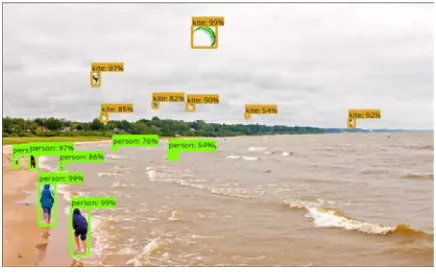
I. Tensor Flow Object Detection API- Machine Learning systems for computer vision has been developed by Google for
improving their products and services and for research community.
It is a very powerful tool that enable everyone (even those who do not belong to machine learning background) to build
and deploy powerful image recognition software. The functionality of Object Detection API comes with the Mobile Nets
single shot detector optimized to run on mobile devices. It has been designed for the limited computational and power
resources of smart phones.
Mobile Nets makes it easier for mobile developers to integrate the machine learning functionality into their mobile
applications .Anyone who wants to use AI/ML functionality in their desktop, Object Detection API provides a heavy duty
inception based CNN (convolution Neural Network) that is optimized for heavy data processing. In both cases Object
Detection API makes it easier to integrate image recognition functionality into their software.
© IJERGS, All Rights Reserved.
Pag
e64
Pag
e64
Pag
e64
Pag
e64
Pag
e64
Pag
e64
Pag
e64
Pag
e64
Pag
e64
Pag
e64
Pag
e64
Pag
e64
Pag
e64
Pag
e64
Pag
e64
Pag
e64
Pag
e64
Pag
e64
Pag
e64
Pag
e64
Pag
e64
Google’s Cloud Video Intelligence API
The video Intelligence API allows developers to figure out what videos are about and detecting objects within them.
Many similar image recognition APIs are available focusing only on images. But with the help of this API, developers
can search and discover information in videos. This means we can search for “apple” or “cat” or “flower” or anything in
the video. Besides this, the API helps us to tag scene changes in a video but those videos have to be stored in Google’s
cloud storage service. Cloud Video Intelligence has been improving over the time as new concepts are introducing and
accuracy has been improving. We can search our video catalog in the same way as we search for the text document.
Cloud Video Intelligence extracts metadata that can be used index the content of our video. We can identify the signal
mixed with noise, by using shot detection to distinguish scene changes within a video and discern only relevant entities at
the video, shot or frame level. Since Video Intelligence API is provided as a REST service, there is no need to download
any library or software. We just only need to do registration on the Google Cloud Platform and begin using Video
Intelligence API via the standard cloud pay-as-you-go scheme. This API is majorly used in the videos of large duration.
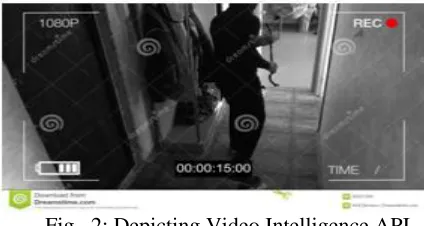
For example (fig 2), Now-a-days people uses CCTVs to protect themselves and/or to see what was happening in their
absence. So if they want to search a man having a black cap, they can simply search this with the use of this API that will
help in saving their time.
Intelligence and Accuracy have been improving.
Fig. 2: Depicting Video Intelligence API
Apple’s Core Machine Learning
In June 2017, Apple released its Core Machine Learning API that has come with ios11 designed to make AI faster on its
iPhones, iPad, and Apple Watch products. This API includes most of the machine learning operations such as image and
face recognition, object detection, natural language processing (NPL).It supports a variety of machine learning models
including neural (deep, convolution recurrent),linear models and decision trees . Core machine learning model format
(models with all model file extension). The Core Machine learning model has been used to integrate machine learning
models into the app. A trained model is the combination of machine learning algorithm and set of training data. This
model makes predictions based on the input data. For example when the number of bedrooms and bathrooms are provided
© IJERGS, All Rights Reserved.
Pag
e65
Pag
e65
Pag
e65
Pag
e65
Pag
e65
Pag
e65
Pag
e65
Pag
e65
Pag
e65
Pag
e65
Pag
e65
Pag
e65
Pag
e65
Pag
e65
Pag
e65
Pag
e65
Pag
e65
Pag
e65
Pag
e65
Pag
e65
Pag
e65
Fig. 3: Apple’s Core Machine Learning
Amazon Polly
It is a service released in November 2016 as a part of AWS(Amazon Web Services) artificial intelligence suite to convert
text into speech. It uses deep learning technology that allow applications to speak with a human like voice. This system
supports 24 languages and multiple voices. We just only need to upload the text into the AWS console, select one of 24
languages (of our choice) and customize pronunciation and download audio files from the cloud to our local machine.
Amazon Polly has many applications. It is used by Go Animate users to immediately give voice to the characters they
animate using this platform. It has also been used by a website named duo lingo where accurate pronunciation is more
important than when we’re learning a new language.
Microsoft Emotion API
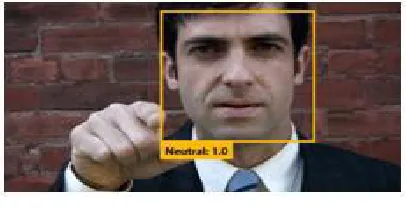
This API has been provided as a part of Microsoft Azure Cloud Services. This API recognizes human emotions in images
and videos. This API recognizes human expressions in an image and returns a face identification boundary box. It detects
happiness, sadness, surprise, anger, fear, contempt, and disgust. It returns emotions of a number of faces in a video over a
period of time. The Emotion API uses JSON for data exchange and API keys for authentication.
Fig. 4: Detecting Emotion via Azure
To start using Microsoft’s tool, we need to send a POST or GET request to specified URLs and a detailed description in
JSON as a result in response. Microsoft offers an SDK (Software development kit) which is integrated with our
application. The API can do 30,000 transactions with the images and 300 operations with the videos per month.
Apache Spark
It is a powerful open source processing engine which is easy to use with various API’s written in java ,python,R, Scala
and Sql . E-commerce companies like Alibaba , Social Networking companies like Tecent and Chines search engine
Baidu, all runs on apache spark engine.
Spark is a general purpose computing engine that allows you to run batch interactive and streaming jobs on the cluster
using same unified frame.
© IJERGS, All Rights Reserved.
Pag
e66
Pag
e66
Pag
e66
Pag
e66
Pag
e66
Pag
e66
Pag
e66
Pag
e66
Pag
e66
Pag
e66
Pag
e66
Pag
e66
Pag
e66
Pag
e66
Pag
e66
Pag
e66
Pag
e66
Pag
e66
Pag
e66
Pag
e66
Pag
e66
First is RDD (Resilient Distributed Data Sets)- It is the representation of data that coming into your system in an object
form and allow you to do computations on it .RDD are resilient because they rely on lineage whenever there is failure in
the system they can recompute themselves using the prior Information using lineage .
Second concept is transformation-It is what you do to RDD to get other resultant RDD .Example of transformation is
opening file and creating RDD or doing function like filter that would then create other resultant RDD. Third concept is
actions. It is when you are asking for an answer that system needs to provide you.
The interesting thing about spark is that it does lazy evaluation means RDD are not loaded or pushed into system when
the system encounter RDD they are only done when the action to be performed.
Benefits
a) Fault Recovery
b) Optimized
c) Easy Programming
d) Rich Library Support (ML, Graphics)
Conclusion
Life style of people are changing and not only the life style their attribute towards the lifestyle is also changing which
encourage Women for their further education using latest technologies. To understand the ability and use of technology
can have positive impact on Women’s freedom, education and employment. There is large population so that they want to
invest less time and get maximum returns. Artificial intelligence, Machine learning or Neural Network is a technique to
make things smart.
Reference
1. Manuel Fernandez-Delgado, Eva Cernadas, Senen Barro, and Dinani Amorim. Do weneed hundreds of
classifiers to solve real world classification problems Journal of Machine Learning Research, 2009
2. Elliot Turner-Enhancing your cloud applications with artificialintelligence
3. Anand Avati, Kenneth Jung, Stephanie Harman, Lance Downing, Andrew Ng, and Nigam H Shah. Improving
palliative care with deep learning.arXiv preprint arXiv:1711.06402, 2017.
4. Sushmito Ghosh and Douglas L Reilly. Credit card fraud detection with a neural-network. InSystemSciences,
1994. Proceedings of the Twenty-Seventh Hawaii International Conference on, volume 3,pages 621–630. IEEE,
1994.
5. Sherif Halawa, Daniel Greene, and John Mitchell. Dropout prediction in moocs using learner
activityfeatures.Experiences and best practices in and around MOOCs, 7:3–12, 2014.
6. Jiazhen He, James Bailey, Benjamin IP Rubinstein, and Rui Zhang. Identifying at-risk students in massive open
online courses. InAAAI, pages 1749–1755, 2015.
7. James Max Kanter and Kalyan Veeramachaneni. Deep feature synthesis: Towards automating data science
endeavors. InData Science and Advanced Analytics (DSAA), 2015. 36678 2015. IEEE Interna-tional
© IJERGS, All Rights Reserved.
Pag
e67
Pag
e67
Pag
e67
Pag
e67
Pag
e67
Pag
e67
Pag
e67
Pag
e67
Pag
e67
Pag
e67
Pag
e67
Pag
e67
Pag
e67
Pag
e67
Pag
e67
Pag
e67
Pag
e67
Pag
e67
Pag
e67
Pag
e67
Pag
e67
8. James Max Kanter, Owen Gillespie, and Kalyan Veeramachaneni. Label, segment, featurize: a cross domain
framework for prediction engineering. InData Science and Advanced Analytics (DSAA), 2016 IEEE
International Conference on, pages 430–439. IEEE, 2016.
9. Arti Ramesh, Dan Goldwasser, Bert Huang, Hal Daumé III, and Lise Getoor.Modeling learnerengagement in
moocs using probabilistic soft logic. InNIPS Workshop on Data Driven Education,volume 21, page 62, 2013.
10. D Sculley, Todd Phillips, Dietmar Ebner, Vinay Chaudhary, and Michael Young. Machine learning: The
high-interest credit card of technical debt. 2014.
11. Haoran Shi, Pengtao Xie, Zhiting Hu, Ming Zhang, and Eric P Xing. Towards automated icd codingusing deep
learning.arXiv preprint arXiv:1711.04075, 2017.
12. ArturKiulian Partner at Colab, helping startupsbuild tech products. Author of "Robot Is The Boss: How To Do
Business with Artificial Intelligence."
13. Burstein J., Leacock C., Chodorow M. (forthcoming) Criterion On-line Essay Evaluation: An Application for
Automated Evaluation of Student Essays. To appear in Proceedings of the Fifteenth Annual Conference on
Innovative Applications of Artificial Intelligence, Acapulco, Mexico, August, 2003.
14. Achindra Bhatnagar-Azure Cognitive Service Emotion API
15. Baldi, P. and Brunak, S. (2002). Bioinformatics: A Machine Learning Approach. Cambridge, MA: MIT Press
16. Baldi, P., Frasconi, P., Smyth, P. (2003). Modeling the Internet and the Web - Probabilistic Methods and
Algorithms. New York: Wiley.