Experimental Investigation on Error Detection
Technique using OFDM Signal
Vinod Nain
1, Er. Poonam Beniwal
21
M.Tech Student, ECE Dept., Om Institute of Technology and Management, Hisar 2
Assistant Professor and HOD, Department of ECE, OM Institute of Technology and Management, Hisar
ABSTRACT
Orthogonal frequency-division multiplexing (OFDM) systems provide efficient spectral usage by allowing overlapping in the frequency domain. Additionally, they are highly immune to multipath delay spread. In these systems, modulation and demodulation can be done using Inverse Fast Fourier Transform (IFFT) and Fast Fourier Transform (FFT) operations, which are computationally efficient. OFDM allows suppression of inter-symbol interference (ISI), provides flexible bandwidth allocation and may increase the capacity in terms of number of users. In this work, we have investigated the performance of different error detecting techniques for OFDM systems. These techniques are based on Convolutional codes, Linear Block codes and Reed- Solomon codes. Simulations are performed to evaluate the considered techniques for different channel conditions. By comparing the three techniques, the results show that Reed-Solomon codes performs the best for all error rates due to its consistency in performance at both low and high code rates which we verified by results.
INTRODUCTION
Orthogonal frequency division multiplexing (OFDM) is a transmission method that can achieve high data rates by multicarrier modulation. The principles of orthogonal frequency division multiplexing modulation have been in existence for several decades. The techniques are employed in data delivery systems over the phone line, digital radio and television, and wireless networking systems. Furthermore, OFDM exhibits much better bandwidth efficiency than classical frequency division multiplexing (FDM) provided that the orthogonality of the carriers is preserved. A very important aspect in OFDM is time and frequency synchronization. In particular, frequency synchronization is the basis of the orthogonality between frequencies. Loss in frequency synchronization is caused by a number of issues. It can be caused by Doppler shift due to relative motion between the transmitter and the receiver. This is particularly severe when each OFDM frame has a large number of frequencies closely spaced next to each other.
Wireless communication, as the name suggests is wireless way of transmitting information from one place to another, is replacing most of the wired transmission of today’s world. Research in the field of wireless communication is still a hot topic to discover new possibilities. The goal of every research in this topic is to find more effective communication methods. Wireless communication helped the user to move freely without worrying about transfer of data. It dramatically changed the concept of information transfer in homes and in offices. Some of the key advantages gained by wireless communication are:
Efficiency Increase - It improved communications that leads to faster transfer of information within businesses and between partners/customers.
Always in reach –There is no need to carry cables or adaptors in order to access some data in your office or home.
Greater flexibility and mobility for users –Workers in an office don’t need to sit on dedicated PCs. They can be wirelessly networked together.
Reduced costs –Compared to wired communication, wireless systems are usually cheaper to use, easy to install and maintain.
frequency spacing, thus lowering the overall SNR. The main goals of this thesis is to understand the effects of frequency offset on OFDM systems and to present frequency offset estimation techniques so that we can correct for their effects. The performance of each technique is compared under various conditions.
OFDM Model
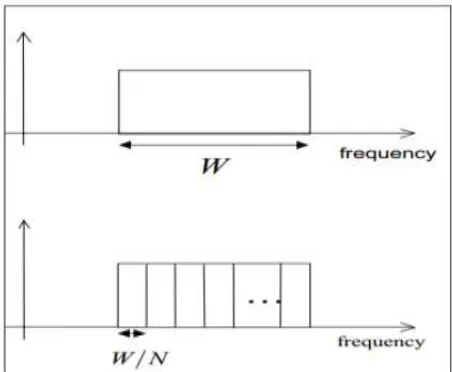
OFDM represents a different system design approach. It can be thought of as a combination of modulation and multiple-access schemes that segments a communications channel in such a way that many users can share it. Whereas TDMA segments are according to time and CDMA segments are according to spreading codes, OFDM segments are according to frequency. It is a technique that divides the spectrum into a number of equally spaced tones and carries a portion of a user's information on each tone. A tone can be thought of as a frequency, much in the same way that each key on a piano represents a unique frequency. OFDM can be viewed as a form of frequency division multiplexing (FDM), however, OFDM has an important special property that each tone is orthogonal with every other tone. FDM typically requires there to be frequency guard bands between the frequencies so that they do not interfere with each other. OFDM allows the spectrum of each tone to overlap, and because they are orthogonal, they do not interfere with each other. By allowing the tones to overlap, the overall amount of spectrum required is reduced.
OFDM is a modulation technique in that it enables user data to be modulated onto the tones. The information is modulated onto a tone by adjusting the tone's phase, amplitude, or both. In the most basic form, a tone may be present or disabled to indicate a one or zero bit of information, however, either phase shift keying (PSK) or quadrature amplitude modulation (QAM) is typically employed. An OFDM system takes a data stream and splits it into N parallel data streams, each at a rate 1/N of the original rate. Each stream is then mapped to a tone at a unique frequency and combined together using the inverse fast fourier transform (IFFT) to yield the time domain waveform to be transmitted.
BACKGROUND
Most of the transmission channels are frequency selective. This means that the frequency components from the input signal are affected differently by the channel. In other words, the channel’s transfer function H(f) is not flat over the whole frequency band but behaves differently for different frequencies. This introduces Inter-symbol interference (ISI) in the received signal and equalizer (filters the received signal to cancel the isi) becomes necessary to deal with ISI. ISI is a time-domain manifestation of the frequency selectivity. The difference is to use the whole band as a single carrier or divide into small bands and use multiple carriers for transmission. In a single carrier system the whole available spectrum is used for transmission of a single message signal. The small time duration of message signal leads to ISI due to multipath signals. While in a multicarrier system the available spectrum is divided into many narrow bands and data is divided into parallel data streams each transmitted in a separate band. OFDM is an example of multicarrier systems in which each carrier has a very narrow bandwidth, having lower symbol rate. This results in the signal having a high tolerance to multipath delay spread, as the delay spread must be very long to cause significant inter-symbol interference.
LITERATURE SURVEY
A number of CFO estimation algorithms have been presented in the literature. Some of them are quite simple, while some of them are more computationally demanding. In 1994 Moose proposed a frequency domain ML CFO estimator that uses two repeated, identical, symbols. This is in practice a form of training symbol and hence lowers the capacity of the communication scheme. Moose et al. analytically evaluated the effects of the carrier frequency offset and carrier phase noise on the SNR degradation for an AWGN channel. The results derived in these papers are used for many of the studies on frequency errors.
In 1997 van de Beek et al. proposed a blind maximum likelihood (ML) estimation algorithm that uses the redundancy introduced in the cyclic prefix to estimate the CFO. However, the algorithm is derived for an AWGN channel. In a multipath environment the cyclic prefix is more or less destroyed which reduces the performance of the algorithm. Still, it is one of the most widely used CFO estimation algorithms. In 2001 Chen and Wang also presented a blind CFO estimation algorithm based on two-fold oversampling.
In 2001 Choi et al. proposed an ML estimation algorithm that assumed that the OFDM symbol is a Gaussian distributed signal, which is asymptotically true for circularly modulated OFDM symbols. However, it also assumes perfect second order knowledge of the channel statistics.
Frequency Errors
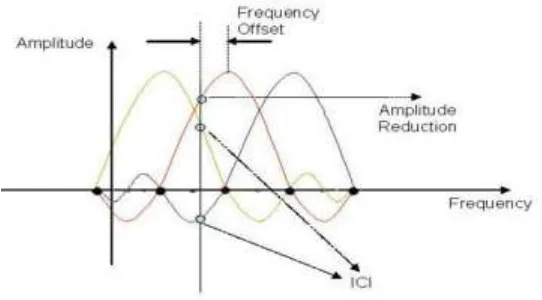
The orthogonality of the sub-carriers can be ensured only if the receiver and the transmitter have the same reference frequency. Any deviation from this reference frequency may cause ICI and loss of orthogonality. Another frequency error factor is phase noise, which is caused by random jitter of the phase of the steady sinusoidal waveform generated by the oscillators. Typically frequency errors are generated by the fact that the oscillators in the modulator and demodulator do not have exactly the same frequency. For single-carrier systems, the effect of phase noise and frequency offset appear only as degradation in the received SNR, rather than ISI or ICI. Nevertheless, many efficient techniques to minimize the effects of this drawback have been proposed in the literature.
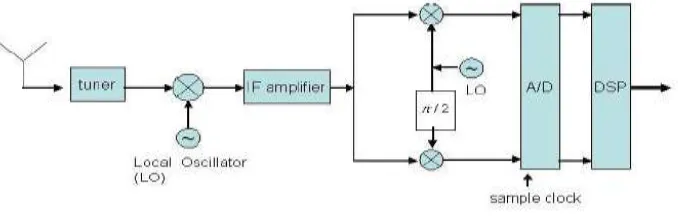
Other reasons for frequency errors include Doppler shift caused by the relative movement between the receiver and the transmitter, and phase noise introduced by nonlinear channels. Figure 1 shows the front end of an OFDM receiver where most of the frequency errors occur, i.e., the local oscillators and the sample clock at the analog to digital (A/D) converter. The A/D converter causes errors when the receiver does not have the same sample clock frequency as at the transmitter.
Figure 1: OFDM Receiver Front End
The frequency offset and the phase noise cause a phase rotation of the received symbols. Coherent OFDM systems need a phase tracking device to obtain the phase of the incoming symbols for correct demodulation [20]. Typically, three types of algorithms are used to estimate the frequency offsets, i.e., to track the phase, in coherent OFDM systems.
Phase Noise, Oscillator Frequency Offset And Their Effects
Figure 2: Effects of Frequency Offset: Reduced Amplitude and ICI
Moose and Pollet et al. analytically evaluated the effects of the carrier frequency offset and carrier phase noise on the SNR degradation for an AWGN channel
CFO Estimation Techniques Using Training Symbol
We have seen that the CFO estimation technique using CP can estimate the CFO only within the range. Since CFO can be large at the initial synchronization stage, we may need estimation techniques that can cover a wider CFO range. The range of CFO estimation can be increased by reducing the distance between two blocks of samples for correlation. This is made possible by using training symbols that are repetitive with some shorter period. Let D be an integer that represents the ratio of the OFDM symbol length to the length of a repetitive pattern. Let a transmitter send the training symbols with D repetitive patterns in the time domain, which can be generated by taking the IFFT of a comb-type signal in the frequency domain.
Frequency-Domain Estimation Techniques for CFO
If two identical training symbols are transmitted consecutively, the corresponding signals with CFO of are related with each other. The MSE performance may deteriorate due to the reduced number of non-zero samples taken for averaging in the frequency domain. Note that this particular CFO estimation technique requires a special period, usually known as a preamble period, in which the consecutive training symbols are provided for facilitating the computation. In other words, it is only applicable during the preamble period, for which data symbols cannot be transmitted.
METHODOLOGY AND RESULTS ANALYSIS
In a wireless digital communication system, the channel effects can heavily degrade the system performance since the wireless link is time varying and may experience multipath fading and interference. Channel effects like deep fades might be hard to avoid, so channel estimation plays an important role when seeking to minimize the degradation due to channel effects, since many receiver methods for handling channel effects require knowledge of the channel.
Need of Channel Estimation
Methodology
The resilience to severe channel conditions can be further enhanced if information about the channel is sent over a return-channel. Based on this feedback information, adaptive modulation, channel coding and power allocation may be applied across all sub-carriers, or individually to each sub-carrier. In the latter case, if a particular range of frequencies suffers from interference or attenuation, the carriers within that range can be disabled or made to run slower by applying more robust modulation or error coding to those sub-carriers. The term discrete multitone modulation (DMT) denotes OFDM based communication systems that adapt the transmission to the channel conditions individually for each sub-carrier, by means of so called bit-loading. Examples are ADSL and VDSL.
The upstream and downstream speeds can be varied by allocating either more or fewer carriers for each purpose. Some forms of rate-adaptive DSL use this feature in real time, so that the bit rate is adapted to the co-channel interference and bandwidth is allocated to whichever subscriber needs it most.
OFDM on the other hand, minimizes both of these effects. Using a low symbol rate and the use of a guard period minimize multipath. Equalization of the channel can be easily achieved through the use of pilot symbols and or pilot tones. This type of equalization is accurate and results in minimal residual error, thus allowing a high average SNR. Additionally, users in OFDM are kept orthogonal to each other, by use of time division multiplexing or synchronized frequency division multiplexing, minimizing inter-user interference. Both these advantages mean that a high effective channel SNR can be maintained even in a multi-user, multipath environment.
This potential for a high SNR means that high modulation schemes can be used in OFDM systems, allowing for improved system spectral efficiency. Additionally each subcarrier can be allocated a different modulation scheme based on the measured channel conditions. These measurements can be easily obtained as part of the channel equalization step, allowing subcarriers to be dynamically allocated modulation schemes based on the SNR of each subcarrier. These variations in SNR arise due to interference, transmission distance, frequency selective fading, etc. This technique is known as adaptive modulation. Those subcarriers with a low SNR can be allocated to use BPSK (1 b/s/Hz) or to transmit no data at all. Subcarriers with a high SNR can transmit higher modulation schemes such as 256-QAM (8 b/s/Hz) allowing a higher system throughput. The modulation allocation is flexible in OFDM systems allowing them to be optimized to local current conditions, rather than having to always use a low modulation scheme just to ensure the system operates during worst-case conditions.
In this project, the frequency offset is modeled as a multiplicative factor introduced in the channel, as shown in
Figure 3: Frequency Offset Model
The received signal is given by,
Where ε is the normalized frequency offset, and is given by ∆fNT
s. ∆f is the frequency difference between the
transmitted and received carrier frequencies and T
s is the sub-carrier symbol period. w(n) is the AWGN introduced
in the channel.
The effect of this frequency offset on the received symbol stream can be understood by considering the received
symbol Y(k) on the k
th
sub-carrier.
)
(
)
(
)
(
2
n
w
e
n
x
n
y
Nn j
Where N is the total number of sub-carriers, X(k) is the transmitted symbol (M-ary phase-shift keying (M-PSK), for
example) for the k
th
sub-carrier, is the FFT of w(n), and S(l-k) are the complex coefficients for the ICI components in
the received signal. The ICI components are the interfering signals transmitted on sub-carriers other than the k
th sub-carrier. The complex coefficients are given by
CONCLUSION
High data rate transmission is one of the major challenges in modern communications, and it is very important for both in military and commercial applications. OFDM is seen as the future technology for communications in high data rate applications. The main disadvantages of OFDM are sensitivity to Intersymbol Interference (ISI) and Intercarrier Interference (ICI). One of the main reasons for ICI is loss of synchronization caused by frequency offset between oscillators at the transmitter and the receiver. This causes the carriers to lose orthogonality, so they cannot be completely separated at the receiver. As a consequence, ICI lowers the signal-to-noise ratio (SNR) and increases the error probability. This thesis investigated the effects of frequency offset in OFDM demodulation and how we can estimate it so that we can compensate for its effects. The objective of this thesis was to investigate the effects of frequency offset and the performance of three different frequency offset estimation techniques. CFO estimation can be performed either in the time or the frequency domain. For CFO estimation in the time domain, cyclic prefix (CP) or training symbol is used. For CFO estimation in the frequency domain, pilot tones are inserted in the frequency domain an transmitted in every OFDM symbol for CFO tracking.
REFRENCES
[1]. Juha Heiskala and John Terry, OFDM Wireless LANs: A Theoretical and Practical Guide, pp. 49-73, Sams Publishing, Indianapolis, 2002.
[2]. J.J. van de Beek, P.A. Odling, S.K. Wilson, and P.O. Borjesson, “Orthogonal Frequency- Division Multiplexing (OFDM)”, Review of Radio Science 1996-1999, W.R. Stone (ed.), International Union of Radio Science (URSI), Oxford University Press, Sweden, pp. 26-38, 1999.
[3]. Mattias Olsson, “Rapid Prototype of an IEEE 802.11a Synchronizer,” LITH-ISYEX- 3290-2002 Linkoping, 2002. [4]. Fuqin Xiong “The Effect of Doppler Frequency Shift, Frequency Offset of the Local Oscillators, and Phase Noise on the
Performance of Coherent OFDM Receivers,” prepared by Ohio Monty Andro Glenn Research Center, Cleveland, Ohio, NASA/TM—2001-210595, 2001.
[5]. Theodore S. Rappaport, Wireless Communications, pp. 177-187, Prentice Hall, Upper Saddle River, New Jersey, 2002. [6]. Bingham, J.A.C. (1990) Multi-carrier modulation for data transmission: an idea whose time has come. IEEE Commun.
Mag., 28(5), 17–25.
[7]. Peled, A. and Ruiz, A., ‘Frequency domain data transmission using reduced computational complexity algorithms’, Proc. IEEE ICASSP, pp. 964–967,Denver, Colorado, 1980.
[8]. Mattias Olsson, “Rapid Prototype of an IEEE 802.11a Synchronizer,” LITH-ISYEX-3290-2002 Linkoping, 2002. [9]. P. H. Moose. A technique for orthogonal frequency division multiplexing frequency offset correction. IEEE Trans.
Commun.,42(10):2908–2914, 1994.
[10]. J. van de Beek, M. Sandell, and P. O. B¨orjesson. ML estimation of time and frequency offset in OFDM systems. IEEE Trans. Signal Process.,45(7):1800–1805, July 1997.
[11]. B. Chen and H. Wang. Blind OFDM carrier frequency offset estimation via oversampling. In Conf. Rec. Thirty-Fifth Asilomar Conf. Signals,Systems, and Computers, volume 2, pages 1465–1469, Nov. 2001.