Open Access
Research
Effects of an attention demanding task on dynamic stability during
treadmill walking
Jonathan B Dingwell*
†1, Roland T Robb
†1, Karen L Troy
†2and
Mark D Grabiner
†2Address: 1Department of Kinesiology & Health Education, University of Texas, 1 University Station, Mail Stop D3700, Austin, TX 78712, USA and 2Department of Movement Sciences, University of Illinois at Chicago, 1919 West Taylor St., Chicago, IL 60612, USA
Email: Jonathan B Dingwell* - [email protected]; Roland T Robb - [email protected]; Karen L Troy - [email protected]; Mark D Grabiner - [email protected]
* Corresponding author †Equal contributors
Abstract
Background: People exhibit increased difficulty balancing when they perform secondary attention-distracting tasks while walking. However, a previous study by Grabiner and Troy (J. Neuroengineering Rehabil., 2005) found that young healthy subjects performing a concurrent Stroop task while walking on a motorized treadmill exhibited decreased step width variability. However, measures of variability do not directly quantify how a system responds to perturbations. This study re-analyzed data from Grabiner and Troy 2005 to determine if performing the concurrent Stroop task directly affected the dynamic stability of walking in these same subjects.
Methods: Thirteen healthy volunteers walked on a motorized treadmill at their self-selected constant speed for 10 minutes both while performing the Stroop test and during undisturbed walking. This Stroop test consisted of projecting images of the name of one color, printed in text of a different color, onto a wall and asking subjects to verbally identify the color of the text. Three-dimensional motions of a marker attached to the base of the neck (C5/T1) were recorded. Marker velocities were calculated over 3 equal intervals of 200 sec each in each direction. Mean variability was calculated for each time series as the average standard deviation across all strides. Both "local" and "orbital" dynamic stability were quantified for each time series using previously established methods. These measures directly quantify how quickly small perturbations grow or decay, either continuously in real time (local) or discretely from one cycle to the next (orbital). Differences between Stroop and Control trials were evaluated using a 2-factor repeated measures ANOVA.
Results: Mean variability of trunk movements was significantly reduced during the Stroop tests compared to normal walking. Conversely, local and orbital stability results were mixed: some measures showed slight increases, while others showed slight decreases. In many cases, different subjects responded differently to the Stroop test. While some of our comparisons reached statistical significance, many did not. In general, measures of variability and dynamic stability reflected different properties of walking dynamics, consistent with previous findings.
Conclusion: These findings demonstrate that the decreased movement variability associated with the Stroop task did not translate to greater dynamic stability.
Published: 21 April 2008
Journal of NeuroEngineering and Rehabilitation 2008, 5:12 doi:10.1186/1743-0003-5-12
Received: 7 June 2007 Accepted: 21 April 2008
This article is available from: http://www.jneuroengrehab.com/content/5/1/12
© 2008 Dingwell et al; licensee BioMed Central Ltd.
Introduction
Falls pose a significant and extremely costly [1] health care problem for the elderly [2] and patients with gait disabil-ities [3-5]. One recent meta-analysis found that abnormal-ities of gait or balance were the most consistent predictors of future falls [6]. Because most falls occur during whole-body movements like walking [7,8], understanding the mechanisms humans use to maintain dynamic stability during walking is critical to addressing this momentous clinical problem effectively [9,10]. The ability to maintain balance during walking can be negatively affected by con-comitant information processing and this effect appears to increase with age [11]. These effects can be studied using various dual-task paradigms, which require subjects to perform an attention demanding secondary task while simultaneously performing a primary task like walking. Dual-task paradigms assume humans possess limited information processing capacity. When performing both primary and secondary tasks, each of which require some level of attention, a negative influence on the performance of either task may indicate structural interference or capac-ity interference [11]. The former is associated with tasks that share common input and output resources whereas the latter is associated with exceeding the total informa-tion processing capacity.
Dual-task paradigms have been used to investigate walk-ing in part because of the frequency with which walkwalk-ing is performed concurrently with cognitive tasks. The changes in reaction time and gait-related variables (e.g., [12-15]) reported for older adults during dual-task paradigms have been associated with increased fall-risk. For example, per-forming a verbal reaction time task during an obstacle avoidance task significantly increases the risk of obstacle contact by young adults [16] and to an even greater extent by older adults [17]. These results broadly suggest that performing cognitive tasks during locomotion may increase the risk of tripping.
The variability of step kinematics has also been strongly linked with falls by older adults. In particular, cross-sec-tional and prospective studies have consistently linked increased step time variability to falls in the normal aging population [18,19]. Older adults without a history of falls exhibit increased step width and step width variability compared to young adults [20], which likely reflects the increased need for lateral stabilization, despite incurring increased energetic cost [21]. Prospective studies have also shown that increases in stride-to-stride variability of walk-ing speed [22] and/or stride time [19] can discriminate older adults who fall from those who do not.
The apparent relationship between increased fall-risk when performing attention demanding tasks while walk-ing, and the relationship between step kinematic
variabil-ity and fall risk raises the question of whether attention demanding tasks increase step kinematic variability. Some evidence supports this idea. For example, step time varia-bility of patients with either Parkinson's or Alzheimer's disease is significantly greater than that of healthy con-trols and also demonstrates additional significant increases when performing an attention demanding task while walking [23,24]. Conversely, Grabiner and Troy [25] recently found that young healthy subjects performing a concurrent Stroop task [26] while walking on a motorized treadmill actually exhibited decreased step width variabil-ity. This Stroop test consisted of projecting images of the name of one color, printed in text of a different color, onto a wall and asking subjects to verbally identify the color of the text. These authors suggested that these changes may have reflected a voluntary gait adaptation toward a more conservative gait pattern that emphasized frontal plane trunk control [25].
While the findings of Grabiner and Troy initially appear counter-intuitive, the biomechanical and physiological significance of changes in gait variability remain an issue of considerable debate. Variability is often assumed to be deleterious, reflecting the presence of unwanted noise in a physiological system.
Alternatively, variability may reflect a desirable trait of an adaptive system that arises from the interaction of multi-ple control systems [27]. As specifically related to walking, several recent studies found that step width variability can distinguish between healthy young and elderly subjects [28], that step width cannot distinguish between fit and frail elderly adults [29], and that elderly adults with a his-tory of falls may exhibit either too much or too little step width variability [30]. Thus, it remains quite unclear what true clinical implications may be drawn from observed changes in measures of locomotor variability.
sen-sitivity of their upper body (i.e. trunk) movements to the small inherent perturbations that naturally occur during normal walking [9,31,32].
Methods
Fifteen young healthy individuals (8 male and 7 female, age: 24.5 ± 3.4 years, height: 1.66 ± 0.12 m, and mass: 68.5 ± 8.0 kg) volunteered to participate. The protocol was reviewed and approved institutionally and all sub-jects provided written informed consent prior to partici-pating. All data were obtained from the same subjects tested during the same experiments previously described by Grabiner and Troy [25]. Data for 2 of these subjects were unusable for the present analyses due to technical difficulties that arose during data collection. Therefore, the results obtained from the remaining 13 subjects are reported here.
Subjects walked on a motorized treadmill at their self-selected constant speed for 10 minutes each, both while walking normally and while concurrently performing an attention demanding Stroop test [26]. During control tri-als, subjects were asked to walk while looking straight ahead at a wall approximately five meters away. During Stroop test trials, images consisting of the name of one of four colors, printed in text of a different color, were pro-jected onto the wall in letters 15 cm tall. These images changed randomly once every second. The subjects were instructed to verbally identify the color of the text and ignore the word itself. The order of presentation of the Stroop and control conditions was randomly assigned and the entire experiment was performed during a single day.
In addition to the foot marker data used to report step width variability in Grabiner and Troy [25], a retro-reflec-tive marker was also attached to the skin over the 5th cer-vical/1st thoracic vertebrae (C5/T1) to measure the three-dimensional movements of the upper body during each trial. Our analyses here focused on these upper body movements because over half of the body's mass is located above the pelvis. Thus, maintaining dynamic sta-bility of the trunk is critical for maintaining stasta-bility of the body as a whole [9,34,35]. The motions of this C5/T1 marker in the anterior-posterior (AP), mediolateral (ML), and vertical (VT) directions were recorded using an 8-cam-era motion analysis system (Motion Analysis, Santa Rosa, CA, USA) operating at 60 Hz. Raw marker data were fil-tered with a zero-lag Butterworth filter with a cutoff fre-quency of 6 Hz.
The analytical techniques applied also required stationary data [36], but the raw motion data exhibited considerable nonstationarity mainly because subjects "wandered" in the horizontal plane as they walked on the treadmill [9].
To obtain more stationary data, the velocity of each time series (VAP, VML, and VVT) was calculated using a standard 3-point difference formula [37]:
where DX(i) was the displacement in each direction, X ∈ {AP, ML, VT}, at data sample i and Δt = 1/60 sec was the time between data samples. The analysis techniques used here were independent of specific measurement units. Thus, analyzing the dynamical properties of the velocity time series was equivalent to analyzing the dynamical properties of the displacement time series [9,36]. Addi-tionally, each ten-minute time series was first divided into three equal intervals of 200 sec (approximately 150 strides) each to calculate both within- and between-sub-ject variances in each dependent measure. Data for all strides from all trials were analyzed. While the number of strides analyzed was slightly different for each subject and trial, the analyses conducted here were not sensitive to small changes in this parameter [9,38].
To quantify variability, the VAP, VML, and VVT data for each individual stride were extracted and time-normalized to 101 samples (0% to 100%). Individual strides were differ-entiated by identifying every other minimum from the vertical movements of the C5/T1 marker [9]. Standard deviations were calculated across all strides at each malized time increment and then averaged over the nor-malized stride to produce a single measure of the mean variability ("MeanSD") for each trial (Fig. 1A):
MeanSD(VX) = 冬SDn [VX]冭 (2)
where VX denotes the velocity in each direction, X ∈ {AP, ML, VT}, n ∈{0%, ..., 100%} is an index denoting each percentage of the gait cycle, and 冬·冭 denotes the average over all values of n [9].
In theoretical mechanics, stability is defined by how a sys-tem's state variables respond to perturbations [39]. For aperiodic systems that exhibit no discernable periodic structure, "local stability" is defined using local divergence exponents [36,40], which quantify how the system's states respond to very small (i.e. "local") perturbations continu-ously in real time [9,10,31]. For limit cycle systems, defined as having a constant fixed period, "orbital stability" is defined using Floquet multipliers [39] that quantify, discretely from one cycle to the next, the tendency of the sys-tem's states to return to the periodic limit cycle orbit after small perturbations [32,41,42]. Because human walking is neither strictly periodic, nor strongly aperiodic, both methods were used to assess the sensitivity of walking
kin-V n D X i D X i
t X
( )
=+
(
1)
−( )
−12Δ
ematics to small perturbations during continuous walk-ing.
For both analyses, we first defined appropriate multi-dimensional state spaces for each individual time series using standard delay-reconstruction techniques [9,10,36] (e.g., Fig. 1B):
S(t) = [q(t), q(t + T), q(t + 2T), ..., q(t + (dE - 1)T)] (3)
where S(t) was the dE-dimensional state vector, q(t) was the original 1-dimensional data [i.e., either VAP(t), VML(t), or VVT(t)], T was the time delay, and dE was the embedding dimension. Time delays were calculated from the first minimum of the Average Mutual Information function [10,36]. An embedding dimension of dE = 5 was used for all data sets, as determined from a Global False Nearest Neighbors analysis [10,36]. Note that these state spaces consisted of the original real-time data (i.e., data were not time normalized).
To quantify local stability, the mean local divergence of nearest neighbor trajectories was calculated using a previ-ously published algorithm [40]. For each point S(t) in state-space, the nearest neighboring point S(t*) on an adjacent trajectory was determined (Fig. 1C). For each pair (j) of initially nearest neighbors, the subsequent diver-gence over time between these two points was then calcu-lated:
dj(i) = ||S(t + iΔt) - S(t* + iΔt)||2 (4)
where dj(i) was the Euclidean distance between the two trajectories after each discrete time step i (i.e. iΔt seconds). This local divergence was computed out to 10 seconds (i = 600 samples) beyond each initial perturbation. This process was repeated for all points from the data set and then averaged to define the mean local divergence curve,
冬dj(i)冭, where 冬•冭 denotes the arithmetic mean over all val-ues of j (Fig. 1C).
For purely deterministic "chaotic" systems, these mean local divergence curves would be linear, reflecting a con-stant exponential rate of divergence [36,40,43], and their slope would approximate the maximum finite-time Lya-punov exponent for the system. Since the curves we obtained (e.g., Fig. 1C and [9,10]) were clearly not linear, there was no basis for defining a true Lyapunov exponent for human walking [36,43]. Nevertheless, these local divergence exponents still provided rigorously defined metrics for estimating the sensitivity of human walking to small intrinsic perturbations [10,35]. To parameterize this sensitivity, we instead fit a double-exponential function to each mean divergence curve [35]:
Schematic representations of dependent measure calcula-tions
Figure 1
Schematic representations of dependent measure calculations.
A: Example of mean ± 1 SD for a typical time series. Between-stride stand-ard deviations are computed at each % of the gait cycle (i) and then aver-aged to compute the MeanSD across the entire gait cycle (Eq. 2). B: An original time series, q(t), is reconstruction into a 3-dimensional attractor such that S(t) = [q(t), q(t+T), q(t+2T)]. The two triplets of points indicated in A and separated by time lags T and 2T each map onto a single point in the 3D state space. C: Expanded view of a local section of the attractor shown in B. An initial naturally occurring local perturbation, dj(0), diverges across i time steps as measured by dj(i). The average logarithmic diver-gence, <dj(i)> is computed across all pairs of initially neighboring trajecto-ries and then fit with a double exponential function (Eq. 5). D:
Representation of a Poincaré section transecting the state space perpen-dicular to the system trajectory. The system state at stride k, Sk, evolves to Sk+1 one stride later. The Floquet multipliers quantify whether the dis-tances between these states and the system fixed point, S*, grow or decay across multiple strides (Eq. 8).
q(t) q(t+T)
t
q(t) q(t+2T)
A
B
D
C
d (i)
jd
j(0)
< d
j
(i)
>
Time (# of Strides)
*
Fixed Point (S*)(
Sk+1 − S*)
Poincare Section
V
AP0 25 50 75 100
% of Stride SDi[VAP]
i
A
−
B
Se
−
B
Le
−t
τS τ−Lt
(
Sk− S*)
Sk+1 Sk
2T
where τS and τL (τL >> τS) represent the time constants that describe how quickly 冬dj(i)冭 saturates to A, and BS and BL determine the size of the effect the dynamics at each timescale have on 冬dj(i)冭 [35]. Eq. 5 was fit to each diver-gence curve using the 'fmincon' function in Matlab. This function requires an initial guess of the parameter values and for most of the 234 time series analyzed, the results were not particularly sensitive to this choice. For ~40 time series (~17%), the initial guess had to be adjusted an addi-tional 1–3 times to obtain good curve fits. The exponents
τS-1 and τ
L-1 are mathematically directly analogous to the "short-term" and "long-term" local divergence exponents we have used previously [35]. Values of A, BS, τS, BL, and
τL were computed for each trial for each subject for each test condition.
Orbital stability was quantified by calculating the Floquet Multipliers (FM) for the system [39] based on well-estab-lished techniques [32,41,42,44]. Because Floquet theory assumes the system is strictly periodic, the state space data (Eq. 3) for each stride were first time-normalized to 101 samples (0% to 100%). We could then define a Poincaré map (Fig. 1D) for the system at any chosen % of the gait cycle as:
Sk+1 = F(Sk) (6)
where k was an index enumerating the individual strides and Sk denoted the system state for the single chosen % of the gait cycle. Limit cycle trajectories correspond to fixed points in each Poincaré map:
S* = F(S*) (7)
For our walking data, we chose Poincaré sections at 0%, 25%, 50%, 75%, and 100% of the gait cycle [32,42]. We defined the fixed point at each Poincaré section by the average trajectory across all strides within a trial. Orbital stability at each Poincaré section was estimated by quan-tifying the effects of small perturbations away from these fixed points, using a linearized approximation of Eq. (6):
[Sk+1 - S*] ≈J(S*) [Sk - S*] (8)
where J(S*) defined the Jacobian matrix for the system at each Poincaré section. Floquet multipliers (FM) are the eigenvalues of J(S*) [39,41,44]. Deviations away from the fixed point are multiplied by FM by the subsequent cycle (Fig. 1D). If the magnitude of the largest FM is < 1, these deviations decay and the limit cycle is orbitally stable. Smaller FM imply greater stability. We therefore com-puted the magnitudes of the maximum FM (MaxFM) for
each Poincaré section for each trial for each subject for each test condition.
For each dependent measure computed, differences between control (CO) walking and Stroop test (ST) walk-ing were evaluated uswalk-ing a two-factor (Subject × Condi-tion) repeated measures (i.e., 3 intervals per trial) balanced ANOVA for randomized block design, where Subject was a random factor. For the local dynamic stabil-ity variables (A, BS, τS, BL, and τL), the data were first log transformed to satisfy linearity and normality constraints. For each dependent measure, p-values for each main effect and for Subject × Condition interaction effects were obtained. Finally, linear and quadratic regression analyses were run to determine if differences in movement varia-bility (i.e., MeanSD) across subjects were generally corre-lated with differences in either local or orbital stability.
Results
The mean variability (MeanSD) of upper body (i.e., trunk) movements was significantly greater during Con-trol (CO) walking than during Stroop (ST) walking (p ≤ 0.021) for all three principle directions: VAP, VML, and VVT (Fig. 2). As expected, trunk movement variability was greatest in the medio-lateral (ML) direction. Additionally, there was a significant Subject × Condition interaction effect for movements in the anterior-posterior (AP) direc-tion (p = 0.008), indicating that while most subjects' AP variability decreased during the Stroop test, this was not true for all subjects (Fig. 2).
differences between the two walking conditions (0.24 < p < 0.67 for BS and 0.15 < p < 0.93 for BL, respectively).
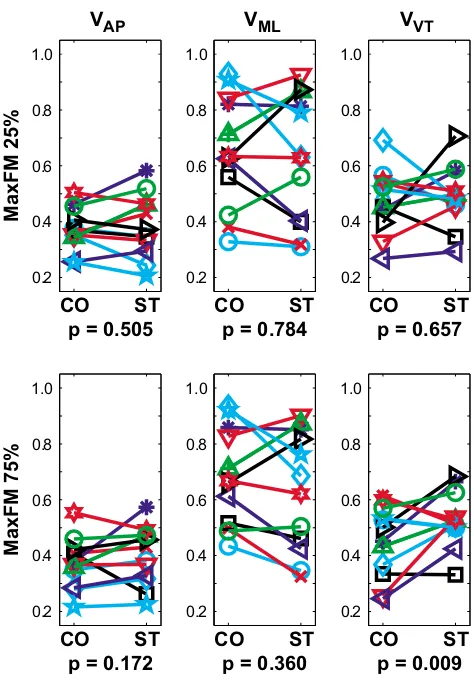
Overall, the Stroop test led to either no changes or slight increases in orbital instability of walking patterns. All sub-jects exhibited orbitally stable walking kinematics (i.e., Max FM < 1) for all walking trials (Fig. 4), consistent with previous findings [32,42]. In contrast to the local stability findings, Max FM values were, on average, slightly larger (i.e., more unstable) for the ST walking condition than the CO walking condition for movements in the AP and VT directions, but slightly smaller (i.e., more stable) for ML movements. None of these differences, however, were sta-tistically significant (0.17 < p < 0.90). At 75% of the gait cycle, subjects did exhibit significantly greater (i.e., more unstable) Max FM values during the Stroop test for vertical movements (p = 0.009; Fig. 4). While none of the Subject × Condition interaction effects were statistically signifi-cant (0.07 < p < 0.85), differences between subjects were again evident in the data (Fig. 4).
Kinematic variability (MeanSD) results for trunk velocities in the anterior-posterior (AP), mediolateral (ML), and vertical (VT) directions
Figure 2
Kinematic variability (MeanSD) results for trunk velocities in the anterior-posterior (AP), medi-olateral (ML), and vertical (VT) directions. Note that the vertical scale is different for the ML direction compared to the AP and VT directions. Nearly all subjects exhibited greater variability during the Control (CO) walking trials, particularly in the AP and VT directions. Variability of ML movements was much greater than that of AP and VT move-ments. The "*" indicates a statistically significant Subject × Condition interaction effect (p = 0.008).
CO ST 0 10 20 30 40 50 60
p = 0.001* VAP MeanSD CO ST 0 50 100 150 200
p = 0.021 VML CO ST 0 10 20 30 40 50 60
p < 0.001 VVT
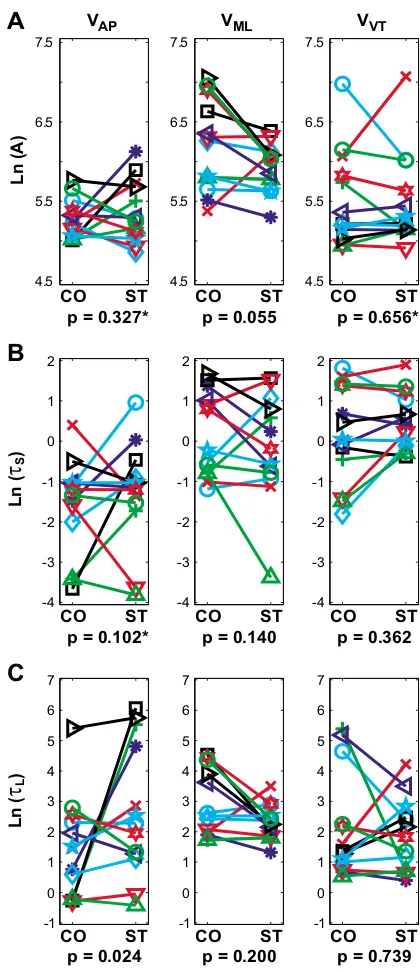
Local dynamic stability results for AP, ML, and VT trunk velocities
Figure 3
Local dynamic stability results for AP, ML, and VT trunk veloci-ties. These data were log transformed to satisfy linearity and normality constraints of the ANOVA analyses. A: Divergence amplitudes (A in Eq. 5) were slightly greater in the ML direction (p = 0.055) during Control (CO) walking relative to Stroop test (ST) walking. B: Short-term time constants (τS in Eq. 5) were not significantly different between the 2 tasks. C: Long-term time constants (τL in Eq. 5) were significantly smaller (i.e., indicating greater local instability) for the CO walking condition for movements in the AP direction (p = 0.024). This same trend was observed in the ML direction, but was not statistically significant (p = 0.200). The "*" indicate statistically significant Subject × Condition interaction effects (p < 0.05). In general, the Stroop test led to slightly more stable movements in the AP direction, but slightly more unstable movements in the ML direction, com-pared to CO walking.
CO ST 4.5
5.5 6.5 7.5
p = 0.327* VAP Ln (A) CO ST 4.5 5.5 6.5 7.5
p = 0.055 VML CO ST 4.5 5.5 6.5 7.5
p = 0.656* VVT CO ST -4 -3 -2 -1 0 1 2
p = 0.102*
Ln (
τ
S ) CO ST -4 -3 -2 -1 0 1 2p = 0.140
CO ST -4 -3 -2 -1 0 1 2
p = 0.362
CO ST -1 0 1 2 3 4 5 6 7
p = 0.024
CO ST -1 0 1 2 3 4 5 6 7
p = 0.200
CO ST -1 0 1 2 3 4 5 6 7
p = 0.739
For AP and VT movements (Fig. 5, top and bottom rows), differences in variability predicted differences in short-term local instability (τS), but did not predict differences in either long-term local instability (τL) or orbital instabil-ity (MaxFM). For ML movements (Fig. 5, middle row), all three stability measures exhibited quadratic relationships with variability, with trials exhibiting intermediate
amounts of variability showing greater instability, while trials exhibiting lesser or greater variability were more sta-ble. We note that since each regression contained depend-ent data (i.e., 2 data points from each subject), the p-values obtained cannot indicate "statistical significance" in the strict sense. The p-values and r2 values in Fig. 5 instead indicate only the general quantitative strengths of these relationships. Thus, measures of variability and dynamic stability reflected different properties of walking dynamics, consistent with previous findings [9,31].
Discussion
People often perform secondary attention-demanding cognitive tasks while walking. The apparent relationships between increased fall-risk when performing attention demanding tasks while walking [11-17] and between step kinematic variability and fall risk [19,20,22] suggest that attention demanding tasks might increase step kinematic variability. However, Grabiner and Troy [25] found that young healthy subjects performing a concurrent Stroop task [26] while walking on a motorized treadmill actually exhibited decreased step width variability. The relationship between step width and risk of falls remains an issue of debate [28-30] and measures of kinematic variability are not well correlated with measures of dynamic stability that directly quantify the sensitivity of walking kinematics to small perturbations [9,31,32]. Therefore, the present study was conducted to determine if performing the con-current Stroop task also affected the dynamic stability of walking in the same experiments described in Grabiner and Troy [25].
The present analyses demonstrate that these subjects also exhibited decreased variability of trunk movements in all three principle directions while performing the concur-rent Stroop test (Fig. 2). These findings support the decreased step width variability results reported by Grab-iner and Troy and demonstrate that this decreased varia-bility was not restricted to leg movements, but also affected trunk movements. Decreasing the variability of trunk (and thereby head) movements during the Stroop test would help subjects stabilize their gaze on the words being projected on the wall [45]. The local and orbital dynamic stability results, however, were mixed. While subjects exhibited somewhat more locally stable move-ments in the AP direction while performing the Stroop test ('τL'; Fig. 3C), most comparisons showed minimal dif-ferences that were not statistically significant (Fig. 3). Fur-thermore, subjects exhibited either no significant differences in orbital stability, or slightly greater orbital instability, while performing the Stroop task (Fig. 4). The lack of main effects differences for these measures was likely due at least in part to the fact that different subjects responded differently to the Stroop task, as indicated by the significant interaction effects. Therefore, the decreased
Orbital stability results Figure 4
Orbital stability results. Magnitudes of maximum Floquet multipliers (MaxFM) for Poincaré sections taken at 25% and 75% of the gait cycle for trunk velocities in the AP, ML, and VT directions. All subjects were orbitally stable (all MaxFM < 1) in all directions, but somewhat less stable (i.e., larger MaxFM) in the ML direction, compared to the AP and VT directions. During the Stroop test, subjects tended to be slightly more stable in the ML direction, but slightly more unstable in the AP and VT directions. This greater instability was statistically significant at the 75% Poincaré section (p = 0.009). Similar results were obtained at the 0%, 50%, and 100% Poincaré sections, but no significant Condition effects (0.231 < p < 0.996) were found. There were no statistically significant Subject × Condition interaction effects for any of the comparisons (0.07 < p < 0.85).
CO ST
0.2 0.4 0.6 0.8 1.0
p = 0.505 VAP
MaxFM 25%
CO ST
0.2 0.4 0.6 0.8 1.0
p = 0.784 VML
CO ST
0.2 0.4 0.6 0.8 1.0
p = 0.657 VVT
CO ST
0.2 0.4 0.6 0.8 1.0
p = 0.172
MaxFM 75%
CO ST
0.2 0.4 0.6 0.8 1.0
p = 0.360
CO ST
0.2 0.4 0.6 0.8 1.0
variability associated with performing the concurrent Stroop task did not translate to greater dynamic stability in these young healthy subjects.
Although subjects did not improve their dynamic stability while performing the Stroop test and walking, they also did not become obviously more unstable either. It is likely that these young healthy subjects altered their gait pat-terns to adapt to the Stroop task, as originally suggested by Grabiner and Troy [25]. However, the present findings demonstrate that they did not over-compensate, but were instead able to maintain approximately the same levels of dynamic stability. Another, albeit not mutually exclusive, possibility is that the Stroop test itself imposed constraints for head orientation that were not present in the control task [45]. Thus, the Stroop task may not have been
chal-lenging enough to elicit more significant deterioration of dynamic stability during walking. We believe it is likely that we would observe more pronounced effects of con-current cognitive tasks on the dynamic stability of walking if we examined more impaired (e.g., elderly) populations with more limited capacity to adapt to the task and/or if we required subjects to perform more complex cognitive tasks, such as more complex Stroop test [46,47], or possi-bly solving arithmetic problems [15,45]. Performing mental arithmetic in particular would likely cause subjects to reorient their visual attention away from external visual landmarks to internal images of the calculation [45], thereby disrupting the otherwise very strong reliance on visual information for the control of walking [48].
Regressions between measures of variability (MeanSD) and short-term local divergence time constants (τS; left column), long-term local divergence time constants (τL; middle column), and magnitudes of maximum Floquet multipliers (MaxFM; right col-umn) for movements in the AP (top row), ML (middle row), and VT (bottom row) directions
Figure 5
Regressions between measures of variability (MeanSD) and short-term local divergence time constants (τS; left
column), long-term local divergence time constants (τL; middle column), and magnitudes of maximum
Flo-quet multipliers (MaxFM; right column) for movements in the AP (top row), ML (middle row), and VT (bot-tom row) directions. Each subplot show the average value for each subject for both Stroop ('O') and Control ('X') walking trials. Linear regressions were performed for AP and VT movements, while quadratic regressions were performed for ML movements. Adjusted r2 values and p-values for each regression are shown in each sub-plot. Since each regression contained
two data points from each subject, these p-values do not indicate "statistical significance" in the strict sense, but instead indi-cate only the general quantitative strengths of these relationships.
20 30 40 50 60 -4
-3 -2 -1 0
r2 = 33.6% p = 0.001
AP
20 30 40 50 60 -1
0 1 2 3 4 5
r2 = 3.1% p = 0.193
20 30 40 50 60 0.2
0.3 0.4 0.5 0.6
MaxFM
r2 = 0.0%, p = 0.725
0 50 100 150 200 -4
-2 0 2
r2 = 28.8%, p = 0.008
ML
0 50 100 150 200 1
2 3 4
r2 = 16.0%, p = 0.052
0 50 100 150 200 0.2
0.4 0.6 0.8 1.0
MaxFM
r2 = 55.9%, p < 0.001
10 20 30 40 -3
-2 -1 0 1 2
r2 = 17.7%, p = 0.019
VT
10 20 30 40 0
1 2 3 4
MeanSD (deg)
r2 = 1.6%, p = 0.247
10 20 30 40 0.2
0.3 0.4 0.5 0.6 0.7
MaxFM
r2 = 0.0%, p = 0.805
Ln (
τ
S)
Ln (
τ
L)
Ln (
τ
S)
Ln (
τ
S)
Ln (
τ
L)
Ln (
τ
LOne possible limitation of the present study was that sub-jects walked on a motorized treadmill. Treadmill walking can reduce the natural variability [31,49] and enhance the local stability [31] and, to a lesser extent, the orbital sta-bility [42] of locomotor kinematics. This may be because walking speed is strictly enforced on the treadmill, allow-ing subjects fewer options for alterallow-ing their gait speed and/or walking kinematics. The present study needed to be conducted on a motorized treadmill so that walking speeds could be controlled experimentally and to provide the Stroop test intervention. Because each subject walked at the same speed under both conditions, this ensured that comparisons of the variability and dynamic stability between the two walking tasks would remain valid and would not be confounded by subjects changing their gait speed.
None of the subjects tested in this study fell, or even stum-bled, during these experiments. As such, the present study was limited to experimentally quantifying how these sub-jects responded to those small perturbations that occur naturally during normal walking [10,32]. Therefore, these results may or may not extend to global stability [39], where the response of the system to much larger perturba-tions, like tripping or slipping (e.g., [50,51]), would be assessed. Clearly, there is a limit to the magnitude of per-turbations that humans can accommodate and we do not know how much inherent local or orbital instability humans can tolerate while remaining globally stable. Pre-vious studies showing that obstacle avoidance is also impaired while walking and performing concurrent cog-nitive tasks [16,17] suggest that global stability is likely also impaired during dual-tasking situations. The present findings, along with our previous work [9,10,35], suggest that the underlying mechanisms responsible for govern-ing local and/or orbital dynamic stability in human loco-motion are likely related in some way to those governing global stability. One important line of future research will be to determine if subtle changes in the dynamic stability properties quantified here can also be used to predict the resilience of humans to much larger perturbations.
Competing interests
The authors declare that they have no competing interests.
Authors' contributions
MDG and JBD conceived the study. MDG and KLT con-ducted the experiments and collected the data. JBD evalu-ated the data and results and was responsible for the initial drafting of the manuscript. RTR wrote/modified software necessary for the analysis and was involved in drafting and revising the manuscript. All authors read and approved the final manuscript.
Acknowledgements
This work was partially funded by NIA R01AG10557 awarded to MDG, by Whitaker Foundation Biomedical Engineering Research Grant #RG-02-0354 awarded to JBD, and by a University of Texas Preemptive Fellowship awarded to RTR. The authors wish to acknowledge the assistance of Rijuta Dhere, who was instrumental in the collection of the data, and of Hyun Gu Kang and Jimmy Su, who helped develop the dynamic stability analysis algo-rithms used in the present study.
References
1. Englander F, Hodson TJ, Terregrossa RA: Economic dimensions of slip and fall injuries. J Forensic Sci 1996, 41(5):733-746.
2. Fuller GF: Falls in the elderly. Am Fam Physician 2000,
61(7):2173-2174.
3. Richardson JK, Hurvitz EA: Peripheral Neuropathy: A True Risk Factor for Falls. J Gerontol A Biol Sci Med Sci 1995,
50(4):M211-M215.
4. Forster A, Young J: Incidence and Consequences of Falls Due to Stroke: A Systematic Inquiry. BMJ 1995, 311(6997):83-86. 5. Hausdorff JM, Schaafsma JD, Balash Y, Bartels AL, Gurevich T, Giladi
N: Impaired regulation of stride variability in Parkinson's dis-ease subjects with freezing of gait. Exp Brain Res 2003,
149(2):187-194.
6. Ganz DA, Bao Y, Shekelle PG, Rubenstein LZ: Will My Patient Fall?
JAMA 2007, 297(1):77-86.
7. Tinetti ME, Doucette J, Claus E, Marottoli R: The contribution of predisposing and situational risk factors to serious fall inju-ries. J Am Geriatr Soc 1995, 43(11):1207-1213.
8. Niino N, Tsuzuku S, Ando F, Shimokata H: Frequencies and cir-cumstances of falls in the National Institute for Longevity Sciences, Longitudinal Study of Aging (NILS-LSA). J Epidemiol
2000, 10(1 Suppl.):S90-S94.
9. Dingwell JB, Marin LC: Kinematic Variability and Local Dynamic Stability of Upper Body Motions When Walking at Different Speeds. J Biomech 2006, 39(3):444-452.
10. Dingwell JB, Cusumano JP: Nonlinear Time Series Analysis of Normal and Pathological Human Walking. Chaos 2000,
10(4):848-863.
11. Woollacott M, Shumway-Cook A: Attention and the control of posture and gait: A review of an emerging area of research.
Gait & Posture 2002, 16(1):1-14.
12. Lajoie Y, Teasdale N, Bard C, Fleury M: Attentional Demands for Static and Dynamic Equilibrium. Exp Brain Res 1993,
97(1):139-144.
13. Ebersbach G, Dimitrijevic MR, Poewe W: Influence of Concurrent Tasks on Gait: A Dual-Task Approach. Percept Motor Skills 1995,
81:107-113.
14. Sparrow WA, Bradshaw EJ, Lamoureux E, Tirosh O: Ageing effects on the attention demands of walking. Hum Mov Sci 2002, 21(5-6):961-972.
15. Beauchet O, Dubost V, Gonthier R, Kressig RW: Dual-Task-Related Gait Changes in Transitionally Frail Older Adults: The Type of the Walking-Associated Cognitive Task Mat-ters. Gerontology 2005, 51(1):48-52.
16. Weerdesteyn V, Schillings AM, van Galen GP, Duysens J: Distraction affects the performance of obstacle avoidance during walk-ing. J Mot Behav 2003, 35:53-63.
17. Chen HC, Schultz AB, Ashton-Miller JA, Giordani B, Alexander NB, Guire KE: Stepping Over Obstacles: Dividing Attention Impairs Performance of Old More Than Young Adults. J Ger-ontol A Biol Sci Med Sci 1996, 51A(3):M116-M122.
18. Hausdorff JM, Nelson ME, Kaliton D, Layne JE, Bernstein MJ, Nuern-berger A, Fiatarone-Singh MA: Etiology and modification of gait instability in older adults: a randomized controlled trial of exercise. J Appl Physiol 2001, 90(6):2117-2129.
19. Hausdorff JM, Rios DA, Edelberg HK: Gait Variability and Fall Risk in Community-Living Older Adults: A 1-Year Prospec-tive Study. Arch Phys Med Rehabil 2001, 82(8):1050-1056. 20. Owings TM, Grabiner MD: Variability of step kinematics in
young and older adults. Gait & Posture 2004, 20(1):26-29. 21. Dean JC, Alexander NB, Kuo AD: The effect of lateral
stabiliza-tion on walking in young and old adults. IEEE Trans Biomed Eng
Publish with BioMed Central and every scientist can read your work free of charge "BioMed Central will be the most significant development for disseminating the results of biomedical researc h in our lifetime."
Sir Paul Nurse, Cancer Research UK
Your research papers will be:
available free of charge to the entire biomedical community
peer reviewed and published immediately upon acceptance
cited in PubMed and archived on PubMed Central
yours — you keep the copyright
Submit your manuscript here:
http://www.biomedcentral.com/info/publishing_adv.asp
BioMedcentral 22. Maki BE: Gait Changes in Older Adults: Predictors of Falls or
Indicators of Fear? J Am Geriatr Soc 1997, 45(3):313-320. 23. Sheridan PL, Solomont J, Kowall N, Hausdorff JM: Influence of
executive function on locomotor function: divided attention increases gait variability in Alzheimer's disease. J Am Geriatr Soc 2003, 51(11):1633-1637.
24. Hausdorff JM, Balash J, Giladi N: Effects of cognitive challenge on gait variability in patients with Parkinson's Disease. J Geriatr Psychiatry Neurol 2003, 16(1):53-58.
25. Grabiner MD, Troy KL: Attention demanding tasks during treadmill walking reduce step width variability in young adults. J Neuroeng Rehabil 2005, 2:25.
26. Stroop JR: Studies of interference in serial verbal reactions. J Exp Phychol 1935, 18:643-661.
27. Lipsitz LA: Dynamics of Stability: The Physiologic Basis of Functional Health and Frailty. J Gerontol A Biol Sci Med Sci 2002,
57(3):B115-125.
28. Owings TM, Grabiner MD: Step width variability, but not step length variability or step time variability, discriminates gait of healthy young and older adults during treadmill locomo-tion. J Biomech 2004, 37(6):935-938.
29. Moe-Nilssen R, Helbostad JL: Interstride trunk acceleration var-iability but not step width varvar-iability can differentiate between fit and frail older adults. Gait & Posture 2005,
21(2):164-170.
30. Brach JS, Berlin JE, VanSwearingen JM, Newman AB, Studenski SA:
Too much or too little step width variability is associated with a fall history in older persons who walk at or near nor-mal gait speed. J Neuroeng Rehabil 2005, 2(1):21.
31. Dingwell JB, Cusumano JP, Sternad D, Cavanagh PR: Local Dynamic Stability Versus Kinematic Variability of Continuous Over-ground and Treadmill Walking. J Biomech Eng 2001,
123(1):27-32.
32. Dingwell JB, Kang HG, Marin LC: The Effects of Sensory Loss and Walking Speed on the Orbital Dynamic Stability of Human Walking. J Biomech 2007, 40(8):1723-1730.
33. Li L, Haddad JM, Hamill J: Stability and variability may respond differently to changes in walking speed. Hum Mov Sci 2005,
24(2):257-267.
34. Prince F, Winter DA, Stergiou P, Walt SE: Anticipatory Control of Upper Body Balance During Human Locomotion. Gait & Pos-ture 1994, 2:19-25.
35. Kang HG, Dingwell JB: A Direct Comparison of Local Dynamic Stability During Standing and Walking. Exp Brain Res 2006,
172(1):35-48.
36. Kantz H, Schreiber S: Nonlinear Time Series Analysis, 2nd Ed.
Cambridge, UK. , Cambridge University Press; 2004.
37. Winter DA: Biomechanics and Motor Control of Human Movement, 3rd Ed. New York, NY , John Wiley & Sons, Inc.; 2005. 38. England SA, Granata KP: The influence of gait speed on local dynamic stability of walking. Gait & Posture 2007, 25(2):172-178. 39. Nayfeh AH, Balachandran B: Applied Nonlinear Dynamics: Ana-lytical, Computational, and Experimental Methods. In Wiley Series in Nonlinear Science Edited by: Nayfeh AL, Holden AV. New York, New York. , John Wiley & Sons,; 1995.
40. Rosenstein MT, Collins JJ, DeLuca CJ: A Practical Method For Calculating Largest Lyapunov Exponents From Small Data Sets. Physica D 1993, 65:117-134.
41. Hurmuzlu Y, Basdogan C, Stoianovici D: Kinematics And Dynamic Stability of the Locomotion of Post-Polio Patients.
In J Biomech EngVolume 118. Issue 3 American Society of Mechanical Engineers; 1996:405-411.
42. Kang HG, Dingwell JB: Separating the Effects of Age and Speed on Gait Variability During Treadmill Walking. Gait Posture
2008, 27(4):572-7.
43. Timmer J, Häussler S, Lauk M, Lücking CH: Pathological Tremors: Deterministic Chaos or Nonlinear Stochastic Oscillators?
Chaos 2000, 10(1):278-288.
44. Donelan JM, Shipman DW, Kram R, Kuo AD: Mechanical and met-abolic requirements for active lateral stabilization in human walking. J Biomech 2004, 37(6):827-835.
45. Jamet M, Deviterne D, Gauchard GC, Vancon G, Perrin PP: Higher visual dependency increases balance control perturbation during cognitive task fulfilment in elderly people. Neurosci Lett
2004, 359(1-2):61-64.
46. Chen Z: Attentional focus, processing load, and Stroop inter-ference. Percept Psychophys 2003, 65(6):888-900.
47. Vallee M, McFadyen BJ, Swaine B, Doyon J, Cantin JF, Dumas D:
Effects of Environmental Demands on Locomotion After Traumatic Brain Injury. Arch Phys Med Rehabil 2006,
87(6):806-813.
48. Warren WH, Kay BA, Zosh WD, Duchon AP, Sahuc S: Optic Flow is Used to Control Human Walking. Nat Neurosci 2001,
4(2):213-216.
49. Wank V, Frick U, Schmidtbleicher D: Kinematics and Electromy-ography of Lower Limb Muscles in Overground and Tread-mill Running. Int J Sports Med 1998, 19(7):455-461.
50. Pavol MJ, Owings TM, Foley KT, Grabiner MD: Mechanisms Lead-ing to a Fall From an Induced Trip in Healthy Older Adults.
J Gerontol A Biol Sci Med Sci 2001, 56A(7):M428-M437.