The Thirty-Third AAAI Conference on Artificial Intelligence (AAAI-19)
Deep Robust Unsupervised Multi-Modal Network
Yang Yang,
1Yi-Feng Wu,
1De-Chuan Zhan,
1Zhi-Bin Liu,
2Yuan Jiang
11National Key Laboratory for Novel Software Technology, Nanjing University,2Tecent
{yangy, wuyf, zhandc, jiangy}@lamda.nju.edu.cn, [email protected]
Abstract
In real-world applications, data are often with multiple modalities, and many multi-modal learning approaches are proposed for integrating the information from different sources. Most of the previous multi-modal methods utilize the modal consistency to reduce the complexity of the learn-ing problem, therefore the modal completeness needs to be guaranteed. However, due to the data collection failures, self-deficiencies, and other various reasons, multi-modal in-stances are often incomplete in real applications, and have the inconsistent anomalies even in the complete instances, which jointly result in the inconsistent problem. These degen-erate the multi-modal feature learning performance, and will finally affect the generalization abilities in different tasks. In this paper, we propose a novel Deep Robust Unsuper-vised Multi-modal Network structure (DRUMN) for solv-ing this real problem within a unified framework. The pro-posed DRUMN can utilize the extrinsic heterogeneous infor-mation from unlabeled data against the insufficiency caused by the incompleteness. On the other hand, the inconsis-tent anomaly issue is solved with an adaptive weighted es-timation, rather than adjusting the complex thresholds. As DRUMN can extract the discriminative feature representa-tions for each modality, experiments on real-world multi-modal datasets successfully validate the effectiveness of our proposed method.
Introduction
With the development of data collection techniques, a huge number of multi-modal data can be collected from different channels, e.g., the articles are always with image and text in-formation, the videos include the image, audio and text. And modal learning approaches aim to utilize these multi-ple information, in which different modalities can commulti-ple- comple-ment each other to improve the generalization abilities of the whole learners, e.g., Yang et al. (2015) extracted informative features of weak modality with the auxiliary strong modal-ities; Arora, Mianjy, and Marinov (2016) studied the partial least square problem as a stochastic optimization problem.
Considering the labeling costs, subspace embedding based unsupervised multi-modal methods, have been at-tracted many researches, which mainly aim to obtain a dis-criminative latent subspace shared by multiple modalities.
Copyright c2019, Association for the Advancement of Artificial Intelligence (www.aaai.org). All rights reserved.
As a consequence, with the learned subspace, it is straight-forward to conduct the subsequent tasks, such as clustering, retrieval, etc. Recently, incorporated with the deep models, the deep unsupervised multi-modal methods are also pro-posed, e.g., Ngiam et al. (2011) proposed the multi-modal deep auto-encoder to learn a shared representation between different modalities; Kan, Shan, and Chen (2016) used a multi-modal deep network MvDN to seek a non-linear dis-criminant and modal-invariant representations. It is notable that previous multi-modal learning methods mainly concen-trate on utilizing the consistency principle between different modalities, which can reduce the complexity of the learning problem, therefore, it is necessary to ensure that all instances have complete modal information and consistency between different modalities.
While in real applications, note that there are many rea-sons for incompleteness, including data collection failures caused by the damage of data sensors, data corruptions from network communication, data privacy policies, etc, e.g., the articles may miss the images or texts as shown in Fig. 1. Ex-isting multi-modal learning approaches cannot directly ap-ply on the incomplete modal situation unless removing the incomplete instances, yet the model trained will clearly loses information. Aiming at this issue, there are some prelimi-nary investigations, Shao et al. (2016) learned the latent fea-ture matrices for each incomplete modality and pushes them towards a common consensus; Yang et al. (2018) utilized the extrinsic information from unlabeled data against the insuf-ficiencies brought by the incomplete modal issues. However, these methods are mainly linear methods, which are difficult to extend to non-linear situation, and rarely consider the in-consistent anomalies in the complete situation.
hyper-parameters for adjusting, which are unprocurable.
In conclusion, there are many reasons for modal incon-sistency in real applications, including the incompleteness and the inconsistent anomalies. To solve these problems, DRUMN utilizes the deep energy based model for each modality to handle the heterogeneous incomplete multi-modalities, while maximizing the consistency among the ho-mogeneous multi-modalities simultaneously. With the het-erogeneous information and consistency constraints, the in-completeness problem can be relieved. Meanwhile, an adap-tive weight estimation for inconsistent anomalous instances can be naturally embedded into our proposed approach, thus it can also adopt for eliminating the influence of anomalies rather than setting thresholds as traditional methods.
In the following of this paper, we start with a brief review of related works. Then give the DRUMN approach and the experimental results. After that, we conclude the paper.
Related Work
The exploitation of multi-modal learning has attracted much attention recently. And the basic assumption behind these methods is the consistent principle, while realistic appli-cations are hard to satisfy this assumption. In this paper, our method concentrates on deep robust multi-modal feature embedding in an unsupervised scenario for handling the in-consistent problem. Therefore, our work is related to unsu-pervised modal feature embedding and robust multi-modal learning.
Most unsupervised multi-modal methods are mainly based on subspace learning, which fully utilize the con-sistency between multiple modalities to find a discrimina-tive shared subspace, e.g., Shrivastava et al. (2015) pro-posed CCCM, which enforces the consistency across all available modalities; Rupnik and Shawe-Taylor (2010) pro-posed the multi-modal CCA (MCCA) to find a common sub-space for different modalities. Considering that deep net-works can learn nonlinear feature representations without suffering from the drawbacks of nonparametric models, An-drew et al. (2013) used the Deep Canonical Correlation Analysis (DCCA) to learn complex nonlinear transforma-tions for two modalities; Wang et al. (2015) proposed the deep canonically correlated auto-encoders (DCCAE), which combines the DCCA and deep auto-encoders in one uni-fied framework. These multi-modal methods mainly utilize the modal consistency with complete modalities. However, multi-modal instances are always with incomplete features and exist inconsistent anomalies.
Therefore, many researchers have devoted to learning robust multi-modal methods. For incomplete problem, Li, Jiang, and Zhou (2014) established a latent representation where the different modalities of the same example are close to each other; Shao, He, and Yu (2015) proposed the MIC based on weighted nonnegative matrix
factoriza-tion with L2,1 regularization. However, these methods are
mainly linear models, which are difficult to learn more dis-criminative feature representation, and rarely consider the inconsistent anomalies. On the other hand, handling the anomalous data is a relatively new topic, Iwata and Ya-mada (2016) proposed probabilistic latent variable models
for multi-modal anomaly detection; Zhao and Fu (2015) pro-posed a novel dual-regularized multi-modal outlier detection method. However, the performance of these methods is sub-ject to the hyper-parameters, which are sensitive to noise.
In this paper, a novel Deep Robust Unsupervised Multi-modal Network (DRUMN) is proposed, which considers both the incomplete and anomalous multi-modal data in a unified framework to solve the inconsistent problem. Specif-ically, DRUMN utilizes the deep energy based model for each modality to handle the heterogeneous multi-modal data, while maximizing the consistency between the homo-geneous multi-modal examples simultaneously, besides, an adaptive weight estimation method is utilized for inconsis-tent anomalies detection, which considers the energy vari-ance of the sample uncertainty sequence, rather than setting thresholds of sample uncertainty for eliminating both class and feature anomalies jointly. Finally, more discriminative feature can be achieved.
Proposed Method
In the incomplete multi-modal setting, an instance can be characterized by multiple modal features. Suppose we are
given N examples with K modalities. The k−th
modal-ity ofi−th instance xi can be represented as xik ∈ Rdk,
wheredk is the dimension of thek−th modality. It is
no-table that each instance may has complete or partial
modali-ties, suppose we haveNchomogeneous examples with
com-plete modal features, meanwhile, we have Nk
heteroge-neous instances for each modality. Thus, the whole dataset
can be represented asD={Xc, X1, X2,· · ·, XK}, where
Xc ={(xi1,xi2,· · ·,xiK)}Nci=1 ∈ RNc×ddenotes the
ex-amples presenting in all modalities,d=d1+d2+· · ·+dK,
Xk ∈ RNk×dk denotes the incomplete examples
present-ing in thek−th modality. Without any loss of generality, we
consider two modalities in this paper, i.e., image and text.
The Formulation of DRUMN
The goal of DRUMN is to learn discriminative feature rep-resentations for each modality with the incomplete and in-consistent anomalous multi-modal data. In this section, we mainly introduce the concrete steps on how to construct a robust deep network. There are several different setting: Threshold Based Deep Network
The hero Li Bai is very dependent on the displacement of his skills: 1. vertigo skill; 2. deceleration and armor skill, 3. invincibility skill.
The hero Lu Na is particularly difficult, when the third skill come out, she will be absolutely unbeatable.
In addition to providing us with the economy, the small soldier also has a critical and lethal effect on the success or failure of the game
Im
com
plet
e
Mult
i-Modal
Da
ta
Figure 1: An illustration of the inconsistency due to incom-pleteness. The data are from the “Strike of Kings” forum paragraph, which can be represented with image and con-tent information. The incomplete modal instances are with yellow shallows.
be reformulated as:
min
Θfk,Θrk,Uk K
X
m6=n Nc
X
i=1
− 1
Nctr(U
>
mfm(xim)fn(xin)>Un)+
λ K
X
k=1
Nc+Nk
X
i=1
kxik−rk(fk(xik))k2F
s.t. Um>( 1
Ncfm(xim)fm(Xim)
>+γmI)Um=I
u>mifm(xim)fn(xjn)
>u
nj = 0 i6=j
(1)
whereΘfk,Θrk are the weight parameters of encoder
net-workfkand decoder networkrkof thek−th modality,Uk=
[uk1,uk2,· · · ,ukL]are the CCA directions that project to
the output space,Lis the shared dimension of latent space.
γm>0is regularization parameter for same covariance
es-timation (Hardoon, Szedmak, and Shawe-Taylor 2004), the
Uk>fk(xik)is the final projection mapping for testing.λ >0
is the off parameter. Therefore, considering the trade-off between the consistent term of different modalities, and the information captured in the bottleneck representations from auto-encoder term, DCCAE can learn more discrimi-native feature representations.
On the other hand, note that real-world data always con-tain inconsistent entries that result in the unreliable multi-modal data, as a matter of fact, the affections of anoma-lies become one of the barriers for modeling robust mod-els. Inconsistent multi-modal anomalies have two varieties, as shown in Fig. 2, paragraph 3 is a class-anomaly since the content and image are not consistent, while paragraph 4 is a feature-anomaly since it is an unrelated advertisement. To solve this problem, a deep structure energy based approach (DSEBMs) (Zhai et al. 2016) for anomaly detection can be adopted naturally in the improved DCCAE framework. Specifically, the energy function is the output of determinis-tic deep neural networks, i.e., MLP, CNN, RNN, the energy function can be represented of L-layers deep EBM structure
The hero Li Bai is very dependent on the displacement of his skills: 1. vertigo skill; 2. deceleration and armor skill, 3. invincibility skill.
The hero Lu Na is particularly difficult, when the third skill come out, she will be absolutely unbeatable.
The main task of the striker is not to kill, but push the tower, the advantage largely depends on which side striker to pushing off the tower first.
This game nee not require any team-mate or any other complex operations, just poke at the bubble. Enjoying the 3D magic Chong Qing Game
Para. 1
Para. 2
Para. 3
Para. 4
Figure 2: An illustration of the inconsistency due to the in-consistent anomalies. The data are from “Strike of Kings” forum paragraph. Para. 1 and Para. 2 are normal para-graph with consistent image and content information. The anomalous instances are with yellow shallows. Para. 3 is a class anomaly, in which different modalities are inconsis-tent. Para. 4 is a feature anomaly, which is an irrelevant ad-verting paragraph.
as:
Ek(xik;θ) =
1
2kxik−b
0k2 2−
Nl
X
j=1
hl,j
s.t. hl=g(f(hl−1)), l∈ {1,· · · , L}
(2)
where Nl is the dimensionality of the l−th layer, g(x) is
the functionlog(1 +ex), andf(hl
−1)is the particular
op-erator for different networks, i.e., for fully connect network,
f(hl−1) =Wl>hl−1+bl, whereWl∈RNl−1×Nl, bl∈
RNl,
hl−1 is the output of the previous layer.b0 ∈ Rdk, and the
termkxik−b0k22acts as a prior, which punishes the
proba-bility of the inputs that far away fromb0.
It is notable that the Restricted Boltzmann Machine (RBM), as one of the most well known EBM model, is proved closely related to a variant of auto-encoders method DAEs (Vincent et al. 2010). Particularly, Vincent (2011) showed that using score matching (SM) (Hyvarinen 2005), an alternative method to MLE, and can be used to esti-mate EBM. Consequently, training RBM is equivalent to a one-layer DAE. In detail, SM minimizes the following objective function:J(θ) = 12Rxpx(x)kΨ(x;θ)−Ψ(x))k,
wherepx(x)is the true data distribution which is unknown,
Ψ(x;θ) = ∇xlogp(x;θ) = −∇xE(x;θ)and Ψx(x) =
∇xlogpx(x)are the score function of the model and the true
density function, respectively. Vincent (2011) showed that
by approximating thepx(x)with the Parzen window
den-sity, minimizingJ(θ)is the same form as an auto-encoder
in DAEs, defined as:
r(f(x; Θf); Θr) =x− ∇xE(x; Θ) (3)
WhereΘ ={Θf,Θr}, andE(x; Θ)is the energy function
To perform the anomaly detection, we can select follow-ing two criteria: first, the samples that are assigned
proba-bility lower than the pre-defined threshold, i.e.,E(x; Θ)<
Ek
th; another criterion is based on the reconstruction error,
i.e.,kx−r(f(x; Θf); Θr)k2F = k∇xE(x; Θ)k2F ≥ Er k th,
in which high reconstruction errors correspond to examples whose energy has large gradient norms. In other words, in-stances with low energy probabilities and high reconstruc-tion errors are viewed as anomalies.
Thus, when expanding to incomplete and anomalous multi-modal data setting, combining Eq. 1, Eq. 2 and Eq. 3 in a unified framework, we can formulate the threshold based deep framework as:
min
Θfk,Θrk,Uk K
X
m6=n NC
X
i=1
`m,nco +λ K
X
k=1
NC+Nk
X
i=1
`kre (4)
where
`m,nco = max{0,N1 ctr(U
>
mfm(xim)fn(xin)>Un) − Ecom,nth },
the Ecom,nth is the hyper-parameter for eliminating the
class anomalies, considering the two criteria mentioned in the EBM model, we can formulate the loss of reconstruction as
`k
re = max{0, E(xik; Θ) −Ethk } + max{0, Erkth −
k∇xEk(xik; Θ)k2F},
the Ek
th and Erthk are the hyper-parameters for
elimi-nating the feature anomalies. However, we find that there is large number of hyper-parameters for adjusting, i.e.,
K×(K+3)
2 , which is unprocurable.
Weighted Based Deep Network
To overcome the disadvantage of the threshold based deep model, we put forward a novel Deep Robust Unsupervised Multi-modal Network approach (DRUMN), which can elim-inate inconsistent anomaly configurations naturally by adap-tive learning the weights of different instances on different modalities.
Without any loss of generality, aiming at learning the dis-criminative feature representation for each modality, we can utilize the framework of Eq. 4 for handling the incomplete multi-modal data. Meanwhile, for the second target, we wish to adaptively update the weight of each instance on different modalities rather than adjusting the thresholds manually. In-spired from the active learning setting, the prediction vari-ance can be used to measure the uncertainty of each sample for either regression or classification problems (Schein and Ungar 2007), and in the unsupervised setting, we can re-fer to the energy variance instead. Considering the anomaly setting, the instances with low energy variances are always easy instances which are more convinced, or anomalies that are always hard to be notarized, and in order to gain more in-formation at each iteration, we prefer to choose the samples with high energy variances, which are more uncertain. Since the energy variances are estimated online, the weights can be calculated based on the estimated variances plus the con-fidence interval as (Chang, Learned-Miller, and McCallum
2017). Thus, the energy variance can be formulated as:
ωik = ˆstd conf ik (H)
ˆ
stdconfik =
v u u tvarˆ (E
Ht−1 ik
(xik; Θ)) +
ˆ
var(EHt−1
ik
(xi; Θ))2
|Hitk−1| −1
(5)
wherevarˆ (EHt−1
ik
(xik; Θ))is the energy variance estimated
by history energyHitk−1ofi−th instance onk−th modality,
and|Hitk−1|is the number of stored energy probability, we
define as 8 in the experiments. Similarly, the correlation
weight can be defined as γim,n between m−th
modal-ity and n−th modality of i−th instance, i.e., γim,n =
s
ˆ
var(CHt−1
im ,in(xi
m,xin)) +
ˆ
var(C Ht−1
im ,in
(xim,xin))2
|Him ,int−1 |−1 ,
whereC(·)is the mutual information function.
Note that in the multi-modal setting, ωik can be used to
eliminate the feature-anomalies, which are with low weights
on all the modalities, γim,n can be used to eliminate the
class-anomalies, which are with low weights betweenm−th
modality and n−th modality of i−th instance. Substitute
ωik, γim,ninto Eq. 1, we have the final formulation:
min
Θfk,Θrk,Uk K X
m6=n NC X
i=1
−γim,n 1
NC
tr(Um>fm(xim)fn(xin)>Un)
+λ
K X
k=1
NC+Nk X
i=1
ωikkxik−rk(fk(xik))k2F
s.t. the same as the constraints of Eq. 1
(6)
Optimization
The objective couples all training samples through the whitening constraints as in Eq. 1, thus, standard stochas-tic gradient descent cannot be applied. Wang et al. (2015) proved that DCCA can still be optimized efficiently when the gradient is estimated with a sufficiently large mini-batch, which owing to large mini-batch contains enough informa-tion for estimating the covariances. The whole procedure is summarized in Algorithm 1.
Experiments
In this section, we first introduce the datasets in brief and then give the empirical results of DRUMN and compared methods.
Datasets and Configurations
1.Genghis khan is a role with high DPS (damage), especially when he gets lower cooldown of attacks during the late-game stage. Together with his passive skills, he can output a very high explosive damage.
2.Basic introduction. Career position: Sagittarius/infield
3.Specialty: fast speed and continuous output ability
4.Out of the pack: the greed, the shadow of the foot, the endless blade of war, the blade of blood, the broken bow, the famous sword.
5.Inscription: inheritance * 10, hunting * 10, eagle eye * 10. Genghis khan (成吉思汗),
output ability, Sagittarius/infield
1.Huang Zhong restraints all heros that with lower displacement abilities. After armed with good equips, he is with high damage.
2.Conclusion: Huang Zhong is an extremely hurtful striker. As long as he has teammates, huang can lead the team to victory easily.
3.Basic introduction: inscriptions match: 10 * destiny, 10 * equilibrium, 10 * long life.
4.Skill of summoner: flash.
5.The idea: in current version, Bai qi are selected as a secondary location in most cases , so there is no need to provide a lot of damage for the team.
Huang Zhong (黄忠), equipment are molded, striker , flash
Summoning skill: flash. Genghis khan (成吉思汗) has insufficient output ability in the early stages of the competition, in the medium term, he will join the group and use the economic advantage to kill the opponents. In the later stage, the economy will be absolutely suppressed and the opponents will be eliminated.
5.Genghis khan 1. Correlated Hero 2.Correlated Hero 3.Map 4. Equipment
In addition to the ability to protect himself as a tank, TAICHI (东皇太一) is able to throw three balls at a distance to slow down and stun the enemy.
4.Mi Yue(芈月) 2.Yang Jian (杨戬)3.Hero relationship 5.TAICHI
1.TAICHI
Figure 3: Examples of retrieval results from WKG Game-Hub dataset, the top row examples are the “T→I” and the bottom
row examples are the “I→T”. There are four example queries on the left, and top 5 results are shown on the right (correct
results are with blue, otherwise with red).
Algorithm 1The pseudo code of DRUMN
Input:
• Dataset:D={Xc, X1, X2,· · · , XK}
• Parameter:λ,S
• MaxIter:T, learning rate:{αt}T
t=1
Output:
• Feature embedding network:fk
1: repeat
2: Create Batch: Randomly pick up|S|examples from
Dwithout replacement;
3: Calculate theωik, γim,n ←Eq. 5;
4: Calculate the lossL←Eq. 6;
5: Obtain the derivative ∂U∂L
k, ∂L ∂Θrk,
∂L
∂Θfk, update
pa-rametersUk,Θrk,Θfk;
6: untilconverge or reach the max-iter
• FLICKR25K: (Huiskes and Lew 2008) consists of 25,000
image-text pairs collected from Flickr website. The text is represented as a 1386-dimensional bag-of-words vector;
• IAPR TC-12: (Escalante et al. 2010) consists of 20,000
image-text pairs. The text is represented as a 2912-dimensional bag-of-words vector;
• WIKI: (Rasiwasia et al. 2010) has 2,866 documents
ex-tracted from Wikipedia. We represent the text information by 7343-dimensional vectors based on TF-IDF;
• NUS-WIDE: (Chua et al. 2009) selects 195,834
image-text pairs that belong to the 21 most frequent concepts. The text is represented as a 1000-dimensional bag-of-words vector;
• WKG Game-Hub: consists of 32,222 image-text pairs
collected from the Game-Hub of “ Strike of Kings”. The content is represented as a 300-dimensional word2vector vector.
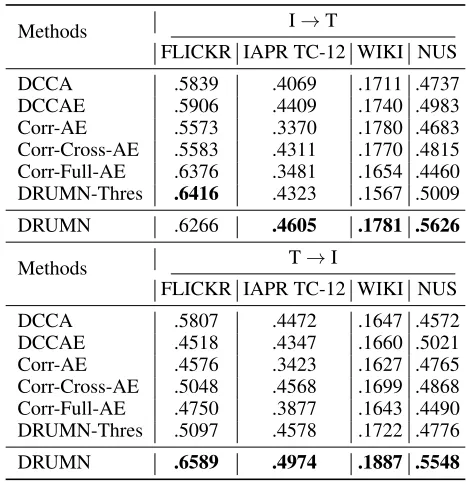
Table 1: MAP of the first 50 rank list of 4 real-world datasets. The best performance is bolded.
Methods I→T
FLICKR IAPR TC-12 WIKI NUS
DCCA .5839 .4069 .1711 .4737
DCCAE .5906 .4409 .1740 .4983
Corr-AE .5573 .3370 .1780 .4683
Corr-Cross-AE .5583 .4311 .1770 .4815
Corr-Full-AE .6376 .3481 .1654 .4460
DRUMN-Thres .6416 .4323 .1567 .5009
DRUMN .6266 .4605 .1781 .5626
Methods T→I
FLICKR IAPR TC-12 WIKI NUS
DCCA .5807 .4472 .1647 .4572
DCCAE .4518 .4347 .1660 .5021
Corr-AE .4576 .3423 .1627 .4765
Corr-Cross-AE .5048 .4568 .1699 .4868
Corr-Full-AE .4750 .3877 .1643 .4490
DRUMN-Thres .5097 .4578 .1722 .4776
DRUMN .6589 .4974 .1887 .5548
For each dataset, we randomly select 20% data for the
Table 2: MAP of the first 50 rank list of WKG Game-Hub. The best performance is bolded.
Methods I→T T→I
L>1 L>3 L>1 L>3
DCCA .3259 .2400 .3080 .2172
DCCAE .3205 .2486 .3212 .2415
Corr-AE .2682 .2370 .2108 .1445
Corr-Cross-AE .3378 .2276 .3415 .2148
Corr-Full-AE .2911 .2031 .1923 .1522
DRUMN-Thres .2729 .1829 .2574 .1577
DRUMN .3594 .2629 .3448 .2495
single modalities.
To verify the learned feature representations of our method, we examine the task of cross-modal retrieval. More specifically, given a text query, we aim to find images that are most relevant to it. For each query in the test set, we rank the retrieval results using the learned feature representations, without any loss of generality, we adopt the Euclidean rank-ing protocol, which ranks the retrieval results accordrank-ing to their Euclidean distances to the given query point, in an in-creasing order. And we adopt the widely used Mean Aver-age Precision (MAP) (Zhu, Shao, and Yu 2014) metric to measure the accuracy of the Euclidean ranking protocol. The deep network for image encoder is implemented the same as
Resnet50(He et al. 2015). We run the following experiments
with the implementation of an environment on NVIDIA K80
GPUs server, and our model can be trained about 290 images
per second with a single K80GPGPU. The parameterλin
the training phase is tuned in{0.1,0.2,· · · ,0.9}. When the variation between the objective value of Eq. 6 is less than
10−4between iterations, we consider DRUMN converges.
Compared methods
DNN-based unsupervised multi-modal methods are com-pared in the experiments: DCCA (Andrew et al. 2013), DC-CAE (Wang et al. 2015), Corr-AE (Feng, Wang, and Li 2014), Cross-AE (Feng, Wang, and Li 2014), Corr-Full-AE (Feng, Wang, and Li 2014) and DRUMN-Thres. Since the DCCA can only handle complete modalities, thus we use the incomplete data for initialization. Note that all compared methods are modified as threshold based models for fairness. In detail, the compared methods are listed as:
• DCCA: computes representations of the two modalities
by passing them through multiple stacked layers of non-linear transformation;
• DCCAE: consists two auto-encoders and optimizes the
combination of canonical correlation between the learned bottleneck representations and the reconstruction errors of the auto-encoders;
• Corr-AE: first use two uni-modal auto-encoders to learn
higher level image feature and text feature respectively, and then use CCA to learn a common representation space on the learned features;
• Corr-Cross-AE: combines immediately cross-modal
auto-encoders and CCA;
• Corr-Full-AE: combines full auto-encoders and CCA;
• DRUMN-Thres: threshold based deep network structure,
as mentioned in section 2.
Cross Modal Retrieval
The MAP (pre@50) results, which calculate the MAP of the first 50 rankings as (Jiang and Li 2017), the results of DRUMN and other compare methods on 4 real-world datasets are reported in Table 1. Here, “T”, “I” represent
the text and image separately, e.g., “I→T” denotes the case
where the query is image and the retrieval result is text, and
“T→ I” denotes the case where the query is text and the
retrieval result is image. From the Table 1, it reveals that for all datasets, DRUMN almost consistently achieve the signif-icant superior retrieval performance on all datasets
compar-ing to other methods except for the “I→T” on FLICKR25K.
To further verify the effectiveness of DRUMN, we con-duct more experiments on the real incomplete multiple modal dataset WKG Game-Hub and record the results in the Table 2. Considering that WKG Game-Hub is a multi-label dataset, which exists the label imbalance problem. On MAP calculation, we measure the similarity between the query in-stances and ranking results by considering the sharing labels
larger than 1 (L>1) or 3 (L>3) labels. From the Table 2, it
reveals that DRUMN also achieves the significantly superior retrieval performance.
Figure 3 shows several illustrative examples of the re-trieval results on the WKG Game-Hub dataset. Qualitatively, it can observe that DRUMN captures the general latent fea-ture representation represented in both the images and the texts. It is notable that most results shown are correct.
Influence on No. of Incomplete Multi-Modal Data
It is notable that the 4 real world datasets are complete. In order to explore the influence of the ratio of the incom-plete modalities on performance, extensive experiments are conducted. In this section, the parameters in each investi-gation are fixed as the optimal values selected in above in-vestigations, while the ratio of the incomplete data varies
in {0%,10%,30%,· · ·,90%}, with 20% as interval.
Re-sults on 4 datasets, i.e., FLICKR25K, IAPR TC-12, WIKI, NUS-WIDE, are recorded in Figure 4. From these figures, it clearly shows that DRUMN achieves the best on most datasets. Besides, we can also find that DRUMN achieves superiorities from high incomplete ratio, and the perfor-mance of DRUMN decreases slower than the compared methods.
Anomaly Detection
PER(%)
0 0.1 0.3 0.5 0.7 0.9
MAP(@50)
0.2 0.3 0.4 0.5 0.6
0.7 DRUMN
DRUMN-Thres DCCA DCCAE Corr-AE Corr-Cross-AE Corr-Full-AE
PER(%)
0 0.1 0.3 0.5 0.7 0.9
MAP(@50)
0.05 0.1 0.15 0.2 0.25 0.3 0.35 0.4 0.45
DRUMN DRUMN-Thres DCCA DCCAE Corr-AE Corr-Cross-AE Corr-Full-AE
PER(%)
0 0.1 0.3 0.5 0.7 0.9
MAP(@50)
0.06 0.08 0.1 0.12 0.14 0.16 0.18 0.2
DRUMN DRUMN-Thres DCCA DCCAE Corr-AE Corr-Cross-AE Corr-Full-AE
PER(%)
0 0.1 0.3 0.5 0.7 0.9
MAP(@50)
0.1 0.2 0.3 0.4 0.5 0.6
DRUMN DRUMN-Thres DCCA DCCAE Corr-AE Corr-Cross-AE Corr-Full-AE
PER(%)
0 0.1 0.3 0.5 0.7 0.9
MAP(@50)
0.2 0.3 0.4 0.5 0.6
0.7 DRUMNDRUMN-Thres
DCCA DCCAE Corr-AE Corr-Cross-AE Corr-Full-AE
PER(%)
0 0.1 0.3 0.5 0.7 0.9
MAP(@50)
0.2 0.25 0.3 0.35 0.4 0.45 0.5
0.55 DRUMN
DRUMN-Thres DCCA DCCAE Corr-AE Corr-Cross-AE Corr-Full-AE
PER(%)
0 0.1 0.3 0.5 0.7 0.9
MAP(@50)
0.08 0.1 0.12 0.14 0.16 0.18 0.2
DRUMN DRUMN-Thres DCCA DCCAE Corr-AE Corr-Cross-AE Corr-Full-AE
PER(%)
0 0.1 0.3 0.5 0.7 0.9
MAP(@50)
0.1 0.2 0.3 0.4 0.5
DRUMN DRUMN-Thres DCCA DCCAE Corr-AE Corr-Cross-AE Corr-Full-AE
Figure 4: The MAP(@50) results of 4 real-world datasets. The four columns from left to right are FLICKR25K, IAPR TC-12,
WIKI, NUS-WIDE datasets in order, the top row examples are the “I→T” and the bottom row examples are the “T→I”. PER
(partial example ratio) is the ratio of incomplete examples.
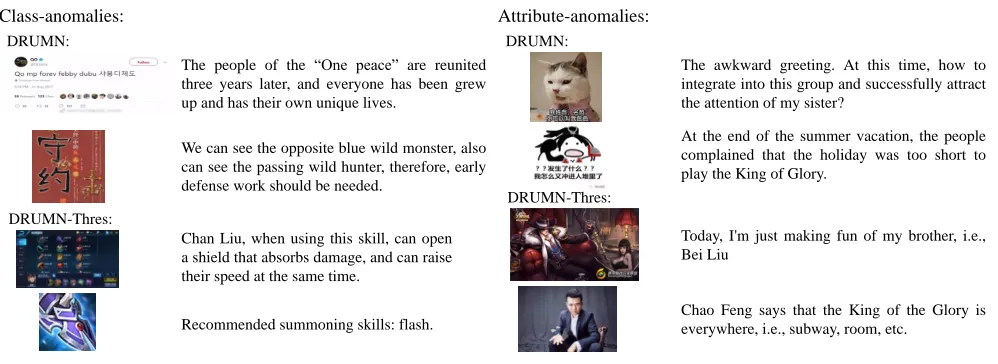
Class-anomalies: DRUMN:
DRUMN-Thres:
The people of the “One peace” are reunited three years later, and everyone has been grew up and has their own unique lives.
We can see the opposite blue wild monster, also can see the passing wild hunter, therefore, early defense work should be needed.
Chan Liu, when using this skill, can open a shield that absorbs damage, and can raise their speed at the same time.
Recommended summoning skills: flash.
Attribute-anomalies: DRUMN:
DRUMN-Thres:
At the end of the summer vacation, the people complained that the holiday was too short to play the King of Glory.
The awkward greeting. At this time, how to integrate into this group and successfully attract the attention of my sister?
Today, I'm just making fun of my brother, i.e., Bei Liu
Chao Feng says that the King of the Glory is everywhere, i.e., subway, room, etc.
Figure 5: Examples of class and feature anomalies of DRUMN and DRUMN-Thres from WKG Game-Hub dataset. Left column are class anomalies and the right column are attribute anomalies
are all corrected, while the first result in class-anomalies of DRUMN-Thres is wrong.
Conclusion
Feature incompleteness and inconsistent class/feature-anomaly in multi-modal learning scenarios are often take place in real applications, which result in the inconsistent problem. In this work, we propose a Deep Robust Unsuper-vised Multi-modal Network (DRUMN) for utilizing the ex-trinsic heterogeneous information, and learning latent rep-resentation via a deep unified network. Besides, the model itself can also tackle the inconsistent anomaly problem with adaptively weight estimation. Experiments on real-world multi-modal datasets successfully validate the effectiveness
of our proposed method. How to fully incorporate the super-vised information into semi-supersuper-vised scenario is an inter-esting future work.
Acknowledgments
The National Key R&D Program of China
(2018YFB1004300), NSFC (61773198, 61632004).
References
Andrew, G.; Arora, R.; Bilmes, J. A.; and Livescu, K. 2013.
Deep canonical correlation analysis. InICML, 1247–1255.
Arora, R.; Mianjy, P.; and Marinov, T. V. 2016. Stochas-tic optimization for multiview representation learning using
Chang, H.; Learned-Miller, E. G.; and McCallum, A. 2017. Active bias: Training more accurate neural networks by
em-phasizing high variance samples. InNIPS, 1003–1013.
Chua, T.; Tang, J.; Hong, R.; Li, H.; Luo, Z.; and Zheng, Y. 2009. NUS-WIDE: a real-world web image database from
national university of singapore. InCIVR.
Escalante, H. J.; Hernandez, C. A.; Gonzalez, J. A.; Lopez-Lopez, A.; andEduardo F. Morales, M. M.; Sucar, L. E.; Pineda, L. V.; and Grubinger, M. 2010. The segmented and
annotated IAPR TC-12 benchmark.CVIU114(4):419–428.
Fan, Y.; Liang, J.; He, R.; Hu, B.; and Lyu, S. 2017.
Robust localized multi-view subspace clustering. CoRR
abs/1705.07777.
Feng, F.; Wang, X.; and Li, R. 2014. Cross-modal retrieval
with correspondence autoencoder. InACMMM, 7–16.
Hardoon, D. R.; Szedmak, S. R.; and Shawe-Taylor, J. R.
2004. Canonical Correlation Analysis: An Overview with
Application to Learning Methods. MIT Press.
He, K.; Zhang, X.; Ren, S.; and Sun, J. 2015. Deep
residual learning for image recognition. arXiv preprint
arXiv:1512.03385.
Huiskes, M. J., and Lew, M. S. 2008. The MIR flickr
re-trieval evaluation. InMIR, 39–43.
Hyvarinen, A. 2005. Estimation of non-normalized
statisti-cal models by score matching. JMLR6:695–709.
Iwata, T., and Yamada, M. 2016. Multi-view anomaly
detec-tion via robust probabilistic latent variable models. InNIPS,
1136–1144.
Jiang, Q., and Li, W. 2017. Deep cross-modal hashing. In
CVPR, 3270–3278.
Kan, M.; Shan, S.; and Chen, X. 2016. Multi-view deep
network for cross-view classification. InCVPR, 4847–4855.
Li, S.; Jiang, Y.; and Zhou, Z. 2014. Partial multi-view
clustering. InAAAI, 1968–1974.
Ngiam, J.; Khosla, A.; Kim, M.; Nam, J.; Lee, H.; and Ng,
A. Y. 2011. Multimodal deep learning. InICML, 689–696.
Rasiwasia, N.; Pereira, J. C.; Coviello, E.; Doyle, G.; Lanck-riet, G. R.; Levy, R.; and Vasconcelos, N. 2010. A New
Ap-proach to Cross-modal Multimedia Retrieval. InACMMM,
251–260.
Rupnik, J., and Shawe-Taylor, J. 2010. Multi-view canonical
correlation analysis. InKDD, 1–4.
Schein, A. I., and Ungar, L. H. 2007. Active learning for
logistic regression: an evaluation.ML68(3):235–265.
Shao, W.; He, L.; Lu, C.; and Yu, P. S. 2016. Online
multi-view clustering with incomplete multi-views. InBigData, 1012–
1017.
Shao, W.; He, L.; and Yu, P. S. 2015. Multiple incomplete views clustering via weighted nonnegative matrix
factoriza-tion with l2,1 regularizafactoriza-tion. InECML/PKDD, 318–334.
Shrivastava, A.; Rastegari, M.; Shekhar, S.; Chellappa, R.; and Davis, L. S. 2015. Class consistent multi-modal fusion
with binary features. InCVPR, 2282–2291.
Vincent, P.; Larochelle, H.; Lajoie, I.; Bengio, Y.; and Man-zagol, P. 2010. Stacked denoising autoencoders: Learning useful representations in a deep network with a local
denois-ing criterion. JMLR11:3371–3408.
Vincent, P. 2011. A connection between score matching and
denoising autoencoders. Neural Computation23(7):1661–
1674.
Wang, W.; Arora, R.; Livescu, K.; and Bilmes, J. 2015. On
deep multi-view representation learning. In ICML, 1083–
1092.
Yang, Y.; Ye, H.-J.; Zhan, D.-C.; and Jiang, Y. 2015. Auxil-iary information regularized machine for multiple modality
feature learning. InIJCAI, 1033–1039.
Yang, Y.; Zhan, D.; Sheng, X.; and Jiang, Y. 2018. Semi-supervised multi-modal learning with incomplete
modali-ties. InIJCAI, 2998–3004.
Zhai, S.; Cheng, Y.; Lu, W.; and Zhang, Z. 2016. Deep structured energy based models for anomaly detection. In
ICML, 1100–1109.
Zhao, H., and Fu, Y. 2015. Dual-regularized multi-view
outlier detection. InIJCAI, 4077–4083.
Zhu, F.; Shao, L.; and Yu, M. 2014. Cross-modality
submod-ular dictionary learning for information retrieval. InCIKM,