Materials Science and Engineering Publications
Materials Science and Engineering
6-11-2007
Cation, dipole, and spin order in Pb(Fe2/3W1/
3)O3-based magnetoelectric multiferroic
compounds
R. Wongmaneerung
Iowa State UniversityXiaoli Tan
Iowa State University, [email protected]
R. William McCallum
Iowa State University, [email protected]
S. Ananta
Chiang Mai University
R. Yimnirun
Chiang Mai UniversityFollow this and additional works at:
http://lib.dr.iastate.edu/mse_pubs
Part of the
Ceramic Materials Commons
The complete bibliographic information for this item can be found at
http://lib.dr.iastate.edu/
mse_pubs/15
. For information on how to cite this item, please visit
http://lib.dr.iastate.edu/
howtocite.html
.
Cation, dipole, and spin order in Pb(Fe2/3W1/3)O3-based
magnetoelectric multiferroic compounds
Abstract
Long range 1:1 cation order was developed in Pb(Fe2(1−x)/3Sc2x/3W1/3)O3solid solution compounds by
high temperature solid state reaction. It is found that the degree of cation order directly influences the
saturation magnetization in these single phase compounds. A high saturation magnetization (
∼
0.61μB/f.u.)
was observed for x=0.15 at 10Kunder 5T. A ferrimagnetic structure was suggested to take into account for the
observed magnetic behavior. These compounds also display a saturated electrical polarization of
∼
15μC/cm2
at 40kV/cm at 120K.
Keywords
Ames Laboratory, Ozone, Ceramics, Lead, Saturation moments, Polarization, Dielectric oxides, Solid
solutions, Magnetization measurement, Ferrimagnetism, Electric fields
Disciplines
Ceramic Materials | Materials Science and Engineering
Comments
The following article appeared in
Applied Physics Letters
90 (2007)" 242905 and may be found at
http://dx.doi.org/10.1063/1.2748098
.
Rights
Copyright 2007 American Institute of Physics. This article may be downloaded for personal use only. Any
other use requires prior permission of the author and the American Institute of Physics.
Cation, dipole, and spin order in Pb ( Fe 2 3 W 1 3 ) O 3 -based magnetoelectric
multiferroic compounds
R. Wongmaneerung, X. Tan, R. W. McCallum, S. Ananta, and R. Yimnirun
Citation: Applied Physics Letters 90, 242905 (2007); doi: 10.1063/1.2748098
View online: http://dx.doi.org/10.1063/1.2748098
View Table of Contents: http://scitation.aip.org/content/aip/journal/apl/90/24?ver=pdfcov
Published by the AIP Publishing
Cation, dipole, and spin order in Pb
„
Fe
2/3W
1/3…
O
3-based magnetoelectric
multiferroic compounds
R. Wongmaneerung and X. Tana兲
Department of Materials Science and Engineering, Iowa State University, Ames, Iowa 50011
R. W. McCallum
Materials and Engineering Physics Program, Ames Laboratory, U.S. DOE, Ames, Iowa 50011
S. Ananta and R. Yimnirun
Department of Physics, Faculty of Science, Chiang Mai University, Chiang Mai 50200, Thailand
共Received 6 March 2007; accepted 17 May 2007; published online 11 June 2007兲
Long range 1:1 cation order was developed in Pb共Fe2共1−x兲/3Sc2x/3W1/3兲O3solid solution compounds by high temperature solid state reaction. It is found that the degree of cation order directly influences the saturation magnetization in these single phase compounds. A high saturation magnetization
共⬃0.61B/ f.u.兲 was observed for x= 0.15 at 10 K under 5 T. A ferrimagnetic structure was
suggested to take into account for the observed magnetic behavior. These compounds also display a saturated electrical polarization of ⬃15C / cm2 at 40 kV/ cm at 120 K. © 2007 American
Institute of Physics.关DOI:10.1063/1.2748098兴
Magnetoelectric multiferroic compounds, combining a spontaneous electrical polarization with a net magnetization, have attracted worldwide interest recently due to their great potentials for fundamental research and practical appli-cations.1–3However, all the known magnetic ferroelectric ox-ides either have a low transition temperature or display an extremely small polarization/magnetization. Among these multiferroic compounds, those with the ABO3 perovsite structure show the highest magnetic transition temperatures and the largest electrical polarizations.3Considering the fact that most magnetic perovskite oxides have an antiferronetic order due to a superexchange coupling between mag-netic ions on theBsite,4Baettig and Spaldin5and Baettiget al.6proposed to introduce spontaneous magnetization via fer-rimagnetismand predicted that Bi共Fe1/2Cr1/2兲O3 would dis-play an electrical polarization of 80C / cm2and a saturation magnetization of 1B/ABO3 f.u. if Fe3+ and Cr3+ occupy separateB sublattices 共B
⬘
and B⬙
兲 to form a double perov-skite structure. The Neel temperature was calculated to be low 共⬍100 K兲, though. However, such a double perovskite structure with long rangeB-site cation order is not likely to form since Fe3+ and Cr3+ have the same charge and close ionic sizes. Bi共Fe1/2Cr1/2兲O3 is, thus, expected to adopt a simple perovskite structure with random occupancy of Fe3+ and Cr3+onBsite. Recent experimental work confirmed that the Bi共Fe1/2Cr1/2兲O3 epitaxial thin film is isostructural to BiFeO3 with a rhombohedral distortion.7 A saturation mag-netization of only 0.26B/ f.u. was measured at roomtem-perature due to the absence of long range cation order. In addition, the film was found to be very leaky with an induced polarization of only 2.8C / cm2 at 82 kV/ cm. In the bulk form, Bi共Fe1/2Cr1/2兲O3shows neitherB-site cation order nor any ferri—or ferromagnetic order down to 2 K.8
In contrast, a few ferroelectric Pb-based complex perovskite oxides have been reported to display long range 1:1B-site cation order, such as Pb共Sc1/2Ta1/2兲O3,9La-doped Pb共Mg1/3Nb2/3兲O3,10,11and Pb共Sc2/3W1/3兲O3.12The
multifer-roic Pb共Fe2/3W1/3兲O3compound also shows 1:1 cation order, however, the chemical order is very weak and the cation ordered domains are limited to the nanometer scale
共⬍5 nm兲.13–15 Developing long range cation order in Pb共Fe2/3W1/3兲O3for large saturation magnetization has been experimentally attempted previously with Mg2+doping16and
Co2+ doping.17The present work aims to enhance cation or-der in Pb共Fe2/3W1/3兲O3 through solid solution with Pb共Sc2/3W1/3兲O3, both of which have aB-cation ratio of 2:1. Magnetic as well as ferroelectric properties are assessed as a function of the degree ofB-site cation order.
Ceramics in the solid solution 共1 −x兲Pb共Fe2/3W1/3兲O3–xPb共Sc2/3W1/3兲O3共x= 0.09, 0.15, 0.21兲, or Pb共Fe2共1−x兲/3Sc2x/3W1/3兲O3, were prepared via a solid state reaction method with high purity powders 共better than 99.9%兲. Proportional amount of Fe2O3, WO3, and Sc2O3 powders were mixed and calcined at 900 ° C for 24 h. Then appropriate amount of PbO powder was mixed and a second calcination was carried out at 850 ° C for 2 h. Ceramic pel-lets were formed by sintering at 890 ° C for 2 h followed by a slow cooling procedure at 9 ° C / h to 800 ° C. The surface layers of the sintered disks were removed before x-ray dif-fraction experiments. Dielectric characterization was per-formed with a LCR meter共HP-4284A, Hewlett-Packard兲in conjunction with an environmental chamber 共9023, Delta Design兲. A heating rate of 3 ° C / min was used during mea-surement. The polarization hysteresis measurement was car-ried out with a standardized ferroelectric test system 共 RT-66A, Radiant technologies兲. A Quantum Design 5T MPMS was used for magnetic characterization.
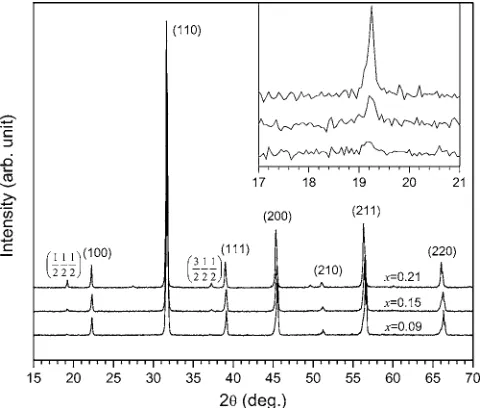
X-ray diffraction indicates that the as-sintered ceramics are phase pure and display a pseudocubic perovskite struc-ture, as shown in Fig.1. The lattice parameters increase with Sc3+content and were determined to be 3.9760, 3.9837, and 4.0004 Å for ceramics of x= 0.09, 0.15, and 0.21, respec-tively. This is consistent with the fact that Sc3+ has a larger ionic radius than both Fe3+ and W6+. Furthermore,
共
1 2 1 2 12
兲
-type superlattice peaks get strengthened as Sc3+ con-tent increases, as revealed clearly by the inset in Fig. 1. Ina兲Electronic mail: [email protected]
APPLIED PHYSICS LETTERS90, 242905共2007兲
0003-6951/2007/90共24兲/242905/3/$23.00 90, 242905-1 © 2007 American Institute of Physics
complex perovskite oxides, the presence of the
共
121221兲
super-lattice peak is an indication of the development of 1:1B-site cation order and the intensity of this superlattice peak has been routinely used to calculate the ordering parameterS.10,11 This parameter ranges from 0 to 1, with 0 marking the com-plete disorder and 1 marking the comcom-plete order. The order-ing parametersSare calculated to be 0.26, 0.55, and 0.81 for ceramics ofx= 0.09, 0.15, and 0.21, respectively. The double perovskite model,Pb关Sc2x/3Fe共1/2−2x/3兲兴关Fe1/6W1/3兴O3,
was used for the calculation.
The dielectric response of these ceramic pellets was ex-amined and the result is shown in Fig. 2. It is noted that broad peaks appear for all three compositions. At 100 kHz, the maximum relative permittivitiesmwere measured to be
5130 at 198 K, 5460 at 206 K, and 4160 at 198 K for ce-ramics ofx= 0.09, 0.15, and 0.21, respectively. It appears that the ceramic with x= 0.15 behaves slightly abnormally. The
dielectric loss is relatively low for all three ceramics, especially under 230 K. Compared to pure Pb共Fe2/3W1/3兲O3
共m= 11 700 atTm= 190 K at 100 kHz兲,13solid solution with
Pb共Sc2/3W1/3兲O3leads to a slight higherTmbut a much lower
mvalue.
The low dielectric loss at low temperatures allows the electric field-induced polarization measurement under quasi-static fields. The electrical polarization versus electric field hysteresis loop was evaluated at 4 Hz at 120 K. As shown in Fig.3, saturated loops were recorded for all three composi-tions. Saturation polarizations of 14.6, 13.8, and 10.9C / cm2 for ceramics of x= 0.09, 0.15, and 0.21, re-spectively, were measured at the peak electric field of 40 kV/ cm at this temperature. Remanent polarizations of 5.2, 4.0, and 3.8C / cm2forx= 0.09, 0.15, and 0.21, respec-tively, were recorded. The coercive fields were determined to be 5.5, 4.5, and 5.5 kV/ cm for x= 0.09, 0.15, and 0.21, re-spectively. Therefore, strong ferroelectricity with large elec-trical polarizations and low coercive fields is demonstrated in the Pb共Fe2共1−x兲/3Sc2x/3W1/3兲O3solid solution.
The magnetization under weak field indicates a clear transition from paramagnetic to ferrimagnetic at ⬃224,
⬃245, and ⬃222 K for the ceramics of x= 0.09, 0.15, and 0.21, respectively. Compared to pure Pb共Fe2/3W1/3兲O3
共TN= 370 K兲,13–15 incorporating Sc decreases the transition
temperature, which can be attributed to the dilution of the magnetic cations. The magnetization under a strong magnetic field of 5 T for the three ceramics is shown in Fig.4. Inter-estingly, the ceramic ofx= 0.15 shows the highest magneti-zation. The saturation magnetizations at 10 K under 5 T were determined to be 0.22B/ABO3f.u., 0.61B/ABO3f.u., and 0.48B/ABO3 f.u. for x= 0.09, 0.15, and 0.21, respec-tively. The saturation magnetizations observed in these ce-ramics are about one order of magnitude higher than disor-dered perovskite compounds3,15 and are even two times as high as single crystalline Bi共Fe1/2Cr1/2兲O3 epitaxial thin films.7
[image:5.612.317.559.50.250.2]We believe that the observed magnetic behavior is dic-tated by the B-site cation order in the ceramics. As mentioned previously, the solid solution can be expressed as a double perovskite compound Pb关Sc2x/3Fe共1/2−2x/3兲兴
FIG. 1. X-ray diffraction pattern of the sintered Pb共Fe2共1−x兲/3Sc2x/3W1/3兲O3
ceramics. Major peaks are indexed on the basis of a simple cubic perovskite structure. The共122112兲-type superlattice peaks due toB-site cation order are also indexed. The inset shows the close view of the共122112兲superlattice peak.
FIG. 2. Relative dielectric permittivity and dielectric loss of the Pb共Fe2共1−x兲/3Sc2x/3W1/3兲O3ceramics as a function of temperature at 100 kHz.
FIG. 3. Polarization vs electric field hysteresis loops measured at 4 Hz at 120 K in the Pb共Fe2共1−x兲/3Sc2x/3W1/3兲O3 ceramics. Well defined saturated
loops are observed.
242905-2 Wongmaneerunget al. Appl. Phys. Lett.90, 242905共2007兲
[image:5.612.54.294.52.256.2] [image:5.612.52.294.563.747.2]⫻关Fe1/6W1/3兴O3when it is fully ordered. We denote the sub-lattice occupied by 关Sc2x/3Fe共1/2−2x/3兲兴 as B
⬘
, while the one occupied by 关Fe1/6W1/3兴 as B⬙
. Due to the superexchange coupling between the Fe3+ cations, an antiferromagnetic or-der is developed on the magnetic moment of Fe3+ between the twoB-site sublattices. Therefore, the measured magneti-zation depends on the partition of the Fe3+cations on the two sublattices. For 0.00艋x艋0.50, the double perovskite model Pb关Sc2x/3Fe共1/2−2x/3兲兴关Fe1/6W1/3兴O3 indicates that the B⬘
sub-lattice has more Fe3+ cations than theB⬙
sublattice and the difference is共1 − 2x兲/ 3 Fe3+ions/f.u. The magnetization data aboveTcindicate that the magnetic moment for each Fe3+inthe paramagnetic state is roughly 3B. Therefore, we
esti-mate that in the ordered state, the saturation magnetization of our double peroskite model for the composition series will be
共1 − 2x兲B/ f.u. for a fully ordered structure. This is a straight
line with respect toxand is plotted in Fig.5.
The three dark dots in Fig.5are the measured saturation magnetization at 10 K under 5 T for the ceramics of
x= 0.09, 0.15, and 0.21, respectively. The experimental val-ues of the saturation magnetization correspond to 27%, 87%, and 83% of the predicted values from the straight line for each composition, respectively. For the ceramics ofx= 0.15 and 0.21, it is clear that the experimental data match the ferrimagnetic double perovskite model quite well. The large discrepancy between the experimental data and the ferrimag-netic model forx= 0.09 is due to the weak long rangeB-site cation order. As mentioned in the x-ray diffraction section, the cation ordering parametersS are 0.26, 0.55, and 0.81 for the ceramics of x= 0.09, 0.15, and 0.21, respectively. It is interesting to note that the values of the chemical order pa-rameterS are in good agreement with the percentage of the predicted saturation magnetization in these ceramics, espe-cially forx= 0.09 andx= 0.21. Clearly there is a direct cor-relation between the degree of the long range cation order and the achieved saturation magnetization. The low satura-tion magnetizasatura-tion measured in the ceramic ofx= 0.09 is due to antisite occupancy of theB-site cations. For the ceramic of
x= 0.15, we believe that the ordering parameter S is under estimated due to the small size of cation ordered domains.
In summary, long range cation order is developed in ce-ramics of Pb共Fe2共1−x兲/3Sc2x/3W1/3兲O3 solid solution prepared with a simple solid state reaction method. Saturated polariza-tion versus electric field hysteresis loops were observed for all three ceramics under quasistatic electric fields. Large electrical polarizations共14.6C / cm2forx= 0.09兲were mea-sured at 40 kV/ cm at 120 K. Direct correlation between the measured saturation magnetization and the degree of B-site cation order is observed. Ultrahigh saturation magnetiza-tion 共0.61B/ABO3 f.u.兲 was measured in the ceramic of
x= 0.15.
This work was supported by the Short Term Innovative Research 共STIR兲 program at the Army Research Office through Grant No. W911NF-06-1-0417. Research at Ames Laboratory 共RWM兲 is supported by the U.S. Department of Energy, Basic Energy Sciences, under Contract No. DE-AC02-07CH11358. Three of the authors 共R.W., S.A., and R.Y.兲are grateful to the Thailand Research Fund.
1S. W. Cheong and M. Mostovoy, Nat. Mater. 6, 13共2007兲. 2N. A. Spaldin and M. Fiebig, Science 309, 391共2005兲. 3M. Fiebig, J. Phys. D 38, R123共2005兲.
4J. Kanamori, J. Phys. Chem. Solids 10, 87共1959兲.
5P. Baettig and N. A. Spaldin, Appl. Phys. Lett. 86, 012505共2005兲. 6P. Baettig, C. Ederer, and N. A. Spaldin, Phys. Rev. B72, 214105共2005兲. 7R. Nechache, C. Harnagea, A. Pignolet, F. Normandin, T. Veres, L. P.
Carignan, and D. Menard, Appl. Phys. Lett. 89, 102902共2006兲.
8M. R. Suchomel, C. I. Thomas, M. Allix, M. J. Rosseinsky, A. M. Fogg,
and M. F. Thomas, Appl. Phys. Lett. 90, 112909共2007兲.
9N. Setter and L. E. Cross, J. Appl. Phys. 51, 4356共1980兲.
10J. Chen, H. M. Chan, and M. P. Harmer, J. Am. Ceram. Soc. 72, 593
共1989兲.
11M. A. Akbas and P. K. Davies, J. Am. Ceram. Soc. 80, 2933共1997兲. 12P. Juhas, I. Grinberg, A. M. Rappe, W. Dmowski, T. Egami, and P. K.
Davies, Phys. Rev. B 69, 214101共2004兲.
13P. M. Vilarinho and J. L. Baptista, J. Eur. Ceram. Soc. 11, 407共1993兲. 14L. Zhou, P. M. Vilarinho, and J. L. Baptista, J. Eur. Ceram. Soc. 18, 1383
共1998兲.
15W. Qu, X. Tan, R. W. McCallum, D. P. Cann, and E. Ustundag, J. Phys.:
Condens. Matter 18, 8935共2006兲.
16G. A. Smolenskii, V. A. Isupov, N. N. Krainik, and A. I. Agranovskaya,
Izv. Akad. Nauk SSSR, Ser. Fiz. 25, 1333共1961兲.
[image:6.612.54.294.50.246.2]17K. Uchino and S. Nomura, Ferroelectrics 17, 505共1978兲.
FIG. 4. Magnetization vs temperature during cooling under 5 T in the Pb共Fe2共1−x兲/3Sc2x/3W1/3兲O3ceramics.
FIG. 5. Predicted linear relation between the saturation magnetization and the composition x in the Pb共Fe2共1−x兲/3Sc2x/3W1/3兲O3 solid solution system
based on the ferrimagnetic double perovskite model. The dark dots mark the measured saturation magnetizations.
242905-3 Wongmaneerunget al. Appl. Phys. Lett.90, 242905共2007兲
[image:6.612.52.296.525.722.2]