Inference is Everything: Recasting Semantic Resources into a Unified
Evaluation Framework
Aaron Steven White
University of Rochester Johns Hopkins UniversityPushpendre Rastogi
Kevin Duh
Johns Hopkins University Johns Hopkins UniversityBenjamin Van Durme
Abstract
We propose to unify a variety of existing se-mantic classification tasks, such as seman-tic role labeling, anaphora resolution, and paraphrase detection, under the heading of Recognizing Textual Entailment (RTE). We present a general strategy to automat-ically generate one or more sentential hy-potheses based on an input sentence and pre-existing manual semantic annotations. The resulting suite of datasets enables us to probe a statistical RTE model’s perfor-mance on different aspects of semantics. We demonstrate the value of this approach by investigating the behavior of a popular neural network RTE model.
1 Introduction
The Recognizing Textual Entailment (RTE) task aims to assess a system’s ability to do textual inference—i.e. derive valid conclusions from
tex-tual clues (Dagan et al.,2006, 2013; Bar-Haim
et al.,2006;Giampiccolo et al.,2007,2009; Ben-tivogli et al.,2009,2010,2011). In this task, a system judges whether “typically, a human
read-ing [the sentential context, ortext] T would infer
that [the sentential hypothesis] H is most likely true” (Dagan et al.,2006).
Recent efforts in textual inference have focused on the Stanford Natural Language Inference (SNLI) dataset. SNLI is made up of hundreds of thou-sands of text-hypothesis pairs, wherein the texts are image captions drawn from the Flickr30k corpus (Young et al.,2014) and the hypotheses are elicited from crowdsourcing workers based on those cap-tions (but not the corresponding image). While SNLI has led to significant methodological im-provements, its collection protocol does not lend itself to understanding the types of semantic
knowl-edge necessary for properly understanding a partic-ular example. Researchers compete on which sys-tem achieves the highest score on a test set, but this itself does not lead to an understanding of which linguistic properties are better captured by a quan-titatively superior system.
In contrast, datasets such as FraCaS (Cooper
et al., 1996) are precisely designed to illustrate a range of semantic phenomenon that a text un-derstanding system should handle. But though this careful design enables fine-grained probes into a system’s semantic capabilities, FraCaS-like datasets tend not to be large-scale enough for recent work in data-driven computational semantics. Ask-ing experts, such as those who constructed FraCaS, to author hundreds of thousands of examples is not practical, just as the existing elicitation protocol behind SNLI will not lead to cleanly partitioned sets of examples that focus specifically on certain kinds of semantic inference.
Our proposal is to leverage existing large-scale semantic annotation collections as a source of tar-geted textual inference examples. This strategy requires only minor effort in developing dataset-specific generation capabilities to recast annota-tions into a shared universal representation: natural language sentences.
We demonstrate the use of this strategy in two steps. First, we construct three recasted datasets from three existing semantic resources that target
three distinct semantic phenomena:1(i) the
Seman-tic Proto-Roles v1 (SPR) dataset (Reisinger et al.,
2015), which contains likelihood judgments about
the semanticproto-roleproperties (Dowty,1991) of
verbal arguments found in PropBank (Palmer et al.,
2005), (ii) the FrameNet Plus (FN+) dataset, which
contains likelihood judgments about the paraphrase
validity offrame triggers(Pavlick et al.,2015), and
1These recasted datasets are made publicly available at
(iii) the Definite Pronoun Resolution (DPR) dataset, which contains annotations relevant to complex
anaphora resolution (Rahman and Ng,2012). We
use these recasted datasets to train a recent neural
RTE model (Bowman et al.,2015) and measure its
performance. We show that complex anaphora is the most difficult semantic phenomenon for neu-ral RTE models to capture, followed by predicting thematic proto-role properties. Perhaps unsurpris-ingly, given the nature of the RTE task, paraphras-ing seems to be the easiest phenomenon to model.
In the next section (§2), we discuss previous
work in RTE, focusing in particular on the devel-opment of RTE datasets. We then discuss our data
creation process (§3) as well as the results of a
small validation (§4). Finally, we report on the
setup and results of our three experiments (§5) and
then conclude (§6).
2 Background and Prior Work
The current paper touches on both the broad theme of understanding continuous approaches to natu-ral language understanding as well as the more narrow focus on textual entailment. We begin by discussing how the current paper fits within the broader context and then specify its place within textual entailment.
2.1 Approaches to logical form
All approaches to natural language understanding utilize intermediate logical forms that are inter-pretable to varying degrees. On one end of the spectrum are approaches that utilize declarative log-ical forms. In such approaches, semantic parsers first convert a sequence into a meaning representa-tion that expresses the semantics needed for infer-ence. In this case, each individual component of the logical form is clearly interpretable. Tremen-dous energies within computational linguistics have been spent on building declarative, component-wise-interpretable logical forms such as Hobbsian
Logic (Hobbs,1985), Discourse Representation
Theory (Kamp et al.,2011), the Rochester
Inter-active Planning System (Allen et al.,2007),
Mini-mal Recursion Semantics (Copestake et al.,2005),
Episodic Logic (Schubert and Hwang,2000),
Com-binatory Categorical Grammar (Steedman,2000),
Semantic Role Labeling (Gildea and Jurafsky,
2002), Framenet Parsing (Fillmore et al.,2003)
and Abstract Meaning Representation (Banarescu
et al.,2013).
Opposite the above approaches are methods that utilize vector space-based logical forms. Recent
work on word and string embeddings (Mikolov
et al.,2013;Pennington et al.,2014) has produced vector space representations that can be induced from large corpora in an unsupervised manner that have been used to initialize the training of neural networks for tasks as complex as English-to-French
machine translation (Sutskever et al.,2014). Vector
space-based intermediate forms are not commonly recognized as logical forms but in light of recent
work (Bouchard et al.,2015) it seems worthwhile
to reconsider this view.
An argument in favor of declarative, inter-pretable logical forms is that one can directly ob-serve the specific mistakes made by a system in the interpretive process of mapping natural language strings to logical forms—e.g., it is possible to find out whether a prepositional phrase was attached incorrectly, or the wrong sense of a particular word was selected, causing a cascade of downstream errors. Neural systems that use vector space repre-sentations for textual inference, instead of logical forms, lack such modularity and interpretability, and therefore it is very difficult to figure out the cause of a particular error in a neural network.
Much prior work has aimed to improve the in-terpretability of neural networks, focusing in par-ticular on extracting rules from the activations of
feed forward networks (Towell and Shavlik,1993;
Thrun,1993; Fu,1994; Thrun,1995). In recent years, this focus has shifted to understanding and visualizing other architectures such as Convolu-tional Neural Networks and Recurrent Neural
Net-works (Zeiler and Fergus,2014; Karpathy et al.,
2015), though the guiding principle remains the
same: understanding the behavior of neural net-works in terms of its activations.
The current paper also presents a strategy for understanding the behavior of neural RTE systems used for solving the task of RTE, but we take a different route. Instead of explaining the behav-ior of neural networks in terms of its parameters and activations, we benchmark their performance on datasets that each require distinct types of se-mantic reasoning for high performance. In this sense, our motivation and strategy is similar to the reasoning behind the bAbI dataset for question
an-swering (Weston et al.,2016).Weston et al.argue
ID Dataset Label Text Hypothesis
1 SPR entailed The network must refund money to the advertisersand loses considerable revenue and prestige. The network was altered or somehow changedduring or by the end of the losing.
2 SPR entailed He turned himself in to authorities in New Yorkearlier this year. He changes location during the turning. 3 SPR not-entailed Later, he marketed glue. He changes location during the marketing. 4 SPR not-entailed So he asked the IRS if the plan would work. The asking caused a change in the IRS. 5 FN+ entailed An agreement is to be signed in late 10/92. An agreement is to be inked in late 10/92. 6 FN+ entailed So our work must continue. So our labor must continue.
7 FN+ not-entailed Friday had beautiful weather. Friday had beautiful forecast.
8 FN+ not-entailed Your support will help them go to work. Your support will allow them go to work. 9 DPR entailed The bird ate the pie and it died. The bird ate the pie and the bird died. 10 DPR not-entailed The bird ate the pie and it died. The bird ate the pie and the pie died. 11 DPR entailed The bird ate the pie and it was ruined. The bird ate the pie and the pie was ruined. 12 DPR not-entailed The bird ate the pie and it was ruined. The bird ate the pie and the bird was ruined.
Table 1:Examples oftext-hypothesispairs generated from the SPR, FN+, and DPR datasets.
ability of systems to perform different kinds of question answering tasks that require specific types of reasoning. Our strategy for building specific datasets that can probe the ability of machine learn-ing systems to perform specific types of reasonlearn-ing is similar to theirs; however, instead of
construct-ing completely artificial datasets, werecastdatasets
constructed on top of natural text.
2.2 Approaches to textual entailment
Research in textual entailment, at least in its most recent form, was catalyzed by the RTE shared
task (Dagan et al.,2006; Bar-Haim et al., 2006;
Giampiccolo et al.,2007,2009;Bentivogli et al.,
2009, 2010, 2011). With each iteration of this
shared task, manually annotated examples were created for testing competing systems. But even after multiple iterations, the amount of available data for RTE was still small. The Sentences In-volving Compositional Knowledge (SICK) corpus was released with the goal of alleviating this prob-lem (Marelli et al.,2014).
A significant further contribution was made with the Stanford Natural Language Inference (SNLI) corpus, which uses crowdsourcing to gather two orders of magnitude more examples than all
pre-vious datasets (Bowman et al.,2015). SNLI
en-abled fully supervised training of powerful machine learning models like neural networks. A number of researchers have pursued this direction by ap-plying completely supervised neural models for sequential data to the problem of textual
entail-ment (Rockt¨aschel et al.,2015;Mou et al.,2015;
Shuohang and Jing,2015;Liu et al.,2016;Cheng et al.,2016;Parikh et al.,2016;Munkhdalai and Yu,2016).
But though the state of the art performance of neural sequential models has steadily increased over the past year, it appears that this area has reached a point where the paradigm of training and evaluating on a single general-purpose RTE dataset has become insufficient for reaching the next level of improvements. It is still informative to measure the performance of a new RTE model on the SNLI dataset, but this black-box evaluation does not help us understand the fine-grained aspects of a model’s capability in performing particular types of natural language inference, such as its ability to handle coreference, paraphrasing, or its ability to judge thematic properties of a named entity. The issue of lack of understandability is especially important for neural models, which are notoriously difficult to interpret.
To address this issue, we take inspiration from
the FraCaS dataset (Cooper et al.,1996) and
con-struct a suite of targeted datasets that separately test a system’s ability to perform individual bits of interpretation such as paraphrasing, semantic role labeling, and coreference. In contrast to the origi-nal FraCaS data set, which is relatively small and which could not support the training of purely lexi-cal neural RTE classifiers, we pursue the strategy of
automatically convertingsemantic classifications—
i.e., human judgments about semantic properties— into labeled examples for textual entailment. This strategy allows us to construct textual entailment datasets that are of the same order of magnitude as SNLI—and hence support data-driven training of large neural networks—but that are also focused on specific semantic properties.
With our strategy we can also quantify the types
semanti-cally undifferentiateddataset contains. For exam-ple, if a neural model trained on the SNLI dataset performs poorly on a test set from another domain that exercises the trained model’s ability to perform anaphora resolution, then it can be inferred that ei-ther the original dataset did not contain enough examples of anaphora resolution, or that the statis-tical model failed to capture that phenomenon.
Finally, we note that the idea of converting question-answer pairs into text-hypothesis pairs is not novel: the RTE dataset for the second RTE Shared task was created by manually con-verting existing Information Extraction, Informa-tion Retrieval and QA pairs from manually cu-rated datasets such as ACE, MUC, TREC and
CLEF (Bar-Haim et al.,2006). The main
contri-bution of the current work is to show that such conversion need not be done manually; automatic conversion of some semantic datasets can be done with a high enough quality to create large-scale RTE datasets.
3 Data Creation Process
In order to create annotated RTE datasets that can probe specific aspects of understanding, our strat-egy is to rewrite semantic classifications into the form of textual entailment pairs. As mentioned above, we define a semantic classification dataset to be a text corpus, along with manual annotations of a particular meaning-related aspect of the data. Here, we describe how to apply this strategy to the SPR, FN+, and DPR datasets, but there exist many further datasets to which this strategy can be applied.
The SPR dataset Semantic Proto-Role Labeling (SPRL) is the problem of assigning a likelihood
value for a particularproto-role propertyholding
of a particular argument of a particular predicate (Reisinger et al.,2015;White et al.,2016;Teichert et al.,2017). These proto-role properties are
in-spired by thethematic proto-roletheory proposed
byDowty(1991), who argued that, for the purpose of determining the mapping from predicates’ se-mantic roles to its syntactic arguments, sese-mantic roles should be viewed not as categories, but rather as sets of entailments that arguments must satisfy in the context of an event kind.
For purposes of recasting, we use the SPR1
dataset, which was collected by Reisinger et al.
(2015) and contains likelihood judgments for the
twelve proto-role properties listed in Table 2.
Role property How likely or unlikely is it that... instigation ARGcaused thePREDto happen? volition ARGchose to be involved in thePRED? awareness ARGwas/were aware of being involved in thePRED? sentient ARGwas/were sentient?
change of location ARGchanged location during thePRED? exists as physical ARGexisted as a physical object? existed before ARGexisted before thePREDbegan? existed during ARGexisted during thePRED? existed after ARGexisted after thePREDstopped? change of possession ARGchanged possession during thePRED?
change of state ARGwas/were altered or somehow changed during or by the end of thePRED?
stationary ARGwas/were stationary during thePRED? location of event ARGdescribed the location of thePRED?
physical contact ARGmade physical contact with someone or something else involved in thePRED?
was used ARGwas/were used in carrying out thePRED? pred changed arg ThePREDcaused a change inARG?
Table 2:Questions posed to SPR annotators.
These judgments were collected by providing the annotator with a sentence in which a predicate and an argument of that predicate were highlighted and asking them to answer, on a five-point scale from 1 (very unlikely) to 5 (very likely), how likely or unlikely each property was to hold of the argument
in the context of the predicate.2
For example, given (1), withthe antibodyas the
highlighted argument andkilledas the highlighted
predicate, the annotator’s job was to answer ques-tions like the one in (2).
(1) The antibody killed the virus.
(2) How likely or unlikely is it that the antibody caused the killing to happen?
For the purposes of SPRL task, Teichert et al.
(2017) propose to collapse the five-point scale to
a binary variable by mapping response 1–3 to
not-entailed and 4–5 to entailed and predicting the resulting binary variable. Collapsing across proper-ties, the current state-of-the-art F1 for the resulting task of predicting this binary variable is reported byTeichert et al.(2017) at 81.7.
Binarized proto-role property judgments can be readily converted to text-hypothesis pairs by simply treating the original sentence as the text and
con-verting the questions listed in Table2to statements
for use as hypotheses. For example, (1) would be treated as a text, and (3) would be treated as a hypothesis generated from (2).
(3) The antibody caused the killing to happen. In this case, the annotator gave a 5 (very likely) response to (2), and so in our recasted dataset, the
resulting pair is labeledentailed.
2Annotators were also given the option of saying that the
I Three women enjoying a balloon joyride. Three women are on a balloon ride. I A woman sings into a microphone indoors.
a women sings
I The kid is sliding down a tan plastic slide. The kid is sliding.
I A black dog is playing in water with a green toy. the dog has a toy
I A woman with glasses and a pink hat rides her bike. A woman with glasses and a pink hat rides her bike
Table 3:Examples of artifacts in the SNLI dataset that pro-mote hypothesis sentences to be substrings of the evidence sentences, specially in case of entailments. The bullet marked sentences are theevidencesentences and thehypothesis sen-tences below them.
This is a simple and inexpensive way of cre-ating entailment pairs, with the benefit that this annotation scheme probes for fundamental seman-tic information from an annotator. Also, note that,
sinceReisinger et al. collect annotations for the
twelve types of proto-role properties mentioned above, the errors made by a neural RTE model can be automatically subcategorized into these 12 categories, further aiding in interpretation.
One potential criticism of our method is that, because our hypothesis sentences are constructed by filling in templates, they do not have the same syntactic diversity as the free elicitation method
used byBowman et al.. We suggest that this is not
a problem for two reasons.
First, since our goal is to distinguish between the kinds of semantic phenomenon that can be ac-curately modeled by statistical RTE models, the lack of diversity is not an obstacle as long as the particular phenomenon that we wish to probe is being covered properly. Second, even the method
used byBowman et al. of enlisting workers on
the Amazon Mechanical Turk (AMT) Platform to write hypotheses sentences in response to an im-age caption is not without its drawbacks since their method introduces artifacts such as the fact that the
hypothesessentences in SNLI are on average half
the length of thetextprompts. We believe that this
happens because workers on AMT have an incen-tive to spend the least amount of time possible in
constructing their responses. In Table3, we list a
few such examples.
The FN+ dataset In Frame Semantics (Fillmore et al.,2003), the primary unit of lexical analysis
is the frame, which captures the central
proper-ties of a concept, situation, or event. The largest resource for frame annotated sentences with
infor-mation about evoked frames, theirtriggerphrases,
Dataset Sentences Label Percentage Entailed Not-Entailed FN+ 154,605 43.45 56.55 SPR 154,607 34.80 65.20
DPR 3,661 49.99 50.01
Total 312,873 39.13 60.87 SNLI† 569,033 33.41 66.59
Table 4: Number oftext-hypothesispairs generated from
each dataset along with percentage of entailing v. non-entailing sentences. SNLI included for comparison.
and frame arguments is the FrameNet dataset (
Fill-more and Baker,2001), which despite its scale, still suffers from lexical sparsity.
In order to alleviate this problem of lexical
sparsityRastogi and Van Durme (2014) use the
Paraphrase Database (Ganitkevitch et al.,2013)
to automatically paraphrase trigger tokens that
evoke frames inside sentences from the FrameNet dataset. These paraphrases are noisy, and their quality is not high enough for our use. How-ever, these paraphrases were subsequently
man-ually rated byPavlick et al., who asked
annota-tors to “judge each paraphrase in terms of how well it preserved the meaning of the original
sen-tence” (Pavlick et al.,2015). These ratings were
collected on a scale from 1 to 5, where 5 meant that the paraphrase retained all of the meaning of the original sentence and 1 meant that paraphrase did not mean anything close to the original phrase. We
generate ourtext–hypothesispairs using the manual
judgments of meaning retention on thesesentence–
paraphrasepairs collected byPavlick et al..
While thesentence–paraphrasepairs that are
la-beledentailedand rated 3.0 and above are usually
grammatically correct, the sentences with an
aver-age rating below 3 and labeledentailedsometimes
contain a grammatical errors, and some are rated
neutral or contradictory. Therefore, we remove sentences with an average rating less than or equal to 3.0 and greater than 2.5. All of the sentence pairs that were rated less than 2.5 were not valid
entailments and they were labeled asnot-entailed.
As an example, consider (4), which is a sentence from FrameNet.
(4) So our work must continue.
The wordworktriggers a frame and is replaced by
its paraphraselaborbyPavlick et al.to create (5).
(5) So our labor must continue.
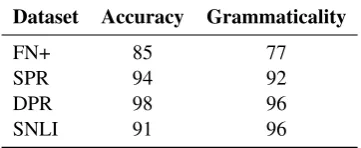
annota-Dataset Accuracy Grammaticality
FN+ 85 77
SPR 94 92
DPR 98 96
SNLI 91 96
Table 5:Accuracy of the labels assigned to the RTE pairs and the grammaticality of the hypothesis sentences. 100 random RTE pairs from each dataset were selected and each pair was assigned a value of 1 if it was correctly labeled/grammatical and 0 otherwise. We report the average score as a percentage in two separate columns for each dataset.
tors on Mechanical Turk gave this pair of sentences an average rating of around 4, and so we consider
this pair of sentences as an instance of theentailed
relation.
The DPR dataset Definite Pronoun Resolution is the problem of identifying the correct antecedent
for a definite pronoun—e.g. he/him,she/her,it,
etc.—in one clause, given two potential antecedents in a preceding clause. Data generation for this task is done manually and relies on the concept oftwin sentences. Twin sentences are (minimally) biclausal sentences that share a (linearly) initial clause containing at least two non-pronominal re-ferring expressions but differ on a non-initial clause containing a pronoun that could corefer with either of the two referring expressions in the initial clause but which is biased to corefer with only one.
This concept is exemplified in (6), wherethe bee
andthe flowerare the two referring expressions in
the initial clause for both (6a) and (6b), anditis
the pronoun.
(6) The bee landed on the flower because... a. ...it wanted pollen.
b. ...it had pollen.
In (6a),itis biased to corefer withthe bee, and in
(6b),itis biased to corefer withthe flower.
In order to assign the correct antecedent of it
in both sentences, a computational system would presumably need world-knowledge about bees and flowers. The DPR dataset is a collection of such
problems and their solutions, collected byRahman
and Ng(2012) as a step towards solving the
Wino-grad Schema Challenge (Hector et al.,2012). The
ranking-based system thatRahman and Ngpresent
obtains an accuracy of 73.1% on their dataset. This result—which, to our knowledge, remains the best posted on this dataset—outperforms a random base-line as well as various systems based on the Stan-ford resolver (Lee et al.,2011).
Dataset Sentence
FN+ 12:06 a.m. hrh: i was per the berkeley mainlibrary when it hit. SPR Me existed as a physical object.
DPR John could not understand his waiter,because the his waiter spoke Spanish. SNLI A person in on concrete.
Table 6:Examples of ungrammatical hypothesis sentences
from each of our datasets and SNLI.
Each DPR coreference problem-solution pair can be converted to two annotated entailment prob-lems by substituting the target pronoun with the two expressions that it could corefer with. Thus, two RTE pairs are generated for each DPR pair: one that is entailed and one that is not entailed.
For example, (6a) is rewritten to (7a) and (7b). (7) a. The bee landed on the flower because the
bee wanted pollen.
b. The bee landed on the flower because the flower wanted pollen.
The two RTE pairs are then (7a)–(8a), which is
paired with the output entailed, and (7a)–(8b),
which is paired with the outputnot-entailed.
Statistics Table 4 summarizes the constructed datasets as well as number of sentences and the
class category breakdown of the SNLI dataset.3
4 Data Validation
Since our data is automatically generated, we per-formed manual validation to ensure that the gen-erated data was high quality. To conduct this vali-dation, we assessed a small subset of our recasted datasets as well as the SNLI dataset.
We randomly sampled 100 RTE pairs from each of the four datasets, and then a single annotator rated those 400 RTE pairs on two criteria of gram-maticality and correctness. The results of the
man-ual validation presented in Table5show that the
data quality of the DPR and SPR datasets is on par with the quality of the RTE pairs in the SNLI datasets. The grammaticality of the hypothesis sen-tences in the FN+ dataset is worse than the other three datasets, but its accuracy is reasonably high.
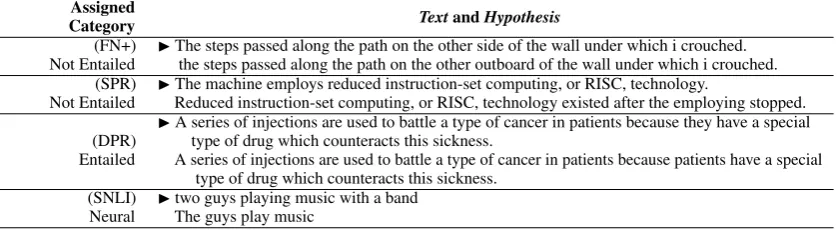
Tables6and7show examples of
ungrammat-ical hypothesis sentences and incorrectly labeled
3For the SNLI statistics, we map the two categories of
Assigned
Category TextandHypothesis
(FN+)
Not Entailed IThe steps passed along the path on the other side of the wall under which i crouched.the steps passed along the path on the other outboard of the wall under which i crouched. (SPR)
Not Entailed IThe machine employs reduced instruction-set computing, or RISC, technology.Reduced instruction-set computing, or RISC, technology existed after the employing stopped.
(DPR) Entailed
IA series of injections are used to battle a type of cancer in patients because they have a special type of drug which counteracts this sickness.
A series of injections are used to battle a type of cancer in patients because patients have a special type of drug which counteracts this sickness.
(SNLI)
Neural Itwo guys playing music with a bandThe guys play music
Table 7:Examples of incorrectly labeled RTE pairs from each of our datasets and SNLI.
RTE sentence pairs to illustrate the types of errors that we make in comparison to the errors made by mechanical turkers.
5 Experiments and Results
We now conduct experiments to measure the varia-tion in performance of neural RTE models trained using the datasets described above. The driving idea is that, by analyzing the variation in accuracy of a neural RTE model trained on different datasets on the same test set, such as the SNLI dataset, we can gain insights into the behavior of the model and potentially reveal interesting information about the SNLI dataset itself.
We first split our three datasets into train, vali-dation, and test sets in the proportion of 80:10:10. Prior to training we convert the SNLI test set to a
binary scheme by replacing bothneutraland
con-tradictionclass labels withnot-entailed.
For our model, we use the LSTM-based neural
RTE model described by Bowman et al. (2015)
which was their best performing individual neu-ral model. This model first embeds the words
us-ing300dimensional word embeddings created
us-ing the Glove method (Pennington et al.,2014).
Then, two LSTM neural networks (Hochreiter
and Schmidhuber, 1997) independently encode
the text and hypothesis sentences into100
dimen-sional vectors. These representations are
concate-nated and input to a3-layer deep200dimensional
neural network classifier. The entire network is trained by maximizing the cross-entropy of the input-output pairs over the entire dataset using
the AdaDelta (Zeiler,2012) update rule with
L2-regularization and Dropout. We evaluated each of our models on all the test sets to obtain the results in Table8.
These results show that when the neural RTE model is trained and tested on the same dataset, the
performance on the test set is high (above80%) for
FN+, SPR, and SNLI. This suggests that these three tasks are relatively amenable to the application of neural sequence models, with the FN+ and SPR dataset being comparable in their difficulty.
Moreover, we see that the performance of the model trained on all four datasets is equal to chance performance on the DPR dataset. Further, it is consistently lower than other cross-evaluation
re-sults shown on the off-diagonals of Table8. This
suggests that complex anaphora resolution is dif-ficult for our model to capture, especially when its training data are not focused on demonstrating correct coreference resolution. And since the per-formance of the SNLI trained model is the least on the DPR dataset, this may suggest that the phe-nomenon of anaphora resolution occurs less often than paraphrasing or proto-role resolution in the SNLI dataset.
This is corroborated by a small manual analysis.
In our random sample of100sentences from the
SNLI dataset, we did not find a single example where pronoun coreference resolution was required to predict the label correctly. In fact, in this analy-sis, we found that the only text that might plausibly have been rewritten as a pronoun resolution prob-lem (8a) was not; the hypothesis for (8a) is (8b). (8) a. A man speaking to a woman in a grocery
store as he selects a carton of juice. b. A man is complimenting a woman on her
jacket.
Finally, we can see that the SNLI trained model
achieves 62.0%on the FN+ test set. While
bet-ter than a most frequent label baseline (56%), this
is still considerably worse than the FN+ model
(80.5%), optimized for paraphrastic inference
Train Set FN+ SPR DPR SNLI
FN+ 80.5 60.0 49.5 62.0
SPR 65.8 80.6 50.7 52.3
DPR 19.2 65.2 49.5 65.7
SNLI 62.0 57.6 48.8 85.3
Table 8:Accuracy under 0-1 loss of predicting the entailment relation. Each cell describes the accuracy of a model trained on the corresponding row’s training set and tested on the corresponding column’s test set
differences compared to the differences between the text and the hypothesis in the SNLI dataset. This may also be why the model trained on SNLI does not perform well on any of the other datasets.
As a second illustration, we analyzed the SNLI trained RTE model’s performance on the SPR test set by dissecting the overall performance of the model by the proto-role properties that the entail-ment pairs were generated from. Note that all the categories appear equally in the test data. The
re-sults, shown in Figure1, show that entailments
be-longing to thechange of Statecategory caused the
highest number of errors. Based on manual
inspec-tion of examples, such as sentence 4 in Table1, we
believe that this happens because such entailments are not easily captured using lexical patterns. On
the other hand information aboutstationarityand
change of possessionmay be captured by neural models because the entailments are tightly coupled to the argument tokens.
6 Conclusion
We argue for constructing a suite of large-scale textual inference datasets that probe specific as-pects of semantics, in order to analyze a statistical RTE model’s ability of “understanding” distinct se-mantic phenomena. To construct such datasets we presented a general strategy of converting semantic classification examples to annotated textual infer-ence pairs that can be used to create large datasets for free on which even neural models for RTE can be trained. Further we used these datasets to gain insights into the behavior of a popular neural RTE model and the SNLI dataset itself. The variation in the performance of that model on the three datasets showed that neural models for natural language understanding recognise lexical variations or para-phrasing much better than anaphora resolution.
Re-cently (Chen et al.,2016) also presented a
simi-lar conclusion after manually analyzing the errors made by neural systems on a reading
comprehen-Figure 1:Percentage of errors of RTE model byproto-role
properties on the SPR test set. The percentage numbers at the bottom are the contribution of the category above to the total errors. Error percentages that are close to each other are omitted for clarity.
sion task. Our approach can be thought of as an automatic way of automating the manual error anal-ysis so that it can be used iteratively in a larger sys-tem and it can remove the requirement of a human in the loop. Our results also strongly suggested that the SNLI dataset does not contain examples of anaphora resolution which we validated manu-ally. Our datasets and annotations are available at
http://decomp.net.
In future work, we plan to execute our strategy on labeled data for Word Sense Disambiguation and Prepositional Phrase attachment resolution, among other semantic resources, because we be-lieve that such diverse datasets will require sophis-ticated RTE models that combine world knowledge with the pattern recognition abilities of neural
net-works. For example, given the sentenceThe dog
wagged its tailand a known sense of the dog the
fol-lowing hypotheses sentences can be generated:The
dog is a domestic dogandThe dog is a wiener. The
former hypothesis isentailedbut the latter is not.
Disambiguating between word senses and decid-ing the correct governor of a prepositional phrase requires world knowledge and RTE examples erated from such sources, even though they are gen-erated automatically unlike the FraCaS dataset, will help researchers build robust statistical models for RTE since each semantic classification dataset high-lights a particular type of semantic phenomenon that a robust system for RTE must model.
Acknowledgments
References
James Allen, Mehdi Manshadi, Myroslava Dzikovska, and Mary Swift. 2007. Deep linguistic processing for spoken dialogue systems. InWorkshop on Deep Linguistic Processing. ACL, pages 49–56.
Laura Banarescu et al. 2013. Abstract meaning
representation for sembanking. In 7th
Linguis-tic Annotation Workshop and Interoperability with Discourse. ACL, Sofia, Bulgaria, pages 178–186. http://www.aclweb.org/anthology/W13-2322. Roy Bar-Haim, Ido Dagan, Bill Dolan, Lisa Ferro,
Danilo Giampiccolo, Bernardo Magnini, and Idan Szpektor. 2006. The second PASCAL recognising
textual entailment challenge. In Second PASCAL
challenges workshop on RTE. volume 6, pages 6–4. Luisa Bentivogli, Peter Clark, Ido Dagan, Hoa T. Dang,
and Danilo Giampiccolo. 2010. The sixth PASCAL recognizing textual entailment challenge. InTAC. Luisa Bentivogli, Peter Clark, Ido Dagan, and Danilo
Giampiccolo. 2011. The seventh PASCAL recogniz-ing textual entailment challenge. InTAC.
Luisa Bentivogli, Ido Dagan, Hoa Trang Dang, Danilo Giampiccolo, and Bernardo Magnini. 2009. The fifth PASCAL recognizing textual entailment chal-lenge. InTAC. volume 9, pages 14–24.
Guillaume Bouchard, Sameer Singh, and Th´eo Trouil-lon. 2015. On approximate reasoning capabilities of low-rank vector spaces. In2015 AAAI Spring Sym-posium Series.
Samuel R Bowman, Gabor Angeli, Christopher Potts, and Christopher D. Manning. 2015. A large anno-tated corpus for learning natural language inference.
arXiv preprint arXiv:1508.05326.
Danqi Chen, Jason Bolton, and Christopher D. Man-ning. 2016. A thorough examination of the cnn/daily mail reading comprehension task. InProceedings of the ACL. ACL.
Jianpeng Cheng, Li Dong, and Mirella Lapata. 2016. Long short-term memory-networks for machine reading http://arxiv.org/abs/1601.06733v6.
Robin Cooper et al. 1996. Using the framework
FRACAS a framework for computational semantics. Technical report, The FRACAS consortium. Ann Copestake, Dan Flickinger, Carl Pollard, and
Ivan A. Sag. 2005. Minimal recursion semantics:
An introduction. Research on Language and
Com-putation3(2-3):281–332.
Ido Dagan, Oren Glickman, and Bernardo Magnini. 2006. The pascal recognising textual entailment challenge. InMachine learning challenges. Evaluat-ing Predictive Uncertainty, Visual Object Classifica-tion, and Recognising textual Entailment, Springer, pages 177–190.
Ido Dagan, Dan Roth, Mark Sammons, and Fabio Mas-simo Zanzotto. 2013. Recognizing textual entail-ment: Models and applications. Synthesis Lectures on HLT6(4):1–220.
David Dowty. 1991. Thematic proto-roles and argu-ment selection. languagepages 547–619.
Charles Fillmore, Christopher Johnson, and
Miriam R.L. Petruck. 2003. Background to
framenet. International Journal to Lexicography
16(3).
Charles J. Fillmore and Collin F. Baker. 2001. Frame semantics for text understanding. InWordNet and Other Lexical Resources Workshop. NAACL.
LiMin Fu. 1994. Rule generation from
neu-ral networks. IEEE Transactions on
Sys-tems, Man, and Cybernetics 24(8):1114–1124. https://doi.org/10.1109/21.299696.
Juri Ganitkevitch, Benjamin Van Durme, and Chris
Callison-Burch. 2013. Ppdb: The paraphrase
database. InNAACL-HLT.
Danilo Giampiccolo, Hoa Trang Dang, Bernardo Magnini, Ido Dagan, Elena Cabrio, and Bill Dolan. 2009. The fourth PASCAL recognizing textual en-tailment challenge. InTAC.
Danilo Giampiccolo, Bernardo Magnini, Ido Dagan, and Bill Dolan. 2007. The third PASCAL
recogniz-ing textual entailment challenge. InACL-PASCAL
workshop on textual entailment and paraphrasing. ACL, pages 1–9.
Daniel Gildea and Daniel Jurafsky. 2002. Automatic la-beling of semantic roles. Computational linguistics
28(3):245–288.
Levesque Hector, Davis Ernest, and Morgenstern Leora. 2012. The winograd schema challenge. In
Knowledge Representation and Reasoning Confer-ence.
Jerry R. Hobbs. 1985. Ontological promiscuity. In Pro-ceedings of the ACL. ACL, pages 60–69.
Sepp Hochreiter and J¨urgen Schmidhuber. 1997. Long short-term memory. Neural computation9(8):1735– 1780.
Hans Kamp, Josef Van Genabith, and Uwe Reyle. 2011.
Discourse representation theory. In Handbook of
philosophical logic, Springer, pages 125–394. Andrej Karpathy, Justin Johnson, and Li Fei-Fei. 2015.
Visualizing and understanding recurrent networks.
arXiv preprint arXiv:1506.02078.
computational natural language learning: Shared task. Association for Computational Linguistics, pages 28–34.
Yang Liu, Chengjie Sun, Lei Lin, and Xiaolong Wang. 2016. Learning natural language inference using bidirectional lstm model and inner-attention http://arxiv.org/abs/1605.09090v1.
Marco Marelli, Stefano Menini, Marco Baroni, Luisa Bentivogli, Raffaella Bernardi, and Roberto Zampar-elli. 2014. A sick cure for the evaluation of com-positional distributional semantic models. InLREC. pages 216–223.
Tomas Mikolov, Wen Tau Yih, and Geoffrey Zweig. 2013. Linguistic regularities in continuous space
word representations. InNAACL-HLT. pages 746–
751.
Lili Mou, Rui Men, Ge Li, Yan Xu, Lu Zhang, Rui Yan, and Zhi Jin. 2015. Natural language infer-ence by tree-based convolution and heuristic match-ing http://arxiv.org/abs/1512.08422v3.
Tsendsuren Munkhdalai and Hong Yu. 2016. Neural tree indexers for text understanding http://arxiv.org/abs/1607.04492v1.
Martha Palmer, Dan Gildea, and Paul Kingsbury. 2005. The proposition bank: A corpus annotated with se-mantic roles.Computational Linguistics31:1. Ankur P. Parikh, Oscar T¨ackstr¨om, Dipanjan Das,
and Jakob Uszkoreit. 2016. A decomposable
attention model for natural language inference http://arxiv.org/abs/1606.01933v1.
Ellie Pavlick, Travis Wolfe, Pushpendre Rastogi, Chris Callison-Burch, Mark Drezde, and Benjamin Van Durme. 2015. Framenet+: Fast paraphrastic tripling of framenet. InACL. ACL, Beijing, China.
Jeffrey Pennington, Richard Socher, and Christopher D. Manning. 2014. Glove: Global vectors for word rep-resentation. InEMNLP. ACL.
Altaf Rahman and Vincent Ng. 2012. Resolving
complex cases of definite pronouns: The winograd
schema challenge. InJoint Conference on EMNLP
and CoNLL. ACL, pages 777–789.
Pushpendre Rastogi and Benjamin Van Durme.
2014. Augmenting framenet via PPDB. In
Second Workshop on EVENTS: Definition, De-tection, Coreference, and Representation. ACL. http://www.aclweb.org/anthology/W14-2901. Drew Reisinger, Rachel Rudinger, Francis Ferraro,
Craig Harman, Kyle Rawlins, and Benjamin
Van Durme. 2015. Semantic proto-roles.
Transac-tions of the ACL3:475–488.
Tim Rockt¨aschel, Edward Grefenstette, Karl Moritz Hermann, Tom´aˇs Koˇcisk`y, and Phil Blunsom. 2015. Reasoning about entailment with neural attention.
arXiv preprint arXiv:1509.06664.
Lenhart K. Schubert and Chung Hee Hwang. 2000. Episodic logic meets little red riding hood: A com-prehensive, natural representation for language
un-derstanding. NLP And Knowledge Representation
pages 111–174.
Wang Shuohang and Jiang Jing. 2015.
Learn-ing natural language inference with lstm http://arxiv.org/abs/1512.08849v1.
Mark Steedman. 2000. The Syntactic Process,
vol-ume 24. MIT Press.
Ilya Sutskever, Oriol Vinyals, and Quoc Le. 2014. Se-quence to seSe-quence learning with neural networks. InAdvances in Neural Information Processing Sys-tems. pages 3104–3112.
Adam R Teichert, Adam Poliak, Benjamin Van Durme, and Matthew R Gormley. 2017. Semantic proto-role labeling. InAAAI. pages 4459–4466.
Sebastian B. Thrun. 1993. Extracting provably correct rules from artificial neural networks. Technical re-port, University of Bonn.
Sebastian B. Thrun. 1995. Extracting rules from
artificial neural networks with distributed
rep-resentations. In Advances in Neural
Infor-mation Processing Systems, pages 505–512. http://papers.nips.cc/paper/3869-conditional-neural-fields.pdf.
Geoffrey G. Towell and Jude W. Shavlik. 1993. Ex-tracting refined rules from knowledge-based
neu-ral networks. Machine Learning 13(1):71–101.
https://doi.org/10.1007/BF00993103.
Jason Weston, Antoine Bordes, Sumit Chopra, Sasha Rush, Bart van Merrienboer, Armand Joulin, and Tomas Mikolov. 2016. Towards ai-complete ques-tion answering: A set of prerequisite toy tasks. In
ICLR.
Aaron Steven White, Drew Reisinger, Keisuke Sak-aguchi, Tim Vieira, Sheng Zhang, Rachel Rudinger, Kyle Rawlins, and Benjamin Van Durme. 2016. Uni-versal decompositional semantics on uniUni-versal de-pendencies. InProceedings of the 2016 Conference on Empirical Methods in Natural Language Pro-cessing. Association for Computational Linguistics, Austin, TX, pages 1713–1723.
Peter Young, Alice Lai, Micah Hodosh, and Julia Hock-enmaier. 2014. From image descriptions to visual denotations: New similarity metrics for semantic in-ference over event descriptions. Transactions of the Association for Computational Linguistics2:67–78. Matthew Zeiler and Rob Fergus. 2014. Visualizing and
understanding convolutional networks. In ECCV.
Springer, pages 818–833.