50
RECENT TRENDS AND ISSUES IN IOT
*K.Yogitha, **V.Alamelumangai
*Research Scholar, Department of E&I, Annamalai University **Professor, Department of E&I, Annamalai University
ABSTRACT
The term IOT refers uniquely identifiable physical object connected to the internet. Research has been carried out with IOT in various fields like smart cities, industrial automation, home automation, agricultural production, bus transportation system, supply chain management, insurance and healthcare,etc., This paper address the challenges, benefits while implementing IOT in the above mentioned fields.
Keywords: IOT, application domains, technologies.
1. INTRODUCTION
The term IOT was invented by K. Ashton in the year 1999[6]. In IOT the objects surrounds us will be on the network. These objects which are being installed with sensors and having the ability to communicate their information with each other, and also with the humans. Intelligence is then required to process this information and make it available for decision making by humans. In an IOT environment decision making becomes a challenge. Around 30 Billion devices will be connected to the network by the year of 2020, due to this lot of electronic waste may occur and a need of significant amount of energy consumption for different task. Besides energy consumption is acute in different heterogeneous IOT devices as it actively relates to cost and availability of the IOT network. Thus energy consumption has become a core issue in future internet and different algorithmic approaches have been initiated.
Fig1: IOT environment
Internet of Things (IOT) enables both communicating and non communicating devices to connect and to interact with each other. IOT allows their own machine readable and ability to transfer data over network without human interaction.
Any thing
Any place
Any time
2. SCOPE AND VISION
Some of the IOT applications are law enforcement, military, border patrol, home automation, customs, etc., water quality of ocean can be monitored with sensors that send the information via the GPRS network [3]. Nowadays a many companies and enterprisers have sensors for energy saving and security purpose. Cars and other vehicles have devices to improve safety. People have smart phones with sensors for running many useful apps; industrial plants are connecting to the Internet for automation. Healthcare services are relying on increased home sensing to support remote medicine and wellness. The irrigation system engages, based on intelligent decisions involving the level of moisture in the soil. A variety of things can report their location to owners including keys, wallets, eyeglasses, jewellery and tools.
3. APPLICATION OF IOT IN DIFFERENT FIELDS
3.1. IOT in industry:
Internet based automation is a recent development in the industrial sector. The industrial process control is possible with the implementation of IOT, controller, etc., in industries [1]. Due to the advances in the Internet, the ability to acquire information and even to control devices at fingertips over the Internet is becoming desirable to the general public as well as professionals. This has actually lead to the concept called “ Internet Based Supervision and Control System ” .The Internet is now providing a new and increasingly important medium for distributing information worldwide without time constraints, permitting information to be displayed numerically and graphically on any client platform. It allows end users to access the real-time data and to control the instruments via a web browser.
Fig2: IOT in industry
In the figure 2 the process of each plant is monitored and controlled through internet .Internet-powered technology innovation within the industrial operations space adds new dimensions almost daily.
IOT
PLANT
1 PLANT
2
52 Manufacturers are converging a new breed of standard network architecture with "smart manufacturing systems" to connect formerly distinct production and business domains. The result is referred to as "Industry 4.0" in which Internet-based manufacturing networks are uniting the factory floor with enterprise-based systems and decision makers.
Challenges:
Security is a critical issue for Internet-connected industrial systems. Industrial attacks are becoming increasingly common. The recent data hack at Sony is a prime example. The technical challenge is to secure Internet-connected devices from cyber network attacks, as well as local physical attacks. A similar challenge exists for the cloud-hosted services, such as data analytics. The challenge is substantial, and may require new industry practices be developed and adopted. Before connecting operations systems to the IT system guarantees on security and stability are needed.
3.2 IOT for Smart Home:
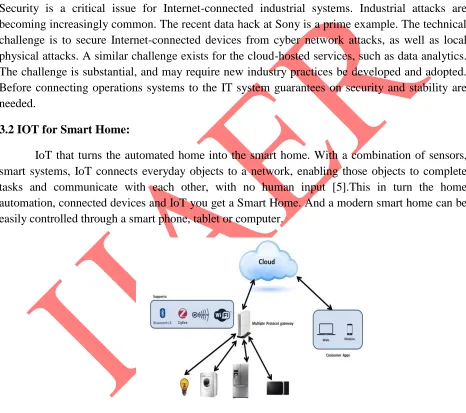
IoT that turns the automated home into the smart home. With a combination of sensors, smart systems, IoT connects everyday objects to a network, enabling those objects to complete tasks and communicate with each other, with no human input [5].This in turn the home automation, connected devices and IoT you get a Smart Home. And a modern smart home can be easily controlled through a smart phone, tablet or computer.
Fig 3: IOT for smart home
Challenges:
consumption. A general problem might be WLAN networks in case more of more aggressive attacks.
3.3 IOT for Agricultural Production:
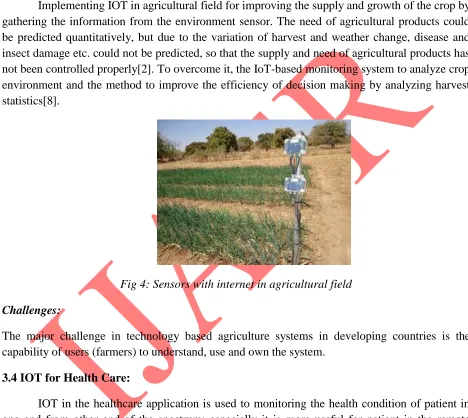
Implementing IOT in agricultural field for improving the supply and growth of the crop by gathering the information from the environment sensor. The need of agricultural products could be predicted quantitatively, but due to the variation of harvest and weather change, disease and insect damage etc. could not be predicted, so that the supply and need of agricultural products has not been controlled properly[2]. To overcome it, the IoT-based monitoring system to analyze crop environment and the method to improve the efficiency of decision making by analyzing harvest statistics[8].
Fig 4: Sensors with internet in agricultural field
Challenges:
The major challenge in technology based agriculture systems in developing countries is the capability of users (farmers) to understand, use and own the system.
3.4 IOT for Health Care:
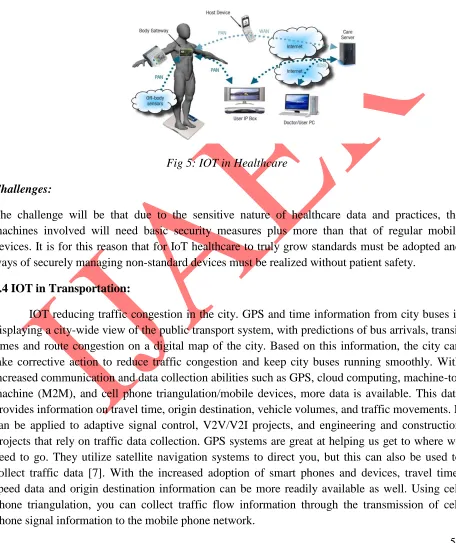
54 data from a variety of sensors, apply complex algorithms to analyse the data and then share it through wireless connectivity with medical professionals who can make appropriate health recommendations [7]. The data collected may also enable a more preventive approach to healthcare by providing information for people to make healthier choices.
Fig 5: IOT in Healthcare
Challenges:
The challenge will be that due to the sensitive nature of healthcare data and practices, the machines involved will need basic security measures plus more than that of regular mobile devices. It is for this reason that for IoT healthcare to truly grow standards must be adopted and ways of securely managing non-standard devices must be realized without patient safety.
3.4 IOT in Transportation:
Challenges:
One of the main challenges for the Internet of Things is in transformation of the connected objects into the real time sensing actors which also involves the societal and ethical considerations. IOT technologies enable or control the capabilities of the people and how this influences people’s capabilities to satisfy accountability demands. The multiple dimensions of accountability such as visibility, responsibility, control transparency and predictability should be taken into consideration to be controlled with the capacities of IOT technologies.
4. INTERNET OF THING TECHNOLOGIES
4.1. RFID:
A radio-frequency identification system uses tags, or labels attached to the objects to be identified. Two-way radio transmitter-receivers called interrogators or readers send a signal to the tag and read its response. The readers generally transmit their observations to a computer system running RFID software or RFID middleware.
RFID tags can be either passive, active or battery assisted passive. An active tag has an on-board battery and periodically transmits its ID signal. A battery assisted passive (BAP) has a small battery on board and is activated when in the presence of a RFID reader. The operating frequency range is: 120–150 kHz (LF), 13.56 MHz (HF), 433 MHz (UHF), 865-868 MHz (Europe)902-928 MHz (North America) UHF, 2450-5800 MHz (microwave), 3.1–10 GHz (microwave) with a range of 10cm to 200m.
4.2. NFC:
NFC is a set of short-range wireless technologies, typically requiring a distance of 10 cm or less. NFC operates at 13.56 MHz on ISO/IEC 18000-3 air interface and at rates ranging from 106 kbit/s to 424 kbit/s. NFC always involves an initiator and a target; the initiator actively generates an RF field that can power a passive target. This enables NFC targets to take very simple form factors such as tags, stickers, key fobs, or cards that do not require batteries. NFC peer-to-peer communication is possible, provided both devices are powered. The operating frequency range is: 13.56MHz with a range of <0.2m.
4.3ENOCEAN :
56 batteryless wireless sensors, switches, controllers and gateways. The operatingFrequency range is: 315 MHz, 868 MHz, 902 MHz with a range of 300m Outdoor, 30m indoors
The other technologies are Bluetooth,WIFI, weightless(SIG),GSM (Association), [4] additionally3G ,4G LTE,ANT,Dash7,Ethernet,GPRS,PLC / Powerline,QR Codes, EPC,WiMax,X-10 ,802.15.4,Z-Wave,Zigbee.
5. CONCLUSION
In this paper, we give an overview of the developments and trends of Industrial IoT systems point out related challenges while implementing IOT in different fields. In the near future the Internet and wireless technologies will connect different sources of information such as sensors, mobile phones and cars in an ever tighter manner. The number of devices which connect to the Internet is – seemingly exponentially – increasing. These billions of components produce consume and process information in different environments such as logistic applications, factories and airports as well as in the work and everyday lives of people. The society need new, scalable, compatible and secure solutions for both the management of the ever more broad, complexly-networked Internet of Things, and also for the support of various business models.
5. REFERENCE
[1]Smart Factory | From Vision to Reality in Factory Technologies. International Federation of Automatic Control, 2008.
[2]C. Alcaraz, R. Roman, P. Najera, and J. Lopez. Security of industrial sensor network-based remote substations in the context of the internet of things. Ad Hoc Netw. , 11(3), 2013.
[3]L. Atzori, A. Iera, and G. Morabito, “The internet of things: A survey,”Comput. Netw., vol. 54, no. 15, pp. 2787–2805, 2010.
[4]Research Directions for the Internet of Things, John A. Stankovic, Life Fellow, IEEE,2014 [5]A. P. Castellani, M. Dissegna, N. Bui, and M. Zorzi, “WebIoT: A web application framework for the internet of things, ”in Proc. IEEE Wireless Commun. Netw. Conf. Workshops, Paris, France, 2012.
[6]K.Ashton, That ‘‘Internet of Things’’ thing, RFiD Journal(2009)
[7] L. Atzori, A. Iera, G. Morabito, The Internet of Things: a survey, Computer Networks 54(2010)2787–2805.
[8]System of monitoring and environmental surveillance, 2011.