1
International Journal of Advances in Engineering Research
“FACIAL IMAGE RECOGNITION MODEL
IMPLEMENTATION WITH ARTIFICIAL NEURAL
NETWORKS USING DIMENSIONS REDUCTION
TECHNIQUES PCA”
*Dr Umesh Sehgal, #Surender Saini *Associate Professor in CSE Dept, ARNI University
#Teaching Associate, CDLU, Sirsa [email protected]
ABSTRACT
We propose further mechanism to recognition facial images using a hybrid computing of principal component analysis and artificial neural network. Principal component analysis can used to extract in feature from its facial images using dimensional reduction techniques these feature will then be used to recognize in facial image in different environment .the feature of facial images, after converting into binary can be submitted to the input layer of feed forward neural networks. The neural network can trained for these facial features using any supervised learning algorithms. The trained network will be able to recognize facial images, even in adverse environment like incomplete face images, low brightness facial images, the different pose of the facial image, facial expressions recognition and pose invariant recognition etc.
Key words: Facial images Recognition, Principal Component Analysis, Artificial neural networks.
INTRODUCTION
2
International Journal of Advances in Engineering Research
easier by exploitation of certain features. PCA is a common statistical technique for finding the patterns in high dimensional data‟s [2]. Feature extraction, also called Dimensionality Reduction, is done by PCA for a three main purposes like: i) To reduce dimension of the data to more tractable limits ii) To capture salient class-specific features of the data, iii) To eliminate redundancy. Here recognition is performed by both PCA and Feed Forward Neural Networks [3]. FFNN mathematically models the behaviour of the feature vectors by appropriate descriptions and then exploits the statistical behaviour of the feature vectors to define decision regions corresponding to different classes. Any new pattern can be classified depending on which decision region it would be falling in. the complete processes are implemented for Face Recognition model: input face image pre-processing
PCA Neural network output image
. The Algorithm for Face recognition using neural classifier is as follows: a) Pre-processing stage- Images are made zero-mean and unit-variance. b) Dimensionality Reduction stage- PCA - Input data is reduced to a lower Dimension to facilitate classification.
c) Classification stage- The reduced vectors from PCA are applied to train FFNN classifier to obtain the recognized image. In this paper, Principal Component Analysis, and Feed Forward Neural Networks, has been demonstrated by different experiments and subsequent results are obtained.
PRINCIPAL COMPONENT ANALYSIS
Principal component analysis (PCA) [4] involves a mathematical procedure that transforms a number of possibly correlated variables into a smaller number of suncorrelated variables called principal components. PCA is a popular technique, to derive a set of features for both face recognition [7]. Any particular face can be:
(i) Economically represented along the Eigen pictures coordinate space, and
3
International Journal of Advances in Engineering Research
carried out by comparing the distances between the weight vectors of the test image and the images from the database.Conversely, using all of the eigen-faces extracted from the original images, one can reconstruct the original image from the eigen-faces so that it matches the original image exactly.
PRINCIPAL COMPONENT ANALYSIS ALGORITHM
The algorithm used for principal component analysis is as follows:
(i) Acquire an initial set of M face images (the training set) & Calculate the eigen-faces from the training set, keeping only M' eigen-faces that correspond to the highest eigen-value.
(ii) Calculate the corresponding distribution in M'-dimensional weight space for each known individual, and calculate a set of weights based on the input image.
(iii) Classify the weight pattern as either a known person or as unknown, according to its distance to the
closest weight vector of a known person. Let the training set of images be , The average face of the set is defined by
(1) Each face differs from the average by vector
(2) The co- variance matrix is formed by
(3)
where the matrix
This set of large vectors is then subject to principal component analysis, which seeks a set of M orthonormal vectors u1….um. To obtain a weight vector _ of contributions of individual eigen-faces to a facial image , the face image is transformed into its eigen-face components projected onto the face space by a simple operation
(4)
For k=1… M', where M' _ M is the number of eigen-faces used for the recognition. The weights form vector_ =_ 1,_2,..._M that describes the contribution of each Eigen-face in representing the face image treating the eigen-faces as a basis set for face images. The simplest method for determining which face provides the best description of an unknown input facial image is to find the image k that minimizes the Euclidean distance
4
International Journal of Advances in Engineering Research
(5) where _K is a weight vector describing the Kth face from the training set. A face is classified as belonging to person k when the „ „is below some chosen threshold otherwise, the face is classified as unknown The algorithm functions by projecting face images onto a feature space that spans the significant variations among known face images. The projection operation characterizes an individual face by a weighted sum of eigen-faces features, so to recognize a particular face, it is necessary only to compare these weights to those of known individuals. The input image is matched to the subject from the training set whose feature vector is the closest within acceptable thresholds Eigen faces have advantages over the other techniques available, such as speed and efficiency. For the system to work well in PCA, the faces must be seen from a frontal view under similar lighting.
USING ARTIFICIAL NEURAL NETWORK
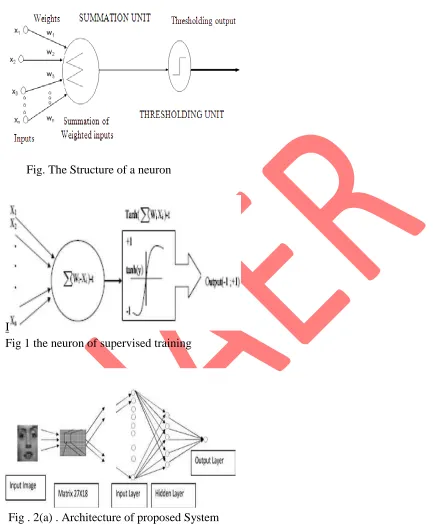
The MLP neural network [5] has feed forward architecture within input layer, a hidden layer, and an output layer. The input layer of this network has N units for an N dimensional input vector. The input units are fully connected to the I hidden layer units, which are in turn, connected to the J output layers units, where J is the number of output classes. A Multi- Layers Perceptron (MLP) is a particular of artificial neural network [6]. We will assume that we have access to a training dataset of l pairs (xi, yi) where x i is a vector containing the pattern, while yi is the class of the corresponding pattern. In our case a 2-class task, yi can be coded 1 and -1. We considered a MLP (Multi-Layers Perceptron) with a 3 layers, the input layer is a vector constituted by n2 units of neurons (n x n pixel input images). The hidden layer has n neurons, and the output layer is a single neuron which is active
to 1 if the face is presented and to otherwise the activity of a particular neuron j in the hidden layer is written by
(8)
a sigmoid function, where W1i is the set of weights of neuron i, b1(i) is the threshold and xi is an input of the neuron
Similarly the output layer activity is: Sj = K w ji x I
5
International Journal of Advances in Engineering Research
Fig. The Structure of a neuron
I
Fig 1 the neuron of supervised training
Fig . 2(a) . Architecture of proposed System
In our system, the dimension of the retina is 27x18 pixels represent human faces and non-face, the input vector is constituted by 2160 neurons, the hidden layer has 100
6
International Journal of Advances in Engineering Research
in a large cell array. Each column will represent the features of an image, which could be a face, or not. Rows are as follows:
Row 1: File name
Row 2: Desired output of the network corresponded to the feature vector Row 3: Prepared vector for the training phase.
We will adjust the histogram of the image for better contrast. Then the image will be convolved with Gabor filters by multiplying the image by Gabor filters in frequency domain. To save time they have been saved in frequency domain before Features is a cell array contains the result of the convolution of the image with each of the forty Gabor filters.These matrices have been concated to form a bif 135x144 matrix of complex numbers We only need the magnitude of the result. That is why “abs “is used.135x144 has 10,400 pixels. It means that the input vector of the network would have 19,400 values, which means a large amount of computation. So we have reduced the matrix size to one-third of its original size by deleting some rows and columns. Deleting is not the best way but it save more time compare to other methods like PCA. We should optimize this function as possible as we can.First training the neural network and then it will return the trained network. The examples were taken from the Internet database. The MLP will be trained on 500 face and 200 nonface examples [7], [8].
Fig. 2(b). Architecture of proposed system
TRAINING FOR ARTIFICIAL NEURAL NETWORK ALGORITHM
7
International Journal of Advances in Engineering Research
layers are present, then the calculation for the P‟s are repeated for each additional hidden layer present, summing all the P‟s for units present in the +previous layer that is fed into the current layer for which P is being calculated. Learning Rate- in FFNN, the weight change is in a direction that is a combination of current gradient and the previous gradient. A small learning rate is used to avoid major disruption of the direction of learning when very unusual pair of training patterns is presented [8] Various parameters assumed for this algorithm are as follows:
No. of Input unit = 1 feature matrix Accuracy = 0.001
Learning rate = 0.4 No. of epochs = 400
No. of hidden neurons = 70 No. of output unit = 1
Main advantage of this back propagation algorithm is that it can identify the given image as a face image or non face image and then recognizes the given input image .Thus the feed forward neural network classifies the input image as recognized mage.
EXPERIMENTATION AND RESULTS
In this paper for experimentation, 200 images from Yale database are taken and a sample of 20 face images is as shown in Fig. 3. One of the images as shown in Fig. 4 is taken as the Input image. The mean image and reconstructed output image by PCA, is as shown in Fig. 4. In FFNN, a training set of 50 images is as shown in Fig. 5 and the Eigen faces and recognized output image are as shown in Fig. 3.
8
International Journal of Advances in Engineering Research
Fig. 4. Training Set
Fig. 5. Recognised by FFNN method
Image
s PCA
PCA with FFNN
40 92.4 96.5
60 90.6 94.3
120 87.9 92.8
160 85.7 90.2
2(X) 83.5 87.1
9
International Journal of Advances in Engineering Research
CONCLUSION
Face recognition has received substantial attention from researches in biometrics, pattern recognition field and computer vision communities. In this paper, Face recognition using Eigen faces has been shown to be accurate and fast. When FFNN technique is combined with PCA, nonlinear face images can be recognized easily. Hence it is concluded that this method has the acceptance ratio is more than 90 % and execution time of only few seconds. Face recognition can be applied in Security measure at Air ports, Passport verification, Criminals list verification in police department, Visa processing , Verification of Electoral identification and Card Security measure at ATM‟s.
REFERENCES
[1] Kailash J. Karande Sanjay N. Talbar “Independent Component Analysis of Edge Information for
Face Recognition “International Journal of Image Processing Volume (3) :Issue (3)pp: 120 -131.
[2] B.K. Gunturk, A.U. Batur, and Y. Altunbasak, (2003)“Eigenface- domain super-resolution for face
recognition,”IEEE Transactions of Image Processing, Vol. 12, No.5, pp.597-606.
[3] T. Yahagi and H. Takano, (1994) “Face recognition using neural networks with multiple
combinations of categories,”International Journal of Electronics Information and Communication
Engineering., vol. 177-D-II, no. 11, pp. 2151-2159.
[4] M.A. Turk and A.P. Petland, (1991) “Eigenfaces forRecognition,” Journal of Cognitive
Neuroscience. vol. 3, pp.71-86.
[5] Yang M.H., Kriegman D.J., and Ahuja N., “Detecting Faces in Images: A Survey”, IEEE
Transaction on Pattern Analysis and Machine Intelligence, Vol. 24, No.1, January 2002.
[6] Theocharides T., Link G., Narayanan V., Irwin M.J.,“Embedded Hardware Face Detection”, 17th
International Conference on VLSI Design, Mumbai, India, January 5-9, 2004.
[7] P. Latha, Dr. L. Ganesan, Dr. S. Annadurai, ” Face Recognition using Neural Networks”, Signal
Processing: An International Journal (SPIJ) Vol. 3, Issue 5.
[8] Avinash Kaushal, J. P. S. Raina, ”Face Detection using Neural Network & Gabor Wavelet