R E S E A R C H
Open Access
An efficient full dynamic group
signature scheme over ring
Yiru Sun
1,2*, Yanyan Liu
1,2and Bo Wu
1,2Abstract
The group signature scheme is an important primitive in cryptography, it allows members in a group to generate signatures anonymously on behalf of the whole group. In view of the practical application of such schemes, it is necessary to allow users’ registration and revocation when necessary, which makes the construction of dynamic group signature schemes become a significant direction. On the basis of (Ling et al., Lattice-based group signatures: achieving full dynamicity with ease, 2017), we present the first full dynamic group signature scheme over ring, and under the premise of ensuring security, the efficiency of the scheme is improved mainly from the following three aspects: the size of keys, the dynamic construction of a Merkle hash tree that used to record the information of registered users, and the reuse of the leaves in this tree. In addition, the public and secret keys of both group manager and trace manager are generated by a trusted third party, which prevents the situation that the two managers generate their respective public key and secret key maliciously. Compared with the counterpart of the scheme in (Ling et al., Lattice-based group signatures: achieving full dynamicity with ease, 2017) over ring, the expected space complexity of the Merkle tree used in our work down almost by half, and the computational complexity of its update has been reduced by a notch because of the dynamic construction of the hash tree.
Keywords: Group signature, Dynamic, Merkle Tree, Ring-LWE
Introduction
The concept of group signature scheme was proposed
by Chaum and van Heyst (1991), which allows and only
allows members in a group to sign messages anonymously on behalf of the whole group, and the generated signa-ture would reveals nothing about the identity of the signer. In other words, the verifier in the scheme can only ver-ify that the signature was generated by one of the group members, and have no idea which member it is. How-ever, the trace manager can use its secret key to open the signature to trace the identity of the signer, which avoids the unnecessary disputes. In view of the group signature scheme has the above properties: anonymity (Chen and
Pedersen1994) and traceability, which help the group
sig-nature scheme to be one of the cryptography primitives to realize anonymous authentication.
*Correspondence:[email protected]
1State Key Laboratory of Information Security, Institute of Information Engineering, Chinese Academy of Sciences, Beijing, China
2School of Cyber Security, University of Chinese Academy of Sciences, Beijing, China
In the early stages, most of the constructions of
group signature schemes are static (Boneh et al. 2004;
Camenisch and Lysyanskaya 2004; Nguyen and Naini
2004; Furukawa and Yonezawa2004), namely the
mem-bers in a group and its size are all fixed in the setup phase, no changes about these parameters would appear during the subsequent operations in the scheme. And further-more, they also assume that the group manager is always honest and trustworthy. After that, many other properties were considered in the construction of the group signature schemes:
(1) It is fortunately that the size of public key and generated signatures could do not depend on the size of the group (Camenisch and Stadler1997;
Camenisch and Michels1998), this property is very important for the construction and application of group signature schemes, which avoids the over-expansion of the size of public key and signatures as the number of valid group members increases, and makes the schemes with this property
are well suited for large groups. At the same time, the former is beneficial to improve the implementation efficiency of schemes, while the latter makes the communication complexity and cost of the scheme are independent of the group size.
(2) The power of the group manager was weakened (Bellare et al.2005) by separating a trace manager GMtracefrom the group manager GMupdateand decreasing the trust level to each authority to enhance protection for honest algorithm executant, for example, their key pairs were generated by a trust third party, which improves the security of the algorithms and makes them closer to the practical application. GMtraceis responsible for the trace of a signature when necessary, and GMupdateis
responsible for the registration and revocation of users and the update of the group information. The tracing soundness of a group signature scheme (Stern1996) no longer assumes that the group managers are all reliable, which means that, before the verifier outputs the final verification result, the identity of the signer traced by a trace manager and the corresponding proof are also need to be checked. This improvement makes the constructed group signature schemes have stronger security.
(3) Semi-dynamic model (Kiayias and Yung2006), which involves the dynamic registration that allows users to apply to join the group when needed in RO model (Camenisch and Stadler1997; Camenisch and Michels1998; Ateniese et al.2000; Furukawa and Imai2005; Kawachi et al.2008; Delerablée and Pointcheval2006; Bichsel et al.2010) and standard model (Practical Group Signatures Without Random Oracles; Boyen and Waters2006; Groth2006; 2007; Boyen and Waters2007; Signing on Elements in Bilinear Groups for Modular Protocol Design), or the dynamic revocation that allows the group manager to remove certain group members from the group. And there are different manners to realize the latter functionality:
(a) The group manager updates the group public key and distribute it to the users that are not revoked (Sakai et al.2012; Camenisch and Lysyanskaya2002).
(b) Making use of a accumulator (Dodis et al. 2004; Nguyen2005), which allows efficient proof of group membership and update of the group information.
(c) The signer is required to include a proof of eligible membership when signing a message (Bresson and Stern2001) or update its secret key (Boneh et al.2004) according to the changes of the group.
(d) VLR(verifier local revocation) (An Efficient Protocol for Anonymously Providing Assurance of the Container of a Private Key; Boneh and Shacham2004; Nakanishi and Funabiki2005; Libert and Vergnaud2009) means that the list of revoked group members is only distributed to the verifier.
(4) Full dynamic model (Naor et al.2001; Peikert and Rosen2007; Camenisch and Groth2004; Nakanishi et al.2009; Libert et al.2012a,b), which allows both the dynamic registration of users and the dynamic revocation of group members, which makes the algorithm has stronger security and higher practicability.
The security of schemes mentioned above are mostly based on the hardness assumption in the algebraic theory while the development of quantum computing technology makes such schemes meet serious security problems. For-tunately, the research of the post-quantum cryptography has brought new hope to cryptology. And as one impor-tant branch of it, lattice based cryptography is widely considered has potential ability to against quantum attack, because there is no efficient algorithm has been found to breaks the hardness assumptions based on lattice. How-ever, the computational complexity and space complexity of lattice based cryptographic schemes have not been solved very well.
The first lattice based group signature scheme is given
in (Gordon et al. 2010) in 2010, which was improved to
obtain stronger anonymity in (Camenisch et al.2012), and
given the size of group N, the size of signatures
gener-ated by the schemes in (Gordon et al.2010; Camenisch et
al.2012) are all polynomials inN. Subsequently, the size
of the signature was lowered up toO(logN)in
(Laguil-laumie et al. 2013; Nguyen et al. 2015; Ling et al. 2015)
by different manners. And then, an efficient lattice based static group signature scheme is presented in (Libert et al. 2016b) without using the GPV trapdoor (Gentry et
al. 2008), where a Merkle tree was used as an
accumu-lator to keep a record of the registered user and group information. In order to further satisfy the requirements of making the schemes allow users to register and to be
revoked dynamically, the schemes in (Langlois et al.2014;
Libert et al.2016a) are dependent on lattice trapdoor seri-ously, and contains some complex modules. By combining the static scheme in (Libert et al.2016b) with the security model in (Bootle et al.2016), it is possible to realize the dynamic registration and revocation of users efficiently (Ling et al.2017). It includes an update algorithm in accu-mulator, and both the security and the signature size were improved.
2017), which realizes the full dynamic register and revo-cation of users, the dynamic construction of Merkle hash tree that is used to record the legitimate users with their witnesses and the group information, the reuse of leaves in this tree, and the honestly generation of keys of
GM=(GMupdate, GMtrace) by a trusted third party, which
leads to a reduction in the security of the generated algo-rithm. And in theory, the trust third party needs to be completely trusted and not easy to be violated, however, it is impossible in practice. We can only use relatively trusted entities to partially implement the functions of a trusted third party, such as certificate authority(CA), to avoid situations where the group manager and trace manager generate their respective keys maliciously. Con-cretely, the scheme in this paper improves the efficiency of that in (Ling et al.2017) from the following three aspects:
(1) To reduces the size of keys and signature, the scheme is implemented over ring, which also helps to reduce the space complexity and computational complexity of the scheme.
(2) The dynamic construction and update of the Merkle hash tree allows the size of it expanded along with the size of group gradually, and this change helps to reduce both the computational complexity of the update of group information and the space complexity of the scheme.
(3) The reuse of leaves in Merkle hash tree is realized in this scheme, which reduces the space complexity of the scheme indirectly to a certain extent.
Though we have tried a lot, there is still a large space for improvement in the use of zero-knowledge protocol to proof a legitimate membership. And the problem of the delayed verification of a signature is also not solved, the direct idea to solve this problem is to store the sig-nature and the verification information or just store the verification result of the signature by the group manager
at each timeτ, and the verifier requests the corresponding
information from it as needed. Unfortunately, this would increase the space complexity unlimitedly along with the extension of the time.
In the remainder of this paper, we start by review-ing some definitions, theorems used in the scheme, and the dynamic algorithm to construct the Merkle hash tree in “Preliminaries” section. And then the detailed full
dynamic group signature scheme is presented in “The
effi-cient full dynamic group signature scheme” section. To analysis the security properties of the scheme, we present the underlying zero knowledge protocol and its security
analysis in “The underlying protocol” section. Finally, we
discuss the properties of the scheme in “The analysis of
the group signature scheme” section, and conclusion in “Conclusion” section.
Preliminaries
The background of lattice
In this section, we will review some notations, defini-tions and theorems used for analysing our main results.
Throughout this paper, set the security parameterλ,
inte-ger n = O(λ), prime modules q = ˜On1.5,k =
logq,m=2k, andR=Z[x]/f(x),f(x)=xn+1,Rq=
R/qR, given vectorsx = (x1,· · ·,xm),z = (z1,· · ·,zm), integert, thenxt = mi=1xit
1
t denotes itst-norm,
(x|z)is a concatenation of the two vectors.
Definition 1 (The ring-SVP and ring-SIVP)
(Lyuba-shevsky et al.2013) Given a fieldR, letγ ≥ 1, then the ring-SVPγproblem is: given the ideal latticeIoverR, find out a non-zero short vector x ∈ I, such that x∞ ≤
γ ·λ1(I). And the ring-SIVPγ problem could be defined similarly: find out n independent elements(x1,· · ·,xn)in I, such that(x1,· · ·,xn)∞≤γ ·λn(I).
Definition 2 (The ring-SIS∞n,m,q,β)(Ling et al. 2015; Peikert2016) Choose m elements aj
$
← Rquniformly, let random vector A = (a1,· · ·,am) ∈ Rmq, positive real number β = poly(n), find out a non-zero short vector
z=(z1,· · ·,zm)∈Rmq,z∞≤β, such that
fA(z)= A,z =A·z=
j
aj·zj=0∈Rq
Numerous studies (Lyubashevsky and Micciancio2006;
Lyubashevsky2008; 2012; Peikert and Rosen2006; 2007)
have shown that iff(x)is irreducible polynomial with inte-ger coefficients,m> loglog(2qβ),γ =16mnlog2n,q≥ γ
√
n
4 logn, then the problem ring-SIS∞n,m,q,β is at least as difficult as
the problem ring-SVP∞γ overI.
Definition 3 (The ring-LWE distribution)(Peikert
2016) For secret element s∈Rq,Xis the noise distribution
inRqwith boundβ, choose a ←$ Rq, e ←$ X uniformly, then As,X =(a,b=s·a+e modq)is called the ring-LWE
distribution inRq×Rq.
Definition 4 (The decision ring-LWEn,m,q,X)
(Lyuba-shevsky et al.2010; Peikert2016) Let n,m≥1,q≥2, given m samples (aj,bj) ∈ Rq×Rq, which are sampled from one of the two distributions: As,X and the uniform
distri-bution inRq×Rq, then the decision ring-LWEn,m,q,X is to
distinguish which one the samples are from.
Theorem 1(Lyubashevsky et al. 2010) Let q = 1
mod 2n,β≥ωnlogn,γ =n2q
β lognm(nm)
1/4
the problem ring-LWEn,m,q,X is at least as difficult as the
problem ring-SVP∞γ overI.
The Merkle hash tree and its dynamic comstruction The construction of Merkle tree used in the group sig-nature scheme is based on the collision-resistant hash
functions. For arbitrary positive integer t, let G =
1, 2, 4,· · ·, 2k−1,bin(t) is the binary representation of
t, then t = G·bin(t). let H = hA|A
$
←Rmq
, hA :
{0, 1}k× {0, 1}k → {0, 1}k is collision-resistant hash func-tions based on the problem ring-SISn,m,q,β, where A =
[A0|A1]∈ Rmq, A0,A1 ←$ Rkq, for arbitrary (u0,u1) ∈
{0, 1}k× {0, 1}k, we have
hA(u0,u1)=bin(A0·u0+A1·u1 modq)∈ {0, 1}k so the following equivalent relationship is true,
hA(u0,u1)=u⇔A0·u0+A1·u1=G·u modq
Let H = {hA|A ∈ Rmq}, then we give the following
specific description of the dynamic updating algorithm
TDA(t,d∗)to construct and update the Merkle tree that
is used to record the registered users and partial group information in this paper:
TSetup: Initialize the Merkle tree as an empty tree
with depth 1, and its root is u. Let t denote the
number of legal members in the group.
TJoin: Search for the first non-zero leaf in all leaves,
and assume that its index isi≤t. Include an empty
tree with depthj = logtinto the original one if
there is not a such leaf. And take its rootut,1and the rootut,0of the original tree as two inputs of the hash function to compute a new root u = hA(ut,0,ut,1) of the new Merkle tree. In other words, the original tree and the empty tree are two children of the new Merkle tree with depthj+1. And for anyi∈2j+1, we have|bin(i)| =j+1.
TUpdate: Letuj+1=d∗denote the value of the leaf corresponding to theith user,bin(i)=(i1,· · ·,ij+1)
is the binary description of integeri, its witness is
w = (bin(i),(wj+1,· · ·,w1)). Update the value of
notes recursively in the pathuj,· · ·,u0from the leaf
uj+1to rootu, then output the witnessw, a new root
unew, wherewj+1,· · ·,w1 anduj,· · ·,u0satisfy the following relationship
∀l∈ {j,· · ·, 1, 0},ul= hhA(ul+1,wl+1), if il+1=0 A(wl+1,ul+1), if il+1=1
Letunew=u0be the new root of the Merkle tree.
Given the variable t, the computational complexity of
algorithmTUpdate(t,d∗)isO(logt), and it satisfies the following property
Theorem 2Suppose that the ring-SIS∞m,q,β is difficult,
R = {d0,· · ·,dt} be the set of the leaves related to users
who have been registered, then the algorithmTDA(t,d∗)is secure. And given a negligible function negl(λ), for anyPPT
adversaryA, the following inequality is true
Pr[(d∗,w∗)←A(R,t):d∗∈/R,u=u0]≤negl(λ)
The full dynamic group signature scheme and its security Generally, there are four participants in a group signa-ture scheme: the trusted third party(TTP): who generates the public parameters and the public-private key of the group manager and the trace manager. The group
man-ager GMupdate: who is responsible to update the group
information and the registration and revocation of users.
The trace manager GMtrace: given a signature, GMtraceis
responsible to trace the identity of signer when there is a dispute. The users: who are usually appeared as a signer to sign messages or a verifier to verify signatures. Here, we give some changes of the full dynamic group signature
scheme in (Ling et al.2017), and a revised definition is
given as follows:
GKeyGen(λ) → (pp,(mpk,msk),(opk,osk)): On
input the security parameterλ, this algorithm
out-puts the public parameter pp, group public key
gpk = (pp,mpk,opk), and distribute the group
secret keymskto GMupdate, the tracing secret key
oskto GMtrace. Initialize the registration listregand
the group informationinfoas∅, and we assume that
they can only be edited by a party knowingmsk.
UKeyGen(pp) → (upk,usk): Given the public
parameterpp, this algorithm outputs a user’s key pair
(upk,usk).
Join(gpk,upk),Issue(gpk,msk,reg,info): This algorithm is an interactive protocol between a user
and the group manager GMupdate. Assume that the
new registered user is thetth member in the group,
the user become a legitimate member of the group if
the algorithm goes well, and theJoinalgorithm sets
its signing secret keygsk = (bin(t),upkt,uskt). For
the Issue algorithm, GMupdate runs the algorithm
TDA(t,upkt) to update the Merkle hash tree, the
group informationinfoτ, and the registered user list
reg.
Revoke(gpk,S,msk,reg,infoτ) → infoτnew: Given
the revocation listS, for anyi ∈ S, the group
man-ager GMupdateruns algorithmTUpdate
bin(i), 0k to update the Merkle hash tree, the registered user listregand the group informationinfoτnew.
Sign(gpk,gski,infoτ,M)→: On input group
pub-lic keygpk, group informationinfoτ, this algorithm
outputs a signatureto a messageMsigned by the
⊥if the user is illicit atτ, i.e. the user has not been
registered or has been revoked atτ.
Verify(gpk,sign,infoτ,M)→0/1: Verify the
signa-ture and output 1 if it is valid, otherwise output
0.
Trace(gpk,osk,M,,reg,infoτ) → (b6,trace): This algorithm is operated by the trace manager GMtrace, it outputs the public keybof the signer who
signed the messageMatτ and generate a proof for
this fact if the signatureis valid. Otherwise output
⊥.
Judge(gpk,b,M,trace,,infoτ)→0/1: Verify the
prooftracegenerated by the trace manager GMtrace,
and output 1 if it is valid, otherwise output 0.
To verify that whether the signer is legitimate or not, i.e. the signer has registered and not be revoked when
he signs a message M at τ, the group manager
veri-fies that whether the value of the leaf corresponding to this signer is non-zero. And to avoid leaking any information about the signer’s identity, we bring to the extension-permutation technology to hide it. In other words, suppose that the binary representation of the value of the leaf that corresponding to the signer is
bin(di) = (di1,di2,· · ·,dik),i ∈[t], choose a vectora
$
←
{0, 1}k−1 uniformly such that the Hamming weight of
di = (bin(di)|a) ∈ {0, 1}2k−1 is k. Given S2k−1 =
{π2k−1|π2k−1 is a random permutation of elements
in{0, 1}2k−1},π2
k−1∈S2k−1, we have
the Hamming weigth of π2k−1
di is k⇔di=0 Moreover, the full dynamic group signature scheme needs to satisfies the following properties: correctness, anonymity, non-frameability, traceability, and tracking soundness.
Correctness: This property means that if the signer
signs a message honestly, the algorithmVerifycan
always output 1, the trace manager GMtracecan trace
the identity of the signer by the algorithmTrace, and
generates a prooftrace accepted by the algorithm
Judge.
Anonymity: For any PPT adversary A, this
prop-erty means that it is impossible to distinguish sig-natures generated by two legitimate users with a non-negligible probability, even though the
adver-saryAcould learn the secret keymsk of GMupdate,
corrupt some of the users, and is given the access to the oracleTrace.
Non-frameability: For any PPT adversary A, the
probability to generate a valid signature that traced to a legitimate user is negligible, even though the
adversaryAcould learn the secret keys of GMupdate
and GMtrace, and corrupt some of the users.
Traceability: For any PPT adversaryA, the probabil-ity to generate a valid signature that traced to a illicit
user is negligible, even though the adversaryAcould
learn the secret key of GMtraceand corrupt some of
the users.
Tracing soundness: For any PPT adversaryA, the
probability to generate a valid signature that traced to two different users is negligible, even though the
adversaryAcould learn the secret keys of GMupdate
and GMtrace, and corrupt some of the users.
The efficient full dynamic group signature scheme By using the dynamic algorithm to construct the Merkle hash tree and the formal definition of the full dynamic group signature scheme, the specific construction of the scheme in this paper could be defined as follows:
GKeyGen(λ): Given the security parameterλ, this
algorithm is operated by a trusted third party, lett>
0 denote the number of registered users,l= logt,
n= O(λ), prime modulesq= ˜O(n1.5),k= logq, m= 2k, real integerβ > 0,X is the noise distribu-tion bounded byβinR,k=ω(logλ).H:{0, 1}∗→
{0, 1}kis a hash function for FS transformation, and Com : {0, 1}∗× {0, 1}m → Znq is a string commit-ment scheme with properties of statistical hiding and
computational binding (Kawachi et al.2008). Choose
a matrixA←$ Rmq uniformly, for anyj∈ {1, 2}, TTP choosesSj ←$ Xk, Ej ←$ X, B ←$ Rkq, msk
$
←
Rm uniformly, and computes the public keysPi =
Si B+Ei ∈Rq,mpk= A×msk. Output the
pub-lic parameterpp=(λ,n,q,k,m,β,X,k,H,Com,A), the tracing public keyopk = (B,P1,P2), the group public keygpk =(pp,mpk,opk). And distribute the
tracing secret key osk = (S1,E1) to GMtrace, the
group secret keymskto GMupdate. Initialize the
reg-istration listregand the group informationinfoas
∅, and we assume that they can only be edited by a
party knowingmsk.
UKeyGen(pp): The user choosesusk ←$ Rm
uni-formly as its secret key, and computes the related public keyupk=bin(A·usk) modq∈ {0, 1}k.
Join(gpk,upk),Issue(gpk,msk,reg,info): Assume
that the new registered user is the tth member
in the group, and the user runs algorithm Join,
sends its public key upk to the group manager
GMupdate, and if this algorithm goes well, the
algo-rithm Issue searches and denotes the first
non-zero leaf as t if he approves the user’s
applica-tion. Let upkt = upk, regt = regt[upkt] [τ],
τ is the time the user registered, the
algo-rithmIssue includesregt into the registration list
regt[upkt] [τ]). Then the group manager GMupdate runs the algorithmTDA(bin(t),upkt)to update the
Merkle tree, outputs the group informationinfoτ =
(u,{wj}ij)whereuis the root and{wj}ijare witnesses
of all legal users, and updates the counter of
regis-tered userst =t+1. Letuskt = usk, the user sets
gskt =(bin(t),upkt,uskt)as its signing secret key.
Revoke(gpk,S,msk,reg,infoτ): Given the
revoca-tion list S that is the set of public keys of
group members who would be revoked, if S =
upki1,· · ·,upkiris not an empty set, ij ∈[t],j ∈
[r], for everyj ∈[r],upkij ∈ S, GMupdateruns the algorithm TUpdate in TDAbin(ij), 0k
to update the Merkle hash tree, then updates the registration list reg: changes regij[upkij] [τ] toregij0k[τnew] if upkij ∈ S, otherwise changes regij[upkij] [τ] to
regij[upkij] [τnew], outputs the new group informa-tioninfoτnew = (unew,{wj}ij)that consists of a new
rootunew and witnesses{wj}ij ofupkij, updates the
counter of legitimate userst = t−r. So, the leaves
with value 0kin the Merkle tree corresponding to the
potential users who have not been registered or those have been revoked.
Sign(gpk,gski,infoτ,M): To sign a messageMatτby
using the group informationinfoτ, the user related
to theith leaf verifies that whether there is a witness ofbin(i)ininfoτ firstly, if not, return⊥. Otherwise, the user obtains(bin(i),(wl,· · ·,w1))frominfoτ to
do the follows: For eachj ∈ {1, 2}, random string
rj ← {$ 0, 1}k, the user encrypts vectorupkiby mak-ing use of the double-encryption paradigm (Naor
and Yung 1990) and the RLWE-based encryption
scheme (Regev 2009; Lyubashevsky et al. 2013) to
obtain the ciphertext
cj=(cj,1,cj,2)=
B·rj modq,Pj·rj+
q 2
·upki
modq∈Rq×Rkq
Then the user generates a non-interactive
zero-knowledge argument of zero-knowledge(NIZKAoK)sign
for:
(1) it has legitimate witness
ζ =(uski,upki,bin(i),wl,· · ·,w1,r1,r2)such that the signer is a legitimate member in the group, i.e.upki=0k, and the values of nodes in the path that from the leaf corresponding to the user to the root are all correct.
(2) (uski,upki)is a valid public-private key-pair. (3) (c1,c2)are two legitimate ciphertext ofupki.
Finally, the signer outputs the signature =
((c1,c2),sign). The NIZK argument of knowledge
mentioned above is obtained from the Stern’s
three-round interactive protocol (Song 2001) by
FS transformation, i.e. runs the Stern
proto-col k times sequentially to obtain a negligible
soundness error, and the transcript is sign =
{CMTj}k
j=1,CH,{RSPj}k
j=1
, where
CH=HM,{CMTj}k
j=1,A,uτ,B,P1,P2,c1,c2
∈ {1, 2, 3}k
Verify(gpk,sign,infoτ,M): The verifier obtains the
rootuτ of the Merkle hash tree atτ from the group
informationinfoτ, and verifies that whether the
pre-dicted challenge CH is true, outputs 0 if not,
oth-erwise verifies the respondRSPjthat corresponding
toCMTjandCHjfor eachj∈[k], and outputs 1 if
everything is correct, otherwise outputs 0.
Trace(gpk,osk,M,,reg,infoτ): The trace manager GMtrace uses its tracing secret key osk to decrypt
the ciphertext c1 = (c1,1,c1,2) and compute b =
(c1,2−S1·c1,1) q/2
∈ {0, 1}k. If there is not a witness of
bininfoτ orb =0k, output⊥. Then GMtrace gen-erates a non-interactive zero-knowledge argument
of knowledge(NIZKAoK)trace for the fact that the
user corresponding tobreally generated a signature
to messageMatτ. In other words, the trace
man-ager GMtraceshould proof that he hasS1∈Rkq,E1∈
Rq,y∈Rkq, such that
S1∞≤β,|E1| ≤β,y∞≤
q 5
S1 ·B+E1=P1 modq
c1,2−S1 ·c1,1=y+ q
2
·b modq
Similarly, the NIZKAoK mentioned above is obtained from the Stern’s three-round interactive
protocol (Song 2001) by FS transformation, i.e.
GMtrace runs the Stern protocol k times sequen-tially to obtain a negligible soundness error, and the
transcript is trace =
{CMTj}k
j=1,CH,{RSPj}k
j=1
, where
CH=H(M,{CMTj}kj=1,gpk,,infoτ,b)∈ {1, 2, 3}k Finally, this algorithm outputs(b,trace).
Judge(gpk,b,M,trace,,infoτ): Verify the proof traceand output 1 if it is true, otherwise output 0.
man-agers. This is one possible attack on this type of scenario that we can think of, such as group members can be added or withdrawn according to a group manager’s per-sonal preference or interest relationship. To this problem, we can consider to set up the group manager a trust
value TV, a confidence threshold CT, and a reduction
coefficient RC, where the value of TV is initialized to
tv = 1, 0 < CT, and RC < 1. The value of TV
is reduced to TVs = tv − s · RC if the group
man-ager hasstimes malpractices, and it would be revoked if
TVs<CT.
Furthermore, it is not necessary to prepare a large storage space for a large empty tree standby before a signature is generated, namely we only need to extend or update the Merkle hash tree when a user needs a registration or be revoked. Compared with the scheme
in (Ling et al. 2017), our work could realizes the truly
dynamic of the group signature scheme, which helps to economize considerable storage space, and there is also no limits on the upper bound of the size of the group as long as the storage space is allowed. In addition, the fact that the scheme is implemented based on ring could help to reduce the computational complexity and space complexity of it.
Finally, a timestamp τ is given to each member in
the group, the group manager GMupdate updates the
group information infoτ once a new user registered
or a legitimate member has been revoked, which
indi-cates that the user can not sign a message M before
a registration or after a revocation. Given a group
information infoτ, we can confirm the timestamp τ
uniquely, and vice versa. For any two timestampsτ1 <
τ2, the group information infoτ1 is published earlier
thaninfoτ2.
The underlying protocol
The definition of the underlying protocol
Suppose that the size of the legitimate members in the
group is t ≥ 1 at time τ, for any b ∈ {1, 2}, i ∈[t],
∀j ∈[l− 1], the underlying zero-knowledge protocol is
used to proof the following relationship by utilizing the
Stern’s protocol (Song2001)
⎧ ⎪ ⎪ ⎪ ⎪ ⎨ ⎪ ⎪ ⎪ ⎪ ⎩
upki=0
uj= hhA(uj+1,wj+1), if ij+1=0 A(wj+1,uj+1), if ij+1=1 ()
upki=bin(A·uski)
cb=(cb,1,cb,2)=
B·rb,Pb·rb+
q 2
·upki
(1)
Given a bit b, a vector a, let ext(b,a) = (b¯ · a,b ·
a),ext2(b)=(b¯,b), then we have the following equiva-lence relationship:
()⇔ ¯ij+1·hA(uj+1,wj+1)+ij+1·hA(wj+1,uj+1)=uj
⇔ ¯ij+1(A0uj+1+A1wj+1)+ij+1(A0wj+1+A1uj+1)=G·uj modq
⇔A·
¯ij+1·uj+1 ij+1·uj+1
+A·
ij+1·wj+1
¯
ij+1·wj+1
=G·uj modq
⇔A·ext(ij+1,uj+1)+A·ext(¯ij+1,wj+1)=G·uj modq
Then for anyb ∈ {1, 2},i∈[t] ,bin(i)= (i1,· · ·,il), the
Eq.1is equal to the following form
⎧ ⎪ ⎪ ⎪ ⎪ ⎪ ⎪ ⎪ ⎪ ⎨ ⎪ ⎪ ⎪ ⎪ ⎪ ⎪ ⎪ ⎪ ⎩
A·ext(i1,u1)+A·ext(¯i1,w1)−G·u=0 modq
A·ext(i2,u2)+A·ext(¯i2,w2)−G·u1=0 modq
· · ·
A·ext(il,upki)+A·ext(i¯l,wl)−G·ul−1=0 modq
A·uski−G·upki =0 modq
cb,1=B·rb modq
cb,2=Pb·rb+
q
2
·upki modq
LetB2nnbe the set of strings with length 2n, where the
Hamming weight of each string isn, to illustrate the fact
that the user’s public keyupki = 0k, we pad upki with
a random string with lengthk−1 to obtain a new string
upk∗i , such thatupk∗i ∈B2kk−1, then for any permutation πupki∈S2k−1, we have
upki=0k ⇔upk∗i ∈B2kk−1⇔πupki
upk∗i∈B2kk−1
We make similar operations for each uski to obtain
usk∗i ∈ B2mm, for any πupki ∈ S2m, we have usk
∗
i ∈
B2mm ⇔ πuski(usk∗i) ∈ B2mm. Similarly, extend the vec-torsu1,· · ·,ul−1,w1,· · ·,wl,r1,r2to obtainu1∗· · ·,u∗l−1,
w∗1· · ·,w∗l ∈ B2kk, r∗1,r∗2 ∈ B2kk. And then let uˆ1 =
ext(i1,u∗1),· · ·,uˆl−1=ext
il−1,u∗l−1
∈ {0, 1}4k,upkˆ i = extil,upk∗i
∈ {0, 1}4k−2, wˆ1 = ext
¯
i1,w∗1
,· · ·,wˆl =
exti¯l,w∗l
∈ {0, 1}4k.
Given upki = (upki1,· · ·,upkik), for any j ∈[k], let
upkij = ext2(upkij). For anyb ∈ {0, 1},t =(t0,t1) ∈Z2, let Tb(t) = tb,tb¯. Then for anybj ∈ {0, 1}, we have
upkij = ext2(upkij) ⇔ Tbj
upkij
= ext2(upkij⊕bj).
Becausebj is chosen randomly, so the operations above
are equal to carry out a one-time pad to the user’supkijby bjto hide it perfectly.
Let r ∈ {2k − 1, 2k},b ∈ {0, 1},π ∈ Sr,t =
(t0,t1)T ∈ Z2r, we define the permutation
Fb,π(t) = (π(tb),π(tb¯)). Then for all b1,· · ·,bl ∈
{0, 1},φu,1,· · ·,φu,l−1,φw,1,· · ·,φw,l ∈S2k,πupki ∈S2k−1,
the following relationship is true,
⎧ ⎪ ⎪ ⎪ ⎨ ⎪ ⎪ ⎪ ⎩
∀j∈[l−1] ,uˆj=ext
ij,u∗j
⇔Fbj,φu,j(uˆj)=ext
ij⊕bj,φu,j
u∗j
∀j∈[l] ,wˆj=ext
ij,w∗j
⇔Fbj,φw,j(wˆj)=ext
ij⊕bj,φw,j
w∗j
ˆ
upki=extil,upk∗i
⇔Fbl,πupki
ˆ
upki
=extil⊕bl,πupki
upk∗i
Let
z=
u∗1|ˆu1| ˆw1| · · · |u∗l−1|ˆul−1| ˆwl−1|upk∗i| ˆupki| ˆwl|
usk∗i|r∗1|r∗2|upki1| · · · |upkik
then z ∈ {0, 1}10kl+2m+6k−3, the Eq. 2 can be unified
into one equationA·z = U modq, whereA,Ucould
be obtained from the public parameters. Let VALIDbe
the set of vectors in {0, 1}10kl+2m+6k−3 that satisfy the relationship above, let
¯
S=S2l−1
2k ×S2k−1×S2m×S22l× {0, 1}l for any
η=(φu,1,· · ·,φu,l−1,φw,1,· · ·,φw,l),πupki,πuski,
(πr,1,πr,2),(b1,· · ·,bl)
∈ ¯S
letηbe the permutation for strings in{0, 1}10kl+2m+6k−3, then we have
z∈VALID⇔η(z)∈VALID
After that, we could utilize the Stern’s protocol and the
equal relationship above to proof thatz ∈ VALID, and
A·z = U modq. LetD = 10kl+2m+6k −3, the
underlying zero-knowledge argument of knowledge is as follows,
The security analysis of the underlying protocol
Theorem 3Suppose that the problem ring-SVPO˜(n) is
difficult, then the protocol in the previous section satisfies the following properties: perfect completeness, statistical zero knowledge, argument of knowledge, and the soundness error is 23, the communication complexity isO˜(Dlogq).
ProofAs to the property of perfect completeness, if
par-ticipants in the protocol run each step honestly, thenV
would accepts the proof generated byPwith probability 1.
Owing torz ∈ZDq,z∈ {0, 1}D,rz = z =D, it is easy to verify that the communication complexity isO˜(Dlogq). And next, we will present a detailed description of the property of zero knowledge.
We construct a PPT simulator Sim firstly to simulate
the real interactions between a honest prover P and a
malicious verifier V∗, such that the distribution of the
transcript outputted simulatorSim is statistical close to
that of the real interactions.SimchoosesCH¯ ∈ {1, 2, 3} randomly as a prediction of the challenge that the verifier
V∗would not choose.
If CH¯ = 1,Sim computes a vectorz ∈ ZDq by using
the algebraic method , such that A · z = u modq.
Then chooses rz ∈ ZDq,η ∈ ¯S, and stringsρ1,ρ2,ρ3 ∈
{0, 1}muniformly and randomly to compute the
commit-mentsC1 = Com(η,A ·rz;ρ1),C2 = Com(η(rz);ρ2),
C3 = Com(η(z+rz);ρ3), and sends the commitment
Algorithm 1: The underlying zero knowledge
argu-ment of knowledge
Commitment:The proverPchoosesrz∈ZDq,η∈ ¯S, andρ1,ρ2,ρ3∈ {0, 1}muniformly and randomly, and computes the commitments
C1=Com(η,A·rz;ρ1),C2=Com(η(rz);ρ2), C3=Com(η(z+rz);ρ3)respectively. Finally, sends the commitmentCMT=(C1,C2,C3)to the verifierV.
Challenge:Vchooses a challengeCH∈ {1, 2, 3}
uniformly and randomly, and sends it toP.
Response:Psends a respondRSPtoVdepend on the
challengeCH,
1. IfCH=1, settz=ρ(z),tr=ρ(rz), RSP=(tz,tr,ρ2,ρ3).
2. IfCH=2, setη2=η,z2=z+rz, RSP=(η2,z2,ρ1,ρ3).
3. IfCH=3, setη3=η,z3=rz, RSP=(η3,z3,ρ1,ρ2).
Verification:Vverifies the proof generated byP
depend on the challengeCHand the respondRSP,
1. IfCH=1, verify thattz∈VALID, C2=Com(tr;ρ2),C3=Com(tz+tr;ρ3). 2. IfCH=2, verify that
C1=Com(η2,A·z2−u;ρ1),
C3=Com(η2(z2);ρ3).
3. IfCH=3, verify thatC1=Com(η3,A·z3;ρ1),
C2=Com(η3(z3);ρ2).
Finally,Voutputs 1 if and only if the verification is true.
CMT = C1,C2,C3toV∗. Depend on the challengeCH
that received fromV∗, the simulator responds as follows:
1. IfCH=1, output⊥and break.
2. IfCH=2, letRSP=(η,z+rz,ρ1,ρ3)and send it to V∗.
3. IfCH=3, letRSP=(η,rz,ρ1,ρ2)and send it toV∗. IfCH¯ = 2,Simchoosesz ∈ VALID,rz ∈ ZDq,η ∈ ¯S, and stringsρ1,ρ2,ρ3∈ {0, 1}muniformly and randomly to compute the commitmentsC1 =Com(η,A·rz;ρ1),C2 = Com(η(rz);ρ2),C3 = Com(η(z+ rz);ρ3), and sends the commitmentCMT = (C1,C2,C3)to the verifierV∗.
Depend on the challengeCHthat received fromV∗, the
simulator responds as follows:
1. IfCH=1, letRSP=(η(z),η(rz),ρ2,ρ3)and send it toV∗.
2. IfCH=2, output⊥and break.
If CH¯ = 3, Sim chooses z ∈ VALID,rz ∈
ZDq,η ∈ ¯S, and strings ρ1,ρ2,ρ3 ∈ {0, 1}m uniformly
and randomly, and computes the commitments C1 =
Com(η,A·(z+rz)−u;ρ1),C2=Com(η(rz);ρ2),C3 =
Com(η(z+rz);ρ3), and sends the commitmentCMT=
C1,C2,C3 to the verifier V∗. Depend on the
chal-lengeCHthat received fromV∗, the simulator responds
as follows:
1. IfCH=1, computeRSP as in the case (CH¯ =2,CH=1), and send it toV∗. 2. IfCH=2, computeRSP as in the case
(CH¯ =1,CH=2), and send it toV∗. 3. IfCH=3, output⊥and break.
For the commitment scheme is statistical
indistinguish-able, the distribution of the output of Sim and that of
the real interactions are statistical indistinguishable. i.e.
there is a negligible functionnegl(n) such that Pr[⊥ ←
Sim]= 13 ±negl(n). So the simulator would outputs an
acceptable transcript as long as no error symbol⊥is
out-putted, in other words, Sim would outputs a transcript
that is indistinguishable from that of a real interactions with probability almost23.
Finally, we would like to give a concrete explana-tion of the property of argument of knowledge. Sup-pose that there are three different valid responds RSP1 = (tz,tr,ρ2,ρ3),RSP2 = (η2,z2,ρ1,ρ3),RSP3 = (η3,z3,ρ1,ρ2)corresponding to three different challenges
of one commitmentCMT, then the validity of responds
indicates the following relationship: ⎧
⎪ ⎨ ⎪ ⎩
tz∈VALID;C1=Com(η2,A·z2−u;ρ1)=Com(η3,A·z3;ρ1);
C2=Com(tr;ρ2)=Com(η3(z2);ρ2); C3=Com(tz+tr;ρ3)=Com(η2(z2);ρ3)
Because of the computational binding of the
commit-ment schemeCom, we have
tz∈VALID;η2=η3;tr=η3(z3);tz+tr=η2(z2) modq;
A·z2−u=A·z3 modq
Fortz ∈ VALID, let z = η−21(tz), then z
∈ VALID,
η2(z)+η2(z3) = φ2(z2) modq, and we could learn thatz+z3=z2,A·z+A·z3=A·z2 modq, Finally, we obtain a solutionzto a instance of the problem ring-SIS,
which satisfiesA·z=u modq.
The analysis of the group signature scheme
Notation
The security of the full dynamic group signature scheme presented in this paper satisfies the strong security
defini-tion given in (Bootle et al.2016): correctness, anonymity,
non-frameability, traceability, and tracing soundness. Before the specific description, we would like to give a
brief description of oracles and special symbols used in
the proof firstly. HUL is the set of honest users whose
secret keys are generated honesty. BUL is the set of
users whose signing secret keys are sent to the
adver-sary.CULis the set of users whose public keys are chosen
by the adversary. SL is the set of signatures generated
by oracle sign. CL is the set of signatures generated
by oracle Chalb. And oracles used in the proof are as
follows:
AddU(i): Add an honest useriinto the setHULat
timeτ.
CreU(i,upki): Create a new useriwhose public key
upkiis chosen by the adversary, which is invoked in
the oracleSenToM.
SenToM(i,Min): It is used to run the algorithmJoin, on behalf of a corrupt user, together with the honest
group manager GMupdate.
SenToU(i,Min): It is used to run the algorithmJoin,
on behalf of the corrupt group manager GMupdate,
together with a legitimate useri.
RReg(i): Return the registration informationregiof useri.
MReg(i,ρ): Change the registration information
regiof useriintoρ.
RevealU(i): Return the signing secret keygskiof user ito the adversary, and addito the setBUL.
Sign(i,M,τ): Return a signature to a message M
signed by useriat timeτ, and add this signature to
the setSL.
Chalb(infoτ,i0,i1,M): For anyb∈ {0, 1}, Return the
signature to a messageMsigned by userib at time
τ, and add this signature to the setCL. This requires that the usersi0,i1are all legitimate at timeτ, and this oracle could be revoked only once.
Trace(infoτ,,M): Return the signer of a signature
signed at timeτ and a proof of this fact, which
requires that the signature /∈CL.
UpdateG(S,τ): It allows the adversary to update
some information about the group at timeτ, which
requires that each element inS is legitimate user’s
public key at timeτ.
IsActive(infoτ,reg,i): Return 1 if and only if the
useriis a legitimate member in the group at timeτ,
otherwise return 0.
The security analysis
Complexity: Given a security parameter λ, the size of
legitimate userst,l = logt,n = O(λ),q = ˜On1.5 =
˜
Ocλ1.5with a constant c,k = Ologλ1.5(Table1). Then the size of group public keygpk=(pp,mpk,opk)is
|gpk| = ˜Oλ1.5+l·O(logλ), the size of signing secret key
Table 1Comparison of main parameters in (Ling et al.2017) and our work
Indicators
|gpk| |gsk[i]| || Schemes
(Ling et al.2017) O˜λ2+λ·l O˜(λ)+l O˜(λ·l) Our work O˜(λ1.5)+l·
O(logλ)
l+O(logλ) O˜(λ)+l·Ologλ1.5
|| =|sign| + |c1| + |c2|
=k· |CMT| +k+k· |RSP| +2(k+1)logq
=k·(20kl+6m+12k+3nlogq−5)
+2(k+1)logq
=k·(20kl+6m+12k+(3n+2k+2)logq−5)
= ˜O(λ)+l·Ologλ1.5
Suppose that the upper bounds of the size of the group
in (Ling et al.2017) and that in our work are the same and
denoted asN, letl = logN, then the expected
compu-tational complexity of realizing the dynamic registration and revocation of the counterpart of the scheme in (Ling et al.2017) over ring isO(l), and that of our work is
O
1 2·l+
1
22·(l−1)+ · · · +
1 2l−1·2+
1 2l
=O
⎛ ⎝l·
⎛ ⎝ ⎛ ⎝l−1
i=1
1 2i
⎞ ⎠+ 1
2l−1
⎞ ⎠−
l−1
i=2
i
2i+1
⎞ ⎠ =O l−
1− l 2l−1
=O(l−1)
Correspondingly, the expected space complexity of
Merkle tree used in (Ling et al. 2017) is O(2N − 1)
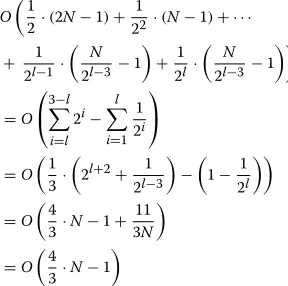
(Table2), and that of our work is
O
1
2·(2N−1)+ 1
22·(N−1)+ · · ·
+ 1
2l−1 ·
N
2l−3 −1
+ 1
2l·
N
2l−3 −1
=O
⎛ ⎝3−l
i=l
2i−
l
i=1
1 2i ⎞ ⎠ =O 1 3·
2l+2+ 1 2l−3
−
1− 1 2l
=O
4
3·N−1+ 11 3N =O 4 3·N−1
.
Table 2Comparison of the expect complexity of Merkle trees used in (Ling et al.2017) and our work
Indicators
The update complexity The space complexity Schemes
(Ling et al.2017) O(logN) O(2N−1) Our work O(logN2) O(43·N−1)
Theorem 4 The full dynamic group signature scheme
based on ring in this paper is correct.
Proof Now, we give a specific description of the correct-ness of our scheme according to the perfect completecorrect-ness of the underlying protocol and the correctness of the encryption scheme. If the signature = (sign,c1,c2)is generated by a legitimate user, then the perfect complete-ness of the underlying protocol could help the signature
to pass the verification of the algorithm Verify, and
the algorithmTracewill outputs the user public keyupki
with a probability approximate to 1 together with a proof traceaccepted byJudge. We need to computee=c1,2−
S1c1,1 = E1·r1+ q
2 #
·upki modqwhen to decrypt a
ciphertext, and letb = b1,· · ·,bl,e = (e1,· · ·,el), for anyj∈[l],
bj= 0,if |ej−0|<|ej− q
2| 1,if |ej−0| ≥ |ej− q2|
Note that E1·r1∞ < q5, so b = upki with over-whelming probability. Furthermore, because the user
cor-responding to upki is legitimate, then the witnessw =
(bin(i),wl,· · ·,w1)is included in the group information
infoτ, and the value of the related leaf is not 0k. So, the algorithm Trace could always obtain a tuple (S1,E1,y) that satisfies requirement. And finally, for the fact that
the prooftraceis perfect completeness, so the algorithm
Judgeoutputs 1 with probability 1.
Theorem 5Suppose that the problem ring-LWEn,m,q,X
is difficult, then the scheme in this paper is anonymous in RO model.
Proof Assume that the size of legitimate users ist, the
adversaryAand challengerCare all PPT algorithms. For
two different usersi0 = i1 ∈[t] given byA, we give the following game before the concrete proof:
We say that the scheme has a property of anonymity
if there is a negligible function negl(λ), such that
Pr $
ExpanonFDGS−,Ab(λ)
%
= 1 ≤ negl(λ). Given a negligible
functionnegl(λ), we will finish this proof by hybrid games. Let the output of each game isOPl,l∈[ 0, 9].
Algorithm 2: ExpanonFDGS−,Ab(λ)
(pp,(opk,osk))←
GKeyGen(λ),HUL,CUL,BUL,SL,CL= ∅. (info,(mpk,msk))←A(pp).
Return 0 ifA’s output is not well-formed, let gpk=(pp,mpk,opk).
Game0: Given two different legitimate usersi0 =i1 ∈
[t] byA, letb = 0, the challengerCruns the experiment
above honestly by usingi0.
Game1: This game is completely consistent with
Game0except that include(S2,E2)to osk, i.e. letosk = ((S1,E1),(S2,E2)). And this change, to the view of the
adversary A, makes no difference, Pr[OP1 = 1]=
Pr[OP0=1].
Game2: This game is completely consistent with
Game1 except that use a simulator Simtrace to
simu-late the real interactions of the protocol that generates trace, i.e. replace the real transcripttracewith a
simu-lated transcript of Simtrace. And the two transcripts are
statistical indistinguishable because of the statistical
zero-knowledge of trace, Pr[OP2 = 1]−Pr[OP1 = 1]≤
negl(λ).
Game3: This game is completely consistent with
Game2 except that replace (S1,E1) with (S2,E2) when
Simtracesimulates the oracleTrace. For a legitimate signa-ture(M,sign,c1,c2), wherec1,c2are encryptions to dif-ferent strings respectively. LetF1be the signature inquiry
initiated byAto the oracleTrace, and the view ofAmay
changing ifF1appears, however, it violates the soundness
of the protocol that generatessign. And the change in
this game, to the view ofA, is indistinguishable except the
incidentF1, i.e. Pr[OP3 = 1]−Pr[OP2 = 1]≤ Pr[F1]≤
negl(λ).
Game4: This game is completely consistent with
Game3 except that use a simulator Simsign to
simu-late the real interactions of the protocol that generates
sign, i.e. replace the real transcript sign with a
simu-lated transcript of Simsign. And the two transcripts are
statistical indistinguishable because of the statistical
zero-knowledge of sign, Pr[OP4 = 1]−Pr[OP3 = 1]≤
negl(λ).
Game5: This game is completely consistent with
Game4 except that change the ciphertext c1 into the
encryption toupki1 when initiate an inquiry to the
ora-cleChalb. And the difference of the view ofAcaused by
this change is negligible for the semantic security of the
encryption scheme. The challenger responds with(S2,E2)
during the inquiry to the oracleTrace, which makes no
difference by substitute the ciphertextc1, so, Pr[OP5 =
1]−Pr[OP4=1]=negl(λ).
Game6: This game is completely consistent with
Game5 except that replace (S2,E2) with (S1,E1) when
Simtrace simulates the oracleTrace. For a legitimate sig-nature(M,sign,c1,c2), where c1,c2 are encryptions to
different strings respectively, let F2 be the signature
inquiry initiated byAto the oracleTrace, which violates
the soundness of the protocol that generatessign. And
the change in this game, to the view ofA, is
indistinguish-able except the incident F2, Pr[OP6 = 1]−Pr[OP5 =
1]≤Pr[F2]≤negl(λ).
Game7: This game is completely consistent with
Game6 except that change the ciphertext c2 into the
encryption toupki1. And the difference of the view ofA
caused by this change is negligible for the semantic secu-rity of the encryption scheme. The challenger responds
with (S1,E1) during the inquiry to the oracle Trace,
which makes no difference to the view of the adversary, Pr[OP7=1]−Pr[OP6=1]=negl(λ).
Game8: This game is completely consistent with
Game7except that replace the simulator Simsign with a
real protocol that generates sign, i.e. replace the
sim-ulated transcript of Simsign by a real transcript sign.
And the two transcripts are statistical indistinguishable because of the statistical zero knowledge of the protocol sign, Pr[OP8=1]−Pr[OP7=1]≤negl(λ).
Game9: This game is completely consistent with
Game8except that replace the simulatorSimtracewith a
real protocol that generates trace, i.e. replace the
sim-ulated transcript of Simtrace by a real transcript trace.
And the two transcripts are statistical indistinguishable because of the statistical zero knowledge of the protocol trace, Pr[OP9=1]−Pr[OP8=1]≤negl(λ).
Finally, we could learn from the games above that the probability:
Pr[OP9=1]−Pr[OP0=1]
=Pr
$
ExpanonFDGS−,A1(λ)
%
−Pr
$
ExpanonFDGS−,A0(λ)
%
≤c·negl(λ)
wherecis constant. So, the scheme in this paper satisfies
the property of anonymity.
Theorem 6Suppose that the ring-SIS∞n,m,q,1 is difficult, then the scheme in this paper is unforgeable in the RO model.
ProofSuppose that there ia a PPT adversary A could
forge a valid signature with a non-negligible probability,
then there is a PPT algorithmBcould break the security of
Merkle hash tree or solve the problem ring-SIS∞n,m,q,1with
a non-negligible probability by invokingAas a black box.
And to complete the proof, we give the following game:
If there is a negligible function negl(λ), such that
Pr $
ExpunforgeFDGS,A(λ)
%
= 1 ≤ negl(λ), then we say that
the scheme is unforgeable. Given a random matrix
A, the challenger computes the public parameter pp
honestly, then invokes the algorithm of A, runs the
operations in the game above, during this process, B
responds the inquiries of A honestly. If the adversary