E
E
N
N
E
E
R
R
G
G
Y
Y
-
-
A
A
W
W
A
A
R
R
E
E
V
V
I
I
R
R
T
T
U
U
A
A
L
L
B
B
A
A
C
C
K
K
O
O
F
F
F
F
A
A
L
L
G
G
O
O
R
R
I
I
T
T
H
H
M
M
F
F
O
O
R
R
I
I
M
M
P
P
R
R
O
O
V
V
E
E
D
D
N
N
E
E
T
T
W
W
O
O
R
R
K
K
L
L
I
I
F
F
E
E
T
T
I
I
M
M
E
E
I
I
N
N
W
W
I
I
R
R
E
E
L
L
E
E
S
S
S
S
S
S
E
E
N
N
S
S
O
O
R
R
N
N
E
E
T
T
W
W
O
O
R
R
K
K
S
S
R
Ra
am
m
es
e
s
h
h
P
P
al
a
l
am
a
m
ak
a
ku
ul
l
a
a
11,
,
D
Dr
r
.
.
P
P
.
.
V
Ve
e
nk
n
ka
at
ta
a
K
Kr
r
i
i
s
s
hn
h
na
a
221
Research Scholar, Dept of CSE, JNTU Anantapur, AP, India
2
Pro fesssor, Dept of CS, SPMVV, Tirupathi, AP, India
Corresponding author: Ramesh Palamakula , [email protected]
ABSTRACT: Medium Access Control (MAC) takes a vital role in the wireless communication networks for making efficient utilization of bandwidth, fairness among the nodes, latency management, and scalability. Unlike other networks, sensor networks required dedicated MAC protocols to consider the energy efficiency to improve the life time of the node along with efficient bandwidth utilization. In this paper, energy aware virtual back off algorithm (EAVBA) is proposed for successful channel access over the medium. In this method overall network energy consumption is managed by maintaining the details of transmission energy and receiving energy of a node. The simulation performed by considering the delay, packet delivery ratio and energy consumption factors to identify the performance of the proposed algorithm.
KEYWORDS: MAC, virtual backoff algorithm, sensor networks, energy, optimization.
1.
INTRODUCTIONThe recent practices in wireless communications enabled the development in low- cost, multi-functional and low power sensors nodes. The wireless sensor nodes are equipped with smart sensing devices, communication and processing and communication capabilities. These type of nodes communicate with each other in the network via sensors to use the data and we formally called as data sink [Q+06]. In the past decade, the medium access control (MAC) protocols have received major attention in area of wireless sensor networks. The MAC techniques developed for WSNs can be divided into two types: TDMA based protocols and Contention based protocols [Cek08]. The TDMA based MAC protocol is implementing IEEE 802.15.4 for low data rates in WSNs, and energy based model is use d for cluster based mechanism [***02, V+10]. These are managing energy constraints in constraint based protocols by adding the additional complexity to the wireless sensor networks. V. Rajendran et al. presented a collision free model for MAC protoco l based on energy constraints. It manages the all nodes information based on theirs loads and follows the time slot allocation procedure. The election based mechanism is introduced here to use the node
appropriately [ROG03, F+11]. The contention based protocol is used in SMAC [YHE02, MKS11]. The CSMA collision avoidance is the mechanism which is employed in the protocol. The energy aware and self-adaption are the primary goals employed for the node. There are fairness, energy efficiency, latency, scalability, bandwidth efficiency and throughput as the parameters to be considered while designing the MAC protocol [K+11, LK14, Kha11]. But when the wireless sensor networks are considered, energy efficiency and the scalability are the major aspects to be considered as the sensor nodes are powered on battery and is difficult in managing these batteries and the network is not stable because of the mobility of the nodes in the network. Hence MAC protocols for sensor networks are designed in order t o increase the life time of the nodes in the network. There are four reasons where energy is getting wasted. They are due to the collisions, overhearing, idle listening, and control packet overhead [RKR14].
This paper employs the energy aware virtual bac k off algorithm for successful channel access over the medium. It uses the node transmission energy and receiving energy for calculating overall network energy consumption. The proposed approach has the special property it can sense the channel by multipat h routing mechanism.
Section 2 explains about the general discussion of existing protocols in WSNs. Section 3 implements the network and energy models for virtual backoff algorithm, and state transition diagram shows the node mobility model. Section 4 explains about the energy aware virtual backoff algorithm and section 5 deals with simulation setup and experimental analysis. Finally the conclusion is drawn in section 6.
2. LITERATURE SURVEY
Management Framework. The video packets are forwarded based on the estimated delay and its significance. The number of packets dropped is reduced while saving the required significant video packets and hence the authors attempted to enhance quality with which the video is being rece ived. The authors in [MK13], proposed a novel procedure semi-distributed backoff algorithm which shifts from random backoff to deterministic backoff algorithm where channel access is assured. The collisions are avoided to be consecutive in nature for critical applications. Here, besides the backoff on sender-side, the backoff on receiver-side also is employed. The deterministic backoff mechanism is shifted to random backoff mechanism when the transmission is successful and vice-versa. Shan et al. [SR02] proposed optimal path routing to increase the lifetime of the network. The probability function is used for path selection, and majorly it concentrated on energy consumption. The parameter which evaluates the proposed model is network stability. The approach justifies that using always the path with minimum energy consumption decreases the energy of nodes in that path. So, using the multipath will increase the lifetime of the network. In [YYA02], Younis et al. proposed a routing algorithm with hierarchal model which is three-tier architecture. The cluster mechanism is employed to track the nodes location in wireless sensor networks. Gate ways are part of the routing mechanism which maintains the details of each node like energy, location cluster head. In [KKK11, H+13], the authors discussed two channel access scheduling algorithms based on STDMA in order to accomplish the bandwidth efficiency and enhance the throughput of the wireless mesh networks which are based on spatial – TDMA (STDMA). The key concept in this paper is that the channel access procedure utilizes the information related to the Optimized Link State Routing (OLSR). Four different cases like OLSR aware centralized scheduling, non-OLSR aware centralised scheduling, OLSR aware distributed scheduling and non-OLSR aware distributed scheduling algorithms are simulated and tested. The authors proved the throughput is enhanced with no added overhead. A protocol for an energy efficient collision free channel in wireless sensor networks called the traffic adaptive medium access (TRAMA) is proposed in [HCB00, HLD12, T+13]. TRAMA is based on TDMA and the nodes move to the low power idle mode during the absence of transmission and reception and thereby minimize the power usage and guarantee the success of transmission of packets without any collision. In [YVM08, SK11, K+11], an optimized MAC protoco l is proposed. The duty cycle of the sensor nodes depend on the density of the network traffic. The duty cycle is high for the heavy traffic and the low for the
less traffic. The number of packets waiting in the queue of a specific sensor is used determine the traffic in the network. The number of control packet and also the size is decreased which reduces the network overhead when compared to the S-MAC protocol.
3. ENERGY AWARE NETWORK MODEL
3.1 NETWORK MODEL
In order to design the wireless sensor networks, we assume that there are N nodes participating in the area of M x M size. The transmission of packet from a node at a particular time is given as P(a). The probability of packet transmission is given as P(st), and it is calculated under the assumption that no other node is sending the packets at the same time. Therefore (1-P(a)) is the no transmission probability of the remaining nodes in the network.
)) ( 1 ( ) ( )
(st P a P a
P (1)
If there are N nodes participating in the packet transmission then the transmission probability is given as
1 )) ( 1 ( )) ( ( )
(st NP a P a N
P (2)
3.2ENERGY MODEL
Let us consider that two nodes i and j are connected by a link with less energy consumption when compared to other linking nodes in the network. Then the distance between the two nodes is calculated by using
(i, j).)) ( ) ( (( )) ( ) ( (( ) ,
(i j i j i j
(3)
Here α and β are the arbitrary variables from the location of two nodes participating in the communication. The energy consumption of sending L- bit packet information for a distance of
is given as2 )
,
(L L
TEnergy (4)
where ε is energy consumed by each packet. The receiving energy at node j is calculated as
L L
REnergy( )
(5)
3.3STATE TRANSIONAL MODEL
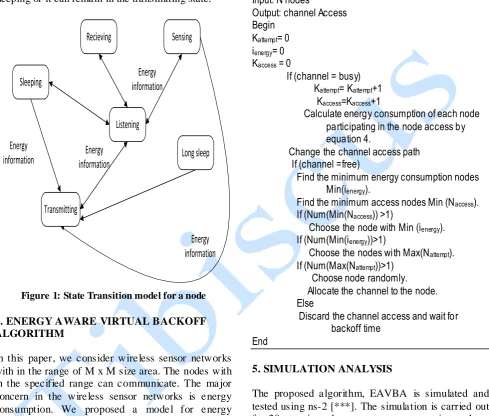
and different level of energy consumption. In this model, every node is considered with 6 operations such as sleeping, sensing, transmitting, receiving, listening and log sleep. Figure 1 explains about the behaviour of each mode and the channel access of each mode. The node in the sleeping state means it is not participating in the communication. The node in the transmitting state means it can move to the long sleeping or it can remain in the transmitting state.
Sleeping
Recieving
Transmitting
Listening
Sensing
Long sleep Energy
information
Energy information
Energy information
Energy information
Figure 1: State Transition model for a node
4.ENERGY AWARE VIRTUAL BACKOFF ALGORITHM
In this paper, we consider wireless sensor networks with in the range of M x M size area. The nodes with in the specified range can communicate. The major concern in the wireless sensor networks is energy consumption. We proposed a model for energy consumption of each node based on their distance they are positioned. The calculation of transmitting and receiving energy plays crucial role in overall network energy consumption. In the energy aware-VBA algorithm the ien ergy is introduced to calculate the energy of contending nodes for channel access. Two different types of counters referred as Nattempt and Naccess for each node. These two counters are initialized with 0 for all the contending nodes for the first time or it can be said as a node joins the network, it’s both counters are initialized to 0. When a node requests for a channe l access, then Nattempt of the corresponding node is incremented irrespective of the node acquiring the channel. Naccess is incremented only when the node acquires a channel to access. When ‘n’ nodes are contending for a channel access,
then the channel is allotted to the node for which Naccess is low and Nattempt is high, provided that the Naccess is less than its corresponding sequence number. Otherwise the access is denied. The algorithm 1 explains about the energy aware model of virtual back off algorithm.
Algorithm 1: Energy aware-VBA (EAVBA)
Input: N nodes
Output: channel Access Begin
Kattempt= 0 ienergy= 0 Kaccess = 0
If (channel = busy) Kattempt= Kattempt+1 Kaccess=Kaccess+1
Calculate energy consumption of each node participating in the node access by equation 4.
Change the channel access path If (channel =free)
Find the minimum energy consumption nodes Min(ienergy).
Find the minimum access nodes Min (Naccess). If (Num(Min(Naccess)) >1)
Choose the node with Min (ienergy). If (Num(Min(ienergy))>1)
Choose the nodes with Max(Nattempt). If (Num(Max(Nattempt))>1)
Choose node randomly. Allocate the channel to the node. Else
Discard the channel access and wait for backoff time
End
5. SIMULATION ANALYSIS
The proposed algorithm, EAVBA is simulated and tested using ns-2 [***]. The simulation is carried out for 20 runs in order to get more appropriate values. NS-2 simulation parameters used for simulation are shown in Table 1. The simulation is carried out with 40 nodes and bit rate of 15kbps.
Table 1: Simulation Parameters
Parame ter Value
Routing AODV
size 300x300
Bandwidth 4 Mbps
Max Packet Length 2000 bytes Frame size 25 slots Packet length 250 bytes
Traffic type CBR
5 10 15 20 25 30 35 40 0.0
0.1 0.2 0.3 0.4 0.5 0.6 0.7
D
e
la
y
(s)
Number of Nodes EAVBA
CLM-VBA S-MAC M-VBA
Figure 2: Performance of EAVBA compared with CLM-VBA, M-VBA and S-MAC in terms of delay
5 10 15 20 25 30 35 40 0
10 20 30 40 50 60 70
Packe
t
D
e
live
ry
R
a
ti
o
Number of Nodes EAVBA
CLM-VBA M-VBA S-MAC
Figure 3: Performance of CLM-VBA compared with VBA, S-MAC and M-VBA in terms of packet delivery ratio
5000 10000 15000 20000 25000 30000 35000 0
200 400 600 800 1000 1200 1400 1600 1800 2000
Avera
g
e
Ene
rg
y
C
o
n
su
mp
ti
o
n
(mJ)
Number of Packets Transmitted EAVBA
CLM-VBA M-VBA S-MAC
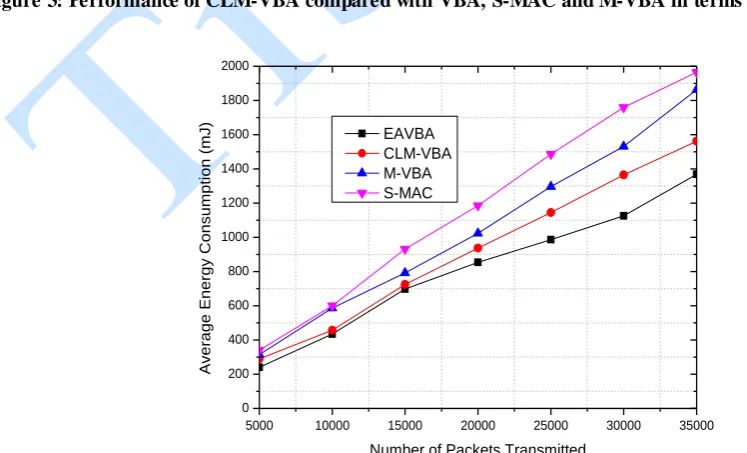
The parameters used to test the performance of the proposed algorithm EAVBA are:
Energy Consumption: The quantity of energy consumed by each node for transmitting a packet. Packet Delivery Ratio: This is the ratio of number of packets received to the number of packets transmitted.
Delay: The time taken for the packet to transmit from the source to the receiver.
CONCLUSION
In this paper, Energy aware virtual backoff algorithm has been proposed to improve the life time of a network by considering the transmitting and receiving powers of each node in the sensor network. Latency, Packet delivery ratio and average energy consumption factors are evaluated by comparing with other existing backoff algorithms such as CLM-VBA, M-VBA and S-MAC. The simulation analysis of EAVBA outperforms the existing algorithms and given considerable improvement in the network.
REFERENCES
[Cek08] Celal Ceken - An energy efficient and
delay sensitive centralized MAC
protocol for wireless sensor networks. Computer Standards& Interfaces 30 (2008) 20–31.
[F+11] H. Fayyazi, M. Sabokrou, M. Hosseini, A. Sabokrou - Solving heterogeneous coverage problem in Wireless Multimedia Sensor Networks in
a dynamic environment using
Evolutionary Strategies, in Computer and Knowledge Engineering (ICCKE), 2011 1st International eConference on, pp.115-119, 13-14 Oct. 2011.
[HG14] W. Haidong, L. Guizhong - Priority and delay aware packet management framework for real time video transport over 802.11e WLANs, Multimed Tools Appl (2014) 69:621– 641 DOI 10.1007/s11042-012-1131-z.
[HCB00] W. Heinzelman, A. Chandrakasan, H. Balakrishnan - Energy-Efficient Communication Protocols for Wireless Micro sensor Networks, Proceedings of the 33rd Hawaaian International Conference on Systems Science (HICSS), January 2000.
[HLD12] Shio w-Fen Hwang, Hsin-Hui Lin, Chyi-Ren Dow - An energy-efficient routing protocol in wireless sensor networks with holes, in Ubiquitous and Future Networks (ICUFN), 2012 Fourth International Conference on , vol., no., pp.17-22, 4-6 July 2012.
[H+13] U. Hernandez-Jayo, I. Ang ulo, M. P. Elejoste, A. Perallos, A. Chertudi, A. Moreno - Streetlight intelligent remote control system based on wireless communication, in Remote Engineering and Virtual Instrumentation (REV), 2013 10th International Conference on, vol., no., pp.1-4, 6-8 Feb. 2013.
[Kha11] I. M. Khalil - ELMO: Energy Aware Local Monitoring in Sensor Networks, in Dependable and Secure Computing, IEEE Transactions on, vol.8, no.4, pp.523-536, July-Aug. 2011.
[KKK11] Miray Kas, Ibrahim Ko rpeoglu, Ezhan Karasan - OLSR-aware channel access scheduling in wireless mesh networks, Journal of Parallel and Distributed Computing 71 (2011) 1225– 1235.
[K+11] K. B. Khajeh, M. A. J. Jamali, H. M. Manie - ACDS: Adaptive Topology Construction for R-random Sensor
Deployment in Wireless Sensor
Networks, in Software Engineering, Artificial Intelligence, Networking and Parallel/Distributed Computing (SNPD), 2011 12th ACIS International Conference on, pp.139-144, 6-8 July 2011.
[LK14] R. Logambigai, A. Kannan - QEER: QoS aware Energy Efficient Routing
protocol for Wireless Sensor Networks,
in Advanced Computing (ICoAC), 2014 Sixth International Conference on , vol., no., pp.57-60, 17-19 Dec. 2014.
[MK13] Sudip Misra, Manas Khatua -
Semi-Distributed Backoff:
Collision-AwareMigration from Random to
Deterministic Backoff, IEEE
[MKS11] S. Misra, P. V. Krishna, V. Saritha - LACAV: an energy-efficient channel assignment mechanism for vehicular ad hoc networks, J. Super Comput. (2011) 1–22, http://dx.doi.org/10.1007/s11227-011-0552-1.
[Q+06] Q. Gao , K. J. Blow, D.J. Holding et al.
- Radio range adjustment for energy
efficient wireless sensor networks
[EB/OL].www.elsevier.com/locate/adho c, in: Ad Hoc Networks 4-2006, 75–82.
[RKR14] T. S. K. Reddy, P. V. Krishna, P. C. Reddy - Power Aware Fra mework for
Scheduling Tasks in Grid based
Workflows, Int. J. Communication
Networks and Distributed Systems , Indersc ience Publishers, 2014.
[ROG03] V. Rajendran, K. Obraczka, J. J. Garcia-Luna-Aceves – Energy-efficient, collision-free medium access control for wireless sensor networks, in: Proceedings of the ACM SenSys 2003, LosAngeles, CA, November 2003.
[SK11] K. S. Shivaprakasha, M. Kulkarni - Energy Efficient Shortest Path Routing Protocol for Wireless Sensor Networks, in Computational Intelligence and Communication Networks (CICN), 2011 International Conference on, pp.333-337, 7-9 Oct. 2011.
[SR02] R. Shah, J. Rabaey - Energy Aware Routing for Low Energy Ad Hoc Sensor Networks, in the Proceedings of the IEEE Wireless Communications and Networking Conference (WCNC), Orlando, FL, March 2002.
[T+13] Lee Taewoo, D. S. Kim, Choo Hyunseung, Kim Mihui - A Delay-Aware Scheduling for Data Aggregation
in Duty-Cycled Wireless Sensor
Networks, in Mobile Ad-hoc and Sensor Networks (MSN), 2013 IEEE Ninth International Conference on, pp.254-261, 11-13 Dec. 2013
[V+10] P. Venkata Krishna, S. Misra, M. S. Obaidat, V. Saritha - Virtual Backoff Algorithm: An Enhancement to 802.11 Medium-Access Control to Improve the Performance of Wireless Networks, in Vehicular Technology, IEEE Transactions on, vol.59, no.3, pp.1068-1075, March 2010.
[YHE02] W. Ye, J. Heidemann, D. Estrin - An
energy-efficient MAC protocol for
wireless sensor networks, Twenty-First Annual Joint Conference of the IEEE Computer and Communications Societies (INFOCOM), vol. 3, 2002, pp. 1567–1576, in: Ad Hoc Networks 4-2006, 75– 82.
[YVM08] Rajesh Yadav, Shirshu Varma, N. Malaviya - Optimized Mediu m Access
Control for Wireless Sensor Network,
IJCSNS International Journal of Computer Science and Network Security, Vol. 8, No.2, pp. 334 -338 (February 2008).
[YYA02] M. Younis, M. Youssef, K. Arisha - Energy-Aware Routing in Cluster-Based Sensor Networks, in the Proceedings of the 10th IEEE/ACM International Symposium on Modelling, Analysis and Simulation of Computer and
Telecommunication Systems
(MASCOTS2002), Fort Worth, TX, October 2002.
[***] *** - The Network Simulator NS-2, http://www.isi.edu/nsnam/ns.