University of Pennsylvania
ScholarlyCommons
Publicly Accessible Penn Dissertations
1-1-2015
Emulsion Stabilization with Janus Particles
Fuquan TuUniversity of Pennsylvania, [email protected]
Follow this and additional works at:http://repository.upenn.edu/edissertations
Part of theChemical Engineering Commons, and thePolymer Chemistry Commons
This paper is posted at ScholarlyCommons.http://repository.upenn.edu/edissertations/1155
For more information, please [email protected].
Recommended Citation
Tu, Fuquan, "Emulsion Stabilization with Janus Particles" (2015).Publicly Accessible Penn Dissertations. 1155.
Emulsion Stabilization with Janus Particles
Abstract
Emulsions are dispersions of droplets of one fluid within a second, immiscible fluid and have a wide range of applications from foodstuffs to pharmaceuticals to personal care products and agrochemicals. Emulsions are intrinsically unstable because of large interfacial area associated with the system. To obtain stable emulsions, the interfaces between immiscible fluids must be stabilized by emulsifying agents such as surfactants and colloidal particles. Surfactants refer to surface-active agents which prefer to segregate to interfaces between two immiscible fluids. Their surface activity originates from their amphiphilic structure. Colloidal particles can stabilize emulsions due to their tendency to attach strongly to the interface. It has been demonstrated that particles with amphiphilic structure (also known as Janus particles) can be synthesized. An important potential application of Janus particles comes from the fact that they could make unique solid surfactants, however, several questions needs to be answered: (1) It has been recognized for more than 100 years that surfactant molecules and homogeneous particles can attach to interfaces and stabilize emulsions. How would Janus particles be different from and, more importantly, advantageous over molecular surfactants and homogeneous particles in emulsion stabilization? (2) How does the structure or geometry of Janus particles influence their properties as solid surfactants? To answer these questions, thermodynamics of emulsion stabilization using amphiphilic Janus particles is investigated showing that they can indeed generate
thermodynamically stable emulsion whereas emulsions stabilized by surfactant molecules and homogeneous particles are only kinetically stable. In addition, a new synthesis method is developed enabling the bulk synthesis of highly uniform pH-responsive Janus particles that are able to completely reverse their surfactant properties in response to changes in the solution pH. These Janus particles can stabilize different types of simple emulsions (oil-in-water and water-in-oil) at different pH and, more importantly, induce phase inversion of emulsions in response to changes in solution pH. Furthermore, one-step formation of stable multiple emulsions is demonstrated using these amphiphilic Janus. Multiple emulsions stabilized by these stimuli-responsive Janus particles can be induced to release the encapsulant by simply increasing the pH of the continuous phase. In conclusion, Janus particles represent promising systems as solid surfactants for making stable and smart emulsions.
Degree Type Dissertation
Degree Name
Doctor of Philosophy (PhD)
Graduate Group
Chemical and Biomolecular Engineering
First Advisor Daeyeon Lee
Keywords
amphiphilic, emulsion, Janus particle, stimuli-responsive
Subject Categories
Chemical Engineering | Engineering | Polymer Chemistry
EMULSION STABILIZATION WITH JANUS PARTICLES
Fuquan Tu
A DISSERTATION
in
Chemical and Biomolecular Engineering
Presented to the Faculties of the University of Pennsylvania
in
Partial Fulfillment of the Requirements for the
Degree of Doctor of Philosophy
2015
Supervisor of Dissertation
_____________________
Daeyeon Lee, Associate Professor, Chemical and Biomolecular Engineering
Graduate Group Chairperson
________________________
Raymond J. Gorte, Professor, Chemical and Biomolecular Engineering
Dissertation Committee
Russell J. Composto, Professor, Materials Science and Engineering
Daniel A. Hammer, Professor, Chemical and Biomolecular Engineering
EMULSION STABILIZATION WITH JANUS PARTICLES
COPYRIGHT
2015
iii
iv
Acknowledgements
Without the support of numerous individuals, the completion of this thesis would not
have been possible and I am grateful for all of their support. First of all, I would like to
thank my advisor Professor Daeyeon Lee for his guidance over the past four to five years.
He introduced me to the world of colloids and interfacial science and also helped me
develop my critic thinking and experimental skills, which are needed to be a qualified
researcher. He is supportive, patient and always there to help when I experience
difficulties in my research. His dedication and enthusiasm to science inspires me and
keeps me motivated for the next big challenge.
I also would like to thank my thesis committee members Professor Composto, Professor
Hammer, and Professor Stebe. It was very generous for Professor Burdick and Professor
Kagan to let me use their equipment to conduct my research and I really appreciate Dr.
Christopher Highley, Ryan Wade and Eric Wong’s guidance in properly operating the
equipment.
I feel really lucky to have met all the students and post-docs in the Lee group: Myung
Han Lee, Bum Jun Park, Iris Yi, Kwadwo Tetty, Lei Zhang, Sang-Wook Lee, Zaki
Estephan, Weifeng Wang, Seonju Yeo, Yun-Ru Huang, Elio Angilè, Teresa Brugarolas,
v
Gang Duan, Sarah Hann, Ankit Kumar, Jacob Prosser, Tae Soup Shim, Martin Hasse and
Rohini Gupta. It has been a wonderful experience and I really appreciate their kindness.
I am truly grateful for several people’s help and time during my most difficult time of my
thesis research. Dr. Kisun Yoon, Dr. Mark Panczyk and Professor Jin Woong Kim have
offered me a lot of suggestions for my particle synthesis, and their help on the successful
development of my own technique cannot be underestimated.
I would also like to thank my SEAS friends including Richard Tourdot, Amit Shavit,
Cory Silva, Yifan Wang, Zhihao Jiang, Jiechang Hou and Huikuan Chao. We have had a
lot of memorable times during the past few years.
Finally, I want to thank my parents for their patience and for supporting and encouraging
me to pursue my dreams without reservation. I also would like to thank my sister. She
always treats me as a role model, and this motivates me to become a self-disciplined,
hard-working, and caring brother. I also want to thank Ms. Mei Wang for her support,
help, and trust in both my personal life and career.
Without funding from PENN MRSEC though the National Science Foundation, the NSF
CAREER Award, Biomolecular Materials programs at the DOE, the American Chemical
vi
ABSTRACT
EMULSION STABILIZATION WITH JANUS PARTICLES
Fuquan Tu
Daeyeon Lee
Emulsions are dispersions of droplets of one fluid within a second, immiscible fluid and
have a wide range of applications from foodstuffs to pharmaceuticals to personal care
products and agrochemicals. Emulsions are intrinsically unstable because of large
interfacial area associated with the system. To obtain stable emulsions, the interfaces
between immiscible fluids must be stabilized by emulsifying agents such as surfactants
and colloidal particles. Surfactants refer to surface-active agents which prefer to
segregate to interfaces between two immiscible fluids. Their surface activity originates
from their amphiphilic structure. Colloidal particles can stabilize emulsions due to their
tendency to attach strongly to the interface. It has been demonstrated that particles with
amphiphilic structure (also known as Janus particles) can be synthesized. An important
potential application of Janus particles comes from the fact that they could make unique
solid surfactants, however, several questions needs to be answered: (1) It has been
recognized for more than 100 years that surfactant molecules and homogeneous particles
can attach to interfaces and stabilize emulsions. How would Janus particles be different
vii
particles in emulsion stabilization? (2) How does the structure or geometry of Janus
particles influence their properties as solid surfactants? To answer these questions,
thermodynamics of emulsion stabilization using amphiphilic Janus particles is
investigated showing that they can indeed generate thermodynamically stable emulsion
whereas emulsions stabilized by surfactant molecules and homogeneous particles are
only kinetically stable. In addition, a new synthesis method is developed enabling the
bulk synthesis of highly uniform pH-responsive Janus particles that are able to
completely reverse their surfactant properties in response to changes in the solution pH.
These Janus particles can stabilize different types of simple emulsions (oil-in-water and
water-in-oil) at different pH and, more importantly, induce phase inversion of emulsions
in response to changes in solution pH. Furthermore, one-step formation of stable multiple
emulsions is demonstrated using these amphiphilic Janus. Multiple emulsions stabilized
by these stimuli-responsive Janus particles can be induced to release the encapsulant by
simply increasing the pH of the continuous phase. In conclusion, Janus particles represent
viii
Table of Contents
Acknowledgements ... iv
ABSTRACT ... vi
Table of Contents ... viii
List of Tables ... x
List of Figures ... xi
Chapter 1. Introduction ... 1
1.1 Backgroud ... 1
1.2 Motivations and Objectives ... 12
1.3 Thesis Outline ... 14
Chapter 2. Thermodynamically Stable Emulsions Using Janus Dumbbells as Colloid Surfactants ... 16
2.1 Introduction ... 16
2.2 Method ... 19
2.3 Results and Discussion ... 24
2.4 Conclusions ... 46
Chapter 3. Shape-Changing and Amphiphilicity-Reversing Janus Particles with pH-Responsive Surfactant Properties ... 48
3.1 Introduction ... 48
ix
3.3 Results and Discussions ... 54
3.4 Conclusions ... 77
Chapter 4. One-Step Encapsulation and Triggered Release Based on Janus Particle-Stabilized Multiple Emulsions ... 79
4.1 Introduction ... 79
4.2 Experimental Section ... 81
4.3 Results and Discussions ... 83
4.4 Conclusions ... 101
Chapter 5. Synthesis of Janus Particles with Pure Compartments and Anisotropic Particles ... 102
5.1 Introduction ... 102
5.2 Experimental Section ... 104
5.3 Results and Discussions ... 106
5.4 Conclusions ... 116
Chapter 6. Conclusions and Outlook ... 117
6.1 Conclusions ... 117
6.2 Outlook for Future Research ... 119
APPENDIX ... 123
x
List of Tables
Table 4.1 Parameters obtained from O/W emulsion in Figure 4.9 (a) and packing fraction calculated for each case. ... 95
Table A.1 Salts used to test the stability of PLGA-containing double emulsions. ... 134
xi
List of Figures
Figure 1.1 (upper) Position of a small spherical particle at a planar oil–water interface for a contact angle (measured through the aqueous phase) less than 90° (left), equal to 90° (centre) and greater than 90° (right). (lower) Corresponding probable positioning of particles at a curved interface. For θ<90°, solid-stabilised o/w emulsions may form (left). For θ>90°, solid-solid-stabilised w/o emulsions may form (right). Figure reproduced from reference 10. ... 5
Figure 1.2 Comparisons between homogeneous iron-oxide nanoparticles and 1-dodecanethiol (DDT) modified Janus nanoparticles in decreasing the interfacial tension at a water–n-hexane interface. Reprinted with permission from reference 21. ... 9
Figure 1.3 Comparison between emulsion stabilization (left) without particles, (second column) with unmodified silica particles, and (third to last columns) with Janus particles. Images were taken immediately after and 26 days after emulsification. Reprinted with permission from reference 22. ... 9
Figure 1.4 (Left) Schematic illustration of a Janus dumbbell with a parameter used to define the packing parameter (Ppacking=v/aolc) of a dumbbell; (right)
non-spherical emulsion droplets formed by using amphiphilic dumbbells as colloid surfactants. Reprinted with permission from reference 23. ... 10
Figure 2.1 (a) Geometry and amphiphilicity of a Janus dumbbell. The blue and red colours represent hydrophilic and hydrophobic surfaces, respectively. (b) Top view of a symmetric Janus dumbbell attached to a hexagonal fluid-fluid interface, which circumscribes a lobe of the dumbbell. ... 20
Figure 2.2 (a) A bare oil droplet with a radius of R0. (b) The droplet in (a) covered with
close-packed Janus dumbbells with a slightly larger radius R. (c) Notionally swollen droplet that has a radius of R but has the same volume of oil phase as that in (a) and (b). ... 23
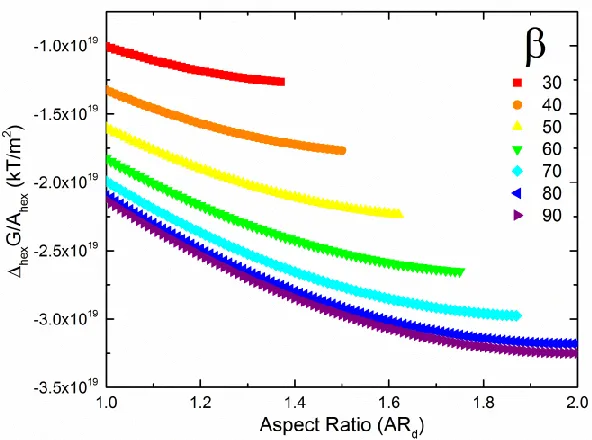
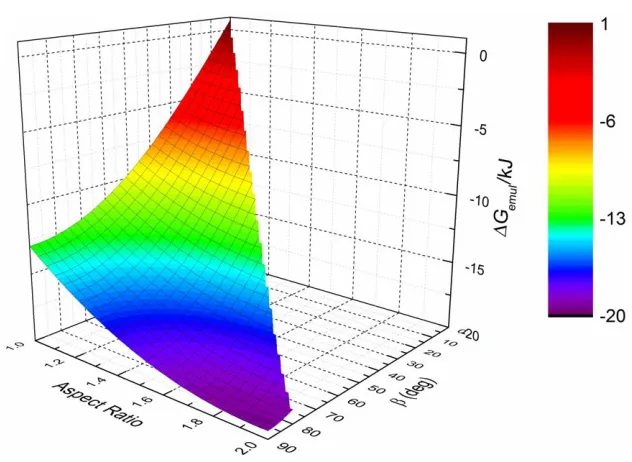
Figure 2.3 Free energy of creating a unit area of a hexagonal element in Figure 2.1 (b) with a symmetric dumbbell as a function of the aspect ratio and amphiphilicity of Janus dumbbells. ... 30
xii
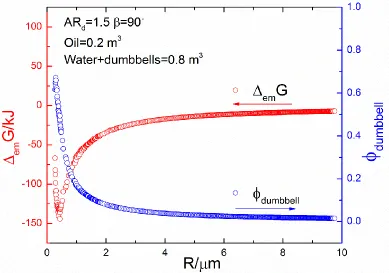
Figure 2.5 Free energy of emulsion formation (red) and the corresponding volume fraction of dumbbells in the aqueous phase needed to form a close-packed layer on the droplet surface (blue) as a function of droplet radius. The Janus dumbbells have an aspect ratio of 1.5 with a high amphiphilicity of β=90°. The emulsion consists of a mixture of a 0.2 m3 oil phase and a 0.8 m3 aqueous phase. ... 35
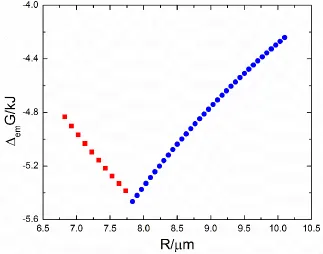
Figure 2.6 Free energy of emulsion formation as a function of droplet radius. Close packed and non-close packed states are represented by blue circles and red squares, respectively. The volume fraction of dumbbell is fixed at 2 vol%. Janus dumbbells have an aspect ratio of 1.5 and =40º. The emulsion consists of a 0.2 m3 oil phase and a 0.8 m3 aqueous phase. ... 37
Figure 2.7 (a) Non-dimensionalized average droplet radius as a function of the dumbbell aspect ratio and volume ratio between oil and aqueous phases. The volume fraction of Janus dumbbell is 2 vol% of the aqueous phase. (b) Non-dimensionalized average droplet radius as a function of the volume fraction of Janus dumbbells and volume ratio between oil and aqueous phases. The Janus dumbbells have an aspect ratio of 1.5. ... 40
Figure 2.8 (a) Schematic illustration of the effect of increasing asymmetry of Janus dumbbells on their packing at the oil-water interface and (b) non-dimensionalized average droplet radius as a function of the ratio between radii of hydrophilic and hydrophobic lobes. Parameters used for this calculation are Vo/Vw=1/4 and ds=2%. ... 43
Figure 2.9 Effect of asymmetry of Janus dumbbells on the average droplet radius when the number of Janus dumbbells in the system (Nd) remains constant. The value of Nd is the same as the total number of symmetric Janus dumbbells with the aspect ratio of 1.5 in a system consisting of a 0.8 m3 aqueous phase, 2 vol% of which is Janus dumbbells... 45
Figure 3.1 (a) Schematic illustration for the synthesis of amphiphilic Janus particles by seeded emulsion polymerization followed by acid hydrolysis. Scanning electron microscope (SEM) images of (b) linear polystyrene (LPS) seed particles, (c) P(S-co-tBA)/LPS composite particles and (d) (Sty/AA) Janus particles after hydrolysis. The inset of the image in (d) shows hydrolyzed composite particles prepared by fast evaporation with AA-rich side collapsed (scale bar = 2 μm). ... 55
xiii
Figure 3.3 Scanning electron microscope images of P(S-co-tBA)/LPS composite particles show the boundary of smooth surface and slightly rougher surface ((b) marked by black dashed line) (scale bar = 1μm). ... 57
Figure 3.4 Instantaneous copolymer composition as a function of degree of monomer conversion calculated for copolymerization of styrene and tBA from Equation (2-1). ... 59
Figure 3.5 Styrene-tBA composite particles synthesized by emulsion polymerization without LPS seed particles (a) before and (b) after hydrolysis (scale bar = 5 µm). ... 61
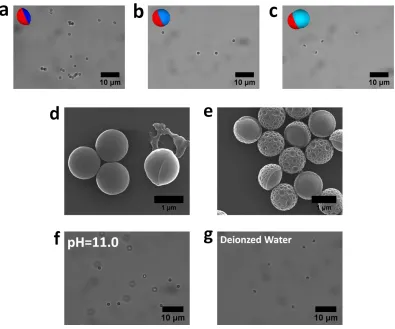
Figure 3.6 Microscope images of (Sty/AA) Janus particles made with 50 vol% of both styrene and tBA in the monomer mixture (Sty50/AA50) in (a) pH =2.2, (b) DI, and (c) pH=11.0 water. (Sty/AA) Janus particles swollen by monomer mixtures with styrene:tBA ratios of (d) 75:25 and (e) 25:75. Microscopy images of (f) (Sty75/AA25) Janus particles in pH=11.0 water and (g) (Sty25/AA75) Janus particles in DI water (pH=5.5 – 6) (scale bar = 10 μm in a, b, c, f and g; scale bar = 1 μm in d and e). ... 65
Figure 3.7 SEM images of (Sty50/AA50) Janus particles with increasing swelling ratio Vmono/VPS: (a) 3:1, (b) 4:1, (c) 5:1, (d) 6:1 and (e) 7:1. The scale bar is 1 µm.
... 66
Figure 3.8 Macroscopic and fluorescence microscopy images of emulsions made with aqueous phases of pH 2.2, deionized water (water-in-oil emulsion) and aqueous phase of pH=11.0 (oil-in-water emulsion). The volume ratio of oil and water phases is kept 50:50 in all cases, and the oil phase contains 0.01 wt% Nile Red (scale bar = 500 μm). ... 69
Figure 3.9 Scanning electron microscopy images of polymerized styrene-in-water emulsion (a,b and c) and water-in-styrene emulsion (d and e). (a) Image of a polymerized styrene emulsion droplet made at pH 11.0 with (Sty50/AA50) Janus particles on the surface (scale bar = 50 µm). (b) High magnification image of an embedded (Sty50/AA50) Janus particle on the surface (scale bar = 2 µm). (c) A free (Sty50/AA50) Janus particle on substrate (scale bar = 2 µm). (d) Image of polymerized water-in-styrene emulsions (scale bar = 300 µm). (e) (Sty50/AA50) Janus particles embedded in the surface of the polymerized styrene phase in (d) (scale bar = 1 µm). ... 70
xiv
Figure 3.11 Microscope images of toluene-in-water emulsions made with (Sty50/AA50) Janus particles dispersed in (a) pH 2.2 and (b) pH 11.0 aqueous solutions. The volume ratio of oil to water is 20:80 (scale bar = 200 μm). ... 75
Figure 3.12 Microscope images of toluene-in-water emulsion stabilized by (Sty50/AA50) Janus particles made at (a) pH 2.2 and (b) pH 11.0 flowing inside a glass capillary microchannel. (c) Attractive toluene-in-water emulsion made at pH 2.2 that are stuck to the microchannel being washed away by a pH 11.0 aqueous solution. (scale bar = 500 μm). ... 76
Figure 4.1 SEM image of (Sty50/AA50) Janus particles. The scale bar is 2 µm. ... 83
Figure 4.2 (a) Photo and (b) fluorescent microscopy images of emulsion stabilized by 0.5wt% (Sty50/AA50) Janus particles at pH5.0 with different volume fraction of oil phase (o). The scale bar for fluorescent images is 200 µm. ... 84
Figure 4.3 Microscopy images of a multiple emulsion droplet showing Janus particles adsorbed at both (a) outer and (b) inner oil-water interfaces. ... 85
Figure 4.4 SEM images of (a) intact and (b-d) broken multiple emulsion stabilized by (Sty50/AA50) Janus particles. (c) and (d) are taken from the red and blue dashed areas in (b) and (c), respectively. The scale bars are 20 µm for (a) and (b), 5 µm for (c) and 2 µm for (d). ... 86
Figure 4.5 Photos and Microscopy images of multiple emulsion (a-c) two hours and (d-f) more than three months after emulsification. Multiple emulsions are made from 1 wt% (Sty50/AA50) Janus particle dispersed in deionized water and toluene with o = 0.4. 1.5×10⁻⁴ wt% calcein added in the water phase. The
scale bar is 500 µm. ... 88
Figure 4.6 Fluorescent microscopy images of emulsion stabilized by 0.5wt% (Sty50/AA50) Janus particles at pH5.0 with volume fraction of oil phase (o)
equal to (a) 0.3 and (b) 0.5, respectively. The scale bar for fluorescent images is 200 µm. (c) Phase diagram of emulsion made with (Sty50/AA50) Janus particles as a function of both pH of water phase and volume fraction of oil phase (o). ... 90
Figure 4.7 (a) Photo and (b-f) fluorescence microscopy images of emulsions made with different time of emulsification: (b) 5, (c) 10, (d) 20, (e) 25 and (f) 30 seconds, respectively. Each glass vial is labelled with time of emulsification. Emulsions are made with o = 0.4. Water phase consists of deionized water
xv
Figure 4.8 Schematic illustration of parameters for the calculation of packing fraction and encapsulation fraction. ... 93
Figure 4.9 Emulsions made at (a) pH11.0 and (b) pH lower than 11.0 with different o
for calculating (a) packing parameter and (b) encapsulation fraction, respectively. In all cases, particle concentration is kept as 0.5 wt%. ... 96
Figure 4.10 (a) Encapsulation fraction as a function of o and pH of water phases.
Particle concentration is kept at 0.5 wt%. (b) Encapsulation fraction as a function of particle concentration. o and pH are kept 0.4 and 7.0,
respectively. ... 97
Figure 4.11 (a) Microscopy images of evolution of a multiple emulsion drop upon pH increase. Multiple emulsions are made from 0.5 wt% (Sty50/AA50) Janus particle dispersed in pH2.2 water and toluene with o = 0.2. (b) Photo and
microscopy images of (c) as-prepared multiple emulsion, (d) multiple emulsion with tumble only and (e) multiple emulsion tumbled with increasing pH. Multiple emulsions are made from 1 wt% (Sty50/AA50) Janus particle dispersed in deionized water and toluene with o = 0.4. 1.5×10⁻⁴
wt% calcein added in the water phase. The scale bar is 200 µm for (a) and 500 µm for (c), (d) and (e). ... 100
Figure 5.1 Scanning electron microscopy images of Janus particles synthesized with monomer mixture containing (a) toluene and (b) styrene. The monomer mixture consists of 50 vol% of either toluene or styrene and 1 vol% divinyl benzene as cross-linker. The rest monomer is tBA. LPS dispersion and monomer emulsion are prepared with 1 wt% PVA aqueous solution. The volume ratio between monomer mixture and LPS is 4:1. The scale is 1 µm. ... 107
Figure 5.2 The scanning electron microscopy image of particles synthesized with a monomer mixture containing toluene and tBA without cross-linker DVB. LPS dispersion and monomer emulsion are prepared with 1 wt% PVA aqueous solution. The volume ratio between monomer mixture and LPS is 4:1. The scale is 2 µm. ... 108
Figure 5.3 Schematic of the procedure for synthesizing geometrically anisotropic particles ... 109
xvi
with 0.4 wt% SDS aqueous solution. The volume ratio between monomer mixture and LPS is 4:1. The scale is 1 µm. ... 110
Figure 5.5 (a) The scanning electron microscopy and (b) optic microscopy images of Janus particles synthesized with a monomer mixture containing toluene (50 vol%), tBMA and DVB (1 vol%) as cross-linker. LPS dispersion and monomer emulsion are prepared with 0.4 wt% SDS aqueous solution. The volume ratio between monomer mixture and LPS is 4:1. The scale in (a) and (b) are is 1 µm and 5 µm, respectively. ... 113
Figure 5.6 Microscopy images and fluorescent images of (a) (Sty50/AA50) Janus particles from Chapter 3 and (b) Janus particles shown in Figure 5.5. Particles are dyed with a hydrophobic dye Nile Red. The scale bars are (a) 3 µm and (b) 10 µm, respectively. ... 114
Figure 5.7 Scanning electron microscopy images of anisotropic particles synthesized using (a) 1:2:27 and (b) 1:1:18 for the volume ratio of LPS, tBA and toluene. No DVB is used in the monomer mixture. LPS dispersion and monomer emulsion are prepared with 0.4 wt% SDS aqueous solution. The scale is 1 µm. ... 116
Figure A.2 Stability of double emulsions with inner drops containing different salts. The middle and outer phases are 0.9 wt% PLGA (85:15) in CHCl3 and 2 wt%
PVA solution, respectively. (a) and (b) are optical microscopy images of double emulsions that are unstable and stable, respectively. All the scale bars are 100 μm. ... 133
Figure A.3 Stability of double emulsions containing PLGA of different composition as a function of solution pH. Red circle, blue triangle and green inverted triangle represent the double emulsions containing 85:15, 65:15 and 50:50 PLGA, respectively. ... 135
Figure A.4 Stability of PLGA (85:15)-containing double emulsions as a function of the pH of the inner phase. All scale bars are 100 μm. ... 136
Figure A.5 Interfacial tension between a PLGA solution in chloroform and an aqueous solution as a function of solution pH. Black square represents pure chloroform. Red circle, blue triangle and green inverted triangle represent chloroform solutions with 85:15, 65:35 and 50:50 PLGA, respectively. .... 137
xvii
Figure A.7 Change in the color of PLGA double emulsions containing Alizarin Yellow R in the inner phase. Double emulsion on the left are generated using 100mg/L Alizarin Yellow R in 1.0M NaOH as the inner phase, and one on the right are generated using 100mg/L Alizarin Yellow R in 0.01M NaOH as the inner phase. The inset shows Alizarin Yellow R in 1.0M NaOH and 0.01M NaOH. ... 140
Figure A.8 Schematic illustration of tuning the size of double emulsions and microcapsules by osmotic annealing. ... 142
Figure A.9 (a) PLGA microcapsules formed using osmotic annealing and (b) the diameter evolution of the inner droplets of double emulsions under osmotic annealing. The first, second and third columns in (a) represent the initial double emulsions, double emulsions at equilibrium and PLGA microcapsules formed, respectively, under different conditions. All the scales bar in (a) are 100 μm. The legend in (b) represents different conditions under which PLGA microcapsules are formed. For example, blue squares with “0.8M in 0.1M” represent double emulsions generated using 0.8M NaCl solution (also containing 5 mM Na2CO3) as the inner phase and collected in 0.1M NaCl
solution. ... 144
Figure A.10 Schematic representation of parameters used in the calculation of the equilibrium diameter of the inner droplets of double emulsions after osmotic annealing. ... 144
Figure A.11 The ratio of initial and equilibrium diameter of inner droplets as a function of the NaCl concentration ratio of the inner and collection solutions. The dotted line in (b) represents the prediction based on Equation (A-7). The legend has the same interpretation as that in Figure A-8. ... 147
Figure A.12 Concentrating encapsulated species using osmotic annealing. (a) and (b) show bright field and fluorescent images of the PLGA microcapsules without and with osmotic annealing. (c) Fluorescence intensity of encapsulated species along the white lines in (a) and (b). (d) Optical microscopy images showing the shrinkage of encapsulated silica suspension to an agglomerate of silica particles under osmotic annealing. Double emulsions are generated with 0.5 wt% silica particle suspensions in 5mM Na2CO3 as the inner phase
1
Chapter 1. Introduction
1.1 Backgroud
1.1.1 Emulsion
An emulsion is a stable dispersion of droplets of fluid within a second, immiscible fluid.
Emulsions are widely encountered in a huge variety of industries, e.g. agrochemical, food,
pharmaceutical, cosmetics, paint, printing and petroleum.1,2 Emulsions are classified into
three categories based upon the size of the dispersed droplets: (1) macroemulsion, opaque
emulsions with particles >400 nm (0.4 m), easily visible under a microscope; (2)
microemulsions, transparent dispersions with droplets <100 nm (0.1 m) in size; and (3)
nanoemulsions (miniemulsions), a type that is blue-white, with particle sizes between
those of the first two types (100-400 nm [0.1-0.4 m]). Multiple emulsions3, in which the
dispersed droplets are themselves emulsions, have also been subject of considerable
investigation.4
Macroemulsions are the most well-known emulsions of the three types4, which is the only
consideration in this thesis (“emulsion” will be used instead of “macroemulsion” later in
this thesis for simplicity). There are two types of simple emulsions based on the nature of
the dispersed phase: oil-in-water (O/W) and water-in-oil (W/O). In the case of O/W type,
oil phase is the dispersed phase while water phase is the continuous phase. Emulsions are
2
into the other, in the presence of a third component called the emulsifying agent, which
can be either surface-active agents such as surfactant molecules and polymer surfactants
or finely divided solids, e.g. homogeneous colloidal particles. The function of
emulsifying agents is to stabilize emulsion for a sufficient time by adsorption or
attachment to the fluid-fluid interfaces.
1.1.1.1 Surfactant
Surfactants are surface-active agents and include small surfactant molecules, e.g. sodium
dodecyl sulfate (SDS) as well as polymeric surfactants such as polyvinyl alcohol (PVA).
Their surface activity comes from the fact that they possess both hydrophilic and
lipophilic properties, leading to the preferential adsorption to interfaces between two
immiscible fluids. The surface activity of surfactants and their ability to stabilize
emulsions strongly depend on their molecular structure and the degree of
hydrophilicity/lipophilicity as often represented by hydrophile-lipophile balance (HLB)
number.5 For example, surfactants with HLB number >10 usually stabilize O/W
emulsions while those with HLB number <10 stabilize W/O emulsions.
Emulsions stabilized by surfactants, in general, are thermodynamically unstable. The
thermodynamics of emulsion stabilization can be considered by calculating the free
energy change during emulsion formation which consists of an interfacial free energy
3
em I config
G
G
T S
(1-1)The interfacial free energy term is equal to the increase in contact area between the oil
and aqueous phases (A) multiplied by the interfacial tension () at the oil-water interface:
I
G
A
(1-2)In most cases, especially macroemulsions considered here, A˃˃─TSconfig, which
means that Gem is positive – that is, the formation of emulsions is nonspontaneous and
the system is thermodynamically unstable.2 Surfactants at fluid-fluid interfaces performs
two functions: (1) it reduces the interfacial tension between the two fluids and
consequently the thermodynamic instability of the system resulting from the increase in
the interfacial area between the two phases. (2) It decreases the rate of coalescence of the
dispersed droplets by forming mechanical, steric, and/or electrical barriers around them.4
That is, emulsions are kinetically stabilized by surfactants.
1.1.1.2 Homogenous Particle
It has been known for more than 100 years that homogeneous particles even without
amphiphilicity can stabilize emulsions. Ramsden was the first to report emulsion droplets
stabilized by particles in 1903.7 Interestingly, particle-stabilized emulsions are named
after Pickering as “Pickering emulsion” for his first systematic study on
4
Homogeneous particles with moderate wettability can strongly attach to fluid-fluid
interfaces. Consider a spherical particle of radius r as shown in Figure 1.1 which is
initially in one phase and is subsequently adsorbed to the fluid interface. The adsorption
of the particle at the interface results in a reduction in the area of the fluid interface
whose magnitude depends on the wettability of the particles characterized by three-phase
contact angle θ (measured through the aqueous phase). The energy of attachment of a
particle to a fluid–fluid interface is related not only to the contact angle but also to the
tension of the interface γ. Assuming the particle is small enough (typically less than a few
microns in diameter) so that the effect of gravity is negligible, the energy Gde required to
remove the particle from the interface is given by
22
1 cos
de
G
r
(1-3)in which the sign inside the bracket is negative for removal into the aqueous phase, and
positive for removal into the air or oil phase.9 For a particle with neutral wetting (θ=90)
with a radius of r=10 nm and the interfacial tension of =0.036 Nm-1, the detachment
energy is 2750 kT which is orders of magnitude higher than thermal fluctuation (~kT)
meaning that the adsorption of a particle to fluid interface is essentially irreversible.10
This effectively irreversible adsorption leads to extreme stability for certain emulsions
and is in contrast to the behavior of surfactant molecules which are usually in rapid
5
when the wettability of particles is too hydrophilic (0≤θ≤20) or too hydrophobic
(160≤θ≤180), the detachment energy (Gde) falls rapidly to less than 10 kT.
The wettability of the particles not only affects the detachment energy but also
determines the type of emulsion they can stabilize. The work of Finkle et al.11 first
recognized the relationship between the type of particles and emulsion type (o/w or w/o).
They stated that in an emulsion containing solid particles, one of the liquids would
probably wet the solid more than the other liquid, with the more poorly wetting liquid
becoming the dispersed phase. That is, particles with contact angle θ<90° stabilize O/W
emulsion while those with θ>90° stabilize W/O emulsion. These ideas are strongly
supported by many following studies.10,12,13
6
The significant difference in adsorption/desorption dynamics of homogeneous particles,
however, does not alter the similar thermodynamic nature of Pickering emulsions from
emulsion stabilized by surfactants. The free energy change for Pickering emulsions
stabilized by homogeneous particles are given by
(
)
em
G
n
d dG
n
dA
ow
own
p aG T
aS
(1-4)where nd and np are respectively the number of drops in the emulsion and the number of
particles adsorbed onto a drop; the free energy of forming a particle-coated drop is
denoted ΔdG. In equation (1-4), Aow represents the surface area of a bare, notionally
swollen drop (interfacial tension γow) but with no particles adsorbed. ΔaG is the free
energy of adsorption of a particle to the drop surface excluding the entropy change, ΔaS,
due to de-mixing of particles from the phase in which they are initially dispersed. The
entropy of dispersion of the droplets in the continuous phase, which in the current context
is very small, is ignored.14 With moderate wettability, particles at droplet interfaces can
act as effective steric barriers due to strong attachment giving Pickering emulsion
superior stability over emulsions stabilized by surfactants.1 However, it is generally
believed that, like emulsion stabilized by surfactants, Pickering emulsions are
nevertheless thermodynamically unstable.10,15
7
In 1991, in his Nobel lecture, Pierre-Gilles de Gennes introduced the concept of “Janus
particles” first made by C. Casagrande et al.16
These are particles with opposite polarities
on the two hemispheres.17 Janus particles, according to de Gennes, resemble surfactant
molecules in their amphiphilicity but should exhibit a unique property that is not
observed in molecular amphiphiles when they assemble at an fluid-fluid interface. While
a film of surfactant molecules at the interface would be dense, a film of Janus particles
with interstices would form a “breathable skin” at the interface, through which exchange
of chemicals can occur between the two phases.
In 1990s, not much was done on Janus particle research other than a limited number of
publications in this area due to difficulty in the synthesis of Janus particles.18 During the
past 15 years, however, various synthesis methods are developed and motivations from a
wide array of potential applications have emerged.19 Janus particles exhibit unique
assembly behaviors that are not observed in homogeneous particles and inspired new
areas of potential applications due to improved performance over homogenous particles
in a large variety of fields such as targeted drug delivery, biomedicine, electronics and
sensors, optics, super-hydrophobic texitles, and many others.
One of the most promising applications of Janus particles is their use as solid surfactants
for the stabilization of multiphasic mixtures such as emulsions. What’s most exciting is
that de Gennes' vision of a breathable skin made of a Janus particle monolayer at a fluid–
8
been realized in a study by Faria and co-workers.20 Using Janus particles as solid
surfactants, they are able to selectively catalyze reactions in both phases.
Research focusing on the application of Janus particles as solid surfactants has shown
that these particles are able to stabilize emulsions and maintain their stability for an
extended period of time, more effectively than homogeneous particles. For example, it
was shown that Janus particles have significantly higher interfacial activity than their
homogeneous counterparts, and thus, can effectively lower the interfacial tension
between oil and water, as shown in Figure 1.2.21 Janus particles synthesized by partial
surface hydrophobization of hydrophilic silica particles are shown to effectively
stabilized oil in water emulsions. In addition, O/W emulsions stabilized with Janus
particles show superior long-term stability compared to those stabilized with
9
Figure 1.2 Comparisons between homogeneous iron-oxide nanoparticles and 1-dodecanethiol (DDT) modified Janus nanoparticles in decreasing the interfacial tension at a water–n-hexane interface. Reprinted with permission from reference 21.
Figure 1.3 Comparison between emulsion stabilization (left) without particles, (second column) with unmodified silica particles, and (third to last columns) with Janus particles. Images were taken immediately after and 26 days after emulsification. Reprinted with permission from reference 22.
Non-spherical Janus particles also have been explored as emulsifiers. Janus dumbbells (or
dimers) made of two partially fused spheres of opposing wettability (Figure 1.4) have
been shown to exhibit considerable “surfactancy”.23
10
inducing phase separation between two incompatible polymers or polymer network via
the seeded emulsion polymerization technique.24 It was proposed that the shape (i.e., the
ratio of the size of the two spheres) could play an important role in determining the
surface activity of these Janus dumbbells. These particles have the tendency to cover the
interface with closely packed arrangements. Another remarkable observation was the
stabilization of emulsion droplets that are non-spherical, as shown in Figure 1.4, which
was hypothesized to occur due to jamming of dumbbells at the interface in time scales
smaller than the relaxation time of the droplets. In another study, amphiphilic Janus
nanosheets were explored for emulsion stabilization.25 These plate-like Janus particles
were found to be effective in decreasing the surface tension, demonstrated by a decrease
in the size of emulsion droplets formed using these particles as emulsifiers. When used in
emulsion polymerization, increasing the concentration of these amphiphilic nanosheets
led to a decrease in the size of the synthesized polystyrene particles.
11
Used as solid surfactants, Janus particles have also facilitated the formation of new
materials. It was demonstrated that Janus particles could compatibilize polymer blends
much more effectively than block and graft copolymers, which, currently, are the
state-of-the-art compatibilizers.26,27 The effectiveness of Janus particles as polymer
compatibilizers was attributed to their tendency to readily adsorb to polymer–polymer
interfaces and to remain at the interfaces without micellization, even under high
temperature and high shear conditions. Another study showed that when Janus particles
were used as emulsifiers in mini-emulsion polymerization, no additives were required,
unlike in Pickering emulsion polymerization using homogeneous particles.28 Also, the
size of the particles produced with Janus particles was shown to be very well controlled
and monodisperse. The reason for such excellent performance of Janus particles as a
stabilizer in emulsion polymerization was attributed to their strong tendency to adsorb to
the oil–water interfaces.
In addition to these advances in experiments, a simulation study using dissipative particle
dynamics was used to study the mechanism of coalescence between two emulsion
droplets stabilized with Janus particles.29 The nanoparticle surface coverage, their surface
activity and the stability of the film forming between two coalescing droplets were found
to be extremely critical in determining the stability of emulsions. At a comparable
coverage, Janus nanoparticle-covered emulsions showed superior emulsion stability over
those stabilized with homogeneous nanoparticles because of the high surface activity of
12
The main reason that Janus particles are able to stabilize emulsions more effectively than
homogenous particles can be explained by their strong attachment to fluid interfaces. Due
to the amphiphilicity of Janus particles, the desorption energy of a Janus particle from a
fluid interface can be as large as three times that of a homogeneous particle.30 Further
extending this work, it was theoretically shown that spherical Janus particles can lead to
the formation of thermodynamically stable Pickering emulsions.14 In contrast, Pickering
emulsions stabilized with homogeneous particles generally are only kinetically stable.
The large attachment energy of Janus particles to fluid interfaces is able to overcome the
energy penalty that is associated with creating a bare oil–water surface area during
emulsion formation.
1.2 Motivations and Objectives
1.2.1 Motivations
Recent studies have shown that Janus particles have much higher adsorption energy and
interfacial activity than their homogeneous counterparts. These studies inspire both
theoretical and experimental investigation for a comprehensive understanding of the
behaviors of Janus particles at fluid interfaces and their uses as solid surfactants for
emulsion stabilization.
Although spherical Janus particles represent good model systems, good control over the
13
addition, the techniques to make them in a large quantity are still lacking. Pickering
emulsion-templated method developed by Liang et al. improves the yields of spherical
Janus particles by some extent.31 This method, however, only offers limited tunability of
the Janus boundary which separates the hydrophilic and hydrophobic portions.32 This will
greatly limit the application of Janus particles, especially when using them as solid
surfactants for emulsion stabilization where large area of interface is presented thus
requiring large amount of Janus particles. In contrast, non-spherical Janus particles,
especially, dumbbell Janus particles can be easily synthesized in bulk using seeded
emulsion polymerization. This method also allows good tunability on both the geometry
and wettability of Janus particles. Therefore, theoretical work on using these
non-spherical Janus particles as solid surfactant is imperative.
Furthermore, there has been a great interest in stimuli-responsive surfactants which
allows the generation of smart emulsions. Studies on stimuli-responsive polymer
surfactants have shown that the configuration or amphiphilicity of these polymer
surfactants can be tuned by external stimuli allowing either destabilization or phase
inversion to occur. These interesting behaviors of stimuli-responsive polymer surfactants
inspires us to design synthesis scheme for making stimuli-responsive Janus particles
which will allow us to explore the relationship between the geometry of Janus particles
14 1.2.2 Objectives
The main objective of this thesis is to explore answers both theoretically and
experimentally to the following questions:
(1) Are Janus particles “better” solid surfactants than homogeneous particles?
(2) How can stimuli-responsive Janus particles be synthesized in large volume?
(3) How does the geometry of Janus particles influence their behavior as solid
surfactants?
1.3 Thesis Outline
Chapter 2 answers the question whether Janus particles are better solid surfactant than
homogeneous particles by considering the thermodynamics of emulsion stabilized by
Janus dumbbells particles. It will be shown that, different from homogeneous
particle-stabilized Pickering emulsion which are only kinetically stable, the use of Janus
dumbbells as emulsion stabilizers leads to the formation of thermodynamically stable
emulsions. Several other aspects are investigated including preferred droplet size and
effect of particle geometry on the droplet size.
Chapter 3 presents a novel synthesis scheme for making uniform, amphiphilic and
15
emulsion polymerization and makes use of both polymer physics and chemistry. The
tunability of this synthesis is studied. In addition, these Janus particles are used as solid
surfactants to stabilize emulsion to investigate their ability to manipulate the properties of
emulsions such as emulsion types and interactions in response to external stimuli, which
reveals the relationship between the geometry of Janus particles and their behavior as
solid surfactants.
Chapter 4 presents a systematically studies of emulsion stabilized by Janus particles
synthesized in Chapter 3 as a function of two parameters: pH and emulsion composition.
An interesting finding is the formation of stable multiple emulsions stabilized by these
Janus particles. Their triggered release by the change of solution pH again reveals the
relationship between the geometry of Janus particles and their property as solid surfactant.
Chapter 5 shows a synthesis scheme for making Janus particles with pure compartments
and geometrically anisotropic particles by a modifying the synthesis method introduced
in Chapter 3. In the new synthesis scheme, the effect of surfactants, monomer and
cross-linker is investigated to optimize the final particles.
The dissertation concludes with Chapter 6, which gives a brief summary on emulsion
16
Chapter 2. Thermodynamically Stable Emulsions Using
Janus Dumbbells as Colloid Surfactants
Reprinted (adapted) with permission from Tu, F.; Park, B. J.; Lee, D. Thermodynamically Stable Emulsions Using Janus Dumbbells as Colloid Surfactants Langmuir 2013, 29, 12679-12687. Copyright © 2013 American Chemical Society.
2.1 Introduction
Emulsions are mixtures of two immiscible fluids that have a wide range of applications
from foodstuffs to pharmaceuticals to personal care products and enhanced oil
recovery.1,33 One important property that is critical in the application of emulsions is their
stability (e.g., shelf life of emulsion-based products). In general, emulsions stabilized
with molecular surfactants tend to undergo destabilization via coalescence and Ostwald
ripening.10
Pickering emulsions, which are emulsions stabilized using colloidal particles, have shown
to possess superior stability compared to surfactant-stabilized emulsions.8 This extended
stability has been attributed to the fact that the desorption energy of a particle with a
moderate contact angle from a liquid/liquid interface is typically several orders of
magnitude greater than the thermal energy, kBT. Therefore the adsorption of a particle to
a liquid/liquid interface is essentially irreversible.9 Although emulsions stabilized by
homogeneous particles generally have better stability compared to those stabilized with
surfactants, they are nevertheless only kinetically stable because the free energy of
17
indicates that Pickering emulsions could eventually undergo destabilization, like
traditional emulsions stabilized by surfactants.22,35,36
A new class of colloidal particles with amphiphilic properties, also known as Janus
particles17, have shown great promise in the stabilization of emulsions. Janus particles
with both hydrophilic and hydrophobic surfaces have shown to be more surface active
than homogeneous particles.21 In particular, theoretical work has shown that the
adsorption energy of a Janus sphere to a fluid-fluid interface can be three times as high as
that of the maximum adsorption energy of its homogeneous counterpart.30 Furthermore,
emulsions stabilized by Janus particles are reported to be more stable than those
stabilized by homogeneous particles, and therefore they are advantageous in applications
such as emulsion polymerization and emulsion-based microreactors for biofuel
conversion.20,22,25,28,37 Motivated by these results and other earlier work,34,38 it was
recently demonstrated theoretically that spherical Janus particles can give
thermodynamically stable Pickering emulsions.14
To date, numerous methods for synthesizing spherical Janus particles have been
reported19,22,39-41; however, these methods have some limitations. Methods based on the
selective deposition of a material on a two-dimensional array of spherical particles on a
planar substrate16,42-44 or those based on microfluidic and electrospinning techniques45-49
generate particles with high uniformity. However, these methods cannot be reliably used
to generate Janus particles in a large quantity. In contrast, methods based on particle
18
however, the uniformity of these particles based on these methods is not very high. We
believe that these disadvantages significantly limit the application of spherical Janus
particles in emulsion stabilization, which inherently presents a large surface area thus
requires a large number of particles.
One recent development offers promise in generating Janus particles with high
uniformity in a large quantity.23 The synthesis of dumbbell particles (a.k.a., dimers,
snowman particles and dicolloids) using seeded-emulsion polymerization is a
well-developed technique both theoretically and experimentally.54-56 Seeded-emulsion
polymerization is ideal in two aspects. First, this method is a truly bulk synthesis
technique, which allows large-scale generation of particles (e.g., > grams) and has a high
probability of being adapted by industry for a large scale synthesis of Janus particles.
Furthermore, it is possible to independently modify the two lobes of dumbbells57 to
impart and, more importantly, tune the amphiphilicity of these particles. Therefore, it is
critical to investigate whether Janus dumbbells would function as effective colloid
surfactants, and, more specifically, to study the thermodynamic stability of Janus
dumbbell-stabilized emulsions and the effect of various particle parameters on the
emulsification.
In this chapter, we calculate the free energy of the formation of emulsions stabilized with
amphiphilic Janus dumbbells. Our numerical calculations clearly show that
thermodynamically stable emulsions can be formed using Janus dumbbells as colloid
19
predicts a preferred area for the oil-water interface that can be achieved when Janus
dumbbells are used as emulsion stabilizers; this interfacial area can be used to predict a
non-dimensionalized average droplet radius of the emulsion. We also present the effect of
dumbbell geometry and emulsion composition on the average droplet size. We believe
our work provides guidelines for synthesizing and utilizing Janus dumbbells as colloid
surfactants in the stabilization of emulsions for a variety of applications.
2.2 Method
2.2.1 Geometry of Janus dumbbells
The geometry of Janus dumbbells studied in this work is shown in Figure 2.1 (a). A
dumbbell particle consists of two partially fused spheres (also called lobes). RA and RP are
the radii of hydrophobic and hydrophilic lobes, respectively. Symmetric Janus dumbbells
have equal radii (RA=RP). The centers of these two lobes are separated by a distance d.
The aspect ratio of a Janus dumbbell is defined as ARd=(RP+RA+d)/(RP+RA). P and A
are the angles which define the area of hydrophilic and hydrophobic lobes, respectively,
which can be calculated with known RA, RP and ARd. The volume of a single Janus
dumbbell is
3 3
3 3
= 2 3cos cos 2 3cos cos
3 3
P A
d P P A A
R R
20
When the Janus dumbbells are symmetric, i.e., cosP=cosA=1- ARd, we have
3
2 3
2
= 3
3
A
d d d
R
V AR AR . (2-2)
The wettability of the two lobes of a Janus dumbbell is defined by three-phase contact
angles through the water phase (inset in Figure 2.1 (a)). We consider the “supplementary
wetting condition”; that is, the three phase contact angles of the hydrophilic and
hydrophobic lobes are described by P=90º- and A=90º+. A larger value of , thus,
represents a bigger difference in the wettability of the two lobes and a greater degree of
amphiphilicity in the Janus dumbbells.
21 2.2.2 Free energy of emulsion formation
The free energy of Pickering emulsion formation is the sum of free energy of droplet
formation:
em d i
i
G G
(2-3)where i stands for the ith droplet and dGi stands for the free energy for creating the ith
droplet. The free energy of droplet formation is
+ + +
dG Aow ow np aG Uele Uvdw Uhyd
(2-4)
Where np is the number of dumbbells attached onto the surface of a single droplet; Aow
represents the surface area of a bare, notionally swollen droplet but with no dumbbells
attached. ow is the interfacial tension. aG is the free energy of adsorption of a dumbbell
particle to the droplet surface excluding particle interactions. Uele, Uvdw and Uhyd are
energy contribution from electrostatic, van der Waals and hydration forces of attaching a
single dumbbell particle to the formation of Janus dumbbell-covered emulsions,
respectively. Janus dumbbell-covered emulsions are modeled by first creating notionally
swollen droplets, and subsequently adsorbing Janus dumbbells to the droplet surfaces,
22
When particles are adsorbed onto the interface of an emulsion droplet, particles will
displace a small portion of the oil phase which leads to the swelling of the droplet as
shown in Figure 2.2. A droplet with radius of R0 becomes R after the adsorption of Janus
dumbbells. A notionally swollen droplet can be regarded as a droplet with a cavity as
shown in Figure 2.2 (c) such that the droplet has a radius of R but still maintains a
volume of oil phase that is equal to the droplet shown in Figure 2.2 (a) and (b). This
approach simplifies the calculation of free energy of droplet formation
dG=Aowow+npaG where Aow=4R2 because we do not have to consider the adsorption
of individual Janus dumbbells one at a time; instead, we can consider the attachment of np
Janus dumbbells at a time for the calculation of dG. The extra interface created by the
cavity will eventually disappear when particles are adsorbed to the interface therefore
there is no need to consider the free energy for creating this interface in the free energy of
23
Figure 2.2 (a) A bare oil droplet with a radius of R0. (b) The droplet in (a) covered with close-packed Janus dumbbells with a slightly larger radius R. (c) Notionally swollen droplet that has a radius of R but has the same volume of oil phase as that in (a) and (b).
To proceed with the calculation, we apply the following conditions:
1. RA=100 nm, whereas RP can be larger than 100 nm.
2. The hydrophilic and hydrophobic lobes satisfy the so-called supplementary wetting
condition which indicates that the sum of the two contact angles (P and A) is 180°.
3. Amphiphilic dumbbells form a close-packed layer on the droplet interface.23
4. Amphiphilic dumbbells are initially dispersed in the aqueous phase.
5. The emulsion consists of oil-in-water droplets with a total volume of 1 m3 (Vw+Vo=1
m3).
6. The oil-water interfacial tension (ow) is 50 mN/m, similar to n-decane/water interfacial
24
Here we only consider amphiphilic dumbbells with the upright configuration at the
oil-water interface.59,60 In the upright configuration, the long axis of a Janus dumbbell lies
perpendicular to the oil-water interface, and the wettability separation line (Janus
boundary) lies at the fluid interface. This condition imposes certain constraints on the
geometry and wettability (i.e., amphiphilicity ) of amphiphilic dumbbells which we will
discuss later. We consider both monodisperse and polydisperse emulsions. We also
assume that the Janus boundary does not cause undulation in the fluid interface, thus does
not induce lateral capillary attractions between Janus dumbbells.61-65
2.3 Results and Discussion
2.3.1 Free energy of emulsion formation
We first consider the situation, in which the radius of droplets is much larger than the size
of the amphiphilic dumbbells, i.e., R≥50RA and the dumbbells are symmetric. Under this
condition, particles can be assumed to form hexagonally close-packed structure on the
droplet surface14 because of the large radius of curvature of the droplet.66 Thus the
surface area of each droplet can be divided into np hexagonal elements. We modify
Equation (2-4) so that
+ + +
d ow
ow a ele vdw hyd
p p
G A
G U U U n n
25
where Aow/np≈Ahex and Ahex is the area of the hexagonal element as shown in Figure 2.1
(b). The free energy of emulsion formation, therefore, will be negative (i.e.,
thermodynamically stable emulsion) if the free energy of creating this element is negative.
The free energy for creating the hexagonal element can be expressed as
+ + +
IN
hexG hexG Uele Uvdw Uhyd
(2-6)
where IN
hexG
=dG/np andhexG=Ahexow+aG. hexG consists of two parts: creating a
hexagonal interface and the adsorption of a Janus dumbbell to this interface. The free
energy change due to the adsorption of one Janus dumbbell to the interface from the bulk
phase (aG) is the energy difference between a particle at the interface and a particle in
the bulk phase59 (aqueous phase in this context) and can be expressed as
2 2
= 2 1 sin ow
aG RA ow ARd ARd Vd
R
(2-7)
for symmetric Janus dumbbells. The last term on the right hand side of Equation (2-7) is
due to the pressure difference between inside and outside of the droplet, which becomes
negligible when the droplet size is large compared to the particle size.67 The contribution
of particle-particle interactions such as electrostatic repulsion, van der Waals interaction
and hydration force to the free energy of emulsion formation will be shown to be
26
We compare the magnitudes of potential energies associated with electrostatic
interactions, van der Waals interactions and hydration interactions to the free energy of
creating a hexagonal element illustrated in Figure 2.1 (b). We incorporate the three
interactions mentioned above using the following approach.14
The free energy for creating a hexagonal element while considering particle-particle
interactions can be expressed as INhexG=hexG+Uele+Uvdw+Uhyd as described in the main
context. Notice that Uele=3sph-sph, Uvdw=3Vvdw and Uhyd=3Vhyd where sph-sph, Vvdw and
Vhyd are pair potentials for electrostatic, van der Waals and hydration interactions,
respectively. The factor 3 comes in because every dumbbell has six nearest neighbours.
The free energy for creating the hexagon shown in Figure 2.1 (b) excluding
particle-particle interactions is hexG =-3.5×10⁵kBT.
2.3.1.1 Electric double layer repulsion
There could be electrostatic double layer repulsion between the two hydrophilic lobes.
This can be approximated with the potential energy of electrostatic repulsion between
two equal-sized spheres. The formula is sph-sph=(64an∞kBT2/2)exp(-S0) following
the Derjaguin approximation, where -1 is the Debye length and =2z2e2n∞/0kBT.
=tanh(ze/4kBT) and is Stern potential. a is the radius of the sphere. n∞ is the
27
spheres. z is the number of charge.68 For |z|≥100 mV (highly charged), z=1 and S0=0,
sph-sph/kBT=1122 with water=80 and T=293 K. Each hexagonal element will be connected
with six other hexagonal elements thus one dumbbell will have six nearest neighbors.
Therefore, if electrostatic interaction is included, every hexagonal element created will
result in another 3sph-sph energy penalty. We see that 3sph-sph=3366 kBT is much less
than 1% of hexG.
The calculation above most likely overestimates the electrostatic repulsion. First, stern
potential larger than 100 mV is not very common. Usually, a smaller potential is
expected. For example, Levine et al. estimated the double layer interaction between silica
particles of 0.286 μm in radius that are close to each other using the surface potential of
25 mV and 50 mV. The estimated values of sph-sph for these particles were 65.5 kBT and
300 kBT, respectively.69 Moreover, in the case of dumbbells, the polar lobes are not
completely spherical, thus the electrostatic potential is expected to be smaller than the
spherical case.
To consider the electrostatic interaction beyond the nearest neighbours, we need to
consider the Debye length -1 which can be calculated using =2z2e2NAVC∞/0kBT
where NAV is the Avogadro's number and C∞ is the concentration of ions in bulk solution.
Assuming C∞=10-4 M, Debye length in this case is -1≈30 nm, which is much smaller
than the radius of dumbbell lobes (RA=100 nm). Therefore, electrostatic double layer