1251
Hand Gesture Wheelchair Control Using
Raspberry-Pi
K.S Vairavel, R.Nevetha
Abstract:Hand gesture wheelchair system is trending nowadays for disabled peoples. In this paper, we designed a hand gesture wheelchair system for a disabled person using the raspberry pi. This is useful for disabled peoples who face difficulty in moving one place to another in daily life. Normally wheelchairs are driven by the help of other persons or by ourselves. Various type of wheelchairs is constructed like joystick control, eye control and head control systems. And in the proposed system we used hand gesture for movement of a wheelchair by capturing hand gesture using a web camera it will move according to the numbers of fingers captured. The camera is the input in this system. By recognizing the number of fingers wheelchair move in required direction i.e, when one finger is captured wheelchair moves left side, two fingers move right side, three-finger moves front side and four-finger it move backside. The main aim of this paper is to implement an automatic wheelchair-using hand gesture reorganization.
Keyword: Wheelchair, Hand gesture, Raspberry-pi.
————————————————————
1.INTRODUCTION:
This main aims of this paper is to create a wheelchair system using hand gestures for physically disabled peoples using raspberry-pi. A wheelchair is the best assistive device used by elder and disabled persons. The Way of Human and Machine Interaction is done previously with Gesture Reorganization using an accelerometer sensor, But the main disadvantage of this system is low efficiency. Recently there are many advanced techniques used in day to life. Raspberry Pi is the credit card-sized microcontroller capable to perform on-chip image processing techniques. Common medium to communicate easily with others by using gesture communication. This algorithm can be used to find hand movements by contour detection. Hereby using a web camera we capture images and process them using Raspberry Pi. The entire system mounted in a wheelchair and it operates wirelessly. Raspberry Pi has the built-in Graphical user Interface module Then it is possible to perform onboard image processing techniques. We interface web camera through the Raspberry pi USB port. By using a web camera we capture hand movements and according to the algorithm the wheelchair move in specific direction i.e Front, Back, Left, Right. This Algorithm mainly focuses on the number of fingers and perform operations according to that. Whenever the user shows 2 fingers wheelchair move in forwarding direction, 3 fingers wheelchair move in the backward direction, 4 fingers right and 5 fingers wheelchair move in the left direction in all other cases wheelchair is in the stop position. This proposal is completely based on vision-based methodology useful for Physically Handicapped persons and also in Military applications.
2.SCOPE:
Disabled persons are under some peoples who help them regularly to go somewhere else. The proposed system is useful for disabled persons to operate with theirown fingers to go front, back, left and right sides easily. By using the camera the system can captures how many the fingers detected and if one finger is raised wheelchair will turn left and go and if it two fingers it goes right side and the same three fingers it goes backside and four-finger go frontside
3.LITERATURE REVIEW:
PushpendraJha(2016) in his work on Hand Gesture Controlled Wheelchair they used ADXL335 accelerometer sensor is used to move from one place to another by using hand gesture for disabled persons. And here they consider X and Y as directions. Here in this ADXL335 accelerometer which gives analog signal and it is converted into digital signal using operational amplifier. To interface the receiver module and control of motors ADXL335 accelerometer is used. The system works as related to the direction given by the user only.
Vishal V. Pande(2014) proposed Hand Gesture Based Wheelchair Movement Control for Disabled Person Using MEMS in this the main aim of the project is to control wheelchair using hand gesture reorganization. According to acceleration sensor direction the wheelchair direction is controlled by the microcontroller direction like front, back, left and rigth side. And while we changing the sensor direction, the values of sensor are changed and the changed values are entered to the microcontroller. According to the values given the wheelchair will moves by that direction.
Chittep.p(2016) in his work on hand gesture based wheelchair for physically handicapped person with emergency alert system in this work the wheelchair movement is controlled by the user hand gesture. The classification of the developed system is divided into wheelchair unit and gesture unit. The wheelchair unit which is controlled by the DC motor and the gesture unit is operated by the user direction. Same as previous paper the values of sensor are changed and the changed values are entered to the lpc 2138. Here the wheelchair movement are controlled by the ARM controller like right, left, backward and forward.
MahipalManda(2018) proposed hand gestures controlled wheel chair in this project developed a wheelchair system used for disabled peoples with hand gesture or movement of hand recognition by using MEMS technology. Embedded c programming is programmed in this system. Microcontroller is easy to communicating with receiver and transmitter. The aims is to control the wheelchair by using MEMS technology .MEMS is used for detecting the tilt and it is also cost effective system.
1252 wheelchair system. If any emergency the user touches the
touch screen in a specific area, then the voice playback module will play the voice message via the speaker. GSM module is used to communicate with the mobile device to controller. Here the obstacles are detected by the ultrasonic sensor and if any obstacles found it stops the wheelchair automatically.
D.SharathBabuRao(2015) proposed gesture controlled wheelchair normally wheelchair are not controlled by ourselves it is controlled by other persons. Here the wheelchair is controlled by hand gestures either by using head movement. Head gesture uses the accelerometer and for hand gestures touchpad is used. By using switch-mode operation the user can use both gestures. Based on the input the accelerometer sense the angular movement of head. The wheelchair movement is controlled by either using touchpad or accelerometer.
Mohammad IlyasMalik(2017) in his work on voice-controlled wheelchair system the main advantage of this paper is to control the wheelchair using voice recognition sensor module. The user can control wheelchair movement by using their voice no other person needs help. The wheelchair movement is controlled by the dc motor and arduino controller and the obstacles are detected by the ultrasonic sensor while the wheelchair is in moving if any obstacles found it will automatically stop the wheelchair. And the main aim of this system is to control the wheelchair using users voice recognition.
PranitaBhosale(2016) introduced Wheelchair for physically disabled people with voice & eye control in this system they used voice control and eye recognition for movement of wheelchair. The eye movement is recognized by the head camera and the wheelchair movement controlled by the dc motors. IR sensor is used to avoid obstacles while the wheelchair is in movement. Locomotor disabilities peoples can use this project.
KoheiArai(2011) proposed eye based electric wheelchair control system in this system the disables can move their wheelchair using their eye movement. Already the images of the eye are stored in the microcontroller, if user needs to change position of the wheelchair they must change their eye movement it will enter to the microcontroller the image matches the saved image sand then wheelchair position will be changed. It also indicates via EWC vibration. Eye controlled wheelchair systems can be controlled only by human eyes by safely and accurately.
DulariSahu(2016) worked on an automatic camera-based eye-controlled wheelchair system using Raspberry Pi the main aim of this proposed system is to control a wheelchair using the user eye movement. The camera captures the eye movement of the persons and sends it to the microcontroller and wheelchair moves accordingly to right, left, front and back. The obstacles are detected by using ultrasonic sensor and if any obstacles found the wheelchair will stop automatically. Whole system is controlled by the Raspberry-pi.
Abhishek(2016) proposed an eye movement-based electric system wheelchair the concept is that the disabled person will see the camera which is placed in front of their head which captures the direction of eye movement which is stored in the laptop. Here by using the output which already given to the microcontroller is sent to the wheelchair for the movement. The signals are monitored by open CV software
and then which guides the motors wired to the microcontroller and it moves in a particular direction. The system is cost-effective and all the disabilities is used.
4.PROPOSED SYSTEM:
The hand gesture control wheelchair system is mainly used for disabled persons. The whole system is controlled by the raspberry-pi. In this system by using their own hand gesture the wheelchair will move in particular direction. The wheelchair will moves in four direction. The camera is the input module which captures the hand gesture of the user and sent it to the controller. The direction of wheelchair to move left, right, forward and backward direction command are send by the raspberry-pi unit. In the proposed system camera acts as the input module which captures the hand gesture and send it to the controller.If any obstacles found in front of the wheelchair while in movement it will stop automatically.
Following commands available for the disabled persons. For leftt side
By showing one finger in front of the camera. For right side
By showing two finger in front of the camera. For backward direction
By showing three finger in front of the camera. For forward diection
By showing four finger in front of camera its captures and sends it to the wheelchair and the direction of wheelchair changes.
To stop the wheelchair the user must fold all the fingers. And that will be captured by the camera and send it to the raspberry-pi controller. It Will send command to the wheelchair system according to the command send the wheelchair will move in all the four direction.
The proposed system block diagram is shown in figure 1.
Advantages of the system
It is easy to design and it is portable It can be placed anywhere
Low cost for manufacturing
Wireless makes ease way of operation
Figure 1 The proposed system Block diagram
5.WORKING AND RESULTS
1253 Camera acts a input unit which intakes the input from the
hand gestures, which is then given as input to the raspberry pi which process the result given by the camera and forwards them to the wheel chair for further action (i.e) the movement of wheelchair right ,left, forward or backward direction.
First open the command and enter the location of the file we saved.
Click cntrl+alt+T commad ro open the command window. Figure 5.1 shoes the command window.
Figure 5.1 Raspberry-pi command window
To open the program file in python we need to write the command in command window to enter the program file the command used is
Python filename .py
Figure 5.2 shows how to open the file name of the python in command window
Figure 5.2 Command window to open the python program file
The output of the system given while showing single hand gesture the wheelchair will move in left direction. Figure 5.3 shows the hand gesture and its direction.
Figure 5.3 Output for the first gesture
And the second output is that while the users shows two fingers the wheelchair will move in right direction. Figure 5.4 shows the hand gestures of two fingers and its direction movement of wheelchair.
Figure 5.4 Output of the second gesture
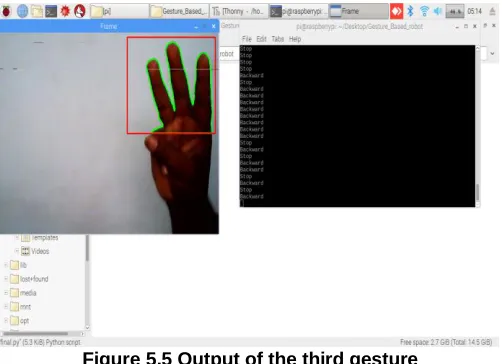
And the third output is that while the users shows three fingers the wheelchair will move in backward direction. Figure 5.5 shows the hand gestures of three fingers and also the direction movement of wheelchair.
Figure 5.5 Output of the third gesture
1254 5.6 shows the hand gestures of four fingers and also
direction of the wheelchair movement.
Figure 5.6 Output of the fourth gesture
And also to stop the wheelchair we can use all fingers folded and that also by using the camera it captures the folded hand and will stop the wheelchair by sending the input through camera to Raspberry-pi. Figure 5.7 shows how to stop the wheelchair using the hand gestures.
Figure 5.7 Output to stop the wheelchair
Thus all five outputs of the proposed systems are shown in the above figures.
6.CONCLUSION AND FUTURE WORK
The proposed system will serve as an active system for the disables persons. It facilitates the disable peoples to move the wheelchair in front, back, left and right direction through the hand gestures. By the hardware modules such as Raspberry-pi and the camera. Since the system uses the hand gestures movement to activate the wheelchair it helps the disabled persons to move in different directions. The added advantages of this system is the use of Raspberry-pi which controls the whole system through its own OS Raspbian. The future scope of this system is to introduced the movement of the wheelchair and their by using this
system in real time system. And also it focus on the improvement of the above proposed system.
7. REFERENCE
[1] PushpendraJha ―Hand Gesture Controlled Wheelchair‖ International Journal of Scientific & Technology Research Volume 5, Issue 04, April 2016.
[2] Prof. Vishal V. Pande, Nikita S.Ubale, Darshana P. Masurkar, Nikita R. Ingole, Pragati P. Man ―Hand Gesture Based Wheelchair Movement Control for Disabled Person Using MEMS‖ International Journal of Engineering Research and Applications, Vol. 4, Issue 4( Version 4), April 2014.
[3] Prof. Chitte p.p., Miss: KhemnarS.B. ,Miss: Kanawade A.A., Miss:Wakale S.B. ― A hand gesture based wheelchair for physically handicapped person with emergency alert system‖International Research Journal of Engineering and Technology (IRJET) Volume: 03 Issue: 04 | Apr-2016.
[4] MahipalManda, B Shankar Babu, M Abhishek and J Srikanth ―Hand Gestures Controlled Wheel Chair‖ Journal of Emerging Technologies and Innovative Research (JETIR) September 2018, Volume 5, Issue 9. [5] TatigutlaAkhila, BadavathMohanrao―Wheel Chair Robot using Raspberry Pi‖ International Journal of Advanced Technology and Innovative Research Volume. 09, IssueNo.09, August-2017.
[6] D. SharathBabuRao, T. Anusha―Gesture Controlled Wheelchair‖ International Journal of Science, Engineering and Technology Research (IJSETR), Volume 4, Issue 8, August-2015.
[7] Mohammad Ilyas Malik,Tanveer Bashir, Mr. Omar Farooq Khan ―Voice Controlled Wheel Chair System‖ International Journal of Computer Science and Mobile Computing, Vol.6 Issue.6, June- 2017.
[8] Prof. Miss. PranitaBhosale, Mr. TapanSingha, Mr. AkshaySatpe, Miss. KajalPatil, ―Wheelchair for Physically Disabled People with Voice & Eye Control‖ Global Research and Development Journal for Engineering | Volume 1 | Issue 6 | May 2016.
[9] Kohei Arai, Ronny Mardiyanto, ―Eyes Based Electric Wheel Chair Control System‖ International Journal of Advanced Computer Science and Applications, Vol. 2, No. 12, 2011.
[10] DulariSahu, ―Automatic Camera Based Eye Controlled Wheelchair System Using Raspberry Pi‖ International Journal of Science, Engineering and Technology Research (IJSETR), Volume 5, Issue 1, January 2016. [11] Abhishek, AbhishekKhandelwal, Gautam Kumar Singh,
Kumar Rahul, Shilpashree P. S. ―Eye Movement Based Electric Wheel Chair‖ International Journal Of Current Engineering And Scientific Research (IJCESR), Volume-3, Issue-5, 2016.
[12] GundaGautam, GundaSumanth, Karthikeyan K C, ShyamSundar, D.Venkataraman , ―Eye Movement Based Electronic Wheel Chair For Physically Challenged Persons‖ International Journal Of Scientific & Technology Research Volume 3, Issue 2, February 2014.
1255 [14] Swati Jajee, Prof. SanjivkumarJalde, ―Voice and Eye
Controlled Smart Wheelchair for Physically Disabled Persons‖ International Journal of Innovative Research in Computer and Communication Engineering .Volume-5, Special Issue-4, June 2017.
[15] Jayashankar.V,Karthikeyan.S, Kirubakaran.N, Nagarjun.M, ―Design and Analysis of Gesture Controlled Wheelchair‖ International Journal of Advance Research and Innovative Ideas in Education,Volume-4, Issue-2 2018.
[16] KonduruSujana, N. Gunasekhar Reddy, ―Hand Gesture Controlled Wheelchair using Raspberry Pi and Open CV‖ International Journal of Scientific Engineering and Technology Research Volume-5, IssueNo-29, September-2016.
[17] DevikaraniPatil, VaralakshmiB.D‖Hand Gesture Recognition for MP3 Player using Image Processing Techniques and PIC16F877‖International Journal of Soft Computing and Engineering (IJSCE)Vol-4Issue-4, September 2014.
[18] RenqiangXieXiaSun, Xiang Xia, and
JunchengCao‖Similarity Matching –Based Extensible Hand Gesture Recognition‖IEEESensors Journal, Volume-15,issue-6.June 2015.
[19] Shivamshinde ,S.D.Lokhande, ‖ Hand gesture recognization for heavy cranes‖,ARIJEET,2015. [20] Jobin Francis, Anoop B K,‖ Significance of Hand
Gesture Recognition Systems in Vehicular Automation- A Survey‖, International Journal of Computer Applications (0975 – 8887) Volume 99– issue No.7, August 2014.
[21] DikshaGoyaland Dr. S. P. Saini ‖ Accelerometer based Hand Gesture Controlled Wheelchair‖ International Journal on Engineering Technologies Volume 4(2):15-20(2013).
[22] Cheng Li and Kris M.Kitani ―Pixel-Level Hand Detection in Ego-Centric Videos‖IEEE Conference on Computer Vision and Pattern Recognition 2013.