University of Pennsylvania
ScholarlyCommons
Publicly Accessible Penn Dissertations
2017
Inference And Learning: Computational Difficulty
And Efficiency
Tengyuan Liang
University of Pennsylvania, [email protected]
Follow this and additional works at:
https://repository.upenn.edu/edissertations
Part of the
Computer Sciences Commons, and the
Statistics and Probability Commons
Recommended Citation
Liang, Tengyuan, "Inference And Learning: Computational Difficulty And Efficiency" (2017).Publicly Accessible Penn Dissertations. 2421.
Inference And Learning: Computational Difficulty And Efficiency
Abstract
In this thesis, we mainly investigate two collections of problems: statistical network inference and model selection in regression. The common feature shared by these two types of problems is that they typically exhibit an interesting phenomenon in terms of computational difficulty and efficiency.
For statistical network inference, our goal is to infer the network structure based on a noisy observation of the network. Statistically, we model the network as generated from the structural information with the presence of noise, for example, planted submatrix model (for bipartite weighted graph), stochastic block model, and Watts-Strogatz model. As the relative amount of ``signal-to-noise'' varies, the problems exhibit different stages of computational difficulty. On the theoretical side, we investigate these stages through characterizing the transition thresholds on the ``signal-to-noise'' ratio, for the aforementioned models. On the methodological side, we provide new computationally efficient procedures to reconstruct the network structure for each model.
For model selection in regression, our goal is to learn a ``good'' model based on a certain model class from the observed data sequences (feature and response pairs), when the model can be misspecified. More concretely, we study two model selection problems: to learn from general classes of functions based on i.i.d. data with minimal assumptions, and to select from the sparse linear model class based on possibly adversarially chosen data in a sequential fashion. We develop new theoretical and algorithmic tools beyond empirical risk
minimization to study these problems from a learning theory point of view.
Degree Type Dissertation
Degree Name
Doctor of Philosophy (PhD)
Graduate Group Statistics
First Advisor Tony T. Cai
Second Advisor Alexander Rakhlin
Subject Categories
INFERENCE AND LEARNING: COMPUTATIONAL DIFFICULTY AND EFFICIENCY
Tengyuan Liang
A DISSERTATION
in
Statistics
For the Graduate Group in Managerial Science and Applied Economics
Presented to the Faculties of the University of Pennsylvania
in
Partial Fulfillment of the Requirements for the
Degree of Doctor of Philosophy
2017
Supervisor of Dissertation
T. Tony Cai
Dorothy Silberberg Professor; Professor of Statistics
Co-Supervisor of Dissertation
Alexander Rakhlin
Associate Professor of Statistics, Computer and Information Science
Graduate Group Chairperson
Catherine Schrand Celia Z. Moh Professor; Professor of Accounting
Dissertation Committee
INFERENCE AND LEARNING: COMPUTATIONAL DIFFICULTY AND
EFFICIENCY
c
COPYRIGHT
2017
Tengyuan Liang
This work is licensed under the
Creative Commons Attribution
NonCommercial-ShareAlike 3.0
License
To view a copy of this license, visit
ACKNOWLEDGEMENT (optional)
I would like to thank Tony Cai, for being an excellent advisor. Tony offered kind support
and insightful advice during my Ph.D. studies. Tony is very generous about his time spent
with students. I am fortunate to come to Penn to work with him. More importantly, I
learned from him how to be a productive researcher.
I would like to thank Alexander (Sasha) Rakhlin, for being an excellent advisor as well. It
was always enjoyable to discuss problems with Sasha and to hear his unique and insightful
feedback. I am indebted to him for showing me many interesting aspects about academia,
and for introducing me to the larger research community.
I would like to thank Mark Low for his dedication to nurturing Ph.D. students. Mark cares
deeply about the overall development of the young generation. I would also like to thank
Mark for bringing me to nice recitals in Kimmel center and Curtis School.
In addition, I would like to thank Elchanan Mossel for stimulating discussions during his
stay at Penn. It was always very interesting to hear his insightful and sharp questions
during the seminar talk.
I am grateful to Larry Brown, Abba Krieger, Ed George, Mike Steele, Nancy Zhang and
Dylan Small for their encouragement.
In the end, I would like to thank my fellow students and postdocs at Penn — Wenxin Zhou,
Yupeng Chen, Yang Jiang, Yin Xia, Xiaodong Li, Jiaming Xu, Weijie Su, Daniel McCarthy,
Matt Olsen, Colin Fogarty, Veronika Rockova, Hyunseung Kang, Sameer Deshpande, Justin
Khim, Min Xu, Yuancheng Zhu, Yiran Chen, Shi Gu, Xiang Fang, Yang Liu and Xingtan
Zhang. I value the friendship I carried on with Kyle Luh, Zhengying Liu, Shuting Lu and
ABSTRACT
INFERENCE AND LEARNING: COMPUTATIONAL DIFFICULTY AND
EFFICIENCY
Tengyuan Liang
T. Tony Cai
Alexander Rakhlin
In this thesis, we mainly investigate two collections of problems: statistical network
infer-ence and model selection in regression. The common feature shared by these two types
of problems is that they typically exhibit an interesting phenomenon in terms of
compu-tational difficulty and efficiency. For statistical network inference, our goal is to infer the
network structure based on a noisy observation of the network. Statistically, we model
the network as generated from the structural information with the presence of noise, for
example, planted submatrix model (for bipartite weighted graph), stochastic block model,
and Watts-Strogatz model. As the relative amount of “signal-to-noise” varies, the problems
exhibit different stages of computational difficulty. On the theoretical side, we investigate
these stages through characterizing the transition thresholds on the “signal-to-noise” ratio,
for the aforementioned models. On the methodological side, we provide new
computation-ally efficient procedures to reconstruct the network structure for each model. For model
selection in regression, our goal is to learn a “good” model based on a certain model class
from the observed data sequences (feature and response pairs), when the model can be
mis-specified. More concretely, we study two model selection problems: to learn from general
classes of functions based on i.i.d. data with minimal assumptions, and to select from the
sparse linear model class based on possibly adversarially chosen data in a sequential
fash-ion. We develop new theoretical and algorithmic tools beyond empirical risk minimization
TABLE OF CONTENTS
ACKNOWLEDGEMENT . . . iv
ABSTRACT . . . v
LIST OF TABLES . . . viii
LIST OF ILLUSTRATIONS . . . 1
CHAPTER 1 : Introduction . . . 1
1.1 Outline . . . 5
1.1.1 Chapter 2 . . . 5
1.1.2 Chapter 3 . . . 6
CHAPTER 2 : Statistical Network Inference and Computation . . . 8
2.1 Submatrix Localization and Bi-Clustering . . . 8
2.1.1 Introduction . . . 8
2.1.2 Computational Boundary . . . 17
2.1.3 Statistical Boundary . . . 26
2.1.4 Discussion . . . 28
2.2 Semi-supervised Community Detection . . . 30
2.2.1 Introduction . . . 30
2.2.2 Preliminaries . . . 37
2.2.3 Number of Communitiesk= 2 : Message Passing with Partial Infor-mation . . . 40
2.2.4 Growing Number of Communities . . . 50
2.2.5 Numerical Studies . . . 56
2.3.1 Introduction . . . 58
2.3.2 The Impossible Region: Lower Bounds . . . 64
2.3.3 Hard vs. Easy Regions: Detection Statistics . . . 66
2.3.4 Reconstructable Region: Fast Structural Reconstruction . . . 69
2.3.5 Discussion . . . 73
CHAPTER 3 : Regression, Learning and Model Selection . . . 76
3.1 Learning under Square Loss with Offset Rademacher Complexity . . . 76
3.1.1 Introduction . . . 76
3.1.2 Problem Description and the Estimator . . . 78
3.1.3 A Geometric Inequality . . . 79
3.1.4 Symmetrization . . . 83
3.1.5 Offset Rademacher Process: Chaining and Critical Radius . . . 85
3.1.6 Examples . . . 90
3.1.7 Lower bound on Minimax Regret via Offset Rademacher Complexity 92 3.2 Geometric Inference for General High Dimensional Linear Models . . . 94
3.2.1 Introduction . . . 94
3.2.2 Preliminaries and Algorithms . . . 101
3.2.3 Local Geometric Theory: Gaussian Setting . . . 110
3.2.4 Local Geometric Theory: General Setting . . . 121
3.2.5 Discussion . . . 124
3.3 Adaptive Feature Selection: Efficient Online Sparse Regression . . . 125
3.3.1 Introduction . . . 125
3.3.2 Realizable Model . . . 132
3.3.3 Agnostic Setting . . . 137
3.3.4 Conclusions and Future Work . . . 143
APPENDIX . . . 144
LIST OF ILLUSTRATIONS
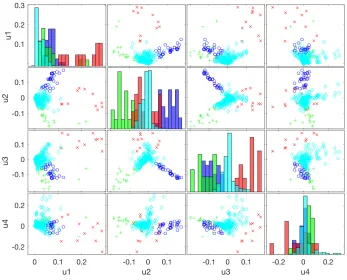
FIGURE 1 : Plot of the community structure in the space spanned by the top
four left singular vectors. Here each color represents a community
and ui,1 ≤ i ≤ 4 denotes the singular vectors respectively. For
instance, the top right subfigure denotes projecting the nodes onto
the space spanned by (u4, u1). . . 2
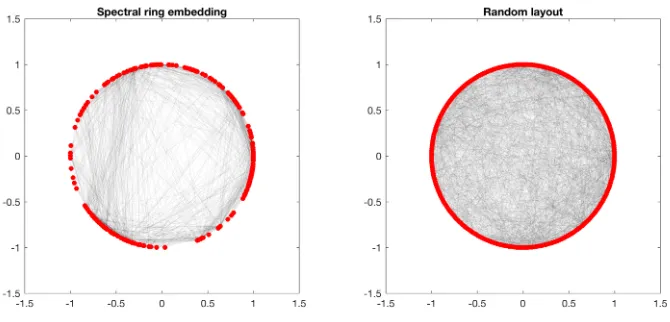
FIGURE 2 : Plot of the ring lattice structure. On the left, the layout is returned
by our spectral embedding algorithm; on the right, the layout is
returned by a random permutation. . . 3
FIGURE 3 : Simulated neuron data with three fitting models: cubic smoothing
spline, polynomial regression of degree 4, and Bayesian adaptive
regression splines (BARS). . . 4
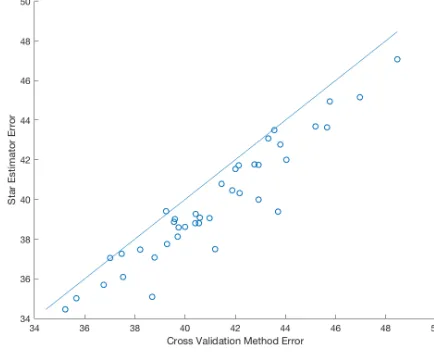
FIGURE 4 : Plot of MSE of Star algorithm compared to cross validation. . . 4
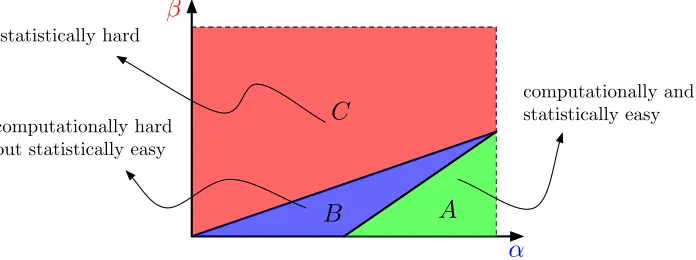
FIGURE 5 : Phase diagram for submatrix localization. Red region (C):
statis-tically impossible, where even without computational budget, the
problem is hard. Blue region (B): statistically possible but
compu-tationally expensive (under the hidden clique hypothesis), where
the problem is hard to all polynomial time algorithm but easy with
exponential time algorithm. Green region (A): statistically possible
and computationally easy, where a fast polynomial time algorithm
will solve the problem. . . 13
FIGURE 7 : Illustration of recursion in Eq. (2.14) for messages on a d-regular
tree. Hered= 3 with two unlabeled children ((1−δ)d= 2, denoted
by blue) and one labeled child (δd= 1, denoted by black), and the
depth is 2. Ct(ρ) denotes depth t children of the root ρ. The red
arrows correspond to messages received from the labeled children
and black arrow are from the unlabeled children. . . 45
FIGURE 8 : AMP algorithm on Political Blog Dataset. . . 57
FIGURE 9 : Phase diagram for small-world network: impossible region (red
re-gion I), hard rere-gion (blueregion II), easy region (greenregion III),
and reconstructable region (cyanregion IV). . . 63
FIGURE 10 : Phase diagram for small-world networks: impossible region (red
re-gion I), hard rere-gion (blueregion II), easy region (greenregion III),
and reconstructable region (cyan region IV and IV’). Compared
to Figure 9, the spectral ordering procedure extends the
recon-structable region (IV) whenkn1516 (IV’). . . 72
FIGURE 11 : Ring embedding of Les Mis´erable co-appearance network. . . 73
FIGURE 12 : The structural matrices for stochastic block model (left), mixed
membership SBM (middle), and small-world model (right). The
black location denotes the support of the structural matrix. . . . 74
FIGURE 13 : Proof of the geometry inequality. The solid and dotted balls are
B(Y,kbg−Ykn) and B(Y,kfb−Ykn), respectively. . . 80
FIGURE 14 : Tangent cone: general illustration in 2D. The red shaped area is
the scaled convex hull of atom set. The blue dashed line forms the
tangent cone at M. Black arrow denotes the possible directions
inside the cone. . . 104
FIGURE 15 : Tangent cone illustration in 3D for sparse regression. For three
possible locations Mi,1 ≤ i ≤ 3, the tangent cone are different,
CHAPTER 1 : Introduction
The unprecedented “data deluge” emerging in science and engineering in recent years poses
many challenges to the development of theory and methodology. Specifically, part of the
new features of these challenges can be summarized as follows:
• Inference How to make inference on a large amount of unknown variables or
param-eters with limited amount of partial, noisy, and indirect measurements (observations)?
• Learning How to predict as well as a class of complex models (non-linear and
non-convex), using heterogeneous data that can be arbitrary or even adversarial, in
various specific protocols (online, bandit feedback, partial information)?
• Computation Computation adds a new dimension to this modern challenge. As
the scale of the data increases significantly, how to take computational and memory
budgets into account when designing inference and learning algorithms?
The goal of this thesis is to investigate these features for two collections of problems:
statis-tical network inference, and model selection in regression. We will start with two concrete
data examples as a gentle introduction to motivate our studies, then we will move to the
outline of the remaining chapters before stepping into detailed discussions.
Structural inference of C. elegans neuron network In this paragraph, we will use
the C. elegans neuron network (Pavlovic et al., 2014) as an example to illustrate the
im-portance of structural inference for complex networks, which is the focus of Chapter 2. C.
elegans is one of the simplest organisms with a nervous system whose neuronal “wiring
diagram” (neural connections) has been completed (with around 300 neurons and 2000
edges). In practice, it is important to understand the structural information of the complex
systems/networks based on the connection patterns. From the statistical side, researchers
often model the network as generated from some statistical model (for example, stochastic
structure from the data. Brute-force maximum likelihood based approach is usually
com-putationally prohibitive with large scale networks. Therefore, it is important to understand
when we can solve the inference problem in a computationally efficient manner. Here we
illustrate some of the methods proposed in Chapter 2 on this C.elegans network.
We apply the algorithm proposed in Chapter 2.1 on discovering the community structure
on this dataset. Figure 1 summarizes the community structure we discover.
Figure 1: Plot of the community structure in the space spanned by the top four left singular vectors. Here each color represents a community and ui,1 ≤ i ≤ 4 denotes the singular vectors respectively. For instance, the top right subfigure denotes projecting the nodes onto the space spanned by (u4, u1).
We also apply the algorithm proposed in Chapter 2.3 on reconstructing the ring lattice
structure on this dataset. Figure 2 describes the result. On the left, we solve for the ring
the nodes. On the right, we randomly permute the nodes as the circle layout (what one
expects to see without the ring lattice structure). As a contrast, one can clearly see the
edges are much better organized in the left compared to the right, suggesting the presence
of Watts-Strogatz ring lattice structure.
Figure 2: Plot of the ring lattice structure. On the left, the layout is returned by our spectral embedding algorithm; on the right, the layout is returned by a random permutation.
Model selection for fitting neuronal data In this paragraph, we will employ simulated
neuronal data (Kaufman et al., 2005) to motivate the focus of Chapter 3 — model selection
in regression. The task is to predict the firing rate of neurons based on the simulated data as
good as the best one among a collection of models. Specifically, in Figure 3, we fitted three
models, cubic smoothing spline, polynomial regression of degree 4, and Bayesian adaptive
regression splines (BARS). Traditionally, model selection is typically addressed using
cross-validation (CV) in a general way. However, it is questionable whether CV will provide
the optimal behavior, let alone the computational burden when facing a large collection of
Figure 3: Simulated neuron data with three fitting models: cubic smoothing spline, poly-nomial regression of degree 4, and Bayesian adaptive regression splines (BARS).
We apply the two-step Star algorithm proposed in Chapter 3.1 on the neuronal dataset,
and summarize the result in Figure 4. Here each data point corresponds to one experiment,
whose x-axis denotes the mean square error (MSE) of the cross-validation, and y-axis
de-notes the MSE of the Star algorithm. As one can see, clearly the Star algorithm outperforms
the CV significantly over many experiments.
1.1. Outline
1.1.1. Chapter 2
Historically, statisticians and information theorists mostly focus on analyzing the threshold
that separates “signal” and “noise” over random instances (in the average-case sense),
over-looking computation complexity. However, computer scientists are usually concerned with
quantifying problems according to their computational difficulty in the worst-case sense. In
this chapter, we will investigate the intersection of the above perspectives. For an average
instance, we would like to: (a) identify the statistical threshold that describes the solvability
of the problem information-theoretically, and (b) quantify the computational threshold that
sheds light on the difficulty for polynomial-time algorithms (inside the statistically solvable
phase).
In Cai et al. (2015a), we examined the above two thresholds on the problem of
subma-trix localization with background noise. We discovered that, quite surprisingly, there is
always an intrinsic gap between computational and statistical thresholds under standard
computational hardness assumption. There is a non-vanishing phase quantifying the price
to pay for pursuing polynomial run-time. We established the computational optimality in
two stages: (a) we provided a new average-case reduction to the hidden clique problem; (b)
we proposed a simple near-linear time algorithm that achieves the computational threshold.
Overall, this work illustrates that for certain statistical problems, there are more structured
phases inside the statistically-solvable phase.
Motivated by the fact that real network datasets always contain side information (partial
labels, nodes’ features) in addition to the connections, our work Cai et al. (2016c) studied
the computational difficulty of partially-labeled stochastic block models when a vanishing
portion of true labels are revealed. One the one hand, we derived and analyzed a new
lo-cal algorithm — linearized message passing — that achieves exponential decaying error for
we proved that this K-S threshold is indeed the barrier for all local algorithms
(heuristi-cally believed to be powerful polynomial time algorithms) through a minimax lower bound.
Whether the gap between K-S and information-theoretic threshold (with growing number
of blocks) is inevitable for polynomial time algorithms, remains an open problem.
In Cai et al. (2016a), we initiated the investigation of the corresponding thresholds for
detec-tion and structural reconstrucdetec-tion in Watts-Strogatz (W-S) small world networks. The W-S
model with neighborhood size kand rewiring probability β can be viewed as a continuous
interpolation between a deterministic ring lattice graph and the Erd˝os-R´enyi random graph.
We studied both the computational and statistical aspects of detecting the deterministic
ring lattice structure (or local geographical links) in the presence of random connections (or
long range links), and for its recovery. We partitioned parameter space (k, β) into several
phases according to the difficulty of the problem, and proposed distinct methods that
math-ematically achieve the corresponding thresholds separating the phases. We implemented our
spectral ring embedding algorithm on the Les Mis´erables co-appearance network.
1.1.2. Chapter 3
In this chapter we will study regression and model selection problem focusing on two aspects:
(a) model misspecification; (b) model class can be non-convex. For the first point, classic
decision theory is concerned with making decisions from i.i.d. data generated from a
well-specified statistical model. However, one should be agnostic about these two assumptions:
(a) the i.i.d. data may be generated from a mis-specified model; (b) the underlying stochastic
process generating the data is non-i.i.d., even adversarially chosen by oblivious nature.
Statistical learning theory and online learning provide handful tools to solve these two
problems respectively. For the second point, when the model class is non-convex (such as
sparse linear regression and finite aggregation), we would like to understand its consequences
on the estimation/prediction procedure and accuracy, as well as the computation difficulty.
learning setting (i.i.d., mis-specified model), for general classes of functions that can be
unbounded and non-convex. We introduced a new notion of offset Rademacher complexity,
and showed that the excess loss can be upper bounded by this new complexity through a
novel geometric inequality. We achieved this goal through: (a) proposing a novel two-step
estimator; (b) adopting the symmetrization and chaining tools in empirical processes theory
to this offset complexity. We showed that localization for unbounded class is automatic
through this offset analysis. This new framework recovers the sharp rates in parametric
regression, finite aggregation, and non-parametric regression simultaneously.
Cai et al. (2016b) presents a unified geometric framework for the statistical analysis of a
general ill-posed linear inverse model which includes as special cases noisy compressed
sens-ing, sign vector recovery, trace regression, orthogonal matrix estimation, and noisy matrix
completion. We propose computationally feasible convex programs for statistical inference
including estimation, confidence intervals and hypothesis testing. A theoretical framework
is developed to characterize the local estimation rate of convergence and to provide
sta-tistical inference guarantees. Our results are built based on the local conic geometry and
duality. The difficulty of statistical inference is captured by the geometric characterization
of the local tangent cone through the Gaussian width and Sudakov estimate.
Online sparse linear regression is an online problem where an algorithm repeatedly chooses
a subset of coordinates to observe in an adversarially chosen feature vector, makes a
real-valued prediction, receives the true label, and incurs the squared loss. The goal is to design
an online learning algorithm with sublinear regret to the best sparse linear predictor in
hind-sight. Without any assumptions, this problem is known to be computationally intractable.
In Kale et al. (2017), we make the assumption that data matrix satisfies restricted
isome-try property, and show that this assumption leads to computationally efficient algorithms
with sublinear regret for two variants of the problem. In the first variant, the true label is
generated according to a sparse linear model with additive Gaussian noise. In the second,
CHAPTER 2 : Statistical Network Inference and Computation
2.1. Submatrix Localization and Bi-Clustering
2.1.1. Introduction
The “signal + noise” model
X=M+Z, (2.1)
where M is the signal of interest and Z is noise, is ubiquitous in statistics and is used
in a wide range of applications. Such a “signal + noise” model has been well studied
in statistics in a number of settings, including nonparametric regression where M is a
function, and the Gaussian sequence model where M is a finite or an infinite dimensional
vector. See, for example, Tsybakov (2009); Johnstone (2013) and the references therein.
In nonparametric regression, the structural knowledge on M is typically characterized by
smoothness, and in the sequence model the structural knowledge on M is often described
by sparsity. Fundamental statistical properties such as the minimax estimation rates and
the signal detection boundaries have been established under these structural assumptions.
For a range of contemporary applications in statistical learning and signal processing,M and
Z in the “signal + noise” model (2.1) are high-dimensional matrices (Tufts and Shah, 1993;
Drineas et al., 2006; Donoho and Gavish, 2014; Chandrasekaran et al., 2009; Cand`es et al.,
2011). In this setting, many new interesting problems arise under a variety of structural
assumptions onM and the distribution ofZ. Examples include sparse principal component
analysis (PCA) (Vu and Lei, 2012; Berthet and Rigollet, 2013b; Birnbaum et al., 2013;
Cai et al., 2013, 2015b), low-rank matrix de-noising (Donoho and Gavish, 2014), matrix
factorization and decomposition (Chandrasekaran et al., 2009; Cand`es et al., 2011; Agarwal
et al., 2012), non-negative PCA (Zass and Shashua, 2006; Montanari and Richard, 2014),
synchronization and planted partition (Javanmard et al., 2015; Decelle et al., 2011), among
many others. In the conventional statistical framework, the goal is developing optimal
statistical procedures (for estimation, testing, etc), where optimality is understood with
respect to the sample size and parameter space.
When the dimensionality of the data becomes large as in many contemporary applications,
the computational concerns associated with the statistical procedures come to the
fore-front. After all, statistical methods are useful in practice only if they can be computed
within a reasonable amount of time. A fundamental question is: Is there a price to pay
for statistical performance if one only considers computable (polynomial-time) procedures?
This question is particularly relevant for non-convex problems with combinatorial
struc-tures. These problems pose a significant computational challenge because naive methods
based on exhaustive search are typically not computationally efficient. Trade-off between
computational efficiency and statistical accuracy in high-dimensional inference has drawn
increasing attention in the literature. In particular, Chandrasekaran et al. (2012) and
Wain-wright (2014) considered a general class of linear inverse problems, with different emphasis
on geometry of convex relaxation and decomposition of statistical and computational
er-rors. Chandrasekaran and Jordan (2013) studied an approach for trading off computational
demands with statistical accuracy via relaxation hierarchies. Berthet and Rigollet (2013a);
Ma and Wu (2013a); Zhang et al. (2014b) focused on computational difficulties for various
statistical problems, such as detection and regression.
In the present thesis, we study the interplay between computational efficiency and statistical
accuracy in submatrix localization based on a noisy observation of a large matrix. The
Problem Formulation
Consider the matrix X of the form
X=M+Z, where M =λ·1Rm1 T
Cn (2.2)
and 1Rm ∈R
mdenotes a binary vector with 1 on the index setR
mand zero otherwise. Here,
the entriesZij of the noise matrix are i.i.d. zero-mean sub-Gaussian random variables with
parameterσ (defined formally in Equation (2.5)). Given the parameters m, n, km, kn, λ/σ,
the set of all distributions described above – for all possible choices ofRm and Cn – forms
the submatrix model M(m, n, km, kn, λ/σ).
This model can be further extended to multiple submatrices where
M =
r
X
s=1
λs·1Rs1 T
Cs (2.3)
where |Rs| = ks(m) and |Cs| = ks(n) denote the support set of the s-th submatrix. For
simplicity, we first focus on the single submatrix and then extend the analysis to the model
(2.3) in Section 2.1.2.
There are two fundamental questions associated with the submatrix model (2.2). One is the
detection problem: given one observation of the X matrix, decide whether it is generated
from a distribution in the submatrix model or from the pure noise model. Precisely, the
detection problem considers testing of the hypotheses
H0 :M =0 v.s. Hα :M ∈ M(m, n, km, kn, λ/σ).
The other is thelocalization problem, where the goal is to exactly recover the signal index
setsRmandCn(the support of the mean matrixM). It is clear that the localization problem
focus of the current thesis is on the localization problem. As we will show in this thesis,
the localization problem requires larger signal to noise ratio, as well as novel algorithm and
analysis to exploit the submatrix structure.
Main Results
To state our main results, let us first define a hierarchy of algorithms in terms of their
worst-case running time on instances of the submatrix localization problem:
LinAlg⊂PolyAlg⊂ExpoAlg⊂AllAlg.
The setLinAlgcontains algorithmsA that produce an answer (in our case, the localization
subset ˆRA
m,CˆnA) in time linear inm×n(the minimal computation required to read the
ma-trix). The classesPolyAlgandExpoAlg of algorithms, respectively, terminate in polynomial
and exponential time, whileAllAlg has no restriction.
Combining Theorem 2.1.3 and 2.1.4 in Section 2.1.2 and Theorem 2.1.5 in Section 2.1.3,
the statistical and computational boundaries for submatrix localization can be summarized
as follows. The notations %,-,are formally defined in Section 2.1.1.
Theorem 2.1.1 (Computational and Statistical Boundaries). Consider the submatrix
lo-calization problem under the model (2.2). The computational boundary SNRc for the dense
case when min{km, kn}%max{m1/2, n1/2} is
SNRc
r
m∨n
kmkn +
r logn
km ∨
logm kn
,
in the sense that
lim m,n,km,kn→∞
inf
A∈LinAlg Msup∈MP
ˆ
RmA 6=Rm or CˆnA 6=Cn
= 0, if λ
σ %SNRc
lim m,n,km,kn→∞
inf
A∈PolyAlg Msup∈MP
ˆ
RAm6=Rm or CˆnA6=Cn
>0, if λ
where (2.4)holds under the Hidden Clique hypothesis HCl(see Section 2.1.2). For the sparse
case when max{km, kn} -min{m1/2, n1/2}, the computational boundary is SNRc= Θ∗(1),
more precisely
1-SNRc
-r
logm∨n
kmkn
.
The statistical boundary SNRs is
SNRs
r logn
km ∨
logm kn
,
in the sense that
lim m,n,km,kn→∞
inf
A∈ExpoAlg Msup∈MP
ˆ
RAm6=Rm or CˆnA6=Cn
= 0, if λ
σ %SNRs
lim m,n,km,kn→∞
inf
A∈AllAlg Msup∈MP
ˆ
RAm6=Rm or CˆnA6=Cn
>0, if λ
σ -SNRs
under the minimal assumption max{km, kn}-min{m, n}.
If we parametrize the submatrix model as m=n, km knk= Θ∗(nα), λ/σ = Θ∗(n−β),
for some 0< α, β <1, we can summarize the results of Theorem 2.1.1 in a phase diagram,
as illustrated in Figure 5.
To explain the diagram, consider the following cases. First, the statistical boundary is
r logn
km ∨
logm kn
,
which gives the line separating the red and the blue regions. For the dense regimeα≥1/2,
the computational boundary given by Theorem 2.1.1 is
r
m∨n
kmkn +
r logn
km ∨
logm kn
,
↵
computationally and statistically easy computationally hard
but statistically easy statistically hard
B
A
C
Figure 5: Phase diagram for submatrix localization. Red region (C): statistically impos-sible, where even without computational budget, the problem is hard. Blue region (B): statistically possible but computationally expensive (under the hidden clique hypothesis), where the problem is hard to all polynomial time algorithm but easy with exponential time algorithm. Green region (A): statistically possible and computationally easy, where a fast polynomial time algorithm will solve the problem.
regime α < 1/2, the computational boundary is Θ(1) -SNRc - Θ(
q
log m∨n
kmkn), which is
the horizontal line connecting (α= 0, β= 0) to (α= 1/2, β= 0).
As a key part of Theorem 2.1.1, we provide linear time spectral algorithm that will succeed
in localizing the submatrix with high probability in the regime above the computational
threshold. Furthermore, the method is data-driven and adaptive: it does not require the
prior knowledge on the size of the submatrix. This should be contrasted with the method of
Chen and Xu (2014) which requires the prior knowledge ofkm, kn; furthermore, the running
time of their SDP-based method is superlinear innm. Under the hidden clique hypothesis,
we prove that below the computational threshold there is no polynomial time algorithm
that can succeed in localizing the submatrix. We remark that the computational lower
bound for localization requires distinct new techniques compared to the lower bound for
detection; the latter has been resolved in Ma and Wu (2013a).
Beyond localization of one single submatrix, we generalize both the computational and
sta-tistical story to a growing number of submatrices in Section 2.1.2. As mentioned earlier, the
culty of localization for a growing number of submatrices, at the expense of not providing
the exact constants for the thresholds.
The phase transition diagram in Figure 5 for localization should be contrasted with the
corresponding result for detection, as shown in (Butucea and Ingster, 2013; Ma and Wu,
2013a). For a large enough submatrix size (as quantified byα >2/3), the
computationally-intractable-but-statistically-possible region collapses for the detection problem, but not for
localization. In plain words, detecting the presence of a large submatrix becomes both
computationally and statistically easy beyond a certain size, while for localization there
is always a gap between statistically possible and computationally feasible regions. This
phenomenon also appears to be distinct to that of other problems like estimation of sparse
principal components (Cai et al., 2013), where computational and statistical easiness
coin-cide with each other over a large region of the parameter spaces.
Prior Work
There is a growing body of work in statistical literature on submatrix problems.
Arias-Castro et al. (2011) studied the detection problem for a cluster inside a large matrix.
Butucea and Ingster (2013); Butucea et al. (2013) formulated the submatrix detection
and localization problems under Gaussian noise and determined sharp statistical transition
boundaries. For the detection problem, Ma and Wu (2013a) provided a computational lower
bound result under the assumption that hidden clique detection is computationally difficult.
Shabalin et al. (2009) provided a fast iterative maximization algorithm to heuristically solve
the submatrix localization problem. Balakrishnan et al. (2011); Kolar et al. (2011) focused
on statistical and computational trade-offs for the submatrix localization problem. Under
the sparse regimekm -m1/2 andkn-n1/2, the entry-wise thresholding turns out to be the
“near optimal” polynomial-time algorithm (which we will show to be a de-noised spectral
algorithm that perform slightly better in Section 2.1.2). However, for the dense regime when
in the sense that there are other polynomial-time algorithm that can succeed in finding the
submatrix with smaller SNR. Concurrently with our work, Chen and Xu (2014) provided a
convex relaxation algorithm that improves the SNR boundary of Kolar et al. (2011) in the
dense regime. On the computational downside, the implementation of the method requires
a full SVD on each iteration, and therefore does not scale well with the dimensionality
of the problem. Furthermore, there is no computational lower bound in the literature to
guarantee the optimality of the SNR boundary achieved in Chen and Xu (2014). A problem
similar to submatrix localization is that of clique finding in random graph. Deshpande and
Montanari (2013) presented an iterative approximate message passing algorithm to solve
the latter problem with sharp boundaries on SNR.
We would like to emphasize on the differences between the localization and the
detec-tion problems. In terms of the theoretical results, unlike detecdetec-tion, there is always a gap
between statistically optimal and computationally feasible regions for localization. This
non-vanishing computational-to-statistical-gap phenomenon also appears in the community
detection literature with growing number of communities (Decelle et al., 2011). In terms of
the methodology, for detection, combining the results in (Donoho and Jin, 2004; Ma and
Wu, 2013a), there is no loss in treating M in model (2.2) as a vector and applying the
higher criticism method (Donoho and Jin, 2004) to the vectorized matrix for the problem of
submatrix detection, in the computationally efficient region. In fact, the procedure achieves
sharper constants in the Gaussian setting. However, in contrast, we will show that for
lo-calization, it is crucial to utilize the matrix structure, even in the computationally efficient
region.
Organization
The section is organized as follows. Section 2.1.2 establishes the computational boundary,
with the computational lower bounds given in Section 2.1.2 and upper bound results in
2.1.2. The upper and lower bounds for statistical boundary for multiple submatrices are
discussed in Section 2.1.3. A short discussion is given in Section 2.1.4. Technical proofs are
deferred to Appendix.
Notation
Let [m] denote the index set{1,2, . . . , m}. For a matrix X ∈Rm×n,Xi· ∈Rn denotes its
i-th row andX·j ∈Rm denotes itsj-th column. For any I ⊆[m], J ⊆[n], XIJ denotes the
submatrix corresponding to the index setI×J. For a vectorv∈Rn,kvk`p = ( P
i∈[n]|vi|p)1/p
and for a matrix M ∈ Rm×n, kMk`p = supv=6 0kM vk`p/kvk`p. When p = 2, the latter is
the usual spectral norm, abbreviated askMk2. The nuclear norm of a matrixM is convex
surrogate for the rank, with the notation to bekMk∗. The Frobenius norm of a matrixM
is defined as kMkF =
q P
i,jMij2. The inner product associated with the Frobenius norm
is defined as hA, Bi=tr(ATB).
Denote the asymptotic notationa(n) = Θ(b(n)) if there exist two universal constantscl, cu
such that cl ≤ lim
n→∞a(n)/b(n)≤nlim→∞a(n)/b(n) ≤cu. Θ
∗ is asymptotic equivalence hiding
logarithmic factors in the following sense: a(n) = Θ∗(b(n)) iff there exists c >0 such that
a(n) = Θ(b(n) logcn). Additionally, we use the notationa(n)b(n) as equivalent toa(n) =
Θ(b(n)), a(n)%b(n) iff limn→∞a(n)/b(n) =∞ anda(n)-b(n) iff limn→∞a(n)/b(n) = 0.
We define the zero-mean sub-Gaussian random variable z with sub-Gaussian parameter σ
in terms of its Laplacian
Eeλz≤exp(σ2λ2/2), for all λ >0, (2.5)
then we have
We call a random vectorZ ∈Rn isotropic with parameterσ if
E(vTZ)2 =σ2kvk2`2, for all v∈R
n.
Clearly, Gaussian and Bernoulli measures, and more general product measures of zero-mean
sub-Gaussian random variables satisfy this isotropic definition up to a constant scalar factor.
2.1.2. Computational Boundary
We characterize in this section the computational boundaries for the submatrix localization
problem. Sections 2.1.2 and 2.1.2 consider respectively the computational lower bound and
upper bound. The computational lower bound given in Theorem 2.1.2 is based on the
hidden clique hypothesis.
Algorithmic Reduction and Computational Lower Bound
Theoretical Computer Science identifies a range of problems which are believed to be “hard,”
in the sense that in the worst-case the required computation grows exponentially with the
size of the problem. Faced with a new computational problem, one might try to reduce any
of the “hard” problems to the new problem, and therefore claim that the new problem is
as hard as the rest in this family. Since statistical procedures typically deal with a random
(rather than worst-case) input, it is natural to seek token problems that are believed to be
computationally difficult on average with respect to some distribution on instances. The
hidden clique problem is one such example (for recent results on this problem, see Feldman
et al. (2013); Deshpande and Montanari (2013)). While there exists a quasi-polynomial
algorithm, no polynomial-time method (for the appropriate regime, described below) is
known. Following several other works on reductions for statistical problems, we work under
the hypothesis that no polynomial-time method exists.
Let us make the discussion more precise. Consider the hidden clique modelG(N, κ) where
model, a random graph instance is generated in the following way. Choose κ clique nodes
uniformly at random from all the possible choices, and connect all the edges within the
clique. For all the other edges, connect with probability 1/2.
Hidden Clique Hypothesis for Localization (HCl) Consider the random instance
of hidden clique model G(N, κ). For any sequence κ(N) such that κ(N) ≤ Nβ for some
0< β <1/2, there is no randomized polynomial time algorithm that can find the planted
clique with probability tending to 1 as N → ∞. Mathematically, define the randomized
polynomial time algorithm class PolyAlgas the class of algorithmsA that satisfies
lim
N,κ(N)→∞A∈supPolyAlgE
CliquePG(N,κ)|Clique(runtime of A not polynomial inN) = 0.
Then
lim N,κ(N)→∞
inf
A∈PolyAlgECliquePG(N,κ)|Clique(clique set returned by Anot correct)>0,
where PG(N,κ)|Clique is the (possibly more detailed due to randomness of algorithm) σ-field
conditioned on the clique location and EClique is with respect to uniform distribution over
all possible clique locations.
Hidden Clique Hypothesis for Detection (HCd) Consider the hidden clique model
G(N, κ). For any sequence ofκ(N) such thatκ(N)≤Nβ for some 0< β <1/2, there is no
randomized polynomial time algorithm that can distinguish between
H0 : PER v.s. Hα: PHC
with probability going to 1 as N → ∞. Here PER is the Erd˝os-R´enyi model, while PHC is
More precisely,
lim N,κ(N)→∞
inf
A∈PolyAlgECliquePG(N,κ)|Clique(detection decision returned by Awrong)>0,
wherePG(N,κ)|Clique andEClique are the same as defined in HCl.
The hidden clique hypothesis has been used recently by several authors to claim
compu-tational intractability of certain statistical problems. In particular, Berthet and Rigollet
(2013a); Ma and Wu (2013a) assumed the hypothesis HCd and Wang et al. (2014) used
HCl. Localization is harder than detection, in the sense that if an algorithm A solves the
localization problem with high probability, it also correctly solves the detection problem.
Assuming that no polynomial time algorithm can solve the detection problem implies
im-possibility results in localization as well. In plain language,HCl is a milder hypothesis than
HCd.
We will provide computational lower bound result for localization in Theorem 2.1.2. In
Appendix, we contrast the difference of lower bound constructions between localization and
detection. The detection computational lower bound was proved in Ma and Wu (2013a).
For the localization computational lower bound, to the best of our knowledge, there is no
proof in the literature. Theorem 2.1.2 ensures the upper bound in Lemma 2.1.1 being sharp.
Theorem 2.1.2 (Computational Lower Bound for Localization). Consider the submatrix
model (2.2) with parameter tuple (m = n, km kn nα, λ/σ = n−β), where 12 < α <
1, β >0. Under the computational assumption HCl, if
λ
σ
-r
m+n
kmkn ⇒
β > α−1
2,
it is not possible to localize the true support of the submatrix with probability going to 1
within polynomial time.
the usual computational lower bound arguments. Bootstrapping introduces an additional
randomness on top of the randomness in the hidden clique. Careful examination of these
two σ-fields allows us to write the resulting object into mixture of submatrix models. For
submatrix localization we need to transform back the submatrix support to the original
hidden clique support exactly, with high probability. In plain language, even though we
lose track of the exact location of the support when reducing the hidden clique to submatrix
model, we can still recover the exact location of the hidden clique with high probability.
For technical details of the proof, please refer to the Appendix.
Adaptive Spectral Algorithm and Upper Bound
In this section, we introduce linear time algorithm that solves the submatrix localization
problem above the computational boundary SNRc. Our proposed localization Algorithms
1 and 2 are motivated by the spectral algorithm in random graphs (McSherry, 2001; Ng
et al., 2002).
Algorithm 1 Vanilla Spectral Projection Algorithm for Dense Regime Input: X∈Rm×n the data matrix.
Output: A subset of the row indexes ˆRm and a subset of column indexes ˆCn as the
local-ization sets of the submatrix.
1. Compute top left and top right singular vectorsU·1andV·1, respectively (these correspond
to the SVDX =UΣVT)
2. To compute ˆCn, calculate the inner productsU·T1X·j ∈R,1≤j≤n. These values form
two data-driven clusters, and a cut at the largest gap between consecutive values returns
the subsets ˆCn and [n]\Cˆn. Similarly, for the ˆRm, calculate Xi·V·1 ∈ R,1 ≤ i ≤ m and
obtain two separated clusters.
The proposed algorithm has several advantages over the localization algorithms that
ap-peared in literature. First, it is a linear time algorithm (that is, Θ(mn) time complexity).
ef-ficient both in terms of space and time. Secondly, this algorithm does not require the prior
knowledge of km and kn and automatically adapts to the true submatrix size.
Lemma 2.1.1 below justifies the effectiveness of the spectral algorithm.
Lemma 2.1.1 (Guarantee for Spectral Algorithm). Consider the submatrix model (2.2),
Algorithm 1 and assume min{km, kn} % max{m1/2, n1/2}. There exist a universal C > 0
such that when
λ
σ ≥C·
r
m∨n
kmkn +
r logn
km ∨
logm kn
! ,
the spectral method succeeds in the sense that Rˆm =Rm,Cˆn =Cn with probability at least
1−m−c−n−c−2 exp (−c(m+n)).
Remark 2.1.1. The theory and algorithm remain the same if the signal matrixM is more
general in the following sense: M has rank one, its left and right singular vectors are sparse,
and the nonzero entries of the singular vectors are of the same order. Mathematically,
M = λ√kmkn·uvT, where u, v are unit singular vectors with km, kn non-zero entries,
and |u|max/|u|min ≤ c and |v|max/|v|min ≤ c for some constant c ≥ 1. Here for a vector
w, |w|max and |w|min denote respectively the largest and smallest magnitudes among the
nonzero coordinates. When c = 1, the algorithm is fully data-driven and does not require
the knowledge of λ, σ, km, kn. When c is large but finite, one may require in addition the
knowledge of km and kn to perform the final cut to obtain ˆCn and ˆRm.
Dense Regime
We are now ready to state the SNR boundary for polynomial-time algorithms (under an
appropriate computational assumption), thus excluding the exhaustive search procedure.
The results hold under the dense regime when k%n1/2.
Theorem 2.1.3 (Computational Boundary for Dense Regime). Consider the submatrix
model (2.2)and assume min{km, kn}%max{m1/2, n1/2}. There exists a critical rate
SNRc
r
m∨n
k k +
r logn
k ∨
for the signal to noise ratio SNRc such that for λ/σ % SNRc, both the adaptive linear
time Algorithm 1 and convex relaxation (runs in polynomial time) will succeed in submatrix
localization, i.e., Rˆm =Rm,Cˆn = Cn, with high probability. For λ/σ -SNRc, there is no
polynomial time algorithm that will work under the hidden clique hypothesis HCl.
The proof of the above theorem is based on the theoretical justification of the spectral
Algorithm 1 and the new computational lower bound result for localization in Theorem
2.1.2. We remark that the analyses can be extended to multiple, even growing number of
submatrices case. We postpone a proof of this fact to Section 2.1.2 for simplicity and focus
on the case of a single submatrix.
Sparse Regime
Under the sparse regime whenk-n1/2, a naive plug-in of Lemma 2.1.1 requires theSNR
c
to be larger than Θ(n1/2/k) % √logn, which implies the vanilla spectral Algorithm 1 is
outperformed by simple entrywise thresholding. However, a modified version with
entry-wise soft-thresholding as a preprocessing de-noising step turns out to provide near optimal
performance in the sparse regime. Before we introduce the formal algorithm, let us define
the soft-thresholding function at level tto be
ηt(y) = sign(y)(|y| −t)+. (2.6)
Soft-thresholding as a de-noising step achieving optimal bias-and-variance trade-off has been
widely understood in the wavelet literature, for example, see Donoho and Johnstone (1998).
Now we are ready to state the following de-noised spectral Algorithm 2 to localize the
Algorithm 2 De-noised Spectral Algorithm for Sparse Regime
Input: X∈Rm×n the data matrix, a thresholding level t= Θ(σ
q
log m∨n kmkn).
Output: A subset of the row indexes ˆRm and a subset of column indexes ˆCn as the
local-ization sets of the submatrix.
1. Soft-threshold each entry of the matrix X at level t, denote the resulting matrix as
ηt(X)
2. Compute top left and top right singular vectorsU·1 andV·1 of matrixηt(X), respectively
(these correspond to the SVDηt(X) =UΣVT)
3. To compute ˆCn, calculate the inner products U·T1 ·ηt(X·j),1 ≤ j ≤ n. These values
form two clusters. Similarly, for the ˆRm, calculate ηt(Xi·)·V·1,1≤i≤m and obtain two
separated clusters. A simple thresholding procedure returns the subsets ˆCn and ˆRm.
Lemma 2.1.2 below provides the theoretical guarantee for the above algorithm when k
-n1/2.
Lemma 2.1.2 (Guarantee for De-noised Spectral Algorithm). Consider the submatrix
model (2.2), soft-thresholded spectral Algorithm 2 with thresholded level σt, and assume
min{km, kn}-max{m1/2, n1/2}. There exist a universal C >0 such that when
λ
σ ≥C·
"r
m∨n
kmkn +
r logn
km ∨
logm kn
#
·e−t2/2+t !
,
the spectral method succeeds in the sense that Rˆm =Rm,Cˆn =Cn with probability at least
1−m−c−n−c−2 exp (−c(m+n)). Further if we choose Θ(σqlog m∨n
kmkn) as the optimal
thresholding level, we have de-noised spectral algorithm works when
λ
σ %
r
logm∨n
kmkn
.
Combining the hidden clique hypothesis HCl together with Lemma 2.1.2, the following
Theorem 2.1.4 (Computational Boundary for Sparse Regime). Consider the submatrix
model (2.2) and assume max{km, kn} - min{m1/2, n1/2}. There exists a critical rate for
the signal to noise ratioSNRc between
1-SNRc
-r
logm∨n
kmkn
such that for λ/σ % qlog m∨n
kmkn, the linear time Algorithm 2 will succeed in submatrix
localization, i.e., Rˆm = Rm,Cˆn = Cn, with high probability. For λ/σ - 1, there is no
polynomial time algorithm that will work under the hidden clique hypothesis HCl.
Remark 2.1.2. The upper bound achieved by the de-noised spectral Algorithm 2 is optimal
in the two boundary cases: k= 1 andkn1/2. Whenk= 1, both the information theoretic
and computational boundary meet at √logn. When k n1/2, the computational lower
bound and upper bound match in Theorem 2.1.4, thus suggesting the near optimality of
Algorithm 2 within the polynomial time algorithm class. The potential logarithmic gap is
due to the crudeness of the hidden clique hypothesis. Precisely, for k = 2, hidden clique
is not only hard for G(n, p) with p = 1/2, but also hard for G(n, p) with p = 1/logn.
Similarly for k=nα, α <1/2, hidden clique is not only hard for G(n, p) with p= 1/2, but
also for some 0< p <1/2.
Extension to Growing Number of Submatrices
The computational boundaries established in the previous sections for a single submatrix
can be extended to non-overlapping multiple submatrices model (2.3). The non-overlapping
assumption corresponds to that for any 1≤s6=t≤r,Rs∩Rt=∅ and Cs∩Ct=∅. The
Algorithm 3 below is an extension of the spectral projection Algorithm 1 to address the
Algorithm 3 Spectral Algorithm for Multiple Submatrices
Input: X∈Rm×n the data matrix. A pre-specified number of submatrices r.
Output: A subset of the row indexes {Rˆs
m,1 ≤ s ≤ r} and a subset of column indexes
{Cˆs
n,1≤s≤r} as the localization of the submatrices.
1. Calculate top r left and right singular vectors in the SVD X = UΣVT. Denote these
vectors as Ur∈Rm×r and Vr ∈Rn×r, respectively
2. For the ˆCs
n,1 ≤s ≤ r, calculate the projection Ur(UrTUr)−1UrTX·j,1 ≤ j ≤ n, run k
-means clustering algorithm (withk=r+1) for thesenvectors inRm. For the ˆRsm,1≤s≤r,
calculateVr(VrTVr)−1VrTXiT·,1≤i≤m, run k-means clustering algorithm (withk=r+ 1)
for these m vectors inRn (while the effective dimension isRr).
We emphasize that the following Proposition 2.1.3 holds even when the number of
subma-trices r grows withm, n.
Lemma 2.1.3 (Spectral Algorithm for Non-overlapping Submatrices Case). Consider the
non-overlapping multiple submatrices model (2.3)and Algorithm 3. Assume
k(m)
s km, ks(n) kn, λsλ
for all 1≤s≤r and min{km, kn}%max{m1/2, n1/2}. There exist a universal C >0 such
that when
λ
σ ≥C·
r r km∧kn
+ r
logn
km ∨
r logm
kn +
r
m∨n
kmkn
!
, (2.7)
the spectral method succeeds in the sense that Rˆ(ms) = R(ms),Cˆn(s) = Cn(s),1 ≤ s ≤ r with
probability at least 1−m−c−n−c−2 exp (−c(m+n)).
Remark 2.1.3. Under the non-overlapping assumption, rkm -m, rkn-n hold in most
cases. Thus the first term in Equation (2.7) is dominated by the latter two terms. Thus a
2.1.3. Statistical Boundary
In this section we study the statistical boundary. As mentioned in the introduction, in
the Gaussian noise setting, the statistical boundary for a single submatrix localization has
been established in Butucea et al. (2013). In this section, we generalize to localization of
a growing number of submatrices, as well as sub-Gaussian noise, at the expense of having
non-exact constants for the threshold.
Information Theoretic Bound
We begin with the information theoretic lower bound for the localization accuracy.
Lemma 2.1.4 (Information Theoretic Lower Bound). Consider the submatrix model (2.2)
with Gaussian noise Zij ∼ N(0, σ2). For any fixed 0 < α < 1, there exist a universal
constant Cα such that if
λ
σ ≤Cα· s
log(m/km)
kn
+ log(n/kn)
km
, (2.8)
any algorithm A will fail to localize the submatrix in the following minimax sense:
inf
A∈AllAlg Msup∈M P
ˆ
RAm6=Rm or CˆnA 6=Cn
>1−α− log 2
kmlog(m/km) +knlog(n/kn)
.
Combinatorial Search for Growing Number of Submatrices
Combinatorial search over all submatrices of sizekm×knfinds the location with the strongest
aggregate signal and is statistically optimal (Butucea et al., 2013; Butucea and Ingster,
2013). Unfortunately, it requires computational complexity Θ km m
+ kn
n
, which is
expo-nential inkm, kn. The search Algorithm 4 was introduced and analyzed under the Gaussian
setting for a single submatrix in Butucea and Ingster (2013), which can be used iteratively
Algorithm 4 Combinatorial Search Algorithm Input: X∈Rm×n the data matrix.
Output: A subset of the row indexes ˆRm and a subset of column indexes ˆCn as the
local-ization of the submatrix.
For all index subsetsI ×J with |I|=km and |J|=kn, calculate the sum of the entries in
the submatrixXIJ. Report the index subset ˆRm×Cˆnwith the largest sum.
For the case of multiple submatrices, the submatrices can be extracted with the largest sum
in a greedy fashion.
Lemma 2.1.5 below provides a theoretical guarantee for Algorithm 4 to achieve the
infor-mation theoretic lower bound.
Lemma 2.1.5 (Guarantee for Search Algorithm). Consider the non-overlapping multiple
submatrices model (2.3) and iterative application of Algorithm 4 in a greedy fashion for r
times. Assume
k(m)
s km, ks(n) kn, λsλ
for all 1≤s≤r and max{km, kn} -min{m, n}. There exists a universal constant C >0
such that if
λ
σ ≥C·
s
log(em/km)
kn
+log(en/kn)
km
,
then Algorithm 4 will succeed in returning the correct location of the submatrix with
proba-bility at least 1−2kmkn mn .
To complete Theorem 2.1.1, we include the following Theorem 2.1.5 capturing the statistical
boundary. It is proved by exhibiting the information-theoretic lower bound Lemma 2.1.4
and analyzing Algorithm 4.
Theorem 2.1.5 (Statistical Boundary). Consider the submatrix model (2.2). There exists
a critical rate
SNRs
r logn
k ∨
for the signal to noise ratio, such that for any problem with λ/σ % SNRs, the statistical
search Algorithm 4 will succeed in submatrix localization, i.e., Rˆm = Rm,Cˆn = Cn, with
high probability. On the other hand, ifλ/σ-SNRs, no algorithm will work (in the minimax
sense) with probability tending to 1.
2.1.4. Discussion
Submatrix Localization v.s. Detection As pointed out in Section 2.1.1, for any
k = nα,0 < α < 1, there is an intrinsic SNR gap between computational and statistical
boundaries for submatrix localization. Unlike the submatrix detection problem where for
the regime 2/3 < α < 1, there is no gap between what is computationally possible and
what is statistical possible, the inevitable gap in submatrix localization is due to the
com-binatorial structure of the problem. This phenomenon is also seen in some network related
problems, for instance, stochastic block models with a growing number of communities
De-celle et al. (2011). Compared to the submatrix detection problem, the algorithm to solve
the localization problem is more complicated and the techniques required for the analysis
are much more involved.
Detection for Growing Number of Submatrices The current thesis solves
localiza-tion of a growing number of submatrices. In comparison, for deteclocaliza-tion, the only known
results are for the case of a single submatrix as considered in Butucea and Ingster (2013)
for the statistical boundary and in Ma and Wu (2013a) for the computational boundary.
The detection problem in the setting of a growing number of submatrices is of significant
interest. In particular, it is interesting to understand the computational and statistical
trade-offs in such a setting. This will need further investigation.
Estimation of the Noise Levelσ Although Algorithms 1 and 3 do not require the noise
levelσ as an input, Algorithm 2 does require the knowledge of σ. The noise levelσ can be
median absolute deviation (MAD) estimator due to the fact thatM is sparsek2/m20.25:
ˆ
σ= medianij|Xij −medianij(Xij)|/Φ−1(0.75)
2.2. Semi-supervised Community Detection
2.2.1. Introduction
The stochastic block model (SBM) is a well-studied model that addresses the clustering
phenomenon in large networks. Various phase transition phenomena and limitations for
ef-ficient algorithms have been established for this “vanilla” SBM (Coja-Oghlan, 2010; Decelle
et al., 2011; Massouli´e, 2014; Mossel et al., 2012, 2013a; Krzakala et al., 2013; Abbe et al.,
2014; Hajek et al., 2014; Abbe and Sandon, 2015a; Deshpande et al., 2015). However, in real
network datasets, additional side information is often available. This additional information
may come, for instance, in the form of a small portion of revealed labels (or, community
memberships), and this thesis is concerned with methods for incorporating this additional
information to improve recovery of the latent community structure. Many global algorithms
studied in the literature are based on spectral analysis (with belief propagation as a further
refinement) or semi-definite programming. For these methods, it appears to be difficult to
incorporate such additional side information, although some success has been reported
(Cu-curingu et al., 2012; Zhang et al., 2014a). Incorporating the additional information within
local algorithms, however, is quite natural. In this thesis, we focus on local algorithms and
study their fundamental limitations. Our model is apartially labeled stochastic block
model(p-SBM), where δ portion of community labels are randomly revealed.
We address the following questions:
Phase Boundary Are there different phases of behavior in terms of the recovery
guar-antee, and what is the phase boundary for partially labeled SBM? How does the amount of
additional informationδ affect the phase boundary?
Inference Guarantee What is the optimal guarantee on the recovery results for p-SBM
and how does it interpolate between weak and strong consistency known in the literature?
Limitation for Local v.s. Global Algorithms While optimal local algorithms (belief
propagation) are computationally efficient, some global algorithms may be computationally
prohibitive. Is there a fundamental difference in the limits for local and global algorithms?
An answer to this question gives insights on the computational and statistical trade-offs.
Problem Formulation
We define p-SBM with parameter bundle (n, k, p, q, δ) as follows. Letndenote the number of
nodes,kthe number of communities,pand q– the intra and inter connectivity probability,
respectively. The proportion of revealed labels is denoted byδ. Specifically, one observes a
partially labeled graphG(V, E) with|V|=n, generated as follows. There is a latent disjoint
partitionV =Sk
l=1Vlintokequal-sized groups,1 with|Vl|=n/k. The partition information
introduces the latent labeling`(v) =liffv∈Vl. For any two nodesvi, vj,1≤i, j≤n, there
is an edge between them with probabilityp ifvi andvj are in the same partition, and with
probability q if not. Independently for each node v ∈V, its true labeling is revealed with
probability δ. Denote the set of labeled nodes Vl, its revealed labels `(Vl), and unlabeled
nodes by Vu (where V =Vl∪Vu).
Equivalently, denote byG∈Rn×nthe adjacency matrix, and letL∈Rn×nbe the structural
block matrix
Lij = 1`(vi)=`(vj),
where Lij = 1 iff node i, j share the same labeling, Lij = 0 otherwise. Then we have
independently for 1≤i < j ≤n
Bij ∼Bernoulli(p) ifLij = 1,
Bij ∼Bernoulli(q) ifLij = 0.
Given the graphG(V, E) and the partially revealed labels`(Vl), we want to recover the
re-1The result can be generalized to the balanced case,|V
maining labels efficiently and accurately. We are interested in the case whenδ(n), p(n), q(n)
decrease with n, and k(n) can either grow withnor stay fixed.
Prior Work
In the existing literature on SBM without side information, there are two major criteria
– weak and strong consistency. Weak consistency asks for recovery better than random
guessing in a sparse random graph regime (p q 1/n), and strong consistency requires
exact recovery for each node above the connectedness theshold (p q logn/n).
Inter-esting phase transition phenomena in weak consistency for SBM have been discovered in
(Decelle et al., 2011) via insightful cavity method from statistical physics. Sharp phase
transitions for weak consistency have been thoroughly investigated in (Coja-Oghlan, 2010;
Mossel et al., 2012, 2013a,b; Massouli´e, 2014). In particular, spectral algorithms on the
non-backtracking matrix have been studied in (Massouli´e, 2014) and the non-backtracking
walk in (Mossel et al., 2013b). Spectral algorithms as initialization and belief propagation
as further refinement to achieve optimal recovery was established in (Mossel et al., 2013a).
The work of Mossel et al. (2012) draws a connection between SBM thresholds and
broad-casting tree reconstruction thresholds through the observation that sparse random graphs
are locally tree-like. Recent work of Abbe and Sandon (2015b) establishes the positive
detectability result down to the Kesten-Stigum bound for all k via a detailed analysis of a
modified version of belief propagation. For strong consistency, (Abbe et al., 2014; Hajek
et al., 2014, 2015) established the phase transition using information theoretic tools and
semi-definite programming (SDP) techniques. In the statistical literature, Zhang and Zhou
(2015); Gao et al. (2015) investigated the mis-classification rate of the standard SBM.
Kanade et al. (2014) is one of the few papers that theoretically studied the partially labeled
SBM. The authors investigated the stochastic block model where the labels for a vanishing
fraction (δ →0) of the nodes are revealed. The results focus on the asymptotic case when
![Figure 6: Function fθ for θ ∈ [0, 1].](https://thumb-us.123doks.com/thumbv2/123dok_us/9248452.1461222/51.612.183.463.401.579/figure-function-fth-for-th.webp)