Page 83 www.ijiras.com | Email: [email protected]
A Study On Selection Of Structural System Minimizing Lateral
Drift Of Tall RC Structure In Third Seismic Zone Of Afghanistan
Ahmadshah Ibrahimi
M-Tech, ES Scholar, Civil Engineering Department, NIT Warangal, T.E, India
Dr. C. B. Kameswara Rao
Professor, Structure Division, Civil Engineering Department, NIT Warangal, T.E, India
VIEW TO CURRENT TALL STRUCTURES Compare to previous buildings current buildings becoming more slender because of more sway and unsymmetrical plans.it is the biggest challenge for engineers nowadays, to cater for both gravity and lateral loads with all other loads such as fire, blast etc. it is highly required to resist structure against lateral loads specially ground shaking. There are some important parameters need to be consider for selection of structural system in higher seismic areas based on required criteria.
I. STRUCTURAL SYSTEM MODELING
Irregularities of structure (vertical and horizontal), seismic weight of structure, infill wall load resistance consideration etc.
A. SEISMIC PARAMETERS
such as seismic acceleration, natural time period of structure height of structure, soil property, design category, risk category and method of analysis.
Abstract: Structures in high seismic areas may be susceptible to the severe damage. Along with gravity load structure has to withstand to lateral load which can develop high stresses. Now a day, shear wall in R.C structure and bracings are most popular system to resist lateral load due to earthquake, wind, blast etc. The shear wall is one of the best lateral load resisting systems which is widely used in construction world but use of bracings will be the viable solution for enhancing earthquake resistance. In this study R.C.C. building is modeled and analyzed for 16, 21, 26- storey by two analysis methods (Response spectrum, Static equivalent) based on Afghanistan Building Code (ABC) for one way symmetric plan, considering following cases.
Special moment resisting systems without bracing and shear wall
Dual system(Special moment resisting frame with shear wall )
Dual system(Special moment resisting frame with concrete bracings)
Special Moment resisting frame with infill wall consideration as lateral load resisting system.
The computer aided analysis is done by using E-TABS to find out the effective lateral load system during earthquake in third seismic zone of Afghanistan. The performance of the building is evaluated in terms of Lateral Displacement and Storey Drifts. It is found that the shear wall system is the most stable, lower storey drift system for all (16, 21, 26) storey models .It is also found that bracing system is also the stable system due to lower displacement and storey drift for 16 storey models. The study found that Response spectrum analysis reduced lateral displacement and storey drift due to earthquake loads compare to static analysis for all analyzed models. The study also found; infill wall reducing considerable lateral displacement during lateral load but increasing storey drift because of unequal distribution of lateral loads and stiffness during earthquake.
Page 84 www.ijiras.com | Email: [email protected] The time period of structure is related to structural system
and height of structure, the higher the structure the higher the lateral load effect.Another important aspect in the design of earthquake resistant structures is soil type, as the soil type changes the whole behavior and design of the structure changes. So to cater all the lateral forces, we have to design the structure very uniquely so that the structure can withstand for the maximum time period. We have to achieve low story drift so that there is no harm to the structure [1]
B. OBJECTIVE AND SCOPE OF STUDY
The objective of this study is to develop a formal process and guidelines to select optimal structural systems which minimize lateral drift of tall building in Afghanistan seismic zone three. The process involves two stages:
Stage 1: Pre-select systems based on list of criteria (MR, BR and SW)
Stage 2: Select a case study system, considering moment resisting, braced and shear wall systems. As a first stage; based on criteria‟s in Afghanistan, RC structure are commonly better compare to others material because materials, available technology and skill labors.
During this investigation i tried to select system for RC tall structure in Afghanistan. The process conducted for tall buildings of various heights in Kabul Afghanistan. The ETAB 2015 used to analyze these systems according to the allowable stress requirements for an objective function to minimize drift, for maximum earthquake intensity in zone three based on Afghanistan seismic map under Afghanistan building code (ABC).
C. SELECTION STEPS
1- Pre-select appropriate systems based on a list of criteria for RC Tall structure
2- Testing structural systems (moment resisting, braced and shear wall) under lateral load
3- Compare drift of each structural system and other important responses due to lateral load to select the optimum one.
D. TECTONIC SETTING OF AFGHANISTAN
Based on U.S. Geological Survey (USGS), Afghanistan forms the most stable part of a promontory that projects south from the Eurasian. West of Afghanistan, the Arabian plate sub ducts northward under Eurasia, and east of Afghanistan the Indian plate does the same. South of Afghanistan, the Arabian and Indian plates adjoin and both sub duct northward under the Eurasian promontory. The plate boundaries west, south, and east of Afghanistan are hundreds of kilometers wide. They involve the contractional deformation of large parts of the Eurasian promontory [USGS survey report].
E. EARTHQUAKE HISTORY IN AFGHANISTAN The Hindu Kush mountain range lies near the boundary of the Eurasian and Indo-Australian tectonic plates, where the greatest continental collision on Earth is currently taking
place. "The Indian continent is moving north, and it is colliding with the Eurasian continent, and that results in the subsequent uplift of the Himalayan Mountains and the Tibetan plateau "Dr Brian Baptie of the British Geological Survey Said "It's this collision that is the cause of all the seismic activity that is going on in this area [http://www.geologyin.com/].
Afghanistan has experienced some high magnitude earth quakes since 1965.On 26 October 2015, at 14:45 (09:09 UTC), a magnitude 7.5 earthquake struck South Asia with the epicenter 45 km north of `Alaqahdari-ye Kiran wa Munjan, Afghanistan in the Hindu Kush region Tremors were felt in Afghanistan, Pakistan, India, Tajikistan, and Kyrgyzstan [USGS]. Though this quake was in high magnitude, but the depth of the quake was 212.5 km which coming in intermediate earthquakes .The same region shacked by other earthquake in 2005 with the similar magnitude (7.6Mw) exactly ten years ago resulted in 87,351 deaths, 75,266 injured, 2.8 million people being displaced and 250,000 farm animals being dead.
The notable difference between this earthquake and the 2005 earthquake was the depth of the seismic activity. The 2005 earthquake was 15 km deep while the other earthquake was 212.5 km deep. [USGS] .Some high magnitude earthquakes happened in Afghanistan see in the Table 1.1
DATE ZONE MAGNITUDE
(Mw)
10/26/2015 AFGHANISTAN 7.5
12/12/2005 AFGHANISTAN 6.5
4/5/2004 AFGHANISTAN 6.6
3/3/2002 AFGHANISTAN 7.4
5/30/1998 AFGHANISTAN 6.9
3/14/1965 AFGHANISTAN 7.8
Table 7- 1: Earthquake history of Afghanistan
F. TOOLS AND TESTING MODEL
a. TESTING MODEL
16, 21,26 -Storey Models investigated during this research The testing models created from a real residential building plan considered in Kabul Afghanistan, it is one side symmetric building plan with unequaled spans. The very first floor of this plan considered as basement for vehicle parking, the second, third and fourth floors of this plans modelled for the super Markets and the remain upper storey considered for the living apartments . Width and length of the horizontal plan are determined according to code requirements for expansion joints. The maximum distance for the expansion joint should not exceed 30 m or (100 feet) .dimensions of the plan (28,65x14.72) m with Height (3 m) for each floor.
ETABE 2015 software has been used to analyze the models.
b. ANALYZED MODELS
Page 85 www.ijiras.com | Email: [email protected] This model has been considered as a simple bare frame
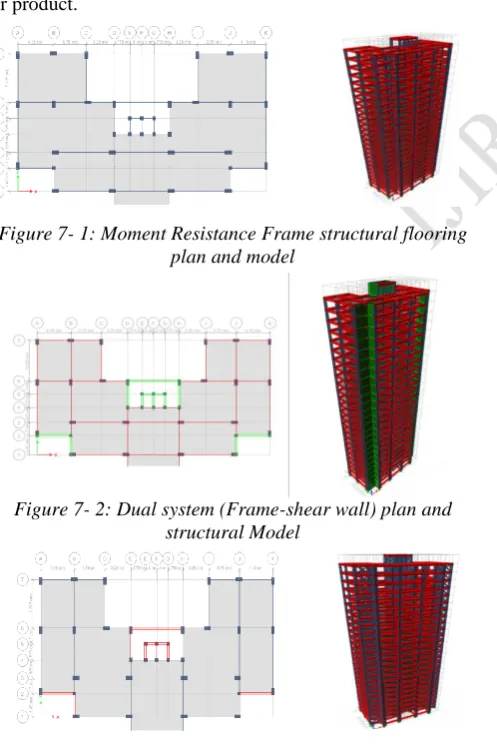
without any lateral load resistance system for 16, 21 and 26 storey (Figure7-1)
Dual System Model (Frame-Shear Walls)
This model has been considered as a RC frame with shear walls in different locations for 16, 21and 26- Storey. (Figure 7-2).
Bracing System (Frame- RC Bracings)
This model has been considered as a RC frame with RC “X” shape bracings in different locations for 16, 21 and 26 Storey (Figure 7-3).
Bare Frame With Infill Wall Model
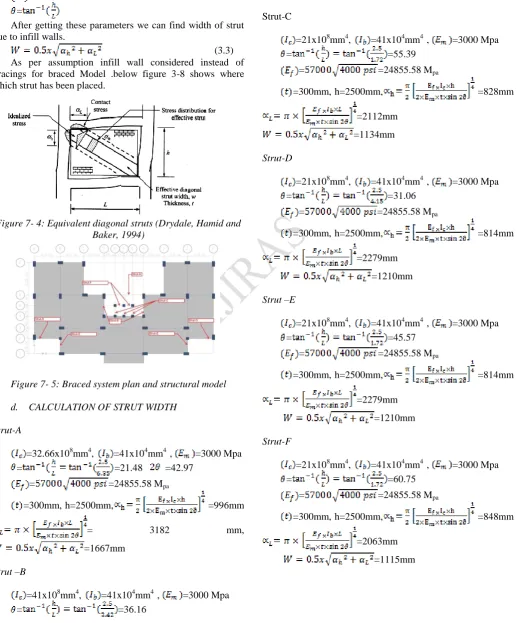
This model has been considered as a RC frame with infill wall effect. The infill walls have been considered diagonal struts in a model where bracing were considered. The size of the infill wall has been calculated then defined to the software. (Figure7.4). infill walls are light weight blocks, modules of elasticity is 3000Mpa and compressive strength is 4.5 Mpa as per product.
Figure 7- 1: Moment Resistance Frame structural flooring plan and model
Figure 7- 2: Dual system (Frame-shear wall) plan and structural Model
Figure 7- 3: Dual system (Frame-Bracing) plan and structural Model
c. MODELS PARAMETERS
Moment Resistance Frame Parameters
Bare frame considered without any lateral load system. Below Table shows elements Properties for (26) storey Bared RC frames. For 21 -storey, the same element sizes are there, but only (1000x400) size columns are up 5th floors. For 16 storey systems all columns considered (600x400) mm instead of (1000X400) mm.
RC Frame Structural Elements properties -26 storey Model
No Structural Elements Size
1 Columns up to 10th floors (1000x400)mm 2 Columns 10th to 25th floors (600x400)mm 3 Columns around the elevator (400x400)
4 Beams (400x500)mm
5 Floor slab 120mm
6 Cantilever beam (400x500)mm
Table 7- 2: RC frame Model parameters
Dual System (RC Frame-Shear Wall) Parameters
This is the same as bared frame with the same structural elements properties. The only change is shear walls, placed in different locations in the plan as per Figure 7.2.Shear walls considered “200mm” thick RCC walls among RC frame. Compressive strength of concrete is “4000 psi” and steel has been considered “60000 psi”.
Parameters Of Dual System (RC Frame- With RC
Bracings)Model
Frame with the same structural elements properties. The only change is bracings, placed in different locations in the plan as per Figure 7-3 bracings are considered ”X” shape RC elements, size of bracing are (300x300)mm. Mark of concrete is “4000 psi” and steel has been considered “60000 psi”
Parameters Of Infill Wall Consideration (Modelled
As Diagonal Strut)
This is the same as bracing systems, because infill walls modelled as equivalent diagonal struts for resisting lateral load. One of the most common and popular approximations is, replacing the masonry infill by equivalent diagonal strut whose thickness is equal to the thickness of the masonry infill. The width of strut depends on the length of contact between the wall and the columns, „αh‟, and between the wall and beams,„αL‟ as shown in Figure 7-4. The width of the equivalent diagonal strut varies between, third to one-tenth of the diagonal length of masonry infill [3].
(3.1)
(3.2)
Page 86 www.ijiras.com | Email: [email protected] Length of contact between the beam and wall
Modulus of elasticity of frame material Modulus of elasticity of masonry material Moment of inertia for the column
Moment of inertia for the beam Width of wall
=
After getting these parameters we can find width of strut due to infill walls.
(3.3) As per assumption infill wall considered instead of bracings for braced Model .below figure 3-8 shows where which strut has been placed.
Figure 7- 4: Equivalent diagonal struts (Drydale, Hamid and Baker, 1994)
Figure 7- 5: Braced system plan and structural model
d. CALCULATION OF STRUT WIDTH
Strut-A
=32.66x108mm4, =41x104mm4 , =3000 Mpa
= =21.48 =42.97
= =24855.58 Mpa
=300mm, h=2500mm, =996mm
= 3182 mm,
=1667mm
Strut –B
=41x108mm4, =41x104mm4 , =3000 Mpa
= =36.16
= =24855.58 Mpa
=300mm, h=2500mm, =974mm =2507mm
=1344mm Strut-C
=21x108mm4, =41x104mm4 , =3000 Mpa
= =55.39
= =24855.58 Mpa
=300mm, h=2500mm, =828mm
=2112mm =1134mm
Strut-D
=21x108mm4, =41x104mm4 , =3000 Mpa
= =31.06
= =24855.58 Mpa
=300mm, h=2500mm, =814mm =2279mm
=1210mm
Strut –E
=21x108mm4, =41x104mm4 , =3000 Mpa
= =45.57
= =24855.58 Mpa
=300mm, h=2500mm, =814mm =2279mm
=1210mm
Strut-F
=21x108mm4, =41x104mm4 , =3000 Mpa
= =60.75
= =24855.58 Mpa
=300mm, h=2500mm, =848mm =2063mm
Page 87 www.ijiras.com | Email: [email protected]
LOAD CONSIDERATION
Dead load, wall load, finish floor load, live load are considered .The live load for first three floors are (5 KN/m2), these floors are using for the super Markets and for remain up stories which will be living apartments, the live load considered (3KN/m2). Live load for the roof considered (2.5KN/m2)[ABC]. (1KN/m2) super dead load considered to all floors except roof. Finish floor load added 2KN/m2 and 2.5KN/m2 to the mid floors and roof respectively. All outer walls are (0.3m) and inner wall considered [0.2m] light weight masonry blocks with (2.5m) heights. Wall load for all outer and inner walls are (7KN/m) and (4KN/m2) respectively
e. SEISMIC PARAMETERS
As per Afghanistan seismic map Afghanistan categorized on four seismic zone as per table below
Zone SS S1
1 0.15<Ss<0.44 0.04<S1<0.16
2 0.44<Ss<0.8 0.16<S1<0.3
3 0.8<Ss<1.2 0.3<S1<0.5
4 1.2< 0.5<S1
Table 7- 3: Afghanistan seismic zones
As Kabul is in third seismic zone as per seismic map where short period response acceleration(SS) is between 0.5
and 1.2 and one second period response acceleration(S1) is
between 0.3 and 0.5.I considered SS=1.2 and S1=0.5 for this
study based on acceleration and other parameters due to Afghanistan Building Code (ABC) .
(3.3)
: Special response acceleration parameter in short time period
; The maximum considered earthquake spectral response accelerations for short period
(3.3)
Special response acceleration parameter in one second period
The maximum considered earthquake spectral response accelerations for 1-second period
(3.4)
(3.5) Fa = Site coefficient defined in Table 311.4.3-1[ABC].
Fv = Site coefficient defined in Table 311.4.3-2[ABC]
Finally found:
=1.5x0.5 =0.75 =1.02x1 =1.224 =2/3X1.224=0.816
=2/3X0.75=0.5
As per seismic design category “D” the code not allowing ordinary moment resisting frame, that‟s why selected special moment resistance frame from [Table 311.4.3-1, ABC]
Below are the factors for special moment resisting frame based on [Table 311.4.3-1, ABC]
=8 Response Modification Co efficient
= 3 over strength Factor
=5.5 Deflection Amplification Factor
f. ANALYSIS METHODS
As per code for height more than 49 meters static analysis are not allowed, but during this study used to checked the difference between the methods.
After getting all parameters added data to the models in ETAB 2015 and analyzed model by Static equivalent and response spectrum analysis.
In order to get maximum mass participation ratio, considered 20 Mode shape for response spectrum analysis .The seismic weight is DL+50% of live load as per code ABC
g. ANALYSIS AND DISCUSSIONS
Analysis results of 26 storey Models due to Response spectrum and Static equivalent analysis
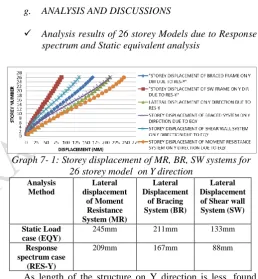
Graph 7- 1: Storey displacement of MR, BR, SW systems for 26 storey model on Y direction
As length of the structure on Y direction is less, found higher storey displacement compare to X direction .Below table shows maximum lateral displacement for MR, BR, SW systems due to Response spectrum and static equivalent load cases on Y direction.
Graph 7- 2: Storey drift ratio of MR, BR, SW systems for 26 storey model on Y direction
Analysis Results Of 21 Storey Models Due To
Response Spectrum And Static Equivalent Analysis
Analysis Method
Storey Drift ratio of Moment
Storey Drift ratio of Bracing
System (BR)
Storey Drift ratio of Shear
wall System Analysis
Method
Lateral displacement
of Moment Resistance System (MR)
Lateral Displacement
of Bracing System (BR)
Lateral Displacement of Shear wall System (SW)
Static Load case (EQY)
245mm 211mm 133mm
Response spectrum case
(RES-Y)
Page 88 www.ijiras.com | Email: [email protected] Resistance System (MR) (SW) Static Load case (EQY)
0.0217 0.0188 0.0118
Response spectrum case
(RES-Y)
0.0192 0.015 0.0088
Graph 7- 3: Storey displacement of MR, BR, SW systems for 21 storey model on Y direction
Graph 7- 4: Storey drift ratio of MR, BR, SW systems for 21 storey model on Y direction
Analysis Results Of 16 Storey Models Due To
Response Spectrum And Static Equivalent Analysis
Graph 7- 5: Storey displacement of MR, BR, SW systems for 16 storey model on Y direction
Analysis Method Lateral displacement of Moment Resistance System (MR) Lateral Displacement of Bracing System (BR) Lateral Displacement of Shear wall System (SW)
Static Load case (EQY)
111mm 60mm 48mm
Response spectrum case (RES-Y)
109mm 53mm 46mm
Graph 7- 6: Storey drift ratio of MR, BR, SW systems for 16 storey model on Y direction
Analysis Method Storey Drift ratio of Moment Resistance System (MR) Storey Drift ratio of Bracing System (BR) Storey Drift ratio of Shear wall System (SW) Static Load case
(EQY)
0.0162 0.0119 0.0069
Response spectrum case
(RES-Y)
0.0167 0.0119 0.0066
Analysis results of 26 storey Moment resisting frame with infill wall consideration instead of bracings
Graph 7- 7: Storey displacement of infill wall, MR, BR, SW systems for 26 storey model on Y direction
Analysis Method Lateral displacement of Moment Resistance System (MR) Lateral Displaceme nt of Bracing System (BR) Lateral Displaceme
nt of infill wall System
Lateral Displaceme nt of Shear wall System (SW) Static Load case (EQY)
245mm 211mm 223 133mm
Response spectrum
case (RES-Y)
209mm 167mm 159 88mm
Analysis Method Lateral displacement of Moment Resistance System (MR) Lateral Displacement of Bracing System (BR) Lateral Displacement of Shear wall System (SW)
Static Load case (EQY)
167mm 146mm 84mm
Response spectrum case (RES-Y)
146mm 122mm 66mm
Analysis Method Storey Drift ratio of Moment Resistance System (MR) Storey Drift ratio of Bracing System (BR) Storey Drift ratio of Shear
wall System (SW)
Static Load case (EQY)
0.0181 0.0163 0.0093
Response spectrum case
(RES-Y)
Page 89 www.ijiras.com | Email: [email protected]
Graph7- 8: Storey drift ratio of infill wall MR, BR, SW systems for 26 storey models on Y direction
Analysis Method
Storey Drift ratio of Moment Resistance System (MR)
Storey Drift ratio of Bracing System
(BR)
Storey Drift ratio of
infill wall System
Storey Drift ratio
of Shear wall System
(SW) Static Load
case (EQY)
0.0216 0.0188 0.0196 0.0118
Response spectrum case
(RES-Y)
0.0192 0.0152 0.0169 0.0088
h. CONCLUSIONS
26 STOREY MODELS
The structure has more lateral displacement due to static load case on Y direction compare to X direction because of lower stiffness on X direction.
Maximum lateral displacements due to static load case for MR, BR, SW systems are 245mm, 211mm, 133 respectively. Shear wall system reducing 46% of lateral displacement which bracing system reducing 14% compare to moment resisting system due to Earthquake load on Y direction (EQY).
Maximum storey drift ratio due to static load case for moment resistance, bracing, and shear wall systems are 0.0217 in 12th storey ,0.0188 in 14th storey and 0.0118 in 15th storey respectively. As height of sotrey is 3000mm then the storey drifts for MR, BR, SW systems are 65mm, 56mm, 35mm respectively.
Only shear wall system is in allowable limit in static analysis for 26 storey model, because the allowable storey drift as per ABC for design category three is 0.015H, where for height 3000mm the drift will be 36mm.
Maximum lateral displacement for MR, BR, SW systems are 209mm, 167mm, 88mm respectively on Y direction due to response spectrum load case. It show 15%, 21% and 34% decrement for MR, BR, SW systems compare to static analysis.
Maximum storey drift ratios due to response spectrum case are 0.0192, 0.0152, 0.008 for MR, BR, SW systems which storey drift are 57mm, 46mm, 24mm respectively.
The result shows only SW system in allowable limit of storey drifts due to response spectrum load case.
Response spectrum analysis reduced storey drift 13%, 18%, 32% for MR, BR, SW systems compare to static analysis respectively.
21 STOREY MODELS
Maximum lateral displacements due to static load case on Y direction for MR BR and SW systems are 167mm, 146mm, 84mm respectively. Which show 50% and 13% decrement due to Earthquake load on Y direction (EQY) compare to MR system.
Maximum storey drift ratios due to static load case for moment resistance, bracing, and shear wall systems are 0.0181 in 11th storey ,0.0163 in 11th storey and 0.0093 in 12th storey respectively. As height of storey is 3000mm then storey drifts for MR, BR, SW systems are 54mm, 49mm, 28mm respectively.
Only shear wall system is in allowable storey drift limit for 21 storey model due to static load case.
Response spectrum analysis reduced response of structure compare to static analysis. Because, in static analysis natural time period calculated from approximate formula but in response spectrum analysis considered maximum time period in all mode shapes.
Maximum lateral displacement for MR, BR, SW systems are146mm, 122mm, 66 mm respectively on Y direction due to response spectrum load case.
It show 13%, 16.4% and 21% decrement for MR, BR, SW systems compare to static analysis.
Max storey drift ratios are 0.0167, 0.0139, 0.0075 for MR, BR, SW systems which storey drift are 50mm, 42mm, 23mm respectively due to response spectrum case.
Only SW system is in allowable limit of storey drift.
Response spectrum analysis reduced storey drift 7.4%, 14%, 18% for MR, BR, SW systems compare to static analysis.
16 STOREY MODELS
Maximum lateral displacement on Y direction for MR, BR, SW systems are111mm, 60mm, 48mm respectively. The result show 56.7% and 45.9% lateral displacement decrement for SW and BR systems due to Earthquake load on Y direction (EQY).
Maximum storey drift ratios due to stactic load case for moment resistance, bracing, and shear wall systems are 0.0162 in 6th storey ,0.0119 in 8th storey and 0.0069 in 9th storey respectively. As height of sotrey is 3000mm then storey drifts for MR, BR, SW systems are 49mm, 35mm, 21mm respectively.
Shear wall and bracing systems are in allowable limit for 16 storey model due to static analysis.
With reducing structure height than 49m, static analysis results are almost same with response spectrum analysis results.
Response spectrum analysis reduced the response of structure compare to static analysis
Page 90 www.ijiras.com | Email: [email protected]
As per code if the structure height is less than 49m allowed to use static analysis. As per result for 16 Storey model, response spectrum analysis are almost same with the static analysis.
Max storey drift ratios are 0.0167, 0.0119 and 0.0066 for MR, BR, SW systems due to response spectrum case, which storey drift are 50mm, 35mm, 20mm respectively.
Shear wall and bracing systems are in allowable limit of storey drift based on Response spectrum analysis too.
Infill Wall Consideration In 26 Storey Moment
Resisting Frame
Infill wall reducing lateral displacement when considered in frame as a lateral load resisting system and model as a strut.
Maximum storey displacements due to static equivalent analysis on Y directions for bracing, infill wall Moment resisting systems are 211mm, 223mm, 245 mm respectively.
Infill wall reducing about 9% lateral displacement compare to moment resisting system where bracing system reduced 14% compare to moment resisting system in static analysis
Maximum storey drift ratio on Y direction due to static load case for Bracing, infill wall and moment resisting systems are 0.0188, 0.0196, and 0.0216 respectively. Storey drift for BR, infill wall and MR systems are 56mm, 59mm, 65mm respectively. It shows higher storey drift for infill walls compare to bracing system
Maximum storey displacement on Y direction for bracing, infill wall, and moment resisting systems are 159mm, 167mm, 209 mm respectively by RES-Y load case. The results show about 20 % decrement in lateral displacement compare to moment resisting system where bracing system shows about 23% decrement.
Storey drift ratios on Y direction due to response spectrum case for bracing, infill wall and moment resisting systems are 0.0152, 0.0169, 0.0192 respectively. The design storey drift for BR, infill wall, MR systems are 46mm, 51mm, 58mm respectively .It show higher storey drift for Moment resistance frame.
The result show higher storey drift for infill wall system compare to braced system.
REFERENCES JOURNALS
[1] (Abhijeet Baikerikar1, Kanchan Kanagali2” Study of lateral load resisting systems of variable heights in all soil types of high seismic zone” International Journal of Research in Engineering and Technology, Volume: 03 Issue: 10 | Oct-2014)
[2] Shahzad Jamil Sardar and Umesh. N. Karadi” Effect of change in shear wall location on storey drifts of multi storey building subjected to lateral loads.”ISSN:2319-8753 International Journal of Innovative Research in
Science, Engineering and Technology Vol. 2, Issue 9,
September 2013 [3] S.K.Madan,R.S.Malik, V.K.Sehgal,” Seismic Evaluation
with Shear Walls and Braces for Buildings “World Academy of Science, Engineering and Technology International Journal of Civil, Environmental Structural, Construction and Architectural Engineering Vol:9, No:2, 2015
[4] Mahdi Hosseini, Hadi Hosseini, Seyed Amin Ahmadi Olounabadi, Ahmad Hosseini” Study the Effective of Lateral Load on Story Drift in RC Frame Structures” ISSN: 2319-6386, Volume-3 Issue-6, May 2015
[5] Prof.Syed Farrukh Anwar, Mohd Arif” A study of the behavior of parametric and cost analysis of high rise buildings in different seismic zones”, ISSN: 2277-9655 (I2OR), Publication Impact Factor: 3.785, [Anwar*, 4.(8): August, 2015]
[6] 1P. M. Pradhan*, 2P. L. Pradhan, 1R. K. Maskey” A Review on partial infilled frames under lateral loads” Katmandu university journal of science, Engineering and technology VOL. 8, No. I, FEBRUARY, 2012, pp 142-152
[7] M.D. Kevadkar1 P.B. kidag2 “Lateral Load Analysis of R.C.C. Building” International Journal of Modern Engineering Research (IJMER) Vol.3, Issue.3, May-June. 2013 pp-1428-1434 ISSN: 2249-6645
[8] Narayanan S P1, Sirajuddin M2 “Properties of Brick Masonry for FE modeling” American Journal of Engineering Research (AJER) e-ISSN : 2320-0847 p-ISSN : 2320-0936 Volume-1 pp-06-11
[9] T M Prakash, Dr. B G Naresh kumar and Dr. Karisiddappa “Strength and Elastic Properties of Aerated Concrete Blocks (ACBs) “International Journal of Chemical, Environmental & Biological Sciences (IJCEBS) Volume 1, Issue 2 (2013) ISSN 2320 –4087 (Online)
[10] Thuat V. Dinh1 and Toshikatsu Ichinose, M.ASCE2 “Probabilistic Estimation of Seismic Story Drifts in Reinforced Concrete Buildings” Article in Journal of Structural Engineering · March 2005
TEXT BOOK
[1] M.Y.H. Bangash London UK “Earthquake Resistant
Buildings” ISBN 978-3-540-93817-0 Springer Heidelberg Dordrecht London New York, Library of Congress Control Number: 2010920825
[2] Pankaj Agarwal,Manish Shrikhande, “Earthquake
resistant design of structures”2006 by PHI learning Private Limited,ISBN-978-81-203-2892-2
CONSIDERED CODES
[1] Afghanistan Building Code (ABC) 2012
[2] American Society of Civil Engineers (ASCE)
[3] International Building Code (IBC) 2006
ABBREVIATION
Page 91 www.ijiras.com | Email: [email protected]
[2] EQX: Earthquake load on X direction (static load case)
[3] RES-Y: Response spectrum on Y direction (load case)
[4] RES-X: Response spectrum on X direction (load case)
[5] ABC: Afghanistan Building code
[6] MR: Moment resisting systems
[7] BR: Bracing system
[8] SW: Shear wall system
[9] USGS: United State Geological Survey
[10] MW: Moment Magnitude
[11] SDS: Special response acceleration parameter in short
time period
[12] SD1: Special response acceleration parameter in one
second time period