
DESIGN AND DEVELOPMENT OF DRUG-POLYMER MATRIX FILMS USING POLY-?-CAPROLACTONE-POLY ETHYLENE GLYCOL 4000 BY FILM CASTING TECHNOLOGY
11
0
0
Full text
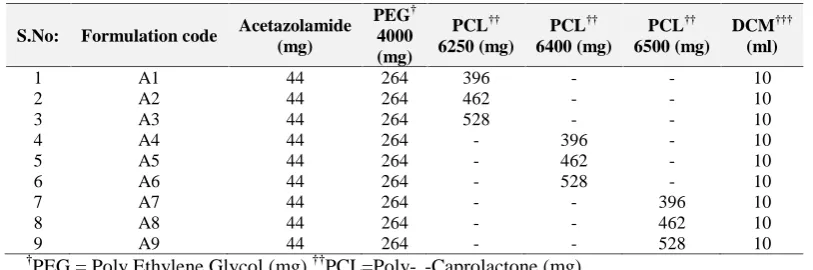
(2) 163. Ananya Parikibandla. et al., Int. J. Pharm. & H. Care Res., Vol.–02 (03) 2014 [162 - 172]. Glycol 4000, Potassium dihydrogen ortho phosphate AR, Sodium hydroxide LR were obtained from S.D Fine Chem Ltd., Mumbai. Dialysis Membrane was obtained from Hi Media Laboratories Ltd., Mumbai.. minutes to remove the air bubbles. The air bubble free solution was poured into the self-designed glass mould 35 cm2 kept on flat surface. An inverted funnel was placed over the glass mould to prevent the sudden evaporation of the solvent.9 The mould was kept for 12 hours at room temperature for drying. After this period, the film was removed and cutted then preserved in the dessicator until further use.10. Drug-polymer matrix films were prepared by film casting technology The matrix films containing Acetazolamide were prepared by solvent casting method by choosing Poly-ε-caprolactone as film former and dichloromethane as solvent.7 Accurately 44mg of Acetazolamide was weighed and dissolved in 10 ml of dichloromethane and kept aside for 5 minutes for swelling of the polymer. Specified quantity of Acetazolamide dissolved in 10 ml of Dichloro methane solvent. Required quantity of PEG 4000 mg was added to the prepared polymeric solution then stirred to form dispersion.8 Prepared Acetazolamide solution was added to polymeric solution and stirred with the magnetic stirrer 500 RPM for 10 minutes continuously. Prepared medicated gel was allowed to stand for 10 to 15. Size Calculation of Drug-polymer matrix film11 Area of rectangle = breadth X height Film casted area in the glass plate = 7 X 5=35cm2 Area of one circular film cutted with diameter of 0.8cm = 0.502cm2 Quantity of Acetazolamide in one Drug-polymer matrix film = 1 mg Therefore for 35cm2 area of rectangle = 44 mg of acetazolamide was taken. Number of ocuset in 35cm2area = 0.502/35=43.75 Drug-polymer matrix films12-16 Specially fabricated glass surface apparatus.. Table No. 01: Composition of Drug-polymer matrix film Formulations S.No:. Formulation code. Acetazolamide (mg). 1 2 3 4 5 6 7 8 9. A1 A2 A3 A4 A5 A6 A7 A8 A9. 44 44 44 44 44 44 44 44 44. PEG† 4000 (mg) 264 264 264 264 264 264 264 264 264. PCL†† 6250 (mg). PCL†† 6400 (mg). PCL†† 6500 (mg). DCM††† (ml). 396 462 528 -. 396 462 528 -. 396 462 528. 10 10 10 10 10 10 10 10 10. †. PEG = Poly Ethylene Glycol (mg),††PCL=Poly-ε-Caprolactone (mg), DCM=Dichloromethane (ml). †††. Formulations A1-A9 are evaluated for Physical Appearance and Surface Texture, Weight uniformity, Thickness, Surface pH, Folding Endurance, Drug content uniformity, Percentage Moisture Absorption, Moisture content, In vitro drug release studies and In vivo studies. Physical Appearance and Surface Texture Includes visual inspection of patches evaluation of texture by feel or touch.. and. Weight uniformity For the evaluation of patch weight, ten patches of sizes 1.6 cm diameter from every formulation were taken and weighed individually on electronic. balance and the average weights were calculated. All measurements (Thickness and weight) were determined after residual solvent has been removed from samples by storing the films in dessicator with anhydrous Calcium chloride at an appropriate temperature 27±2ºC for a week prior to evaluation and testing. Thickness The thickness of the film was measured at six different points on one film using screw gauge. For each formulation three selected films were used and average thickness was recorded.. www.ijphr.com.
(3) 164. Ananya Parikibandla. et al., Int. J. Pharm. & H. Care Res., Vol.–02 (03) 2014 [162 - 172]. Surface pH Each patch was placed in petri plate and allowed to swell in contact with 2 ml of phosphate buffer, pH 7.4 for 2 hours at room temperature, and the pH was recorded with the aid of a digital pH meter. These measurements were conducted by bringing a glass microelectrode near the surface of the tablets and allowing it to equilibrate for 1 min prior to recording the readings. Experiments were performed in triplicate and average values were reported. Folding Endurance The flexibility of patches can be measured quantitatively in terms of as folding endurance. Folding endurance of the patches was determined by repeatedly folding a small strip of the patch (approximately 2x2 cm) at the same place till it broke. The number of times patch could be folded at the same place, without breaking gives the value of folding endurance. Drug content uniformity The formulated polymeric films were assayed for drug content in each case. Drug content was determined the homogenization of the wafer in 100 ml of pH 7.4 phosphate buffer for 4-6 h until the patch was completely dissolved in the solvent and the resulting solution was filtered through Whatmann filter paper No.1. The solution was diluted suitably and the absorbance of the solution was measured using UV-Vis spectrophotometer at a wavelength of 266 nm against phosphate buffer as blank. The experiment was performed in triplicate and average values were reported. Percentage Moisture Absorption The moisture uptake studies give an indication about the relative moisture absorption capacities of polymers and an idea whether the formulations maintain their integrity after absorption of moisture. 5% w/v agar was dissolved in hot water. It was transferred into petri plates and allowed to solidify. Six patches from each formulation were selected, laminated on one side with water impermeable backing membrane. They were placed on the agar plates, incubated at 37±1ºC, and examined for any physical changes. At regular 1hour intervals until 6 hours, patches were removed from the plates, excess surface water was removed carefully using a filter paper and were reweighed.. Moisture content The ocular patches were weighed accurately and kept in desiccators containing anhydrous calcium chloride. After 3 days, the patches were taken out and weighed. The moisture content (%) was determined by calculating the moisture loss using the formula:. In vitro drug release studies A diffusion system was employed to In vitro release studies. The In vitro drug release study was performed on Franz diffusion cell using cellulose acetate membrane (0.45µm pore size, cut off 1000Da).17-20 The insert was placed on the donor chamber. The receptor compartment (30 mL) was filled with phosphate buffer, pH 7.4. The experiment was performed at 37±0.5°C, at a stirring speed of 50 rpm using a magnetic stirrer. 3 ml of sample was collected from the receptor compartment at appropriate time intervals up to 60 h and replaced with phosphate buffer pH 7.4. Analysis was carried out using UV-Visible Spectrophotometer at 266 nm against phosphate buffer pH 7.4 as reference. The % cumulative drug release was calculated and reported. Mathematical expressions like Zero order , First order and Higuchi model Korsemeyer –Peppas model were applied to analyze the release mechanism from the patches.21-24 Sterilization Studies Sterilization of optimized film was done placing films under UV light in UV germicidal chamber, exposing both sides for 15 min at a 10 cm height from UV lamp.24-31 Stability studies The selected formulations were subjected to short term stability testing. Films wrapped in aluminium foil and kept in a humidity chamber maintained at 40 ± 2ºC and 75 ±5 %RH for 3 months as per ICH guidelines.. Results and discussion The Acetazolamide ocular films were prepared by the method of Film casting technique employing glass surface well as substrate by using different of polymers such as Poly-ε-caprolactone 25,000,. www.ijphr.com.
(4) Ananya Parikibandla. et al., Int. J. Pharm. & H. Care Res., Vol.–02 (03) 2014 [162 - 172]. 165. Poly-ε-caprolactone 37,000, Poly-ε-caprolactone Fourier Transform Infrared Spectroscopy 50,000 grades, as film formers and release rate (FTIR) retardants and Poly Ethylene Glycol 40000 as pore The pure drug (Acetazolamide) and polymers were forming, solubility enhancing carrier also serves as subjected to IR studies alone and in combination. plasticizer and permeation enhancer. Pure drug, combination of drug-PEG4000, Pure Dichloromethane is used as solvent. Drug polymer drug-Poly-ε-caprolactone, and pure drug-PEG4000compatibility studies were performed by FTIR Poly-ε-caprolactone were mixed with 100mg of (Fourier transform infrared spectroscopy).The potassium bromide. Through grinding in smooth prepared Acetazolamide ocular films were agate mortar effected mixing. The mixtures were characterized based upon their physico chemical then pressed in to a discs using pellet maker) and characteristics like Physical Appearance and placed in the sample holder of the instrument. These Surface Texture, Thickness, Surface pH were analysed by FTIR to study the interference of measurement, Folding Endurance, Drug content poly- ε -caprolactone and PEG 4000 with the drug. uniformity, Percentage Moisture Absorption, The FTIR diagrams are shown in figure below. Moisture content, In vitro drug release studies, Sterilization Studies, Stability study results found satisfactory. Table No. 02: Interpretation of FTIR Spectra. IR Absorbance band (cm-1) Interpretation O-H Stretching N-H Stretching CH2 Stretching CH3 Stretching C=O Stretching C=N Stretching C-0 Stretching S=O Stretching C-O Stretching C-N Stretching C-S Stretching. Pure drug Acetazolamide. PEG 4000. Poly- ε-caprolactone. 3329 2999 1625 1590 1350 1290 1250. 3437 2957 -. 2997 1707 1495 -. Pure drug + PEG4000 3329 2297 2999 1625 1634 1495 1340 1305 1243. Fig. No. 01: FTIR Spectra of Pure drug Acetazolamide. www.ijphr.com. Pure drug+ PEG4000+ Poly- ε-caprolactone 3437 3329 2997 3041 1707 1590 1411 1340 1504 1290 1240.
(5) 166. Ananya Parikibandla. et al., Int. J. Pharm. & H. Care Res., Vol.–02 (03) 2014 [162 - 172]. Fig. No. 02: FTIR Spectra of Poly- ε-caprolactone 70. %T. 60. 50. 40. 1556.55. 1415.75. 3437.15 3419.79. 20. 648.08. 3334.92 3280.92. 1703.14. 3176.76. 30. 10. 0 4000. 3500. 3000. 2500. 2000. 1750. 1500. 1250. 1000. 750. 500 1/cm. Fig. No. 03: FTIR Spectra of PEG 4000. Fig. No. 04: FTIR Spectra of Pure drug+PEG4000. Fig. No. 05: FTIR Spectra of Pure drug+PEG4000+ Poly- ε-caprolactone. www.ijphr.com.
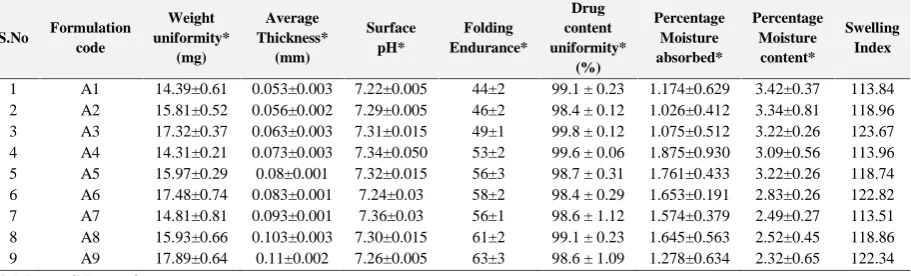
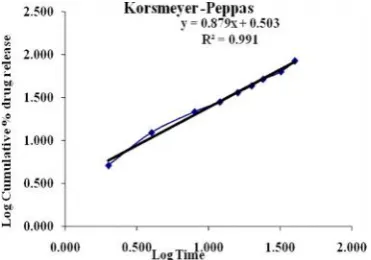
(6) 167. Ananya Parikibandla. et al., Int. J. Pharm. & H. Care Res., Vol.–02 (03) 2014 [162 - 172]. The FTIR spectrum of pure drug Acetazolamide matches with that of Acetazolamide with excipients. Hence it can be concluded that there is no interaction of the excipients with the pure drug used in formulations. The FTIR spectrum of pure. drug Acetazolamide matches with that of Acetazolamide with excipients. Hence it can be concluded that there is no interaction of the excipients with the pure drug used in formulations.. Table No. 03: Physicochemical Evaluation of Acetazolamide Drug-polymer matrix films A1-A9 S.No. Formulation code. Weight uniformity* (mg). Average Thickness* (mm). Surface pH*. Folding Endurance*. Drug content uniformity* (%). Percentage Moisture absorbed*. Percentage Moisture content*. Swelling Index. 1 2 3 4 5 6 7 8 9. A1 A2 A3 A4 A5 A6 A7 A8 A9. 14.39±0.61 15.81±0.52 17.32±0.37 14.31±0.21 15.97±0.29 17.48±0.74 14.81±0.81 15.93±0.66 17.89±0.64. 0.053±0.003 0.056±0.002 0.063±0.003 0.073±0.003 0.08±0.001 0.083±0.001 0.093±0.001 0.103±0.003 0.11±0.002. 7.22±0.005 7.29±0.005 7.31±0.015 7.34±0.050 7.32±0.015 7.24±0.03 7.36±0.03 7.30±0.015 7.26±0.005. 44±2 46±2 49±1 53±2 56±3 58±2 56±1 61±2 63±3. 99.1 ± 0.23 98.4 ± 0.12 99.8 ± 0.12 99.6 ± 0.06 98.7 ± 0.31 98.4 ± 0.29 98.6 ± 1.12 99.1 ± 0.23 98.6 ± 1.09. 1.174±0.629 1.026±0.412 1.075±0.512 1.875±0.930 1.761±0.433 1.653±0.191 1.574±0.379 1.645±0.563 1.278±0.634. 3.42±0.37 3.34±0.81 3.22±0.26 3.09±0.56 3.22±0.26 2.83±0.26 2.49±0.27 2.52±0.45 2.32±0.65. 113.84 118.96 123.67 113.96 118.74 122.82 113.51 118.86 122.34. * Mean±S.D, n=3 Physical appearance and surface texture of ocular patches These parameters were checked simply with visual inspection of patches and by feel or touch. The observation suggests that the patches are having smooth surface and they are elegant enough to see. Weight uniformity of patches The weight was determined using digital balance. The patches prepared with Poly-e-caprolactone and PEG 4000 polymers with formulations codes A1A9 were weighed about 14.39±0.61 to 17.89±0.64 mg respectively. In all the cases the calculated standard deviation values are very low suggesting that the prepared patches were uniform in weight. Thickness of patches The thickness of the patch was measured using screw gauge. The thicknesses of patches prepared were about 0.053±0.003 to 0.110±0.002 mm respectively. As the molecular weight of Poly-ecaprolactone increases the increased thickness was observed. Formulation A9 had a thickness of 0.11±0.002 mm, which was highest amongst all the formulations. Surface pH Considering the fact that acidic or alkaline pH may cause irritation to the cornea and influence the rate of hydration of the polymers, the surface pH of the films was determined. The observed surface pH of the formulations was found to be in the range of 7.22±0.05 to 7.36±0.03. The results are found that. there is no significant difference of surface pH in all the formulations and the pH range lies within the range of lacrimal fluid pH i.e.7.2 to 7.4, hence do not cause irritation and achieve patient compliance. Folding endurance The folding endurance was found to be greater than 44±2 times in case of all the formulations. This makes the system acceptable as Drug-polymer matrix films, indicating good mechanical strength and elasticity. Folding endurance test results indicated that the films would maintain the integrity within the cul-de-sac when applied. Drug content uniformity The observed results of content uniformity indicated that the drug was uniformly dispersed and with minimum intra batch variability. Percentage Moisture Absorption Checking the physical stability of the film at high humid conditions and integrity of the film at dry conditions, the films were evaluated for the moisture absorption, moisture uptake studies give an indication about the relative moisture absorption capacities of polymers. The formulations maintained their integrity after absorption of moisture. The formulation A4 has shown the highest value of moisture absorption of 1.875±0.930.. www.ijphr.com.
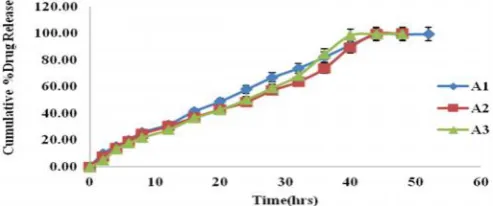
(7) 168. Ananya Parikibandla. et al., Int. J. Pharm. & H. Care Res., Vol.–02 (03) 2014 [162 - 172]. Percentage Moisture content Percentage moisture content was found to be between 2.52±0.45 to 3.42±0.37 for formulations A1-A9, All the formulations maintained their integrity.The literature survey discussed reveals the research work done to develop ophthalmic inserts with the hydrophillic polymers which have the tendency of moisture absorption which can be overcome with the usage of Poly-ε-caprolactone. Swelling percentage The swelling behaviour of the polymer was reported. The formulation A9 (264 mg of PEG 4000, 528 mg of Poly-ε-Caprolactone 6500) shows higher value of Swelling percentage 122.3 which is due to presence of higher concentration of Poly-εCaprolactone 6500. Sterilization Studies The Drug-polymer matrix films were sterilized by UV radiation. In vitro Diffusion Studies The in vitro diffusion studies were performed in triplicate using Franz diffusion cell and Inserts of known dimensions and weights were placed in a donor compartment and the flow rate of was maintained at 0.50 ± 0.10 ml/hr over the insert with phosphate buffer pH 7.4. The amount of drug released was determined by collecting aliquots from the receiving chamber at fixed time intervals.. The temperature was maintained at 35 ± 2ºC throughout the study. Absorbance was measured by UV spectrophotometer at 266 nm using a Double beam UV- spectrophotometer T60 (Analytical Technologies Ltd). Finally, the concentration corresponding to a specific absorbance was determined from a calibration curve. The drug release profile of Acetazolamide from inserts after predetermined time intervals is expressed as a percentage. The results of cumulative percentage drug release from the formulations A1, A2, A3 were 99.11±0.96%, 89.50±2.46% and 99.25±3.48% respectively and the results, these formulations were able to release the drug for only 44 hrs the desired objective of two days delivery was not achieved. The results of cumulative percentage drug release from the formulations A4, A5, A6 were 99.25±3.48%, 98.50±3.19% and 99.89±2.34% respectively and the results are represented in Figure. Formulation A4 was able to release the drug for only 46 hrs the desired objective of two days delivery was not achieved.A5 and A6 formulations showed a 48 hrs drug release profile i.e for a period of two days for this reason it was considered as the best formulations. From the above evaluation parameters it was concluded that the formulation A6 having the higher percentage of drug release in a sustained manner, so the formulation was selected as the best formulation.. Fig. No. 06: In vitro Diffusion of Drug-polymer matrix film formulations A1, A2, A3.. Fig. No. 07: In vitro Diffusion of Drug-polymer matrix film formulations A4, A5, A6. www.ijphr.com.
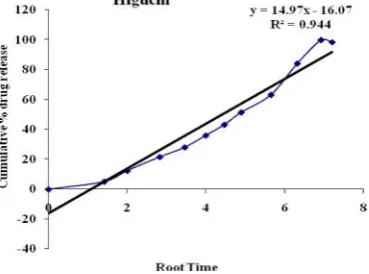
(8) Ananya Parikibandla. et al., Int. J. Pharm. & H. Care Res., Vol.–02 (03) 2014 [162 - 172]. 169. Fig. No. 08: In vitro Diffusion of Drug-polymer matrix film formulations A7, A8, A9. The results of cumulative percentage drug release from the formulations A7, A8, A9 were 97.46±2.91%, 99.25±2.66% and 99.25±3.16% respectively and the results are represented in. above figures these formulations were able to release the drug for 52 hrs, 56hrs and 56 hrs respectively so desired objective of two days delivery was not achieved.. Fig. No. 09: Zero order graph of Best Drug-polymer matrix film formulation A6.. Fig. No. 10: First order graph of Best Drug-polymer matrix film formulation A6.. Fig. No. 11: Higuchi graph of Best Drug-polymer matrix film formulation A6.. www.ijphr.com.
(9) 170. Ananya Parikibandla. et al., Int. J. Pharm. & H. Care Res., Vol.–02 (03) 2014 [162 - 172]. Fig. No. 12:Korsmeyer-Peppasgraph of Best Drug-polymer matrix film formulation A6.. Fig. No. 13:Hixon-Crowellgraph of Best Drug-polymer matrix film formulation A6. Table No. 04: Release Kinetic Summary A1-A9 Formulation Code A1 A2 A3 A4 A5 A6 A7 A8 A9. Zero order r2 0.9809 0.9893 0.9848 0.9889 0.9923 0.9931 0.9741 0.9825 0.9541. First order r2 0.8524 0.716 0.7849 0.7463 0.7950 0.6939 0.7217 0.8116 0.8339. Higuchi r2 0.9647 0.9268 0.9133 0.9515 0.9538 0.9442 0.9741 0.8820 0.8185. The in vitro drug release data of Acetazolamide Drug-polymer matrix films were processed for regression analysis and the correlation coefficient (R2) values obtained from the kinetic equations indicated that the release of the drug from the all formulations majority of formulations followed Zero order kinetics, Higuchi release pattern with non-erodable swelling release was followed and obeys release rate mechanism was Korsmeyer-. Hixon-Crowell r2 0.9531 0.070 0.8874 0.9056 0.9227 0.8897 0.8453 0.8932 0.8830. Korsmeyer-Peppas r2 n value 0.980 0.6896 0.990 0.7683 0.916 0.9167 0.991 0.766 0.994 0.7862 0.991 0.8792 0.983 1.031 0.988 0.952 0.978 0.9866. Peppas with Non -Fickian transport obeys Super case II transport. Stability studies The selected formulations were subjected to short term stability testing. Films wrapped in aluminum foil and kept in a humidity chamber maintained at 40 ± 2ºC and 75 ±5 %RH for 1 month as per ICH guidelines.. Table No. 05: Data of stability studies of the formulation A6 Time(days) 30 60 90. Physical appearance No changes No changes No changes. Surface pH* 7.2-7.4 7.2-7.4 7.2-7.4. Folding Endurance* 48±2 46±2 44±1. * Each reading was an average of three determinations. www.ijphr.com. Drug content uniformity* 96.83±0.043 95.35±0.071 95.08±0.044. Percentage drug released at 48 hrs* 96.93±0.132 96.12±0.098 95.87±0.146.
(10) Ananya Parikibandla. et al., Int. J. Pharm. & H. Care Res., Vol.–02 (03) 2014 [162 - 172]. Conclusion On the basis of results of evaluation A6 formulation was found to be the best formulation. A6 formulation has met the objective of 48 hour release with zero order, following higuchi with supercase II transport. It was concluded that Acetazolamide: PEG 4000: PCL 6400 in the ratio of 1:4:12 (Drug: Polymer) would act as a suitable ocular drug delivery system for effective treatment of Glaucoma.. 10.. 11.. 12.. Acknowledgement We would like to thank Dr.Anna Balaji for his constant encouragement during the research work at Vaageswari college of pharmacy.. 13.. References 1.. 2.. 3.. 4.. 5.. 6.. 7.. 8.. 9.. Woodruff, Hutmacheret al, “The return of a forgotten polymer—Polycaprolactone in the 21st century”, Progress in Polymer Science 35 (2010) 1217–1256. Narsimha Murthy, S., et al., “Biodegradable polymer matrix based Drug-polymer matrix films of Diclofenac sodium”. Indian Drugs, 1997; 34(6): 336-8 Ritu M Gilhotr a et al, “Enhancement of anti- glaucoma potential by novel ocular drug delivery system”, International Journal of Pharmacy and Pharmaceutical Sciences, Vol 3, Issue 2, 2011. Thirukkovaluri S Ashwin kumar, AnanyaParikibandla*, “Optimization of Antiglaucoma Drug-polymer matrix films Using 32 Factorial Design with Response Surface Methodology”, Inventi Impact: Pharm Tech Vol 1. Issue 1 2014 Sarim Imam et al,“Novel ocular dosage form in the treatment of glaucoma”, The Pharma Research Vol:01, Year: 2009. Kamal Singh Rathoreet al, “Timolol maleate a gold standard drug in glaucoma used as ocular films and inserts: an overview”, Volume 3; Article 005 Issue 1, July – August 2010. Banerjee et al, “Biodegradable hybrid polymeric membranes for ocular drug delivery”, ActaBiomaterialia 6 (2010) 1370– 1379. Berson et al., Acetazolamide Dosage Forms in the Treatment of Glaucoma, Arch Ophthalmol 98:1051-1054, 1980. U. L. Patel et al, “Design and evaluation of polymeric ocular drug delivery system for. 14.. 15.. 16.. 17.. 18.. 19.. www.ijphr.com. 171. controlled delivery of moxifloxacin hydrochloride: in vitro and in vivo evaluation”, ActaPharmaceuticaSciencia, 2010, 52:523-35. K.S.Rathore, R.K.Nema, S.S.Sisodia, “Formulation and Evaluation of Brimonidine Tartrate Ocular Films”.The Pharma Review (Mar 2010), p.133-138. MacoulPavan Langston,“Pilocarpine Drugpolymer matrix film Control of Ocular System for Sustained Hypertension”, Arch Ophthalmol., vol 93 Aug 1975. Yogyata N. Tandale et al, “Formulation and Evaluation of Dorzolamide Hydrochloride Polymeric Film”, International Journal of PharmTech Research , Vol. 3, No.2, pp 12111218, April-June 2011. Biswajit Mukherjee et al, “A comparison between povidone-ethylcellulose and povidone-eudragit transdermal dexamethasone matrix patches based on in vitro skin permeation”, European Journal of Pharmaceutics and Biopharmaceutics 59 (2005) 475–483. Hitesh B. Gevariya et al “Sustained ophthalmic delivery of levofloxacin from once a day Drug-polymer matrix films”,International Journal of Pharmacy and Pharmaceutical Sciences, Vol. 1, Suppl 1, Nov.-Dec. 2009. Joseph R. Robinson et al, “Ocular pharmacokinetics/pharmacodynamics”, European Journal of Pharmaceutics and Biopharmaceutics 44 (1927) 71-83. Kumaresan C et al. “Development of novel Drug-polymer matrix film contains norfloxacin and in-vitro evaluation”, Journal of Pharmacy Research 2011,4(2),393-395. Purna Chandra Rao.M et al, “Fluconazole Ocular Inserts: Formulation and In -Vitro Evaluation” , J. Pharm. Sci. & Res. Vol.2 (6), 2010, 344-35. Banker GS, Christopher T. Rhodes, “Drugs and Pharmaceutical Science Modern Pharmaceutics”, 2nd Edition, 1990, Marcel Dekker INC, New York, pp 406, 410,412 and 413. Saettone MF, Burglousi S and Chetoni P, Bioadhesive Drug Delivery Systems, Fundamental novel approaches and development. Edited by Mathiowitz W, Chickering III DE, Lehr CM, New York,Marcel Dekker Inc.,1999;621-625..
(11) 172. Ananya Parikibandla. et al., Int. J. Pharm. & H. Care Res., Vol.–02 (03) 2014 [162 - 172]. 20. Maria Ann Woodruff, Dietmar Werner Hutmacher“ The return of a forgotten polymer—Polycaprolactone in the 21st century”Progressin Polymer Science 35 (2010) 1217–1256. 21. P Rohini et al, “Studies on Dissolution Enhancement of Itraconazole Using WaterSoluble Carriers”, Inventi Rapid: Pharm Tech Vol. 1, Issue 1, 2010 22. Sreenivas SA et al, “Ofloxacin ocular inserts: Design, Formulation and Evaluation” Iranian journal of pharmacology & therapeutics, 5:159-162, 2006. 23. Swati C. Jagdale et al, “Solid State Characterization of Clonazepam in Solid Dispersion and Formulation of Fast Dissolving Tablet”, Journal of Pharmacy Research 2011,4(2),480-487 24. Tamara Elzein et al, “FTIR study of polycaprolactone chain organization at interfaces”, Journal of Colloid and Interface Science 273 (2004) 381–387. 25. Tanwar et al, “In vitro and in vivo evaluation of ocular inserts of ofloxacin”, DARU 2007 15(3) 139-145. 26. Wen-Jen Lin, Chia-Hui Lu.,“Characterization and permeation of microporous poly(εcaprolactone) films”, Journal of Membrane Science 198 (2002) 109–118.. 27. Ashwin Kumar T. S.*, Kameswara Rao C. H. , Gurudeep N., Rama KrishnaRaparla., (2010), “Design and Evaluation of Binding, Compression, and Release Properties of PVPK30 in the Formulation ofParacetamol Tablets”,Inventi Impact: Pharm Tech Vol. 1, Issue 3. 28. Thirukkovaluri S Ashwin kumar, Ananya Parikibandla, “Optimization of Anti-diabetic Microspheres Prepared with Emulsification (o/w) Solvent Evaporation Technique”, Journal of Medical and Pharmaceutical Innovation; 1 (2) 2014; 38-44. 29. Ashwin Kumar T. S.Santhosh Duddelli*, “Formulation and In vitro Evaluation of Zolmitriptan Sublingual Tablets” International Journal of Pharmacy and Biological Sciences. Volume 3. Issue 2. Pg 235-246, Apr-Jun.2013. 30. Ashwin kumar T.S., et al Formulation and Evaluation of Bio-adhesive Buccal Drug Delivery of Esomeprazole Magnesium Tablets. Research Journal of Pharmacy and Technology 2013; 6 (2);220-224. 31. Aulton ME, Pharmaceutics. The Design and Manufacture of Medicines, 3rd edition, London, Churchill Living stone, Elsevier, 2007.p. 443-445.. www.ijphr.com.
(12)
Figure


+4
Related documents
Government agencies currently value these expected effects using estimates of the value of a statistical life (VSL), that is, the tradeoff rate between money and very small risks
By studying the economical regression analysis for the past 34 years, and also its transgression analysis (feasibility study) for the next 30 years, it indicates an influence
The patient (Case 16) examined at 25 months after onset showed generalized, diffuse capillary cell proliferation (4+ ), generalized, focal base- ment membrane thickening (2+), and
Effects of the xenobiotic Actara 25WG in the dynamics of size and biomass of mean population of earthworm E..
Found in Renisus because of the publications regarding medicinal applications, the genus Bauhinia presents diuretic, hypoglycemic, tonic, depurative and in the fight
Conclusion: The prevalence of obesity among ID students in special schools for the disabled type C/C1 in Jakarta is 16%, with the age, sex, and parental education level as
Valley to detach that one of the pupils, when drawing the mixture water/alcohol in microscopic level, it used representation of the symbolic level for the water (molecular formula h
In order to benefit from Grandcourt’s good nature, Gwendolen is compelled not to make people know she is angry: “All she had to do now was to adjust
