IOSR Journal of Engineering (IOSRJEN) www.iosrjen.org ISSN (e): 2250-3021, ISSN (p): 2278-8719
Vol. 09, Issue 4 (April. 2019), ||S (II) || PP 68-75
Better Resource Provisioning in Cloud Computing Using Fuzzy
System
Pooja Chopra
1*and Dr. RPS Bedi
2
1Research Scholar, Department of Computer Applications, I.K.G PTU, Jalandhar, India 2Controllers of Examinations, I.K.G PTU, Jalandhar, India
Abstract: Cloud computing is one of the most promising technologies in which a good number of the researchers are doing research. Out of the various challenges in this field, one challenge is regarding the precise and reasonable resource provisioning to submitted jobs. Organizations prefer hybrid clouds for keeping their secure data on private cloud and rest of the data on public cloud .Our work involves building and implementing decision making model that will determine route the cloud computing processes will follow to go to appropriate cloud for resource provisioning. The decision is based on parameters such as priority, age and execution time required for the process. The simulation results improve performance in terms of security, accuracy, response time and resource utilization.
Keywords: Cloud Computing, Resource Provisioning, Hybrid Cloud, Fuzzy Logic, Soft Computing.
--- --- Date of Submission: 02-04-2019 Date of acceptance: 17-04-2019
---I. INTRODUCTION
1.1. Cloud Computing
Cloud Computing, as the name implies, is the system of computing that contains various hardware and software resources that can be delivered to the customers on the basis of resources requested1.These resources are provided to the consumers as services. The cloud consumers use these resources and pay on the basis of resources requested. They don’t know where these services are located .They just use these resources when needed and release them when they are no longer required2. As per NIST “Cloud computing3 is a model for enabling convenient, on-demand network access to a shared pool of configurable computing resources (e.g. networks, servers, storage, applications and services)that can rapidly be provisioned and released with minimal management effort or service provider interaction”. Cloud computing provides three types of services which are Infrastructure as a service (IAAS) for provisioning of hardware resources, Platform as a service (PAAS) for providing application development environment where user can code, test and deploy their applications and Software as a service (SAAS) for providing readymade software applications to the cloud consumers. Cloud providers are broadly classified into four categories: public cloud, private cloud, hybrid cloud and community cloud. Public cloud services are open to anyone who is on internet4. Advantages of public cloud include scalability, inexpensiveness with continuous availability of services. Its disadvantages include lack of data security and privacy. Private cloud provides services to the organizations in which it is built and managed5.Its main advantages as against public cloud are security and privacy but its disadvantage is that it is expensive .Both private and public cloud provides complimentary benefits .To enjoy the benefits of both private cloud and public cloud, an organization prefer to use hybrid cloud. In simple sense, hybrid cloud is the intermixing of both public cloud and private cloud. The cloud shared by many organizations is the community cloud6.Cloud resource provisioning is a painstaking job7.Resources can be allocated easily when they are sufficiently available but there will be problem when required resources are not sufficiently available. Resource provisioning involves activities like identification of available resources and selection of best resource-workload match while considering Quality of Service (QOS) requirements submitted by the user in terms of Service Level Agreement (SLA) provided7.It helps in reducing cost and time required while maximizing resource utilization. Various cloud computing based resource provisioning mechanisms are covered in our recent work8.These mechanisms are as follows:
Hybrid Based
Reliability Based
Queuing Model Based
Ontology Based
Deadline Based
Better Resource Provisioning in Cloud Computing Using Fuzzy System
Cost Based.
Application Based
1.2. Fuzzy Logic
Fuzzy Logic is a tool which provides a way of decision making where input information is vague, ambiguous and imprecise or missing9.Fuzzy Logic is a four step process. In every problem, Fuzzy Logic follows a sequence of four steps which is defined as follows:
Fuzzification defines membership functions for the linguistic terms for fuzzy variables10.Various types of membership functions are there and the selection of the particular membership function depends upon application for which they are designed. Second is designing Rule base. Broadly, there are three approaches for designing a rule base. Mamdani Systems, Sugeno systems, Tskamoto Models. Third is Firing of Rules with their varying strengths. The last step is defuzzification which is the process of obtaining crisp output from fuzzy output. There are many approaches of defuzzification like centroid method, weighted average method, min-max method etc.
II. LITERATURE REVIEW
An on demand resource provisioning11 in multiple clouds has been implemented on Cloud Sim v2.1.1 and the results have shown that proposed approach helps in increasing resource utilization and proves to be cost-effective. A failure aware resource provisioning12 for hybrid cloud infrastructure has been proposed where a hybrid cloud resource provisioning along with the failure recovery policies have been proposed. The proposed policy has been implemented on cloud Sim. Results have revealed that the proposed policy is able to improve QOS by improving 32% in case of deadline violation rate and 57% in case of slowdown. A dynamic resource provisioning13 in cloud based on queuing model has been proposed where the resources are allocated dynamically to the requests with Banker’s algorithm avoiding the situation of deadlock. The proposed system is simulated on Hadoop, a cloud computing simulator. The results show that the proposed system provides less response time in serving requests. Another rule based approach14 for effective resource provisioning in hybrid cloud environment has been proposed which is simulated on Cloud Sim 3.0.The results have shown that private cloud utilization is found to be 70.59% with rule based approach as compared to 64% with non rule based approach, Another resource management15 in a hybrid cloud infrastructure has been proposed where the priority has been given to the user’s requests on the basis of VMs requested and the processes are routed to appropriate cloud accordingly. The proposed policy has been implemented on Cloud Sim 3.0 and help in decreasing overall outflow of the organization. A cost-effective service provisioning16 for hybrid cloud applications has been proposed where the private cloud is utilized for fulfilling resource requests then the public clouds are utilized. As the price of public cloud changes with time, this policy adjusts accordingly. Other features of this policy include maintaining cost-effectiveness and focusing on load balancing problem.
In the above literature, various cloud based resource provisioning mechanisms have been summarized. In the following sections, we are briefing some of the applications of fuzzy logic in cloud computing. An efficient load balancing scheme17 in cloud computing has been proposed using fuzzy logic where a new load balancing algorithm is projected and is compared with the existing round robin load balancer. The results obtained show that fuzzy logic based load balancing algorithm helps in load balancing by decreasing processing time as well as improving overall response time. A job scheduling18 using fuzzy neural network algorithm in cloud environment has been proposed where fuzzy logic fuzzifies bandwidth, memory, time and the genetic algorithm is used for mapping the system resources with the jobs and the again fuzzy logic performs defuzzification process. The algorithm is compared with conventional model and the results show that the proposed technique results in reduction in bandwidth utilization and completion time. A fuzzy-based firefly algorithm19 for load balancing in cloud computing has been presented where the cloud is partitioned into heavy and least loaded nodes. With this approach, the best suitable node for the existing load is preferred and firefly algorithm helps this load to get fascinated towards that division. Here, a balance factor is calculated. If the balance factor is greater than 1 then fuzzy logic handles this situation. The proposed algorithm is compared with the genetic algorithm approach and the result shows that this approach consumes less execution time, incurs less cost, can handle much heavier load, and balances a good amount of arrived load as compared to genetic algorithm. A fuzzy logic based risk assessment approach20 for evaluating and prioritizing risks in cloud computing environment has been proposed. The model is based on fuzzy logic to deal with inadequate and deficient information. Here, impact of risk and probability of risk have been fuzzified and the defuzzified value is obtained which is the crisp risk rate and the calculated crisp risk rate is compared with the expected risk rate to show the accuracy of the proposed technique.
While provisioning resources in hybrid cloud, priority conflict situation is there. The existing approach is uni-dimensional, that is, only security is considered for defining the priority to the process. Our aim is to address the problems discussed above and also improve the existing approach in terms of response time, security
and accuracy and resource utilization. We have applied fuzzy logic in cloud computing for allocating priorities to the cloud computing based requests for resources.
III. DESIGN OF THE MODEL
We have added a fuzzy inference system (FIS) to the existing system hybrid model where we assume that private and public clouds have sufficient resources. If requested resources are available at private cloud, the resources are allocated from there otherwise FIS will handle the situation. The fuzzy logic part is designed and implemented in MATLAB21 in our previous paper22and is explained as follows The fuzzy logic approach in our work is as follows:
Fuzzification
For fuzzification, we have taken 3 Fuzzy variables. 1. Priorities on the basis of security and importance 2. Age
3. Execution time
Better Resource Provisioning in Cloud Computing Using Fuzzy System
1. Security and Importance:
We have taken triangular membership function for defining security and importance
2. Age:
We have taken Gaussian membership function for defining age.
= − − .75 2 /2 ∗. 10622]
3 .Execution Time
Here, we have used triangular function.
4. Allocated Priority
The allocated priority is the clubbed priority allocated to each process. For this, we have used triangular function.
Defining Rule Base: On the basis of IT professional’s responses, rule base in our research is designed. In our work, we have used Mamdani approach for defining rule base using if then statements:
R1: if security is very high and age is very high and execution_ time is very high then Allocated_Priority is high. Like wise, 57 rules have been defined in the Rule Base.
Defuzzification: Defuzzification is the process of discovery of crisp value from fuzzy output set as crisp value is crucial for any action to be taken. In our work, we have used centroid method for defuzzification. Following formula is used as centroid method
0 =
( )
Where z0 is the defuzzified output, µi is a membership function and x is an output variable.
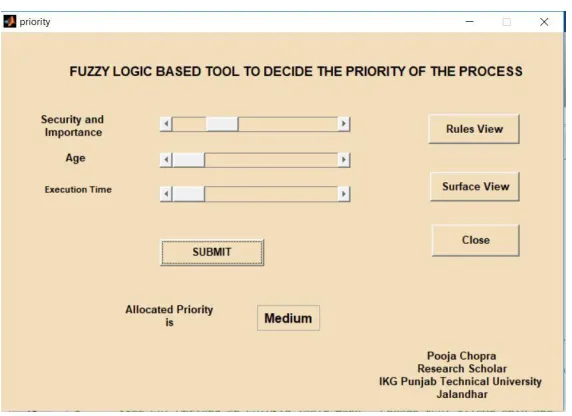
A graphical user interface is designed for taking inputs in the form of security, age and execution time and giving outputs in the form of allocated priority. A sample screen shot is shown as below:
4. Implementation and Testing
On the basis of testing data, the expert responses and our system responses are collected and checked for uniformity by applying Mann Whitney test23 to check the accuracy of our system. The results of experts and our system are shown in the following table:
Table I: Results of FIS and Experts
Sr.N Input Parameters
System Expert1 Expert2 Expert
Execution 3
o Security Age Output Output Output
Time Output
1 Very High Very High Medium High High Very High High
2 Very High Very High Low High Very High Very High High
3 Very High High Low High Very High Very High High
4 Very High Medium Very Low Very High High Very High Very
High
5 Very High Low High Medium High High High
6 Very High Low Low High Medium High High
7 High High Very High High Medium Medium High
8 High Low Very High Medium Medium Medium Mediu
m
9 High Low Medium High Medium Medium Mediu
m
10 Medium High Very High Low Low Low Low
11
Medium High
Medium
Medium
Medium
Medium
Mediu
m
12 Medium High Very Low High High High High
Better Resource Provisioning in Cloud Computing Using Fuzzy System
13 Medium Medium Low Medium Medium Medium Mediu
m
14 Medium Low Medium Low Low Low Low
15 Low High Medium Low Low Low Low
16 Low Medium Low Medium Low Low Mediu
m
17 Low Medium Very Low Medium Medium Medium Mediu
m
18 Low Low Very Low Medium Very Low Very Low Mediu
m
Very
19 Low Very Low High Very Low Very Low Very Low Low
20 Very Low High Medium Low Low Very Low Low
Very
21 Very Low Medium High Very Low Very Low Very Low Low
Mediu
22 Very Low Medium Very Low Medium Low Low m
23 Very Low Low Very High Low Very Low Very Low Low
24 Very Low Very Low Very High Low Very Low Very Low Low
25 Very High High Medium High Very High Very High High
26 Very High Low Very Low High Very High Very High High
27 High Very High High High Very High Very High High
28 Medium Low Very Low Medium Medium Medium Mediu
m
Mediu
29 Medium Very Low Very Low Medium Medium Medium m
Mediu
30 Low Very High Low Medium Medium Medium m
Low
Low
31 Low High Medium Low Low
32 Low High Very Low Medium Medium Medium Mediu m
33 Low Low Medium Low Low Low Low
Mediu
34 Very Low High High Medium Very Low Very Low m
Mediu
35 Very Low Medium Low Medium Very Low Very Low m
The defuzzified output generated is compared with the predefined threshold value. If the defuzzifed value is less than threshold limit, the resources will be provisioned from public cloud otherwise resources will be provisioned from private cloud. If on private cloud, there is already a process of low defuzzified priority as compared to arrived request with high defuzzified priority, in that case high defuzzified priority request will be swapped into the private cloud and request with low defuzzified priority will be swapped out to public cloud.
Another feature of security analyzer is there. The security analyzer will check the security parameter of the process. If it is high or very high, the process will be routed to the private cloud as private cloud is considered more secure than public cloud.
5.Simulation and Results: Cloud Sim3.0 is used for simulation of results generated from our proposed system. The following parameters metrics are taken:
1.CPU Utilization
The CPU utilization rate is calculated as the percentage of CPU being used in a given time interval.
Percentage of Server Utilization, = × 100
+
Where total response tim e, = , Ti= Time taken by ith individual request and= time taken by the
= 1
fuzzy logic based decision making process. The calculation of server utilization is based upon a total of 35 requests taken as samples and executed using CloudSim 3.0 environment24.
= 0.00075947 * 35 = .02658145 sec = 0.289142801 sec 0.289142801
= × 100 = 91. 58%
0.289142801 + .02658145 2.Security
In our work, the processes that are highly sensitive are directed to private cloud as public cloud is prone to outside attacks.
3.Accuracy
The consistency of experts’ results and system results is obtained using Mann-Whitney test and hence proved the accuracy of the system.
4.Response Time
When the processes go to public cloud, the response time is 889523.4363839998 nano seconds. When the processes go to private Cloud, the response time is 296507.81401800003 nano seconds whereas it is 289142.8009020001 nano seconds, when the processes go through fuzzy logic based system
IV. Conclusion
Our paper is based on comparing two approaches i.e. when the entire processes are directed towards a particular cloud and when the entire processes are directed towards hybrid cloud where fuzzy inference system will decide the appropriate cloud where to direct the processes. The proposed approach using Fuzzy Logic helps in improving CPU utilization, decreasing response time, improving accuracy while promoting security.
References
[1]. Alam MI, Pandey M, Rautaray SS. A comprehensive survey on cloud computing. International Journal of Information Technology and Computer Science (IJITCS). 2015 Jan 8; 7(2):68.
[2]. Jadeja Y, Modi K. Cloud computing-concepts, architecture and challenges. In Computing, Electronics and Electrical Technologies (ICCEET), 2012 International Conference on 2012 Mar 21 (pp. 877-880). IEEE.
[3]. Geelan J. Twenty one experts define cloud computing. Cloud Computing Journal. 2009 Jan 24;4:1-5. [4]. Goyal S. Public vs. private vs. hybrid vs. community-cloud computing: a critical review. International
Journal of Computer Network and Information Security. 2014 Feb 1;6(3):20.
[5]. Begum S, Prashanth CS. Review of load balancing in cloud computing. International Journal of Computer Science Issues (IJCSI). 2013;10(1):343.
[6]. Srinivasan A, Quadir MA, Vijayakumar V. Era of cloud computing: a new insight to hybrid cloud. Procedia Computer Science. 2015 Jan 1;50:42-51.
[7]. Singh S, Chana I. Cloud resource provisioning: survey, status and future research directions. Knowledge and Information Systems. 2016 Dec 1;49(3):1005-69.
[8]. Chopra P, Bedi RP. STUDY OF CLOUD COMPUTING TECHNIQUES: RESOURCE PROVISIONING ASPECT.
[9]. Singh B, Mishra AK. Fuzzy Logic Control System and its Applications. Int. Res. J. Eng. Technol. 2015 Nov;2(8):743-6.
[10]. Mago VK, Bhatia N, Bhatia A, Mago A. Clinical decision support system for dental treatment. Journal of Computational Science. 2012 Sep 1;3(5):254-61.
[11]. Marria, N. and Pateriya, K., 2011. On-Demand Resource Provisioning In Sky Environment. International journal of Computer Science and its applications, pp.275-280.
[12]. Javadi B, Abawajy J, Buyya R. Failure-aware resource provisioning for hybrid Cloud infrastructure. Journal of parallel and distributed computing. 2012 Oct 1;72(10):1318-31.
Better Resource Provisioning in Cloud Computing Using Fuzzy System
[13]. Sood SK. Dynamic resource provisioning in cloud based on queuing model. International Journal of Cloud Computing and Services Science. 2013 Jul 1;2(4):313.
[14]. Grewal RK, Pateriya PK. A rule-based approach for effective resource provisioning in hybrid cloud environment. InNew Paradigms in Internet Computing 2013 (pp. 41-57). Springer, Berlin, Heidelberg. [15]. Choudhury K, Dutta D, Sasmal K. Resource Management in a Hybrid Cloud Infrastructure. International
Journal of Computer Applications. 2013 Jan 1;79(12).
[16]. Liu F, Luo B, Niu Y. Cost-effective service provisioning for hybrid cloud applications. Mobile Networks and Applications. 2017 Apr 1;22(2):153-60.
[17]. Sethi S, Sahu A, Jena SK. Efficient load balancing in cloud computing using fuzzy logic. IOSR Journal of Engineering. 2012 Jul;2(7):65-71.
[18]. Kumar VV, Dinesh K. Job scheduling using fuzzy neural network algorithm in cloud environment. Bonfring International Journal of Man Machine Interface. 2012 Mar;2(1):01-6.
[19]. Susila N, Chandramathi S, Kishore R. A fuzzy-based firefly algorithm for dynamic load balancing in cloud computing environment. Journal of Emerging Technologies in Web Intelligence. 2014 Nov 1;6(4):435-40.
[20]. Amini A, Jamil N, Ahmad AR, Sulaiman H. A Fuzzy Logic Based Risk Assessment Approach for Evaluating and Prioritizing Risks in Cloud Computing Environment. InInternational Conference of Reliable Information and Communication Technology 2017 Apr 23 (pp. 650-659). Springer, Cham. [21]. Sivanandam SN, Sumathi S, Deepa SN. Introduction to fuzzy logic using MATLAB. Berlin: Springer;
2007 Jan.
[22]. Chopra, P. and Bedi , RPS., 2018. Fuzzy Logic Model to Reprioritize Cloud Computing Process Requests using Extended Parameters. International Journal of Computer Applications.
[23]. Nachar N. The Mann-Whitney U: A test for assessing whether two independent samples come from the same distribution. Tutorials in quantitative Methods for Psychology. 2008 Mar;4(1):13-20.
[24]. Calheiros RN, Ranjan R, Beloglazov A, De Rose CA, Buyya R. CloudSim: a toolkit for modeling and simulation of cloud computing environments and evaluation of resource provisioning algorithms. Software: Practice and experience. 2011 Jan;41(1):23-50.
IOSR Journal of Engineering (IOSRJEN) is UGC approved Journal with Sl. No. 3240, Journal no. 48995.
Pooja Chopra. “Better Resource Provisioning in Cloud Computing Using Fuzzy System.” IOSR Journal of Engineering (IOSRJEN), vol. 09, no. 04, 2019, pp. 68-75.